light MITSUBISHI PAJERO IV 2011 User Guide
[x] Cancel search | Manufacturer: MITSUBISHI, Model Year: 2011, Model line: PAJERO IV, Model: MITSUBISHI PAJERO IV 2011Pages: 377, PDF Size: 29.43 MB
Page 46 of 377
CAUTION
l
If the following types of persons use the
heated seats, they might become too hot
or receive minor burns (red skin, heat blis-
ters, etc.): • Children, elderly or ill people
• People with sensitive skin
• Excessively tired people
• People under the influence of alcoholor sleep inducing medication (cold
medicine, etc.)
l Do not place heavy objects on the seat or
stick pins, needles, or other pointed ob-
jects into it.
l Do not use a blanket, cushion, or other ma-
terial with high heat insulation properties
on the seat while using the heater; this
might cause the heater element to overheat
l When cleaning the seat, do not use ben-
zene, kerosene, petrol, alcohol, or other or-
ganic solvents; these might damage the
surface of the seat and also the heater ele-
ment.
l If water or any other liquid is spilled on
the seat, allow it to dry thoroughly before
attempting to use the heater.
l Turn the heater off immediately if it ap-
pears to be malfunctioning during use. Rear seats (3-door models)*/
Second seats (5-door models)* E00402000184 WARNING
l When a
person
is sitting in the middle seat-
ing position of the rear seats (3-door mod-
els)/second seats (5-door models), pull up
the head restraint to a height at which it
locks in position. Be sure to make this ad-
justment before starting to drive. Serious
injuries could otherwise be suffered as
the result of an impact. Refer to “Head re-
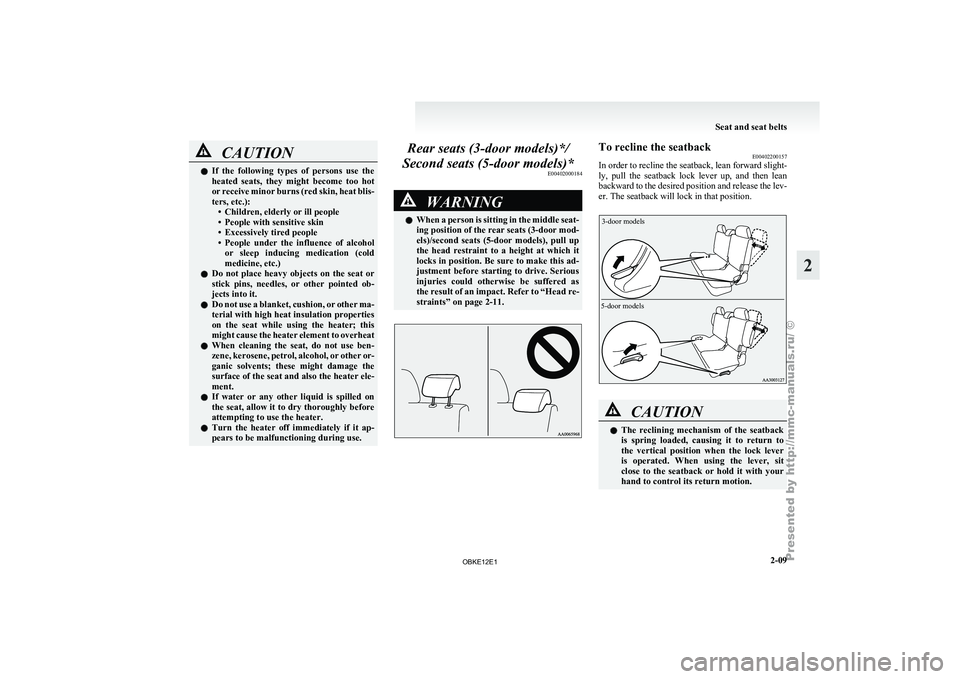
straints” on page 2-11. To recline the seatback
E00402200157
In order to
recline the seatback, lean forward slight-
ly, pull the seatback lock lever up, and then lean
backward to the desired position and release the lev-
er. The seatback will lock in that position.
3-door models
5-door models CAUTION
l
The reclining mechanism
of the seatback
is spring loaded, causing it to return to
the vertical position when the lock lever
is operated. When using the lever, sit
close to the seatback or hold it with your
hand to control its return motion. Seat and seat belts
2-09 2
OBKE12E1
Page 48 of 377
Third seat (5-door models)*
E00402700149
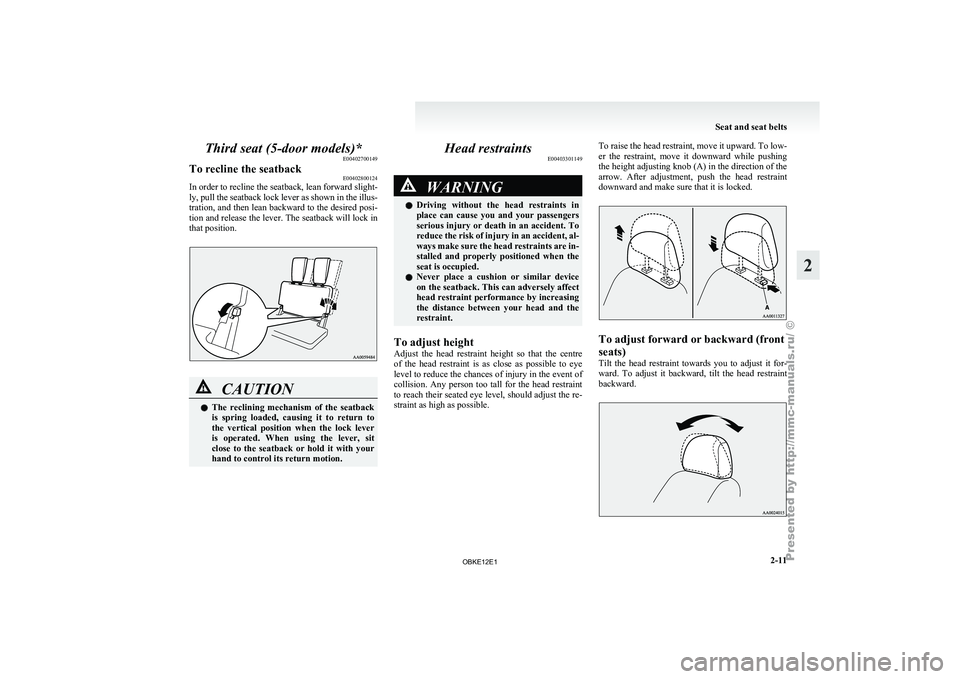
To recline the seatback E00402800124
In order to recline the seatback, lean forward slight-
ly, pull the
seatback lock lever as shown in the illus-
tration, and then lean backward to the desired posi-
tion and release the lever. The seatback will lock in
that position. CAUTION
l
The reclining
mechanism
of the seatback
is spring loaded, causing it to return to
the vertical position when the lock lever
is operated. When using the lever, sit
close to the seatback or hold it with your
hand to control its return motion. Head restraints
E00403301149 WARNING
l Driving without
the
head restraints in
place can cause you and your passengers
serious injury or death in an accident. To
reduce the risk of injury in an accident, al-
ways make sure the head restraints are in-
stalled and properly positioned when the
seat is occupied.
l Never place a cushion or similar device
on the seatback. This can adversely affect
head restraint performance by increasing
the distance between your head and the
restraint.
To adjust height
Adjust the head
restraint height so that the centre
of the head restraint is as close as possible to eye
level to reduce the chances of injury in the event of
collision. Any person too tall for the head restraint
to reach their seated eye level, should adjust the re-
straint as high as possible. To raise the head restraint, move it upward. To low-
er the
restraint,
move it downward while pushing
the height adjusting knob (A) in the direction of the
arrow. After adjustment, push the head restraint
downward and make sure that it is locked. To adjust forward or backward (front
seats)
Tilt
the
head
restraint towards you to adjust it for-
ward. To adjust it backward, tilt the head restraint
backward. Seat and seat belts
2-11 2
OBKE12E1
Page 50 of 377
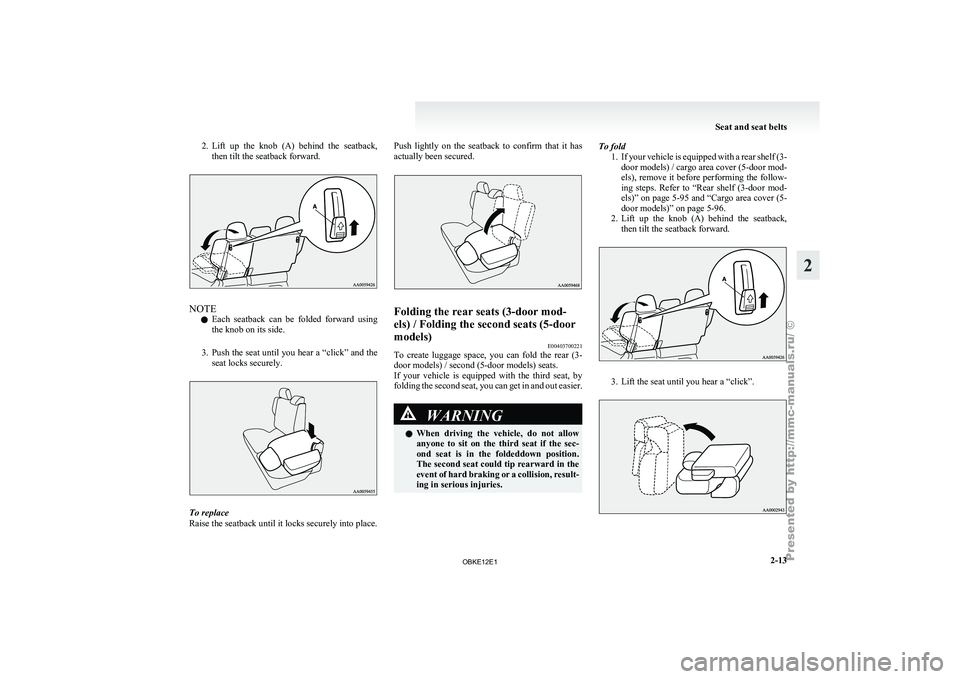
2. Lift up the knob (A) behind the seatback,
then tilt the seatback forward. NOTE
l Each
seatback can
be folded forward using
the knob on its side.
3. Push the seat until you hear a “click” and the seat locks securely. To replace
Raise the seatback until it locks securely into place. Push lightly on the seatback to confirm that it has
actually been secured.
Folding the rear seats (3-door mod-
els) / Folding the second seats (5-door
models)
E00403700221
To create luggage space, you can fold the rear (3-
door models) / second (5-door models) seats.
If your vehicle
is equipped with the third seat, by
folding the second seat, you can get in and out easier. WARNING
l When driving
the
vehicle, do not allow
anyone to sit on the third seat if the sec-
ond seat is in the foldeddown position.
The second seat could tip rearward in the
event of hard braking or a collision, result-
ing in serious injuries. To fold
1. If your vehicle
is equipped with a rear shelf (3-
door models) / cargo area cover (5-door mod-
els), remove it before performing the follow-
ing steps. Refer to “Rear shelf (3-door mod-
els)” on page 5-95 and “Cargo area cover (5-
door models)” on page 5-96.
2. Lift up the knob (A) behind the seatback, then tilt the seatback forward. 3. Lift the seat until you hear a “click”. Seat and seat belts
2-13 2
OBKE12E1
Page 51 of 377
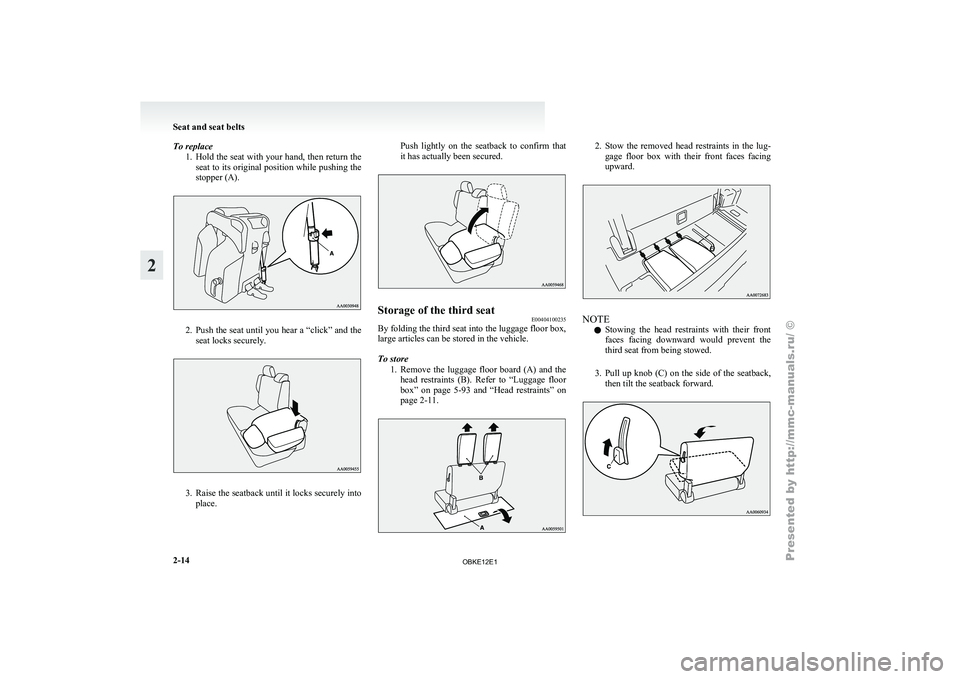
To replace
1. Hold the seat with your hand, then return the
seat to its original position while pushing the
stopper (A). 2. Push the seat until you hear a “click” and the
seat locks securely. 3. Raise the seatback until it locks securely into
place. Push
lightly
on the seatback to confirm that
it has actually been secured. Storage of the third seat
E00404100235
By folding the third seat into the luggage floor box,
large articles can be stored in the vehicle.
To store
1. Remove the luggage
floor board (A) and the
head restraints (B). Refer to “Luggage floor
box” on page 5-93 and “Head restraints” on
page 2-11. 2. Stow the removed head restraints in the lug-
gage floor
box with their front faces facing
upward. NOTE
l Stowing
the head
restraints with their front
faces facing downward would prevent the
third seat from being stowed.
3. Pull up knob (C) on the side of the seatback, then tilt the seatback forward. Seat and seat belts
2-14
2
OBKE12E1
Page 53 of 377
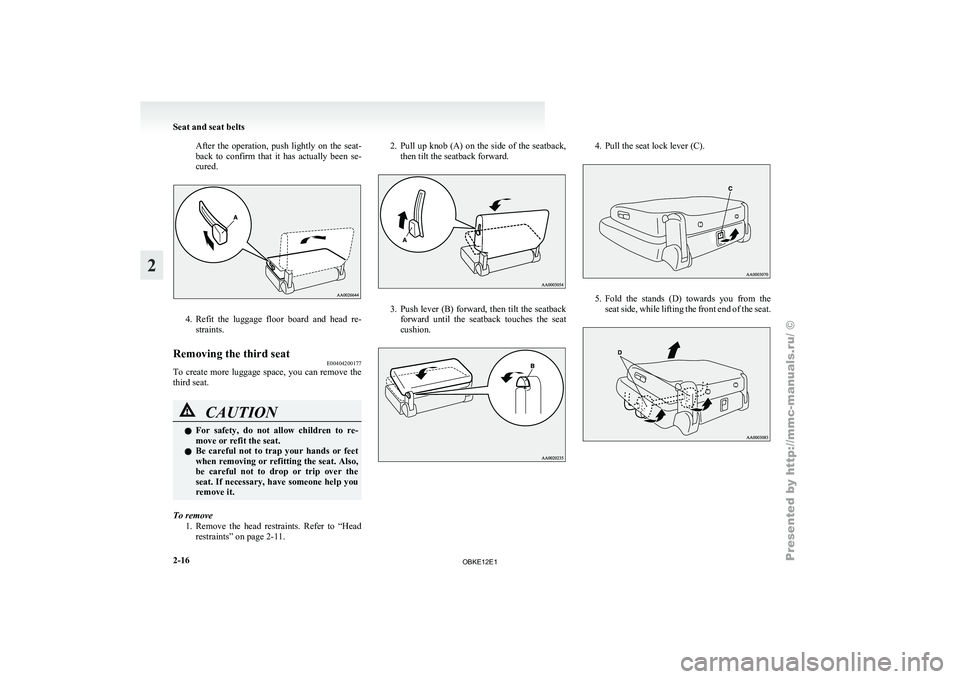
After the operation, push lightly on the seat-
back to confirm
that it has actually been se-
cured. 4. Refit the luggage floor board and head re-
straints.
Removing the third seat E00404200177
To create
more luggage space, you can remove the
third seat. CAUTION
l
For safety,
do
not allow children to re-
move or refit the seat.
l Be careful not to trap your hands or feet
when removing or refitting the seat. Also,
be careful not to drop or trip over the
seat. If necessary, have someone help you
remove it.
To remove 1. Remove the head
restraints. Refer to “Head
restraints” on page 2-11. 2. Pull up knob (A) on the side of the seatback,
then tilt the seatback forward. 3. Push lever (B) forward, then tilt the seatback
forward until
the seatback touches the seat
cushion. 4. Pull the seat lock lever (C).
5. Fold the stands (D) towards you from the
seat side,
while lifting the front end of the seat.Seat and seat belts
2-16
2
OBKE12E1
Page 55 of 377
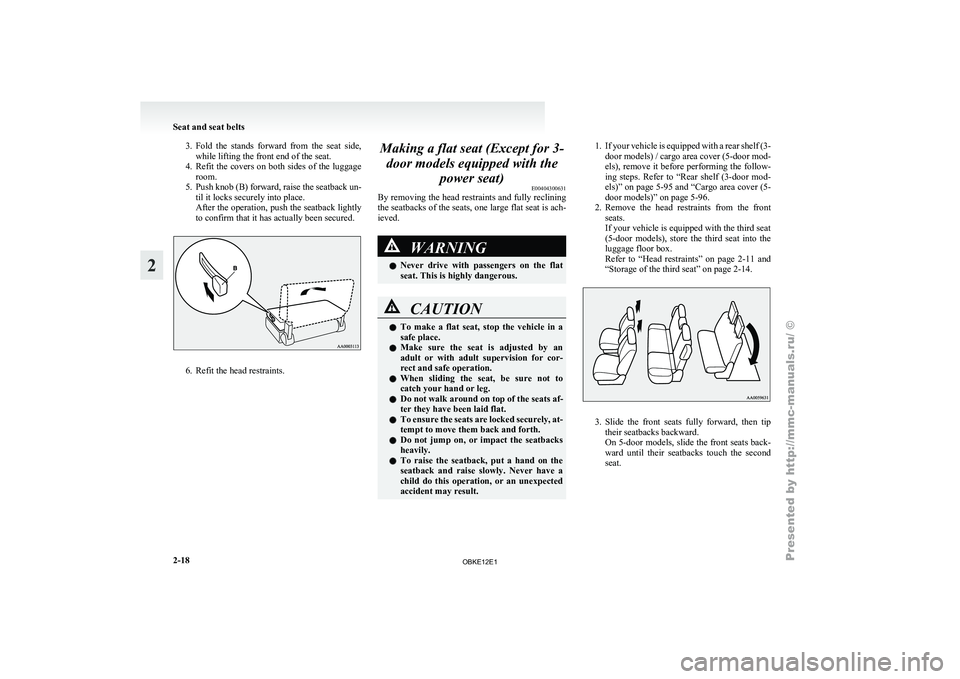
3. Fold the stands forward from the seat side,
while lifting the front end of the seat.
4. Refit
the covers on both sides of the luggage
room.
5. Push knob (B) forward, raise the seatback un- til it locks securely into place.
After the operation, push the seatback lightly
to confirm that it has actually been secured. 6. Refit the head restraints. Making a flat seat (Except for 3-
door models equipped with the power seat) E00404300631
By removing the
head restraints and fully reclining
the seatbacks of the seats, one large flat seat is ach-
ieved. WARNING
l Never drive
with
passengers on the flat
seat. This is highly dangerous. CAUTION
l
To make a
flat seat, stop the vehicle in a
safe place.
l Make sure the seat is adjusted by an
adult or with adult supervision for cor-
rect and safe operation.
l When sliding the seat, be sure not to
catch your hand or leg.
l Do not walk around on top of the seats af-
ter they have been laid flat.
l To ensure the seats are locked securely, at-
tempt to move them back and forth.
l Do not jump on, or impact the seatbacks
heavily.
l To raise the seatback, put a hand on the
seatback and raise slowly. Never have a
child do this operation, or an unexpected
accident may result. 1. If your vehicle is equipped with a rear shelf (3-
door models)
/ cargo area cover (5-door mod-
els), remove it before performing the follow-
ing steps. Refer to “Rear shelf (3-door mod-
els)” on page 5-95 and “Cargo area cover (5-
door models)” on page 5-96.
2. Remove the head restraints from the front seats.
If your vehicle is equipped with the third seat
(5-door models), store the third seat into the
luggage floor box.
Refer to “Head restraints” on page 2-11 and
“Storage of the third seat” on page 2-14. 3. Slide the front seats fully forward, then tip
their seatbacks backward.
On 5-door
models, slide the front seats back-
ward until their seatbacks touch the second
seat. Seat and seat belts
2-18
2
OBKE12E1
Page 58 of 377
WARNING
l The seat belts must not be twisted when
worn.
3. Pull the belt slightly to adjust slackness as de-
sired.
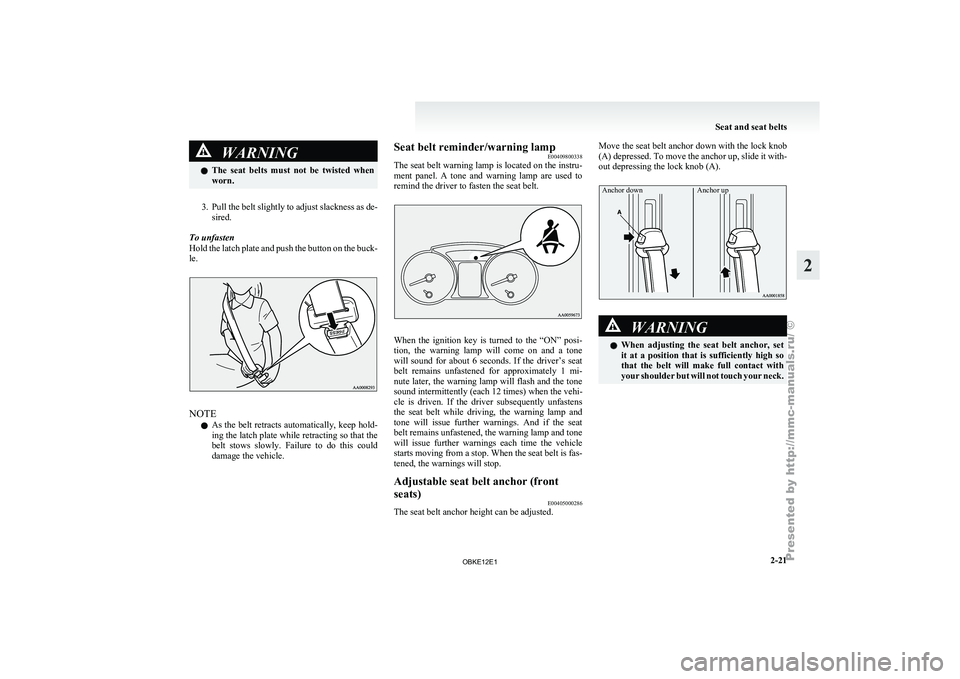
To unfasten
Hold the
latch plate and push the button on the buck-
le. NOTE
l As
the belt
retracts automatically, keep hold-
ing the latch plate while retracting so that the
belt stows slowly. Failure to do this could
damage the vehicle. Seat belt reminder/warning lamp
E00409800338
The seat belt
warning lamp is located on the instru-
ment panel. A tone and warning lamp are used to
remind the driver to fasten the seat belt. When the ignition key is turned to the “ON” posi-
tion, the warning
lamp will come on and a tone
will sound for about 6 seconds. If the driver’s seat
belt remains unfastened for approximately 1 mi-
nute later, the warning lamp will flash and the tone
sound intermittently (each 12 times) when the vehi-
cle is driven. If the driver subsequently unfastens
the seat belt while driving, the warning lamp and
tone will issue further warnings. And if the seat
belt remains unfastened, the warning lamp and tone
will issue further warnings each time the vehicle
starts moving from a stop. When the seat belt is fas-
tened, the warnings will stop.
Adjustable seat belt anchor (front
seats) E00405000286
The seat belt anchor height can be adjusted. Move the seat belt anchor down with the lock knob
(A) depressed. To
move the anchor up, slide it with-
out depressing the lock knob (A).
Anchor down Anchor up WARNING
l When adjusting
the
seat belt anchor, set
it at a position that is sufficiently high so
that the belt will make full contact with
your shoulder but will not touch your neck. Seat and seat belts
2-21 2
OBKE12E1
Page 71 of 377
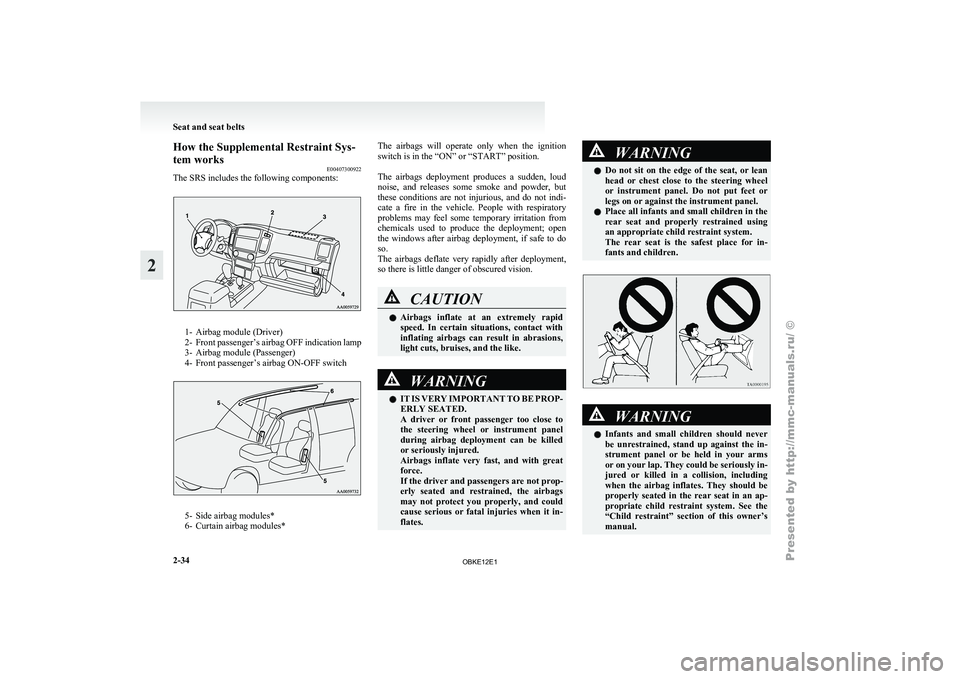
How the Supplemental Restraint Sys-
tem works
E00407300922
The SRS includes the following components: 1- Airbag module (Driver)
2- Front passenger’s airbag
OFF indication lamp
3- Airbag module (Passenger)
4- Front passenger’s airbag ON-OFF switch 5- Side airbag modules*
6- Curtain airbag modules* The
airbags
will operate only when the ignition
switch is in the “ON” or “START” position.
The airbags deployment
produces a sudden, loud
noise, and releases some smoke and powder, but
these conditions are not injurious, and do not indi-
cate a fire in the vehicle. People with respiratory
problems may feel some temporary irritation from
chemicals used to produce the deployment; open
the windows after airbag deployment, if safe to do
so.
The airbags deflate very rapidly after deployment,
so there is little danger of obscured vision. CAUTION
l
Airbags inflate
at
an extremely rapid
speed. In certain situations, contact with
inflating airbags can result in abrasions,
light cuts, bruises, and the like. WARNING
l IT IS VERY
IMPORTANT TO BE PROP-
ERLY SEATED.
A driver or front passenger too close to
the steering wheel or instrument panel
during airbag deployment can be killed
or seriously injured.
Airbags inflate very fast, and with great
force.
If the driver and passengers are not prop-
erly seated and restrained, the airbags
may not protect you properly, and could
cause serious or fatal injuries when it in-
flates. WARNING
l Do not sit
on the edge of the seat, or lean
head or chest close to the steering wheel
or instrument panel. Do not put feet or
legs on or against the instrument panel.
l Place all infants and small children in the
rear seat and properly restrained using
an appropriate child restraint system.
The rear seat is the safest place for in-
fants and children. WARNING
l Infants and
small
children should never
be unrestrained, stand up against the in-
strument panel or be held in your arms
or on your lap. They could be seriously in-
jured or killed in a collision, including
when the airbag inflates. They should be
properly seated in the rear seat in an ap-
propriate child restraint system. See the
“Child restraint” section of this owner’s
manual. Seat and seat belts
2-34
2
OBKE12E1
Page 89 of 377
Indication lamps
E00501600012Turn-signal indication lamps/
Hazard warning indication
lamps
E00501700068
These indication lamps
blink on and off
when a turn-signal lamp is operating.
NOTE
l If the blinking is too fast, the
cause may be a blown lamp bulb
or a faulty turn-signal connection.
When the hazard warning lamp switch is
pressed, all turn-signal lamps will flash
on and off continuously. High-beam indication lamp
E00501800072
This indication lamp
illuminates when
the high-beam is used. Front fog lamp indication
lamp*
E00501900132
This indication lamp
illuminates while
the front fog lamps are on. Rear fog lamp indication lamp
E00502000084
This lamp illuminates
while the rear fog
lamp is on. Position lamp indication lamp
E00508900102
This lamp illuminates
with the lamp
switch at “ ” or “ ” position
Diesel preheat indication lamp
(diesel-powered vehicles)
E00502300146
This indication lamp
illuminates when
the ignition switch is placed in the “ON”
position. As the glow plug becomes hot,
the lamp goes out and the engine can be
started. CAUTION
l
If the
diesel
preheat indication
lamp comes on after the engine
is started, the engine speed may
not rise above the idling speed
because of fuel freezing. In this
case, keep the engine idling for
about ten minutes, then turn
off the ignition switch and im-
mediately turn it on again to
confirm that the diesel preheat
indication lamp is off.
NOTE l If
the engine
is cold, the diesel pre-
heat indication lamp is on for a lon-
ger time. l
When the
engine
has not been star-
ted within about 5 seconds after
the diesel preheat indication lamp
went out, return the ignition
switch to the “LOCK” position.
Then, turn the switch to the “ON”
position to preheat the engine
again.
l When the engine is warm, the die-
sel preheat indication lamp does
not come on even if the ignition
switch is placed in the “ON” posi-
tion. Fuel filter indication lamp (die-
sel-powered vehicles)
E00509900239
This indication lamp
illuminates when
the ignition switch is turned to the “ON”
position and goes off after the engine
has started. If it lights up while the en-
gine is running, it indicates that water
has accumulated inside the fuel filter; if
this happens, remove the water from the
fuel filter. Refer to “Removal of water
from the fuel filter (diesel-powered vehi-
cles only)” on page 6-06.
When the lamp goes out, you can re-
sume driving. If it either does not go out
or comes on from time to time, we rec-
ommend you to have the vehicle inspec-
ted. Instruments and controls
3-08
3
OBKE12E1
Page 94 of 377
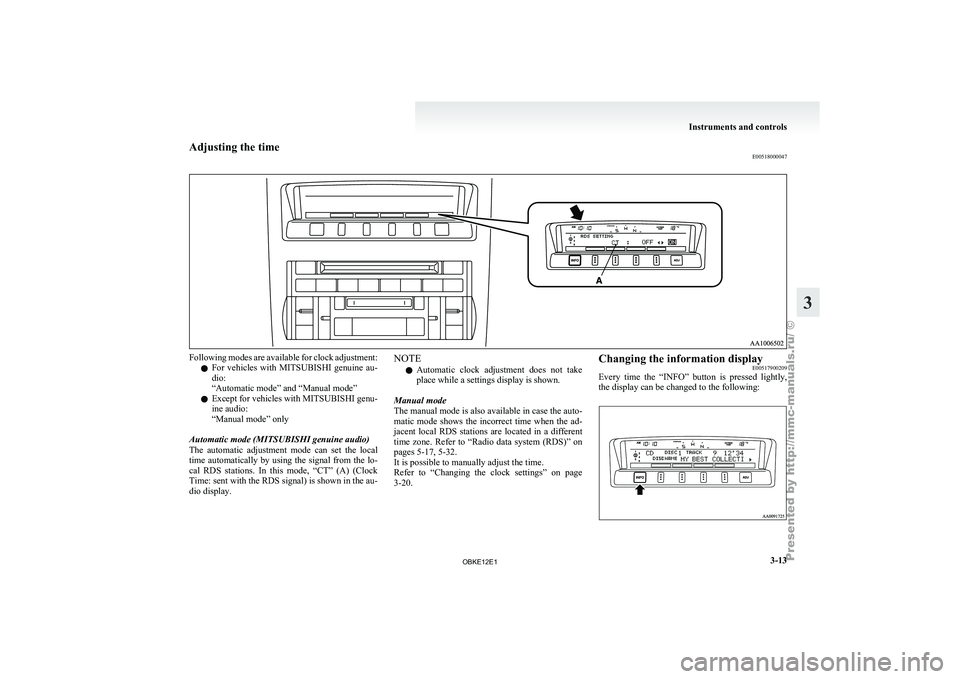
Adjusting the time
E00518000047Following modes are available for clock adjustment:
l For vehicles with
MITSUBISHI genuine au-
dio:
“Automatic mode” and “Manual mode”
l Except for vehicles with MITSUBISHI genu-
ine audio:
“Manual mode” only
Automatic mode (MITSUBISHI genuine audio)
The automatic adjustment mode can set the local
time automatically by using the signal from the lo-
cal RDS stations. In this mode, “CT” (A) (Clock
Time: sent with the RDS signal) is shown in the au-
dio display. NOTE
l Automatic
clock adjustment
does not take
place while a settings display is shown.
Manual mode
The manual mode is also available in case the auto-
matic mode shows the incorrect time when the ad-
jacent local RDS stations are located in a different
time zone. Refer to “Radio data system (RDS)” on
pages 5-17, 5-32.
It is possible to manually adjust the time.
Refer to “Changing the clock settings” on page
3-20. Changing the information display
E00517900209
Every time
the
“INFO” button is pressed lightly,
the display can be changed to the following: Instruments and controls
3-13 3
OBKE12E1