light MITSUBISHI PAJERO IV 2011 Repair Manual
[x] Cancel search | Manufacturer: MITSUBISHI, Model Year: 2011, Model line: PAJERO IV, Model: MITSUBISHI PAJERO IV 2011Pages: 377, PDF Size: 29.43 MB
Page 306 of 377
CAUTION
l
Do not use a scrubbing brush or other
hard tools as they may damage the plastic
part surface.
l Do not use wax containing compound (pol-
ishing powder) which may damage the
plastic part surface.
l Do not bring the plastic parts into contact
with petrol, light oil, brake fluids, engine
oils, greases, paint thinners, and sulphu-
ric acid (battery electrolyte) which may
crack, stain or discolour the plastic parts.
If they touch the plastic parts, wipe them
off with soft cloth, chamois or the like
and an aqueous solution of neutral deter-
gent then immediately rinse the affected
parts with water.
Chrome parts E00901400115
In order to prevent spots and corrosion of chrome
parts, wash with
water, dry thoroughly, and apply a
special protective coating. This should be done
more frequently in winter.
Aluminium wheels* E00901500321
1. Remove dirt using a sponge while sprinkling
water on the wheel.
2. Use
neutral detergent on any dirt that cannot
be removed easily with water.
Rinse off the neutral detergent after washing
the wheel.
3. Dry the vehicle thoroughly using a chamois leather or a soft cloth. CAUTION
l
Do not use
a brush or other hard imple-
ment on the wheels.
Doing so could scratch the wheels.
l Do not use any cleaner that contains an
abrasive substance or is acidic or alka-
line. Doing so could cause the coating on
the wheels to peel or become discoloured
or stained.
l Do not directly apply hot water using a
steam cleaner or by any other means.
l Contact with seawater and road deicer
can cause corrosion. Rinse off such sub-
stances as soon as possible.
Window glass E00901600032
The window glass can normally be cleaned using
only a sponge and water.
Glass cleaner can
be used to remove oil, grease,
dead insects, etc. After washing the glass, wipe dry
with a clean, dry, soft cloth. Never use the same
cloth to wipe the window glass as would be used to
wipe the paintwork; wax from the painted surfaces
could adhere to the glass and reduce its transparen-
cy and visibility.
NOTE
l To clean the inside of the backdoor window,
always use a soft cloth and wipe the window
glass along the demister heater element so as
not to cause damage. Wiper blades
E00901700059
Use a soft cloth and glass cleaner to remove grease,
dead insects, etc.,
from the wiper blades. Replace
the wiper blades when they no longer wipe proper-
ly. (Refer to page 8-17.)
Cleaning the sunroof* E00901800180
Clean the inside of the sunroof with a soft cloth.
Hard deposits should
be wiped away with a cloth
dipped in warm, neutral detergent solution. Wipe
away the solution with a sponge dipped in fresh wa-
ter.
NOTE
l The surface treatment on the inside of the
glass may be removed if hard cloth or organ-
ic solvent (benzine, kerosene, thinner, etc.) is
used.
Engine compartment E00902100311
Clean the engine compartment at the beginning and
end of winter.
Pay particular attention to flanges,
crevices and peripheral parts where dust containing
road chemicals and other corrosive materials might
collect.
If salt and other chemicals are used on the roads in
your area, clean the engine compartment at least ev-
ery three months.
Never spray or splash water on the electrical com-
ponents in the engine compartment, as this may
cause damage.
Do not bring the nearby parts, the plastic parts and
so on into contact with sulphuric acid (battery elec-
trolyte) which may crack, stain or discolour them. Vehicle care
7-05 7
OBKE12E1
Page 310 of 377
Bonnet
E01000302630
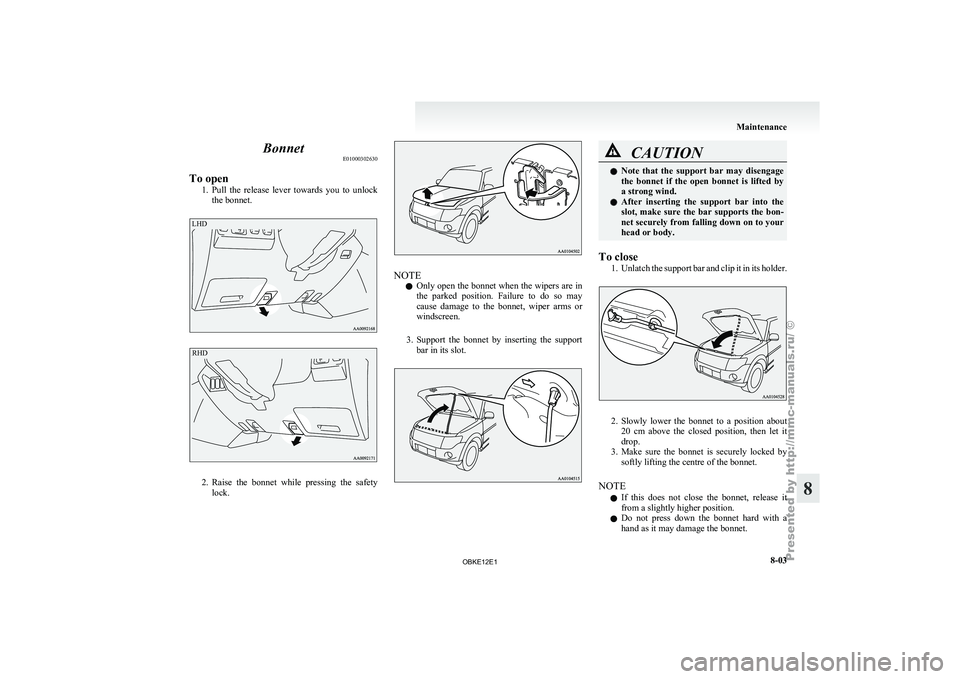
To open 1. Pull the release
lever towards you to unlock
the bonnet.
LHD
RHD 2. Raise
the bonnet while pressing the safety
lock. NOTE
l Only
open the
bonnet when the wipers are in
the parked position. Failure to do so may
cause damage to the bonnet, wiper arms or
windscreen.
3. Support the bonnet by inserting the support bar in its slot. CAUTION
l
Note that the
support bar may disengage
the bonnet if the open bonnet is lifted by
a strong wind.
l After inserting the support bar into the
slot, make sure the bar supports the bon-
net securely from falling down on to your
head or body.
To close 1. Unlatch the support
bar and clip it in its holder. 2. Slowly lower the bonnet to a position about
20 cm
above the closed position, then let it
drop.
3. Make sure the bonnet is securely locked by softly lifting the centre of the bonnet.
NOTE l If this does not close the bonnet, release it
from a slightly higher position.
l Do not press down the bonnet hard with a
hand as it may damage the bonnet. Maintenance
8-03 8
OBKE12E1
Page 313 of 377
NOTE
l Use
of additives
is not recommended since
they may reduce the effectiveness of addi-
tives already included in the engine oil. It
may result in failure of the mechanical assem-
bly.
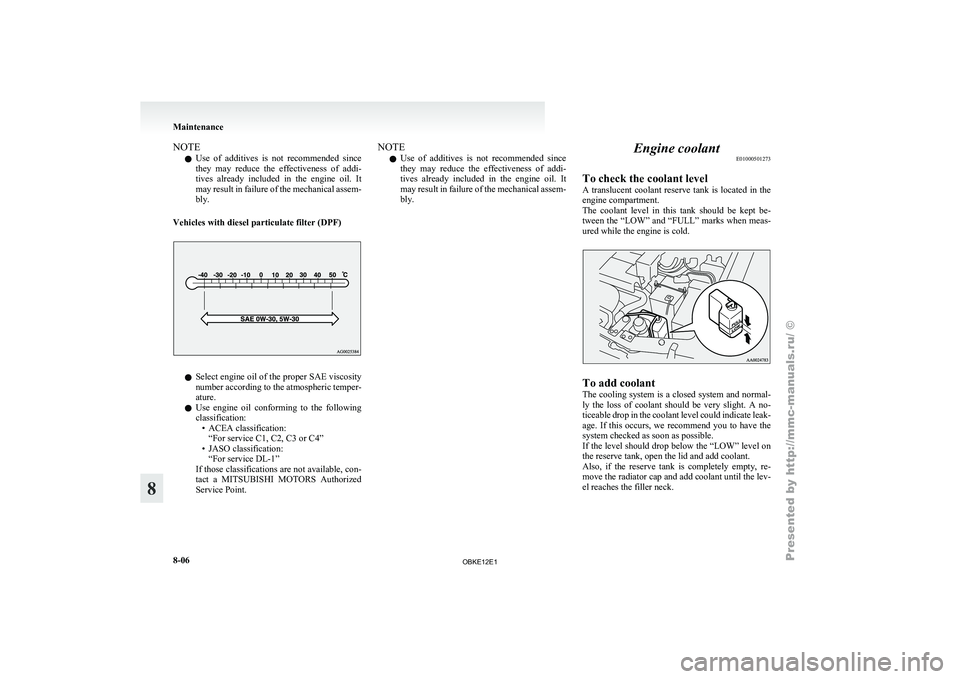
Vehicles with diesel particulate filter (DPF) l
Select engine
oil
of the proper SAE viscosity
number according to the atmospheric temper-
ature.
l Use engine oil conforming to the following
classification:
• ACEA classification:“For service C1, C2, C3 or C4”
• JASO classification: “For service DL-1”
If those classifications are not available, con-
tact a MITSUBISHI MOTORS Authorized
Service Point. NOTE
l Use
of additives
is not recommended since
they may reduce the effectiveness of addi-
tives already included in the engine oil. It
may result in failure of the mechanical assem-
bly. Engine coolant
E01000501273
To check the coolant level
A translucent
coolant
reserve tank is located in the
engine compartment.
The coolant level in this tank should be kept be-
tween the “LOW” and “FULL” marks when meas-
ured while the engine is cold. To add coolant
The cooling
system
is a closed system and normal-
ly the loss of coolant should be very slight. A no-
ticeable drop in the coolant level could indicate leak-
age. If this occurs, we recommend you to have the
system checked as soon as possible.
If the level should drop below the “LOW” level on
the reserve tank, open the lid and add coolant.
Also, if the reserve tank is completely empty, re-
move the radiator cap and add coolant until the lev-
el reaches the filler neck. Maintenance
8-06
8
OBKE12E1
Page 315 of 377
Rear window washer fluid
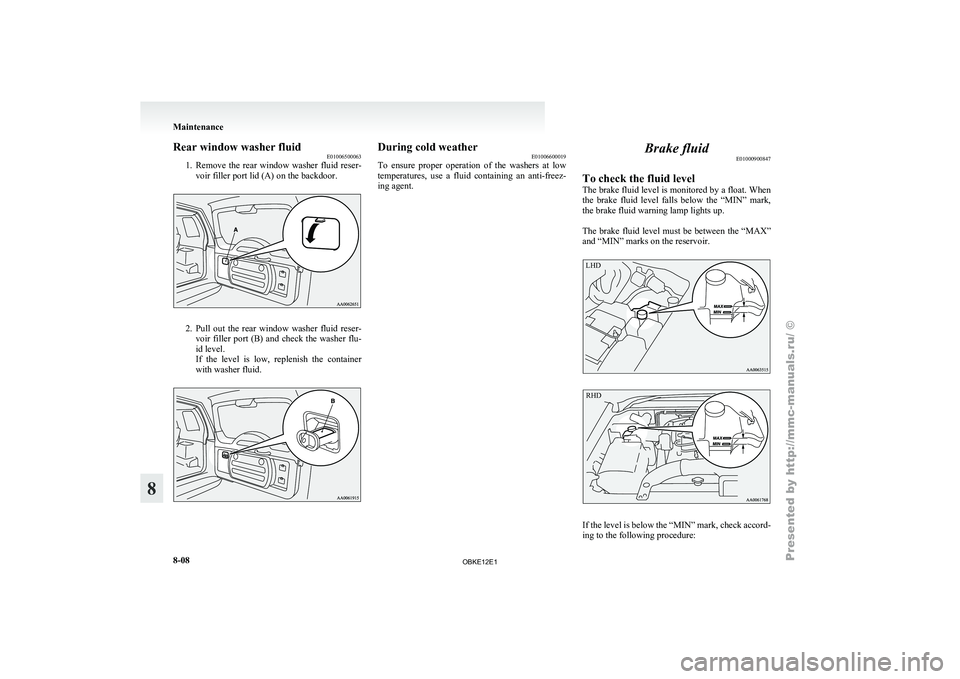
E01006500063
1. Remove the rear
window washer fluid reser-
voir filler port lid (A) on the backdoor. 2. Pull out the rear window washer fluid reser-
voir filler
port (B) and check the washer flu-
id level.
If the level is low, replenish the container
with washer fluid. During cold weather
E01006600019
To ensure proper
operation of the washers at low
temperatures, use a fluid containing an anti-freez-
ing agent. Brake fluid
E01000900847
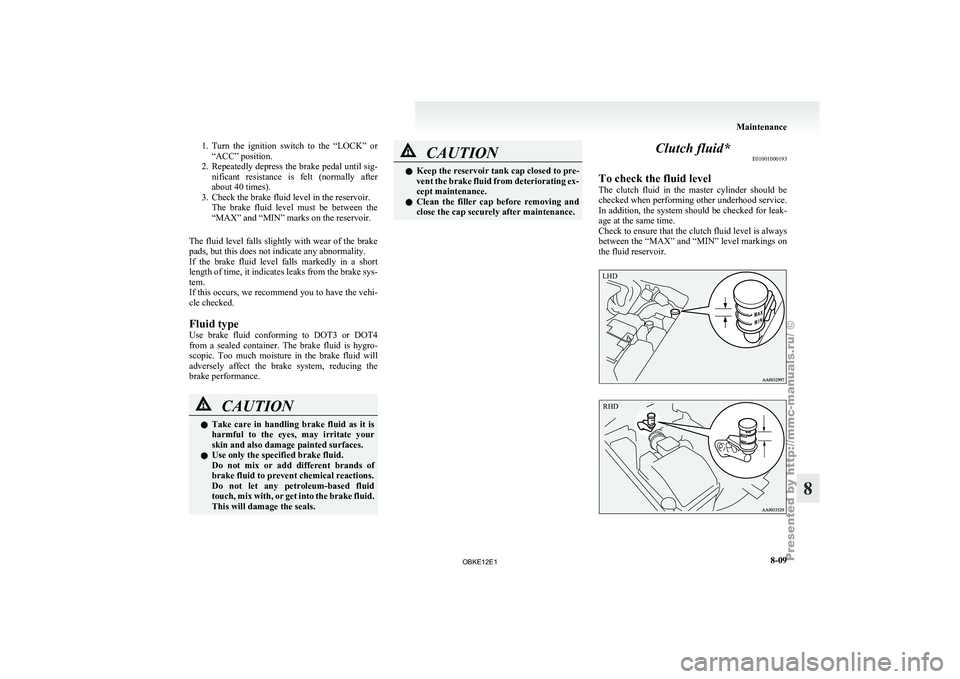
To check the fluid level
The brake fluid
level is monitored by a float. When
the brake fluid level falls below the “MIN” mark,
the brake fluid warning lamp lights up.
The brake fluid level must be between the “MAX”
and “MIN” marks on the reservoir.
LHD
RHD If the level is below the “MIN” mark, check accord-
ing to the following procedure:Maintenance
8-08
8
OBKE12E1
Page 316 of 377
1. Turn the ignition switch to the “LOCK” or
“ACC” position.
2. Repeatedly
depress the brake pedal until sig-
nificant resistance is felt (normally after
about 40 times).
3. Check the brake fluid level in the reservoir. The brake fluid level must be between the
“MAX” and “MIN” marks on the reservoir.
The fluid level falls slightly with wear of the brake
pads, but this does not indicate any abnormality.
If the brake fluid level falls markedly in a short
length of time, it indicates leaks from the brake sys-
tem.
If this occurs, we recommend you to have the vehi-
cle checked.
Fluid type
Use brake fluid conforming to DOT3 or DOT4
from a sealed container. The brake fluid is hygro-
scopic. Too much moisture in the brake fluid will
adversely affect the brake system, reducing the
brake performance. CAUTION
l
Take care
in
handling brake fluid as it is
harmful to the eyes, may irritate your
skin and also damage painted surfaces.
l Use only the specified brake fluid.
Do not mix or add different brands of
brake fluid to prevent chemical reactions.
Do not let any petroleum-based fluid
touch, mix with, or get into the brake fluid.
This will damage the seals. CAUTION
l
Keep the reservoir tank cap closed to pre-
vent the brake
fluid from deteriorating ex-
cept maintenance.
l Clean the filler cap before removing and
close the cap securely after maintenance. Clutch fluid*
E01001000193
To check the fluid level
The clutch fluid
in the master cylinder should be
checked when performing other underhood service.
In addition, the system should be checked for leak-
age at the same time.
Check to ensure that the clutch fluid level is always
between the “MAX” and “MIN” level markings on
the fluid reservoir.
LHD
RHD Maintenance
8-09 8
OBKE12E1
Page 327 of 377
Engine compartment
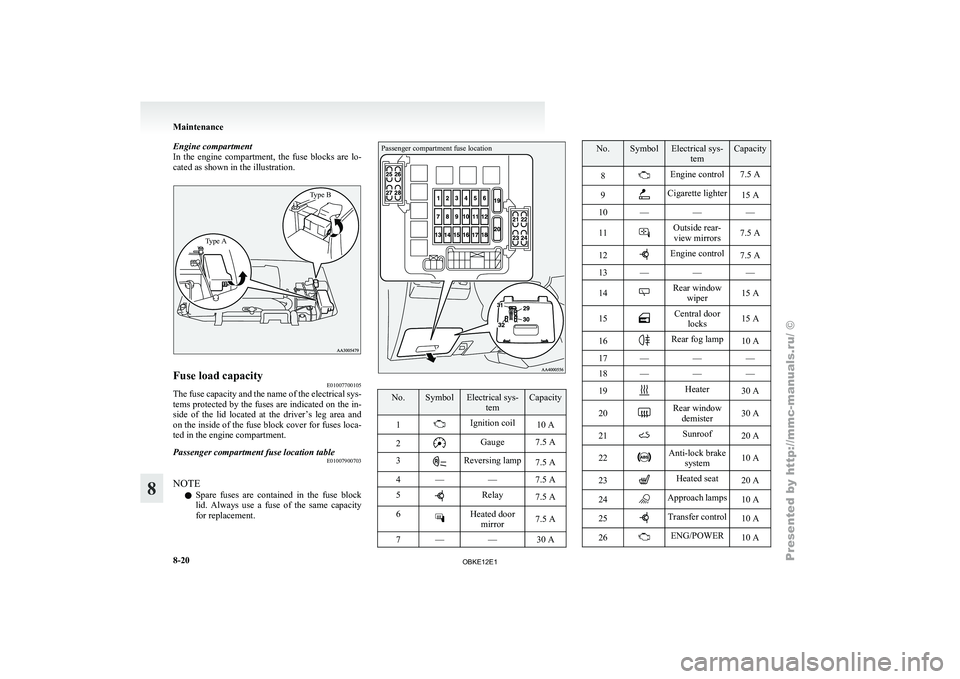
In the engine
compartment, the fuse blocks are lo-
cated as shown in the illustration.
Type A Type BFuse load capacity
E01007700105
The fuse capacity and the name of the electrical sys-
tems protected by
the fuses are indicated on the in-
side of the lid located at the driver’s leg area and
on the inside of the fuse block cover for fuses loca-
ted in the engine compartment.
Passenger compartment fuse location table E01007900703
NOTE l Spare
fuses are
contained in the fuse block
lid. Always use a fuse of the same capacity
for replacement.
Passenger compartment fuse location No. Symbol Electrical sys-
tem Capacity
1 Ignition coil
10 A
2 Gauge 7.5 A
3 Reversing lamp
7.5 A
4 — — 7.5 A
5 Relay
7.5 A
6 Heated door
mirror 7.5 A
7 — — 30 A No. Symbol Electrical sys-
tem Capacity
8 Engine control 7.5 A
9 Cigarette lighter
15 A
10 — — —
11 Outside rear-
view mirrors 7.5 A
12 Engine control
7.5 A
13 — — —
14 Rear window
wiper 15 A
15 Central door
locks 15 A
16 Rear fog lamp
10 A
17 — — —
18 — — —
19 Heater
30 A
20 Rear window
demister 30 A
21 Sunroof
20 A
22 Anti-lock brake
system 10 A
23 Heated seat
20 A
24 Approach lamps
10 A
25 Transfer control
10 A
26 ENG/POWER
10 AMaintenance
8-20
8
OBKE12E1
Page 328 of 377
No. Symbol Electrical sys-
tem Capacity
27 Starter motor
10 A
28 — — —
29 — Spare fuse 20 A
30 — Spare fuse 10 A
31 — Spare fuse 30 A
32 — Spare fuse 25 A l
Some fuses
may not be installed on your ve-
hicle, depending on the vehicle model or spec-
ifications.
l The table above shows the main equipment
corresponding to each fuse.
The fuse block does not contain spare 7.5 A
and 15 A fuses. If a fuse of one of these ca-
pacities blows, replace it temporarily by bor-
rowing the one that matches from:
7.5 A: Outside rear-view mirrors
15 A: Cigarette lighter
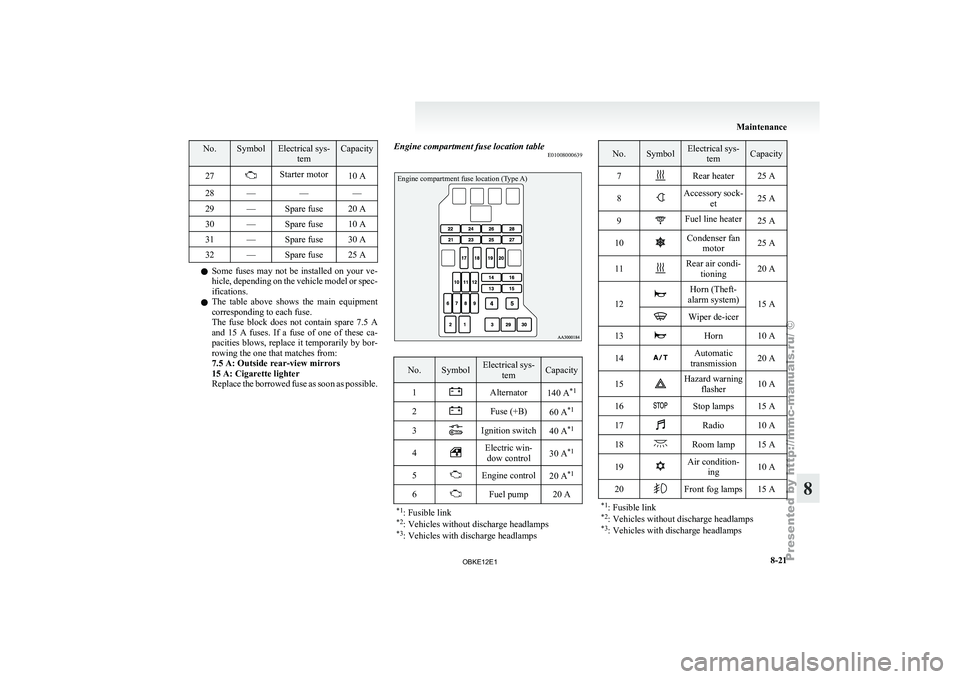
Replace the borrowed fuse as soon as possible. Engine compartment fuse location table
E01008000639
Engine compartment fuse location (Type A) No. Symbol Electrical sys-
tem Capacity
1 Alternator
140 A*1
2 Fuse (+B)
60 A*1
3 Ignition switch
40 A*1
4 Electric win-
dow control 30 A
*1
5 Engine control
20 A*1
6 Fuel pump 20 A
*1 : Fusible link
*2 : Vehicles without discharge headlamps
*3 : Vehicles with discharge headlamps No. Symbol Electrical sys-
tem Capacity
7 Rear heater 25 A
8 Accessory sock-
et 25 A
9 Fuel line heater
25 A
10 Condenser fan
motor 25 A
11 Rear air condi-
tioning 20 A
12 Horn (Theft-
alarm system) 15 A Wiper de-icer
13 Horn 10 A
14 Automatic
transmission 20 A
15 Hazard warning
flasher 10 A
16 Stop lamps 15 A
17 Radio 10 A
18 Room lamp 15 A
19 Air condition-
ing 10 A
20 Front fog lamps 15 A
*1 : Fusible link
*2 : Vehicles without discharge headlamps
*3 : Vehicles with discharge headlamps Maintenance
8-21 8
OBKE12E1
Page 329 of 377
No. Symbol Electrical sys-
tem Capacity
21 — — —
22 Windscreen
wiper 20 A
23 Tail lamp (right) 7.5 A
24 Tail lamp (left) 7.5 A
25 Headlamp low
beam (right) 10 A
*2
20 A *3
26 Headlamp low
beam (left) 10 A
*2
20 A *3
27 Headlamp high-
beam (right) 10 A
28 Headlamp high-
beam (left) 10 A
29 Audio
30 A*1
30 Heater
50 A*1
*1 : Fusible link
*2 : Vehicles without discharge headlamps
*3 : Vehicles with discharge headlamps l
Some fuses
may not be installed on your ve-
hicle, depending on the vehicle model or spec-
ifications. l
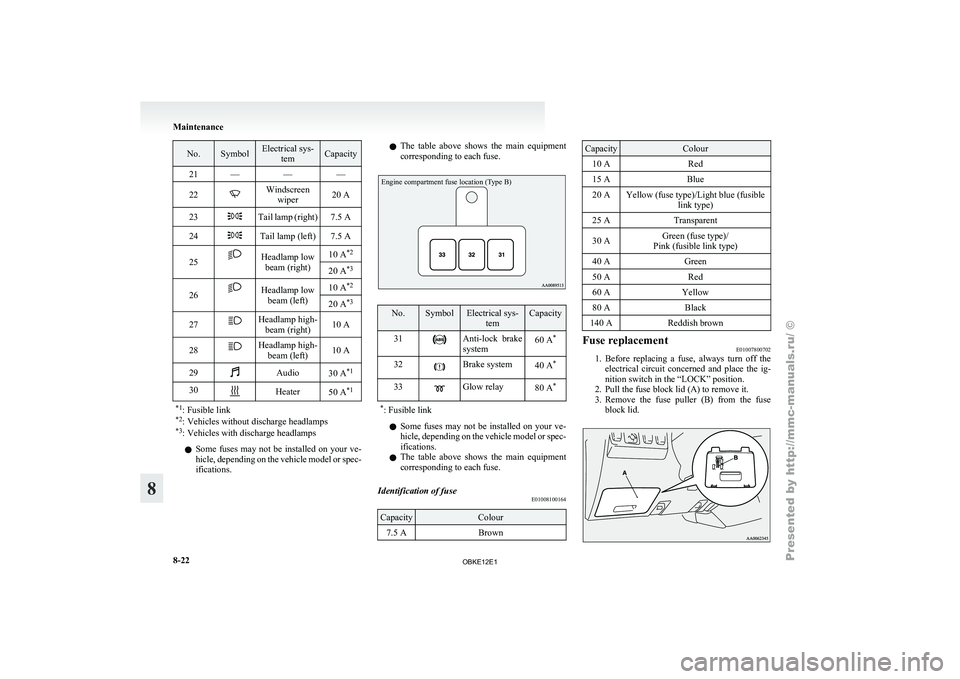
The
table above
shows the main equipment
corresponding to each fuse.
Engine compartment fuse location (Type B) No. Symbol Electrical sys-
tem Capacity
31 Anti-lock brake
system
60 A
*
32 Brake system
40 A*
33 Glow relay
80 A*
* : Fusible link l
Some fuses
may
not be installed on your ve-
hicle, depending on the vehicle model or spec-
ifications.
l The table above shows the main equipment
corresponding to each fuse.
Identification of fuse E01008100164 Capacity Colour
7.5 A Brown Capacity Colour
10 A Red
15 A Blue
20 A Yellow (fuse type)/Light blue (fusible link type)
25 A Transparent
30 A Green (fuse type)/
Pink (fusible link type)
40 A Green
50 A Red
60 A Yellow
80 A Black
140 A Reddish brown Fuse replacement
E01007800702
1. Before replacing a fuse, always turn off the
electrical circuit
concerned and place the ig-
nition switch in the “LOCK” position.
2. Pull the fuse block lid (A) to remove it.
3. Remove the fuse puller (B) from the fuse block lid. Maintenance
8-22
8
OBKE12E1
Page 358 of 377
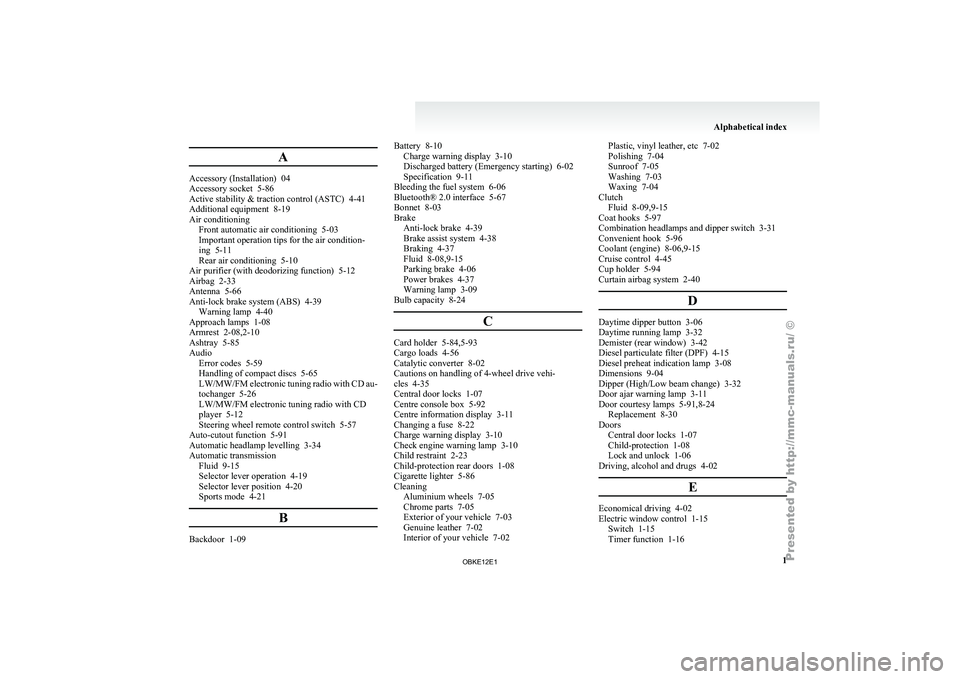
A
Accessory (Installation) 04
Accessory socket 5-86
Active stability & traction control (ASTC) 4-41
Additional equipment
8-19
Air conditioning Front automatic air conditioning
5-03
Important operation tips for the air condition-
ing 5-11
Rear air conditioning 5-10
Air purifier (with deodorizing function) 5-12
Airbag 2-33
Antenna 5-66
Anti-lock brake system (ABS) 4-39 Warning lamp 4-40
Approach lamps 1-08
Armrest 2-08,2-10
Ashtray 5-85
Audio Error codes 5-59
Handling of compact discs 5-65
LW/MW/FM electronic tuning radio with CD au-
tochanger 5-26
LW/MW/FM electronic tuning radio with CD
player 5-12
Steering wheel remote control switch 5-57
Auto-cutout function 5-91
Automatic headlamp levelling 3-34
Automatic transmission Fluid 9-15
Selector lever operation 4-19
Selector lever position 4-20
Sports mode 4-21
BBackdoor 1-09 Battery 8-10
Charge warning display 3-10
Discharged battery (Emergency starting) 6-02
Specification 9-11
Bleeding the fuel system
6-06
Bluetooth® 2.0 interface 5-67
Bonnet 8-03
Brake Anti-lock brake 4-39
Brake assist system 4-38
Braking 4-37
Fluid 8-08,9-15
Parking brake 4-06
Power brakes 4-37
Warning lamp 3-09
Bulb capacity 8-24
C Card holder 5-84,5-93
Cargo loads 4-56
Catalytic converter 8-02
Cautions on handling of 4-wheel drive vehi-
cles 4-35
Central door locks 1-07
Centre console box 5-92
Centre information display
3-11
Changing a fuse 8-22
Charge warning display 3-10
Check engine warning lamp
3-10
Child restraint 2-23
Child-protection rear doors 1-08
Cigarette lighter 5-86
Cleaning Aluminium wheels 7-05
Chrome parts 7-05
Exterior of your vehicle 7-03
Genuine leather 7-02
Interior of your vehicle 7-02 Plastic, vinyl leather, etc 7-02
Polishing 7-04
Sunroof 7-05
Washing 7-03
Waxing 7-04
Clutch Fluid 8-09,9-15
Coat hooks 5-97
Combination headlamps and dipper switch 3-31
Convenient hook 5-96
Coolant (engine) 8-06,9-15
Cruise control 4-45
Cup holder 5-94
Curtain airbag system 2-40
D Daytime dipper button 3-06
Daytime running lamp 3-32
Demister (rear window) 3-42
Diesel particulate filter (DPF)
4-15
Diesel preheat indication lamp
3-08
Dimensions 9-04
Dipper (High/Low beam change) 3-32
Door ajar warning lamp 3-11
Door courtesy lamps 5-91,8-24 Replacement 8-30
Doors Central door locks 1-07
Child-protection 1-08
Lock and unlock 1-06
Driving, alcohol and drugs 4-02
E Economical driving 4-02
Electric window control 1-15
Switch 1-15
Timer function 1-16 Alphabetical index
1
OBKE12E1