seats MITSUBISHI PAJERO IV 2011 User Guide
[x] Cancel search | Manufacturer: MITSUBISHI, Model Year: 2011, Model line: PAJERO IV, Model: MITSUBISHI PAJERO IV 2011Pages: 377, PDF Size: 29.43 MB
Page 47 of 377
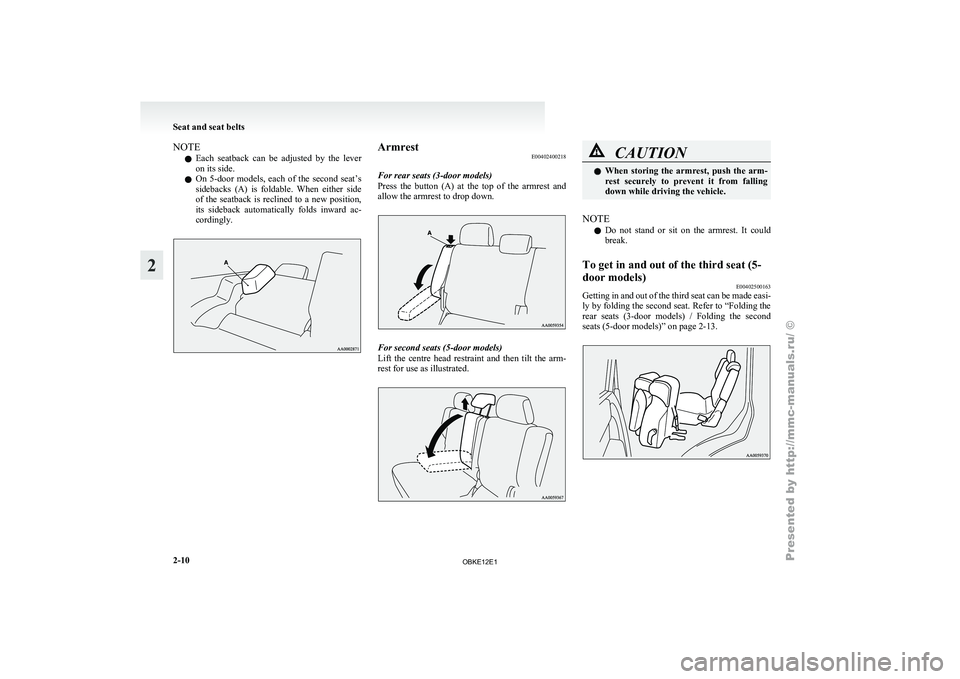
NOTE
l Each
seatback can
be adjusted by the lever
on its side.
l On 5-door models, each of the second seat’s
sidebacks (A) is foldable. When either side
of the seatback is reclined to a new position,
its sideback automatically folds inward ac-
cordingly. Armrest
E00402400218
For rear seats (3-door models)
Press the button
(A) at the top of the armrest and
allow the armrest to drop down. For second seats (5-door models)
Lift the
centre
head restraint and then tilt the arm-
rest for use as illustrated. CAUTION
l
When storing the
armrest, push the arm-
rest securely to prevent it from falling
down while driving the vehicle.
NOTE l Do
not stand
or sit on the armrest. It could
break.
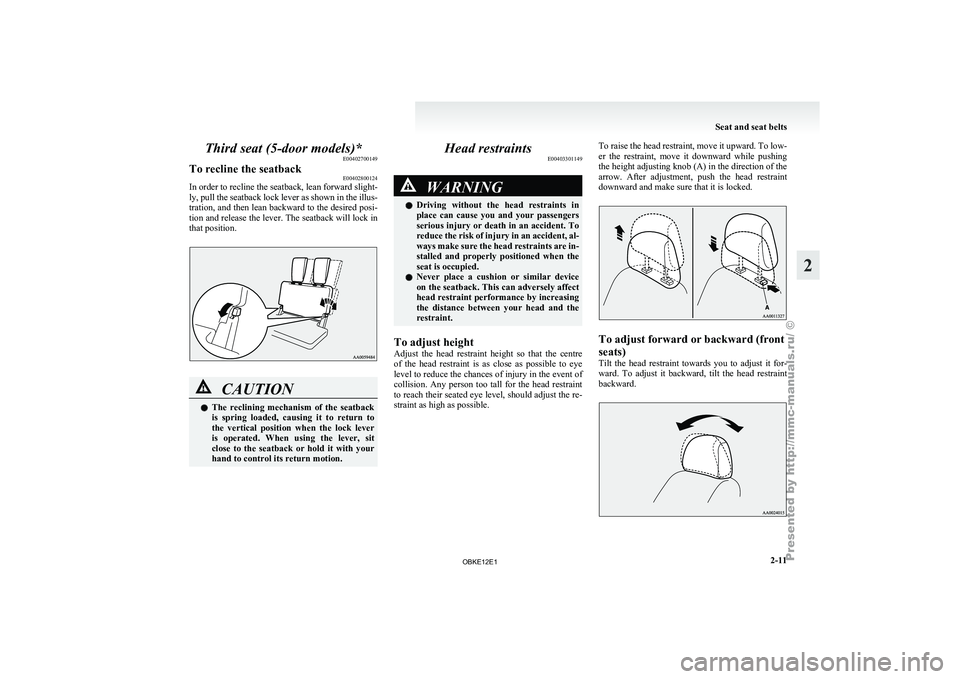
To get in and out of the third seat (5-
door models) E00402500163
Getting in and out of the third seat can be made easi-
ly by folding
the second seat. Refer to “Folding the
rear seats (3-door models) / Folding the second
seats (5-door models)” on page 2-13. Seat and seat belts
2-10
2
OBKE12E1
Page 48 of 377
Third seat (5-door models)*
E00402700149
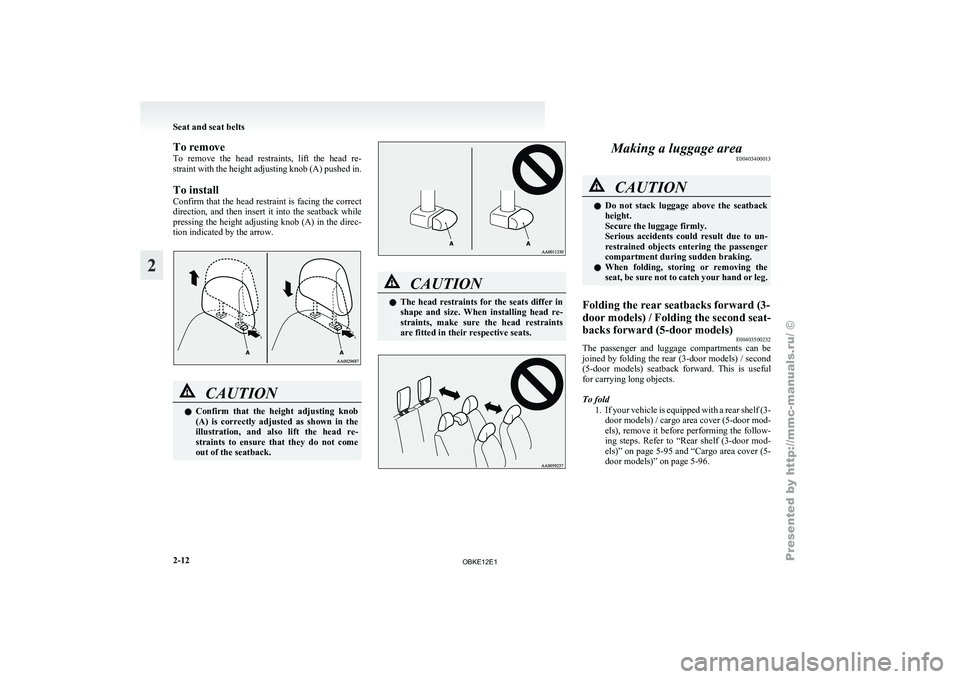
To recline the seatback E00402800124
In order to recline the seatback, lean forward slight-
ly, pull the
seatback lock lever as shown in the illus-
tration, and then lean backward to the desired posi-
tion and release the lever. The seatback will lock in
that position. CAUTION
l
The reclining
mechanism
of the seatback
is spring loaded, causing it to return to
the vertical position when the lock lever
is operated. When using the lever, sit
close to the seatback or hold it with your
hand to control its return motion. Head restraints
E00403301149 WARNING
l Driving without
the
head restraints in
place can cause you and your passengers
serious injury or death in an accident. To
reduce the risk of injury in an accident, al-
ways make sure the head restraints are in-
stalled and properly positioned when the
seat is occupied.
l Never place a cushion or similar device
on the seatback. This can adversely affect
head restraint performance by increasing
the distance between your head and the
restraint.
To adjust height
Adjust the head
restraint height so that the centre
of the head restraint is as close as possible to eye
level to reduce the chances of injury in the event of
collision. Any person too tall for the head restraint
to reach their seated eye level, should adjust the re-
straint as high as possible. To raise the head restraint, move it upward. To low-
er the
restraint,
move it downward while pushing
the height adjusting knob (A) in the direction of the
arrow. After adjustment, push the head restraint
downward and make sure that it is locked. To adjust forward or backward (front
seats)
Tilt
the
head
restraint towards you to adjust it for-
ward. To adjust it backward, tilt the head restraint
backward. Seat and seat belts
2-11 2
OBKE12E1
Page 49 of 377
To remove
To remove
the
head restraints, lift the head re-
straint with the height adjusting knob (A) pushed in.
To install
Confirm that the head restraint is facing the correct
direction, and then insert it into the seatback while
pressing the height adjusting knob (A) in the direc-
tion indicated by the arrow. CAUTION
l
Confirm that
the
height adjusting knob
(A) is correctly adjusted as shown in the
illustration, and also lift the head re-
straints to ensure that they do not come
out of the seatback. CAUTION
l
The head
restraints
for the seats differ in
shape and size. When installing head re-
straints, make sure the head restraints
are fitted in their respective seats. Making a luggage area
E00403400013 CAUTION
l
Do not
stack
luggage above the seatback
height.
Secure the luggage firmly.
Serious accidents could result due to un-
restrained objects entering the passenger
compartment during sudden braking.
l When folding, storing or removing the
seat, be sure not to catch your hand or leg.
Folding the rear seatbacks forward (3-
door models) /
Folding the second seat-
backs forward (5-door models) E00403500232
The passenger and luggage compartments can be
joined by folding
the rear (3-door models) / second
(5-door models) seatback forward. This is useful
for carrying long objects.
To fold
1. If your vehicle is equipped with a rear shelf (3-door models) / cargo area cover (5-door mod-
els), remove it before performing the follow-
ing steps. Refer to “Rear shelf (3-door mod-
els)” on page 5-95 and “Cargo area cover (5-
door models)” on page 5-96. Seat and seat belts
2-12
2
OBKE12E1
Page 50 of 377
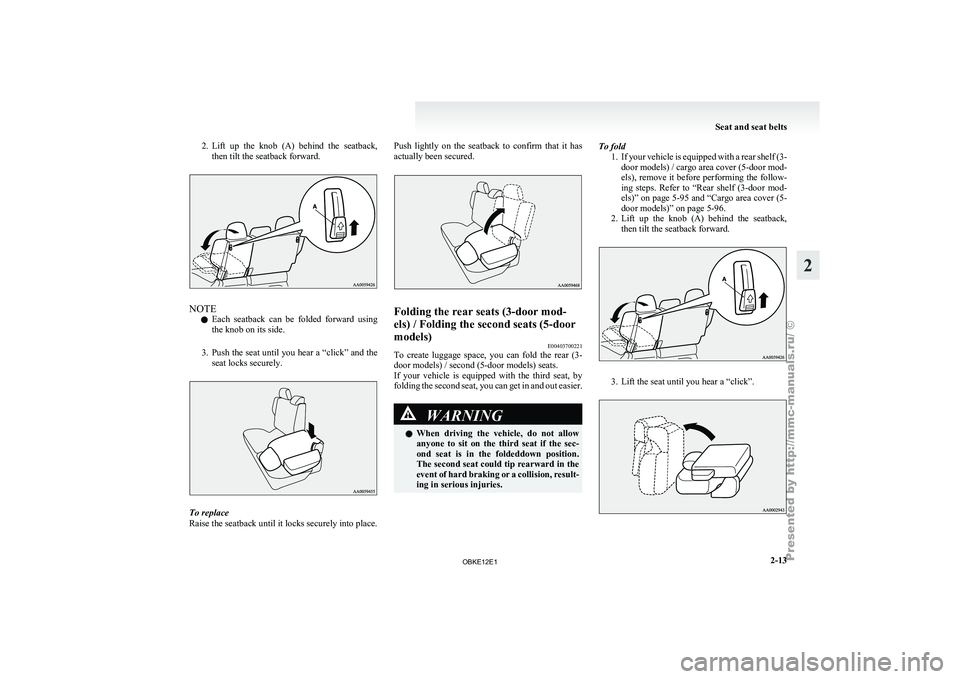
2. Lift up the knob (A) behind the seatback,
then tilt the seatback forward. NOTE
l Each
seatback can
be folded forward using
the knob on its side.
3. Push the seat until you hear a “click” and the seat locks securely. To replace
Raise the seatback until it locks securely into place. Push lightly on the seatback to confirm that it has
actually been secured.
Folding the rear seats (3-door mod-
els) / Folding the second seats (5-door
models)
E00403700221
To create luggage space, you can fold the rear (3-
door models) / second (5-door models) seats.
If your vehicle
is equipped with the third seat, by
folding the second seat, you can get in and out easier. WARNING
l When driving
the
vehicle, do not allow
anyone to sit on the third seat if the sec-
ond seat is in the foldeddown position.
The second seat could tip rearward in the
event of hard braking or a collision, result-
ing in serious injuries. To fold
1. If your vehicle
is equipped with a rear shelf (3-
door models) / cargo area cover (5-door mod-
els), remove it before performing the follow-
ing steps. Refer to “Rear shelf (3-door mod-
els)” on page 5-95 and “Cargo area cover (5-
door models)” on page 5-96.
2. Lift up the knob (A) behind the seatback, then tilt the seatback forward. 3. Lift the seat until you hear a “click”. Seat and seat belts
2-13 2
OBKE12E1
Page 55 of 377
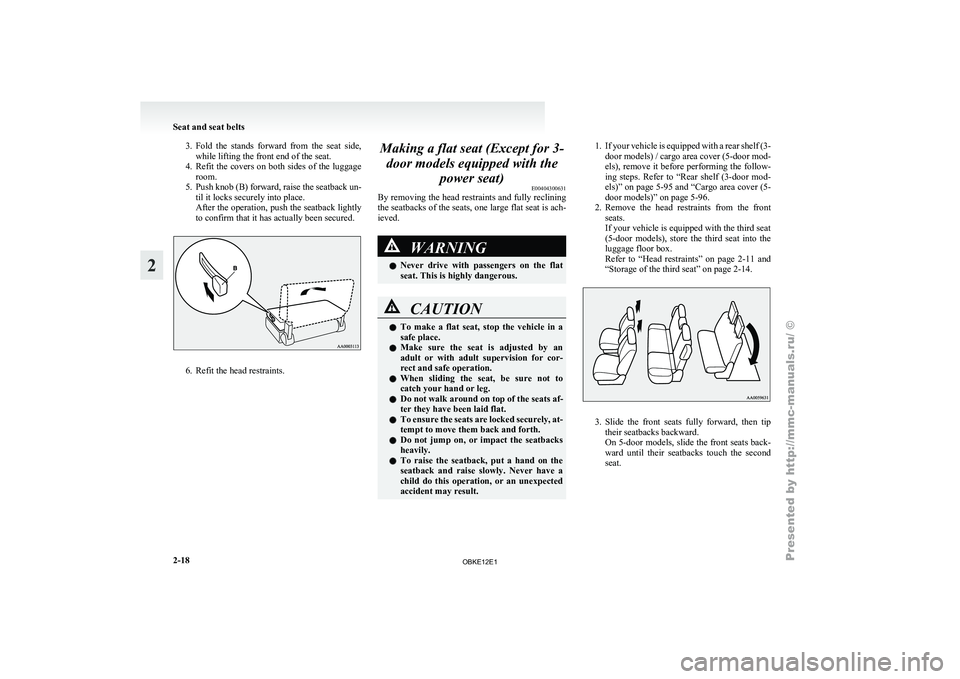
3. Fold the stands forward from the seat side,
while lifting the front end of the seat.
4. Refit
the covers on both sides of the luggage
room.
5. Push knob (B) forward, raise the seatback un- til it locks securely into place.
After the operation, push the seatback lightly
to confirm that it has actually been secured. 6. Refit the head restraints. Making a flat seat (Except for 3-
door models equipped with the power seat) E00404300631
By removing the
head restraints and fully reclining
the seatbacks of the seats, one large flat seat is ach-
ieved. WARNING
l Never drive
with
passengers on the flat
seat. This is highly dangerous. CAUTION
l
To make a
flat seat, stop the vehicle in a
safe place.
l Make sure the seat is adjusted by an
adult or with adult supervision for cor-
rect and safe operation.
l When sliding the seat, be sure not to
catch your hand or leg.
l Do not walk around on top of the seats af-
ter they have been laid flat.
l To ensure the seats are locked securely, at-
tempt to move them back and forth.
l Do not jump on, or impact the seatbacks
heavily.
l To raise the seatback, put a hand on the
seatback and raise slowly. Never have a
child do this operation, or an unexpected
accident may result. 1. If your vehicle is equipped with a rear shelf (3-
door models)
/ cargo area cover (5-door mod-
els), remove it before performing the follow-
ing steps. Refer to “Rear shelf (3-door mod-
els)” on page 5-95 and “Cargo area cover (5-
door models)” on page 5-96.
2. Remove the head restraints from the front seats.
If your vehicle is equipped with the third seat
(5-door models), store the third seat into the
luggage floor box.
Refer to “Head restraints” on page 2-11 and
“Storage of the third seat” on page 2-14. 3. Slide the front seats fully forward, then tip
their seatbacks backward.
On 5-door
models, slide the front seats back-
ward until their seatbacks touch the second
seat. Seat and seat belts
2-18
2
OBKE12E1
Page 56 of 377
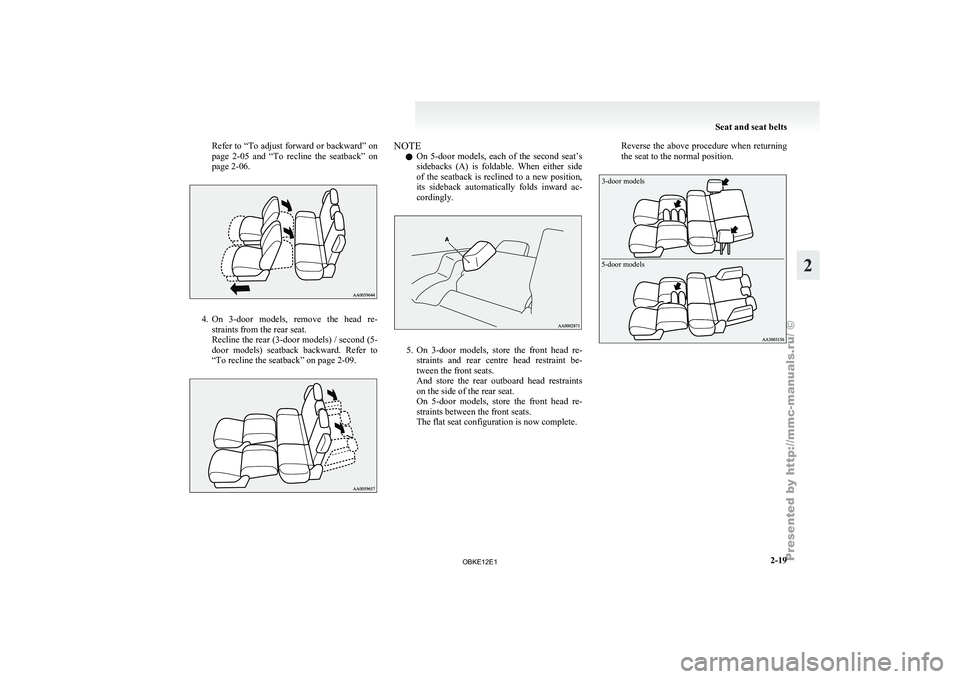
Refer to “To adjust forward
or backward” on
page 2-05 and “To recline the seatback” on
page 2-06. 4. On 3-door models, remove the head re-
straints from the rear seat.
Recline the
rear (3-door models) / second (5-
door models) seatback backward. Refer to
“To recline the seatback” on page 2-09. NOTE
l On
5-door models,
each of the second seat’s
sidebacks (A) is foldable. When either side
of the seatback is reclined to a new position,
its sideback automatically folds inward ac-
cordingly. 5. On 3-door models, store the front head re-
straints and
rear centre head restraint be-
tween the front seats.
And store the rear outboard head restraints
on the side of the rear seat.
On 5-door models, store the front head re-
straints between the front seats.
The flat seat configuration is now complete. Reverse the above procedure when returning
the seat to the normal position.
5-door models
3-door models Seat and seat belts
2-19 2
OBKE12E1
Page 58 of 377
WARNING
l The seat belts must not be twisted when
worn.
3. Pull the belt slightly to adjust slackness as de-
sired.
To unfasten
Hold the
latch plate and push the button on the buck-
le. NOTE
l As
the belt
retracts automatically, keep hold-
ing the latch plate while retracting so that the
belt stows slowly. Failure to do this could
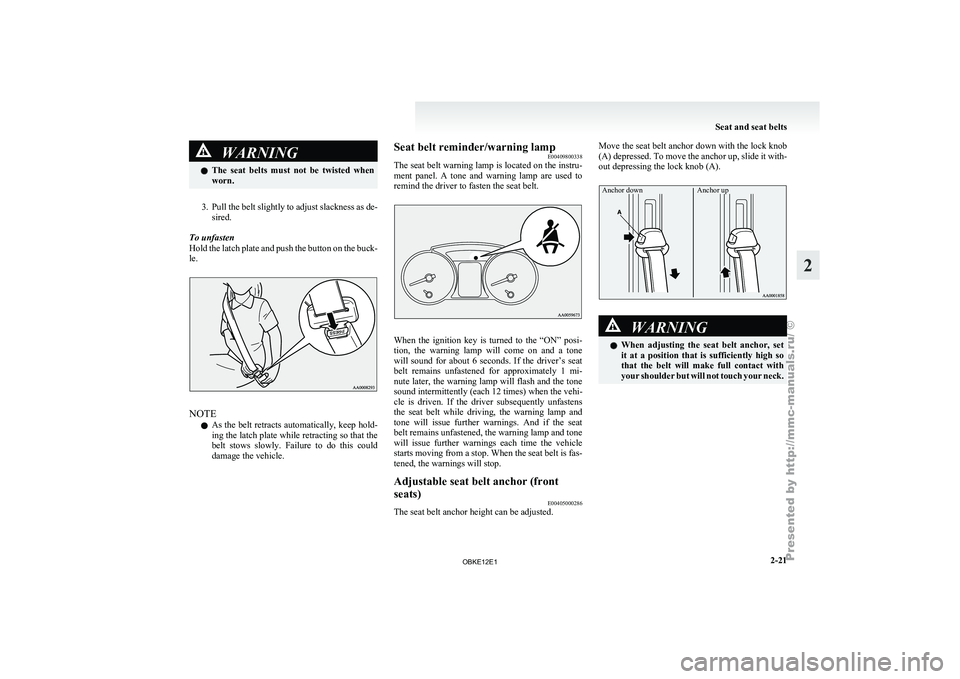
damage the vehicle. Seat belt reminder/warning lamp
E00409800338
The seat belt
warning lamp is located on the instru-
ment panel. A tone and warning lamp are used to
remind the driver to fasten the seat belt. When the ignition key is turned to the “ON” posi-
tion, the warning
lamp will come on and a tone
will sound for about 6 seconds. If the driver’s seat
belt remains unfastened for approximately 1 mi-
nute later, the warning lamp will flash and the tone
sound intermittently (each 12 times) when the vehi-
cle is driven. If the driver subsequently unfastens
the seat belt while driving, the warning lamp and
tone will issue further warnings. And if the seat
belt remains unfastened, the warning lamp and tone
will issue further warnings each time the vehicle
starts moving from a stop. When the seat belt is fas-
tened, the warnings will stop.
Adjustable seat belt anchor (front
seats) E00405000286
The seat belt anchor height can be adjusted. Move the seat belt anchor down with the lock knob
(A) depressed. To
move the anchor up, slide it with-
out depressing the lock knob (A).
Anchor down Anchor up WARNING
l When adjusting
the
seat belt anchor, set
it at a position that is sufficiently high so
that the belt will make full contact with
your shoulder but will not touch your neck. Seat and seat belts
2-21 2
OBKE12E1
Page 68 of 377
Installing a child restraint system to
the lower anchorage (ISOFIX child re-
straint mountings) and tether anchor-
age*
E00408900387
Lower anchorage location
Your vehicle’s rear
seat (3-door models)/second
seat (5-door models) is fitted with lower anchorag-
es for attaching a child restraint system with ISO-
FIX mountings. Tether anchorage locations
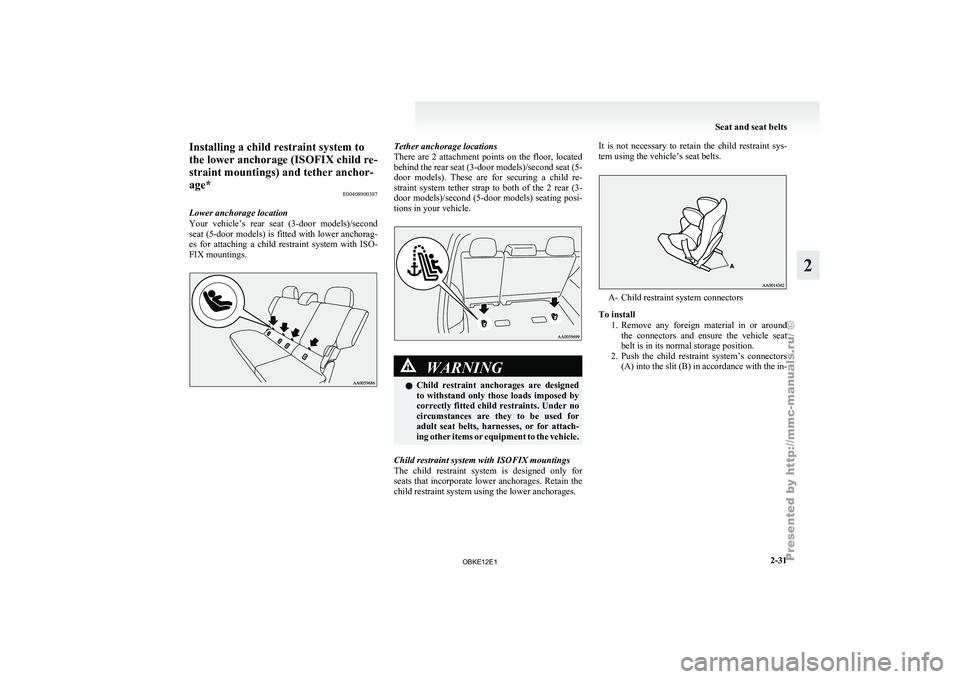
There are 2
attachment points on the floor, located
behind the rear seat (3-door models)/second seat (5-
door models). These are for securing a child re-
straint system tether strap to both of the 2 rear (3-
door models)/second (5-door models) seating posi-
tions in your vehicle. WARNING
l Child restraint
anchorages
are designed
to withstand only those loads imposed by
correctly fitted child restraints. Under no
circumstances are they to be used for
adult seat belts, harnesses, or for attach-
ing other items or equipment to the vehicle.
Child restraint system with ISOFIX mountings
The child restraint
system is designed only for
seats that incorporate lower anchorages. Retain the
child restraint system using the lower anchorages. It is not necessary to retain the child restraint sys-
tem using the vehicle’s seat belts.
A- Child restraint system connectors
To install 1. Remove any foreign
material in or around
the connectors and ensure the vehicle seat
belt is in its normal storage position.
2. Push the child restraint system’s connectors (A) into the slit (B) in accordance with the in- Seat and seat belts
2-31 2
OBKE12E1
Page 79 of 377
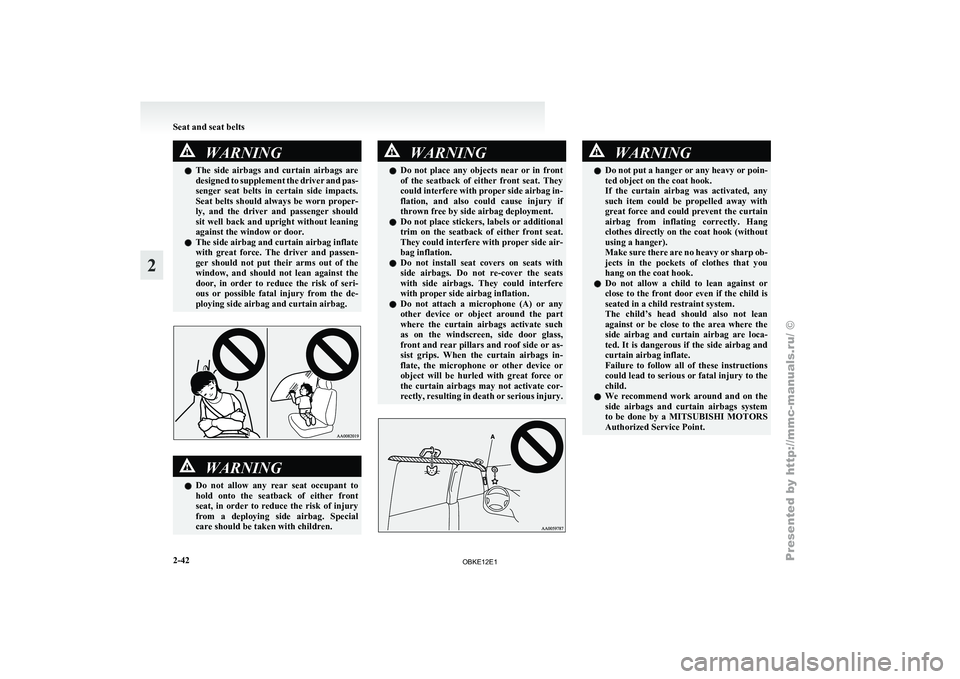
WARNING
l The side airbags and curtain airbags are
designed to supplement the driver and pas-
senger seat belts in certain side impacts.
Seat belts should always be worn proper-
ly, and the driver and passenger should
sit well back and upright without leaning
against the window or door.
l The side airbag and curtain airbag inflate
with great force. The driver and passen-
ger should not put their arms out of the
window, and should not lean against the
door, in order to reduce the risk of seri-
ous or possible fatal injury from the de-
ploying side airbag and curtain airbag. WARNING
l Do not
allow
any rear seat occupant to
hold onto the seatback of either front
seat, in order to reduce the risk of injury
from a deploying side airbag. Special
care should be taken with children. WARNING
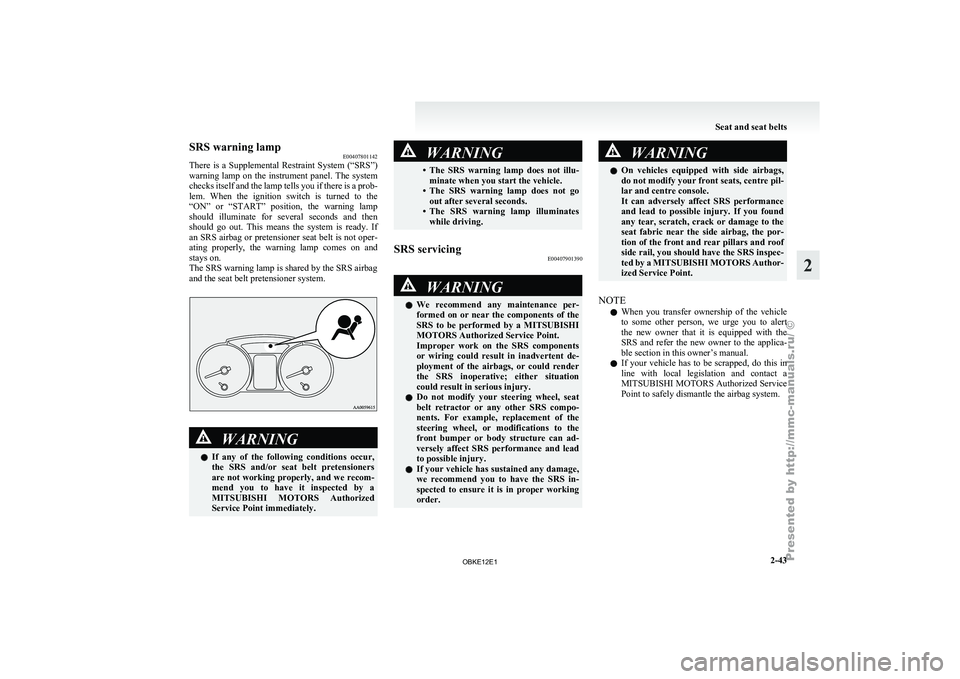
l Do not place
any objects near or in front
of the seatback of either front seat. They
could interfere with proper side airbag in-
flation, and also could cause injury if
thrown free by side airbag deployment.
l Do not place stickers, labels or additional
trim on the seatback of either front seat.
They could interfere with proper side air-
bag inflation.
l Do not install seat covers on seats with
side airbags. Do not re-cover the seats
with side airbags. They could interfere
with proper side airbag inflation.
l Do not attach a microphone (A) or any
other device or object around the part
where the curtain airbags activate such
as on the windscreen, side door glass,
front and rear pillars and roof side or as-
sist grips. When the curtain airbags in-
flate, the microphone or other device or
object will be hurled with great force or
the curtain airbags may not activate cor-
rectly, resulting in death or serious injury. WARNING
l Do not put a hanger or any heavy or poin-
ted object on the coat hook.
If the curtain airbag was activated, any
such item could be propelled away with
great force and could prevent the curtain
airbag from inflating correctly. Hang
clothes directly on the coat hook (without
using a hanger).
Make sure there are no heavy or sharp ob-
jects in the pockets of clothes that you
hang on the coat hook.
l Do not allow a child to lean against or
close to the front door even if the child is
seated in a child restraint system.
The child’s head should also not lean
against or be close to the area where the
side airbag and curtain airbag are loca-
ted. It is dangerous if the side airbag and
curtain airbag inflate.
Failure to follow all of these instructions
could lead to serious or fatal injury to the
child.
l We recommend work around and on the
side airbags and curtain airbags system
to be done by a MITSUBISHI MOTORS
Authorized Service Point. Seat and seat belts
2-42
2
OBKE12E1
Page 80 of 377
SRS warning lamp
E00407801142
There is a
Supplemental Restraint System (“SRS”)
warning lamp on the instrument panel. The system
checks itself and the lamp tells you if there is a prob-
lem. When the ignition switch is turned to the
“ON” or “START” position, the warning lamp
should illuminate for several seconds and then
should go out. This means the system is ready. If
an SRS airbag or pretensioner seat belt is not oper-
ating properly, the warning lamp comes on and
stays on.
The SRS warning lamp is shared by the SRS airbag
and the seat belt pretensioner system. WARNING
l If any of
the following conditions occur,
the SRS and/or seat belt pretensioners
are not working properly, and we recom-
mend you to have it inspected by a
MITSUBISHI MOTORS Authorized
Service Point immediately. WARNING
• The SRS warning lamp does not illu- minate when you start the vehicle.
• The
SRS warning lamp does not go
out after several seconds.
• The SRS warning lamp illuminates while driving.
SRS servicing E00407901390 WARNING
l We recommend
any
maintenance per-
formed on or near the components of the
SRS to be performed by a MITSUBISHI
MOTORS Authorized Service Point.
Improper work on the SRS components
or wiring could result in inadvertent de-
ployment of the airbags, or could render
the SRS inoperative; either situation
could result in serious injury.
l Do not modify your steering wheel, seat
belt retractor or any other SRS compo-
nents. For example, replacement of the
steering wheel, or modifications to the
front bumper or body structure can ad-
versely affect SRS performance and lead
to possible injury.
l If your vehicle has sustained any damage,
we recommend you to have the SRS in-
spected to ensure it is in proper working
order. WARNING
l On vehicles equipped
with side airbags,
do not modify your front seats, centre pil-
lar and centre console.
It can adversely affect SRS performance
and lead to possible injury. If you found
any tear, scratch, crack or damage to the
seat fabric near the side airbag, the por-
tion of the front and rear pillars and roof
side rail, you should have the SRS inspec-
ted by a MITSUBISHI MOTORS Author-
ized Service Point.
NOTE l When
you transfer
ownership of the vehicle
to some other person, we urge you to alert
the new owner that it is equipped with the
SRS and refer the new owner to the applica-
ble section in this owner’s manual.
l If your vehicle has to be scrapped, do this in
line with local legislation and contact a
MITSUBISHI MOTORS Authorized Service
Point to safely dismantle the airbag system. Seat and seat belts
2-43 2
OBKE12E1