warning MITSUBISHI PAJERO IV 2011 User Guide
[x] Cancel search | Manufacturer: MITSUBISHI, Model Year: 2011, Model line: PAJERO IV, Model: MITSUBISHI PAJERO IV 2011Pages: 377, PDF Size: 29.43 MB
Page 33 of 377
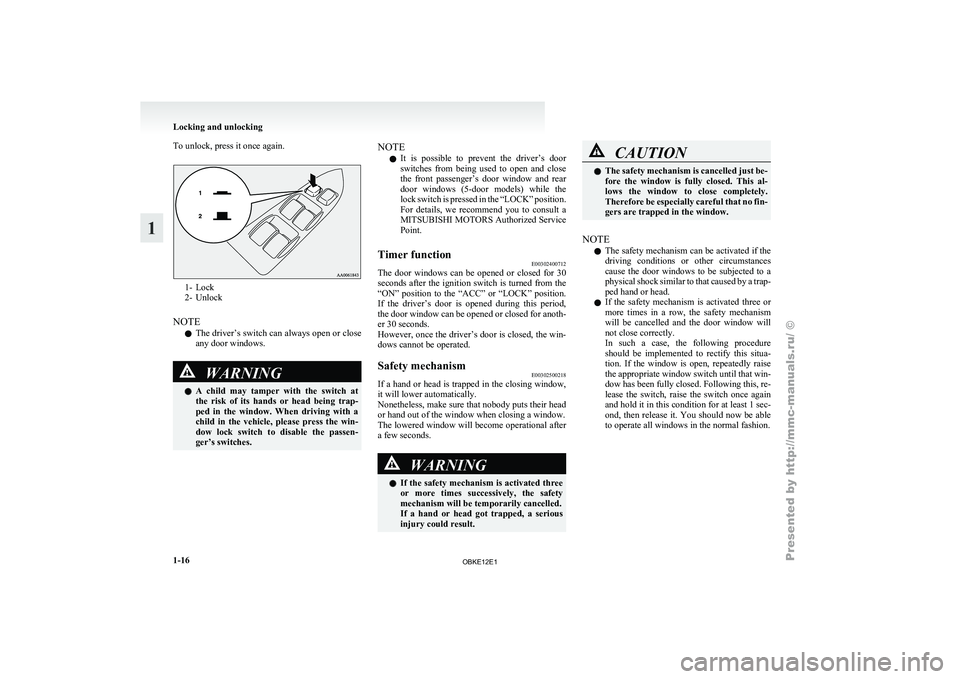
To unlock, press it once again.
1- Lock
2- Unlock
NOTE l The
driver’s
switch can always open or close
any door windows. WARNING
l A
child
may
tamper with the switch at
the risk of its hands or head being trap-
ped in the window. When driving with a
child in the vehicle, please press the win-
dow lock switch to disable the passen-
ger’s switches. NOTE
l It
is possible
to prevent the driver’s door
switches from being used to open and close
the front passenger’s door window and rear
door windows (5-door models) while the
lock switch is pressed in the “LOCK” position.
For details, we recommend you to consult a
MITSUBISHI MOTORS Authorized Service
Point.
Timer function E00302400712
The door windows can be opened or closed for 30
seconds after the
ignition switch is turned from the
“ON” position to the “ACC” or “LOCK” position.
If the driver’s door is opened during this period,
the door window can be opened or closed for anoth-
er 30 seconds.
However, once the driver’s door is closed, the win-
dows cannot be operated.
Safety mechanism E00302500218
If a hand or head is trapped in the closing window,
it will lower automatically.
Nonetheless, make sure
that nobody puts their head
or hand out of the window when closing a window.
The lowered window will become operational after
a few seconds. WARNING
l If the
safety
mechanism is activated three
or more times successively, the safety
mechanism will be temporarily cancelled.
If a hand or head got trapped, a serious
injury could result. CAUTION
l
The safety mechanism
is cancelled just be-
fore the window is fully closed. This al-
lows the window to close completely.
Therefore be especially careful that no fin-
gers are trapped in the window.
NOTE l The
safety mechanism
can be activated if the
driving conditions or other circumstances
cause the door windows to be subjected to a
physical shock similar to that caused by a trap-
ped hand or head.
l If the safety mechanism is activated three or
more times in a row, the safety mechanism
will be cancelled and the door window will
not close correctly.
In such a case, the following procedure
should be implemented to rectify this situa-
tion. If the window is open, repeatedly raise
the appropriate window switch until that win-
dow has been fully closed. Following this, re-
lease the switch, raise the switch once again
and hold it in this condition for at least 1 sec-
ond, then release it. You should now be able
to operate all windows in the normal fashion. Locking and unlocking
1-16
1
OBKE12E1
Page 35 of 377
NOTE
l When
the sunroof
is tilted up, the sunshade
is automatically opened slightly.
To tilt down, press the switch (2). WARNING
l Do not
put
head, hands or anything else
out of the sunroof opening while driving
the vehicle.
l Never leave a child (or other person who
might not be capable of safe operation of
the sunroof switch) in the vehicle alone.
l Before operating the sunroof, make sure
that nothing is capable of being trapped
(head, hand, finger, etc.).
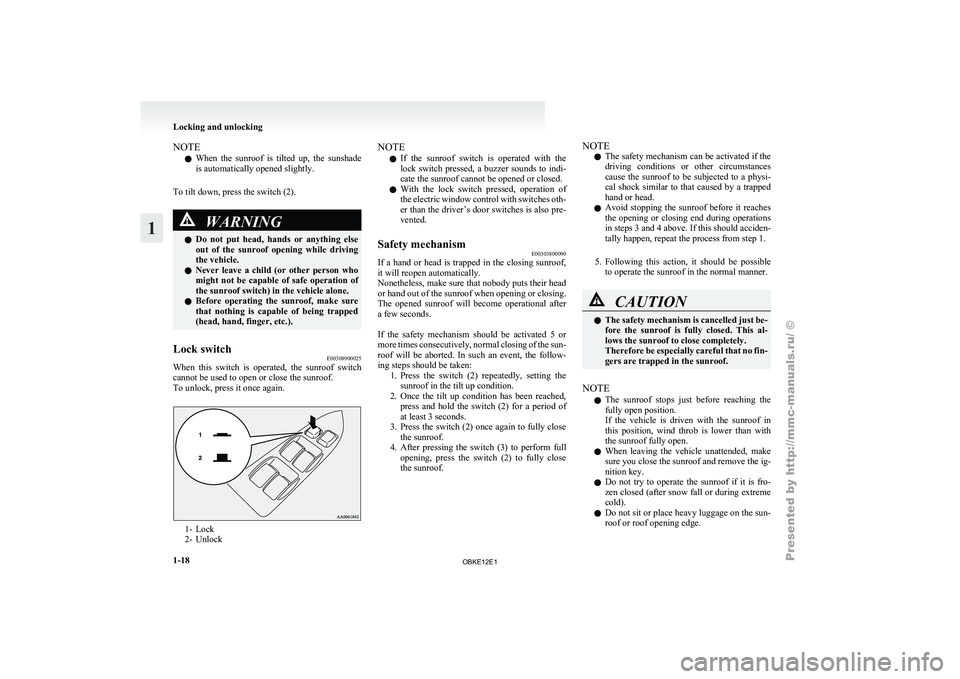
Lock switch E00308900025
When this switch is operated, the sunroof switch
cannot be used to open or close the sunroof.
To unlock, press it once again. 1- Lock
2- Unlock NOTE
l If
the sunroof
switch is operated with the
lock switch pressed, a buzzer sounds to indi-
cate the sunroof cannot be opened or closed.
l With the lock switch pressed, operation of
the electric window control with switches oth-
er than the driver’s door switches is also pre-
vented.
Safety mechanism E00303800090
If a hand or head is trapped in the closing sunroof,
it will reopen automatically.
Nonetheless, make sure
that nobody puts their head
or hand out of the sunroof when opening or closing.
The opened sunroof will become operational after
a few seconds.
If the safety mechanism should be activated 5 or
more times consecutively, normal closing of the sun-
roof will be aborted. In such an event, the follow-
ing steps should be taken: 1. Press the switch (2) repeatedly, setting thesunroof in the tilt up condition.
2. Once the tilt up condition has been reached, press and hold the switch (2) for a period of
at least 3 seconds.
3. Press the switch (2) once again to fully close the sunroof.
4. After pressing the switch (3) to perform full opening, press the switch (2) to fully close
the sunroof. NOTE
l The
safety mechanism
can be activated if the
driving conditions or other circumstances
cause the sunroof to be subjected to a physi-
cal shock similar to that caused by a trapped
hand or head.
l Avoid stopping the sunroof before it reaches
the opening or closing end during operations
in steps 3 and 4 above. If this should acciden-
tally happen, repeat the process from step 1.
5. Following this action, it should be possible to operate the sunroof in the normal manner. CAUTION
l
The safety
mechanism
is cancelled just be-
fore the sunroof is fully closed. This al-
lows the sunroof to close completely.
Therefore be especially careful that no fin-
gers are trapped in the sunroof.
NOTE l The
sunroof stops
just before reaching the
fully open position.
If the vehicle is driven with the sunroof in
this position, wind throb is lower than with
the sunroof fully open.
l When leaving the vehicle unattended, make
sure you close the sunroof and remove the ig-
nition key.
l Do not try to operate the sunroof if it is fro-
zen closed (after snow fall or during extreme
cold).
l Do not sit or place heavy luggage on the sun-
roof or roof opening edge. Locking and unlocking
1-18
1
OBKE12E1
Page 42 of 377
Seat adjustment
E00400300314
Adjust the driver’s
seat so that you are comfortable
and that you can reach the pedals, steering wheel,
switches etc. while retaining a clear field of vision. WARNING
l Do not
attempt
to adjust the seat while
driving. This can cause loss of vehicle con-
trol and result in an accident. After ad-
justments are made, ensure the seating is
locked in position by attempting to move
the seat forward and rearward without us-
ing the adjusting mechanism.
l Do not allow people or children to ride in
any area of your vehicle that is not equip-
ped with seats and seat belts, and make
sure that everyone travelling in your vehi-
cle is in a seat and wearing a seat belt, or
in the case of a child is strapped in a child
restraint.
l To minimize the risk of personal injury
in the event of a collision or sudden brak-
ing, the seatbacks should always be in the
almost upright position while the vehicle
is in motion. The protection provided by
the seat belts may be reduced significant-
ly when the seatback is reclined. There is
greater risk that the passenger will slide
under the seat belt, resulting in serious in-
jury, when the seatback is reclined. CAUTION
l
Make sure the
seat is adjusted by an
adult or with adult supervision for cor-
rect and safe operation.
l Do not place a cushion or the like be-
tween your back and the seatback while
driving. The effectiveness of the head re-
straints will be reduced in the event of an
accident.
l When sliding the seats, be careful not to
catch your hand or foot. Front seats
E00400400100
To adjust forward or backward E00400500055
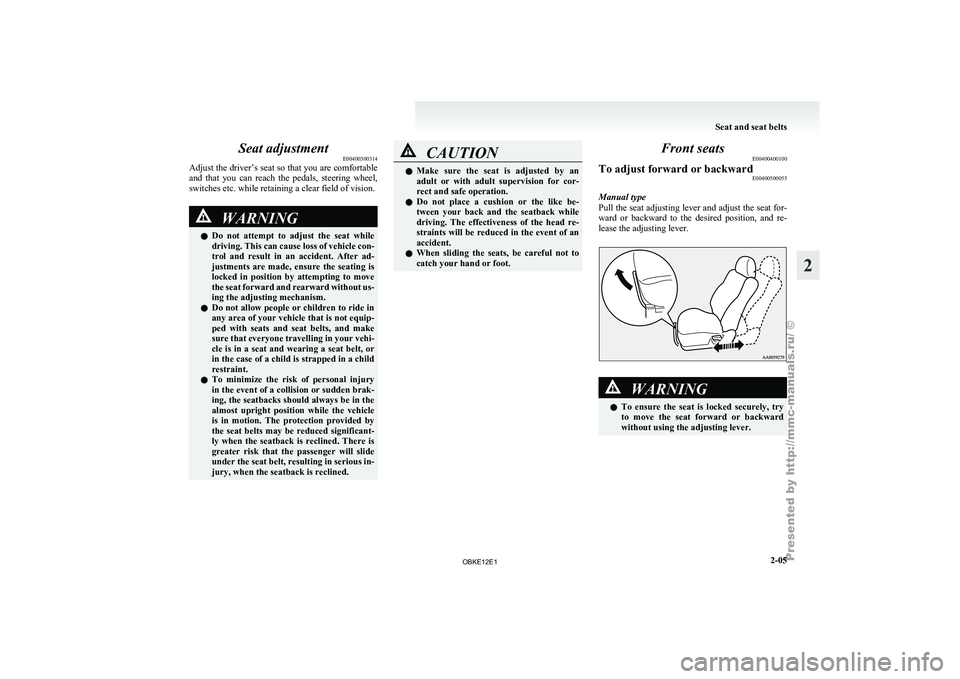
Manual type
Pull the seat
adjusting lever and adjust the seat for-
ward or backward to the desired position, and re-
lease the adjusting lever. WARNING
l To ensure
the
seat is locked securely, try
to move the seat forward or backward
without using the adjusting lever. Seat and seat belts
2-05 2
OBKE12E1
Page 45 of 377
NOTE
l To
prevent the
battery from running down,
operate the power seat with the engine run-
ning.
Armrest E00400900118
Slide forward the centre console lid while pressing
the right upper lever (A). To get in and out of the rear seat (3-
door models, passenger’s seat)
E00401000044
The lever can be used to make getting in and out
easier. Pull up the lever (A) or depress the pedal (B), tilt
the seatback forward.
Then slide the entire seat for-
ward. To return the seat, raise the seatback, then
slide the entire seat backward until there is a
“click” in a locked position. Adjust the seat position. WARNING
l Do not drive the vehicle with the seatback
folded forward. The
seat is not retained
with the seatback in this position, so seri-
ous injuries could be suffered in the event
of hard braking or a collision. CAUTION
l
The reclining
mechanism
of the seatback
is spring loaded, causing it to return to
the vertical position when the lock lever
is operated. When using the lever, sit
close to the seatback or hold it with your
hand to control its return motion. Heated seats*
E00401100797
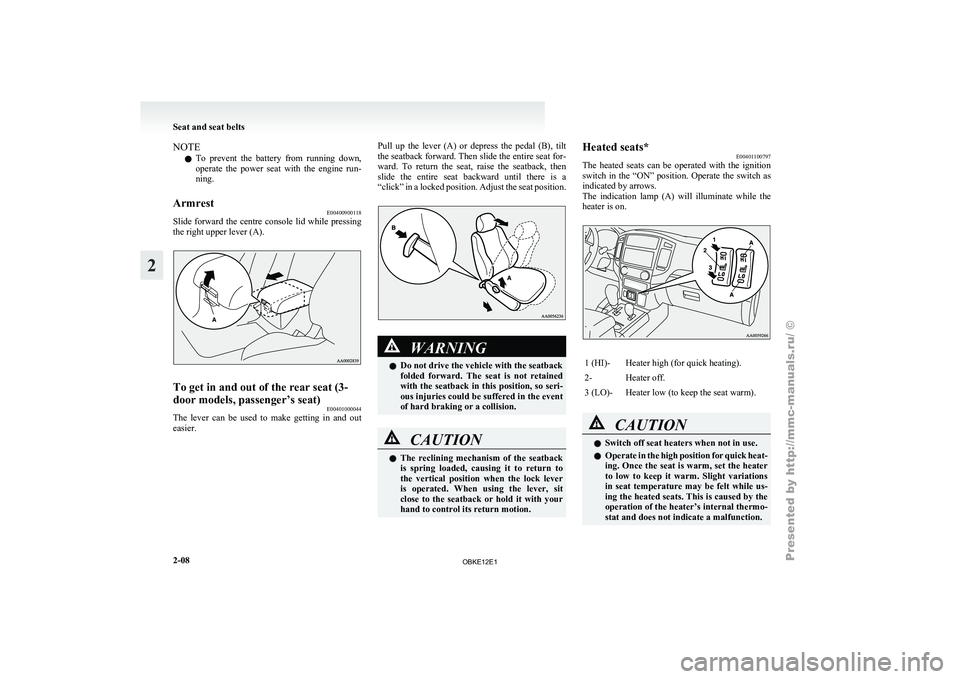
The heated seats
can be operated with the ignition
switch in the “ON” position. Operate the switch as
indicated by arrows.
The indication lamp (A) will illuminate while the
heater is on. 1 (HI)- Heater high (for quick heating).
2- Heater off.
3 (LO)- Heater low (to keep the seat warm).
CAUTION
l
Switch off seat heaters when not in use.
l Operate in
the
high position for quick heat-
ing. Once the seat is warm, set the heater
to low to keep it warm. Slight variations
in seat temperature may be felt while us-
ing the heated seats. This is caused by the
operation of the heater’s internal thermo-
stat and does not indicate a malfunction. Seat and seat belts
2-08
2
OBKE12E1
Page 46 of 377
CAUTION
l
If the following types of persons use the
heated seats, they might become too hot
or receive minor burns (red skin, heat blis-
ters, etc.): • Children, elderly or ill people
• People with sensitive skin
• Excessively tired people
• People under the influence of alcoholor sleep inducing medication (cold
medicine, etc.)
l Do not place heavy objects on the seat or
stick pins, needles, or other pointed ob-
jects into it.
l Do not use a blanket, cushion, or other ma-
terial with high heat insulation properties
on the seat while using the heater; this
might cause the heater element to overheat
l When cleaning the seat, do not use ben-
zene, kerosene, petrol, alcohol, or other or-
ganic solvents; these might damage the
surface of the seat and also the heater ele-
ment.
l If water or any other liquid is spilled on
the seat, allow it to dry thoroughly before
attempting to use the heater.
l Turn the heater off immediately if it ap-
pears to be malfunctioning during use. Rear seats (3-door models)*/
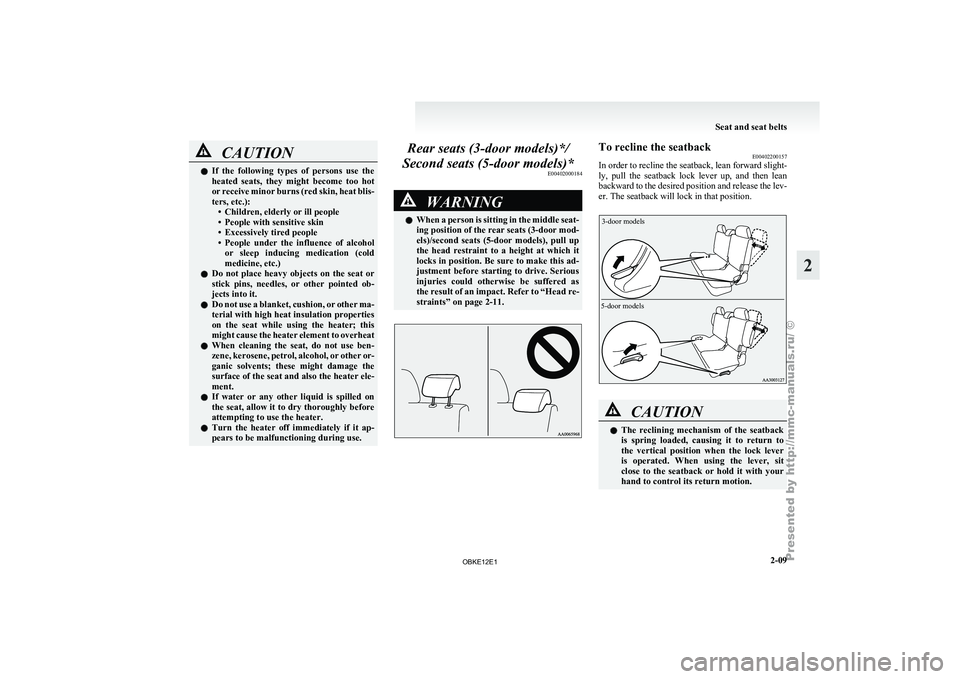
Second seats (5-door models)* E00402000184 WARNING
l When a
person
is sitting in the middle seat-
ing position of the rear seats (3-door mod-
els)/second seats (5-door models), pull up
the head restraint to a height at which it
locks in position. Be sure to make this ad-
justment before starting to drive. Serious
injuries could otherwise be suffered as
the result of an impact. Refer to “Head re-
straints” on page 2-11. To recline the seatback
E00402200157
In order to
recline the seatback, lean forward slight-
ly, pull the seatback lock lever up, and then lean
backward to the desired position and release the lev-
er. The seatback will lock in that position.
3-door models
5-door models CAUTION
l
The reclining mechanism
of the seatback
is spring loaded, causing it to return to
the vertical position when the lock lever
is operated. When using the lever, sit
close to the seatback or hold it with your
hand to control its return motion. Seat and seat belts
2-09 2
OBKE12E1
Page 48 of 377
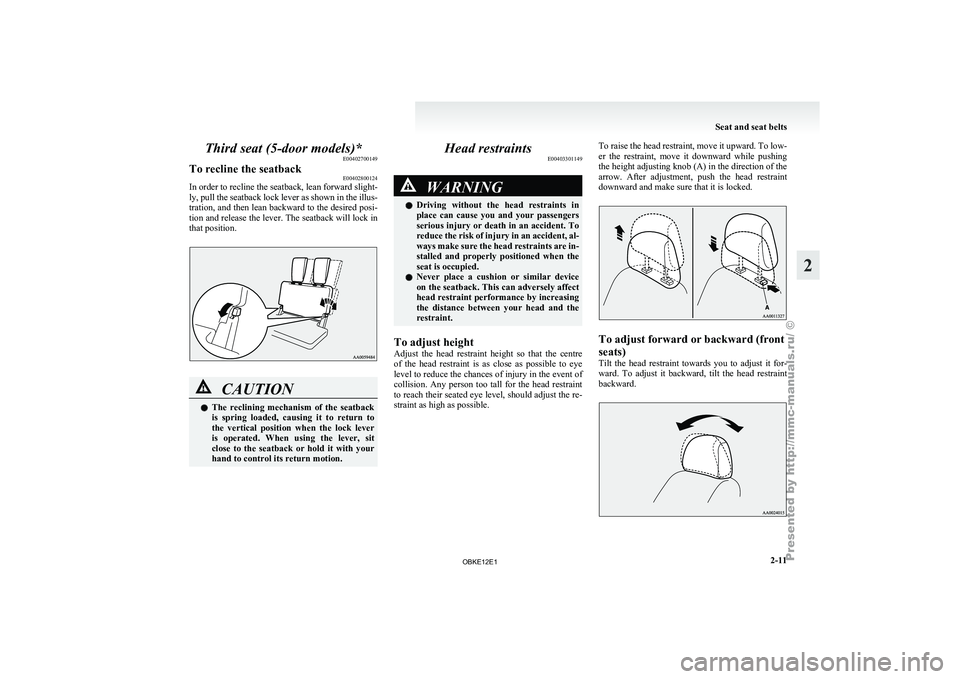
Third seat (5-door models)*
E00402700149
To recline the seatback E00402800124
In order to recline the seatback, lean forward slight-
ly, pull the
seatback lock lever as shown in the illus-
tration, and then lean backward to the desired posi-
tion and release the lever. The seatback will lock in
that position. CAUTION
l
The reclining
mechanism
of the seatback
is spring loaded, causing it to return to
the vertical position when the lock lever
is operated. When using the lever, sit
close to the seatback or hold it with your
hand to control its return motion. Head restraints
E00403301149 WARNING
l Driving without
the
head restraints in
place can cause you and your passengers
serious injury or death in an accident. To
reduce the risk of injury in an accident, al-
ways make sure the head restraints are in-
stalled and properly positioned when the
seat is occupied.
l Never place a cushion or similar device
on the seatback. This can adversely affect
head restraint performance by increasing
the distance between your head and the
restraint.
To adjust height
Adjust the head
restraint height so that the centre
of the head restraint is as close as possible to eye
level to reduce the chances of injury in the event of
collision. Any person too tall for the head restraint
to reach their seated eye level, should adjust the re-
straint as high as possible. To raise the head restraint, move it upward. To low-
er the
restraint,
move it downward while pushing
the height adjusting knob (A) in the direction of the
arrow. After adjustment, push the head restraint
downward and make sure that it is locked. To adjust forward or backward (front
seats)
Tilt
the
head
restraint towards you to adjust it for-
ward. To adjust it backward, tilt the head restraint
backward. Seat and seat belts
2-11 2
OBKE12E1
Page 50 of 377
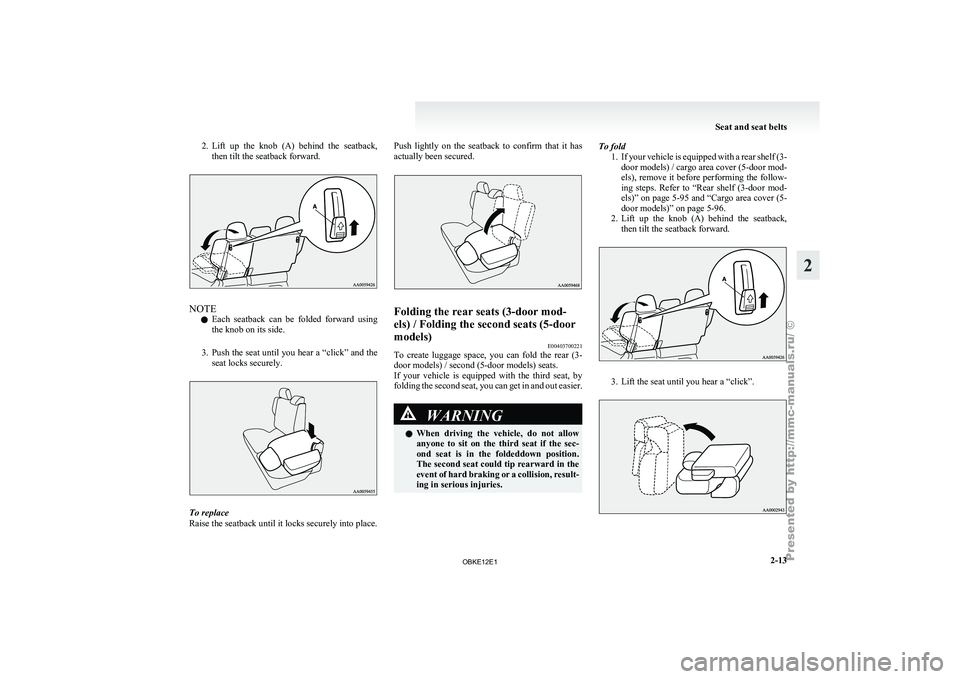
2. Lift up the knob (A) behind the seatback,
then tilt the seatback forward. NOTE
l Each
seatback can
be folded forward using
the knob on its side.
3. Push the seat until you hear a “click” and the seat locks securely. To replace
Raise the seatback until it locks securely into place. Push lightly on the seatback to confirm that it has
actually been secured.
Folding the rear seats (3-door mod-
els) / Folding the second seats (5-door
models)
E00403700221
To create luggage space, you can fold the rear (3-
door models) / second (5-door models) seats.
If your vehicle
is equipped with the third seat, by
folding the second seat, you can get in and out easier. WARNING
l When driving
the
vehicle, do not allow
anyone to sit on the third seat if the sec-
ond seat is in the foldeddown position.
The second seat could tip rearward in the
event of hard braking or a collision, result-
ing in serious injuries. To fold
1. If your vehicle
is equipped with a rear shelf (3-
door models) / cargo area cover (5-door mod-
els), remove it before performing the follow-
ing steps. Refer to “Rear shelf (3-door mod-
els)” on page 5-95 and “Cargo area cover (5-
door models)” on page 5-96.
2. Lift up the knob (A) behind the seatback, then tilt the seatback forward. 3. Lift the seat until you hear a “click”. Seat and seat belts
2-13 2
OBKE12E1
Page 55 of 377
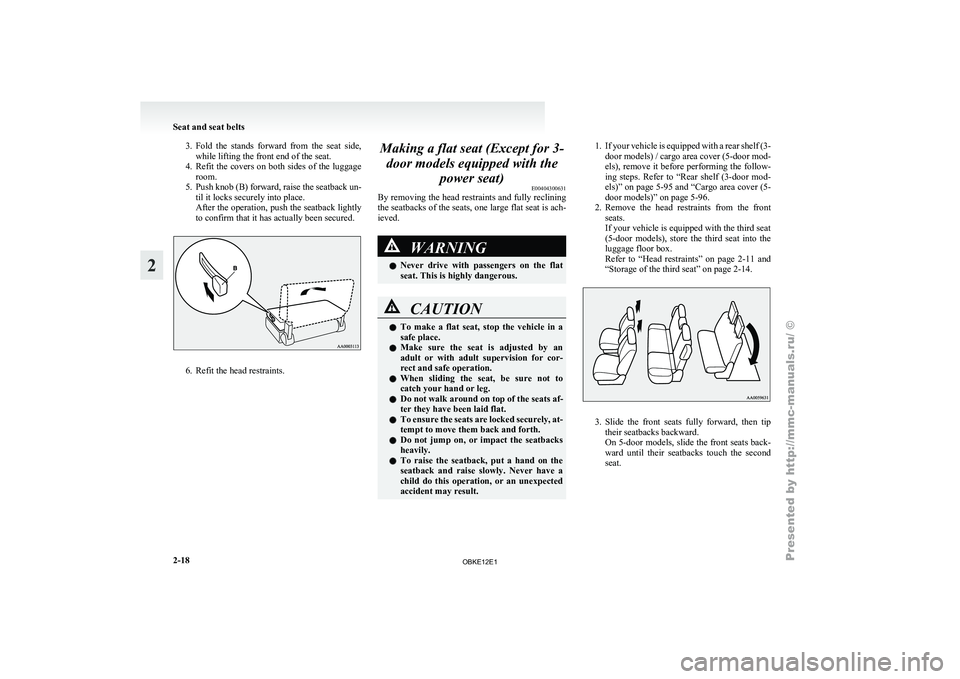
3. Fold the stands forward from the seat side,
while lifting the front end of the seat.
4. Refit
the covers on both sides of the luggage
room.
5. Push knob (B) forward, raise the seatback un- til it locks securely into place.
After the operation, push the seatback lightly
to confirm that it has actually been secured. 6. Refit the head restraints. Making a flat seat (Except for 3-
door models equipped with the power seat) E00404300631
By removing the
head restraints and fully reclining
the seatbacks of the seats, one large flat seat is ach-
ieved. WARNING
l Never drive
with
passengers on the flat
seat. This is highly dangerous. CAUTION
l
To make a
flat seat, stop the vehicle in a
safe place.
l Make sure the seat is adjusted by an
adult or with adult supervision for cor-
rect and safe operation.
l When sliding the seat, be sure not to
catch your hand or leg.
l Do not walk around on top of the seats af-
ter they have been laid flat.
l To ensure the seats are locked securely, at-
tempt to move them back and forth.
l Do not jump on, or impact the seatbacks
heavily.
l To raise the seatback, put a hand on the
seatback and raise slowly. Never have a
child do this operation, or an unexpected
accident may result. 1. If your vehicle is equipped with a rear shelf (3-
door models)
/ cargo area cover (5-door mod-
els), remove it before performing the follow-
ing steps. Refer to “Rear shelf (3-door mod-
els)” on page 5-95 and “Cargo area cover (5-
door models)” on page 5-96.
2. Remove the head restraints from the front seats.
If your vehicle is equipped with the third seat
(5-door models), store the third seat into the
luggage floor box.
Refer to “Head restraints” on page 2-11 and
“Storage of the third seat” on page 2-14. 3. Slide the front seats fully forward, then tip
their seatbacks backward.
On 5-door
models, slide the front seats back-
ward until their seatbacks touch the second
seat. Seat and seat belts
2-18
2
OBKE12E1
Page 57 of 377
Seat belts
E00404800072
To protect you
and your passengers in the event of
an accident, it is most important that the seat belts
are worn correctly while driving.
The front seat belts have a pretensioner system.
These belts are used the same way as a convention-
al seat belt.
Refer to “Seat belt pretensioner system and force
limiter system” on page 2-23. WARNING
l Always place
the
shoulder belt over your
shoulder and across your chest. Never
put it behind you or under your arm.
l One seat belt should be used by only one
person. Doing otherwise can be dangerous.
l The seat belt will provide its wearer with
maximum protection if the recliner seat-
back is placed in fully upright position.
When the seatback is reclined, there is
greater risk that the passenger will slide
under the belt, especially in a forward im-
pact accident, and may be injured by the
belt or by striking the instrument panel
or seatbacks.
l Seat belts should always be worn by ev-
ery adult who drives or rides in this vehi-
cle, and by all children who are tall
enough to wear seat belts properly.
Other children should always use proper
child restraint systems.
l Remove any twists when using the belt. WARNING
l No modifications or
additions should be
made by the user which will either pre-
vent the seat belt adjusting devices from
operating to remove slack, or prevent the
seat belt assembly from being adjusted to
remove slack.
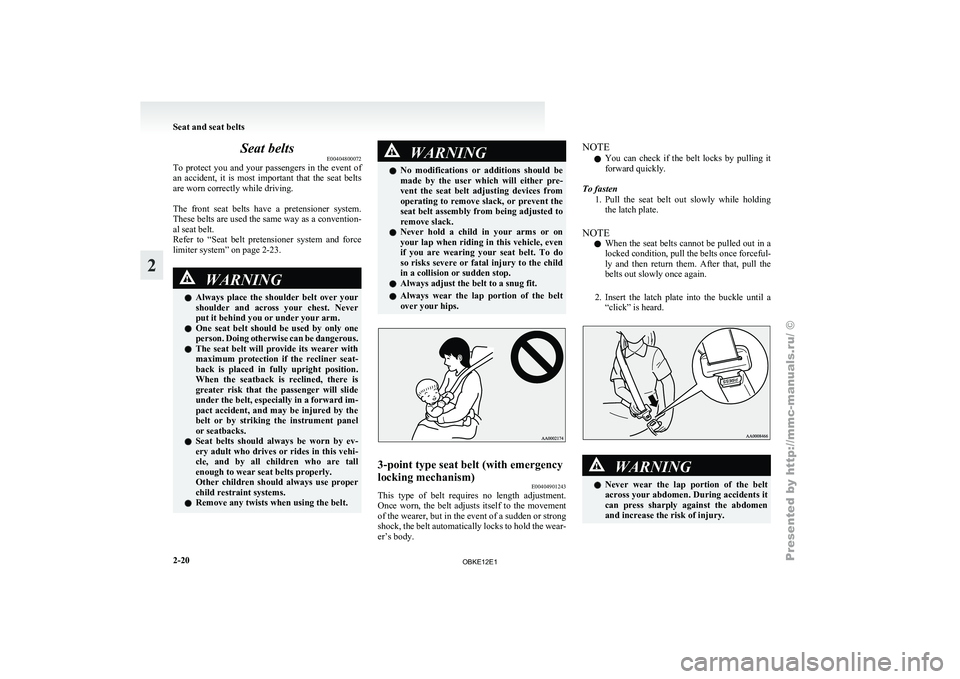
l Never hold a child in your arms or on
your lap when riding in this vehicle, even
if you are wearing your seat belt. To do
so risks severe or fatal injury to the child
in a collision or sudden stop.
l Always adjust the belt to a snug fit.
l Always wear the lap portion of the belt
over your hips. 3-point type seat belt (with emergency
locking mechanism)
E00404901243
This type of belt requires no length adjustment.
Once worn, the
belt adjusts itself to the movement
of the wearer, but in the event of a sudden or strong
shock, the belt automatically locks to hold the wear-
er’s body. NOTE
l You
can check
if the belt locks by pulling it
forward quickly.
To fasten 1. Pull the seat belt out slowly while holdingthe latch plate.
NOTE l When the seat belts cannot be pulled out in a
locked condition, pull the belts once forceful-
ly and then return them. After that, pull the
belts out slowly once again.
2. Insert the latch plate into the buckle until a “click” is heard. WARNING
l Never wear
the
lap portion of the belt
across your abdomen. During accidents it
can press sharply against the abdomen
and increase the risk of injury. Seat and seat belts
2-20
2
OBKE12E1
Page 58 of 377
WARNING
l The seat belts must not be twisted when
worn.
3. Pull the belt slightly to adjust slackness as de-
sired.
To unfasten
Hold the
latch plate and push the button on the buck-
le. NOTE
l As
the belt
retracts automatically, keep hold-
ing the latch plate while retracting so that the
belt stows slowly. Failure to do this could
damage the vehicle. Seat belt reminder/warning lamp
E00409800338
The seat belt
warning lamp is located on the instru-
ment panel. A tone and warning lamp are used to
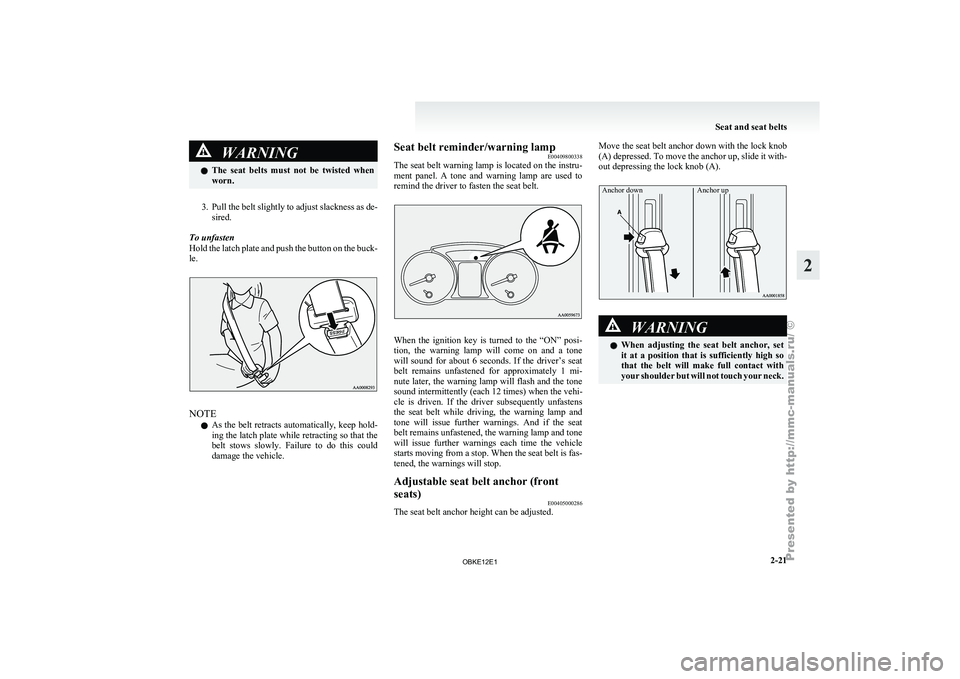
remind the driver to fasten the seat belt. When the ignition key is turned to the “ON” posi-
tion, the warning
lamp will come on and a tone
will sound for about 6 seconds. If the driver’s seat
belt remains unfastened for approximately 1 mi-
nute later, the warning lamp will flash and the tone
sound intermittently (each 12 times) when the vehi-
cle is driven. If the driver subsequently unfastens
the seat belt while driving, the warning lamp and
tone will issue further warnings. And if the seat
belt remains unfastened, the warning lamp and tone
will issue further warnings each time the vehicle
starts moving from a stop. When the seat belt is fas-
tened, the warnings will stop.
Adjustable seat belt anchor (front
seats) E00405000286
The seat belt anchor height can be adjusted. Move the seat belt anchor down with the lock knob
(A) depressed. To
move the anchor up, slide it with-
out depressing the lock knob (A).
Anchor down Anchor up WARNING
l When adjusting
the
seat belt anchor, set
it at a position that is sufficiently high so
that the belt will make full contact with
your shoulder but will not touch your neck. Seat and seat belts
2-21 2
OBKE12E1