warning MITSUBISHI PAJERO IV 2011 Owners Manual
[x] Cancel search | Manufacturer: MITSUBISHI, Model Year: 2011, Model line: PAJERO IV, Model: MITSUBISHI PAJERO IV 2011Pages: 377, PDF Size: 29.43 MB
Page 3 of 377
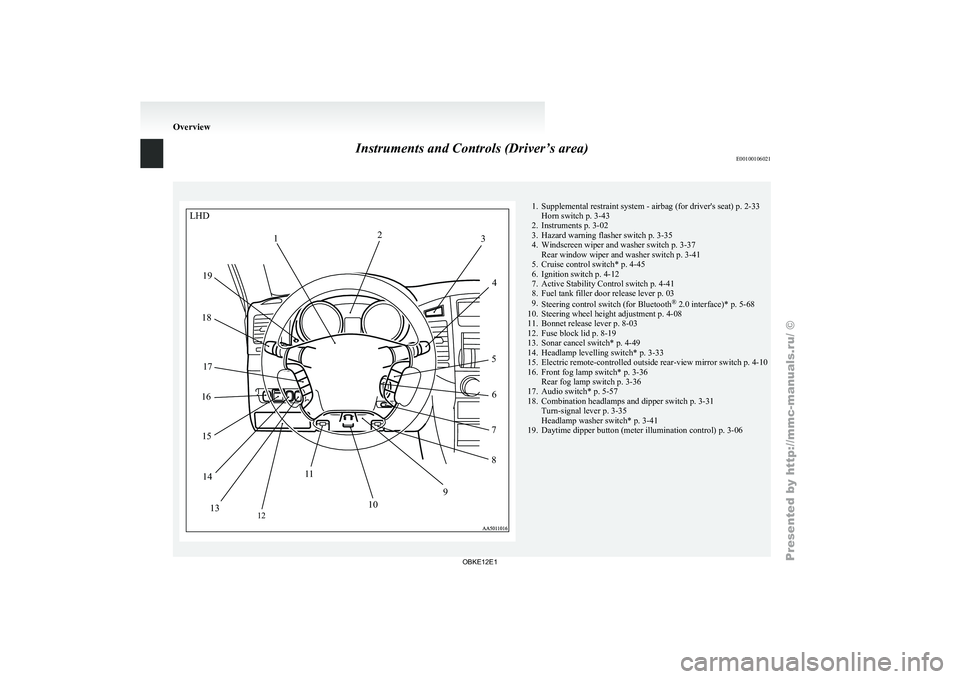
Instruments and Controls (Driver’s area)
E00100106021 1. Supplemental restraint system - airbag (for driver's seat) p. 2-33
Horn switch p. 3-43
2. Instruments p. 3-02
3. Hazard warning flasher switch p. 3-35
4.
Windscreen wiper and washer switch p. 3-37Rear window wiper and washer switch p. 3-41
5. Cruise control switch* p. 4-45
6. Ignition switch p. 4-12
7. Active Stability Control switch p. 4-41
8. Fuel tank filler door release lever p. 03
9. Steering control switch (for Bluetooth ®
2.0 interface)* p. 5-68
10. Steering wheel height adjustment p. 4-08
11. Bonnet release lever p. 8-03
12. Fuse block lid p. 8-19
13. Sonar cancel switch* p. 4-49
14. Headlamp levelling switch* p. 3-33
15. Electric remote-controlled outside rear-view mirror switch p. 4-10
16. Front fog lamp switch* p. 3-36 Rear fog lamp switch p. 3-36
17. Audio switch* p. 5-57
18. Combination headlamps and dipper switch p. 3-31 Turn-signal lever p. 3-35
Headlamp washer switch* p. 3-41
19. Daytime dipper button (meter illumination control) p. 3-06 OverviewLHD
2
1 3
4
5 6
7
8
9
10
1
1
12
13
14
15
16
17
18
19
OBKE12E1
Page 4 of 377
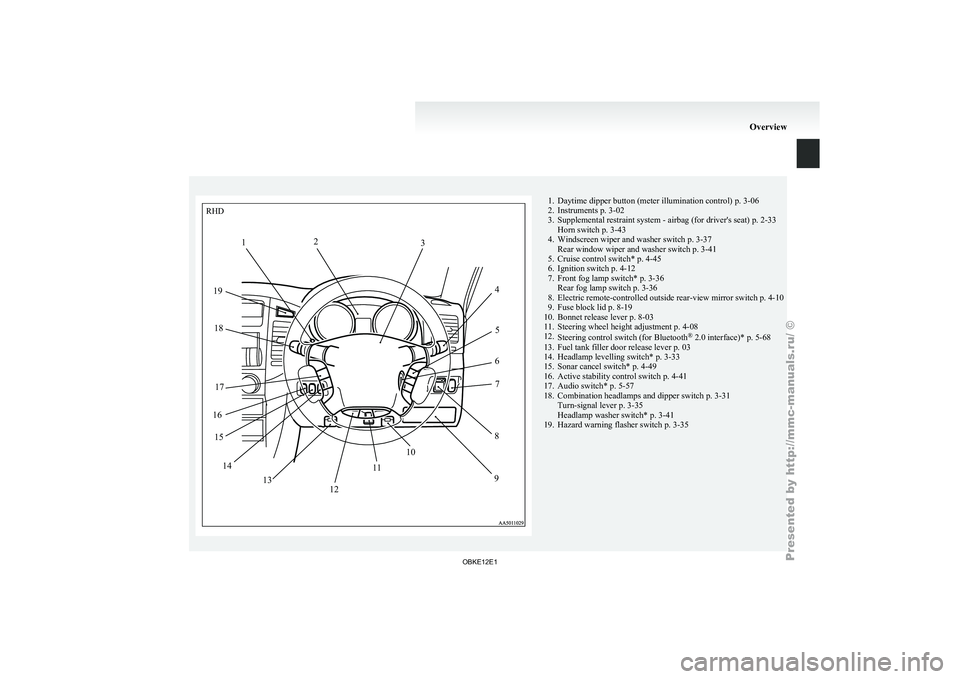
1. Daytime dipper button (meter illumination control) p. 3-06
2. Instruments p. 3-02
3. Supplemental restraint system - airbag (for driver's seat)
p. 2-33
Horn switch p. 3-43
4. Windscreen wiper and washer switch p. 3-37 Rear window wiper and washer switch p. 3-41
5. Cruise control switch* p. 4-45
6. Ignition switch p. 4-12
7. Front fog lamp switch* p. 3-36 Rear fog lamp switch p. 3-36
8. Electric remote-controlled outside rear-view mirror switch p. 4-10
9. Fuse block lid p. 8-19
10. Bonnet release lever p. 8-03
11. Steering wheel height adjustment p. 4-08
12. Steering control switch (for Bluetooth ®
2.0 interface)* p. 5-68
13. Fuel tank filler door release lever p. 03
14. Headlamp levelling switch* p. 3-33
15. Sonar cancel switch* p. 4-49
16. Active stability control switch p. 4-41
17. Audio switch* p. 5-57
18. Combination headlamps and dipper switch p. 3-31 Turn-signal lever p. 3-35
Headlamp washer switch* p. 3-41
19. Hazard warning flasher switch p. 3-35 OverviewRHD
1 2
3
45
6 7
8
9
12 10
1
1
13
14
15
16 17
18
19
OBKE12E1
Page 9 of 377
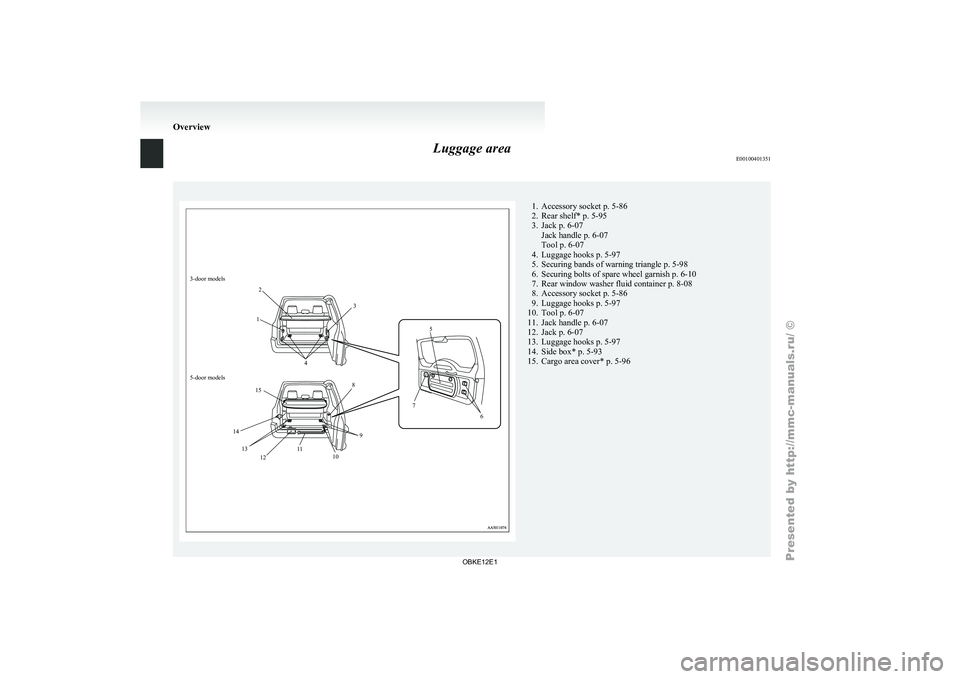
Luggage area
E001004013513-door models
12
3
4 5
6
7
8
9
10
12 11
13
14 15
5-door models 1. Accessory socket p. 5-86
2. Rear shelf* p. 5-95
3.
Jack p. 6-07
Jack handle p. 6-07
Tool p. 6-07
4.
Luggage hooks p. 5-97
5. Securing bands of warning triangle p. 5-98
6. Securing bolts of spare wheel garnish p. 6-10
7. Rear window washer fluid container p. 8-08
8. Accessory socket p. 5-86
9. Luggage hooks p. 5-97
10. Tool p. 6-07
11. Jack handle p. 6-07
12. Jack p. 6-07
13. Luggage hooks p. 5-97
14. Side box* p. 5-93
15. Cargo area cover* p. 5-96 Overview
OBKE12E1
Page 13 of 377
Fuel selection
E00200102587Recom-
mended
fuel
Petrol-powered vehicles
Unleaded petrol octane
num-
ber (EN228) 90 RON or higher (3000
models)
95 RON or higher (3800
models)
Diesel-powered vehicles
Vehicles to comply with the Euro 4
and Euro 5 regulation Cetane number (EN590)51 or higher
Vehicles to comply with the Euro 3
regulation Cetane number45 or higher CAUTION
l
For petrol-powered vehicles,
the use of lea-
ded fuel can result in serious damage to
the engine and catalytic converter. Do not
use leaded fuel.
l Diesel-powered vehicles to comply with
the Euro 4 and Euro 5 regulation are de-
signed to use only diesel fuel that meets
the EN 590 standard.
Use of any other type of diesel fuel would
adversely affect the engine’s performance
and durability. CAUTION
l
For diesel-powered vehicles,
if proper
“winter” fuel is not used in winter, the die-
sel preheat indication lamp may blink
and the engine speed may not rise above
the idling speed because of fuel freezing.
In this case, keep the engine idling for
about ten minutes, then turn off the igni-
tion switch and immediately turn it on
again to confirm that the diesel preheat in-
dication lamp is off. (Refer to “Diesel pre-
heat indication lamp” on page 3-08)
NOTE l It is advisable to sufficiently warm up the en-
gine
after starting
it when the outside temper-
ature is below zero °C.
l Due to the separation of paraffin, the fluidity
of the fuel decreases considerably as the tem-
perature falls. Because of this fact there are
two kinds of fuel: “summer” and “winter”.
This must be considered in winter use.
Select either of the two kinds of fuel in ac-
cordance with ambient temperature.
Above -5 °C: “Summer” diesel
Below -5 °C: “Winter” diesel
When travelling abroad, find out in advance
about the fuels served in local service stations.
l Petrol-powered vehicles have the knock con-
trol system so that you can use unleaded pet-
rol 91 RON as an emergent measure in case
unleaded petrol 95 RON or higher is not avail-
able on journey, etc. In such a case, you
don’t need to adjust the engine specially.
In case of using unleaded petrol 91 RON, the
engine performance level is reduced. l
In petrol-powered
vehicles,
repeatedly driv-
ing short distances at low speeds can cause
deposits to form in the fuel system and en-
gine, resulting in poor starting and poor accel-
eration.
If these problems occur, you are advised to
add a detergent additive to the gasoline when
you refuel the vehicle. The additive will re-
move the deposits, thereby returning the en-
gine to a normal condition. Be sure to use a
genuine MITSUBISHI FUEL SYSTEM
CLEANER. Using an unsuitable additive
could make the engine malfunction.
For details, please contact a MITSUBISHI
MOTORS Authorized Service Point.
l Poor quality petrol can cause problems such
as difficult starting, stalling, engine noise
and hesitation. If you experience these prob-
lems, try another brand and/or grade of petrol.
If the check engine warning lamp flashes,
have the system checked as soon as possible
at a MITSUBISHI MOTORS Authorized
Service Point.
l In diesel-powered vehicles, poor-quality die-
sel fuel can cause deposits form in the injec-
tor, resulting in black smoke and rough idling.
If these problems occur, you are advised to
add a cleaning additive to the diesel fuel
when you refuel the vehicle. The additive
will break up and remove the deposits, there-
by returning the engine to a normal condition.
Be sure to use a genuine MITSUBISHI DIE-
SEL FUEL SYSTEM CLEANER. Using an
unsuitable additive could make the engine
malfunction. For details, please contact a
MITSUBISHI MOTORS Authorized Service
Point. General information
02
OBKE12E1
Page 14 of 377
E10 type petrol
E00203200019
The petrol engines
are compatible with E10 type
petrol (containing 10 % ethanol) conforming to Eu-
ropean standards EN 228. CAUTION
l
Do not use more than 10 %
concentration
of ethanol (grain alcohol) by volume.
Use
of more than 10 % concentration
may lead to damage to your vehicle fuel
system, engine, engine sensors and ex-
haust system. Filling the fuel tank
E00200201767 WARNING
l When handling
fuel,
comply with the safe-
ty regulations displayed by garages and
filling stations.
l Before removing the fuel tank filler tube
cap, be sure to get rid of your body’s stat-
ic electricity by touching a metal part of
the car or fuel pump. Any static electrici-
ty on your body could create a spark that
ignites fuel vapour.
l Perform the whole refueling process
(opening the fuel tank filler door, remov-
ing the fuel tank filler tube cap, etc.) by
yourself. Do not let any other person
come near the fuel tank filler. If you al-
lowed a person to help you and that per-
son was carrying static electricity, fuel va-
pour could be ignited.
l Do not move away from the fuel tank fill-
er door until refueling is finished. If you
moved away and did something else (for
example, cleaning your windscreen) part-
way through the refueling process, you
could pick up a fresh charge of static elec-
tricity.
l If the fuel tank filler tube cap must be re-
placed, use only a MITSUBISHI
MOTORS original part.
Fuel tank capacity
3-door models: 69 litres
5-door models: 88 litres Refueling
1.Before filling with fuel, stop the engine.
2. The
fuel tank filler is located on the rear
right side of your vehicle.
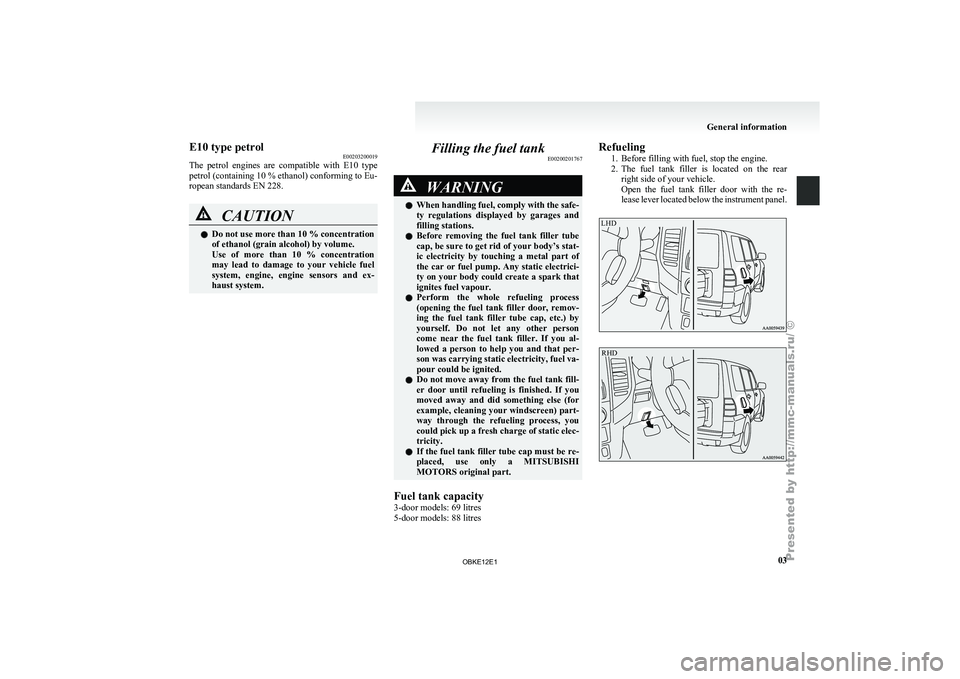
Open the fuel tank filler door with the re-
lease lever located below the instrument panel.
LHD General information
03 RHD
OBKE12E1
Page 15 of 377
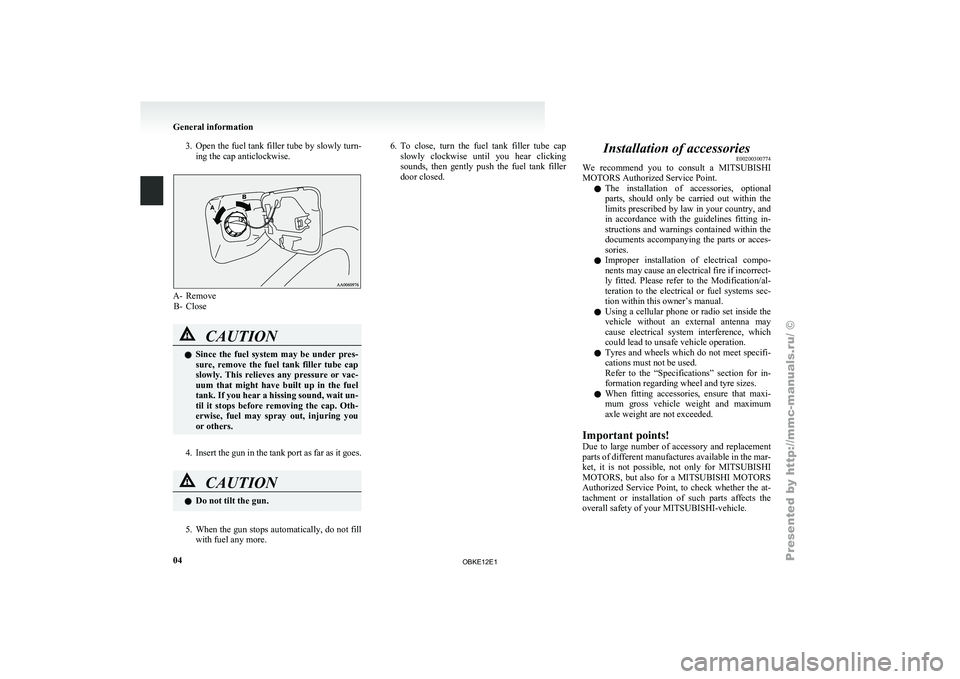
3. Open the fuel tank filler tube by slowly turn-
ing the cap anticlockwise. A- Remove
B- Close CAUTION
l
Since the
fuel system may be under pres-
sure, remove the fuel tank filler tube cap
slowly. This relieves any pressure or vac-
uum that might have built up in the fuel
tank. If you hear a hissing sound, wait un-
til it stops before removing the cap. Oth-
erwise, fuel may spray out, injuring you
or others.
4. Insert the gun in the tank port as far as it goes. CAUTION
l
Do not tilt the gun.
5. When the gun stops automatically, do not fill with fuel any more. 6.
To close,
turn the fuel tank filler tube cap
slowly clockwise
until you hear clicking
sounds, then gently push the fuel tank filler
door closed. Installation of accessories
E00200300774
We recommend you
to consult a MITSUBISHI
MOTORS Authorized Service Point.
l The installation of accessories, optional
parts, should only be carried out within the
limits prescribed by law in your country, and
in accordance with the guidelines fitting in-
structions and warnings contained within the
documents accompanying the parts or acces-
sories.
l Improper installation of electrical compo-
nents may cause an electrical fire if incorrect-
ly fitted. Please refer to the Modification/al-
teration to the electrical or fuel systems sec-
tion within this owner’s manual.
l Using a cellular phone or radio set inside the
vehicle without an external antenna may
cause electrical system interference, which
could lead to unsafe vehicle operation.
l Tyres and wheels which do not meet specifi-
cations must not be used.
Refer to the “Specifications” section for in-
formation regarding wheel and tyre sizes.
l When fitting accessories, ensure that maxi-
mum gross vehicle weight and maximum
axle weight are not exceeded.
Important points!
Due to large number of accessory and replacement
parts of different manufactures available in the mar-
ket, it is not possible, not only for MITSUBISHI
MOTORS, but also for a MITSUBISHI MOTORS
Authorized Service Point, to check whether the at-
tachment or installation of such parts affects the
overall safety of your MITSUBISHI-vehicle.
General information
04
OBKE12E1
Page 17 of 377
Used engine oils safety
instructions and disposal information E00200600025WARNING
l Prolonged and
repeated contact may
cause serious skin disorders, including
dermatitis and cancer.
l Avoid contact with the skin as far as pos-
sible and wash thoroughly after any con-
tact.
l Keep used engine oils out of reach of chil-
dren.
Protect the environment
It is illegal
to pollute drains, water courses and soil.
Use authorized waste collection facilities, includ-
ing civic amenity sites and garages providing facili-
ties for disposal of used oil and used oil filters. If in
doubt, contact your local authority for advice on dis-
posal. Disposal information for used
batteries E00201300016 Your vehicle contains batteries
and/or accumulators.
Do not
mix
with general house-
hold waste.
For proper treatment, recovery
and recycling of used batteries,
please take them to applicable col-
lection points, in accordance
with your national legislation
and the Directives 2006/66/EC.
By disposing of these batteries
correctly, you will help to save
valuable resources and prevent
any potential negative effects on
human health and the environ-
ment which could otherwise
arise from inappropriate waste
handling. General information
06
OBKE12E1
Page 19 of 377
Keys
E00300102038
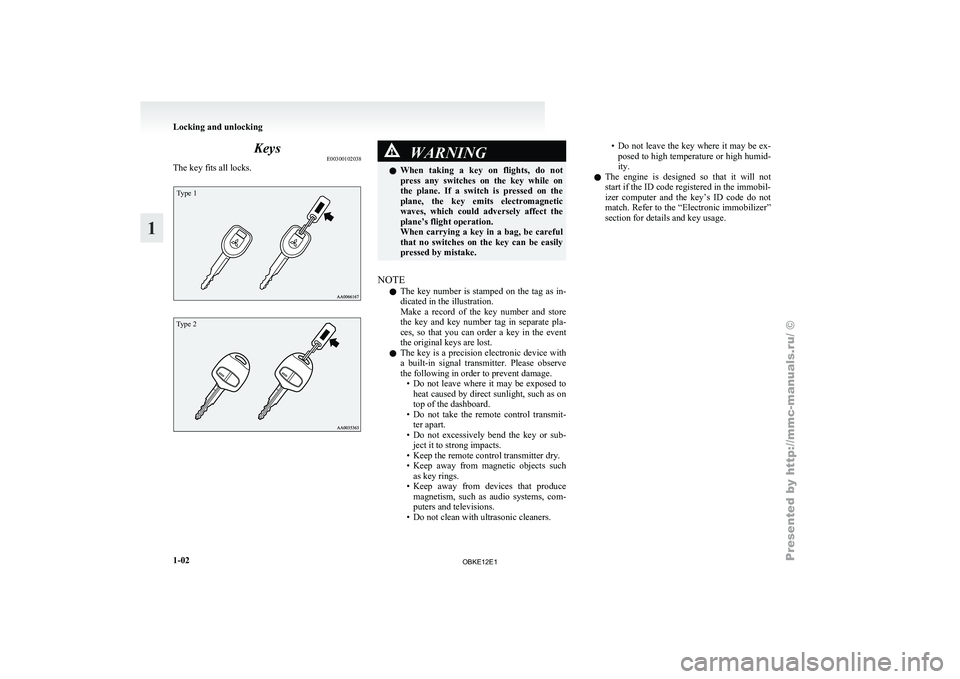
The key fits all locks.Type 1
Type 2 WARNING
l When taking a
key on flights, do not
press any switches on the key while on
the plane. If a switch is pressed on the
plane, the key emits electromagnetic
waves, which could adversely affect the
plane’s flight operation.
When carrying a key in a bag, be careful
that no switches on the key can be easily
pressed by mistake.
NOTE l The
key number
is stamped on the tag as in-
dicated in the illustration.
Make a record of the key number and store
the key and key number tag in separate pla-
ces, so that you can order a key in the event
the original keys are lost.
l The key is a precision electronic device with
a built-in signal transmitter. Please observe
the following in order to prevent damage.
• Do not leave where it may be exposed toheat caused by direct sunlight, such as on
top of the dashboard.
• Do not take the remote control transmit- ter apart.
• Do not excessively bend the key or sub- ject it to strong impacts.
• Keep the remote control transmitter dry.
• Keep away from magnetic objects such as key rings.
• Keep away from devices that produce magnetism, such as audio systems, com-
puters and televisions.
• Do not clean with ultrasonic cleaners. • Do
not leave the key where it may be ex-
posed to
high temperature or high humid-
ity.
l The engine is designed so that it will not
start if the ID code registered in the immobil-
izer computer and the key’s ID code do not
match. Refer to the “Electronic immobilizer”
section for details and key usage. Locking and unlocking
1-02
1
OBKE12E1
Page 26 of 377
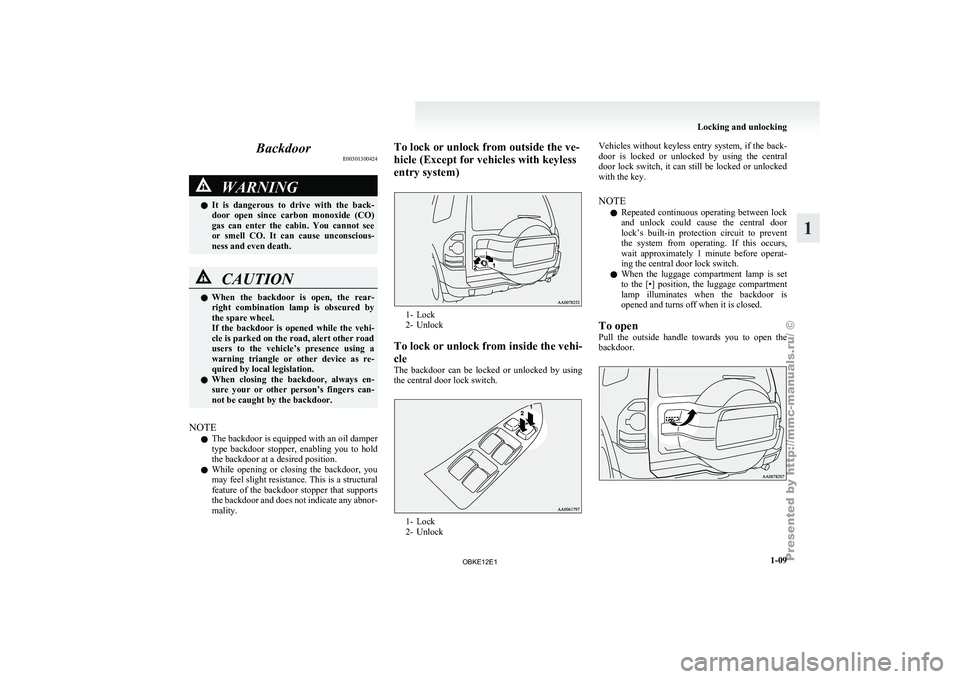
Backdoor
E00301300424WARNING
l It is
dangerous to drive with the back-
door open since carbon monoxide (CO)
gas can enter the cabin. You cannot see
or smell CO. It can cause unconscious-
ness and even death. CAUTION
l
When the
backdoor
is open, the rear-
right combination lamp is obscured by
the spare wheel.
If the backdoor is opened while the vehi-
cle is parked on the road, alert other road
users to the vehicle’s presence using a
warning triangle or other device as re-
quired by local legislation.
l When closing the backdoor, always en-
sure your or other person’s fingers can-
not be caught by the backdoor.
NOTE l The
backdoor is
equipped with an oil damper
type backdoor stopper, enabling you to hold
the backdoor at a desired position.
l While opening or closing the backdoor, you
may feel slight resistance. This is a structural
feature of the backdoor stopper that supports
the backdoor and does not indicate any abnor-
mality. To lock or unlock from outside the ve-
hicle (Except for vehicles with keyless
entry system)
1- Lock
2- Unlock
To lock
or unlock from inside the vehi-
cle
The backdoor can be locked or unlocked by using
the central door lock switch. 1- Lock
2- UnlockVehicles
without
keyless entry system, if the back-
door is locked
or unlocked by using the central
door lock switch, it can still be locked or unlocked
with the key.
NOTE
l Repeated continuous operating between lock
and unlock could cause the central door
lock’s built-in protection circuit to prevent
the system from operating. If this occurs,
wait approximately 1 minute before operat-
ing the central door lock switch.
l When the luggage compartment lamp is set
to the [•] position, the luggage compartment
lamp illuminates when the backdoor is
opened and turns off when it is closed.
To open
Pull the outside handle towards you to open the
backdoor. Locking and unlocking
1-09 1
OBKE12E1
Page 32 of 377
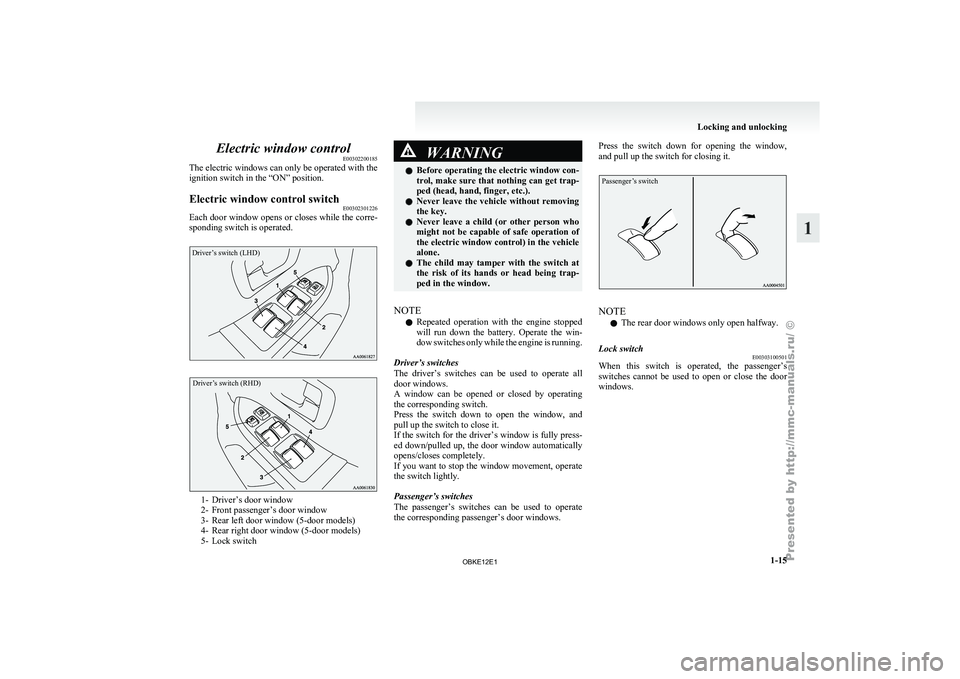
Electric window control
E00302200185
The electric windows can only be operated with the
ignition switch in the “ON” position.
Electric window control switch E00302301226
Each door window opens or closes while the corre-
sponding switch is operated.Driver’s switch (LHD)
Driver’s switch (RHD) 1- Driver’s door window
2- Front passenger’s door window
3-
Rear left door window (5-door models)
4-
Rear right door window (5-door models)
5- Lock switch WARNING
l Before operating the
electric window con-
trol, make sure that nothing can get trap-
ped (head, hand, finger, etc.).
l Never leave the vehicle without removing
the key.
l Never leave a child (or other person who
might not be capable of safe operation of
the electric window control) in the vehicle
alone.
l The child may tamper with the switch at
the risk of its hands or head being trap-
ped in the window.
NOTE l Repeated
operation with
the engine stopped
will run down the battery. Operate the win-
dow switches only while the engine is running.
Driver’s switches
The driver’s switches can be used to operate all
door windows.
A window can be opened or closed by operating
the corresponding switch.
Press the switch down to open the window, and
pull up the switch to close it.
If the switch for the driver’s window is fully press-
ed down/pulled up, the door window automatically
opens/closes completely.
If you want to stop the window movement, operate
the switch lightly.
Passenger’s switches
The passenger’s switches can be used to operate
the corresponding passenger’s door windows. Press the switch down for opening the window,
and pull up the switch for closing it.
Passenger’s switch
NOTE
l The rear door windows only open halfway.
Lock switch E00303100501
When this switch is operated, the passenger’s
switches cannot be
used to open or close the door
windows. Locking and unlocking
1-15 1
OBKE12E1