wheel MITSUBISHI PAJERO IV 2011 User Guide
[x] Cancel search | Manufacturer: MITSUBISHI, Model Year: 2011, Model line: PAJERO IV, Model: MITSUBISHI PAJERO IV 2011Pages: 377, PDF Size: 29.43 MB
Page 76 of 377
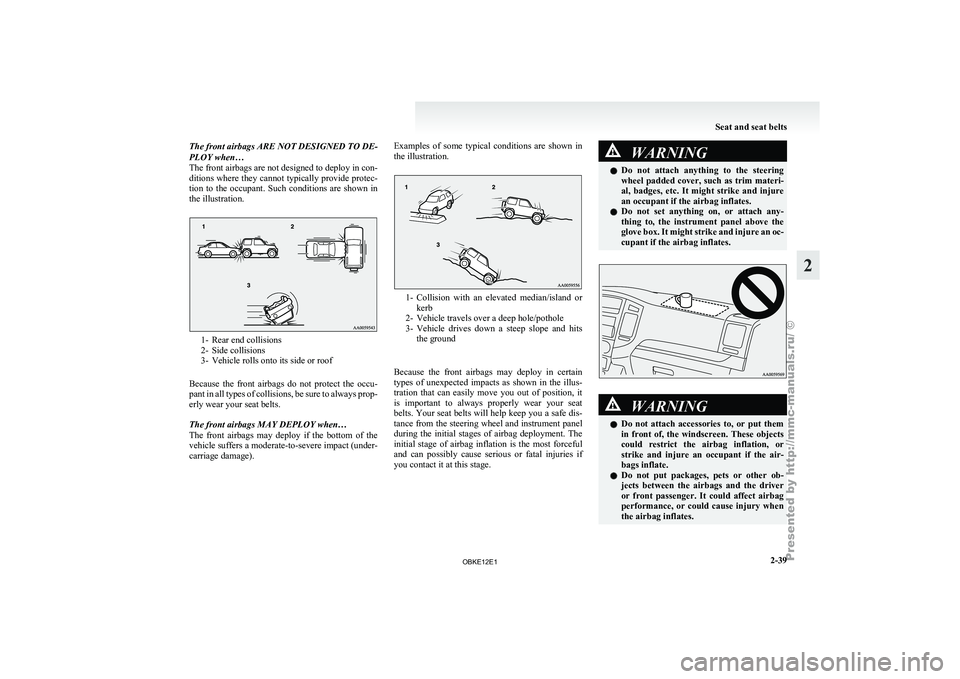
The front airbags ARE NOT DESIGNED TO DE-
PLOY when…
The front airbags
are not designed to deploy in con-
ditions where they cannot typically provide protec-
tion to the occupant. Such conditions are shown in
the illustration. 1- Rear end collisions
2- Side collisions
3-
Vehicle rolls onto its side or roof
Because
the front airbags do not protect the occu-
pant in all types of collisions, be sure to always prop-
erly wear your seat belts.
The front airbags MAY DEPLOY when…
The front airbags may deploy if the bottom of the
vehicle suffers a moderate-to-severe impact (under-
carriage damage). Examples of some typical conditions are shown in
the illustration.
1- Collision with
an
elevated median/island or
kerb
2- Vehicle travels over a deep hole/pothole
3- Vehicle drives down a steep slope and hits the ground
Because the front airbags may deploy in certain
types of unexpected impacts as shown in the illus-
tration that can easily move you out of position, it
is important to always properly wear your seat
belts. Your seat belts will help keep you a safe dis-
tance from the steering wheel and instrument panel
during the initial stages of airbag deployment. The
initial stage of airbag inflation is the most forceful
and can possibly cause serious or fatal injuries if
you contact it at this stage. WARNING
l Do not attach
anything to the steering
wheel padded cover, such as trim materi-
al, badges, etc. It might strike and injure
an occupant if the airbag inflates.
l Do not set anything on, or attach any-
thing to, the instrument panel above the
glove box. It might strike and injure an oc-
cupant if the airbag inflates. WARNING
l Do not
attach
accessories to, or put them
in front of, the windscreen. These objects
could restrict the airbag inflation, or
strike and injure an occupant if the air-
bags inflate.
l Do not put packages, pets or other ob-
jects between the airbags and the driver
or front passenger. It could affect airbag
performance, or could cause injury when
the airbag inflates. Seat and seat belts
2-39 2
OBKE12E1
Page 80 of 377
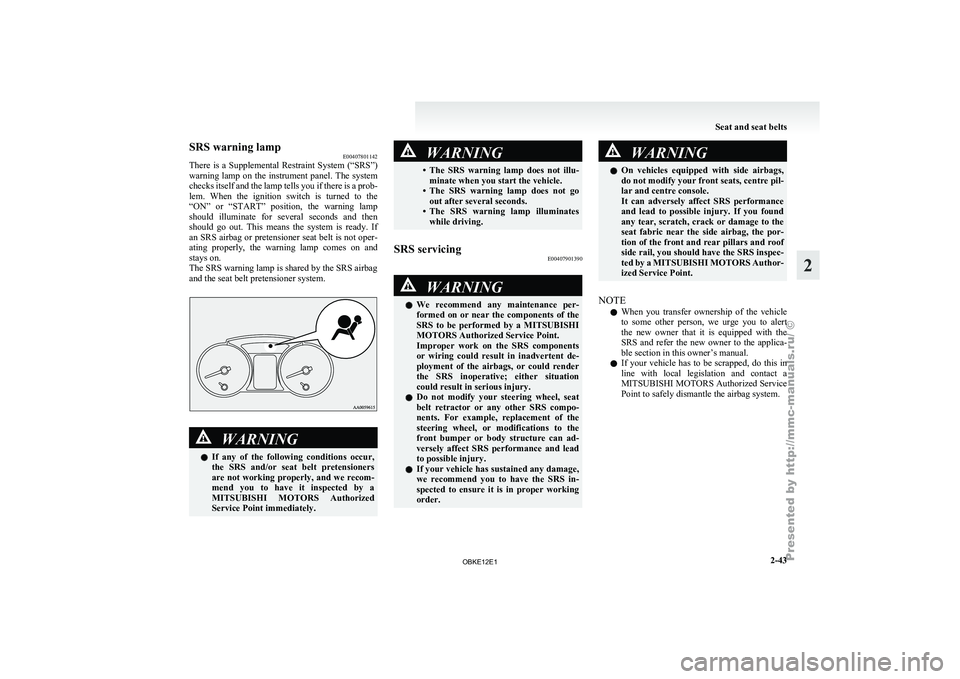
SRS warning lamp
E00407801142
There is a
Supplemental Restraint System (“SRS”)
warning lamp on the instrument panel. The system
checks itself and the lamp tells you if there is a prob-
lem. When the ignition switch is turned to the
“ON” or “START” position, the warning lamp
should illuminate for several seconds and then
should go out. This means the system is ready. If
an SRS airbag or pretensioner seat belt is not oper-
ating properly, the warning lamp comes on and
stays on.
The SRS warning lamp is shared by the SRS airbag
and the seat belt pretensioner system. WARNING
l If any of
the following conditions occur,
the SRS and/or seat belt pretensioners
are not working properly, and we recom-
mend you to have it inspected by a
MITSUBISHI MOTORS Authorized
Service Point immediately. WARNING
• The SRS warning lamp does not illu- minate when you start the vehicle.
• The
SRS warning lamp does not go
out after several seconds.
• The SRS warning lamp illuminates while driving.
SRS servicing E00407901390 WARNING
l We recommend
any
maintenance per-
formed on or near the components of the
SRS to be performed by a MITSUBISHI
MOTORS Authorized Service Point.
Improper work on the SRS components
or wiring could result in inadvertent de-
ployment of the airbags, or could render
the SRS inoperative; either situation
could result in serious injury.
l Do not modify your steering wheel, seat
belt retractor or any other SRS compo-
nents. For example, replacement of the
steering wheel, or modifications to the
front bumper or body structure can ad-
versely affect SRS performance and lead
to possible injury.
l If your vehicle has sustained any damage,
we recommend you to have the SRS in-
spected to ensure it is in proper working
order. WARNING
l On vehicles equipped
with side airbags,
do not modify your front seats, centre pil-
lar and centre console.
It can adversely affect SRS performance
and lead to possible injury. If you found
any tear, scratch, crack or damage to the
seat fabric near the side airbag, the por-
tion of the front and rear pillars and roof
side rail, you should have the SRS inspec-
ted by a MITSUBISHI MOTORS Author-
ized Service Point.
NOTE l When
you transfer
ownership of the vehicle
to some other person, we urge you to alert
the new owner that it is equipped with the
SRS and refer the new owner to the applica-
ble section in this owner’s manual.
l If your vehicle has to be scrapped, do this in
line with local legislation and contact a
MITSUBISHI MOTORS Authorized Service
Point to safely dismantle the airbag system. Seat and seat belts
2-43 2
OBKE12E1
Page 124 of 377
l
To avoid
unnecessary discharge of the bat-
tery, do not use the rear window demister dur-
ing starting of the engine or when the engine
is not running. Turn the demister off immedi-
ately after the window is clear.
l When cleaning the inside of the rear win-
dow, use a soft cloth and wipe gently along
the heater wires, being careful not to damage
the wires.
l Do not allow objects to touch the inside of
the rear window glass, damaged or broken
wires may result. Horn switch
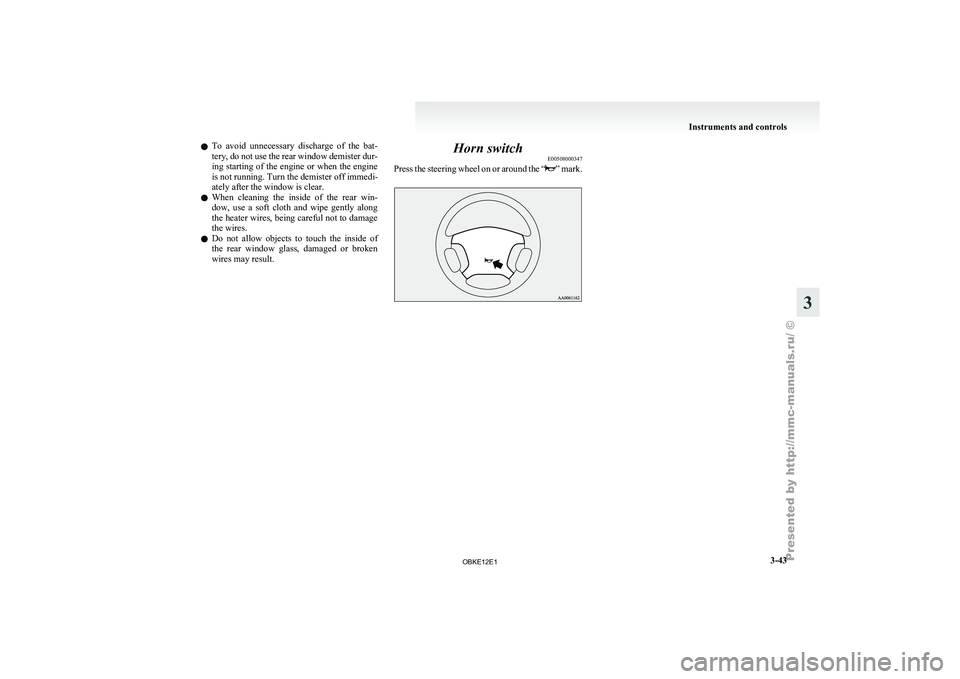
E00508000347
Press the steering
wheel on or around the “ ” mark. Instruments and controls
3-43 3
OBKE12E1
Page 126 of 377
Economical driving.......................................................................4-02
Driving, alcohol and drugs
........................................................... 4-02
Safe driving techniques ................................................................ 4-03
Running-in recommendations....................................................... 4-04
Parking brake
................................................................................ 4-06
Parking.......................................................................................... 4-07
Steering wheel height adjustment .................................................4-08
Inside rear-view mirror ................................................................. 4-08
Outside rear-view mirrors ............................................................. 4-10
Ignition switch .............................................................................. 4-12
Steering wheel lock ...................................................................... 4-13
Starting.......................................................................................... 4-14
Diesel particulate filter (DPF)* .................................................... 4-15
Manual transmission ..................................................................... 4-16
Automatic transmission INVECS-II Sports Mode 5A/T (Intelligent & Innovative Vehicle Electronic Control
System II)................................................................................. 4-19
Super select 4WD II (SS4 II)........................................................ 4-24
Rear differential lock* .................................................................. 4-29
4-wheel drive operation ................................................................ 4-32
Inspection and maintenance following rough road oper- ation.......................................................................................... 4-35
Cautions on handling of 4-wheel drive vehicles ..........................4-35
Braking......................................................................................... 4-37
Brake assist system....................................................................... 4-38
Anti-lock brake system (ABS) ..................................................... 4-39
Power steering system.................................................................. 4-41
Active stability & traction control (ASTC) ..................................4-41
Cruise control* ............................................................................. 4-45
Reversing sensor system*............................................................. 4-49 Rear-view camera*
....................................................................... 4-52
Cargo loads................................................................................... 4-56
Trailer towing ............................................................................... 4-57Starting and driving
4
OBKE12E1
Page 131 of 377
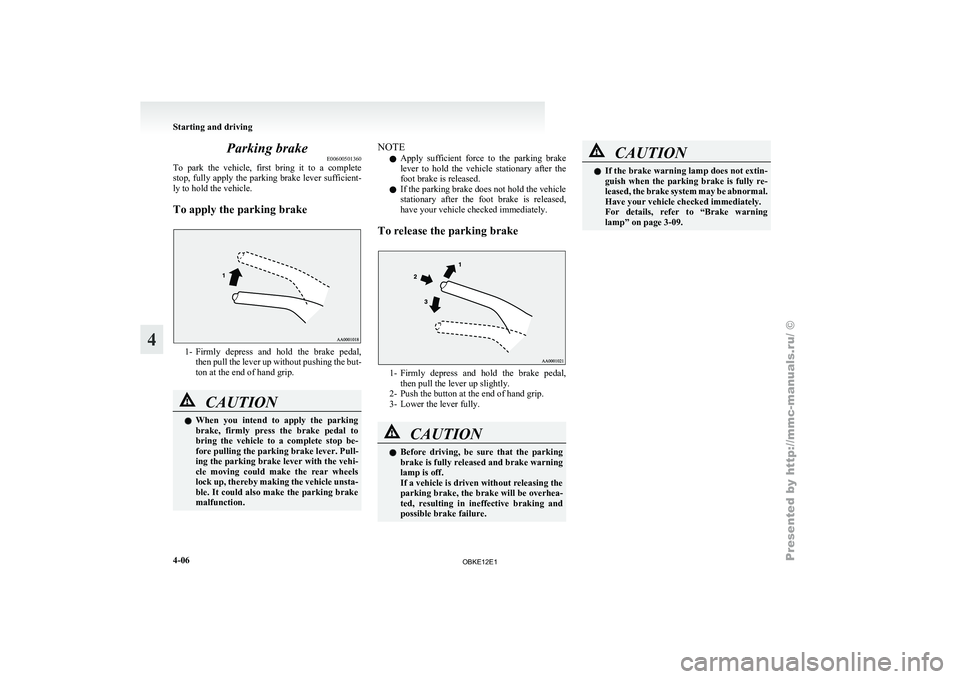
Parking brake
E00600501360
To park the
vehicle, first bring it to a complete
stop, fully apply the parking brake lever sufficient-
ly to hold the vehicle.
To apply the parking brake 1- Firmly depress and hold the brake pedal,
then pull
the lever up without pushing the but-
ton at the end of hand grip. CAUTION
l
When you
intend
to apply the parking
brake, firmly press the brake pedal to
bring the vehicle to a complete stop be-
fore pulling the parking brake lever. Pull-
ing the parking brake lever with the vehi-
cle moving could make the rear wheels
lock up, thereby making the vehicle unsta-
ble. It could also make the parking brake
malfunction. NOTE
l Apply
sufficient force
to the parking brake
lever to hold the vehicle stationary after the
foot brake is released.
l If the parking brake does not hold the vehicle
stationary after the foot brake is released,
have your vehicle checked immediately.
To release the parking brake 1- Firmly depress and hold the brake pedal,
then pull the lever up slightly.
2- Push the button at the end of hand grip.
3-
Lower the lever fully. CAUTION
l
Before driving,
be
sure that the parking
brake is fully released and brake warning
lamp is off.
If a vehicle is driven without releasing the
parking brake, the brake will be overhea-
ted, resulting in ineffective braking and
possible brake failure. CAUTION
l
If the brake
warning lamp does not extin-
guish when the parking brake is fully re-
leased, the brake system may be abnormal.
Have your vehicle checked immediately.
For details, refer to “Brake warning
lamp” on page 3-09. Starting and driving
4-06
4
OBKE12E1
Page 132 of 377

Parking
E00600601097
To park the
vehicle, fully engage the parking
brake, and then move the gearshift lever to 1 st
or
“R” (Reverse) position for vehicles with M/T, or
set the selector lever to “P” (PARK) position on
A/T vehicles.
Parking on a hill
To prevent the vehicle from rolling, follow these
procedures:
Parking on a downhill slope
Turn the front wheels towards the kerb and move
the vehicle forward until the kerb side wheel gently
touches the kerb.
Apply the parking brake and place the gearshift lev-
er into the “R” (Reverse) position (with M/T) or
the selector lever into the “P” (PARK) position
(with A/T).
If necessary, apply chocks to wheels.
Parking on an uphill slope
Turn the front wheels away from the kerb and
move the vehicle back until the kerb side wheel gen-
tly touches the kerb.
Apply the parking brake and place the gearshift lev-
er into the 1 st
position (with M/T) or the selector lev-
er into the “P” (PARK) position (with A/T).
If necessary, apply chocks to wheels. NOTE
l If
your vehicle
is equipped with A/T, be sure
to apply the parking brake before moving the
selector lever to the “P” (PARK) position. If
you move the selector lever to the “P”
(PARK) position before applying the parking
brake, it may be difficult to disengage the se-
lector lever from the “P” (PARK) position
when next you drive the vehicle, requiring ap-
plication of a strong force to the selector lev-
er to move from the “P” (PARK) position.
Parking with the engine running
Never leave the engine running while you take a
short sleep/rest, or you open or close a gate or ga-
rage door, etc. Also, never leave the engine run-
ning in a closed or poorly ventilated place. WARNING
l Leaving
the
engine
running risks injury
or death from accidentally moving the
gearshift lever (on M/T vehicles) or the se-
lector lever (on A/T vehicles) or the accu-
mulation of toxic exhaust fumes in the pas-
senger compartment.
Where you park WARNING
l Do not
park
your vehicle in areas where
combustible materials such as dry grass
or leaves can come in contact with a hot
exhaust, since a fire could occur. When leaving the vehicle
Always remove
the
key from the ignition switch
and lock all doors (including the backdoor) when
leaving the vehicle unattended.
Always try to park your vehicle in a well lit area. Starting and driving
4-07 4
OBKE12E1
Page 133 of 377
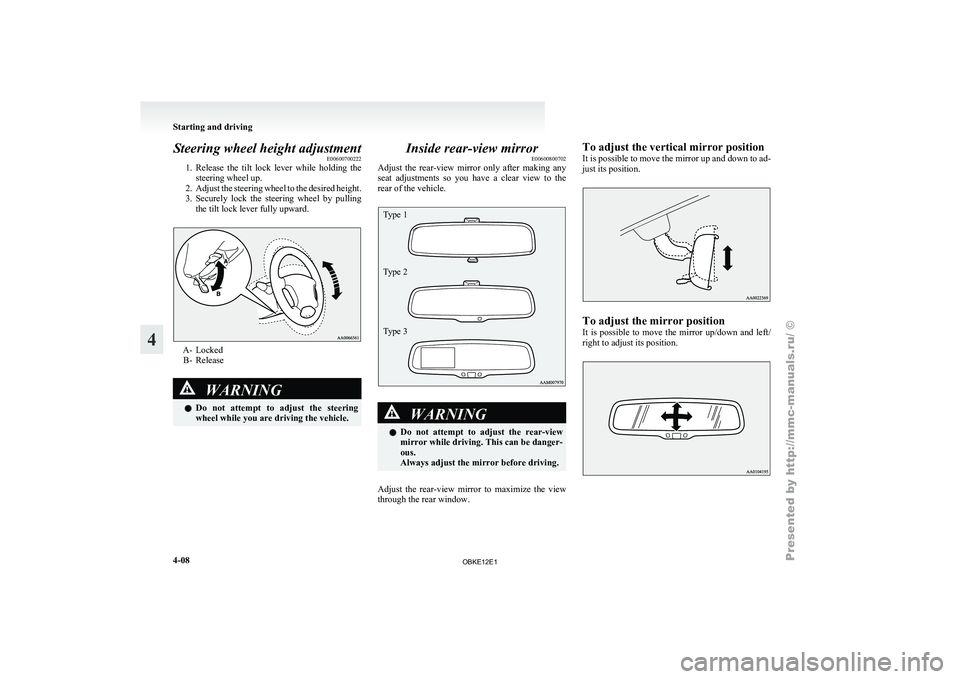
Steering wheel height adjustment
E00600700222
1. Release the tilt
lock lever while holding the
steering wheel up.
2. Adjust the steering wheel to the desired height.
3. Securely lock the steering wheel by pulling the tilt lock lever fully upward. A- Locked
B- Release WARNING
l Do not attempt
to adjust the steering
wheel while you are driving the vehicle. Inside rear-view mirror
E00600800702
Adjust the rear-view
mirror only after making any
seat adjustments so you have a clear view to the
rear of the vehicle.
Type 1
Type 2
Type 3 WARNING
l Do not attempt
to adjust the rear-view
mirror while driving. This can be danger-
ous.
Always adjust the mirror before driving.
Adjust the rear-view mirror to maximize the view
through the rear window. To adjust the vertical mirror position
It
is possible
to move the mirror up and down to ad-
just its position. To adjust the mirror position
It is
possible
to move the mirror up/down and left/
right to adjust its position. Starting and driving
4-08
4
OBKE12E1
Page 137 of 377
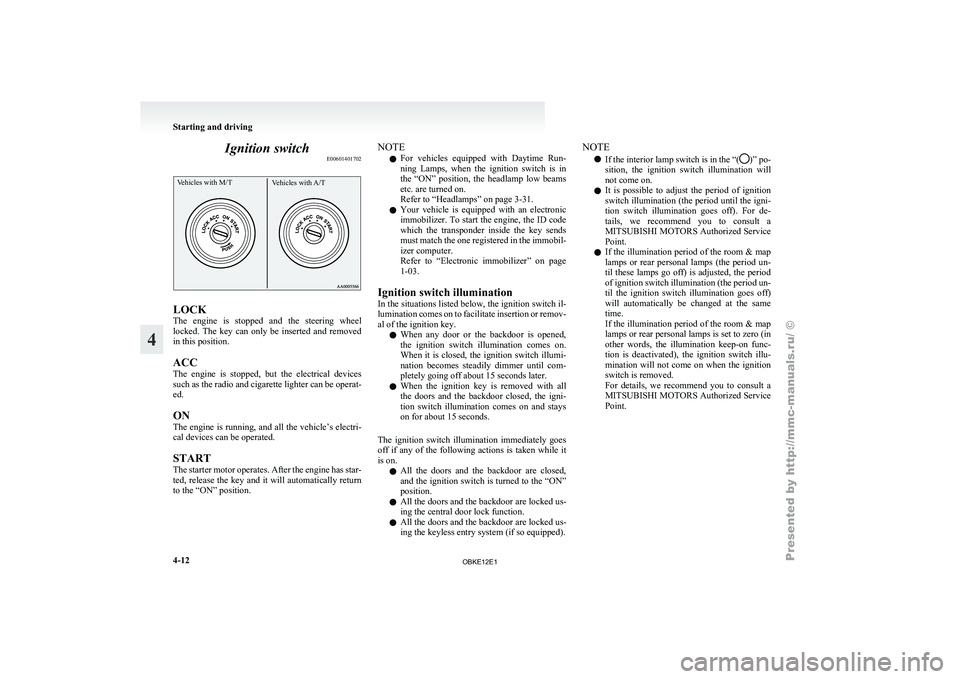
Ignition switch
E00601401702Vehicles with M/T Vehicles with A/TLOCK
The
engine is
stopped and the steering wheel
locked. The key can only be inserted and removed
in this position.
ACC
The engine is stopped, but the electrical devices
such as the radio and cigarette lighter can be operat-
ed.
ON
The engine is running, and all the vehicle’s electri-
cal devices can be operated.
START
The starter motor operates. After the engine has star-
ted, release the key and it will automatically return
to the “ON” position. NOTE
l For
vehicles equipped
with Daytime Run-
ning Lamps, when the ignition switch is in
the “ON” position, the headlamp low beams
etc. are turned on.
Refer to “Headlamps” on page 3-31.
l Your vehicle is equipped with an electronic
immobilizer. To start the engine, the ID code
which the transponder inside the key sends
must match the one registered in the immobil-
izer computer.
Refer to “Electronic immobilizer” on page
1-03.
Ignition switch illumination
In the situations listed below, the ignition switch il-
lumination comes on to facilitate insertion or remov-
al of the ignition key. l When any door or the backdoor is opened,
the ignition switch illumination comes on.
When it is closed, the ignition switch illumi-
nation becomes steadily dimmer until com-
pletely going off about 15 seconds later.
l When the ignition key is removed with all
the doors and the backdoor closed, the igni-
tion switch illumination comes on and stays
on for about 15 seconds.
The ignition switch illumination immediately goes
off if any of the following actions is taken while it
is on. l All the doors and the backdoor are closed,
and the ignition switch is turned to the “ON”
position.
l All the doors and the backdoor are locked us-
ing the central door lock function.
l All the doors and the backdoor are locked us-
ing the keyless entry system (if so equipped). NOTE
l If the interior
lamp switch is in the “( )” po-
sition, the ignition
switch illumination will
not come on.
l It is possible to adjust the period of ignition
switch illumination (the period until the igni-
tion switch illumination goes off). For de-
tails, we recommend you to consult a
MITSUBISHI MOTORS Authorized Service
Point.
l If the illumination period of the room & map
lamps or rear personal lamps (the period un-
til these lamps go off) is adjusted, the period
of ignition switch illumination (the period un-
til the ignition switch illumination goes off)
will automatically be changed at the same
time.
If the illumination period of the room & map
lamps or rear personal lamps is set to zero (in
other words, the illumination keep-on func-
tion is deactivated), the ignition switch illu-
mination will not come on when the ignition
switch is removed.
For details, we recommend you to consult a
MITSUBISHI MOTORS Authorized Service
Point. Starting and driving
4-12
4
OBKE12E1
Page 138 of 377
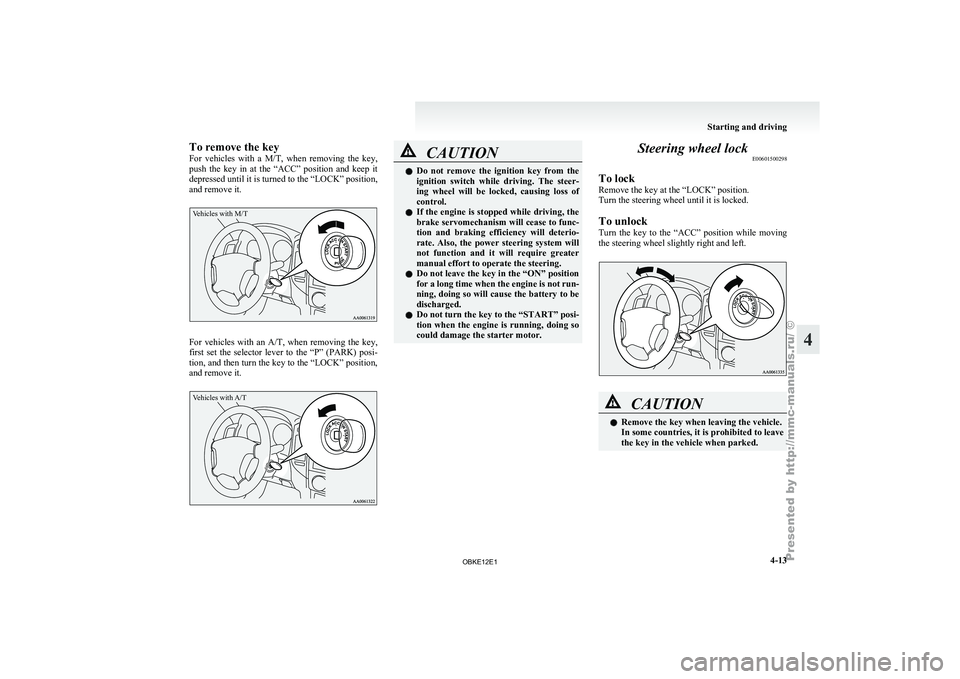
To remove the key
For vehicles
with
a M/T, when removing the key,
push the key in at the “ACC” position and keep it
depressed until it is turned to the “LOCK” position,
and remove it.
Vehicles with M/T For vehicles with an A/T, when
removing
the key,
first set the selector lever to the “P” (PARK) posi-
tion, and then turn the key to the “LOCK” position,
and remove it.
Vehicles with A/T CAUTION
l
Do not remove
the ignition key from the
ignition switch while driving. The steer-
ing wheel will be locked, causing loss of
control.
l If the engine is stopped while driving, the
brake servomechanism will cease to func-
tion and braking efficiency will deterio-
rate. Also, the power steering system will
not function and it will require greater
manual effort to operate the steering.
l Do not leave the key in the “ON” position
for a long time when the engine is not run-
ning, doing so will cause the battery to be
discharged.
l Do not turn the key to the “START” posi-
tion when the engine is running, doing so
could damage the starter motor. Steering wheel lock
E00601500298
To lock
Remove the key at the “LOCK” position.
Turn the steering wheel until it is locked.
To unlock
Turn the key
to the “ACC” position while moving
the steering wheel slightly right and left. CAUTION
l
Remove the key when leaving the vehicle.
In some countries, it is prohibited to leave
the key in the vehicle when parked. Starting and driving
4-13 4
OBKE12E1
Page 147 of 377

When a malfunction occurs in the A/T
E00615100035
When the “N” indication lamp blinks E00615200023
When the “N” indication lamp (A) blinks with the
“D” (DRIVE) position
or “Sports mode” being se-
lected, the A/T may be malfunctioning. CAUTION
l
If the “N”
indication lamp blinks while
driving in the “D” (DRIVE) position or
“Sports Mode”, the A/T safety device
may be operating due to a malfunction.
We recommend you to have your vehicle
inspected as soon as possible. When the A/T fluid temperature warning lamp
comes on
E00615300109
When the A/T
fluid temperature warning lamp
comes automatic transmission fluid temperature be-
comes abnormally high. Normally the warning
lamp comes on when the ignition switch is turned
to the “ON” position, and then will go out after a
few seconds. CAUTION
l
If the lamp
comes on, reduce the engine
speed and stop the vehicle in a safe area.
Then set the selector lever to “P” (PARK)
position and idle the engine until the warn-
ing lamp goes off. When the warning
lamp goes off, resume normal driving. If
the warning lamp does not go off, we rec-
ommend you to have your vehicle inspec-
ted. Operation of the A/T
E00604200560 CAUTION
l
Before selecting
a
gear with the engine
running and the vehicle stationary, fully
depress the brake pedal to prevent the ve-
hicle from creeping.
The vehicle will begin to move as soon as
the gear is engaged, especially when the
engine speed is high, at fast idle or with
the air conditioning operating, the brakes
should only be released when you are
ready to drive away.
l Depress the brake pedal with the right
foot at all times.
Using the left foot could cause driver move-
ment delay in case of an emergency.
l Operating the accelerator pedal while the
other foot is resting on the brake pedal
will affect braking efficiency and may
cause premature wear of brake pads.
l To prevent sudden acceleration, never
race the engine when shifting from the
“P” (PARK) or “N” (NEUTRAL) position.
l Use the selector lever in the correct shift
position in accordance with driving condi-
tions.
Never coast downhill backward with the
selector lever in the “D” (DRIVE) or
sports mode position or coast forward
with the selector lever in the “R” (RE-
VERSE) position.
The engine may stop and the unexpected
increase in brake pedal effort and steer-
ing wheel weight could lead to an accident. Starting and driving
4-22
4
OBKE12E1