engine temp MITSUBISHI PAJERO IV 2011 Owner's Guide
[x] Cancel search | Manufacturer: MITSUBISHI, Model Year: 2011, Model line: PAJERO IV, Model: MITSUBISHI PAJERO IV 2011Pages: 377, PDF Size: 29.43 MB
Page 298 of 377
Towing with rear wheels off the ground (Type C)
Place the gearshift
lever in the “N” (Neutral) posi-
tion (M/T) or the selector lever in the “N” (NEU-
TRAL) position (A/T). Turn the ignition key to the
“ACC” position and secure the steering wheel in a
straight ahead position with a rope or tie-down
strap. Never place the ignition switch in the
“LOCK” position when towing.
Emergency towing
If towing service is not available in an emergency,
your vehicle may be temporarily towed by a rope
secured to the towing hook.
If your vehicle is to be towed by another vehicle or
if your vehicle tows another vehicle, pay careful at-
tention to the following points:
If your vehicle is to be towed by another vehicle
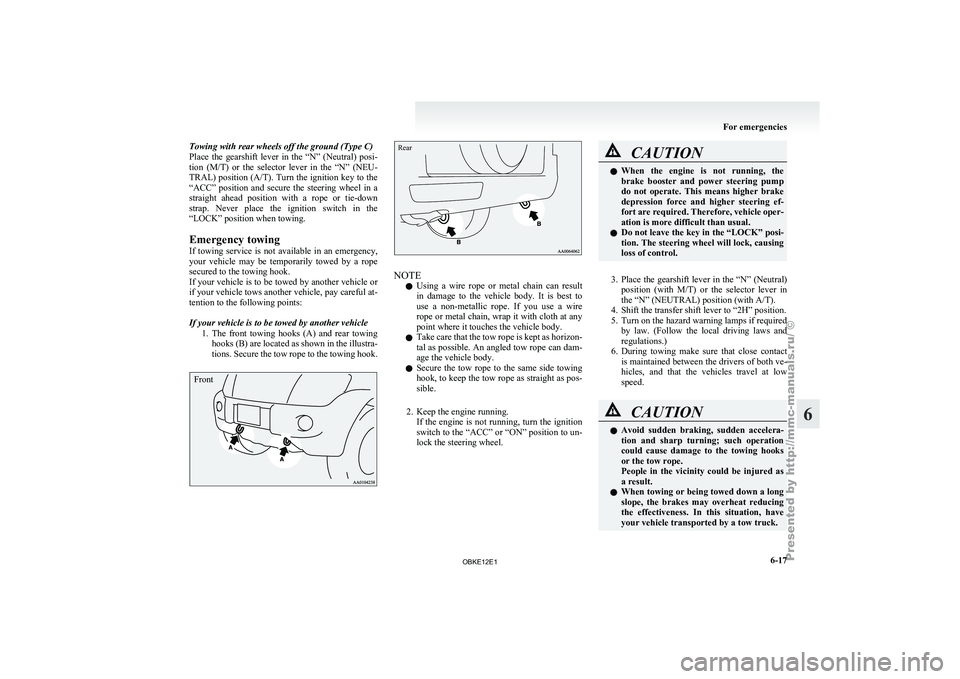
1. The front towing hooks (A) and rear towinghooks (B) are located as shown in the illustra-
tions. Secure the tow rope to the towing hook.
Front
Rear NOTE
l Using
a wire
rope or metal chain can result
in damage to the vehicle body. It is best to
use a non-metallic rope. If you use a wire
rope or metal chain, wrap it with cloth at any
point where it touches the vehicle body.
l Take care that the tow rope is kept as horizon-
tal as possible. An angled tow rope can dam-
age the vehicle body.
l Secure the tow rope to the same side towing
hook, to keep the tow rope as straight as pos-
sible.
2. Keep the engine running. If the engine is not running, turn the ignition
switch to the “ACC” or “ON” position to un-
lock the steering wheel. CAUTION
l
When the engine
is not running, the
brake booster and power steering pump
do not operate. This means higher brake
depression force and higher steering ef-
fort are required. Therefore, vehicle oper-
ation is more difficult than usual.
l Do not leave the key in the “LOCK” posi-
tion. The steering wheel will lock, causing
loss of control.
3. Place the gearshift lever in the “N” (Neutral)
position (with
M/T) or the selector lever in
the “N” (NEUTRAL) position (with A/T).
4. Shift the transfer shift lever to “2H” position.
5. Turn on the hazard warning lamps if required by law. (Follow the local driving laws and
regulations.)
6. During towing make sure that close contact is maintained between the drivers of both ve-
hicles, and that the vehicles travel at low
speed. CAUTION
l
Avoid sudden braking,
sudden accelera-
tion and sharp turning; such operation
could cause damage to the towing hooks
or the tow rope.
People in the vicinity could be injured as
a result.
l When towing or being towed down a long
slope, the brakes may overheat reducing
the effectiveness. In this situation, have
your vehicle transported by a tow truck. For emergencies
6-17 6
OBKE12E1
Page 304 of 377
NOTE
l If
genuine leather
is wet with water or is wash-
ed in water, wipe off water as quickly as pos-
sible with a dry, soft cloth. If left damp, mil-
dew may grow.
l The genuine leather surface may be damaged
if a nylon brush or synthetic fibre is rubbed
hard against it.
l Organic solvents such as benzine, kerosene,
alcohol and petrol, acid or alkaline solvents
may discolour the genuine leather surface.
Be sure to use neutral detergents.
l Remove dirty patches or oil substances quick-
ly as they can stain genuine leather.
l The genuine leather surface may harden and
shrink if it is exposed to direct sun for long
hours. When your vehicle is parked, place it
in the shade as much as possible.
l When the temperature of the vehicle interior
rises in summer, vinyl products left on the
genuine leather seat may deteriorate and
stick to the seat. Cleaning the exterior of your
vehicle E00900700195
If the
following
is left on your vehicle, it may
cause corrosion, discolouration and stains, wash
the vehicle as soon as possible.
l Seawater, road deicing products.
l Soot and dust, iron powder from factories,
chemical substance (acids, alkalis, coal-tar,
etc.).
l Droppings from birds, carcasses of insects,
tree sap, etc.
Washing E00900901875
Chemicals contained in the dirt and dust picked up
from the road
surface can damage the paint coat
and body of your vehicle if left in prolonged contact.
Frequent washing and waxing is the best way to pro-
tect your vehicle from this damage. This will also
be effective in protecting it from environmental el-
ements such as rain, snow, salt air, etc.
Do not wash the vehicle in direct sunlight. Park the
vehicle in the shade and spray it with water to re-
move dust. Next, using an ample amount of clean
water and a car washing brush or sponge, wash the
vehicle from top to bottom.
Use a mild car washing soap if necessary. Rinse
thoroughly and wipe dry with a soft cloth. After
washing the vehicle, carefully clean the joints and
flanges of the doors, bonnet, etc., where dirt is like-
ly to remain. CAUTION
l
When washing the
under side of your ve-
hicle or wheel, be careful not to injure
your hands.
l If your vehicle has rain sensor wipers,
place the wiper switch lever in the “OFF”
position to deactivate the rain sensor be-
fore washing the vehicle. Otherwise, the
wipers will operate in the presence of wa-
ter spray on the windscreen and may get
damaged as a result.
l Refrain from excessively using a car wash
as its brushes may scratch the paint sur-
face, causing it to lose its gloss.
Scratches will be especially visible on
darker coloured vehicles.
l Never spray or splash water on the electri-
cal components in the engine compart-
ment, as this may adversely affect engine
starting.
Exercise caution also when washing the
underbody; be careful not to spray water
into the engine compartment.
l Some types of hot water washing equip-
ment apply high pressure and heat to the
vehicle. They may cause heat distortion
and damage to the vehicle resin parts and
may result in flooding of the vehicle inte-
rior. Therefore;
• Maintain a distance of approx. 50 cmor more between the vehicle body and
the washing nozzle.
• When washing around the door glass, hold the nozzle at a distance of more
than 50 cm and at right angles to the
glass surface. Vehicle care
7-03 7
OBKE12E1
Page 312 of 377
Use only the recommended oils with an ACEA or
API classification as specified in this manual.
NOTE
l For
3200 models,
check or refill the oil ac-
cording to the following manner. • When the oil level is checked in step 6above, check it on a low side of the dip-
stick because it is different in appearance
of oil level in the two sides of the dipstick.
• On vehicles without diesel particulate fil- ter (DPF), the oil level should be within
the range (A) to (B) on the dipstick.
• On vehicles with DPF, the oil level should be within the range (A) to (C) (oil
replacement indication mark) on the dip-
stick.
If the oil level is beyond the oil replace-
ment indication mark (C), replace the oil
as soon as possible.
Then, the oil should be refilled to the max-
imum level (B).
• On vehicles with DPF, the engine oil will increase due to a little fuel getting mixed
in the engine oil when the DPF regener-
ates to burn away the PM (particulate mat-
ter). However, it does not indicate a mal-
function.
l The engine oil will deteriorate rapidly if the
vehicle is subjected to severe conditions, re-
quiring earlier oil replacement. Please refer
to the maintenance schedule.
l For handling of used engine oils, refer to
page 06. Selection of engine oil
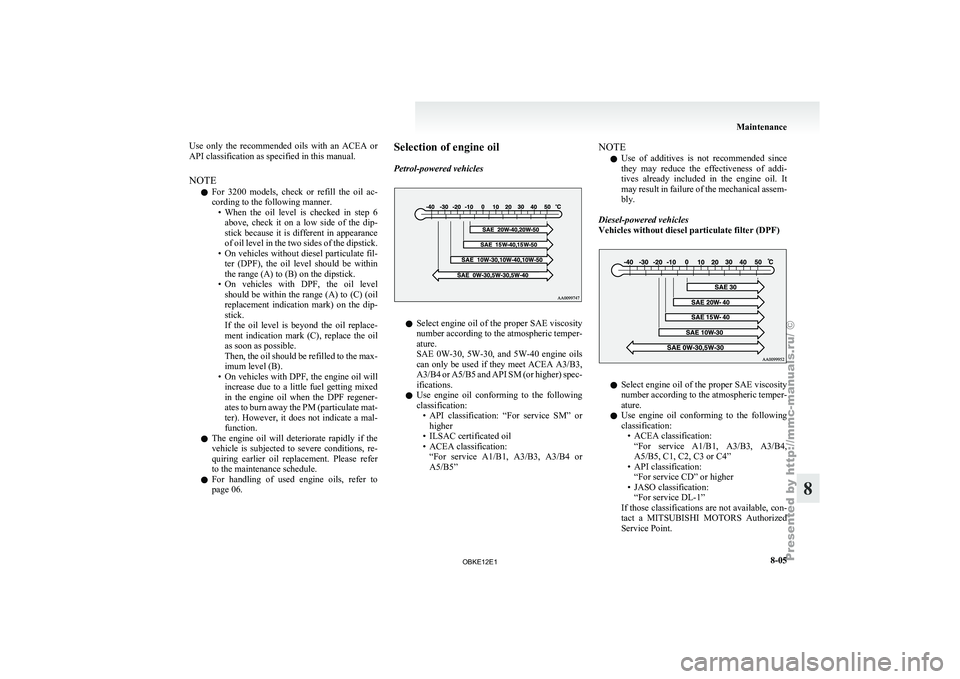
Petrol-powered vehicles
l
Select engine
oil
of the proper SAE viscosity
number according to the atmospheric temper-
ature.
SAE 0W-30, 5W-30, and 5W-40 engine oils
can only be used if they meet ACEA A3/B3,
A3/B4 or A5/B5 and API SM (or higher) spec-
ifications.
l Use engine oil conforming to the following
classification:
• API classification: “For service SM” orhigher
• ILSAC certificated oil
• ACEA classification: “For service A1/B1, A3/B3, A3/B4 or
A5/B5” NOTE
l Use
of additives
is not recommended since
they may reduce the effectiveness of addi-
tives already included in the engine oil. It
may result in failure of the mechanical assem-
bly.
Diesel-powered vehicles
Vehicles without diesel particulate filter (DPF) l
Select engine
oil
of the proper SAE viscosity
number according to the atmospheric temper-
ature.
l Use engine oil conforming to the following
classification:
• ACEA classification:“For service A1/B1, A3/B3, A3/B4,
A5/B5, C1, C2, C3 or C4”
• API classification: “For service CD” or higher
• JASO classification: “For service DL-1”
If those classifications are not available, con-
tact a MITSUBISHI MOTORS Authorized
Service Point. Maintenance
8-05 8
OBKE12E1
Page 313 of 377
NOTE
l Use
of additives
is not recommended since
they may reduce the effectiveness of addi-
tives already included in the engine oil. It
may result in failure of the mechanical assem-
bly.
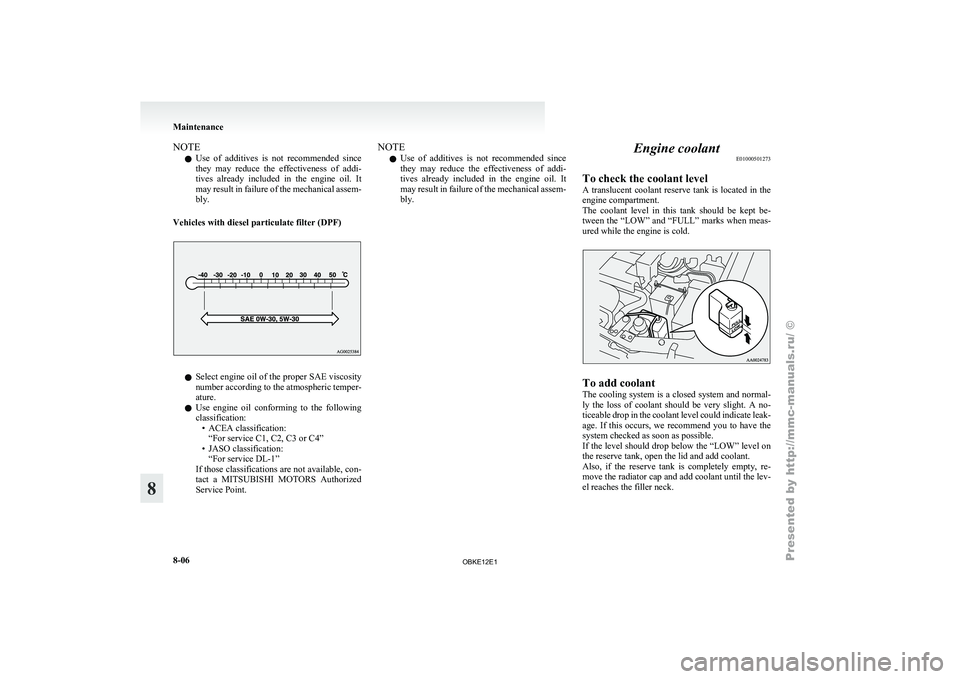
Vehicles with diesel particulate filter (DPF) l
Select engine
oil
of the proper SAE viscosity
number according to the atmospheric temper-
ature.
l Use engine oil conforming to the following
classification:
• ACEA classification:“For service C1, C2, C3 or C4”
• JASO classification: “For service DL-1”
If those classifications are not available, con-
tact a MITSUBISHI MOTORS Authorized
Service Point. NOTE
l Use
of additives
is not recommended since
they may reduce the effectiveness of addi-
tives already included in the engine oil. It
may result in failure of the mechanical assem-
bly. Engine coolant
E01000501273
To check the coolant level
A translucent
coolant
reserve tank is located in the
engine compartment.
The coolant level in this tank should be kept be-
tween the “LOW” and “FULL” marks when meas-
ured while the engine is cold. To add coolant
The cooling
system
is a closed system and normal-
ly the loss of coolant should be very slight. A no-
ticeable drop in the coolant level could indicate leak-
age. If this occurs, we recommend you to have the
system checked as soon as possible.
If the level should drop below the “LOW” level on
the reserve tank, open the lid and add coolant.
Also, if the reserve tank is completely empty, re-
move the radiator cap and add coolant until the lev-
el reaches the filler neck. Maintenance
8-06
8
OBKE12E1
Page 314 of 377
WARNING
l Do not open the radiator cap while the en-
gine is hot.
The coolant system is under pressure and
any hot coolant escaping could cause se-
vere burns.
Anti-freeze
The engine coolant
contains an ethylene glycol anti-
corrosion agent. The cylinder head and water pump
housing are cast aluminium alloy, and periodic
changing of the engine coolant is necessary to pre-
vent corrosion of these parts.
Use “DIA QUEEN SUPER LONG LIFE COOL-
ANT” or equivalent.
MITSUBISHI Genuine Coolant has excellent pro-
tection against corrosion and rust formation of all
metals including aluminium and can avoid block-
ages in the radiator, heater, cylinder head, engine
block, etc.
Because of the necessity of this anti-corrosion
agent, the coolant must not be replaced with plain
water even in summer. The required concentration
of anti-freeze differs depending on the expected am-
bient temperature. Ambient
temperature (mini-
mum) °C -15 -20 -25 -30 -35 -50 Anti-freeze
concentra- tion % 30 35 40 45 50 60 CAUTION
l
Do not use
alcohol or methanol anti-
freeze or any engine coolants mixed with
alcohol or methanol anti-freeze. The use
of an improper anti-freeze can cause cor-
rosion of the aluminium components.
l For effective anti-corrosion and anti-
freeze performance, keep the anti-freeze
concentration within the range of 30 to
60 %.
Concentrations exceeding 60 % will re-
sult in a reduction of both the anti-freeze
and cooling performance thus adversely
affecting the engine.
l Do not top up with water only.
During cold weather
The concentration should
be checked before the
start of cold weather and anti-freeze added to the
system if necessary to prevent damage to engine
and radiator due to freezing. Washer fluid
E01000700656
Windscreen washer fluid
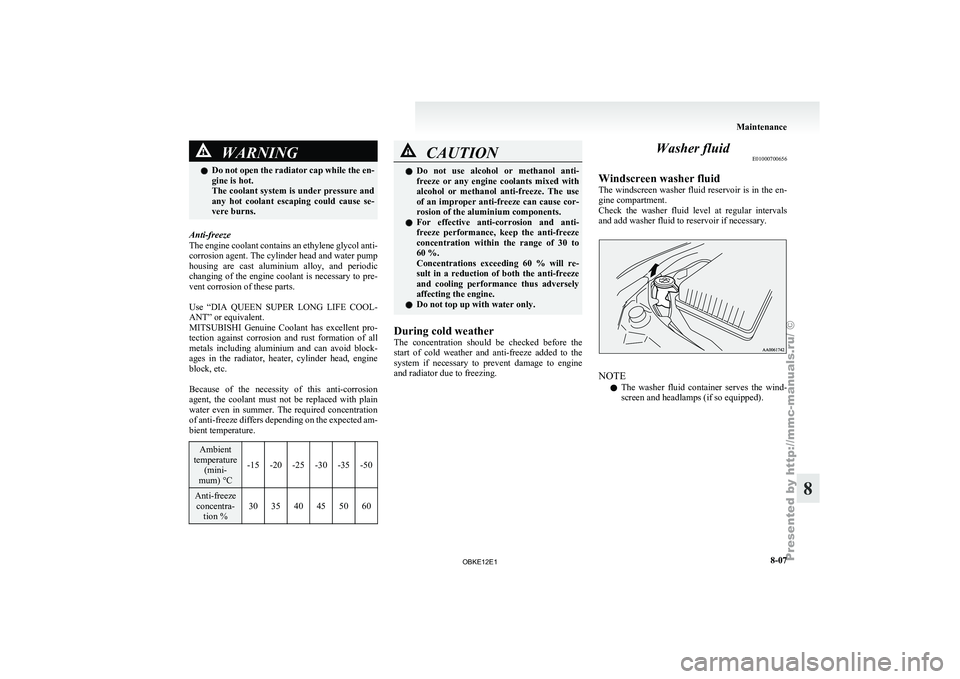
The windscreen washer
fluid reservoir is in the en-
gine compartment.
Check the washer fluid level at regular intervals
and add washer fluid to reservoir if necessary. NOTE
l The
washer fluid
container serves the wind-
screen and headlamps (if so equipped). Maintenance
8-07 8
OBKE12E1
Page 326 of 377
For cold and snowy weather
E01002800299
Ventilation slots
The ventilation slots
in front of the windscreen
should be kept clear of leaves or brushed clear after
heavy snowfall, so that the operation of the heating
and ventilation systems will not be impaired.
Weatherstripping
To prevent freezing of the weatherstripping on the
doors, bonnet, etc., they should be treated with sili-
cone grease.
Additional equipment
It is a good idea to carry a shovel or a short-han-
dled spade in the vehicle during the winter so that
you can clear away snow if you get stranded. A
small hand-brush for sweeping snow off the vehi-
cle and a plastic scraper for the windscreen and
rear window are also useful. Fusible links
E01002900434
The fusible links
will melt to prevent a fire if a
large current attempts to flow through certain elec-
trical systems.
In case of a melted fusible link, we recommend
you to have your vehicle inspected.
For the fusible links, please refer to “Fuse load ca-
pacity” on page 8-20. WARNING
l Fusible links
must
not be replaced by any
other device. Failing to fit the correct fusi-
ble link may result in fire in the vehicle,
property destruction and serious or fatal
injuries at any time. Fuses
E01003000849
Fuse block location E01007600250
To prevent damage to the electrical system due to
shortcircuiting or overloading,
each individual cir-
cuit is provided with a fuse.
There are fuse blocks in the passenger compart-
ment and in the engine compartment.
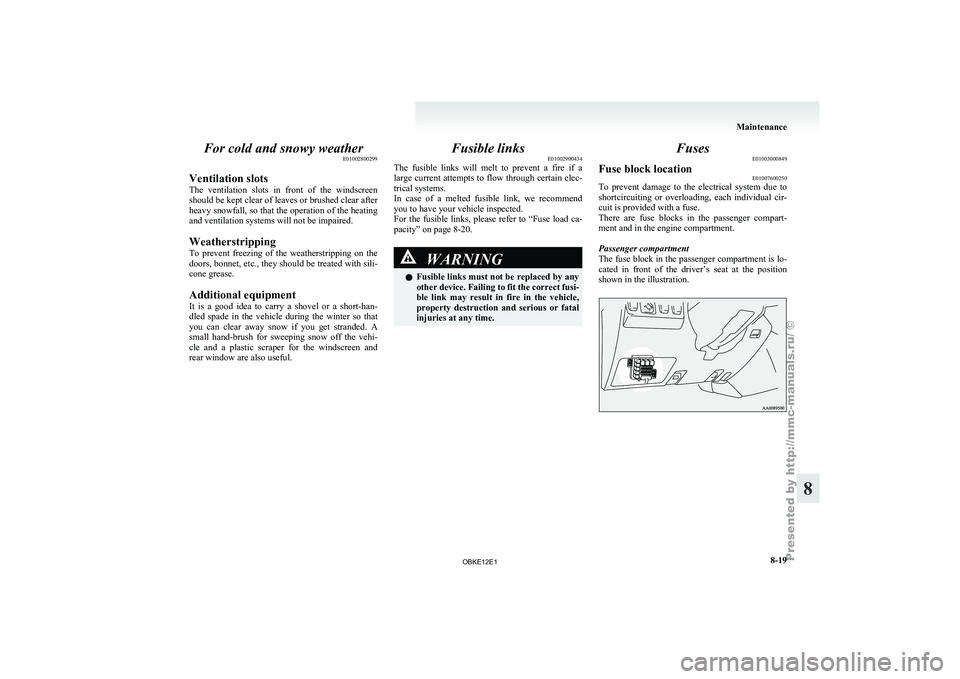
Passenger compartment
The fuse block in the passenger compartment is lo-
cated in front of the driver’s seat at the position
shown in the illustration. Maintenance
8-19 8
OBKE12E1
Page 328 of 377
No. Symbol Electrical sys-
tem Capacity
27 Starter motor
10 A
28 — — —
29 — Spare fuse 20 A
30 — Spare fuse 10 A
31 — Spare fuse 30 A
32 — Spare fuse 25 A l
Some fuses
may not be installed on your ve-
hicle, depending on the vehicle model or spec-
ifications.
l The table above shows the main equipment
corresponding to each fuse.
The fuse block does not contain spare 7.5 A
and 15 A fuses. If a fuse of one of these ca-
pacities blows, replace it temporarily by bor-
rowing the one that matches from:
7.5 A: Outside rear-view mirrors
15 A: Cigarette lighter
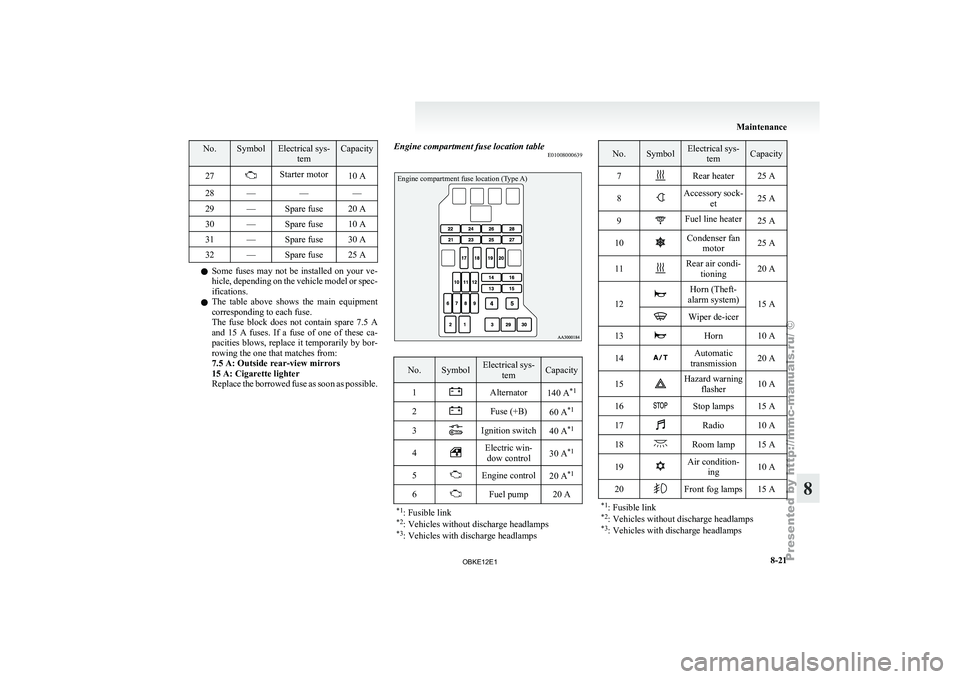
Replace the borrowed fuse as soon as possible. Engine compartment fuse location table
E01008000639
Engine compartment fuse location (Type A) No. Symbol Electrical sys-
tem Capacity
1 Alternator
140 A*1
2 Fuse (+B)
60 A*1
3 Ignition switch
40 A*1
4 Electric win-
dow control 30 A
*1
5 Engine control
20 A*1
6 Fuel pump 20 A
*1 : Fusible link
*2 : Vehicles without discharge headlamps
*3 : Vehicles with discharge headlamps No. Symbol Electrical sys-
tem Capacity
7 Rear heater 25 A
8 Accessory sock-
et 25 A
9 Fuel line heater
25 A
10 Condenser fan
motor 25 A
11 Rear air condi-
tioning 20 A
12 Horn (Theft-
alarm system) 15 A Wiper de-icer
13 Horn 10 A
14 Automatic
transmission 20 A
15 Hazard warning
flasher 10 A
16 Stop lamps 15 A
17 Radio 10 A
18 Room lamp 15 A
19 Air condition-
ing 10 A
20 Front fog lamps 15 A
*1 : Fusible link
*2 : Vehicles without discharge headlamps
*3 : Vehicles with discharge headlamps Maintenance
8-21 8
OBKE12E1
Page 359 of 377
Electrical system 9-11
Electronic immobilizer (Anti-theft starting sys-
tem) 1-03
Emergency starting 6-02
Engine Coolant 8-06,9-15
MIVEC 4-14
Number 9-02
Oil 8-04
Overheating 6-04
Specifications 9-10
Used engine oils safety instructions and disposal
information 06
Water temperature gauge 3-05
Error codes 5-59
Exterior and interior lamp operation
8-18
F Fluid
Automatic transmission fluid 9-15Brake fluid 8-08,9-15
Clutch fluid 8-09,9-15
Engine coolant 8-06,9-15
Manual transmission fluid 9-15
Power steering fluid 8-10,9-15
Washer fluid 8-07,9-15
Fog lamp switch 3-36
Foot lamps and ceiling lamp
5-90
For cold and snowy weather 8-19
Front automatic air conditioning 5-03
Front fog lamps Bulb capacity 8-24
Indication lamp 3-08
Replacement 8-26
Switch 3-36
Front passenger’s airbag OFF indication
lamp 2-36
Front seats 2-05 Front turn-signal lamps
Bulb capacity 8-24
Replacement 8-26
Fuel consumption 9-13
Fuel Filling the fuel tank
03
Fuel filter indication lamp 3-08
Fuel gauge 3-05
Fuel selection 02
Low fuel warning lamp 3-05
Modification/alterations to the electrical or fuel
systems 05
Tank capacity 03
Fuses 8-19
Fusible links 8-19
G Gauges 3-02
General maintenance 8-18
General vehicle data
9-04
Genuine parts 05
Glove box 5-92
Glove box lamp Bulb capacity
8-24
Replacement 8-31
H Handling of compact discs 5-65
Hazard warning flasher switch 3-35
Hazard warning indication lamps 3-08
Head restraints 2-11
Headlamp levelling
3-33
Headlamp washer switch 3-41
Headlamps Bulb capacity
8-24
Headlamp flasher 3-32
Replacement 8-25 Switch 3-31
Heated mirror 4-11
Heated seats 2-08
High-beam indication lamp 3-08
High-mounted stop lamp (bulb type) Replacement 8-28
High-mounted stop lamp Bulb capacity
8-24
Hinges and latches lubrication 8-18
Horn switch 3-43
I If the vehicle breaks down 6-02
Ignition switch 4-12
Indication lamps 3-08
Inside rear-view mirror 4-08
Inspection and maintenance following rough road
operation 4-35
Installation of accessories
04
Installation position for warning triangle
5-98
Instruments 3-02
Interior lamp switch 5-88
Interior lamps 5-87
J Jack handle 6-09
Jack
Storage 6-07
Jump starting (Emergency starting) 6-02
K Keyless entry system 1-04
Keys 1-02Alphabetical index
2
OBKE12E1
Page 361 of 377
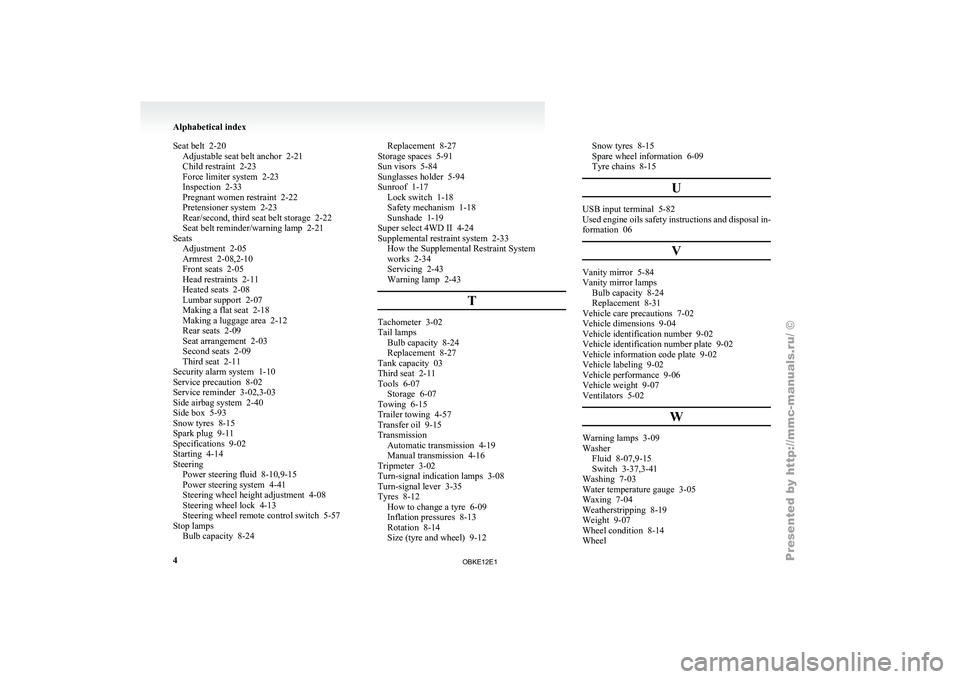
Seat belt 2-20
Adjustable seat belt anchor 2-21Child restraint 2-23
Force limiter system 2-23
Inspection 2-33
Pregnant women restraint
2-22
Pretensioner system 2-23
Rear/second, third seat belt storage 2-22
Seat belt reminder/warning lamp 2-21
Seats Adjustment 2-05
Armrest 2-08,2-10
Front seats 2-05
Head restraints 2-11
Heated seats 2-08
Lumbar support 2-07
Making a flat seat 2-18
Making a luggage area 2-12
Rear seats 2-09
Seat arrangement 2-03
Second seats 2-09
Third seat 2-11
Security alarm system 1-10
Service precaution 8-02
Service reminder 3-02,3-03
Side airbag system 2-40
Side box 5-93
Snow tyres 8-15
Spark plug 9-11
Specifications 9-02
Starting 4-14
Steering Power steering fluid 8-10,9-15
Power steering system 4-41
Steering wheel height adjustment 4-08
Steering wheel lock 4-13
Steering wheel remote control switch 5-57
Stop lamps Bulb capacity 8-24 Replacement 8-27
Storage spaces 5-91
Sun visors 5-84
Sunglasses holder 5-94
Sunroof 1-17 Lock switch 1-18
Safety mechanism 1-18
Sunshade 1-19
Super select 4WD II 4-24
Supplemental restraint system 2-33 How the Supplemental Restraint System
works 2-34
Servicing 2-43
Warning lamp 2-43
T Tachometer 3-02
Tail lamps
Bulb capacity 8-24
Replacement 8-27
Tank capacity
03
Third seat 2-11
Tools 6-07 Storage 6-07
Towing 6-15
Trailer towing 4-57
Transfer oil 9-15
Transmission Automatic transmission 4-19
Manual transmission 4-16
Tripmeter 3-02
Turn-signal indication lamps 3-08
Turn-signal lever 3-35
Tyres 8-12 How to change a tyre 6-09
Inflation pressures 8-13
Rotation 8-14
Size (tyre and wheel) 9-12 Snow tyres 8-15
Spare wheel information 6-09
Tyre chains 8-15
U USB input terminal 5-82
Used engine
oils
safety instructions and disposal in-
formation 06
V Vanity mirror 5-84
Vanity mirror lamps
Bulb capacity 8-24
Replacement 8-31
Vehicle care precautions
7-02
Vehicle dimensions 9-04
Vehicle identification number 9-02
Vehicle identification number plate 9-02
Vehicle information code plate 9-02
Vehicle labeling 9-02
Vehicle performance 9-06
Vehicle weight 9-07
Ventilators 5-02
W Warning lamps 3-09
Washer
Fluid 8-07,9-15
Switch 3-37,3-41
Washing 7-03
Water temperature gauge 3-05
Waxing 7-04
Weatherstripping 8-19
Weight 9-07
Wheel condition
8-14
Wheel Alphabetical index
4
OBKE12E1