roof MITSUBISHI PAJERO IV 2011 Owners Manual
[x] Cancel search | Manufacturer: MITSUBISHI, Model Year: 2011, Model line: PAJERO IV, Model: MITSUBISHI PAJERO IV 2011Pages: 377, PDF Size: 29.43 MB
Page 7 of 377
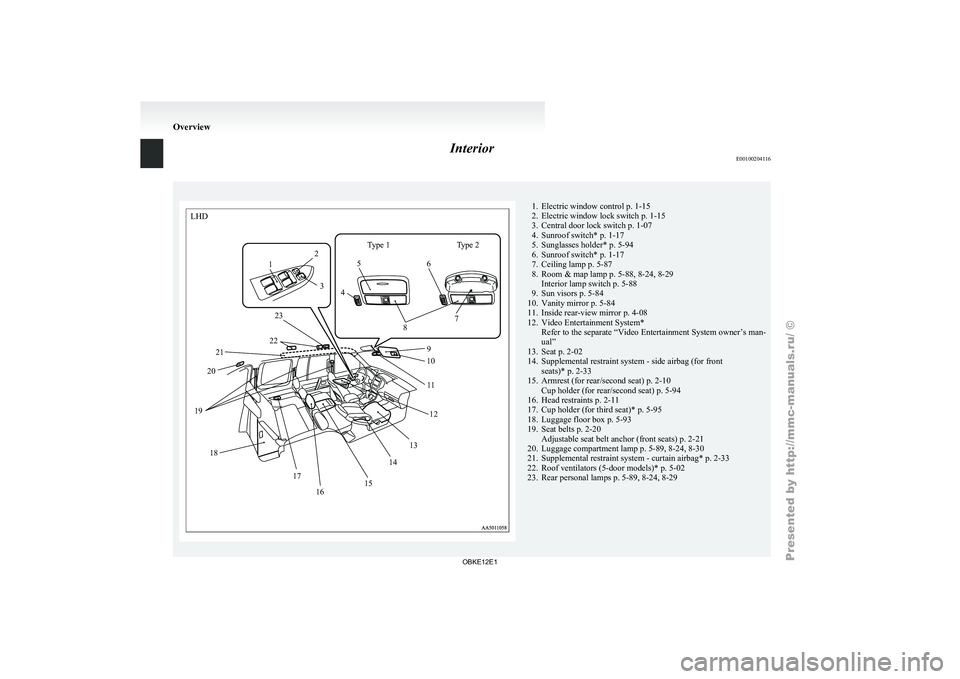
Interior
E00100204116LHD
Type 1
1 2
3 45
6
7
8
9
10
11
12
13
14
15
16
17
18
19
20
21 23
22 Type 2 1. Electric window control p. 1-15
2. Electric window lock switch
p. 1-15
3.
Central door lock switch p. 1-07
4. Sunroof switch* p. 1-17
5. Sunglasses holder* p. 5-94
6. Sunroof switch* p. 1-17
7. Ceiling lamp p. 5-87
8. Room & map lamp p. 5-88, 8-24, 8-29 Interior lamp switch p. 5-88
9. Sun visors p. 5-84
10. Vanity mirror p. 5-84
11. Inside rear-view mirror p. 4-08
12. Video Entertainment System* Refer to the separate “Video Entertainment System owner’s man-
ual”
13. Seat p. 2-02
14. Supplemental restraint system - side airbag (for front seats)* p. 2-33
15. Armrest (for rear/second seat) p. 2-10 Cup holder (for rear/second seat) p. 5-94
16. Head restraints p. 2-11
17. Cup holder (for third seat)* p. 5-95
18. Luggage floor box p. 5-93
19. Seat belts p. 2-20 Adjustable seat belt anchor (front seats) p. 2-21
20. Luggage compartment lamp p. 5-89, 8-24, 8-30
21. Supplemental restraint system - curtain airbag* p. 2-33
22. Roof ventilators (5-door models)* p. 5-02
23. Rear personal lamps p. 5-89, 8-24, 8-29 Overview
OBKE12E1
Page 8 of 377
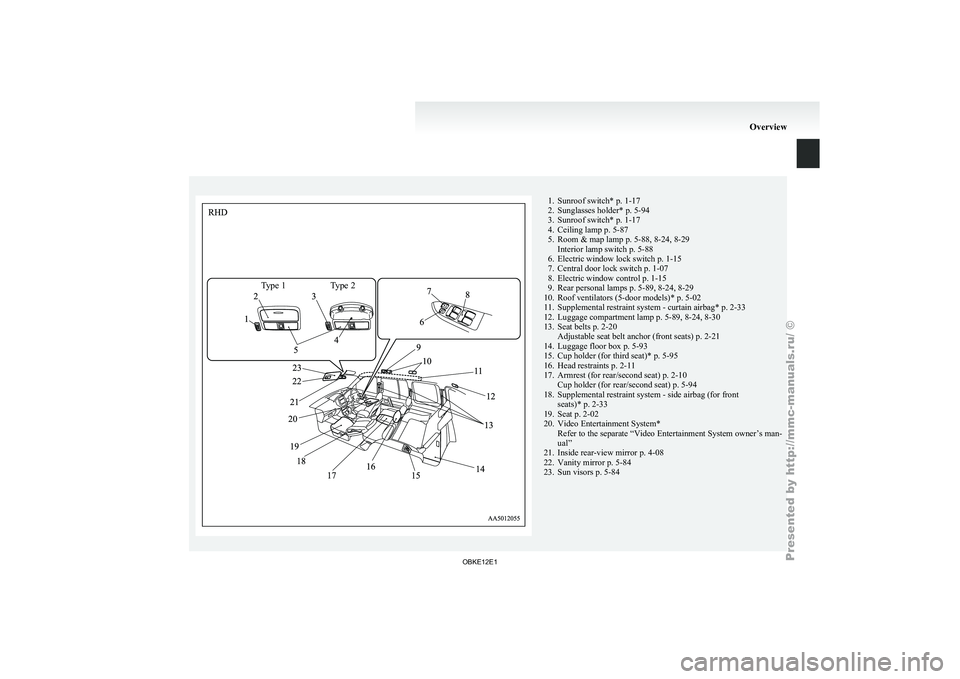
Type 1 Type 21. Sunroof switch* p. 1-17
2. Sunglasses holder* p. 5-94
3. Sunroof switch* p. 1-17
4.
Ceiling lamp p. 5-87
5. Room & map lamp p. 5-88, 8-24, 8-29 Interior lamp switch p. 5-88
6. Electric window lock switch p. 1-15
7. Central door lock switch p. 1-07
8. Electric window control p. 1-15
9. Rear personal lamps p. 5-89, 8-24, 8-29
10. Roof ventilators (5-door models)* p. 5-02
11. Supplemental restraint system - curtain airbag* p. 2-33
12. Luggage compartment lamp p. 5-89, 8-24, 8-30
13. Seat belts p. 2-20 Adjustable seat belt anchor (front seats) p. 2-21
14. Luggage floor box p. 5-93
15. Cup holder (for third seat)* p. 5-95
16. Head restraints p. 2-11
17. Armrest (for rear/second seat) p. 2-10 Cup holder (for rear/second seat) p. 5-94
18. Supplemental restraint system - side airbag (for front seats)* p. 2-33
19. Seat p. 2-02
20. Video Entertainment System* Refer to the separate “Video Entertainment System owner’s man-
ual”
21. Inside rear-view mirror p. 4-08
22. Vanity mirror p. 5-84
23. Sun visors p. 5-84 Overview
OBKE12E1
Page 10 of 377
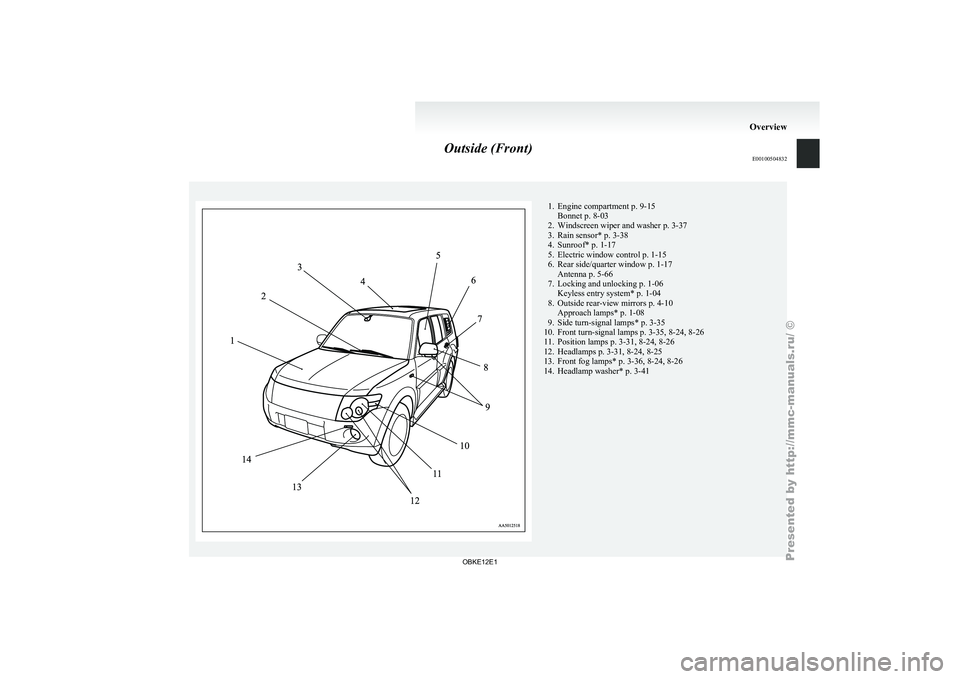
Outside (Front)
E00100504832 1. Engine compartment p. 9-15
Bonnet p. 8-03
2. Windscreen wiper and washer p. 3-37
3. Rain sensor* p. 3-38
4.
Sunroof* p. 1-17
5. Electric window control p. 1-15
6. Rear side/quarter window p. 1-17 Antenna p. 5-66
7. Locking and unlocking p. 1-06 Keyless entry system* p. 1-04
8. Outside rear-view mirrors p. 4-10 Approach lamps* p. 1-08
9. Side turn-signal lamps* p. 3-35
10. Front turn-signal lamps p. 3-35, 8-24, 8-26
11. Position lamps p. 3-31, 8-24, 8-26
12. Headlamps p. 3-31, 8-24, 8-25
13. Front fog lamps* p. 3-36, 8-24, 8-26
14. Headlamp washer* p. 3-41 Overview
OBKE12E1
Page 18 of 377
Keys..............................................................................................
1-02
Electronic immobilizer (Anti-theft starting system) .....................1-03
Keyless entry system*.................................................................. 1-04
Doors............................................................................................ 1-06
Central door locks ......................................................................... 1-07
“Child-protection” rear doors (5-door models) ............................1-08
Approach lamps*.......................................................................... 1-08
Backdoor....................................................................................... 1-09
Security alarm system* .................................................................1-10
Electric window control................................................................1-15 Rear side/quarter window ............................................................. 1-17
Sunroof* ....................................................................................... 1-17Locking and unlocking
1
OBKE12E1
Page 27 of 377
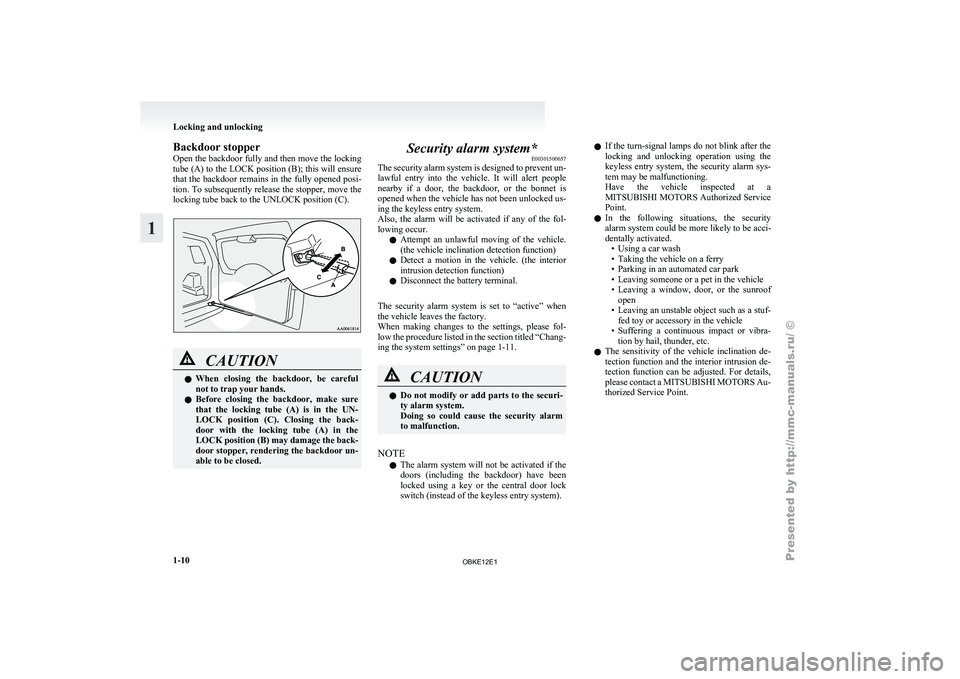
Backdoor stopper
Open the
backdoor
fully and then move the locking
tube (A) to the LOCK position (B); this will ensure
that the backdoor remains in the fully opened posi-
tion. To subsequently release the stopper, move the
locking tube back to the UNLOCK position (C). CAUTION
l
When closing the
backdoor, be careful
not to trap your hands.
l Before closing the backdoor, make sure
that the locking tube (A) is in the UN-
LOCK position (C). Closing the back-
door with the locking tube (A) in the
LOCK position (B) may damage the back-
door stopper, rendering the backdoor un-
able to be closed. Security alarm system*
E00301500657
The security alarm
system is designed to prevent un-
lawful entry into the vehicle. It will alert people
nearby if a door, the backdoor, or the bonnet is
opened when the vehicle has not been unlocked us-
ing the keyless entry system.
Also, the alarm will be activated if any of the fol-
lowing occur.
l Attempt an unlawful moving of the vehicle.
(the vehicle inclination detection function)
l Detect a motion in the vehicle. (the interior
intrusion detection function)
l Disconnect the battery terminal.
The security alarm system is set to “active” when
the vehicle leaves the factory.
When making changes to the settings, please fol-
low the procedure listed in the section titled “Chang-
ing the system settings” on page 1-11. CAUTION
l
Do not
modify
or add parts to the securi-
ty alarm system.
Doing so could cause the security alarm
to malfunction.
NOTE l The
alarm system
will not be activated if the
doors (including the backdoor) have been
locked using a key or the central door lock
switch (instead of the keyless entry system). l
If the
turn-signal
lamps do not blink after the
locking and unlocking operation using the
keyless entry system, the security alarm sys-
tem may be malfunctioning.
Have the vehicle inspected at a
MITSUBISHI MOTORS Authorized Service
Point.
l In the following situations, the security
alarm system could be more likely to be acci-
dentally activated.
• Using a car wash
• Taking the vehicle on a ferry
• Parking in an automated car park
• Leaving someone or a pet in the vehicle
• Leaving a window, door, or the sunroofopen
• Leaving an unstable object such as a stuf- fed toy or accessory in the vehicle
• Suffering a continuous impact or vibra- tion by hail, thunder, etc.
l The sensitivity of the vehicle inclination de-
tection function and the interior intrusion de-
tection function can be adjusted. For details,
please contact a MITSUBISHI MOTORS Au-
thorized Service Point. Locking and unlocking
1-10
1
OBKE12E1
Page 34 of 377
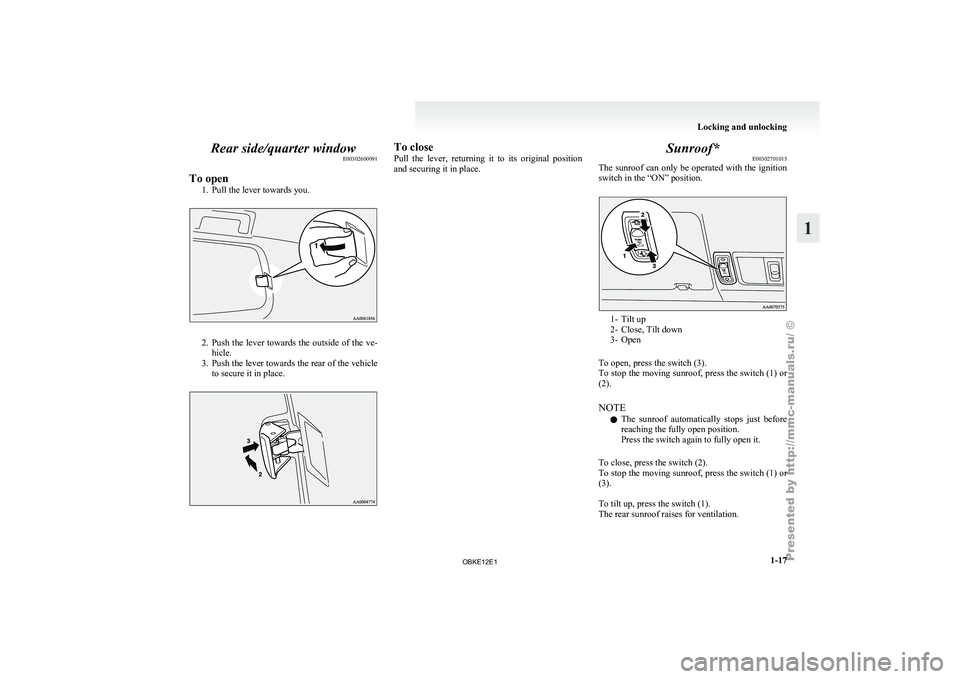
Rear side/quarter window
E00302600091
To open 1. Pull the lever towards you. 2. Push the lever towards the outside of the ve-
hicle.
3. Push
the lever towards the rear of the vehicle
to secure it in place. To close
Pull the
lever,
returning it to its original position
and securing it in place. Sunroof*
E00302701015
The sunroof can
only be operated with the ignition
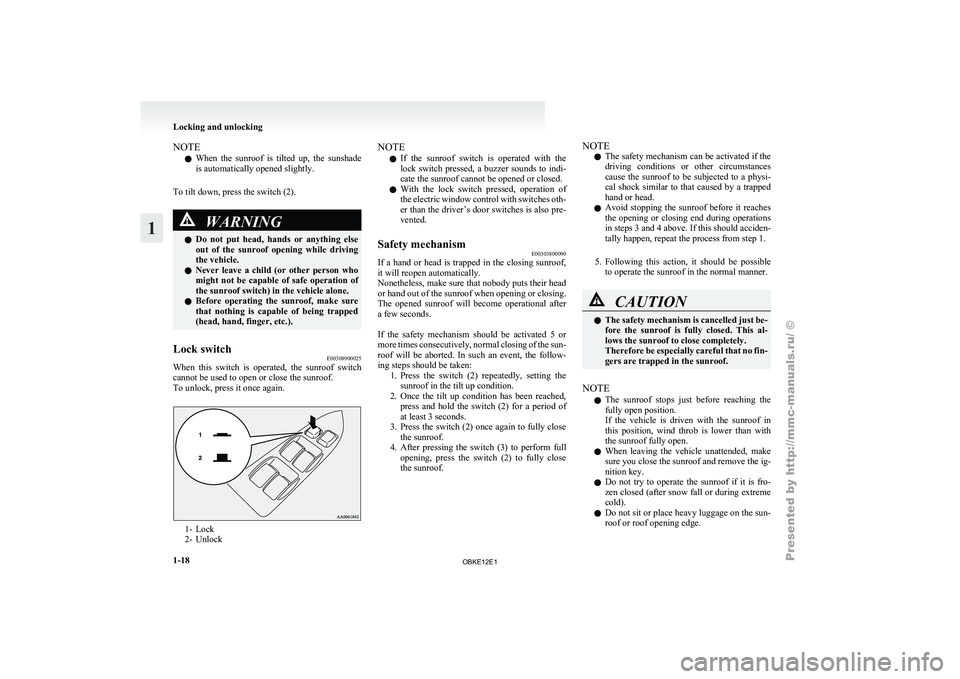
switch in the “ON” position. 1- Tilt up
2- Close, Tilt down
3-
Open
To open, press the switch (3).
To
stop the moving sunroof, press the switch (1) or
(2).
NOTE
l The sunroof automatically stops just before
reaching the fully open position.
Press the switch again to fully open it.
To close, press the switch (2).
To stop the moving sunroof, press the switch (1) or
(3).
To tilt up, press the switch (1).
The rear sunroof raises for ventilation. Locking and unlocking
1-17 1
OBKE12E1
Page 35 of 377
NOTE
l When
the sunroof
is tilted up, the sunshade
is automatically opened slightly.
To tilt down, press the switch (2). WARNING
l Do not
put
head, hands or anything else
out of the sunroof opening while driving
the vehicle.
l Never leave a child (or other person who
might not be capable of safe operation of
the sunroof switch) in the vehicle alone.
l Before operating the sunroof, make sure
that nothing is capable of being trapped
(head, hand, finger, etc.).
Lock switch E00308900025
When this switch is operated, the sunroof switch
cannot be used to open or close the sunroof.
To unlock, press it once again. 1- Lock
2- Unlock NOTE
l If
the sunroof
switch is operated with the
lock switch pressed, a buzzer sounds to indi-
cate the sunroof cannot be opened or closed.
l With the lock switch pressed, operation of
the electric window control with switches oth-
er than the driver’s door switches is also pre-
vented.
Safety mechanism E00303800090
If a hand or head is trapped in the closing sunroof,
it will reopen automatically.
Nonetheless, make sure
that nobody puts their head
or hand out of the sunroof when opening or closing.
The opened sunroof will become operational after
a few seconds.
If the safety mechanism should be activated 5 or
more times consecutively, normal closing of the sun-
roof will be aborted. In such an event, the follow-
ing steps should be taken: 1. Press the switch (2) repeatedly, setting thesunroof in the tilt up condition.
2. Once the tilt up condition has been reached, press and hold the switch (2) for a period of
at least 3 seconds.
3. Press the switch (2) once again to fully close the sunroof.
4. After pressing the switch (3) to perform full opening, press the switch (2) to fully close
the sunroof. NOTE
l The
safety mechanism
can be activated if the
driving conditions or other circumstances
cause the sunroof to be subjected to a physi-
cal shock similar to that caused by a trapped
hand or head.
l Avoid stopping the sunroof before it reaches
the opening or closing end during operations
in steps 3 and 4 above. If this should acciden-
tally happen, repeat the process from step 1.
5. Following this action, it should be possible to operate the sunroof in the normal manner. CAUTION
l
The safety
mechanism
is cancelled just be-
fore the sunroof is fully closed. This al-
lows the sunroof to close completely.
Therefore be especially careful that no fin-
gers are trapped in the sunroof.
NOTE l The
sunroof stops
just before reaching the
fully open position.
If the vehicle is driven with the sunroof in
this position, wind throb is lower than with
the sunroof fully open.
l When leaving the vehicle unattended, make
sure you close the sunroof and remove the ig-
nition key.
l Do not try to operate the sunroof if it is fro-
zen closed (after snow fall or during extreme
cold).
l Do not sit or place heavy luggage on the sun-
roof or roof opening edge. Locking and unlocking
1-18
1
OBKE12E1
Page 36 of 377
l
Release the
switch as soon as the sunroof rea-
ches the fully open or fully closed position.
l If the sunroof does not operate when the sun-
roof switch is operated, release the switch
and check whether something is trapped by
the sunroof. If nothing is trapped, we recom-
mend you to have the sunroof checked.
l Depending on the model of ski carriers or
roof carriers, the sunroof may make contact
with the carrier when the sunroof is tilted up.
Be careful when tilting up the sunroof if such
a ski carrier or a roof carrier is installed.
l Be sure to close the sunroof completely
when washing the vehicle or when leaving
the vehicle.
l Be careful, not to put any wax on the weath-
erstrip (black rubber) around the sunroof
opening. If stained with wax, the weather-
strip cannot maintain a weatherproof seal
with the sunroof.
l After washing the vehicle or after it has
rained, wipe off any water that is on the sun-
roof before operating it.
l Operating the sunroof repeatedly with the en-
gine stationary will run down the battery. Op-
erate the sunroof while the engine is running. Sunshade
E00307900103
Slide the sunshade manually to open and close it. CAUTION
l
Be careful that
hands are not trapped
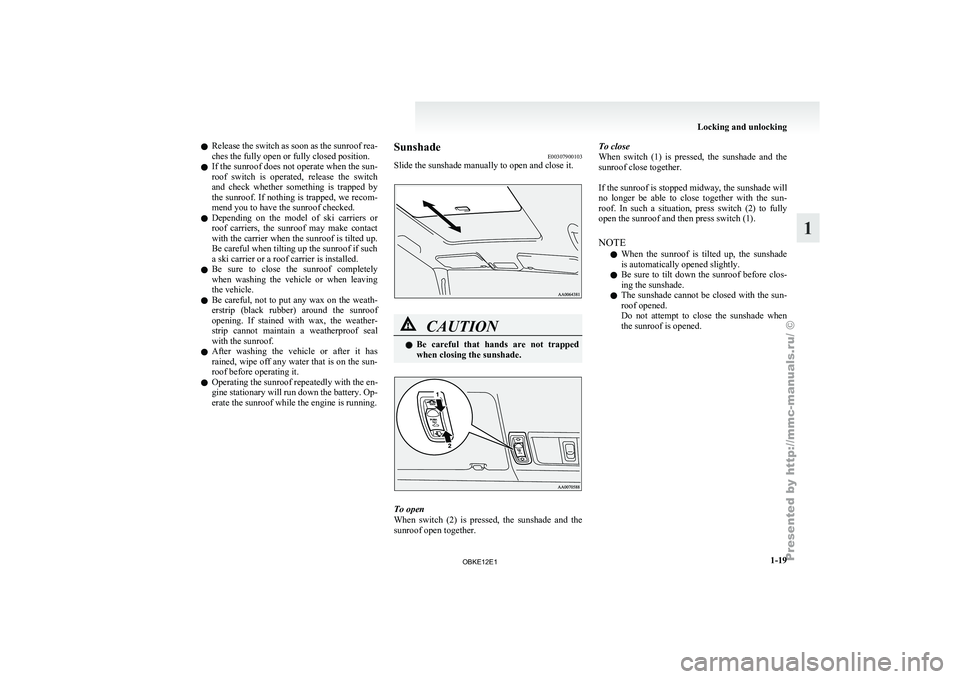
when closing the sunshade. To open
When switch
(2)
is pressed, the sunshade and the
sunroof open together. To close
When switch
(1)
is pressed, the sunshade and the
sunroof close together.
If the sunroof is stopped midway, the sunshade will
no longer be able to close together with the sun-
roof. In such a situation, press switch (2) to fully
open the sunroof and then press switch (1).
NOTE
l When the sunroof is tilted up, the sunshade
is automatically opened slightly.
l Be sure to tilt down the sunroof before clos-
ing the sunshade.
l The sunshade cannot be closed with the sun-
roof opened.
Do not attempt to close the sunshade when
the sunroof is opened. Locking and unlocking
1-19 1
OBKE12E1
Page 76 of 377
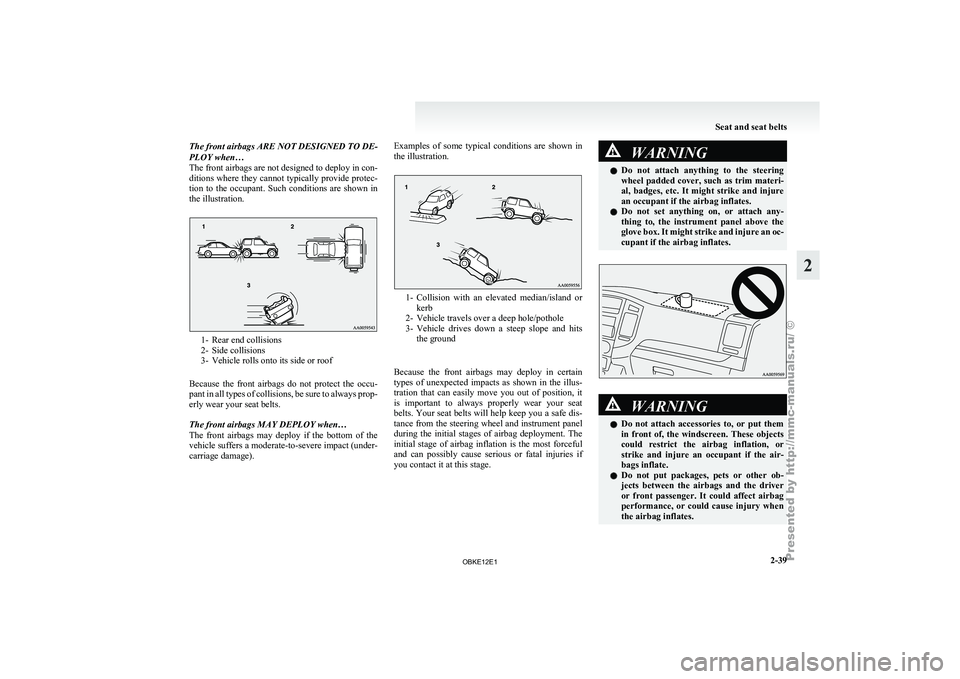
The front airbags ARE NOT DESIGNED TO DE-
PLOY when…
The front airbags
are not designed to deploy in con-
ditions where they cannot typically provide protec-
tion to the occupant. Such conditions are shown in
the illustration. 1- Rear end collisions
2- Side collisions
3-
Vehicle rolls onto its side or roof
Because
the front airbags do not protect the occu-
pant in all types of collisions, be sure to always prop-
erly wear your seat belts.
The front airbags MAY DEPLOY when…
The front airbags may deploy if the bottom of the
vehicle suffers a moderate-to-severe impact (under-
carriage damage). Examples of some typical conditions are shown in
the illustration.
1- Collision with
an
elevated median/island or
kerb
2- Vehicle travels over a deep hole/pothole
3- Vehicle drives down a steep slope and hits the ground
Because the front airbags may deploy in certain
types of unexpected impacts as shown in the illus-
tration that can easily move you out of position, it
is important to always properly wear your seat
belts. Your seat belts will help keep you a safe dis-
tance from the steering wheel and instrument panel
during the initial stages of airbag deployment. The
initial stage of airbag inflation is the most forceful
and can possibly cause serious or fatal injuries if
you contact it at this stage. WARNING
l Do not attach
anything to the steering
wheel padded cover, such as trim materi-
al, badges, etc. It might strike and injure
an occupant if the airbag inflates.
l Do not set anything on, or attach any-
thing to, the instrument panel above the
glove box. It might strike and injure an oc-
cupant if the airbag inflates. WARNING
l Do not
attach
accessories to, or put them
in front of, the windscreen. These objects
could restrict the airbag inflation, or
strike and injure an occupant if the air-
bags inflate.
l Do not put packages, pets or other ob-
jects between the airbags and the driver
or front passenger. It could affect airbag
performance, or could cause injury when
the airbag inflates. Seat and seat belts
2-39 2
OBKE12E1
Page 77 of 377
WARNING
l Right after the airbag inflation, several
airbag system components will be hot. Do
not touch them; you could be burned.
l The airbag system is designed to work on-
ly once. Once the airbags have deployed,
they will not work again. They must
promptly be replaced, and we recom-
mend you to have the entire airbag sys-
tem inspected by a MITSUBISHI
MOTORS Authorized Service Point.
Side airbag system* E00407600198
The side airbags (A) are contained in the driver and
front passenger seatbacks.
The side airbag
is designed to inflate only on the
side of the vehicle that is impacted, even with no
passenger in the front seat. The label shown here is attached to the seatbacks
with a side airbag.
Curtain airbag system*
E00409100243
The curtain airbags are contained in the front pil-
lars and roof
side rail. The curtain airbag is de-
signed to inflate only on the side of the vehicle that
is impacted, even with no passenger in the front
seat or rear (3-door models)/second (5-door mod-
els) seat. Deployment of side airbags and cur-
tain airbags
E00407701301
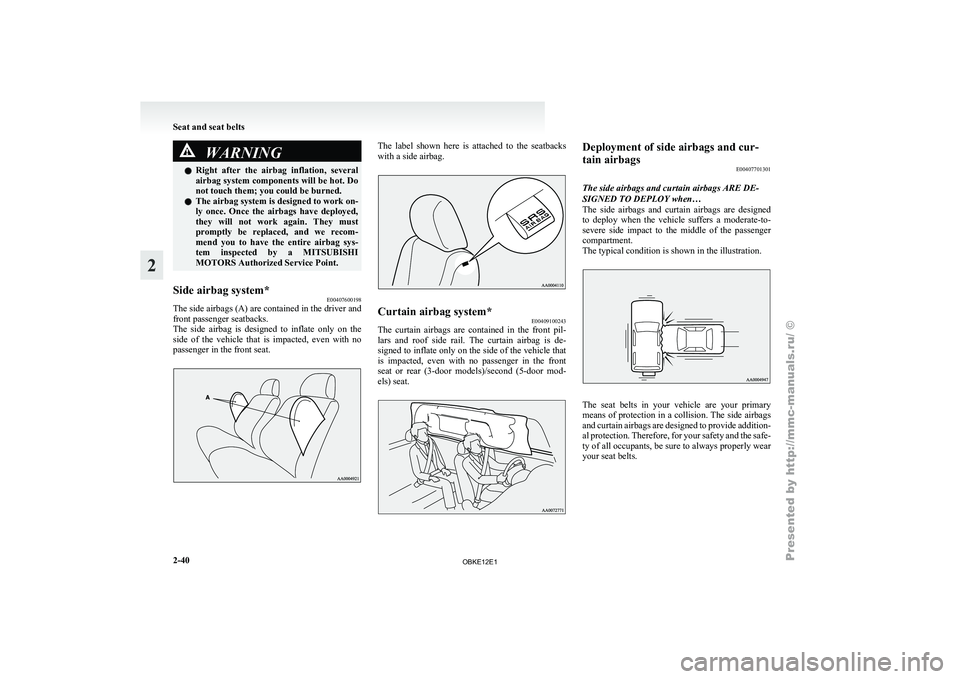
The side airbags and curtain airbags ARE DE-
SIGNED TO DEPLOY when…
The side airbags
and curtain airbags are designed
to deploy when the vehicle suffers a moderate-to-
severe side impact to the middle of the passenger
compartment.
The typical condition is shown in the illustration. The seat belts in your vehicle are your primary
means of
protection
in a collision. The side airbags
and curtain airbags are designed to provide addition-
al protection. Therefore, for your safety and the safe-
ty of all occupants, be sure to always properly wear
your seat belts. Seat and seat belts
2-40
2
OBKE12E1