belt MITSUBISHI PAJERO IV 2011 Workshop Manual
[x] Cancel search | Manufacturer: MITSUBISHI, Model Year: 2011, Model line: PAJERO IV, Model: MITSUBISHI PAJERO IV 2011Pages: 377, PDF Size: 29.43 MB
Page 283 of 377
If the vehicle breaks down
E00800101179
If the vehicle
breaks down on the road, move it to
the shoulder and use the hazard warning flashers and/
or the warning triangle etc. Refer to “Hazard warn-
ing flasher switch” on page 3-35.
If the engine stops/fails
Vehicle operation and control are affected if the en-
gine stops. Before moving the vehicle to a safe
area, be aware of the following:
l The brake booster becomes inoperative and
the pedal effort will increase. Press down the
brake pedal harder than usual.
l Since the power steering pump is no longer
operative, the steering wheel feels heavy
when turning it. Emergency starting
E00800502587
If the engine
cannot be started because the battery
is weak or dead, the battery from another vehicle
can be used with jumper cables to start the engine. WARNING
l To start
the
engine using jumper cables
connected to another vehicle, perform the
correct procedures according to the in-
struction below. Incorrect procedures
could result in a fire or explosion or dam-
age to the vehicles. CAUTION
l
Do not attempt
to start the engine by pull-
ing or pushing the vehicle. It could dam-
age your vehicle.
l Always wear protective eye goggles when
working near the battery.
l Keep the battery out of the reach of chil-
dren.
1. Get the vehicles close enough so the jumper
cables can
reach, but be sure the vehicles
aren’t touching each other. CAUTION
l
Check the
other
vehicle. It must have a 12-
volt battery.
If the other system isn’t 12-volt, shorting
can damage both vehicles. 2. Set the parking brake firmly on each vehicle.
Put an
A/T in “P” (PARK) or a M/T in “N”
(Neutral). Turn off the ignition switch. WARNING
l Turn off
the
ignition on both vehicles be-
forehand. Make sure that the cables or
your clothes cannot be caught by the fan
or drive belt. Personal injury could result.
3. Turn off all lamps, heater and other electrical
loads.
4. Make
sure battery electrolyte is at the proper
level. Refer to “Battery” on page 8-10. WARNING
l If electrolyte
fluid
is not visible, or ap-
pears to be frozen, Do Not Attempt Jump
Starting!
A battery might rupture or explode if the
temperature is below the freezing point
or if it is not filled to the proper level.
5. Connect one end of one jumper cable to the
positive (+)
terminal of the discharged bat-
tery (A or B), and the other end to the posi-
tive (+) terminal of the booster battery (C). For emergencies
6-02
6
OBKE12E1
Page 286 of 377
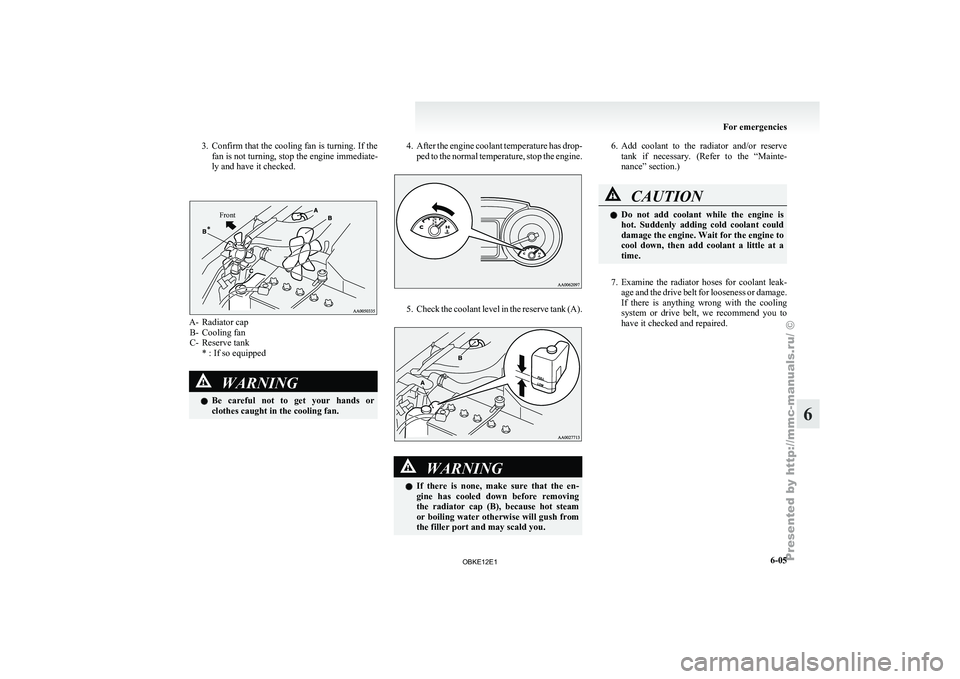
3. Confirm that the cooling fan is turning. If the
fan is not turning, stop the engine immediate-
ly and have it checked.Front A- Radiator cap
B- Cooling fan
C- Reserve tank
* : If so equipped WARNING
l Be careful
not
to get your hands or
clothes caught in the cooling fan. 4. After the engine coolant temperature has drop-
ped to
the normal temperature, stop the engine. 5. Check the coolant level in the reserve tank (A).
WARNING
l If there
is
none, make sure that the en-
gine has cooled down before removing
the radiator cap (B), because hot steam
or boiling water otherwise will gush from
the filler port and may scald you. 6. Add coolant to the radiator and/or reserve
tank if
necessary. (Refer to the “Mainte-
nance” section.) CAUTION
l
Do not
add
coolant while the engine is
hot. Suddenly adding cold coolant could
damage the engine. Wait for the engine to
cool down, then add coolant a little at a
time.
7. Examine the radiator hoses for coolant leak-
age and
the drive belt for looseness or damage.
If there is anything wrong with the cooling
system or drive belt, we recommend you to
have it checked and repaired. For emergencies
6-05 6
OBKE12E1
Page 309 of 377
Service precautions
E01000100764
Adequate care of
your vehicle at regular intervals
serves to preserve the value and appearance as long
as possible.
Maintenance items as described in this owner’s man-
ual can be performed by the owner.
We recommend you to have the periodic inspection
and maintenance performed by a MITSUBISHI
MOTORS Authorized Service Point or another spe-
cialist. In the event a malfunction or other problem
is discovered, we recommend you to have it
checked and repaired. This section contains infor-
mation on inspection maintenance procedures that
you can do yourself.
Follow the instructions and cautions for each of the
various procedures. WARNING
l When checking
or
servicing the inside of
the engine compartment, make sure the
engine is switched off and has had a
chance to cool down.
l If it is necessary to do work in the engine
compartment with the engine running, be
especially careful that your clothing, hair,
etc., does not become caught by the fans,
drive belts, or other moving parts.
l Do not smoke, cause sparks or allow open
flames around fuel or battery. The fumes
are flammable.
l Be extremely cautious when working
around the battery. It contains poisonous
and corrosive sulphuric acid. WARNING
l Do not get
under your vehicle with just
the body jack supporting it. Always use
automotive jack stands.
l Improper handling of components and
materials used in the vehicle can endan-
ger your personal safety. We recommend
you to consult a specialist for necessary in-
formation. Catalytic converter
E01000201355
For ordinary use,
there are no particular precau-
tions except that of using unleaded petrol.
The exhaust gas scavenging devices used with the
catalytic converter are extremely efficient for the re-
duction of noxious gases. The catalytic converter is
installed in the exhaust system.
It is important to keep the engine properly tuned to
ensure proper catalyst operation and prevent possi-
ble catalyst damage. WARNING
l As with
any
vehicle, do not park or oper-
ate this vehicle in areas where combusti-
ble materials such as dry grass or leaves
can come in contact with a hot exhaust
since a fire could occur.
l Paint should not be applied to the catalyt-
ic converter.
NOTE l In
case of
the petrol-powered vehicles, use
UNLEADED PETROL ONLY of the type
recommended in “Fuel selection” on page 02. Maintenance
8-02
8
OBKE12E1
Page 361 of 377
Seat belt 2-20
Adjustable seat belt anchor 2-21Child restraint 2-23
Force limiter system 2-23
Inspection 2-33
Pregnant women restraint
2-22
Pretensioner system 2-23
Rear/second, third seat belt storage 2-22
Seat belt reminder/warning lamp 2-21
Seats Adjustment 2-05
Armrest 2-08,2-10
Front seats 2-05
Head restraints 2-11
Heated seats 2-08
Lumbar support 2-07
Making a flat seat 2-18
Making a luggage area 2-12
Rear seats 2-09
Seat arrangement 2-03
Second seats 2-09
Third seat 2-11
Security alarm system 1-10
Service precaution 8-02
Service reminder 3-02,3-03
Side airbag system 2-40
Side box 5-93
Snow tyres 8-15
Spark plug 9-11
Specifications 9-02
Starting 4-14
Steering Power steering fluid 8-10,9-15
Power steering system 4-41
Steering wheel height adjustment 4-08
Steering wheel lock 4-13
Steering wheel remote control switch 5-57
Stop lamps Bulb capacity 8-24 Replacement 8-27
Storage spaces 5-91
Sun visors 5-84
Sunglasses holder 5-94
Sunroof 1-17 Lock switch 1-18
Safety mechanism 1-18
Sunshade 1-19
Super select 4WD II 4-24
Supplemental restraint system 2-33 How the Supplemental Restraint System
works 2-34
Servicing 2-43
Warning lamp 2-43
T Tachometer 3-02
Tail lamps
Bulb capacity 8-24
Replacement 8-27
Tank capacity
03
Third seat 2-11
Tools 6-07 Storage 6-07
Towing 6-15
Trailer towing 4-57
Transfer oil 9-15
Transmission Automatic transmission 4-19
Manual transmission 4-16
Tripmeter 3-02
Turn-signal indication lamps 3-08
Turn-signal lever 3-35
Tyres 8-12 How to change a tyre 6-09
Inflation pressures 8-13
Rotation 8-14
Size (tyre and wheel) 9-12 Snow tyres 8-15
Spare wheel information 6-09
Tyre chains 8-15
U USB input terminal 5-82
Used engine
oils
safety instructions and disposal in-
formation 06
V Vanity mirror 5-84
Vanity mirror lamps
Bulb capacity 8-24
Replacement 8-31
Vehicle care precautions
7-02
Vehicle dimensions 9-04
Vehicle identification number 9-02
Vehicle identification number plate 9-02
Vehicle information code plate 9-02
Vehicle labeling 9-02
Vehicle performance 9-06
Vehicle weight 9-07
Ventilators 5-02
W Warning lamps 3-09
Washer
Fluid 8-07,9-15
Switch 3-37,3-41
Washing 7-03
Water temperature gauge 3-05
Waxing 7-04
Weatherstripping 8-19
Weight 9-07
Wheel condition
8-14
Wheel Alphabetical index
4
OBKE12E1