ECO mode MITSUBISHI PAJERO IV 2011 Manual Online
[x] Cancel search | Manufacturer: MITSUBISHI, Model Year: 2011, Model line: PAJERO IV, Model: MITSUBISHI PAJERO IV 2011Pages: 377, PDF Size: 29.43 MB
Page 278 of 377
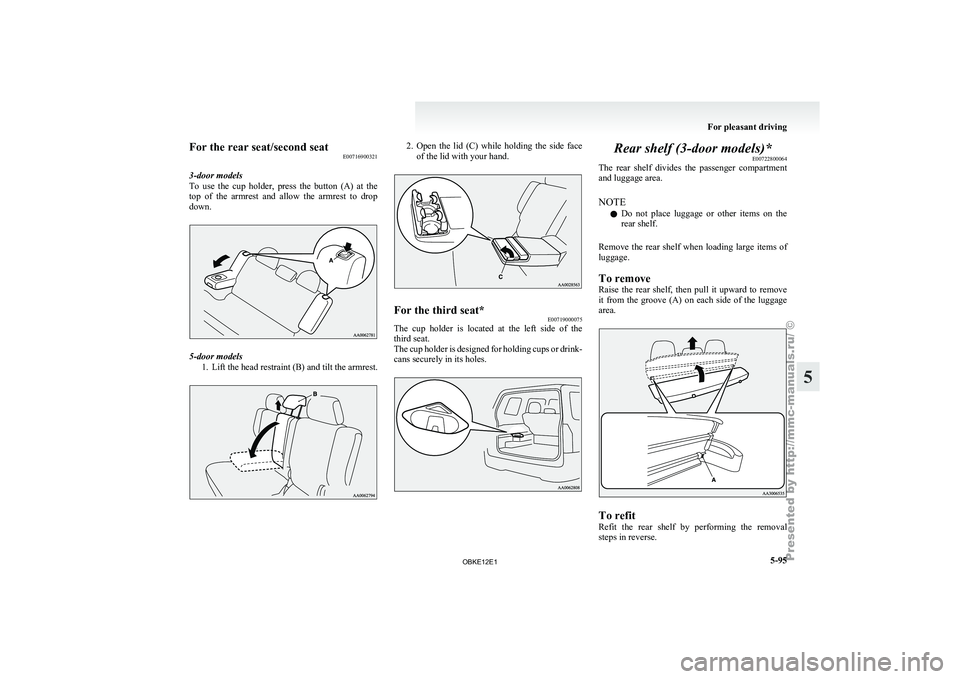
For the rear seat/second seat
E00716900321
3-door models
To use the
cup holder, press the button (A) at the
top of the armrest and allow the armrest to drop
down. 5-door models
1. Lift the head
restraint (B) and tilt the armrest. 2. Open the lid (C) while holding the side face
of the lid with your hand. For the third seat*
E00719000075
The cup holder is located at the left side of the
third seat.
The cup holder
is designed for holding cups or drink-
cans securely in its holes. Rear shelf (3-door models)*
E00722800064
The rear shelf
divides the passenger compartment
and luggage area.
NOTE
l Do not place luggage or other items on the
rear shelf.
Remove the rear shelf when loading large items of
luggage.
To remove
Raise the rear shelf, then pull it upward to remove
it from the groove (A) on each side of the luggage
area. To refit
Refit the rear
shelf by performing the removal
steps in reverse. For pleasant driving
5-95 5
OBKE12E1
Page 280 of 377
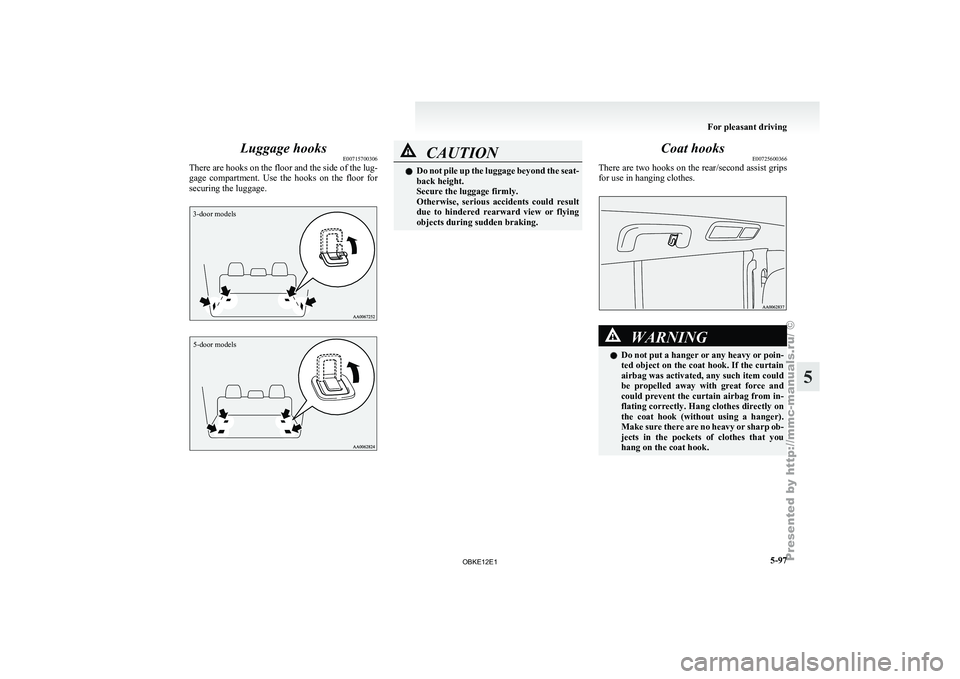
Luggage hooks
E00715700306
There are hooks
on the floor and the side of the lug-
gage compartment. Use the hooks on the floor for
securing the luggage.
3-door models
5-door models CAUTION
l
Do not pile
up the luggage beyond the seat-
back height.
Secure the luggage firmly.
Otherwise, serious accidents could result
due to hindered rearward view or flying
objects during sudden braking. Coat hooks
E00725600366
There are two
hooks on the rear/second assist grips
for use in hanging clothes. WARNING
l Do not
put
a hanger or any heavy or poin-
ted object on the coat hook. If the curtain
airbag was activated, any such item could
be propelled away with great force and
could prevent the curtain airbag from in-
flating correctly. Hang clothes directly on
the coat hook (without using a hanger).
Make sure there are no heavy or sharp ob-
jects in the pockets of clothes that you
hang on the coat hook. For pleasant driving
5-97 5
OBKE12E1
Page 311 of 377
CAUTION
l
Be careful that hands or fingers are not
trapped when closing the bonnet. Engine oil
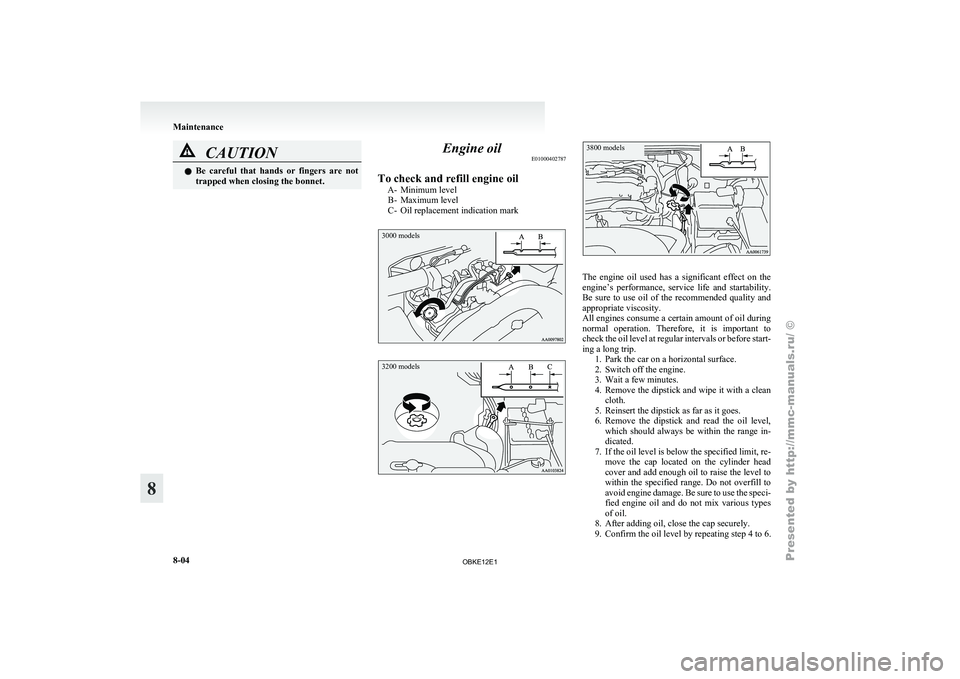
E01000402787
To check and refill engine oil A- Minimum level
B- Maximum level
C-
Oil replacement indication mark
3000 models
3200 models
3800 models The engine oil used has a significant effect on the
engine’s performance,
service
life and startability.
Be sure to use oil of the recommended quality and
appropriate viscosity.
All engines consume a certain amount of oil during
normal operation. Therefore, it is important to
check the oil level at regular intervals or before start-
ing a long trip. 1. Park the car on a horizontal surface.
2. Switch off the engine.
3. Wait a few minutes.
4. Remove the dipstick and wipe it with a cleancloth.
5. Reinsert the dipstick as far as it goes.
6. Remove the dipstick and read the oil level, which should always be within the range in-
dicated.
7. If the oil level is below the specified limit, re- move the cap located on the cylinder head
cover and add enough oil to raise the level to
within the specified range. Do not overfill to
avoid engine damage. Be sure to use the speci-
fied engine oil and do not mix various types
of oil.
8. After adding oil, close the cap securely.
9. Confirm the oil level by repeating step 4 to 6. Maintenance
8-04
8
OBKE12E1
Page 312 of 377
Use only the recommended oils with an ACEA or
API classification as specified in this manual.
NOTE
l For
3200 models,
check or refill the oil ac-
cording to the following manner. • When the oil level is checked in step 6above, check it on a low side of the dip-
stick because it is different in appearance
of oil level in the two sides of the dipstick.
• On vehicles without diesel particulate fil- ter (DPF), the oil level should be within
the range (A) to (B) on the dipstick.
• On vehicles with DPF, the oil level should be within the range (A) to (C) (oil
replacement indication mark) on the dip-
stick.
If the oil level is beyond the oil replace-
ment indication mark (C), replace the oil
as soon as possible.
Then, the oil should be refilled to the max-
imum level (B).
• On vehicles with DPF, the engine oil will increase due to a little fuel getting mixed
in the engine oil when the DPF regener-
ates to burn away the PM (particulate mat-
ter). However, it does not indicate a mal-
function.
l The engine oil will deteriorate rapidly if the
vehicle is subjected to severe conditions, re-
quiring earlier oil replacement. Please refer
to the maintenance schedule.
l For handling of used engine oils, refer to
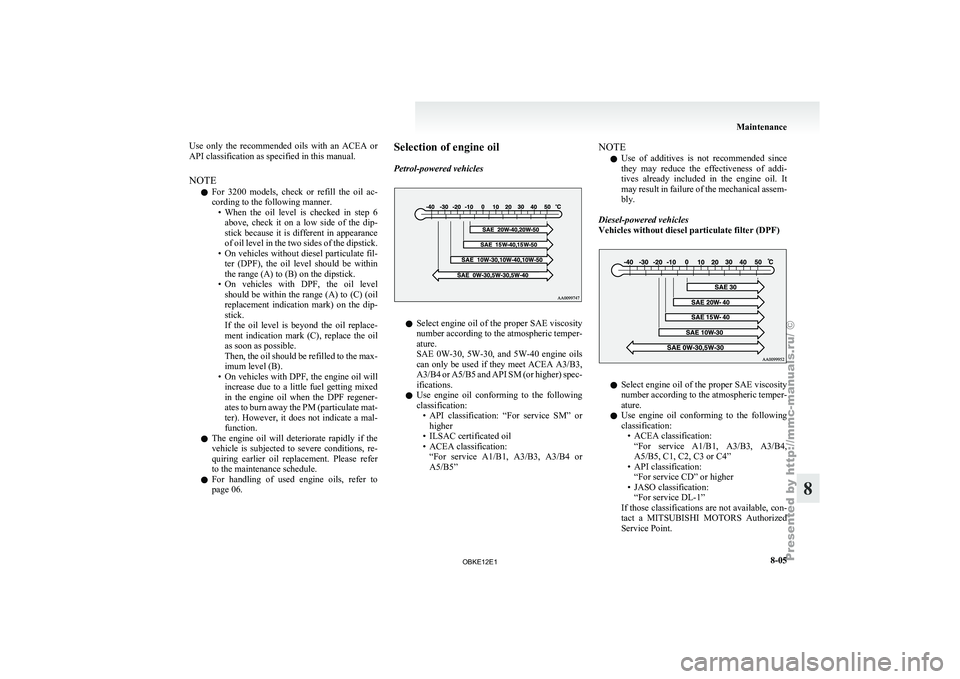
page 06. Selection of engine oil
Petrol-powered vehicles
l
Select engine
oil
of the proper SAE viscosity
number according to the atmospheric temper-
ature.
SAE 0W-30, 5W-30, and 5W-40 engine oils
can only be used if they meet ACEA A3/B3,
A3/B4 or A5/B5 and API SM (or higher) spec-
ifications.
l Use engine oil conforming to the following
classification:
• API classification: “For service SM” orhigher
• ILSAC certificated oil
• ACEA classification: “For service A1/B1, A3/B3, A3/B4 or
A5/B5” NOTE
l Use
of additives
is not recommended since
they may reduce the effectiveness of addi-
tives already included in the engine oil. It
may result in failure of the mechanical assem-
bly.
Diesel-powered vehicles
Vehicles without diesel particulate filter (DPF) l
Select engine
oil
of the proper SAE viscosity
number according to the atmospheric temper-
ature.
l Use engine oil conforming to the following
classification:
• ACEA classification:“For service A1/B1, A3/B3, A3/B4,
A5/B5, C1, C2, C3 or C4”
• API classification: “For service CD” or higher
• JASO classification: “For service DL-1”
If those classifications are not available, con-
tact a MITSUBISHI MOTORS Authorized
Service Point. Maintenance
8-05 8
OBKE12E1
Page 347 of 377
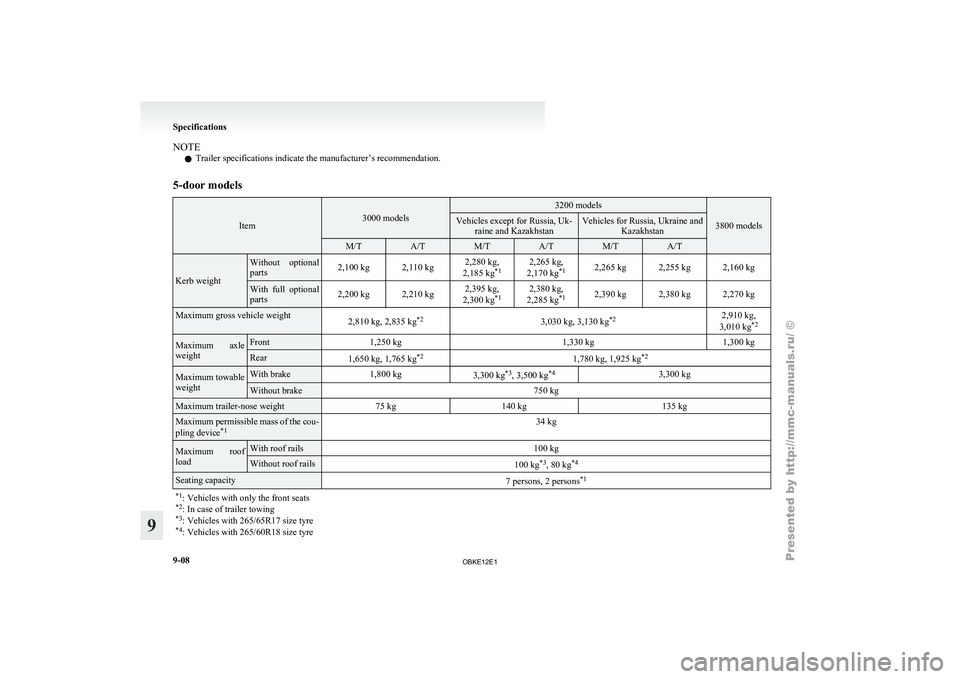
NOTE
l Trailer specifications indicate the manufacturer’s recommendation.
5-door models Item 3000 models 3200 models
3800 modelsVehicles except for Russia, Uk-
raine and Kazakhstan Vehicles for Russia, Ukraine and
Kazakhstan M/T A/T M/T A/T M/T A/T
Kerb weight Without optional
parts
2,100 kg 2,110 kg 2,280 kg,
2,185 kg *1 2,265 kg,
2,170 kg *1
2,265 kg 2,255 kg 2,160 kg With full optional
parts
2,200 kg 2,210 kg 2,395 kg,
2,300 kg *1 2,380 kg,
2,285 kg *1
2,390 kg 2,380 kg 2,270 kgMaximum gross vehicle weight
2,810 kg, 2,835 kg*2
3,030 kg, 3,130 kg*2 2,910 kg,
3,010 kg *2 Maximum axle
weight Front
1,250 kg 1,330 kg1,300 kgRear
1,650 kg, 1,765 kg*2
1,780 kg, 1,925 kg*2Maximum towable
weight With brake
1,800 kg
3,300 kg*3
, 3,500 kg *4
3,300 kgWithout brake
750 kgMaximum trailer-nose weight
75 kg140 kg 135 kgMaximum permissible mass of the cou-
pling device
*1 34 kgMaximum roof
load With roof rails
100 kgWithout roof rails
100 kg*3
, 80 kg *4 Seating capacity
7 persons, 2 persons*1
*1 : Vehicles with only the front seats
*2 : In case of trailer towing
*3 : Vehicles with 265/65R17 size tyre
*4 : Vehicles with 265/60R18 size tyre Specifications
9-08
9
OBKE12E1
Page 358 of 377
A
Accessory (Installation) 04
Accessory socket 5-86
Active stability & traction control (ASTC) 4-41
Additional equipment
8-19
Air conditioning Front automatic air conditioning
5-03
Important operation tips for the air condition-
ing 5-11
Rear air conditioning 5-10
Air purifier (with deodorizing function) 5-12
Airbag 2-33
Antenna 5-66
Anti-lock brake system (ABS) 4-39 Warning lamp 4-40
Approach lamps 1-08
Armrest 2-08,2-10
Ashtray 5-85
Audio Error codes 5-59
Handling of compact discs 5-65
LW/MW/FM electronic tuning radio with CD au-
tochanger 5-26
LW/MW/FM electronic tuning radio with CD
player 5-12
Steering wheel remote control switch 5-57
Auto-cutout function 5-91
Automatic headlamp levelling 3-34
Automatic transmission Fluid 9-15
Selector lever operation 4-19
Selector lever position 4-20
Sports mode 4-21
BBackdoor 1-09 Battery 8-10
Charge warning display 3-10
Discharged battery (Emergency starting) 6-02
Specification 9-11
Bleeding the fuel system
6-06
Bluetooth® 2.0 interface 5-67
Bonnet 8-03
Brake Anti-lock brake 4-39
Brake assist system 4-38
Braking 4-37
Fluid 8-08,9-15
Parking brake 4-06
Power brakes 4-37
Warning lamp 3-09
Bulb capacity 8-24
C Card holder 5-84,5-93
Cargo loads 4-56
Catalytic converter 8-02
Cautions on handling of 4-wheel drive vehi-
cles 4-35
Central door locks 1-07
Centre console box 5-92
Centre information display
3-11
Changing a fuse 8-22
Charge warning display 3-10
Check engine warning lamp
3-10
Child restraint 2-23
Child-protection rear doors 1-08
Cigarette lighter 5-86
Cleaning Aluminium wheels 7-05
Chrome parts 7-05
Exterior of your vehicle 7-03
Genuine leather 7-02
Interior of your vehicle 7-02 Plastic, vinyl leather, etc 7-02
Polishing 7-04
Sunroof 7-05
Washing 7-03
Waxing 7-04
Clutch Fluid 8-09,9-15
Coat hooks 5-97
Combination headlamps and dipper switch 3-31
Convenient hook 5-96
Coolant (engine) 8-06,9-15
Cruise control 4-45
Cup holder 5-94
Curtain airbag system 2-40
D Daytime dipper button 3-06
Daytime running lamp 3-32
Demister (rear window) 3-42
Diesel particulate filter (DPF)
4-15
Diesel preheat indication lamp
3-08
Dimensions 9-04
Dipper (High/Low beam change) 3-32
Door ajar warning lamp 3-11
Door courtesy lamps 5-91,8-24 Replacement 8-30
Doors Central door locks 1-07
Child-protection 1-08
Lock and unlock 1-06
Driving, alcohol and drugs 4-02
E Economical driving 4-02
Electric window control 1-15
Switch 1-15
Timer function 1-16 Alphabetical index
1
OBKE12E1
Page 360 of 377
L
Labeling 9-02
Lamp monitor buzzer 3-32
Lamps
(headlamps,
fog lamp, etc.) auto-cutout func-
tion 3-32
Leakage (Fuel, engine coolant, oil and exhaust
gas) 8-18
Licence plate lamps Bulb capacity 8-24
Replacement 8-28
Link System 5-67
Low fuel warning lamp 3-05
Lubricants 9-15
Luggage compartment lamp 5-89 Bulb capacity 8-24
Replacement 8-30
Luggage floor box 5-93
Luggage hooks 5-97
LW/MW/FM electronic tuning radio with CD au-
tochanger 5-26
LW/MW/FM electronic tuning radio with CD play-
er 5-12
MMaking a flat seat 2-18
Making a luggage area 2-12
Manual transmission 4-16
Oil 9-15
Mirror Inside rear-view mirror 4-08
Outside rear-view mirrors 4-10
MIVEC engine 4-14
Modification/alterations to
the electrical or fuel sys-
tems 05 OOdometer 3-02
Oil pressure warning lamp 3-10
Oil
Differential oil 9-15
Engine oil 8-04
Manual transmission oil 9-15
Transfer oil 9-15
Operation under adverse driving conditions 6-18
Outside rear-view mirrors 4-10
Overheating 6-04
P Parking 4-07
Parking brake 4-06
Position lamps Bulb capacity 8-24
Indication lamp 3-08
Replacement
8-25
Power brakes 4-37
Power steering Fluid 8-10,9-15
System 4-41
Precautions to observe when using wipers and wash-
ers 3-41
Pregnant women restraint 2-22
Puncture (Tyre changing) 6-09
R Radio
LW/MW/FM electronic tuning
radio with CD au-
tochanger 5-26
LW/MW/FM electronic tuning radio with CD
player 5-12
Rear air conditioning 5-10 Rear combination lamps
Bulb capacity 8-24
Replacement 8-27
Rear differential lock
4-29
Rear fog lamp Bulb capacity 8-24
Indication lamp 3-08
Replacement 8-28
Switch 3-36
Rear personal lamp Bulb capacity 8-24
Replacement 8-29
Rear personal lamps 5-89
Rear shelf (3-door models) 5-95
Rear side/quarter window 1-17
Rear turn-signal lamps Bulb capacity 8-24
Replacement 8-27
Rear window demister switch 3-42
Rear-view camera 4-52
Rear-view mirror Inside 4-08
Outside 4-10
Refill capacities 9-15
Removal of water from the fuel filter 6-06
Replacement of lamp bulbs 8-23
Reversing lamps Bulb capacity 8-24
Replacement 8-27
Reversing sensor system 4-49
Roof carrier precaution 4-56
Room & map lamps 5-88 Bulb capacity 8-24
Replacement 8-29
Running-in recommendations 4-04
S Safe driving techniques 4-03 Alphabetical index
3
OBKE12E1