transfer MITSUBISHI PAJERO IV 2011 Owners Manual
[x] Cancel search | Manufacturer: MITSUBISHI, Model Year: 2011, Model line: PAJERO IV, Model: MITSUBISHI PAJERO IV 2011Pages: 377, PDF Size: 29.43 MB
Page 5 of 377
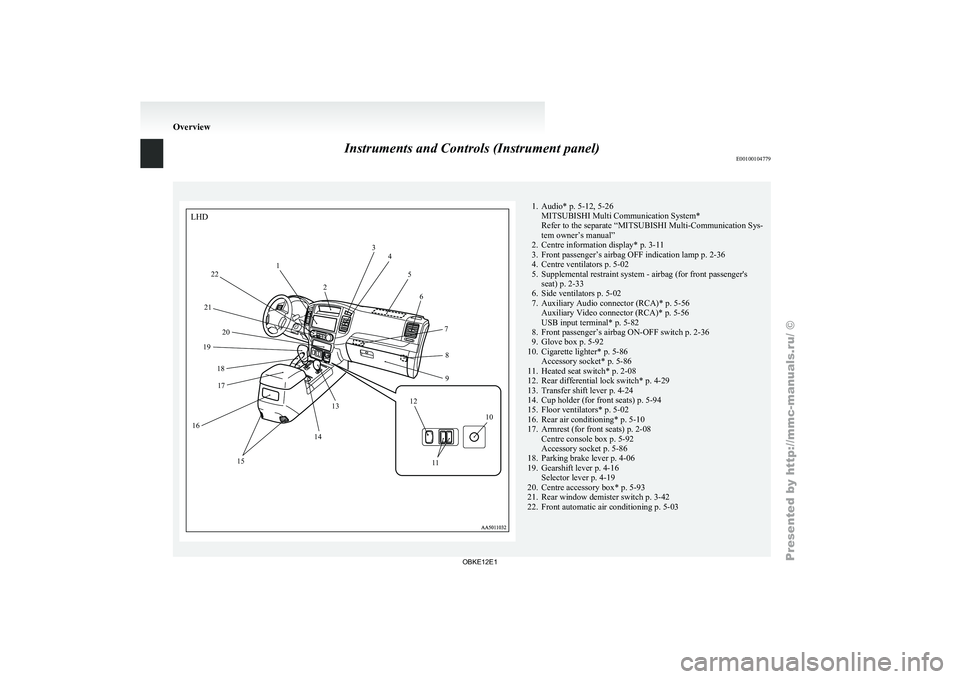
Instruments and Controls (Instrument panel)
E001001047791. Audio* p. 5-12, 5-26
MITSUBISHI Multi Communication System*
Refer to the separate “MITSUBISHI Multi-Communication Sys-
tem owner’s manual”
2. Centre information display*
p. 3-11
3. Front passenger’s airbag OFF indication lamp p. 2-36
4. Centre ventilators p. 5-02
5. Supplemental restraint system - airbag (for front passenger's seat) p. 2-33
6. Side ventilators p. 5-02
7. Auxiliary Audio connector (RCA)* p. 5-56 Auxiliary Video connector (RCA)* p. 5-56
USB input terminal* p. 5-82
8. Front passenger’s airbag ON-OFF switch p. 2-36
9. Glove box p. 5-92
10. Cigarette lighter* p. 5-86 Accessory socket* p. 5-86
11. Heated seat switch* p. 2-08
12. Rear differential lock switch* p. 4-29
13. Transfer shift lever p. 4-24
14. Cup holder (for front seats) p. 5-94
15. Floor ventilators* p. 5-02
16. Rear air conditioning* p. 5-10
17. Armrest (for front seats) p. 2-08 Centre console box p. 5-92
Accessory socket p. 5-86
18. Parking brake lever p. 4-06
19. Gearshift lever p. 4-16 Selector lever p. 4-19
20. Centre accessory box* p. 5-93
21. Rear window demister switch p. 3-42
22. Front automatic air conditioning p. 5-03 OverviewLHD
12 3
4
5
6
78
9
10
1
1
12
13
14
15
16 17
18
19
20
21 22
OBKE12E1
Page 6 of 377
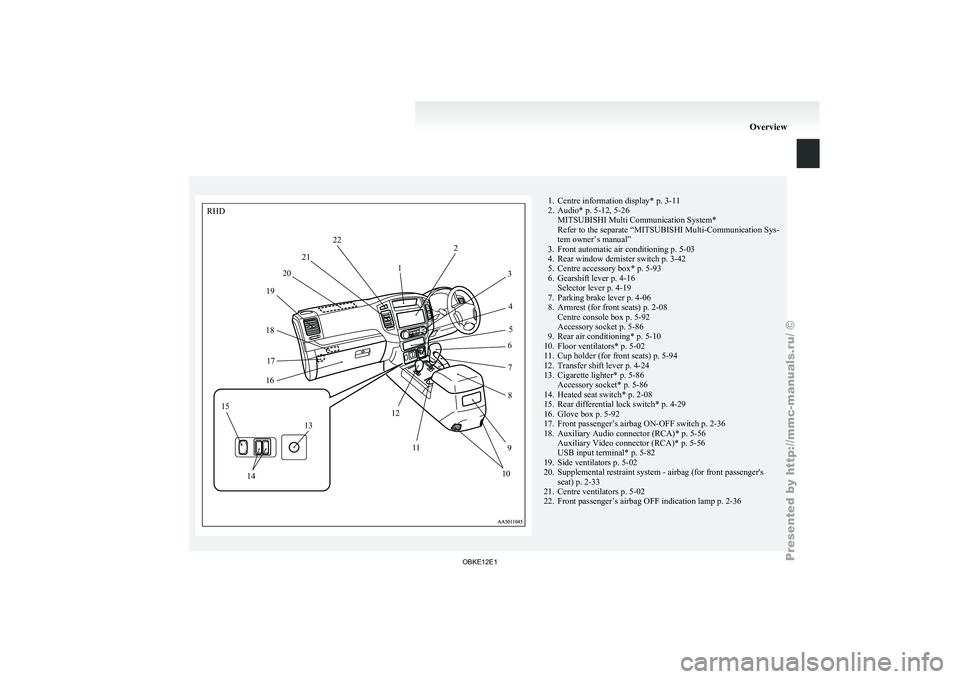
1. Centre information display* p. 3-11
2. Audio* p. 5-12, 5-26 MITSUBISHI Multi Communication System*
Refer to the separate “ MITSUBISHI Multi-Communication Sys-
tem owner’s manual”
3.
Front automatic air conditioning p. 5-03
4. Rear window demister switch p. 3-42
5. Centre accessory box* p. 5-93
6. Gearshift lever p. 4-16 Selector lever p. 4-19
7. Parking brake lever p. 4-06
8. Armrest (for front seats) p. 2-08 Centre console box p. 5-92
Accessory socket p. 5-86
9. Rear air conditioning* p. 5-10
10. Floor ventilators* p. 5-02
11. Cup holder (for front seats) p. 5-94
12. Transfer shift lever p. 4-24
13. Cigarette lighter* p. 5-86 Accessory socket* p. 5-86
14. Heated seat switch* p. 2-08
15. Rear differential lock switch* p. 4-29
16. Glove box p. 5-92
17. Front passenger’s airbag ON-OFF switch p. 2-36
18. Auxiliary Audio connector (RCA)* p. 5-56 Auxiliary Video connector (RCA)* p. 5-56
USB input terminal* p. 5-82
19. Side ventilators p. 5-02
20. Supplemental restraint system - airbag (for front passenger's seat) p. 2-33
21. Centre ventilators p. 5-02
22. Front passenger’s airbag OFF indication lamp p. 2-36 OverviewRHD
12
3
45
6
7
8
9
10
1
1
12
13
14
15
16
17
18 19
20
21 22
OBKE12E1
Page 80 of 377
SRS warning lamp
E00407801142
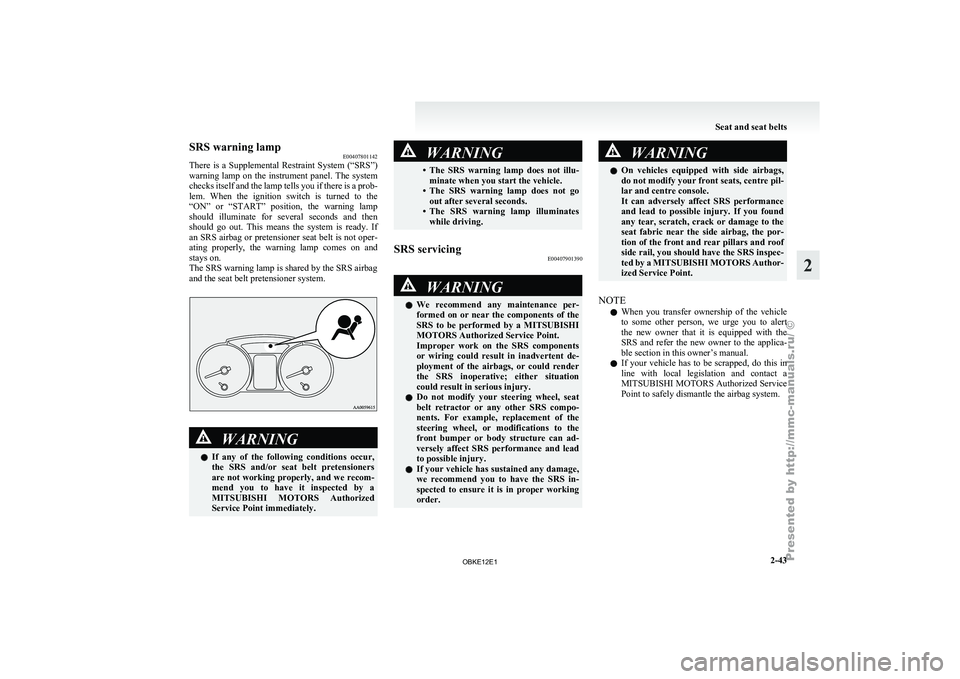
There is a
Supplemental Restraint System (“SRS”)
warning lamp on the instrument panel. The system
checks itself and the lamp tells you if there is a prob-
lem. When the ignition switch is turned to the
“ON” or “START” position, the warning lamp
should illuminate for several seconds and then
should go out. This means the system is ready. If
an SRS airbag or pretensioner seat belt is not oper-
ating properly, the warning lamp comes on and
stays on.
The SRS warning lamp is shared by the SRS airbag
and the seat belt pretensioner system. WARNING
l If any of
the following conditions occur,
the SRS and/or seat belt pretensioners
are not working properly, and we recom-
mend you to have it inspected by a
MITSUBISHI MOTORS Authorized
Service Point immediately. WARNING
• The SRS warning lamp does not illu- minate when you start the vehicle.
• The
SRS warning lamp does not go
out after several seconds.
• The SRS warning lamp illuminates while driving.
SRS servicing E00407901390 WARNING
l We recommend
any
maintenance per-
formed on or near the components of the
SRS to be performed by a MITSUBISHI
MOTORS Authorized Service Point.
Improper work on the SRS components
or wiring could result in inadvertent de-
ployment of the airbags, or could render
the SRS inoperative; either situation
could result in serious injury.
l Do not modify your steering wheel, seat
belt retractor or any other SRS compo-
nents. For example, replacement of the
steering wheel, or modifications to the
front bumper or body structure can ad-
versely affect SRS performance and lead
to possible injury.
l If your vehicle has sustained any damage,
we recommend you to have the SRS in-
spected to ensure it is in proper working
order. WARNING
l On vehicles equipped
with side airbags,
do not modify your front seats, centre pil-
lar and centre console.
It can adversely affect SRS performance
and lead to possible injury. If you found
any tear, scratch, crack or damage to the
seat fabric near the side airbag, the por-
tion of the front and rear pillars and roof
side rail, you should have the SRS inspec-
ted by a MITSUBISHI MOTORS Author-
ized Service Point.
NOTE l When
you transfer
ownership of the vehicle
to some other person, we urge you to alert
the new owner that it is equipped with the
SRS and refer the new owner to the applica-
ble section in this owner’s manual.
l If your vehicle has to be scrapped, do this in
line with local legislation and contact a
MITSUBISHI MOTORS Authorized Service
Point to safely dismantle the airbag system. Seat and seat belts
2-43 2
OBKE12E1
Page 127 of 377
Economical driving
E00600100561
For economical driving,
there are some technical re-
quirements that have to be met. The prerequisite
for low fuel consumption is a properly adjusted en-
gine. In order to achieve longer life of the vehicle
and the most economical operation, we recommend
you to have the vehicle checked at regular intervals
in accordance with the service standards.
Fuel economy and generation of exhaust gas and
noise are highly influenced by personal driving hab-
its as well as the particular operating conditions.
The following points should be observed in order
to minimize wear of brakes, tyres and engine as
well as to reduce environmental pollution.
Starting
Avoid rapid acceleration and sudden starts; such op-
eration will result in higher fuel consumption.
Shifting
Shift only at an appropriate speed and engine
speed. Always use the highest gear possible.
The transfer shift lever should be set to “2H” when
driving on normal roads and express ways to obtain
best possible fuel economy.
City traffic
Frequent starting and stopping increases the aver-
age fuel consumption. Use roads with smooth traf-
fic flow whenever possible. When driving on con-
gested roads, avoid use of a low gear at high en-
gine speeds.
Idling
The vehicle consumes fuel even during idling.
Avoid extended idling whenever possible. Speed
At higher
vehicle
speed, more fuel is consumed.
Avoid driving at full speed. Even a slight release of
the accelerator pedal will save a significant amount
of fuel.
Tyre inflation pressure
Check the tyre inflation pressures at regular inter-
vals. Low tyre inflation pressure increases road re-
sistance and fuel consumption. In addition, low
tyre pressures adversely affect tyre wear and driv-
ing stability.
Load
Do not drive with unnecessary articles in the lug-
gage compartment. Especially during city driving
where frequent starting and stopping is necessary,
the increased weight of the vehicle will greatly af-
fect fuel consumption. Also avoid driving with un-
necessary luggage or carriers, etc., on the roof; the
increased air resistance will increase fuel consump-
tion.
Cold engine starting
Starting of a cold engine consumes more fuel.
Unnecessary fuel consumption is also caused by
keeping a hot engine running. After the engine is
started, commence driving as soon as possible.
Air conditioning
The use of the air conditioning will increase the
fuel consumption. Driving, alcohol and drugs
E00600200067
Driving after drinking
alcohol is one of the most fre-
quent causes of accidents.
Your driving ability can be seriously impaired even
with blood alcohol levels far below the legal mini-
mum. If you have been drinking, don’t drive. Ride
with a designated non-drinking driver, call a cab or
a friend, or use public transportation. Drinking cof-
fee or taking a cold shower will not make you sober.
Similarly, prescription and nonprescription drugs af-
fect your alertness, perception and reaction time.
Consult with your doctor or pharmacist before driv-
ing while under the influence of any of these medi-
cations. WARNING
l NEVER DRINK AND DRIVE.
Your perceptions
are
less accurate, your
reflexes are slower and your judgment is
impaired. Starting and driving
4-02
4
OBKE12E1
Page 149 of 377
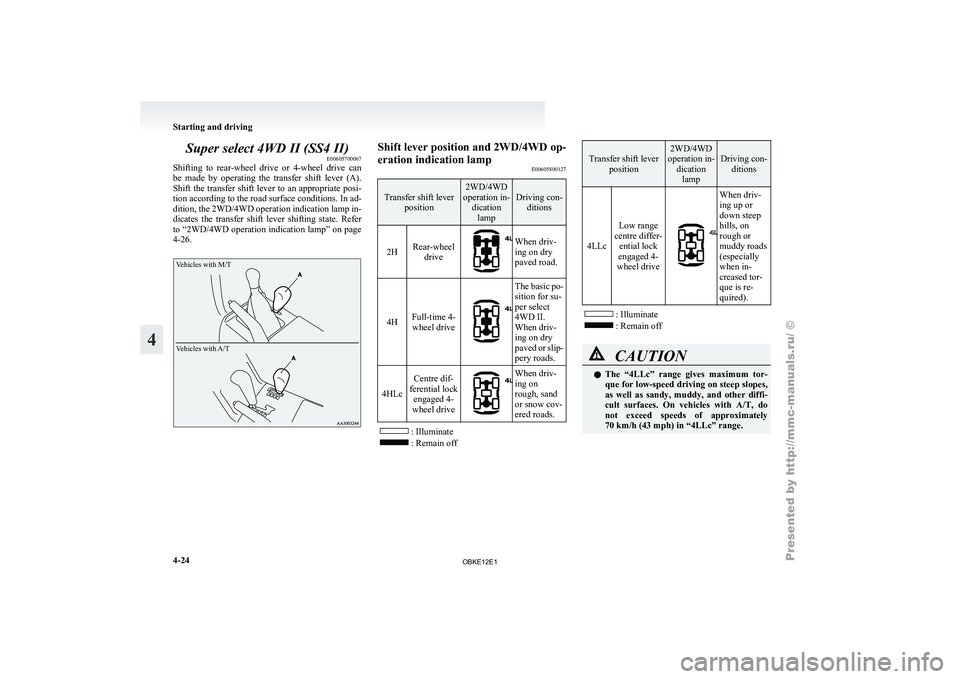
Super select 4WD II (SS4 II)
E00605700067
Shifting to rear-wheel
drive or 4-wheel drive can
be made by operating the transfer shift lever (A).
Shift the transfer shift lever to an appropriate posi-
tion according to the road surface conditions. In ad-
dition, the 2WD/4WD operation indication lamp in-
dicates the transfer shift lever shifting state. Refer
to “2WD/4WD operation indication lamp” on page
4-26.
Vehicles with M/T
Vehicles with A/T Shift lever position and 2WD/4WD op-
eration indication lamp
E00605800127 Transfer shift lever
position 2WD/4WD
operation in- dicationlamp Driving con-
ditions
2H Rear-wheel
drive When driv-
ing on dry
paved road.
4H Full-time 4-
wheel drive The basic po-
sition for su-
per select
4WD II.
When driv-
ing on dry
paved or
slip-
pery roads.
4HLc Centre dif-
ferential lock engaged 4-
wheel drive When driv-
ing on
rough, sand
or snow cov-
ered roads.
: Illuminate
: Remain off Transfer shift lever
position 2WD/4WD
operation in- dicationlamp Driving con-
ditions
4LLc Low range
centre differ- ential lock
engaged 4-
wheel drive When driv-
ing up or
down steep
hills, on
rough or
muddy roads
(especially
when in-
creased tor-
que is re-
quired).
: Illuminate
: Remain off
CAUTION
l
The “4LLc”
range
gives maximum tor-
que for low-speed driving on steep slopes,
as well as sandy, muddy, and other diffi-
cult surfaces. On vehicles with A/T, do
not exceed speeds of approximately
70 km/h (43 mph) in “4LLc” range. Starting and driving
4-24
4
OBKE12E1
Page 150 of 377
CAUTION
l
Do not drive your vehicle in the “4HLc”
or “4LLc” position on dry paved roads
and highways. Doing so may result in ex-
cessive tyre wear, increased fuel consump-
tion, and possible noise generation. It
may also increase the differential oil tem-
perature, which may damage the drive sys-
tem. Further, the drive train will be sub-
jected to excessive loading, resulting in oil
leakage, component seizure, or other seri-
ous problems. On dry paved roads and
highways, drive the vehicle in “2H” or
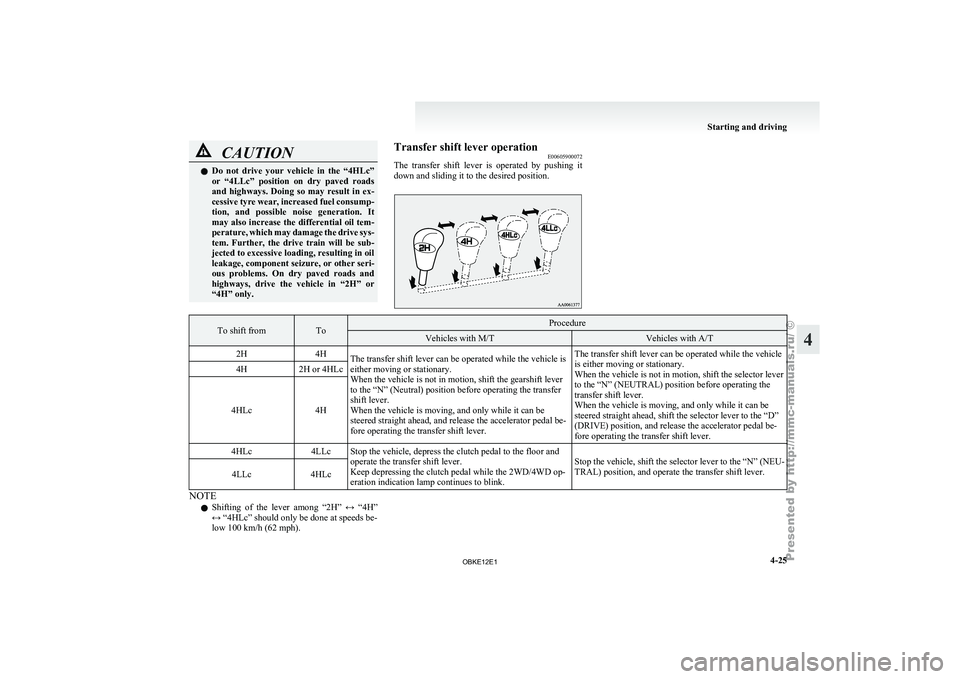
“4H” only. Transfer shift lever operation
E00605900072
The transfer shift
lever is operated by pushing it
down and sliding it to the desired position. To shift from To Procedure
Vehicles with M/T Vehicles with A/T
2H 4H
The transfer shift lever can be operated while the vehicle is
either moving or stationary.
When the vehicle is not in motion, shift the gearshift lever
to the “N” (Neutral) position before operating the transfer
shift lever.
When the vehicle is moving, and only while it can be
steered straight ahead, and release the accelerator pedal be-
fore operating the transfer shift lever. The transfer shift lever can be operated while the vehicle
is either moving or stationary.
When the vehicle is not in motion, shift the selector lever
to the “N” (NEUTRAL) position before operating the
transfer shift lever.
When the vehicle is moving, and only while it can be
steered straight ahead, shift the selector lever to the “D”
(DRIVE) position, and release the accelerator pedal be-
fore operating the transfer shift lever.
4H
2H or 4HLc
4HLc 4H
4HLc 4LLc Stop the vehicle, depress the clutch pedal to the floor and
operate the transfer shift lever.
Keep depressing the clutch pedal while the 2WD/4WD op-
eration indication lamp continues to blink. Stop the vehicle, shift the selector lever to the “N” (NEU-
TRAL) position, and operate the transfer shift lever.
4LLc 4HLcNOTE
l Shifting
of the
lever among “2H” ↔ “4H”
↔ “4HLc” should only be done at speeds be-
low 100 km/h (62 mph). Starting and driving
4-25 4
OBKE12E1
Page 151 of 377
l
When shifting
from “2H” to “4H” in cold
weather while the vehicle is in motion, the
transmission gear may make some noise. In
cold weather, try to shift the gear while the
vehicle is stopped.
l When the lever is shifted between “2H” ↔
“4H” or “4H” ↔ “4HLc” while the vehicle
is stopped, the 2WD/4WD operation indica-
tion lamp blinks while the selection is in proc-
ess. Drive slowly and normally after confirm-
ing that the lamp is illuminated. Refer to
“2WD/4WD operation indication lamp” on
page 4-26.
l Do not move the selector lever while the 2WD/
4WD operation indication lamp is blinking.
l On vehicles with cruise control, when the lev-
er is shifted among “2H” ↔ “4H” ↔
“4HLc” while the cruise control is activated,
the transfer gear may make some noise. CAUTION
l
Do not
operate
the transfer shift lever
while the rear wheels of the vehicle are
slipping on snow or ice. 2WD/4WD operation indication lamp
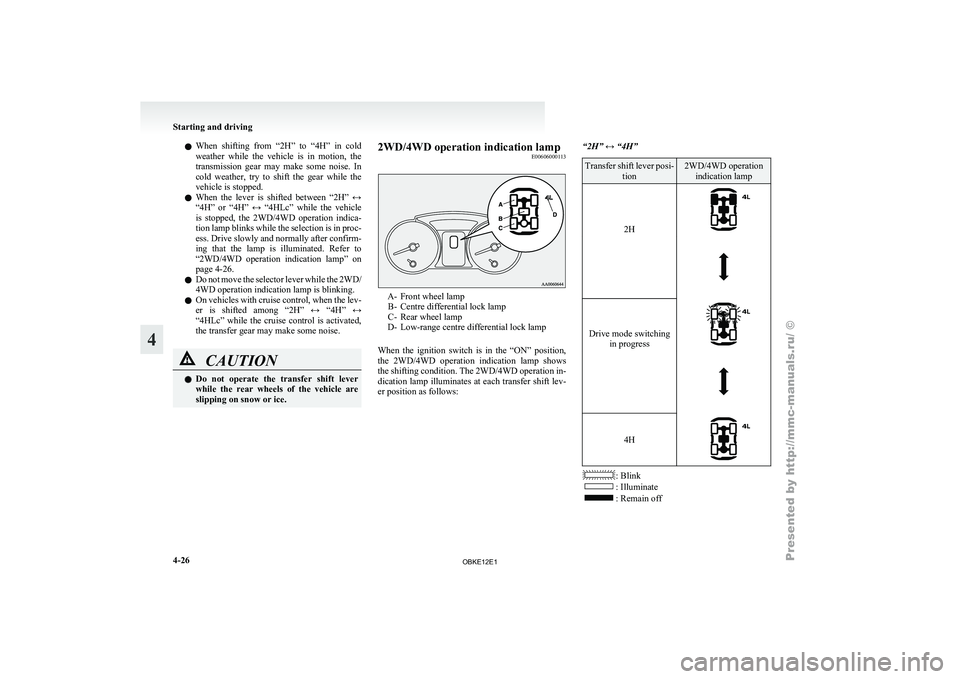
E00606000113 A- Front wheel lamp
B- Centre differential lock lampC- Rear wheel lamp
D-
Low-range centre differential lock lamp
When the ignition switch is in the “ON” position,
the 2WD/4WD operation indication lamp shows
the shifting condition. The 2WD/4WD operation in-
dication lamp illuminates at each transfer shift lev-
er position as follows: “2H” ↔ “4H” Transfer shift lever posi-
tion 2WD/4WD operation
indication lamp
2H
Drive mode switching
in progress
4H
: Blink
: Illuminate
: Remain offStarting and driving
4-26
4
OBKE12E1
Page 152 of 377
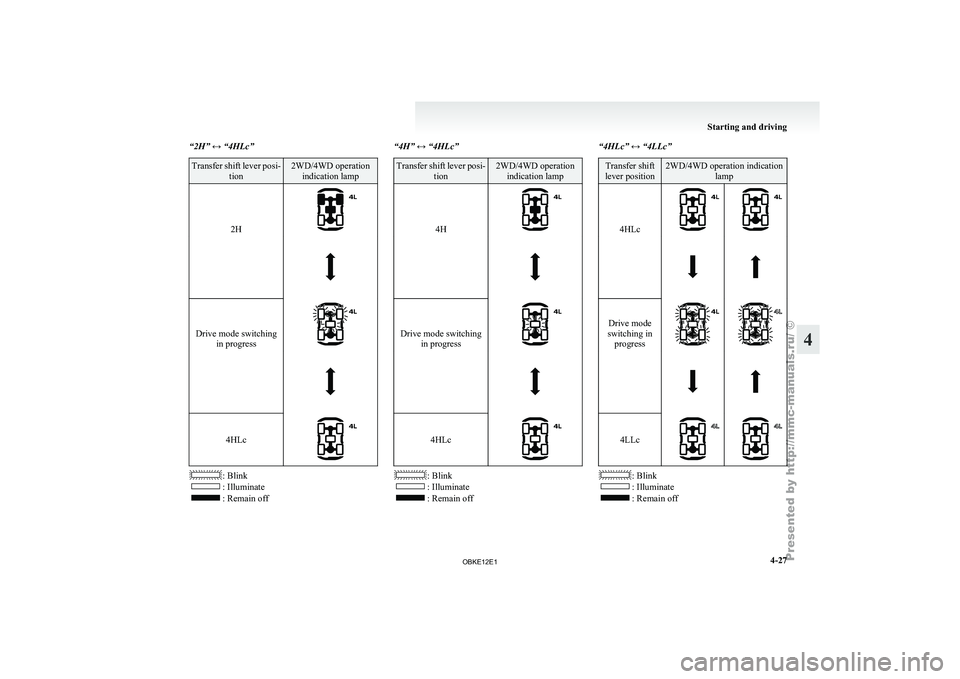
“2H” ↔ “4HLc”
Transfer shift lever posi-
tion 2WD/4WD operation
indication lamp
2H
Drive mode switching
in progress
4HLc
: Blink
: Illuminate
: Remain off “4H” ↔ “4HLc” Transfer shift lever posi-
tion 2WD/4WD operation
indication lamp
4H
Drive mode switching
in progress
4HLc
: Blink
: Illuminate
: Remain off“4HLc” ↔ “4LLc” Transfer shift
lever position 2WD/4WD operation indication
lamp
4HLc
Drive mode
switching in progress
4LLc
: Blink
: Illuminate
: Remain off Starting and driving
4-27 4
OBKE12E1
Page 153 of 377
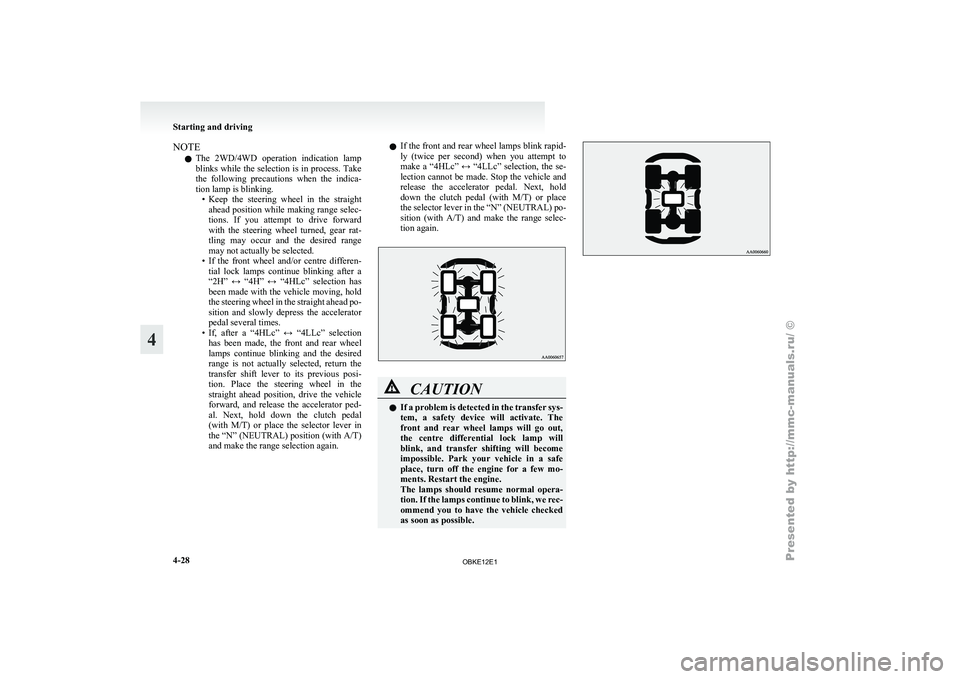
NOTE
l The
2WD/4WD operation
indication lamp
blinks while the selection is in process. Take
the following precautions when the indica-
tion lamp is blinking. • Keep the steering wheel in the straightahead position while making range selec-
tions. If you attempt to drive forward
with the steering wheel turned, gear rat-
tling may occur and the desired range
may not actually be selected.
• If the front wheel and/or centre differen- tial lock lamps continue blinking after a
“2H” ↔ “4H” ↔ “4HLc” selection has
been made with the vehicle moving, hold
the steering wheel in the straight ahead po-
sition and slowly depress the accelerator
pedal several times.
• If, after a “4HLc” ↔ “4LLc” selection has been made, the front and rear wheel
lamps continue blinking and the desired
range is not actually selected, return the
transfer shift lever to its previous posi-
tion. Place the steering wheel in the
straight ahead position, drive the vehicle
forward, and release the accelerator ped-
al. Next, hold down the clutch pedal
(with M/T) or place the selector lever in
the “N” (NEUTRAL) position (with A/T)
and make the range selection again. l
If
the
front and rear wheel lamps blink rapid-
ly (twice per second) when you attempt to
make a “4HLc” ↔ “4LLc” selection, the se-
lection cannot be made. Stop the vehicle and
release the accelerator pedal. Next, hold
down the clutch pedal (with M/T) or place
the selector lever in the “N” (NEUTRAL) po-
sition (with A/T) and make the range selec-
tion again. CAUTION
l
If a
problem
is detected in the transfer sys-
tem, a safety device will activate. The
front and rear wheel lamps will go out,
the centre differential lock lamp will
blink, and transfer shifting will become
impossible. Park your vehicle in a safe
place, turn off the engine for a few mo-
ments. Restart the engine.
The lamps should resume normal opera-
tion. If the lamps continue to blink, we rec-
ommend you to have the vehicle checked
as soon as possible. Starting and driving
4-28
4
OBKE12E1
Page 154 of 377
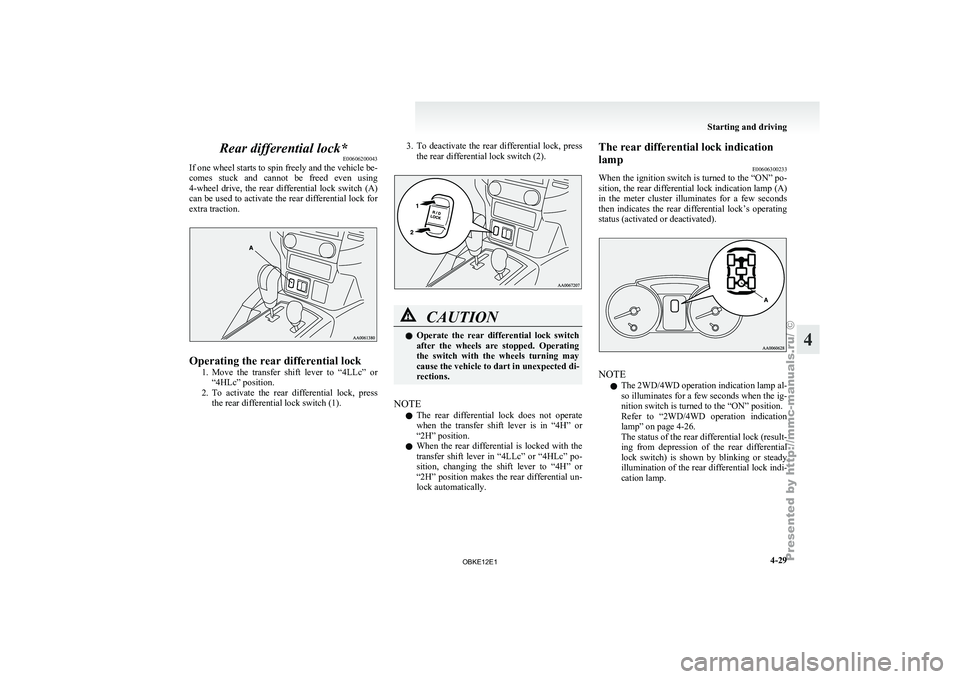
Rear differential lock*
E00606200043
If one wheel
starts to spin freely and the vehicle be-
comes stuck and cannot be freed even using
4-wheel drive, the rear differential lock switch (A)
can be used to activate the rear differential lock for
extra traction. Operating the rear differential lock
1. Move the transfer
shift lever to “4LLc” or
“4HLc” position.
2. To activate the rear differential lock, press the rear differential lock switch (1). 3. To deactivate the rear differential lock, press
the rear differential lock switch (2). CAUTION
l
Operate the rear
differential lock switch
after the wheels are stopped. Operating
the switch with the wheels turning may
cause the vehicle to dart in unexpected di-
rections.
NOTE l The
rear differential
lock does not operate
when the transfer shift lever is in “4H” or
“2H” position.
l When the rear differential is locked with the
transfer shift lever in “4LLc” or “4HLc” po-
sition, changing the shift lever to “4H” or
“2H” position makes the rear differential un-
lock automatically. The rear differential lock indication
lamp
E00606300233
When the ignition
switch is turned to the “ON” po-
sition, the rear differential lock indication lamp (A)
in the meter cluster illuminates for a few seconds
then indicates the rear differential lock’s operating
status (activated or deactivated). NOTE
l The
2WD/4WD operation
indication lamp al-
so illuminates for a few seconds when the ig-
nition switch is turned to the “ON” position.
Refer to “2WD/4WD operation indication
lamp” on page 4-26.
The status of the rear differential lock (result-
ing from depression of the rear differential
lock switch) is shown by blinking or steady
illumination of the rear differential lock indi-
cation lamp. Starting and driving
4-29 4
OBKE12E1