brake MITSUBISHI SHOGUN 2003 (in English) User Guide
[x] Cancel search | Manufacturer: MITSUBISHI, Model Year: 2003, Model line: SHOGUN, Model: MITSUBISHI SHOGUN 2003Pages: 392, PDF Size: 14.34 MB
Page 167 of 392

Maximum towable weight with brake
and maximum trailer-nose weightNever exceed the maximum towable
weight with brake and the maximum
trailer-nose weight as listed in the specifi-
cations. (Refer to page 10-7,10-8)
If you tow a trailer at an altitude of more
than 1000m above sea-level, reduce your
weight by 10% of the gross combination
weight for every increase of 1000m above
sea-level, as the engine output is low-
ered owing to decrease in atmospheric
pressure.
C21A056E
Towing bar mounting specifica-
tionsSee the following table for fixing points (A)
for the towing bar.
C21A057E
Starting and driving
5-9
Div:
Out put date:
Page 168 of 392
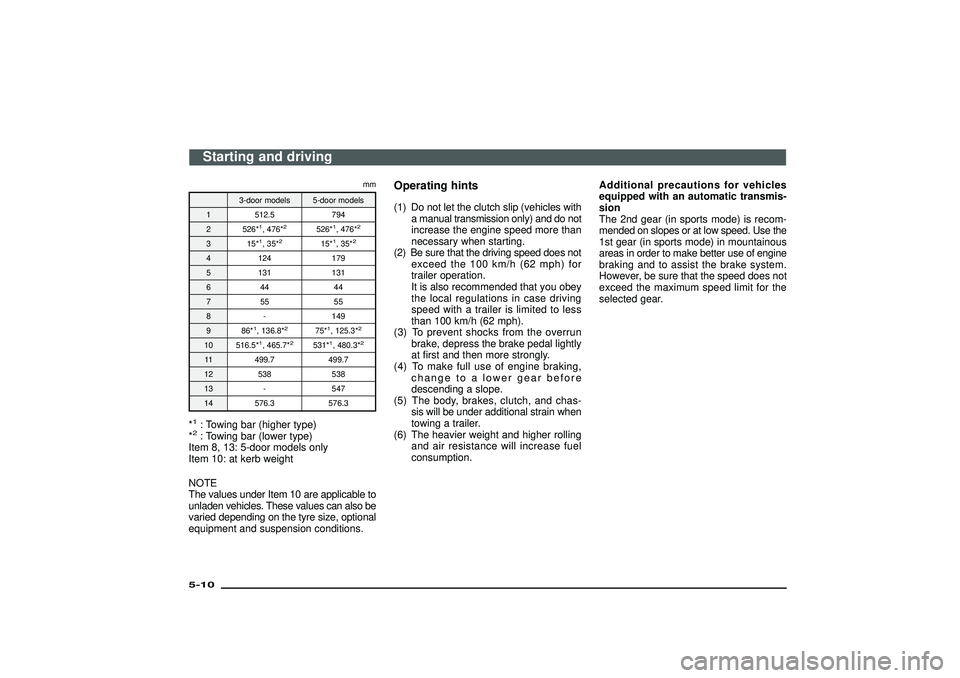
mm
3-door models 5-door models
1 512.5 794
2 526*
1, 476*
2
526*
1, 476*
2
3 15*
1, 35*
2
15*
1, 35*
2
4 124 179
5 131 131
644 44
755 55
8 - 149
9 86*
1, 136.8*
2
75*
1, 125.3*
2
10 516.5*
1, 465.7*
2
531*
1, 480.3*
2
11 499.7 499.7
12 538 538
13 - 547
14 576.3 576.3
*1: Towing bar (higher type)
*2: Towing bar (lower type)
Item 8, 13: 5-door models only
Item 10: at kerb weight
NOTE
The values under Item 10 are applicable to
unladen vehicles. These values can also be
varied depending on the tyre size, optional
equipment and suspension conditions.
Operating hints(1) Do not let the clutch slip (vehicles with
a manual transmission only) and do not
increase the engine speed more than
necessary when starting.
(2) Be sure that the driving speed does not
exceed the 100 km/h (62 mph) for
trailer operation.
It is also recommended that you obey
the local regulations in case driving
speed with a trailer is limited to less
than 100 km/h (62 mph).
(3) To prevent shocks from the overrun
brake, depress the brake pedal lightly
at first and then more strongly.
(4) To make full use of engine braking,
change to a lower gear before
descending a slope.
(5) The body, brakes, clutch, and chas-
sis will be under additional strain when
towing a trailer.
(6) The heavier weight and higher rolling
and air resistance will increase fuel
consumption.Additional precautions for vehicles
equipped with an automatic transmis-
sion
The 2nd gear (in sports mode) is recom-
mended on slopes or at low speed. Use the
1st gear (in sports mode) in mountainous
areas in order to make better use of engine
braking and to assist the brake system.
However, be sure that the speed does not
exceed the maximum speed limit for the
selected gear.
Starting and driving
5-10Div:
Out put date:
Page 170 of 392
(3) For vehicles equipped with the Day-
time Running Lamp, when the igni-
tion switch is“ON”, the headlamp low
beams etc. are turned on.
Refer to“Headlamps”.
(4) As your vehicle is equipped with an
electronic immobilizer, to start the
engine, the ID code which the tran-
sponder inside the key sends must
match the one registered to the immo-
bilizer computer. (Refer to page 2-2).
CAUTION
(1) Do not remove the ignition key
from the ignition switch while
driving. The steering wheel will
be locked, causing loss of con-
trol.
(2) If the engine is stopped while
driving, the brake servomecha-
nism will cease to function and
braking efficiency will deterio-
rate. Also, power steering sys-
tem will not function and it will
require greater manual effort to
operate the steering.
(3) Do not leave the key in the“ON”
position for a long time when the
engine is not running; doing so
will cause the battery to be dis-
charged.
(4) Do not turn the key to the
“START”position when the
engine is running; doing so
could damage the starter motor.
I01B016A
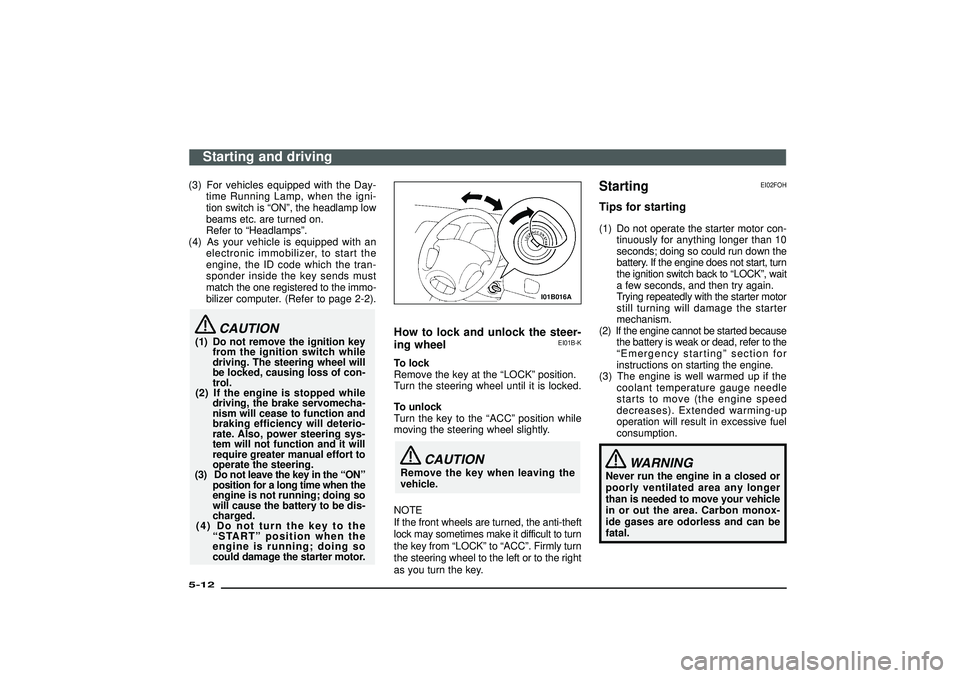
How to lock and unlock the steer-
ing wheel
EI01B-K
To lock
Remove the key at the“LOCK”position.
Turn the steering wheel until it is locked.
To unlock
Turn the key to the“ACC”position while
moving the steering wheel slightly.
CAUTION
Remove the key when leaving the
vehicle.
NOTE
If the front wheels are turned, the anti-theft
lock may sometimes make it difficult to turn
the key from“LOCK”to“ACC”. Firmly turn
the steering wheel to the left or to the right
as you turn the key.
Starting
EI02FOH
Tips for starting(1) Do not operate the starter motor con-
tinuously for anything longer than 10
seconds; doing so could run down the
battery. If the engine does not start, turn
the ignition switch back to“LOCK”, wait
a few seconds, and then try again.
Trying repeatedly with the starter motor
still turning will damage the starter
mechanism.
(2) If the engine cannot be started because
the battery is weak or dead, refer to the
“Emergency starting”section for
instructions on starting the engine.
(3) The engine is well warmed up if the
coolant temperature gauge needle
starts to move (the engine speed
decreases). Extended warming-up
operation will result in excessive fuel
consumption.
WARNING
Never run the engine in a closed or
poorly ventilated area any longer
than is needed to move your vehicle
in or out the area. Carbon monox-
ide gases are odorless and can be
fatal.
Starting and driving
5-12Div:
Out put date:
Page 172 of 392
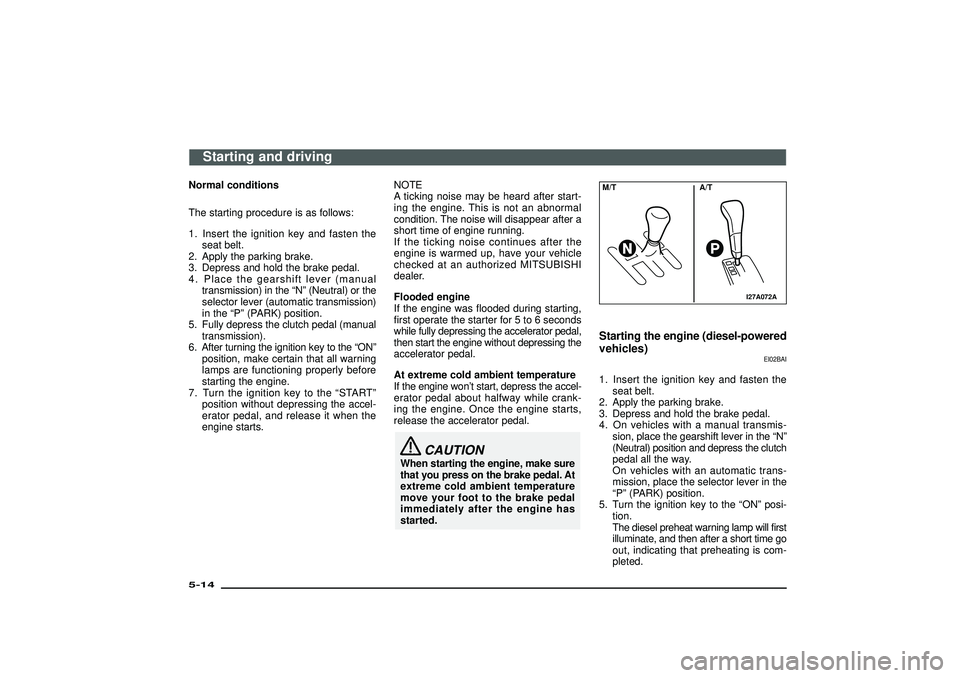
Normal conditions
The starting procedure is as follows:
1. Insert the ignition key and fasten the
seat belt.
2. Apply the parking brake.
3. Depress and hold the brake pedal.
4. Place the gearshift lever (manual
transmission) in the“N”(Neutral) or the
selector lever (automatic transmission)
in the“P”(PARK) position.
5. Fully depress the clutch pedal (manual
transmission).
6. After turning the ignition key to the“ON”
position, make certain that all warning
lamps are functioning properly before
starting the engine.
7. Turn the ignition key to the“START”
position without depressing the accel-
erator pedal, and release it when the
engine starts.NOTE
A ticking noise may be heard after start-
ing the engine. This is not an abnormal
condition. The noise will disappear after a
short time of engine running.
If the ticking noise continues after the
engine is warmed up, have your vehicle
checked at an authorized MITSUBISHI
dealer.
Flooded engine
If the engine was flooded during starting,
first operate the starter for 5 to 6 seconds
while fully depressing the accelerator pedal,
then start the engine without depressing the
accelerator pedal.
At extreme cold ambient temperature
If the engine won’t start, depress the accel-
erator pedal about halfway while crank-
ing the engine. Once the engine starts,
release the accelerator pedal.
CAUTION
When starting the engine, make sure
that you press on the brake pedal. At
extreme cold ambient temperature
move your foot to the brake pedal
immediately after the engine has
started.
I27A072A
M/T A/TStarting the engine (diesel-powered
vehicles)
EI02BAI
1. Insert the ignition key and fasten the
seat belt.
2. Apply the parking brake.
3. Depress and hold the brake pedal.
4. On vehicles with a manual transmis-
sion, place the gearshift lever in the“N”
(Neutral) position and depress the clutch
pedal all the way.
On vehicles with an automatic trans-
mission, place the selector lever in the
“P”(PARK) position.
5. Turn the ignition key to the“ON”posi-
tion.
The diesel preheat warning lamp will first
illuminate, and then after a short time go
out, indicating that preheating is com-
pleted.
Starting and driving
5-14Div:
Out put date:
Page 176 of 392

I04A206A
In the main gate, the selector lever has 4
positions, and is equipped with a lock but-
ton (A) to avoid inadvertent selection of the
wrong gear.
I04A294A
Button must be pushed while the
brake pedal is depressed to move
the lever.Button must be pushed to move the
lever.Button need not be pushed to move
the lever.
WARNING
(1) If the button is always depressed
to operate the selector lever, the
lever may be shifted acciden-
tally into the“P”or“R”posi-
tion.
Be sure not to depress the but-
ton when performing the opera-
tions indicated by“
”in the
illustration.
(2) Always depress the brake pedal
when shifting the selector lever
into a gear from the“P”(PARK)
or“N”(NEUTRAL) position.
When beginning to drive, do not
shift the selector lever from the
“P”(PARK) or“N”(NEUTRAL)
position while depressing the
accelerator pedal, doing so is
dangerous because the vehicle
will“jump”forward or back-
ward.
NOTE
If the brake pedal is not depressed and
held, the shift-lock device activates to pre-
vent the selector lever from being moved
from the“P”(PARK) position to another
position.
Starting and driving
5-18Div:
Out put date:
Page 177 of 392
I04A196A
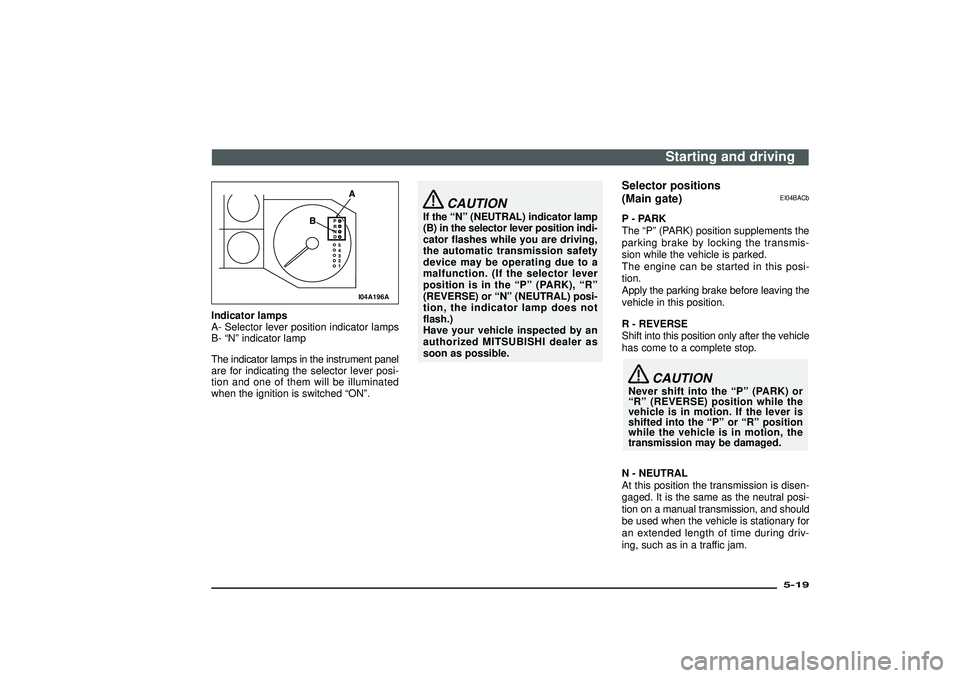
Indicator lamps
A- Selector lever position indicator lamps
B-“N”indicator lamp
The indicator lamps in the instrument panel
are for indicating the selector lever posi-
tion and one of them will be illuminated
when the ignition is switched“ON”.
CAUTION
If the“N”(NEUTRAL) indicator lamp
(B) in the selector lever position indi-
cator flashes while you are driving,
the automatic transmission safety
device may be operating due to a
malfunction. (If the selector lever
position is in the“P”(PARK),“R”
(REVERSE) or“N”(NEUTRAL) posi-
tion, the indicator lamp does not
flash.)
Have your vehicle inspected by an
authorized MITSUBISHI dealer as
soon as possible.
Selector positions
(Main gate)
EI04BACb
P - PARK
The“P”(PARK) position supplements the
parking brake by locking the transmis-
sion while the vehicle is parked.
The engine can be started in this posi-
tion.
Apply the parking brake before leaving the
vehicle in this position.
R - REVERSE
Shift into this position only after the vehicle
has come to a complete stop.
CAUTION
Never shift into the“P”(PARK) or
“R”(REVERSE) position while the
vehicle is in motion. If the lever is
shifted into the“P”or“R”position
while the vehicle is in motion, the
transmission may be damaged.
N - NEUTRAL
At this position the transmission is disen-
gaged. It is the same as the neutral posi-
tion on a manual transmission, and should
be used when the vehicle is stationary for
an extended length of time during driv-
ing, such as in a traffic jam.
Starting and driving
5-19
Div:
Out put date:
Page 178 of 392
WARNING
(1) Never move the selector lever to
the“N”(NEUTRAL) position
while driving. A serious acci-
dent could occur since you
could accidentally move the
lever into the“P”(PARK) or“R”
(REVERSE) position and engine
braking would not be provided.
(2) On a slope the engine should be
started in the“P”(PARK) posi-
tion, not in the“N”(NEUTRAL)
position to avoid the vehicle
from rolling.
(3) Always keep your right foot on
the brake pedal when the vehicle
is in“N”(NEUTRAL), or when
shifting into or out of“N”
(NEUTRAL), to mininize the risk
of loss of control.D - DRIVE
This position is for normal driving.
The transmission automatically selects a
suitable gear for your speed and accelera-
tion.
Engine braking is automatically applied
when necessary, depending on road con-
ditions.
Please refer to“Uphill/downhill driving”on
page 5-22.
NOTE
For information on manual gate opera-
tion, please refer to“Sports mode”on page
5-20.
Sports mode
EI04S-Jb
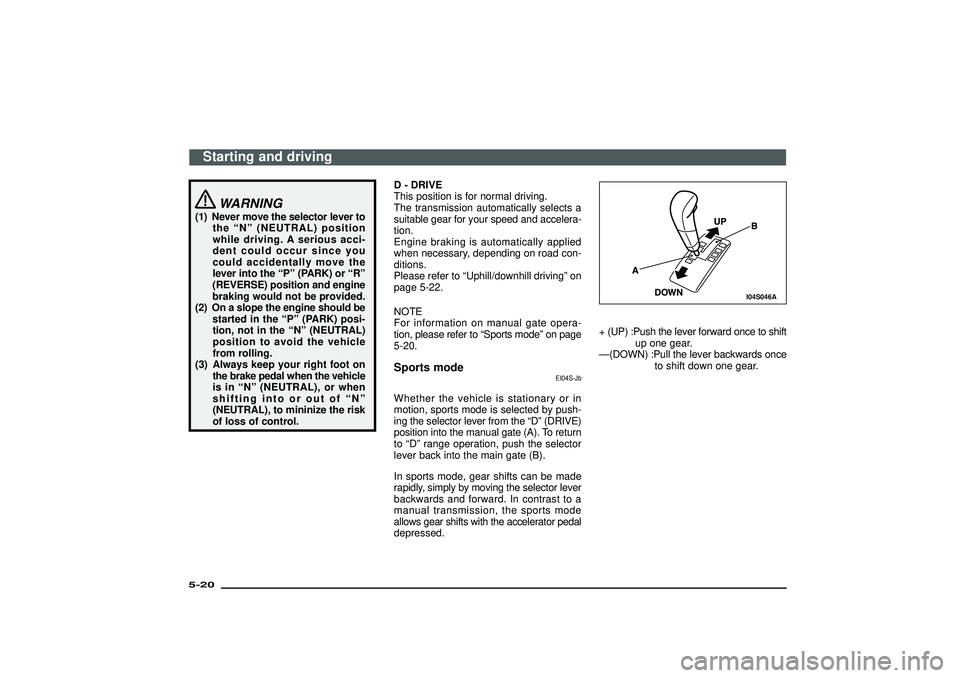
Whether the vehicle is stationary or in
motion, sports mode is selected by push-
ing the selector lever from the“D”(DRIVE)
position into the manual gate (A). To return
to“D”range operation, push the selector
lever back into the main gate (B).
In sports mode, gear shifts can be made
rapidly, simply by moving the selector lever
backwards and forward. In contrast to a
manual transmission, the sports mode
allows gear shifts with the accelerator pedal
depressed.
I04S046A
+ (UP) :Push the lever forward once to shift
up one gear.
—(DOWN) :Pull the lever backwards once
to shift down one gear.
Starting and driving
5-20Div:
Out put date:
Page 180 of 392
Operation of the automatic trans-
mission INVECS II Sport Mode 5A/T
EI04D-Ch
CAUTION
(1) Before selecting a gear with the
engine running and the vehicle
stationary, fully depress the
brake pedal to prevent the
vehicle from creeping.
The vehicle will begin to move
as soon as the gear is engaged,
especially when the engine
speed is high, at fast idle or with
the air conditioning operating,
the brakes should only be
released when you are ready to
drive away.
(2) Depress the brake pedal with the
right foot at all times.
Using the left foot could cause
driver movement delay in case
of an emergency.
(3) To prevent sudden accelera-
tion, never race the engine when
shifting from the“P”(PARK) or
“N”(NEUTRAL).
CAUTION
(4) Operating the accelerator pedal
while the other foot is resting on
the brake pedal will affect brak-
ing efficiency and may cause
premature wear of brake pads.
Do not race the engine with
brake pedal pressed.
This can damage the transmis-
sion.Passing acceleration
EI04F-P
To gain extra acceleration in“D”(DRIVE)
position (when passing another vehicle)
push the accelerator to the floor. The auto-
matic transmission will automatically down-
shift.
NOTE
In sports mode, downshifts do not take
place when the accelerator is depressed all
the way to the floor.
Uphill/downhill driving
EI04O-Ia
DRIVING UPHILL
The transmission may not upshift to a
higher gear if the computer determines the
current speed cannot be maintained once
a higher gear is engaged.
For smoother vehicle performance, if you
release the throttle while climbing a steep
grade, the transmission may not upshift.
This is normal, as the computer is tempo-
rarily preventing shifting. After reaching the
top of the hill, normal gear shift function will
resume.
DRIVING DOWNHILL
When travelling down steep grades, the
computer may automatically select a lower
gear. This function assists engine brak-
ing efforts, reducing the need for using the
brakes.
Starting and driving
5-22Div:
Out put date:
Page 181 of 392
Waiting
EI04G-Ee
For short waiting periods, such as at traf-
fic signal, the vehicle can be left in gear and
held stationary with the service brake.
For longer waiting periods with the engine
running, the selector lever should be placed
in the“N”(NEUTRAL) position.
CAUTION
(1) Never hold the vehicle station-
ary while in gear on a hill with
the accelerator, always apply the
parking brake and/or service
brake.
(2) Unexpected acceleration may
occur if the selector lever is in a
position other than“P”(PARK)
or“N”(NEUTRAL).
Prior to moving off after having
stopped the vehicle, make sure
that the selector lever is in“D”
(DRIVE) or“Sports mode”posi-
tion.
Parking
EI04H-Be
To park the vehicle, first bring it to a com-
plete stop, fully engage the parking brake,
and then move the selector lever to the“P”
(PARK) position.
If you are going to leave the vehicle unat-
tended, always switch off the engine and
remove the ignition key.
NOTE
On a slope, be sure to apply the parking
brake before moving the selector lever to
the“P”(PARK) position. If you move the
selector lever to the“P”(PARK) position
without first applying the parking brake, a
stronger than normal resistance force may
be encountered. In this situation, move the
selector lever strongly when you next wish
to drive.
Starting and driving
5-23
Div:
Out put date:
Page 193 of 392

I34A023A
The rear differential lock indication lamp
When the ignition switch is turned to the
“ON”position, the rear differential lock indi-
cation lamp (A) in the meter cluster illumi-
nates for a few seconds and then indicates
the rear differential lock’s operating sta-
tus (activated or deactivated).
NOTE
The 2WD/4WD indication lamp also illumi-
nates for a few seconds when the igni-
tion switch is turned to the“ON”position,
see page 5-31.
The status of the rear differential lock
(resulting from depression of the rear dif-
ferential lock switch) is shown by flashing
or steady illumination of the rear differen-
tial lock indication lamp.
Transfer shift
lever positionRear differential lock indication
lamp
Rear differen-
tial lock deacti-
vatedSwitching in
progress
Rear differen-
tial lock acti-
vated
BlinkIlluminateRemain offNOTE
(1)
The indication lamp blinks while the rear
differential lock is being switched between
its activated and deactivated condi-
tions. When the switching operation is
complete, the indication lamp is either illu-
minated steadily or not illuminated.
(2)
The anti-lock brake system (ABS) may
not give optimum performance while the
rear differential lock is activated.
(3)
If the indication lamp continues blinking
after the switch has been pressed to
deactivate the rear differential lock, hold
the steering wheel in the straight ahead
position, then slowly depress and release
the accelerator pedal several times.
(4)
If the indication lamp continues blink-
ing after the switch has been pressed
to activate the rear differential lock, bear
in mind the following instructions:•If the vehicle speed is 12 km/h (7 mph)
or higher, decelerate to speed of 6 km/h
(4 mph) or lower. The indication lamp will
illuminate steadily and the rear differen-
tial lock will be activated.
•If the vehicle speed is 12 km/h (7 mph)
or lower, turn the steering wheel from
side to side until the indication lamp illu-
minates steadily. If the vehicle is stuck
in soft ground, make sure the area
around the vehicle is clear then repeat-
edly attempt to drive forward and back-
ward. The indication lamp will illuminate
steadily and the rear differential lock will
be activated.
Starting and driving
5-35
Div:
Out put date: