fuel MITSUBISHI SHOGUN 2003 (in English) Service Manual
[x] Cancel search | Manufacturer: MITSUBISHI, Model Year: 2003, Model line: SHOGUN, Model: MITSUBISHI SHOGUN 2003Pages: 392, PDF Size: 14.34 MB
Page 323 of 392
CAUTION
(1) Do not smoke or have any other
open flame near the vehicle
while bleeding the fuel system.
(2) Be sure to carefully clean away
any water drained out because
any fuel mixed with the water
could ignite and cause a fire.
N28A122A
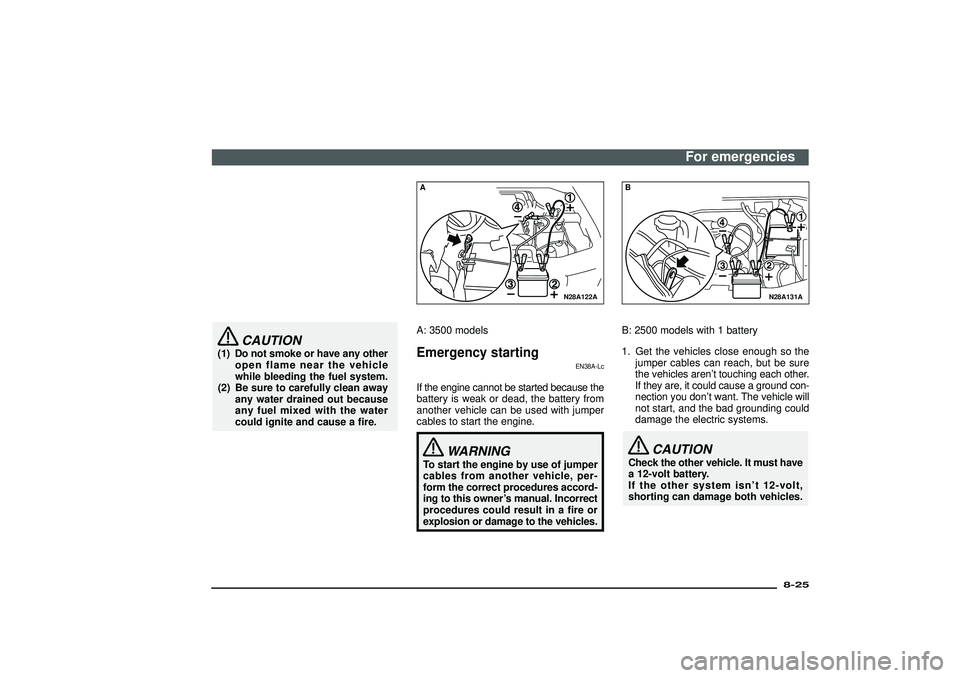
AA: 3500 modelsEmergency starting
EN38A-Lc
If the engine cannot be started because the
battery is weak or dead, the battery from
another vehicle can be used with jumper
cables to start the engine.
WARNING
To start the engine by use of jumper
cables from another vehicle, per-
form the correct procedures accord-
ing to this owner’s manual. Incorrect
procedures could result in a fire or
explosion or damage to the vehicles.
N28A131A
BB: 2500 models with 1 battery
1. Get the vehicles close enough so the
jumper cables can reach, but be sure
the vehicles aren’t touching each other.
If they are, it could cause a ground con-
nection you don’t want. The vehicle will
not start, and the bad grounding could
damage the electric systems.
CAUTION
Check the other vehicle. It must have
a 12-volt battery.
If the other system isn’t 12-volt,
shorting can damage both vehicles.
For emergencies
8-25
Div:
Out put date:
Page 330 of 392
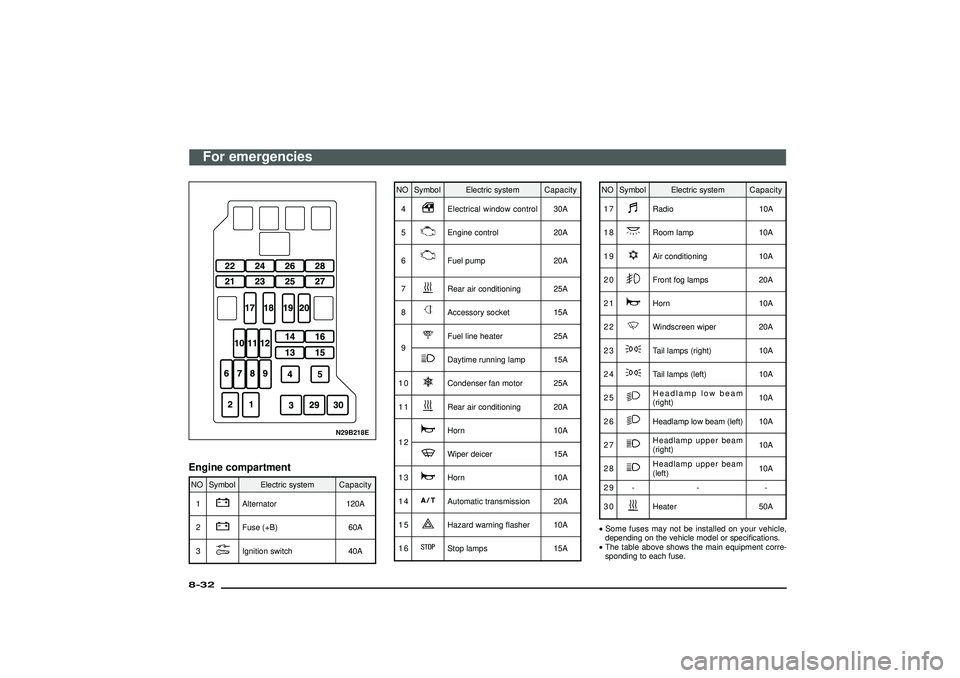
N29B218E
Engine compartmentNO Symbol Electric systemCapacity
1
Alternator 120A
2Fuse (+B) 60A
3Ignition switch 40A
NO Symbol Electric systemCapacity
4
Electrical window control 30A
5Engine control 20A
6Fuel pump 20A
7Rear air conditioning 25A
8Accessory socket 15A
9Fuel line heater 25ADaytime running lamp 15A
10Condenser fan motor 25A
11Rear air conditioning 20A
12Horn 10AWiper deicer 15A
13Horn 10A
14Automatic transmission 20A
15Hazard warning flasher 10A
16Stop lamps 15A
NO Symbol Electric systemCapacity
17
Radio 10A
18Room lamp 10A
19Air conditioning 10A
20Front fog lamps 20A
21Horn 10A
22Windscreen wiper 20A
23Tail lamps (right) 10A
24Tail lamps (left) 10A
25Headlamp low beam
(right)10A
26Headlamp low beam (left) 10A
27Headlamp upper beam
(right)10A
28Headlamp upper beam
(left)10A
29 - - -
30Heater 50A
•Some fuses may not be installed on your vehicle,
depending on the vehicle model or specifications.
•The table above shows the main equipment corre-
sponding to each fuse.
For emergencies
8-32Div:
Out put date:
Page 343 of 392
Maintenance
Engine oil ...................................................... 9- 2
Automatic transmission fluid ...................... 9- 4
Engine coolant ............................................. 9- 5
Battery ........................................................... 9- 6
Brake fluid .................................................... 9- 8
Power steering fluid...................................... 9- 9
Clutch fluid ................................................... 9-10
Washer fluid ................................................... 9-11
Wheel condition ............................................ 9-12
Tyre inflation pressure ................................. 9-14
Tyre rotation ................................................. 9-15
Snow tyres .................................................... 9-16
Tyre chains ................................................... 9-16
Fuel, engine coolant,
oil and exhaust gas leakage..................... 9-17
Exterior and interior lamp operation........... 9-18
Meter, gauge and indication /
warning lamp operation ............................ 9-18
Clutch pedal free play ................................. 9-18
Brake pedal free play.................................... 9-18
Parking brake lever stroke ........................... 9-19
Hinges and latches lubrication.................... 9-19
Wiper blades.................................................. 9-19
Ventilation slots ............................................ 9-21
Weatherstripping........................................... 9-21
Additional equipment
(For regions where snow is encountered). 9-21
Div:
Out put date:
Page 344 of 392
EM01A-Hh
Adequate care of your vehicle at regular
intervals serves to preserve the value and
appearance as long as possible.
Some maintenance items can be carried
out by the owner (do it yourself), while oth-
ers should be carried out by an autho-
rized MITSUBISHI dealer (periodic
inspection and maintenance). This sec-
tion describes only those items which can
be carried out by the owner. In the event a
malfunction or other problem is discov-
ered, have it corrected by an authorized
MITSUBISHI dealer. This section con-
tains information on inspection mainte-
nance procedures that you can do yourself,
if you wish to do so. Follow the instruc-
tions and cautions for each of the various
procedures.
WARNING
(1) When checking or servicing the
inside of the engine compart-
ment, make sure the engine is
switched off and has had a
chance to cool down.
(2) If it is necessary to do work in
the engine compartment with the
engine running, be especially
careful that your clothing, hair,
etc., does not become caught by
the fan, drive belts, or other
moving parts.
(3) Do not smoke, cause sparks or
allow open flames around fuel or
battery. The fumes are flam-
mable.
(4) Be extremely cautious when
working around the battery. It
contains poisonous and corro-
sive sulphuric acid.
(5) Do not get under your vehicle
with just the body jack support-
ing it. Always use automotive
jack stands.
(6) Improper handling of compo-
nents and materials used in the
vehicle can endanger your per-
sonal safety.
Consult an authorized
MITSUBISHI dealer for neces-
sary information.
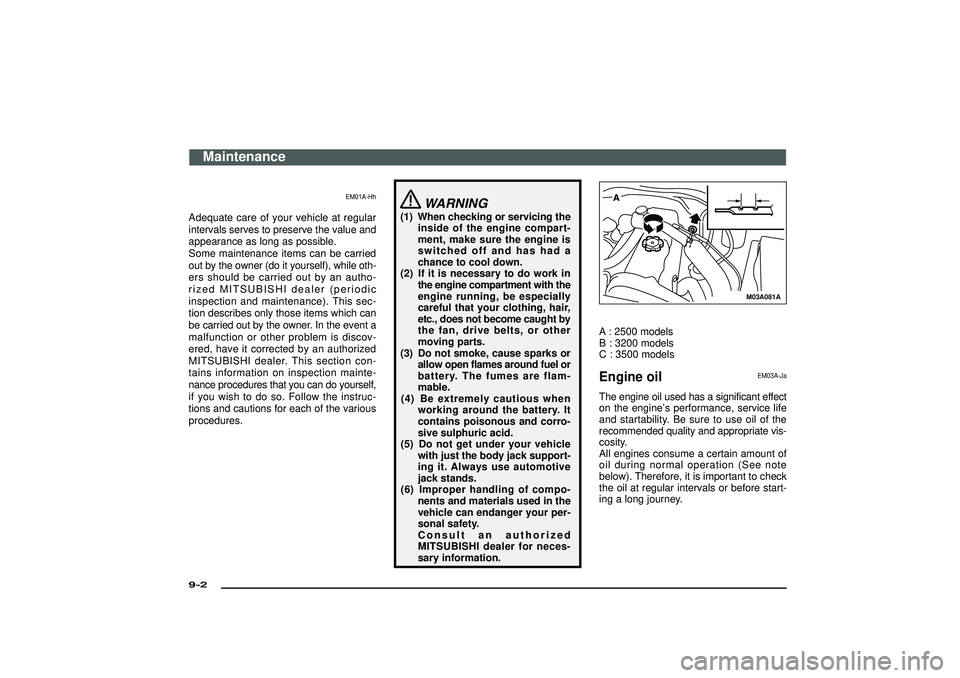
M03A081A
A : 2500 models
B : 3200 models
C : 3500 modelsEngine oil
EM03A-Ja
The engine oil used has a significant effect
on the engine’s performance, service life
and startability. Be sure to use oil of the
recommended quality and appropriate vis-
cosity.
All engines consume a certain amount of
oil during normal operation (See note
below). Therefore, it is important to check
the oil at regular intervals or before start-
ing a long journey.
Maintenance
9-2Div:
Out put date:
Page 359 of 392
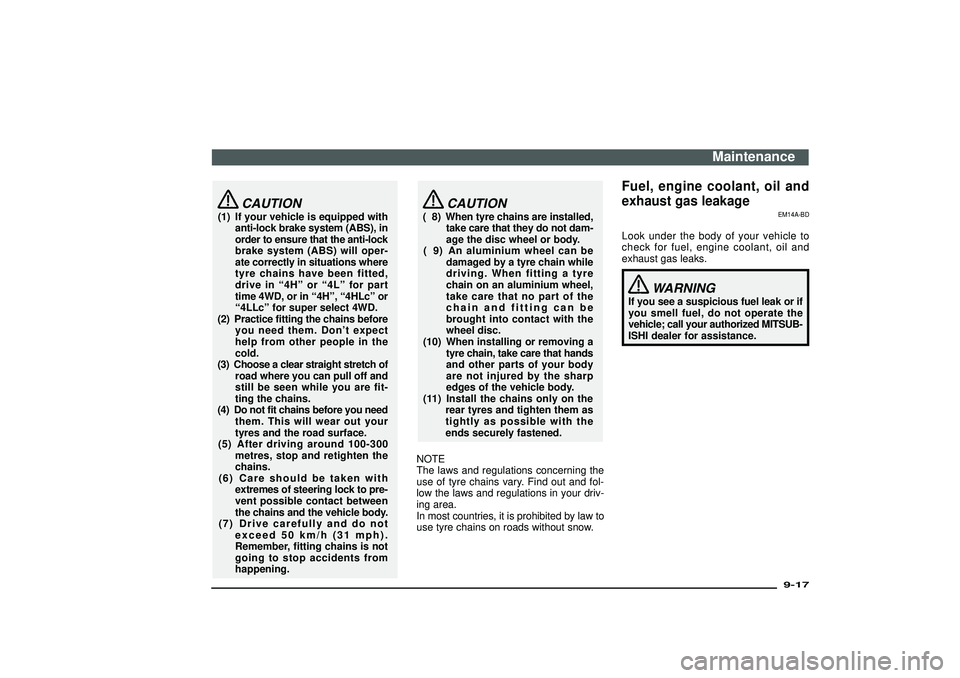
CAUTION
(1) If your vehicle is equipped with
anti-lock brake system (ABS), in
order to ensure that the anti-lock
brake system (ABS) will oper-
ate correctly in situations where
tyre chains have been fitted,
drive in“4H”or“4L”for part
time 4WD, or in“4H”,“4HLc”or
“4LLc”for super select 4WD.
(2) Practice fitting the chains before
you need them. Don’t expect
help from other people in the
cold.
(3) Choose a clear straight stretch of
road where you can pull off and
still be seen while you are fit-
ting the chains.
(4) Do not fit chains before you need
them. This will wear out your
tyres and the road surface.
(5) After driving around 100-300
metres, stop and retighten the
chains.
(6) Care should be taken with
extremes of steering lock to pre-
vent possible contact between
the chains and the vehicle body.
(7) Drive carefully and do not
exceed 50 km/h (31 mph).
Remember, fitting chains is not
going to stop accidents from
happening.
CAUTION
( 8) When tyre chains are installed,
take care that they do not dam-
age the disc wheel or body.
( 9) An aluminium wheel can be
damaged by a tyre chain while
driving. When fitting a tyre
chain on an aluminium wheel,
take care that no part of the
chain and fitting can be
brought into contact with the
wheel disc.
(10) When installing or removing a
tyre chain, take care that hands
and other parts of your body
are not injured by the sharp
edges of the vehicle body.
(11) Install the chains only on the
rear tyres and tighten them as
tightly as possible with the
ends securely fastened.
NOTE
The laws and regulations concerning the
use of tyre chains vary. Find out and fol-
low the laws and regulations in your driv-
ing area.
In most countries, it is prohibited by law to
use tyre chains on roads without snow.
Fuel, engine coolant, oil and
exhaust gas leakage
EM14A-BD
Look under the body of your vehicle to
check for fuel, engine coolant, oil and
exhaust gas leaks.
WARNING
If you see a suspicious fuel leak or if
you smell fuel, do not operate the
vehicle; call your authorized MITSUB-
ISHI dealer for assistance.
Maintenance
9-17
Div:
Out put date:
Page 365 of 392
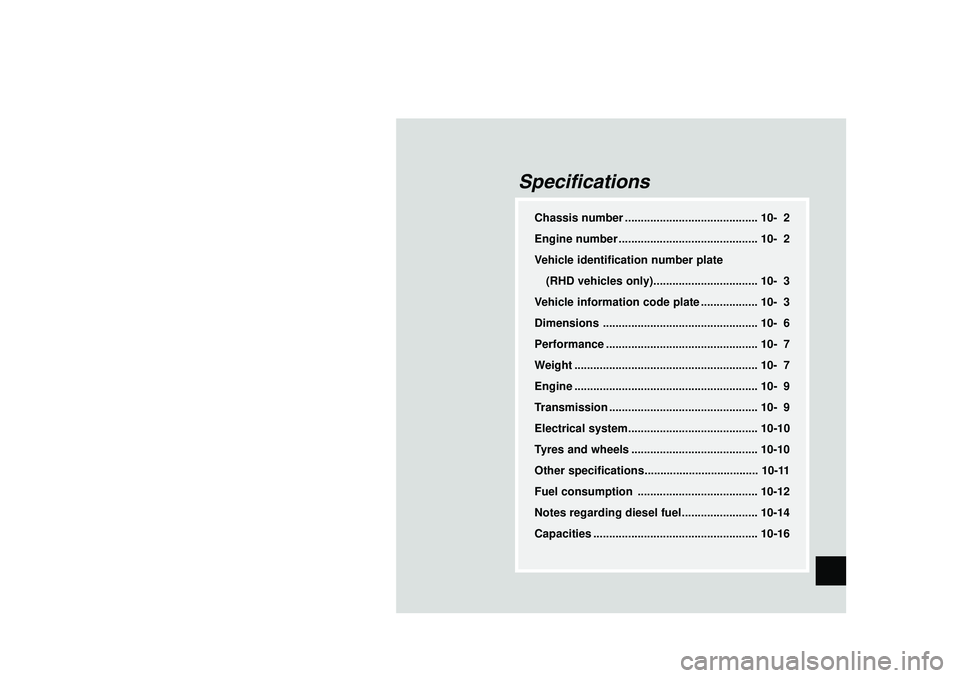
Specifications
Chassis number .......................................... 10- 2
Engine number ............................................ 10- 2
Vehicle identification number plate
(RHD vehicles only)................................. 10- 3
Vehicle information code plate .................. 10- 3
Dimensions ................................................. 10- 6
Performance ................................................ 10- 7
Weight .......................................................... 10- 7
Engine .......................................................... 10- 9
Transmission ............................................... 10- 9
Electrical system......................................... 10-10
Tyres and wheels ........................................ 10-10
Other specifications.................................... 10-11
Fuel consumption ...................................... 10-12
Notes regarding diesel fuel........................ 10-14
Capacities .................................................... 10-16
Div:
Out put date:
Page 375 of 392
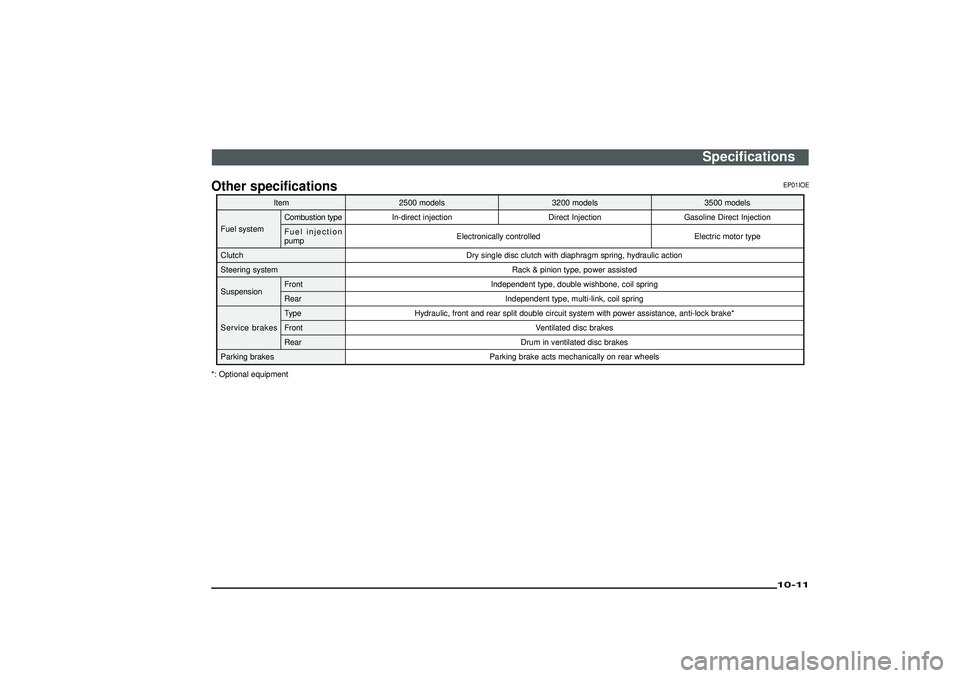
Other specifications
EP01IOE
Item 2500 models 3200 models 3500 models
Fuel systemCombustion typeIn-direct injection Direct Injection Gasoline Direct Injection
Fuel injection
pumpElectronically controlled Electric motor type
Clutch Dry single disc clutch with diaphragm spring, hydraulic action
Steering system Rack & pinion type, power assisted
SuspensionFront Independent type, double wishbone, coil spring
Rear Independent type, multi-link, coil spring
Service brakesType Hydraulic, front and rear split double circuit system with power assistance, anti-lock brake*
Front Ventilated disc brakes
Rear Drum in ventilated disc brakes
Parking brakes Parking brake acts mechanically on rear wheels
*: Optional equipment
Specifications
10-11
Div:
Out put date:
Page 376 of 392
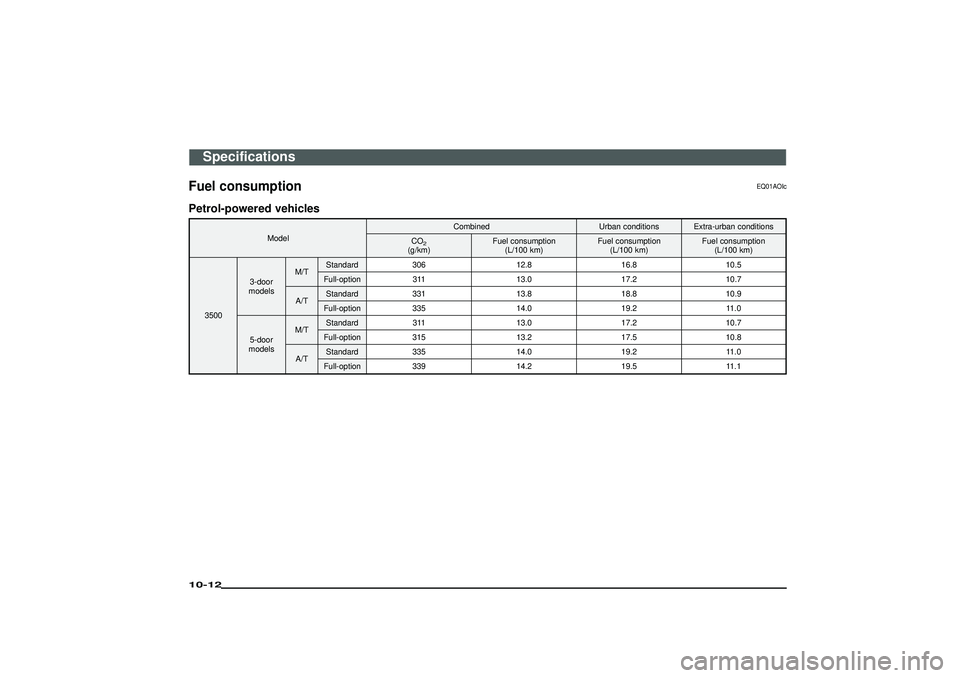
Fuel consumption
EQ01AOIc
Petrol-powered vehicles
ModelCombined Urban conditions Extra-urban conditions
CO
2
(g/km)Fuel consumption
(L/100 km)Fuel consumption
(L/100 km)Fuel consumption
(L/100 km)
35003-door
modelsM/TStandard 306 12.8 16.8 10.5
Full-option 311 13.0 17.2 10.7
A/TStandard 331 13.8 18.8 10.9
Full-option 335 14.0 19.2 11.0
5-door
modelsM/TStandard 311 13.0 17.2 10.7
Full-option 315 13.2 17.5 10.8
A/TStandard 335 14.0 19.2 11.0
Full-option 339 14.2 19.5 11.1
Specifications
10-12Div:
Out put date:
Page 377 of 392
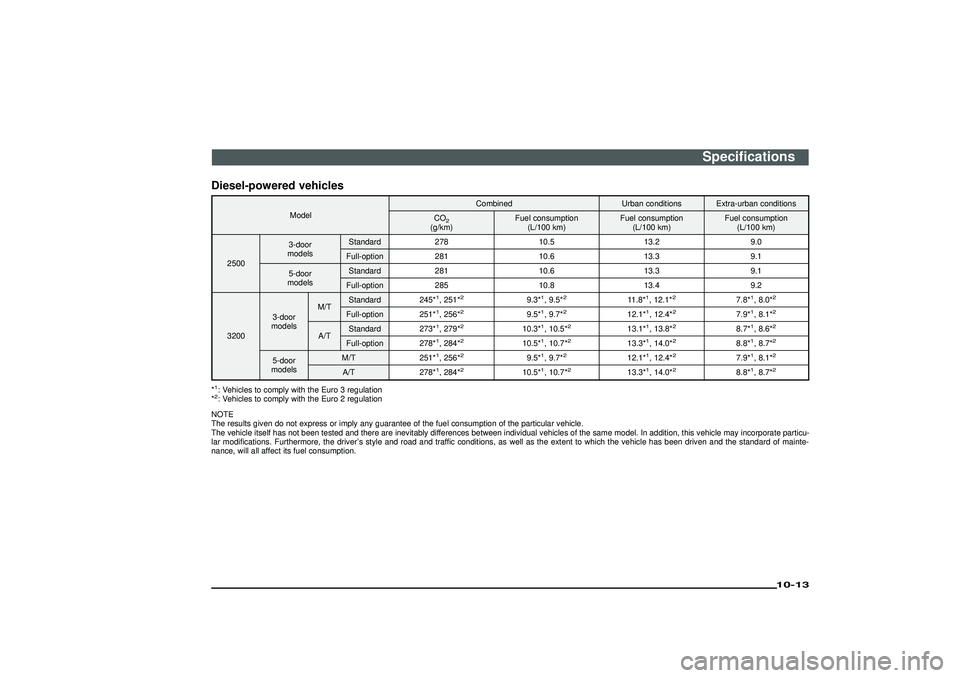
Diesel-powered vehicles
ModelCombined Urban conditions Extra-urban conditions
CO
2
(g/km)Fuel consumption
(L/100 km)Fuel consumption
(L/100 km)Fuel consumption
(L/100 km)
25003-door
modelsStandard 278 10.5 13.2 9.0
Full-option 281 10.6 13.3 9.1
5-door
modelsStandard 281 10.6 13.3 9.1
Full-option 285 10.8 13.4 9.2
32003-door
modelsM/TStandard 245*1, 251*
2
9.3*
1, 9.5*
2
11.8*
1, 12.1*
2
7.8*
1, 8.0*
2
Full-option 251*
1, 256*
2
9.5*
1, 9.7*
2
12.1*
1, 12.4*
2
7.9*
1, 8.1*
2
A/TStandard 273*
1, 279*
2
10.3*
1, 10.5*
2
13.1*
1, 13.8*
2
8.7*
1, 8.6*
2
Full-option 278*
1, 284*
2
10.5*
1, 10.7*
2
13.3*
1, 14.0*
2
8.8*
1, 8.7*
2
5-door
modelsM/T 251*
1, 256*
2
9.5*
1, 9.7*
2
12.1*
1, 12.4*
2
7.9*
1, 8.1*
2
A/T 278*
1, 284*
2
10.5*
1, 10.7*
2
13.3*
1, 14.0*
2
8.8*
1, 8.7*
2
*1: Vehicles to comply with the Euro 3 regulation
*2: Vehicles to comply with the Euro 2 regulation
NOTE
The results given do not express or imply any guarantee of the fuel consumption of the particular vehicle.
The vehicle itself has not been tested and there are inevitably differences between individual vehicles of the same model. In addition, this vehicle may incorporate particu-
lar modifications. Furthermore, the driver’s style and road and traffic conditions, as well as the extent to which the vehicle has been driven and the standard of mainte-
nance, will all affect its fuel consumption.
Specifications
10-13
Div:
Out put date:
Page 378 of 392
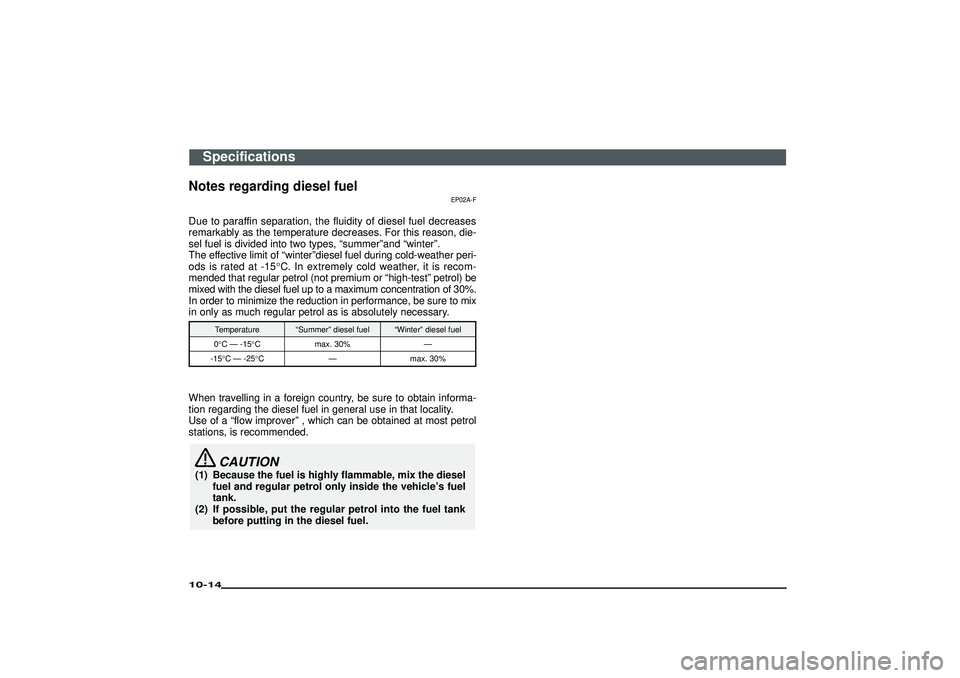
Notes regarding diesel fuel
EP02A-F
Due to paraffin separation, the fluidity of diesel fuel decreases
remarkably as the temperature decreases. For this reason, die-
sel fuel is divided into two types,“summer”and“winter”.
The effective limit of“winter”diesel fuel during cold-weather peri-
ods is rated at -15°C. In extremely cold weather, it is recom-
mended that regular petrol (not premium or“high-test”petrol) be
mixed with the diesel fuel up to a maximum concentration of 30%.
In order to minimize the reduction in performance, be sure to mix
in only as much regular petrol as is absolutely necessary.
Temperature“Summer”diesel fuel“Winter”diesel fuel
0°C—-15°C max. 30%—
-15°C—-25°C—max. 30%
When travelling in a foreign country, be sure to obtain informa-
tion regarding the diesel fuel in general use in that locality.
Use of a“flow improver”, which can be obtained at most petrol
stations, is recommended.
CAUTION
(1) Because the fuel is highly flammable, mix the diesel
fuel and regular petrol only inside the vehicle’s fuel
tank.
(2) If possible, put the regular petrol into the fuel tank
before putting in the diesel fuel.Specifications
10-14Div:
Out put date: