check transmission fluid MITSUBISHI SHOGUN 2003 Owner's Manual (in English)
[x] Cancel search | Manufacturer: MITSUBISHI, Model Year: 2003, Model line: SHOGUN, Model: MITSUBISHI SHOGUN 2003Pages: 392, PDF Size: 14.34 MB
Page 98 of 392
D50A529D
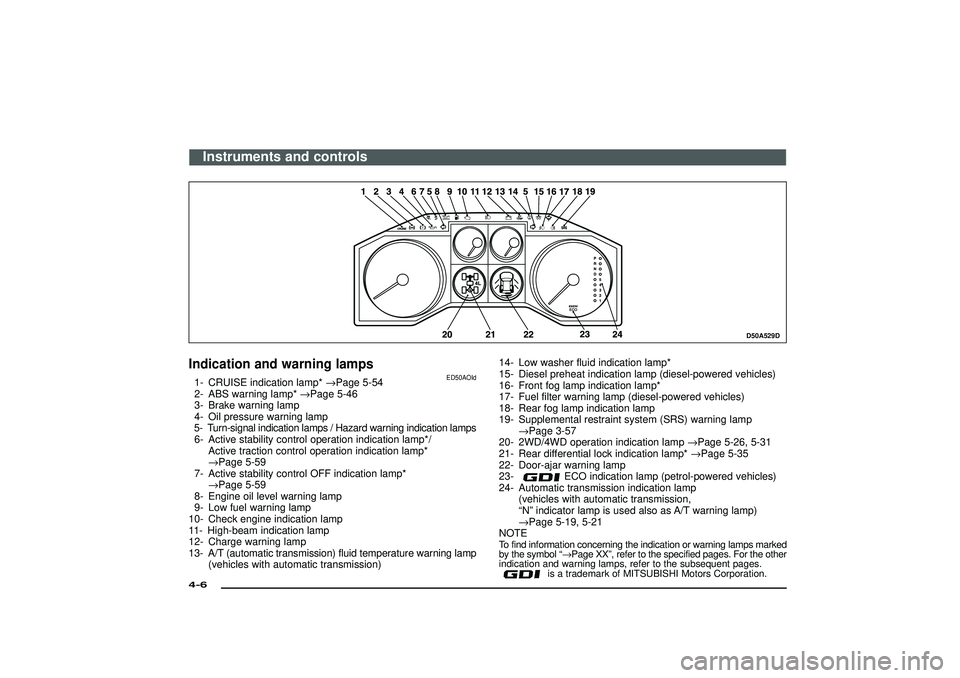
Indication and warning lamps
ED50AOId
1- CRUISE indication lamp*→Page 5-54
2- ABS warning lamp*→Page 5-46
3- Brake warning lamp
4- Oil pressure warning lamp
5- Turn-signal indication lamps / Hazard warning indication lamps
6- Active stability control operation indication lamp*/
Active traction control operation indication lamp*
→Page 5-59
7- Active stability control OFF indication lamp*
→Page 5-59
8- Engine oil level warning lamp
9- Low fuel warning lamp
10- Check engine indication lamp
11- High-beam indication lamp
12- Charge warning lamp
13- A/T (automatic transmission) fluid temperature warning lamp
(vehicles with automatic transmission)14- Low washer fluid indication lamp*
15- Diesel preheat indication lamp (diesel-powered vehicles)
16- Front fog lamp indication lamp*
17- Fuel filter warning lamp (diesel-powered vehicles)
18- Rear fog lamp indication lamp
19- Supplemental restraint system (SRS) warning lamp
→Page 3-57
20- 2WD/4WD operation indication lamp→Page 5-26, 5-31
21- Rear differential lock indication lamp*→Page 5-35
22- Door-ajar warning lamp
23-
ECO indication lamp (petrol-powered vehicles)
24- Automatic transmission indication lamp
(vehicles with automatic transmission,
“N”indicator lamp is used also as A/T warning lamp)
→Page 5-19, 5-21
NOTE
To find information concerning the indication or warning lamps marked
by the symbol“→Page XX”, refer to the specified pages. For the other
indication and warning lamps, refer to the subsequent pages.
is a trademark of MITSUBISHI Motors Corporation.
Instruments and controls
4-6Div:
Out put date:
Page 197 of 392
CAUTION
(1) Do not force the vehicle or drive
recklessly on sandy surfaces. In
comparison with normal road
surfaces, the engine and other
drive-system components are
put under excessive strain when
driving on such a surface, and
this could lead to accidents.
(2) If any of following conditions
occur while the vehicle is being
driven, immediately park your
vehicle in a safe place and fol-
low these procedures:
•The needle in the tempera-
ture gauge approaches the
overheating zone.
Refer to the“Engine
overheating”on page 8-21.
•A/T fluid temperature warning
lamp illuminates.
Refer to the“A/T fluid tempera-
ture warning lamp”on page
4-11.
WARNING
When attempting to rock your vehicle
out of a stuck position, be sure that
the area around the vehicle is clear of
people and physical objects. The
rocking motion may cause the
vehicle to suddenly launch forward
or backward, causing injury or dam-
age to nearby people or objects.
NOTE
(1) Avoid sudden braking, acceleration, and
turning; such operations could result in
the vehicle becoming stuck.
(2) If the vehicle becomes stuck in sandy
or muddy roads, it can often be moved
a rocking motion. Move the selector
lever rhythmically between the“D”
(DRIVE) and“R”(REVERSE) posi-
tion (with manual transmission,
between 1st and Reverse), while apply-
ing slight pressure to the accelerator
pedal.
(3) It is recommended to start the vehicle
with parking brake partially, but not
completely, applied by slightly pulling
the parking brake lever.
After the vehicle has become free, do
not forget to release the parking brake.NOTE
(4) If it is necessary to drive in extremely
muddy conditions, the use of tyre
chains is recommended. Because the
extent of muddy conditions is difficult to
judge and the vehicle could become
bogged down very deeply, operation
should be at a low speed. If possible,
get out of the vehicle and check the
conditions ahead before proceeding.
(5) Driving over roads in coastal areas or
roads on which anti-skid preparations
have been spread can cause rust on
the vehicle; wash the vehicle thor-
oughly as soon as possible after such
use.
Climbing sharp gradesSet the transfer shift lever to“4L”(part time
4WD) or“4LLc”(super select 4WD II) to
maximize the engine torque.
WARNING
(1) Go straight up. Do not try to
traverse across a steep slope.
(2) If you begin to lose traction, ease
off the accelerator pedal and
gently turn the steering wheel
alternatively left and right to
regain adequate traction again.
Starting and driving
5-39
Div:
Out put date:
Page 317 of 392
N25A336A
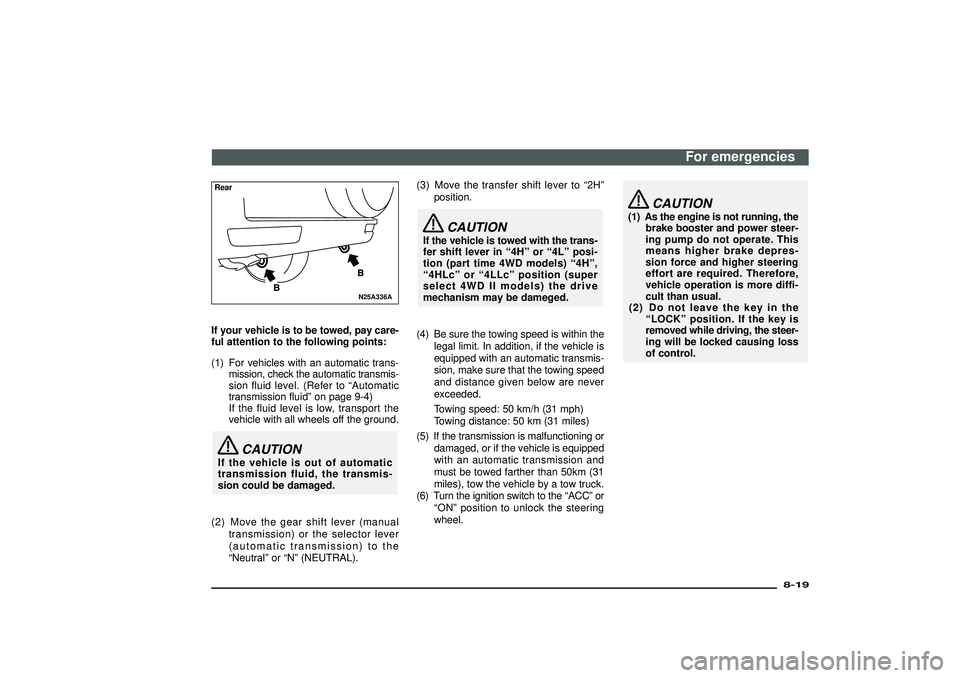
RearIf your vehicle is to be towed, pay care-
ful attention to the following points:
(1) For vehicles with an automatic trans-
mission, check the automatic transmis-
sion fluid level. (Refer to“Automatic
transmission fluid”on page 9-4)
If the fluid level is low, transport the
vehicle with all wheels off the ground.
CAUTION
If the vehicle is out of automatic
transmission fluid, the transmis-
sion could be damaged.
(2) Move the gear shift lever (manual
transmission) or the selector lever
(automatic transmission) to the
“Neutral”or“N”(NEUTRAL).(3) Move the transfer shift lever to“2H”
position.
CAUTION
If the vehicle is towed with the trans-
fer shift lever in“4H”or“4L”posi-
tion (part time 4WD models)“4H”,
“4HLc”or“4LLc”position (super
select 4WD II models) the drive
mechanism may be dameged.
(4) Be sure the towing speed is within the
legal limit. In addition, if the vehicle is
equipped with an automatic transmis-
sion, make sure that the towing speed
and distance given below are never
exceeded.
Towing speed: 50 km/h (31 mph)
Towing distance: 50 km (31 miles)
(5) If the transmission is malfunctioning or
damaged, or if the vehicle is equipped
with an automatic transmission and
must be towed farther than 50km (31
miles), tow the vehicle by a tow truck.
(6) Turn the ignition switch to the“ACC”or
“ON”position to unlock the steering
wheel.
CAUTION
(1) As the engine is not running, the
brake booster and power steer-
ing pump do not operate. This
means higher brake depres-
sion force and higher steering
effort are required. Therefore,
vehicle operation is more diffi-
cult than usual.
(2) Do not leave the key in the
“LOCK”position. If the key is
removed while driving, the steer-
ing will be locked causing loss
of control.
For emergencies
8-19
Div:
Out put date:
Page 346 of 392
M03B017A
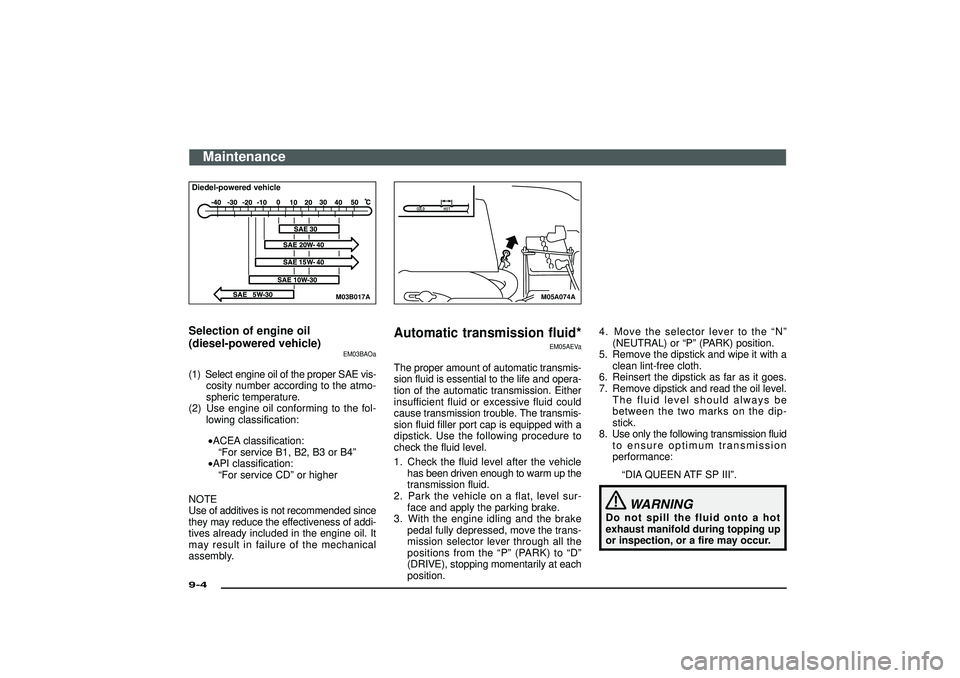
Diedel-powered vehicleSelection of engine oil
(diesel-powered vehicle)
EM03BAOa
(1) Select engine oil of the proper SAE vis-
cosity number according to the atmo-
spheric temperature.
(2) Use engine oil conforming to the fol-
lowing classification:
•ACEA classification:
“For service B1, B2, B3 or B4”
•API classification:
“For service CD”or higher
NOTE
Use of additives is not recommended since
they may reduce the effectiveness of addi-
tives already included in the engine oil. It
may result in failure of the mechanical
assembly.
M05A074A
Automatic transmission fluid*
EM05AEVa
The proper amount of automatic transmis-
sion fluid is essential to the life and opera-
tion of the automatic transmission. Either
insufficient fluid or excessive fluid could
cause transmission trouble. The transmis-
sion fluid filler port cap is equipped with a
dipstick. Use the following procedure to
check the fluid level.
1. Check the fluid level after the vehicle
has been driven enough to warm up the
transmission fluid.
2. Park the vehicle on a flat, level sur-
face and apply the parking brake.
3. With the engine idling and the brake
pedal fully depressed, move the trans-
mission selector lever through all the
positions from the“P”(PARK) to“D”
(DRIVE), stopping momentarily at each
position.4. Move the selector lever to the“N”
(NEUTRAL) or“P”(PARK) position.
5. Remove the dipstick and wipe it with a
clean lint-free cloth.
6. Reinsert the dipstick as far as it goes.
7. Remove dipstick and read the oil level.
The fluid level should always be
between the two marks on the dip-
stick.
8. Use only the following transmission fluid
to ensure optimum transmission
performance:
“DIA QUEEN ATF SP III”.
WARNING
Do not spill the fluid onto a hot
exhaust manifold during topping up
or inspection, or a fire may occur.
Maintenance
9-4Div:
Out put date: