service MITSUBISHI SHOGUN 2003 Owner's Manual (in English)
[x] Cancel search | Manufacturer: MITSUBISHI, Model Year: 2003, Model line: SHOGUN, Model: MITSUBISHI SHOGUN 2003Pages: 392, PDF Size: 14.34 MB
Page 10 of 392
Installation of accessories
EB24A-Cb
Before fitting any accessories, please con-
sult your authorized MITSUBISHI dealer.
(1) The installation of accessories, optional
parts, etc., should only be carried out
within the limits prescribed by law in
your country, and in accordance with
the guidelines and warnings con-
tained within the documents accompa-
nying this vehicle.
Only MITSUBISHI approved accesso-
ries should be fitted to your vehicle.
(2) Improper installation of electrical parts
could cause fire, please refer to the
Modifications/Alterations to the electri-
cal or fuel systems section within this
manual.
(3) When using a communication system
such as a cellular phone or a radio set
inside the vehicle, a separate exter-
nal antenna must be fitted. When a cel-
lular phone or a radio set is used by
using an internal antenna alone, it may
interfere with the vehicle’s electrical
system and adversely affect safe
operation of the vehicle.
(4) Tyres and wheels which do not meet
specifications must not be used.
Refer to the“Specifications”section for
information regarding wheel and tyre
sizes.(5) Do not fail to read all relative instruc-
tions before first putting into service and
prior to the attachment or installation of
accessories, parts or other modifica-
tions to the vehicle!
Important points!
Due to the large number of accessory and
replacement parts of different manufactur-
ers in the market, it is not possible, not only
for MITSUBISHI, but also an authorized
MITSUBISHI dealer, to check whether the
attachment or installation of such parts
affects the driving safety of your
MITSUBISHI-vehicle.
Even when such parts are officially autho-
rized, for example by a“general opera-
tors permit”(an appraisal for the part) or
through the execution of the part in an offi-
cially approved manner of construction, or
when a single operation permit following
the attachment or installation of such parts,
it cannot be deduced from that alone, that
the driving safety of your vehicle has not
been affected.Consider also that there basically exists no
liability on the part of the appraiser or the
official. Only in the case of parts
(MITSUBISHI original replacement or
exchange parts as well as MITSUBISHI
accessories) that are recommended and
released by an authorized MITSUBISHI
dealer and that are attached or installed by
an authorized MITSUBISHI dealer can you
assume, that optimal safety has been pro-
vided. The same also pertains to modifi-
cations of MITSUBISHI vehicles with
respect to the production specifications. For
your own safety, in such cases as well, you
should only undertake modifications
according to the recommendations of an
authorized MITSUBISHI dealer.
General information
1-10Div:
Out put date:
Page 90 of 392
SRS servicing
EG29G-A
The entire SRS including air bag and
pre-tensioner seat belt must be inspected
by an authorized MITSUBISHI dealer after
10 years.
WARNING
(1) Any maintenance performed on
or near the components of the
SRS must be performed only by
an authorized MITSUBISHI
dealer. Do not permit anyone
else to do service, inspection,
maintenance or repair on any
SRS components or wiring;
similarly, no part of the SRS
should ever be handled or dis-
posed of by anyone except an
authorized MITSUBISHI dealer.
Improper work on the SRS com-
ponents or wiring could result in
inadvertent deployment of the air
bags, or could render the SRS
inoperative; either situation
could result in serious injury.
(2) Do not modify your steering
wheel, seat belt retractor or any
other SRS components. For
example, replacement of the
steering wheel, or modifica-
tions to the front bumper or
body structure can adversely
affect SRS performance and lead
to possible injury.
WARNING
(3) If your vehicle has received any
front-end damage, you should
have the SRS inspected by an
authorized MITSUBISHI dealer to
ensure it is in proper working
order.
(4) On vehicles with the side air
bags, do not modify your front
seats centre pillar and centre
console.
It can adversely affect SRS per-
formance and lead to possible
injury.
Also, if you have found any tear
or open seam in the seat fabric
at the portion near the side air
bag, have the seat inspected at
an authorized MITSUBISHI
dealer.
(5) On vehicles with the side air
bags, if your vehicles has
received any damage to either
side, you should have the SRS
inspected by an authorized MIT-
SUBISHI dealer to ensure it is in
proper working order.NOTE
(1) When you transfer ownership of the
vehicle to some other person, we urge
you to alert the new owner that it is
equipped with the SRS and refer that
owner to the applicable section in this
owner’s handbook.
(2) If you junk or scrap the vehicle, we urge
you to first take the vehicle to an autho-
rized MITSUBISHI dealer so that the
SRS can be rendered safe.
Seat and seat belts
3-58Div:
Out put date:
Page 164 of 392
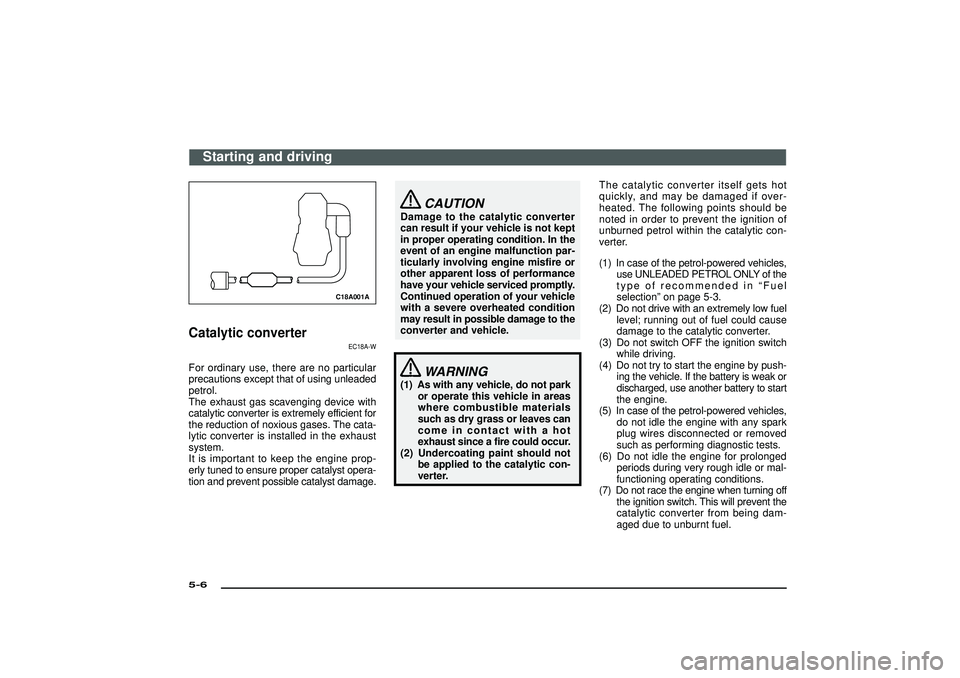
C18A001A
Catalytic converter
EC18A-W
For ordinary use, there are no particular
precautions except that of using unleaded
petrol.
The exhaust gas scavenging device with
catalytic converter is extremely efficient for
the reduction of noxious gases. The cata-
lytic converter is installed in the exhaust
system.
It is important to keep the engine prop-
erly tuned to ensure proper catalyst opera-
tion and prevent possible catalyst damage.
CAUTION
Damage to the catalytic converter
can result if your vehicle is not kept
in proper operating condition. In the
event of an engine malfunction par-
ticularly involving engine misfire or
other apparent loss of performance
have your vehicle serviced promptly.
Continued operation of your vehicle
with a severe overheated condition
may result in possible damage to the
converter and vehicle.
WARNING
(1) As with any vehicle, do not park
or operate this vehicle in areas
where combustible materials
such as dry grass or leaves can
come in contact with a hot
exhaust since a fire could occur.
(2) Undercoating paint should not
be applied to the catalytic con-
verter.The catalytic converter itself gets hot
quickly, and may be damaged if over-
heated. The following points should be
noted in order to prevent the ignition of
unburned petrol within the catalytic con-
verter.
(1) In case of the petrol-powered vehicles,
use UNLEADED PETROL ONLY of the
type of recommended in“Fuel
selection”on page 5-3.
(2) Do not drive with an extremely low fuel
level; running out of fuel could cause
damage to the catalytic converter.
(3) Do not switch OFF the ignition switch
while driving.
(4) Do not try to start the engine by push-
ing the vehicle. If the battery is weak or
discharged, use another battery to start
the engine.
(5) In case of the petrol-powered vehicles,
do not idle the engine with any spark
plug wires disconnected or removed
such as performing diagnostic tests.
(6) Do not idle the engine for prolonged
periods during very rough idle or mal-
functioning operating conditions.
(7) Do not race the engine when turning off
the ignition switch. This will prevent the
catalytic converter from being dam-
aged due to unburnt fuel.
Starting and driving
5-6Div:
Out put date:
Page 165 of 392
(8) Stop driving the vehicle if you think the
performance is noticeably low, or that
there is unnecessary engine rotation, or
any other engine trouble, such as with
the ignition, etc.
If it is impractical to stop driving imme-
diately, reduce the speed and drive for
only a short time. Have an inspection
made by your nearest authorized
MITSUBISHI dealer as soon as pos-
sible.
(9) In unusual situations involving grossly
malfunctioning engine operation, a
burnt smell may indicate severe and
abnormal catalyst overheating.
If this occurs, the vehicle should be
stopped in a safe place, the engine
switched off and the vehicle allowed to
cool. Once the engine is cool, a ser-
vice, including a tune-up to manufac-
turer’s specifications, should be
obtained immediately.
Economical driving
EC19AAX
For economical driving, there are some
technical requirements that have to be met.
The prerequisite for low fuel consumption
is a properly adjusted engine. In order to
achieve longer life of the vehicle and the
most economical operation, have the
vehicle serviced by an authorized
MITSUBISHI dealer at regular intervals in
accordance with the service standards.
Fuel economy and generation of exhaust
gas and noise are highly influenced by per-
sonal driving habits as well as the particu-
lar operating conditions. The following
points should be observed in order to mini-
mize wear of brakes, tyres and engine as
well as to reduce environmental pollu-
tion.
(1)Starting
Avoid rapid acceleration and sudden
starts; such operation will result in
higher fuel consumption.
(2)Shifting
Shift only at an appropriate speed and
engine speed. Always use the high-
est gear possible.
The transfer shift lever should be set to
“2H”when driving on normal roads and
express ways to obtain best possible
fuel economy.(3)City traffic
Frequent starting and stopping
increases the average fuel consump-
tion. Use roads with smooth traffic flow
whenever possible. When driving on
congested roads, avoid use of a low
gear at high engine speeds.
(4)Idling
The vehicle consumes fuel even dur-
ing idling. Avoid extended idling when-
ever possible.
(5)Speed
The higher the vehicle speed, the more
fuel consumed. Avoid driving at full
speed. Even a slight release of the
accelerator pedal will save a signifi-
cant amount of fuel.
(6)Tyre inflation pressure
Check the tyre inflation pressures at
regular intervals. Low tyre inflation
pressure increases road resistance and
fuel consumption. In addition, low tyre
pressures adversely affect tyre wear
and driving stability.
Starting and driving
5-7
Div:
Out put date:
Page 181 of 392
Waiting
EI04G-Ee
For short waiting periods, such as at traf-
fic signal, the vehicle can be left in gear and
held stationary with the service brake.
For longer waiting periods with the engine
running, the selector lever should be placed
in the“N”(NEUTRAL) position.
CAUTION
(1) Never hold the vehicle station-
ary while in gear on a hill with
the accelerator, always apply the
parking brake and/or service
brake.
(2) Unexpected acceleration may
occur if the selector lever is in a
position other than“P”(PARK)
or“N”(NEUTRAL).
Prior to moving off after having
stopped the vehicle, make sure
that the selector lever is in“D”
(DRIVE) or“Sports mode”posi-
tion.
Parking
EI04H-Be
To park the vehicle, first bring it to a com-
plete stop, fully engage the parking brake,
and then move the selector lever to the“P”
(PARK) position.
If you are going to leave the vehicle unat-
tended, always switch off the engine and
remove the ignition key.
NOTE
On a slope, be sure to apply the parking
brake before moving the selector lever to
the“P”(PARK) position. If you move the
selector lever to the“P”(PARK) position
without first applying the parking brake, a
stronger than normal resistance force may
be encountered. In this situation, move the
selector lever strongly when you next wish
to drive.
Starting and driving
5-23
Div:
Out put date:
Page 202 of 392
Braking
EI23AAGa
All the parts of the brake system are criti-
cal to safety. Have the vehicle serviced by an
authorized MITSUBISHI dealer at regular
intervals according to the service booklet.Brake system(1) The service brake is divided into two
brake circuits so that when one brake
circuit fails, the other is available to stop
the vehicle. If this occurs, however, the
brake pedal must be depressed fur-
ther than usual; stop driving as soon as
possible and have the brake system
repaired at the nearest authorized
MITSUBISHI dealer.
(2) The brake boosting force is lost after
the brake pedal is depressed once or
twice while the engine is off. If this
occurs, the brake will require greater
force than usual. This is especially
important when the vehicle is being
towed.
Vehicles equipped with anti-lock brake
system
The brake system uses brake fluid pres-
surized by the pump to power-assist the
brake. If the brake system fails during driv-
ing, the brake warning lamp comes on and
buzzer sounds continuously. In this case,
the brake may not work properly.If this buzzer should continue to sound,
park your vehicle in a safe place and con-
tact your nearest authorized MITSUB-
ISHI dealer.
Please refer to“Brake warning lamp”on
page 4-7.
CAUTION
Bring the vehicle to halt in a safe
location by applying the brakes gen-
tly. Applying the brakes rapidly or
driving at high speed may make the
vehicle unstable.
NOTE
(1) Depressing the brake pedal repeat-
edly may turn on the brake warning
lamp, ABS warning lamp and brake
warning buzzer. It is normal if the lamp
goes out and the buzzer stops sound-
ing after a few seconds.
(2) In certain cases immediately after the
engine has been started or when the
brake pedal is depressed repeatedly, a
noise generated by operation of brake
devices may be heard coming from the
engine compartment. This type of noise
is normal and is no need for concern.
In fact, it indicates that the correspond-
ing devices are operating normal.
Warning lampThe brake warning lamp lets you know if
your brake system is working properly.
Read“Brake warning lamp”on page 4-7.When brakes are wetCheck the brake system while driving at a
low speed immediately after starting, espe-
cially when the brakes are wet, to con-
firm they work normally.
A film of water can form on the brake discs
and prevent normal functioning after driv-
ing in heavy rain or through large puddles,
or after the vehicle is washed. If this occurs,
dry the brakes out by driving slowly while
lightly depressing the brake pedal.When driving downhillIt is important to take advantage of the
engine braking by shifting to a lower gear
while driving on steep downhill roads in
order to prevent the brakes from overheat-
ing.
Starting and driving
5-44Div:
Out put date:
Page 227 of 392
RDS uses PI (program identification) sig-
nal and AF (alternative frequency) list trans-
mitted in addition to the normal UKW
broadcasting programs, and picks up the
UKW stations that are transmitting the
same program from the EON (enhanced
other network) and automatically tunes to
the station with the strongest signal inten-
sity.
Therefore, you can continue listening to
one program in, for example, a long dis-
tance driving without returning to other sta-
tion transmitting the same program when
you are leaving the service area of the cur-
rently receiving station.
The RDS radio also features the limited
reception of the program types, the break-in
reception of the traffic announcement and
emergency broadcast, and the limited
/unlimited reception of the regional pro-
grams.AF (Alternative Frequencies) function
The AF function finds a station broadcast-
ing the same program, and selects sta-
tion with the strongest signal of AF lists.
The AF function is tuned on (with the AF
indicator (13) shown on the display) at all
times unless you manually switch off.
To turn the function off, at first, switch off
the power from UKW mode, and while
pressing the No.5 of the memory select
buttons (7), press the PWR switch (1) until
it beeps. The AF indicator (13) on the dis-
play will turn off.
To turn the function on, use the same pro-
cedure.
REG (Regional) function
REG function limits to receive the sta-
tions broadcasting regional programs.
Regional programming and regional net-
works are organized differently depend-
ing on the country or area (they may be
changed according to the hour, state, or
broadcast area), so if you don’t want to
receive the regional programs automati-
cally, you can set up REG ON not to
receive regional programs.
To turn the function on, switch off the power
from UKW mode, and while pressing the
side of the TUNE/SEEK button (5),
press the PWR switch (1) until it beeps.
The“REG ON”will be shown on the dis-
play.To turn the function off, use the same pro-
cedure.
PI (Program Identification) search func-
tion
When traveling long distance and the
recalled preset station is weak, radio
searches another frequency broadcast-
ing the same programming with the same
PI code in AF list.
If there are no frequencies broadcasting the
same programming, the radio searches a
frequency broadcasting the regional pro-
gramming. The radio succeeds in search-
ing the regional programming, then the
display shows the REG indicator (10).
If the radio does not succeed in search-
ing the regional programming, the radio
returns to the recalled preset station.
For pleasant driving
6-7
Div:
Out put date:
Page 242 of 392
RDS uses PI (program identification) sig-
nal and AF (alternative frequency) list trans-
mitted in addition to the normal UKW
broadcasting programs, and picks up the
UKW stations that are transmitting the
same program from the EON (enhanced
other network) and automatically tunes to
the station with the strongest signal inten-
sity.
Therefore, you can continue listening to
one program in, for example, a long dis-
tance driving without returning to other sta-
tion transmitting the same program when
you are leaving the service area of the cur-
rently receiving station.
The RDS radio also features the limited
reception of the program types, the break-in
reception of the traffic announcement and
emergency broadcast, and the limited
/unlimited reception of the regional pro-
grams.AF (Alternative Frequencies) function
The AF function finds a station broadcast-
ing the same program, and selects sta-
tion with the strongest signal of AF lists.
The AF function is tuned on (with the AF
indicator (13) shown on the display) at all
times unless you manually switch off.
To turn the function off, at first, switch off
the power from UKW mode, and while
pressing the No.5 of the memory select
buttons (7), press the PWR switch (1) until
it beeps. The AF indicator (13) on the dis-
play will turn off.
To turn the function on, use the same pro-
cedure.
REG (Regional) function
REG function limits to receive the sta-
tions broadcasting regional programs.
Regional programming and regional net-
works are organized differently depend-
ing on the country or area (they may be
changed according to the hour, state, or
broadcast area), so if you don’t want to
receive the regional programs automati-
cally, you can set up REG ON not to
receive regional programs.
To turn the function on, switch off the power
from UKW mode, and while pressing the
side of the TUNE/SEEK button (5),
press the PWR switch (1) until it beeps.
The“REG ON”will be shown on the dis-
play.To turn the function off, use the same pro-
cedure.
PI (Program Identification) search func-
tion
When traveling long distance and the
recalled preset station is weak, radio
searches another frequency broadcast-
ing the same programming with the same
PI code in AF list.
If there are no frequencies broadcasting the
same programming, the radio searches a
frequency broadcasting the regional pro-
gramming. The radio succeeds in search-
ing the regional programming, then the
display shows the REG indicator (10).
If the radio does not succeed in search-
ing the regional programming, the radio
returns to the recalled preset station.
For pleasant driving
6-22Div:
Out put date:
Page 315 of 392
CAUTION
(1) After changing the tyre, drive the
vehicle approximately 1,000 km
(620 miles) and retighten the
wheel nuts to make sure that
they are not loose.
(2) If the steering wheel vibrates
when driving after changing the
tyre, have the tyre checked for
balance at your MITSUBISHI
dealer.
(3) For the safe operation of your
vehicle, be sure to avoid mix-
ing one type of tyre with another
type or using tyres of a size
other than the specified size.
Towing
EN25AOIc
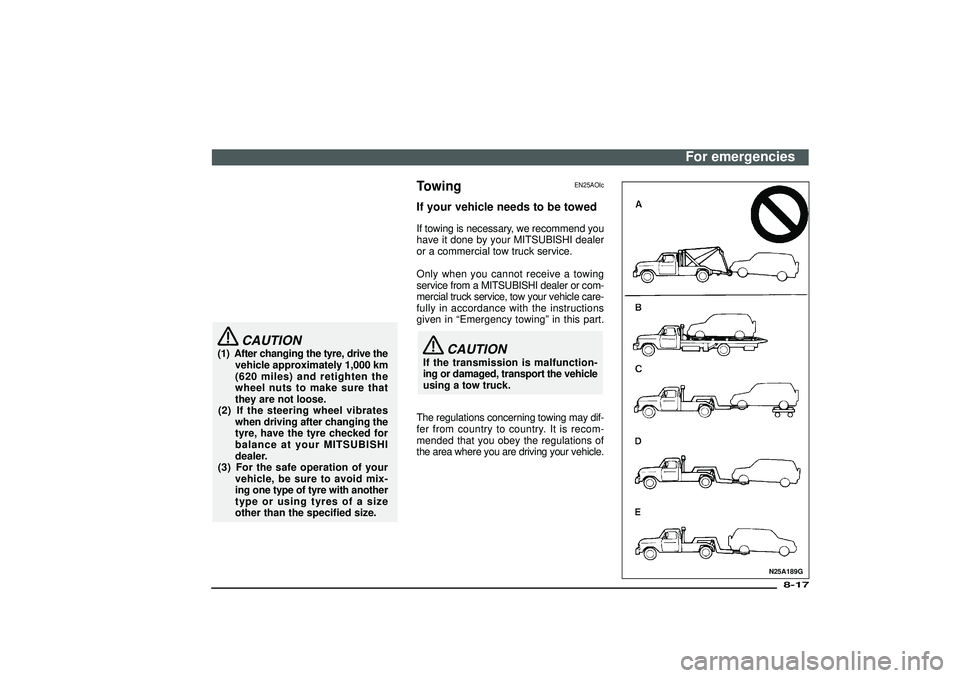
If your vehicle needs to be towedIf towing is necessary, we recommend you
have it done by your MITSUBISHI dealer
or a commercial tow truck service.
Only when you cannot receive a towing
service from a MITSUBISHI dealer or com-
mercial truck service, tow your vehicle care-
fully in accordance with the instructions
given in“Emergency towing”in this part.
CAUTION
If the transmission is malfunction-
ing or damaged, transport the vehicle
using a tow truck.
The regulations concerning towing may dif-
fer from country to country. It is recom-
mended that you obey the regulations of
the area where you are driving your vehicle.
N25A189G
For emergencies
8-17
Div:
Out put date:
Page 316 of 392
CAUTION
(1) This vehicle must not be towedby a tow truck using sling lift
type equipment (Type A) as illus-
trated. Using a sling lift will dam-
age the bumper and front end.
(2) In case the vehicle with an auto- matic transmission must be
towe d farthe r tha n 50k m (3 1
miles) ,transpor tth evehicl ewith
all wheels off the ground (Type B
or C) or with rear wheels off the
ground (Type E) as illustrated.
(3) If the transmission is dam- aged, transport the vehicle with
all wheels off the ground (Type B
or C) as illustrated.
(4) Be sure to shift the transfer shift lever to “2H ”position. Never try
to tow with the transfer shift
lever in “4H ”or “4L ”positions
(part time 4WD models), “4H ”,
“ 4HLc ”,or “4LLc ”positions
(super select 4WD II models) and
with any of the wheels on the
ground (Type D or E). This could
result in damage to the vehi-
cle ’s driving system, or the
vehicle could become sepa-
rated from the tow truck and
unexpected accident might
result. Towing with front wheels off the ground
(Type D)
Place the gear shift lever (manual
transmission) or the selector lever
(automatic transmission) in the
“Neutral ”or
“N” (NEUTRAL) position. Release the park-
ing brake.
Towing with rear wheels off the ground
(Type E)
Turn the ignition switch to the “ACC ”posi-
tion and secure the steering wheel in a
straight-ahead position with a rope or
tie-down strap.
Never place the ignition switch in the
“ LOCK ”position. It is dangerous as the
steering wheel may lock.
CAUTION
[Fo rvehicles equippe dwit hthe
MITSUBISH Iactiv estabilit y &trac-
tio ncontro lsyste m(M-ASTC)]
I f th evehicl eis towe dwit hth eigni-
tion switch in to the “ON ”position
and only the front wheels or only the
rear wheels raised off the ground, the
activ etractio ncontro lsyste mmay
operate, resulting in a an accident.
N25A335A
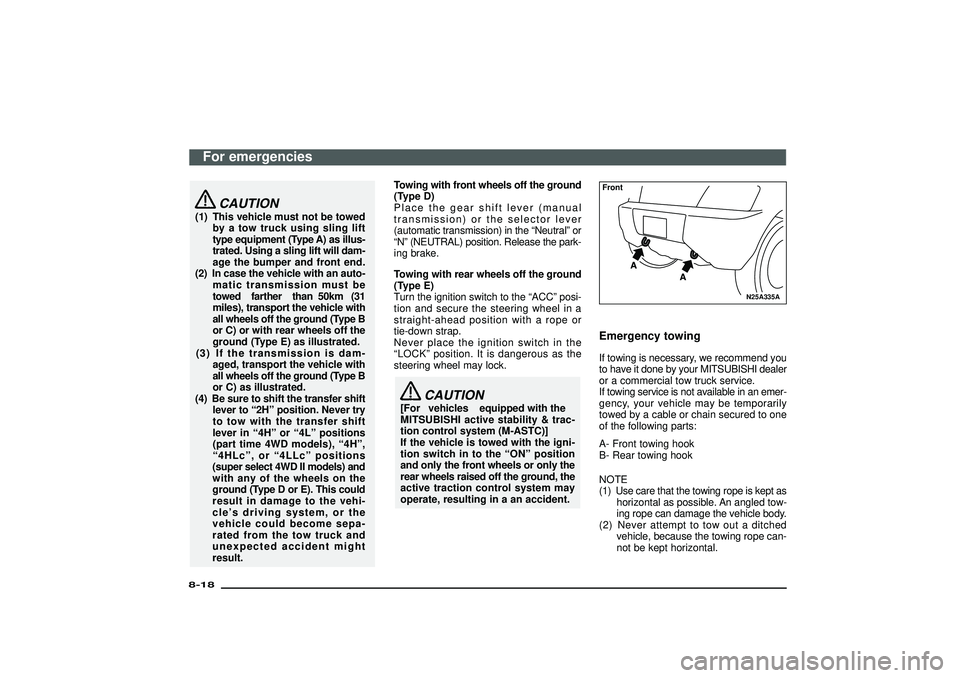
FrontEmergency towingIf towing is necessary, we recommend you
to have it done by your MITSUBISHI dealer
or a commercial tow truck service.
If towing service is not available in an emer-
gency, your vehicle may be temporarily
towed by a cable or chain secured to one
of the following parts:
A- Front towing hook
B- Rear towing hook
NOTE
(1) Use care that the towing rope is kept as horizontal as possible. An angled tow-
ing rope can damage the vehicle body.
(2) Never attempt to tow out a ditched vehicle, because the towing rope can-
not be kept horizontal.
For emergencies
8-18Div:
Out put date: