belt MITSUBISHI SHOGUN 2008 (in English) Manual Online
[x] Cancel search | Manufacturer: MITSUBISHI, Model Year: 2008, Model line: SHOGUN, Model: MITSUBISHI SHOGUN 2008Pages: 538, PDF Size: 25.09 MB
Page 134 of 538
3-10 Instruments and controls
3
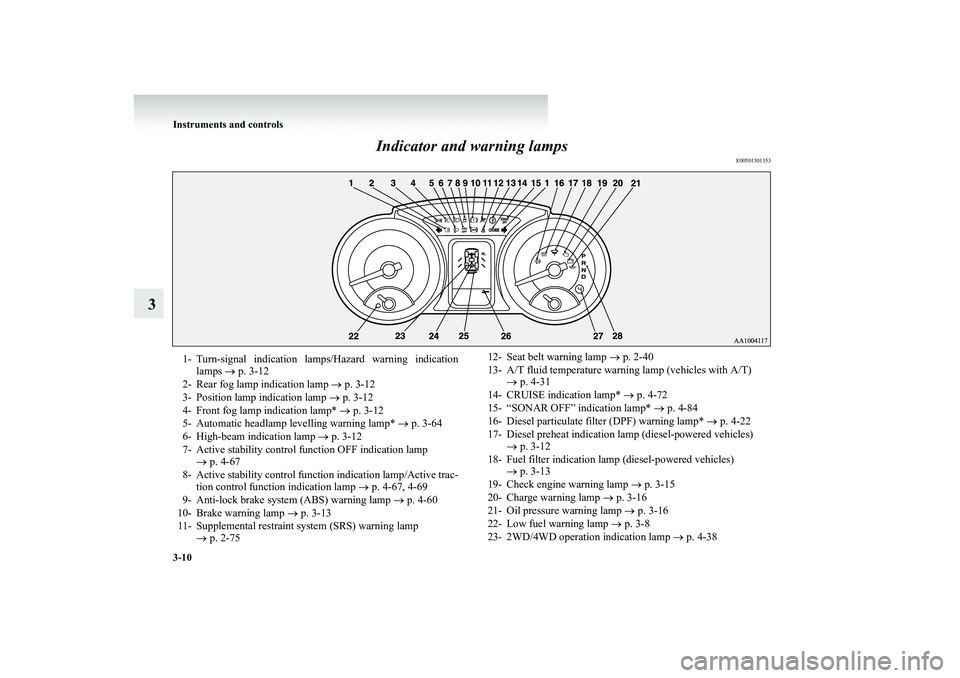
Indicator and warning lamps
E00501501353
1- Turn-signal indication lamps/Hazard warning indication
lamps
→ p. 3-12
2- Rear fog lamp indication lamp
→ p. 3-12
3- Position lamp indication lamp
→ p. 3-12
4- Front fog lamp indication lamp*
→ p. 3-12
5- Automatic headlamp levelling warning lamp*
→ p. 3-64
6- High-beam indication lamp
→ p. 3-12
7- Active stability control function OFF indication lamp
→ p. 4-67
8- Active stability control function indication lamp/Active trac-
tion control function indication lamp
→ p. 4-67, 4-69
9- Anti-lock brake system (ABS) warning lamp
→ p. 4-60
10- Brake warning lamp
→ p. 3-13
11- Supplemental restraint system (SRS) warning lamp
→ p. 2-75
12- Seat belt warning lamp
→ p. 2-40
13- A/T fluid temperature warning lamp (vehicles with A/T)
→ p. 4-31
14- CRUISE indication lamp*
→ p. 4-72
15- “SONAR OFF” indication lamp*
→ p. 4-84
16- Diesel particulate filter (DPF) warning lamp*
→ p. 4-22
17- Diesel preheat indication lamp (diesel-powered vehicles)
→ p. 3-12
18- Fuel filter indication lamp (diesel-powered vehicles)
→ p. 3-13
19- Check engine warning lamp
→ p. 3-15
20- Charge warning lamp
→ p. 3-16
21- Oil pressure warning lamp
→ p. 3-16
22- Low fuel warning lamp
→ p. 3-8
23- 2WD/4WD operation indication lamp
→ p. 4-38
BK-BK2008E1ENUK.en-uk-Section6.fm Page
10 Wednesday, January 9, 2008 4:32 PM
Page 205 of 538
Starting and driving
4-3
4
Driving, alcohol and drugs
E00600200067
Driving after drinking alcohol is one of the most frequent causes of accidents. Your driving ability can be seriously impaired even with bloodalcohol levels far below the legal minimum. If you have been drinking, don’t drive. Ride with a designated non-drinking driver, call a cab or a friend,
or use public transportation.
Drinking coffee or taking a cold shower will not make you sober. Similarly, prescription and nonprescription drugs affect youralertness, perception and reacti
on time. Consult with your doc-
tor or pharmacist before driving while under the influence of any of these medications.
Safe driving techniques
E00600300244
Driving safety and protection against injury cannot be fully ensured. However, we recommen
d that you pay extra attention
to the following:Seat beltsBefore starting the vehicle, make sure that you and your pas-sengers have fastened your seat belts.
WARNING
!●
NEVER DRINK AND DRIVE. Your perceptions are less accurate, your reflexes areslower and your judgme
nt is impaired.
BK-BK2008E1ENUK.en-uk-Section7.fm Page 3 Wednesday, January 9, 2008 4:36 PM
Page 221 of 538
Starting and driving
4-19
4
Starting the engine (p
etrol-powered vehicles)
E00601701297
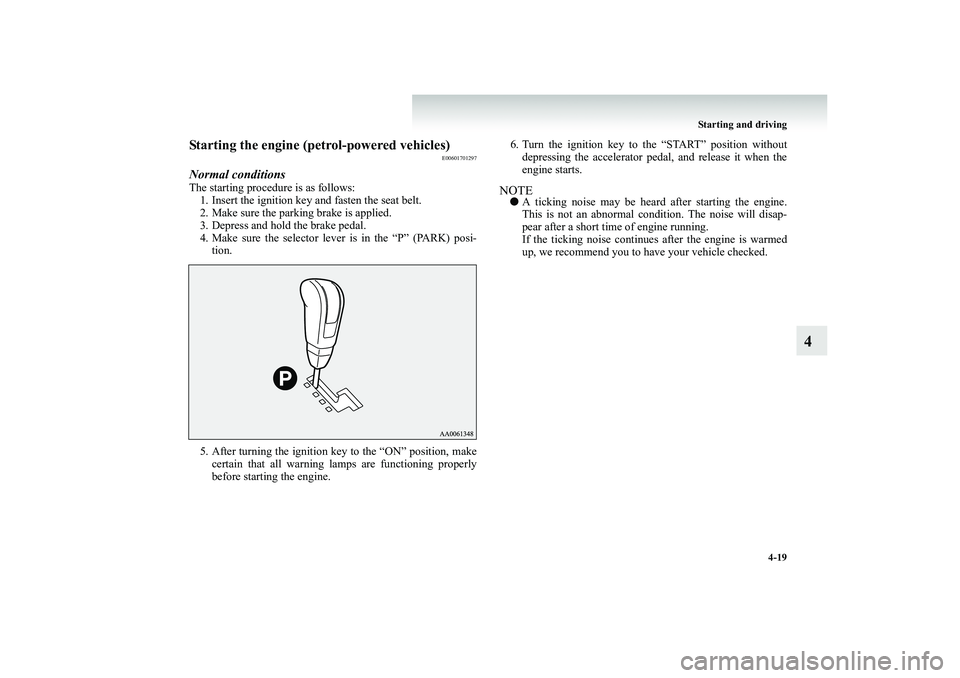
Normal conditionsThe starting procedure is as follows: 1. Insert the ignition key and fasten the seat belt. 2. Make sure the parking brake is applied.3. Depress and hold the brake pedal. 4. Make sure the selector lever is in the “P” (PARK) posi-
tion.
5. After turning the ignition key to the “ON” position, make
certain that all warning lamps are functioning properly before starting the engine.
6. Turn the ignition key to the “START” position without
depressing the accelerator pedal, and release it when the engine starts.
NOTE●
A ticking noise may be hear
d after starting the engine.
This is not an abnormal co
ndition. The noise will disap-
pear after a short time of engine running. If the ticking noise continues after the engine is warmedup, we recommend you to have your vehicle checked.
BK-BK2008E1ENUK.en-uk-Section7.fm Page
19 Wednesday, January 9, 2008 4:36 PM
Page 222 of 538
4-20 Starting and driving
4
At extreme cold ambient temperatureIf the engine won’t start, de
press the accelerator pedal about
halfway while cranking the engi
ne. Once the engine starts,
release the accelerator pedal.Flooded engineIf the engine was flooded during starting, first operate the starter for 5 to 6 seconds whil
e fully depressing the accelerator
pedal, then start the engine
without depressing the accelerator
pedal.Using the MIVEC engineThe MIVEC engine automatically switches its intake-valve control between a low-speed mo
de and a high-speed mode in
accordance with driving conditi
ons for maximum engine per-
formance.NOTE●
To protect the engine, the high-speed mode may not be selected while the engine coolant temperature is low. In such a case, the engine revo
lutions do not rise to over
5,000 rpm even if the acceler
ator pedal is depressed.
Starting the engine (d
iesel-powered vehicles)
E00601800086
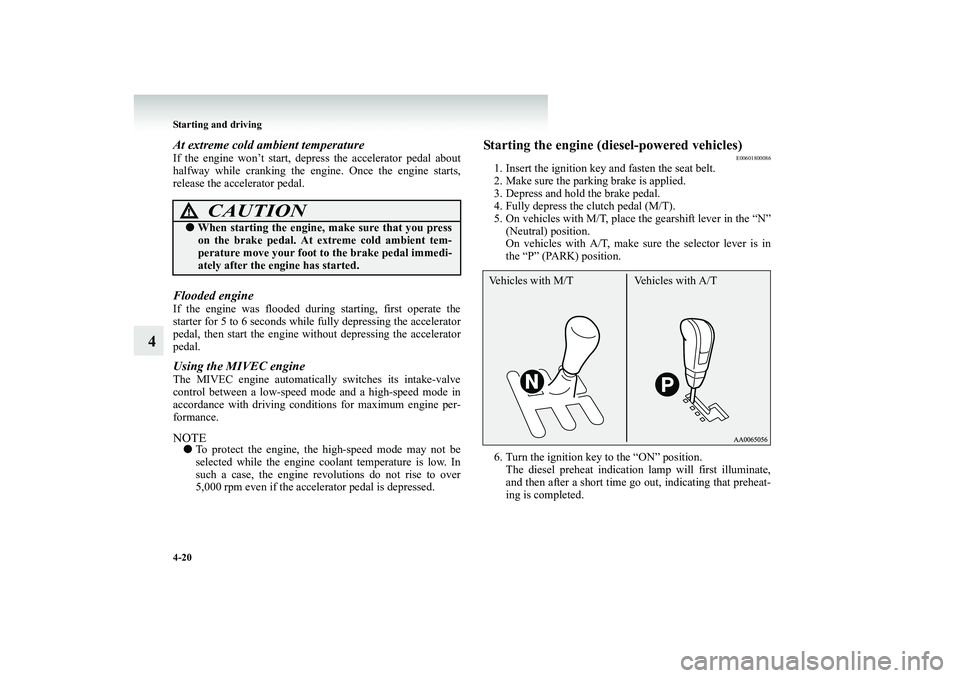
1. Insert the ignition key and fasten the seat belt. 2. Make sure the parking brake is applied. 3. Depress and hold the brake pedal. 4. Fully depress the clutch pedal (M/T).5. On vehicles with M/T, place
the gearshift lever in the “N”
(Neutral) position. On vehicles with A/T, make sure the selector lever is inthe “P” (PARK) position.
6. Turn the ignition key to the “ON” position.
The diesel preheat indication lamp will first illuminate,and then after a short time go
out, indicating that preheat-
ing is completed.
CAUTION
!●
When starting the engine, make sure that you press on the brake pedal. At extreme cold ambient tem- perature move your foot
to the brake pedal immedi-
ately after the en
gine has started.
Vehicles with M/T Vehicles with A/T
BK-BK2008E1ENUK.en-uk-Section7.fm Page
20 Wednesday, January 9, 2008 4:36 PM
Page 250 of 538
4-48 Starting and driving
4
4-wheel drive operation
E00606600627
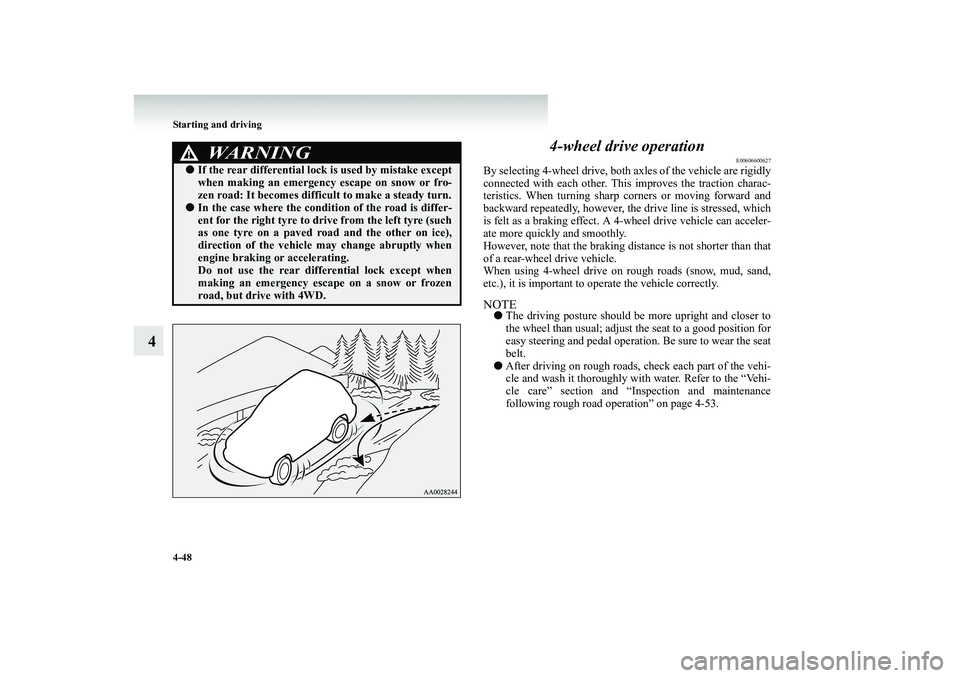
By selecting 4-wheel drive, both
axles of the vehicle are rigidly
connected with each other. Th
is improves the traction charac-
teristics. When turning sharp
corners or moving forward and
backward repeatedly, however, the drive line is stressed, which is felt as a braking effect. A 4-wheel drive vehicle can acceler- ate more quickly and smoothly.However, note that the braking
distance is not shorter than that
of a rear-wheel drive vehicle. When using 4-wheel drive on rough roads (snow, mud, sand,etc.), it is important to
operate the vehicle correctly.
NOTE●
The driving posture should be more upright and closer to the wheel than usual; adjust the seat to a good position foreasy steering and pedal operatio
n. Be sure to wear the seat
belt.
●
After driving on rough roads, check each part of the vehi- cle and wash it thoroughly with water. Refer to the “Vehi- cle care” section and “Inspection and maintenance following rough road operation” on page 4-53.
WARNING
!●
If the rear differential lock
is used by mistake except
when making an emergency
escape on snow or fro-
zen road: It becomes difficult to make a steady turn.
●
In the case where the condit
ion of the road is differ-
ent for the right tyre to drive from the left tyre (suchas one tyre on a paved road and the other on ice), direction of the vehicle
may change abruptly when
engine braking or accelerating.Do not use the rear diff
erential lock except when
making an emergency escape on a snow or frozen road, but drive with 4WD.
BK-BK2008E1ENUK.en-uk-Section7.fm Page
48 Wednesday, January 9, 2008 4:36 PM
Page 407 of 538
For emergencies
6-3
6
1. Get the vehicles close en
ough so the jumper cables can
reach, but be sure the vehicles
aren’t touching each other.
2. Set the parking brake firmly
on each vehicle. Put an auto-
matic transmission in “P” (PARK) or a manual transmis- sion in “N” (Neutral). Turn
off the ignition switch.
3. Turn off all lamps, heater
and other electrical loads.
4. Make sure battery electrolyte is at the proper level.
Refer to “Battery” on page 8-16.
CAUTION
!●
Check the other vehicle. It
must have a 12-volt bat-
tery. If the other system isn’t 12-volt, shorting can dam- age both vehicles. WARNING
!●
Turn off the ignition on
both vehicles beforehand.
Make sure that the cables or your clothes cannot be caught by the fan or dr
ive belt. Personal injury
could result.
WARNING
!●
If electrolyte fluid is not vi
sible, or appears to be fro-
zen, Do Not Attempt Jump Starting! A battery might rupture or
explode if the tempera-
ture is below the freezing poin
t or if it is not filled to
the proper level.
BK-BK2008E1ENUK.en-uk-Section9.fm Page 3 Wednesday, January 9, 2008 4:46 PM
Page 412 of 538
6-8 For emergencies
6
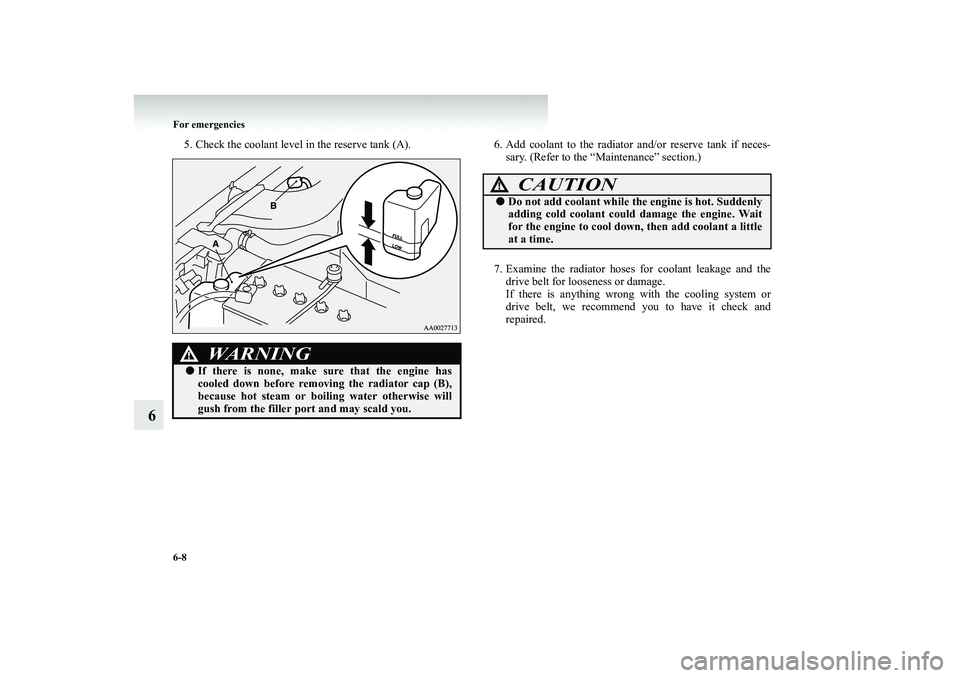
5. Check the coolant level in the reserve tank (A). 6. Add
coolant to the radiator and/or reserve tank if neces-
sary. (Refer to the “Maintenance” section.)
7. Examine the radiator hoses
for coolant leakage and the
drive belt for looseness or damage. If there is anything wrong with the cooling system ordrive belt, we recommend you to have it check and repaired.
WARNING
!●
If there is none, make sure that the engine has cooled down before removi
ng the radiator cap (B),
because hot steam or boiling water otherwise will gush from the filler port and may scald you.
CAUTION
!●
Do not add coolant while the engine is hot. Suddenly adding cold coolant coul
d damage the engine. Wait
for the engine to cool down
, then add coolant a little
at a time.
BK-BK2008E1ENUK.en-uk-Section9.fm Page 8 Wednesday, January 9, 2008 4:46 PM
Page 452 of 538
8-2 Maintenance
8
Service precautions
E01000100331
Adequate care of your vehicle at
regular intervals serves to pre-
serve the value and appear
ance as long as possible.
Maintenance items as described in this owner’s manual can beperformed by the owner. We recommend you to have the periodic inspection and main- tenance performed by a MITS
UBISHI MOTORS Authorized
Service Point or another specialist. In the event a malfunction or other problem is discovered, we recommend you to have it checked and repaired. This s
ection contains information on
inspection maintenance procedures that you can do yourself. Follow the instructions and
cautions for each of the various
procedures.
WARNING
!●
When checking or servicing
the inside of the engine
compartment, make sure th
e engine is switched off
and has had a chan
ce to cool down.
●
If it is necessary to do
work in the engine compart-
ment with the engine runni
ng, be especially careful
that your clothing, hair, et
c., does not become caught
by the fan, drive belts, or other moving parts.
●
Do not smoke, cause sparks or allow open flames around fuel or battery. The fumes are flammable.
●
Be extremely cautious wh
en working around the
battery. It contains poison
ous and corrosive sulphu-
ric acid.
●
Do not get under your vehicle with just the body jack supporting it. Always use automotive jackstands.
●
Improper handling of comp
onents and materials
used in the vehicle ca
n endanger your personal
safety. We recommend you to consult a specialist fornecessary information.WARNING
!
BK-BK2008E1ENUK.en-uk-Section11.fm Page
2 Wednesday, January 9, 2008 4:50 PM
Page 530 of 538
Alphabetical index 6Replacement 8-44 Rear window demister switch 3-77Rear-view camera 4-84Rear-view mirrorInside 4-9Rear-view mirrorOutside 4-11Refill capacities 9-16Removal of water from the fuel filter 6-9Replacement of lamp bulbs 8-36Reversing lampsBulb capacity 8-36Replacement 8-44Reversing sensor system 4-78Roof carrier precaution 4-89Room & map lamps 5-87Bulb capacity 8-38Replacement 8-50Running-in recommendations 4-5
S
Safe driving techniques 4-3Seat belt 2-38Adjustable seat belt anchor 2-41Child restraint 2-44Force limiter system 2-44Inspection 2-58Pregnant women restraint 2-43Pre-tensioner system 2-43
Rear / second, third seat belt storage 2-41 Seat belt reminder/warning lamp 2-40SeatsAdjustment 2-5Armrest 2-10, 2-14Front seats 2-6Head restraints 2-16Heated seats 2-12Lumbar support 2-10Making a flat seat 2-35Making a luggage area 2-19Rear seats 2-13Seat arrangement 2-3Second seats 2-13Third seat 2-16Service precaution 8-2Service reminder 3-3, 3-4Side airbag system 2-69Side box 5-97Snow tyres 8-22Spark plug 9-12Specifications 9-2Starting 4-18SteeringPower steering fluid 8-16, 9-16Power steering system 4-63Steering wheel heig
ht adjustment 4-8
Steering wheel lock 4-18Steering wheel remote control switch 5-70
BK-BK2008E1ENUK.en-ukIX.fm Page 6 Thursday, January 10, 2008 7:53 AM