engine oil MITSUBISHI SHOGUN 2008 Owner's Manual (in English)
[x] Cancel search | Manufacturer: MITSUBISHI, Model Year: 2008, Model line: SHOGUN, Model: MITSUBISHI SHOGUN 2008Pages: 538, PDF Size: 25.09 MB
Page 2 of 538
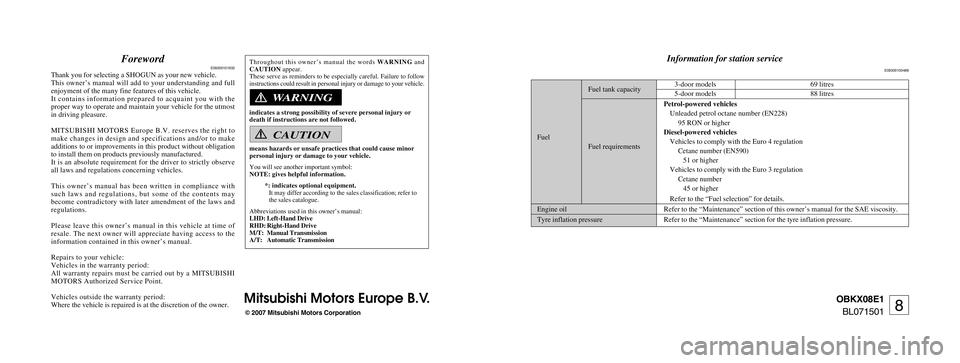
ForewordE09200101932
Thank you for selecting a SHOGUN as your new vehicle.
This owner’s manual will add to your understanding and full
enjoyment of the many fine features of this vehicle.
It contains information prepared to acquaint you with the
proper way to operate and maintain your vehicle for the utmost
in driving pleasure.
MITSUBISHI MOTORS Europe B.V. reserves the right to
make changes in design and specifications and/or to make
additions to or improvements in this product without obligation
to install them on products previously manufactured.
It is an absolute requirement for the driver to strictly observe
all laws and regulations concerning vehicles.
This owner’s manual has been written in compliance with
such laws and regulations, but some of the contents may
become contradictory with later amendment of the laws and
regulations.
Please leave this owner’s manual in this vehicle at time of
resale. The next owner will appreciate having access to the
information contained in this owner’s manual.
Repairs to your vehicle:
Vehicles in the warranty period:
All warranty repairs must be carried out by a MITSUBISHI
MOTORS Authorized Service Point.
Vehicles outside the warranty period:
Where the vehicle is repaired is at the discretion of the owner.
Throughout this owner’s manual the words WARNINGand
CAUTIONappear.
These serve as reminders to be especially careful. Failure to follow
instructions could result in personal injury or damage to your vehicle.
indicates a strong possibility of severe personal injury or
death if instructions are not followed.
means hazards or unsafe practices that could cause minor
personal injury or damage to your vehicle.
You will see another important symbol:
NOTE: gives helpful information.
*: indicates optional equipment.
It may differ according to the sales classification; refer to
the sales catalogue.
Abbreviations used in this owner’s manual:
LHD: Left-Hand Drive
RHD: Right-Hand Drive
M/T: Manual Transmission
A/T: Automatic TransmissionInformation for station service
E09300100486
OBKX08E1
BL071501
8
WARNING
CAUTION
Fuel tank capacity3-door models 69 litres5-door models 88 litres
Petrol-powered vehicles
Unleaded petrol octane number (EN228)
95 RON or higher
FuelDiesel-powered vehicles
Fuel requirementsVehicles to comply with the Euro 4 regulation
Cetane number (EN590)
51 or higher
Vehicles to comply with the Euro 3 regulation
Cetane number
45 or higher
Refer to the “Fuel selection” for details.
Engine oil Refer to the “Maintenance” section of this owner’s manual for the SAE viscosity.
Tyre inflation pressure Refer to the “Maintenance” section for the tyre inflation pressure.
© 2007 Mitsubishi Motors Corporation
Mitsubishi Motors Europe B.V.
eng_CV_SHOGUN_Pajero08.qxd 26-12-2007 15:55 Page 2
Page 13 of 538
General information
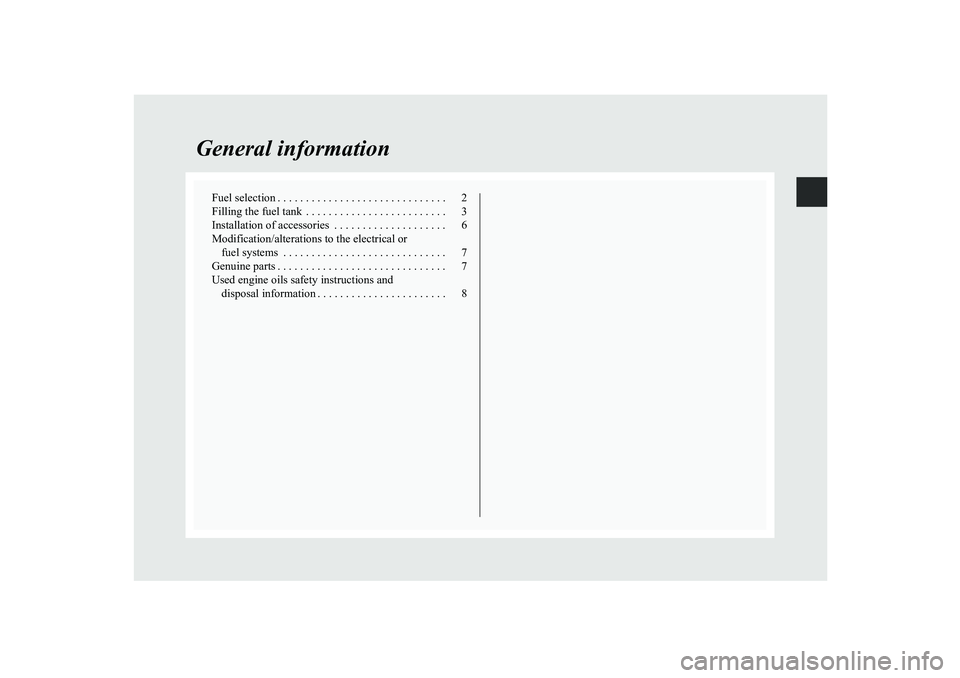
Fuel selection . . . . . . . . . . . . . . . . . . . . . . . . . . . . . . 2 Filling the fuel tank . . . . . . . . . . . . . . . . . . . . . . . . . 3Installation of accessories . . . . . . . . . . . . . . . . . . . . 6Modification/alterations
to the electrical or
fuel systems . . . . . . . . . . . . . . . . . . . . . . . . . . . . . 7Genuine parts . . . . . . . . . . . . . . . . . . . . . . . . . . . . . . 7Used engine oils safety instructions and disposal information . . . . . . . . . . . . . . . . . . . . . . . 8
BK-BK2008E1ENUK.en-uk-Section3.fm Page 1 Wednesday, January 9, 2008 4:21 PM
Page 20 of 538
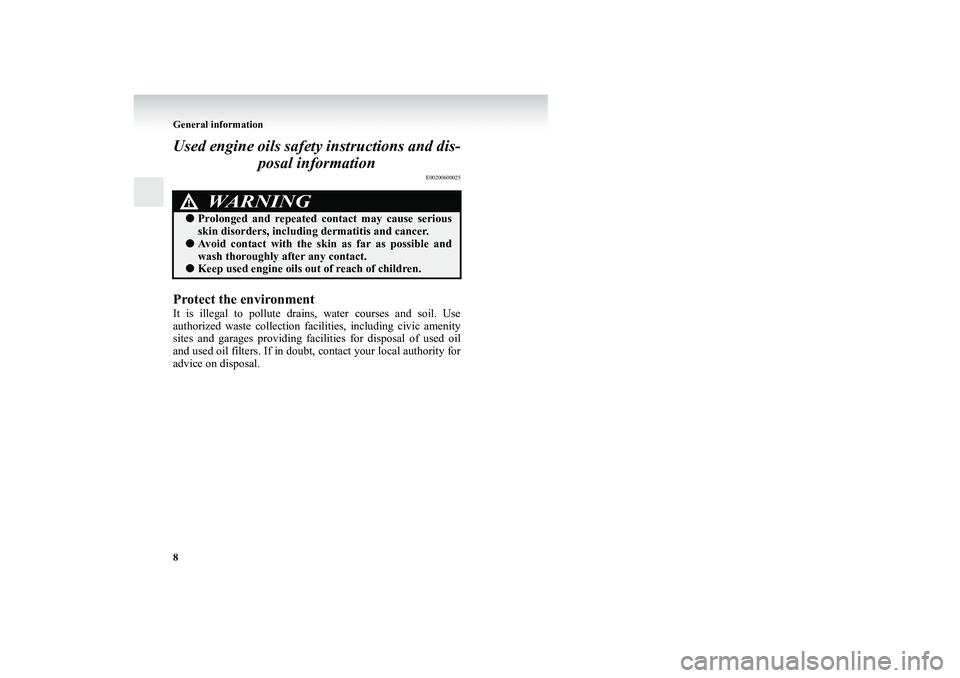
8 General informationUsed engine oils safety
instructions and dis-
posal information
E00200600025
Protect the environmentIt is illegal to pollute drains, water courses and soil. Use authorized waste collection faci
lities, includi
ng civic amenity
sites and garages providing facili
ties for disposal of used oil
and used oil filters. If in doub
t, contact your local authority for
advice on disposal.
WARNING
!●
Prolonged and repeated contact may cause serious skin disorders, including
dermatitis and cancer.
●
Avoid contact with the skin as far as possible and wash thoroughly after any contact.
●
Keep used engine oils ou
t of reach of children.
BK-BK2008E1ENUK.en-uk-Section3.fm Page 8 Wednesday, January 9, 2008 4:21 PM
Page 134 of 538
3-10 Instruments and controls
3
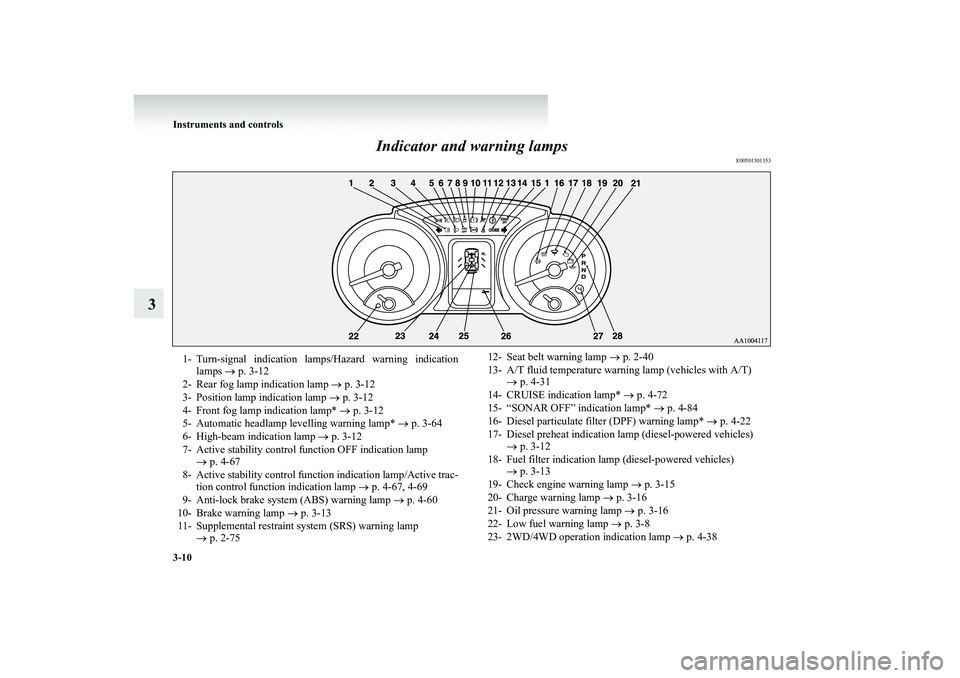
Indicator and warning lamps
E00501501353
1- Turn-signal indication lamps/Hazard warning indication
lamps
→ p. 3-12
2- Rear fog lamp indication lamp
→ p. 3-12
3- Position lamp indication lamp
→ p. 3-12
4- Front fog lamp indication lamp*
→ p. 3-12
5- Automatic headlamp levelling warning lamp*
→ p. 3-64
6- High-beam indication lamp
→ p. 3-12
7- Active stability control function OFF indication lamp
→ p. 4-67
8- Active stability control function indication lamp/Active trac-
tion control function indication lamp
→ p. 4-67, 4-69
9- Anti-lock brake system (ABS) warning lamp
→ p. 4-60
10- Brake warning lamp
→ p. 3-13
11- Supplemental restraint system (SRS) warning lamp
→ p. 2-75
12- Seat belt warning lamp
→ p. 2-40
13- A/T fluid temperature warning lamp (vehicles with A/T)
→ p. 4-31
14- CRUISE indication lamp*
→ p. 4-72
15- “SONAR OFF” indication lamp*
→ p. 4-84
16- Diesel particulate filter (DPF) warning lamp*
→ p. 4-22
17- Diesel preheat indication lamp (diesel-powered vehicles)
→ p. 3-12
18- Fuel filter indication lamp (diesel-powered vehicles)
→ p. 3-13
19- Check engine warning lamp
→ p. 3-15
20- Charge warning lamp
→ p. 3-16
21- Oil pressure warning lamp
→ p. 3-16
22- Low fuel warning lamp
→ p. 3-8
23- 2WD/4WD operation indication lamp
→ p. 4-38
BK-BK2008E1ENUK.en-uk-Section6.fm Page
10 Wednesday, January 9, 2008 4:32 PM
Page 140 of 538
3-16 Instruments and controls
3
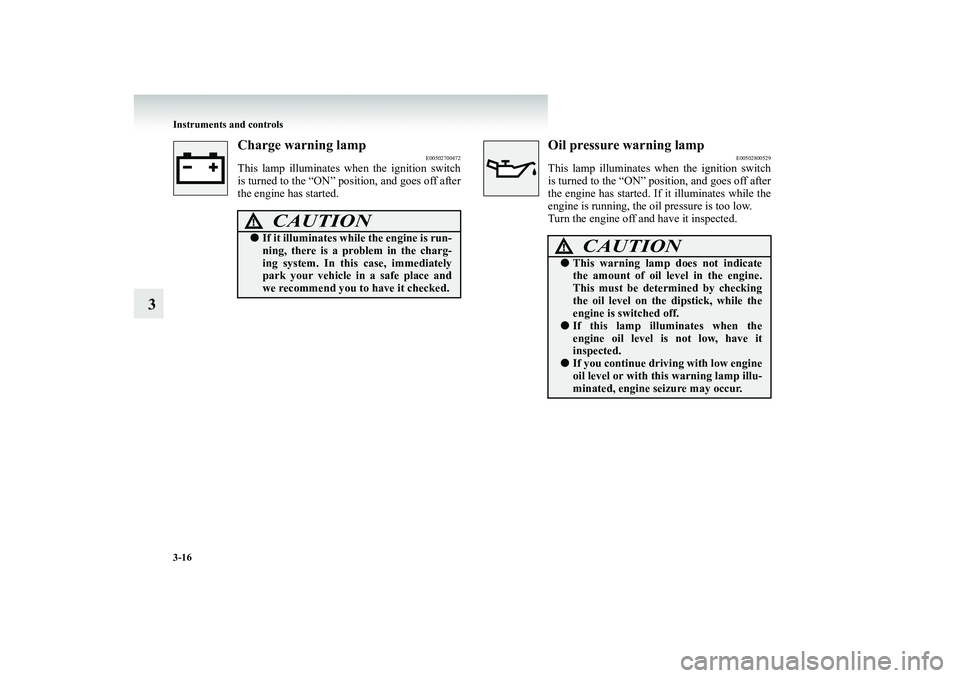
Charge warning lamp
E00502700472
This lamp illuminates when the ignition switch is turned to the “ON” position, and goes off after the engine has started.
Oil pressure warning lamp
E00502800529
This lamp illuminates when the ignition switch is turned to the “ON” position, and goes off after the engine has started. If it illuminates while the engine is running, the oil pressure is too low.Turn the engine off and have it inspected.
CAUTION
!●
If it illuminates while the engine is run- ning, there is a problem in the charg- ing system. In this case, immediatelypark your vehicle in a safe place and we recommend you to have it checked.
CAUTION
!●
This warning lamp does not indicate the amount of oil le
vel in the engine.
This must be determined by checking the oil level on the
dipstick, while the
engine is switched off.
●
If this lamp illum
inates when the
engine oil level is not low, have itinspected.
●
If you continue driving with low engine oil level or with this warning lamp illu-minated, engine seizure may occur.
BK-BK2008E1ENUK.en-uk-Section6.fm Page
16 Wednesday, January 9, 2008 4:32 PM
Page 224 of 538
4-22 Starting and driving
4
Diesel particulate filter (DPF)
*
E00619800027
The diesel particulate filter
(DPF) is a device that captures
most of the particulate matter
(PM) in the exhaust emissions of
the diesel engine. The DPF auto
matically burns away trapped
PM during vehicle operation. Under certain driving conditions, however, the DPF is not able to burn away all of the trapped PM and, as a result, an exces
sive amount of PM accumulates
inside it.NOTE●
To minimize the likelihood
of excessive accumulation of
PM, try to avoid driving for long periods at low speeds and repeatedly driv
ing short distances.
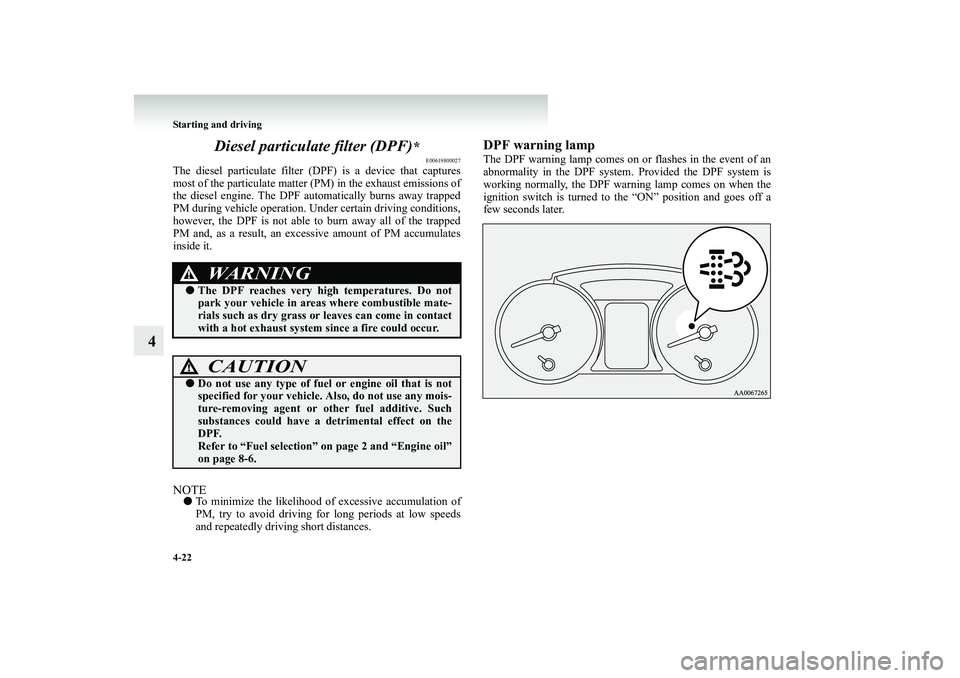
DPF warning lampThe DPF warning lamp comes on or
flashes in the event of an
abnormality in the DPF system
. Provided the DPF system is
working normally, the DPF warning lamp comes on when the ignition switch is turned to the “ON” position and goes off a few seconds later.
WARNING
!●
The DPF reaches very high temperatures. Do not park your vehicle in areas where combustible mate- rials such as dry grass or leaves can come in contact with a hot exhaust system since a fire could occur.CAUTION
!●
Do not use any type of fuel or engine oil that is not specified for your vehicle.
Also, do not use any mois-
ture-removing agent or other fuel additive. Such substances could have a de
trimental effect on the
DPF. Refer to “Fuel selection” on page 2 and “Engine oil” on page 8-6.
BK-BK2008E1ENUK.en-uk-Section7.fm Page
22 Wednesday, January 9, 2008 4:36 PM
Page 251 of 538
Starting and driving
4-49
4
Driving on dry paved road and highwaySelect the “2H” or “4H” position to drive on the dry paved road. Especially on dry highway
, never select the “4HLc” or
“4LLc” position.
Driving on snowy or icy roads Set the transfer shift lever to
the “4H” or “4HLc” position in
accordance with the road conditions, and then graduallydepress the accelerator pe
dal for a smooth start.
NOTE●
The use of snow tyres and/or tyre chains is recommended.
●
In order to ensure that the
anti-lock brake
system (ABS)
will operate correctly in situ
ations where tyre chains have
been fitted, drive in the “4
H”, “4HLc” or “4LLc” position.
●
Maintain a safe distance between vehicles, avoid sudden braking, and use engine braking (downshifting).
Driving on sandy or muddy roadsSet the transfer shift lever to the “4HLc” or “4LLc” positionand then gradually depress th
e accelerator pedal for a smooth
start. Keep the pressure on th
e accelerator pedal as constant as
possible, and drive at low speed.
CAUTION
!●
Selecting the “4HLc” or “4LLc” position to drive on dry paved road will increase the fuel consumption with possible noise genera
tion and early tyre wear.
It may also increase the di
fferential oil temperature,
resulting in possible damage to the driving system. Further, the drive train wi
ll be subjected to excessive
loading, possibly leading
to oil leakage, component
seizure, or other serious faults.
CAUTION
!●
Avoid sudden braking, sudden acceleration, and sharp turning; such opera
tions could cause skidding
and spinouts.
BK-BK2008E1ENUK.en-uk-Section7.fm Page
49 Wednesday, January 9, 2008 4:36 PM
Page 255 of 538
Starting and driving
4-53
4
Inspection and main
tenance following
rough road operation
E00606700048
After operating the vehicle in rough road conditions, be sure to perform the following inspection and maintenance procedures: ●
Check that the vehicle has not been damaged by rocks, gravel, etc.
●
Carefully wash the vehicle with water. After washing, drive the vehicle slowly while lightlydepressing the brake pedal in order to dry out the brakes. If the brakes still do not function properly, we recommend you to have the brakes checked as soon as possible.
●
Remove the insects, dried grass, etc. clogging the radiator core.
●
After crossing a stream, be sure to have the following items inspected at a MITS
UBISHI MOTORS Authorized
Service Point and take the necessary measures. • Check the brake system and,
if necessary, have it serv-
iced. • Check the engine, transmissi
on, transfer, and differential
oil or grease level and turbid
ity. If the oil or grease is
milky, it indicates water co
ntamination. Replace it with
new oil or grease. • Grease the propeller shaft.• Check the inside of the vehi
cle. If ingress of water is
found, dry the carpet etc. • Inspect the headlamps. If th
e headlamp bulb is flooded
with water, we recommend you to have it drained.
Cautions on handling
of 4-wheel drive
vehicles
E00606800401
Tyres and wheelsSince the driving torque can be
applied to the 4 wheels, the per-
formance of the vehicle when
operating in 4-wheel drive is
greatly affected by th
e condition of the tyres.
Pay close attention to the tyres. ●
Install specified tyres on all
wheels. Refer to “Tyres and
wheels” on page 9-13.
●
Be sure to fit all 4 tyres an
d wheels of the same size and
type. When replacement of any of th
e tyres or wheels is neces-
sary, replace all of them.
●
All tyres should be rotated
whenever the wear difference
between the front and rear tyres is recognizable.
BK-BK2008E1ENUK.en-uk-Section7.fm Page
53 Wednesday, January 9, 2008 4:36 PM
Page 256 of 538
4-54 Starting and driving
4
Good vehicle performance cannot be expected if there is a dif- ference in wear between tyres. Refer to “Tyre rotation” on page 8-21. ●
Check the tyre inflation pressure regularly.
●
If the tyre inflation pressure
is inappropriate, the transfer
gear may make some noise and shock while changing the drive mode.
To w i n gIf towing is necessary, we recommend you to have it done byyour MITSUBISHI MOTORS Authorized Service Point or acommercial tow
truck service.
In the following cases, transpor
t the vehicle using a tow truck.
●
The engine runs but the vehicle does not move or abnor- mal noise is produced.
●
Inspection of the vehicle’s und
erside reveals that oil or
some other fluid is leaking.
Only when you cannot receive a towing service from a MIT- SUBISHI MOTORS Authorized
Service Point or commercial
tow truck service, tow your ve
hicle carefully in accordance
with the instructions given in “Towing” on page 6-29.
CAUTION
!●
Always use tyres of the same size, same type, and same brand, and which have no wear differences.Using tyres which differ in size, type, brand or the degree of wear will cause excessive loading, resulting in possible damage to the drive system.
CAUTION
!●
Be sure to shift the tran
sfer shift lever to the “2H”
position. Never try to tow with the transfer shift lever in the “4H”, “4HLc” or “4LLc” positions and with any of the wheels on
the ground (Type A or B).
This could result in damage to the vehicle’s driving system, or the vehicle could become separated from the tow truck and unexpected
accident might result.
If you cannot shift the tr
ansfer shift lever to “2H”
position or the transmission is malfunctioning or damaged, transport the ve
hicle with all the wheels
on a carriage (Type C or D) as illustrated.
BK-BK2008E1ENUK.en-uk-Section7.fm Page
54 Wednesday, January 9, 2008 4:36 PM
Page 412 of 538
6-8 For emergencies
6
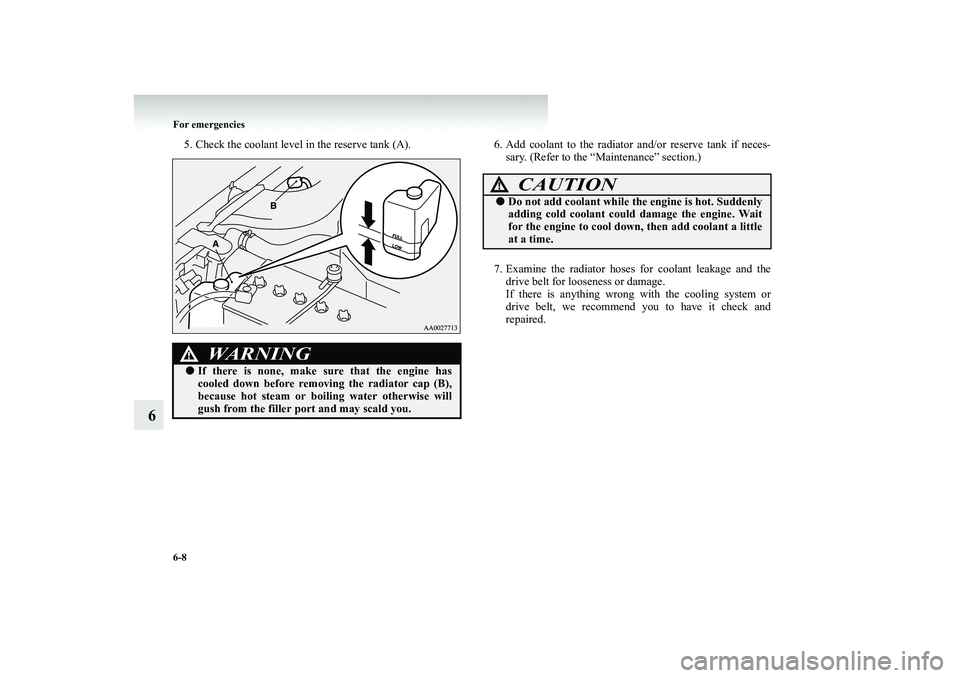
5. Check the coolant level in the reserve tank (A). 6. Add
coolant to the radiator and/or reserve tank if neces-
sary. (Refer to the “Maintenance” section.)
7. Examine the radiator hoses
for coolant leakage and the
drive belt for looseness or damage. If there is anything wrong with the cooling system ordrive belt, we recommend you to have it check and repaired.
WARNING
!●
If there is none, make sure that the engine has cooled down before removi
ng the radiator cap (B),
because hot steam or boiling water otherwise will gush from the filler port and may scald you.
CAUTION
!●
Do not add coolant while the engine is hot. Suddenly adding cold coolant coul
d damage the engine. Wait
for the engine to cool down
, then add coolant a little
at a time.
BK-BK2008E1ENUK.en-uk-Section9.fm Page 8 Wednesday, January 9, 2008 4:46 PM