engine MITSUBISHI SHOGUN 2016 (in English) User Guide
[x] Cancel search | Manufacturer: MITSUBISHI, Model Year: 2016, Model line: SHOGUN, Model: MITSUBISHI SHOGUN 2016Pages: 404, PDF Size: 18.95 MB
Page 39 of 404
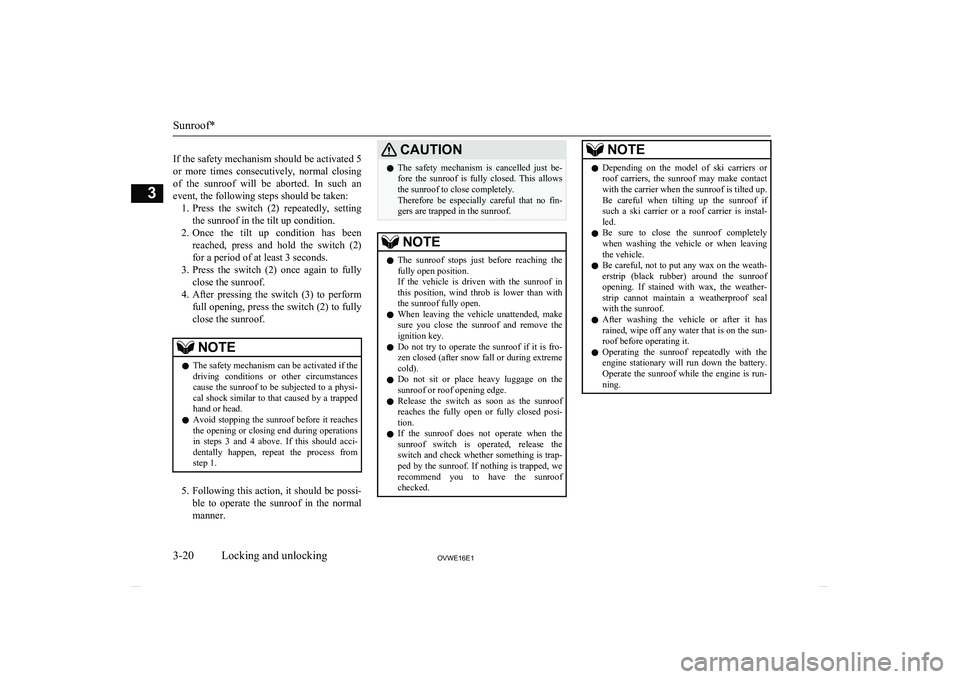
If the safety mechanism should be activated 5 or more times consecutively, normal closing
of the sunroof will be aborted. In such an
event, the following steps should be taken: 1. Press the switch (2) repeatedly, setting
the sunroof in the tilt up condition.
2. Once the tilt up condition has been
reached, press and hold the switch (2)
for a period of at least 3 seconds.
3. Press the switch (2) once again to fully
close the sunroof.
4. After pressing the switch (3) to perform
full opening, press the switch (2) to fully close the sunroof.NOTEl The safety mechanism can be activated if the
driving conditions or other circumstancescause the sunroof to be subjected to a physi-
cal shock similar to that caused by a trapped hand or head.
l Avoid stopping the sunroof before it reaches
the opening or closing end during operations
in steps 3 and 4 above. If this should acci- dentally happen, repeat the process fromstep 1.
5. Following this action, it should be possi-
ble to operate the sunroof in the normal manner.
CAUTIONl The safety mechanism is cancelled just be-
fore the sunroof is fully closed. This allows the sunroof to close completely.
Therefore be especially careful that no fin-
gers are trapped in the sunroof.NOTEl The sunroof stops just before reaching the
fully open position.
If the vehicle is driven with the sunroof in
this position, wind throb is lower than with the sunroof fully open.
l When leaving the vehicle unattended, make
sure you close the sunroof and remove the ignition key.
l Do not try to operate the sunroof if it is fro-
zen closed (after snow fall or during extreme cold).
l Do not sit or place heavy luggage on the
sunroof or roof opening edge.
l Release the switch as soon as the sunroof
reaches the fully open or fully closed posi-
tion.
l If the sunroof does not operate when the
sunroof switch is operated, release the
switch and check whether something is trap-
ped by the sunroof. If nothing is trapped, we recommend you to have the sunroof checked.NOTEl Depending on the model of ski carriers or
roof carriers, the sunroof may make contactwith the carrier when the sunroof is tilted up.Be careful when tilting up the sunroof if
such a ski carrier or a roof carrier is instal-
led.
l Be sure to close the sunroof completely
when washing the vehicle or when leaving the vehicle.
l Be careful, not to put any wax on the weath-
erstrip (black rubber) around the sunroof opening. If stained with wax, the weather- strip cannot maintain a weatherproof seal
with the sunroof.
l After washing the vehicle or after it has
rained, wipe off any water that is on the sun-
roof before operating it.
l Operating the sunroof repeatedly with the
engine stationary will run down the battery. Operate the sunroof while the engine is run-
ning.
Sunroof*
3-20OVWE16E1Locking and unlocking3
Page 47 of 404
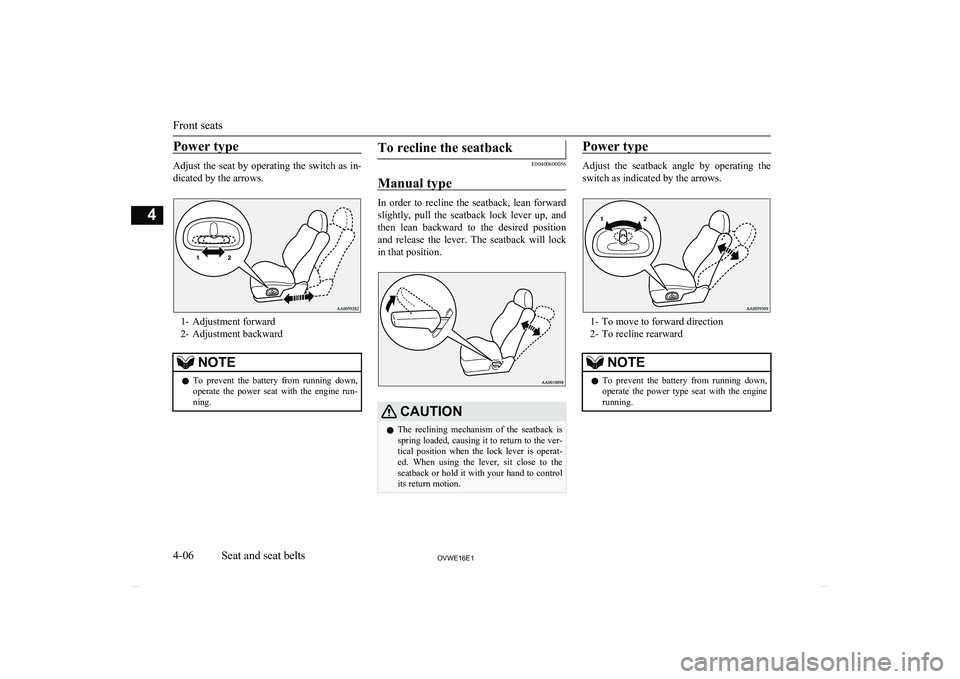
Power type
Adjust the seat by operating the switch as in-
dicated by the arrows.
1- Adjustment forward
2- Adjustment backward
NOTEl To prevent the battery from running down,
operate the power seat with the engine run-ning.To recline the seatback
E00400600056
Manual type
In order to recline the seatback, lean forward slightly, pull the seatback lock lever up, and
then lean backward to the desired position
and release the lever. The seatback will lock in that position.
CAUTIONl The reclining mechanism of the seatback is
spring loaded, causing it to return to the ver- tical position when the lock lever is operat- ed. When using the lever, sit close to the
seatback or hold it with your hand to control its return motion.Power type
Adjust the seatback angle by operating the
switch as indicated by the arrows.
1- To move to forward direction
2- To recline rearward
NOTEl To prevent the battery from running down,
operate the power type seat with the engine
running.
Front seats
4-06OVWE16E1Seat and seat belts4
Page 48 of 404
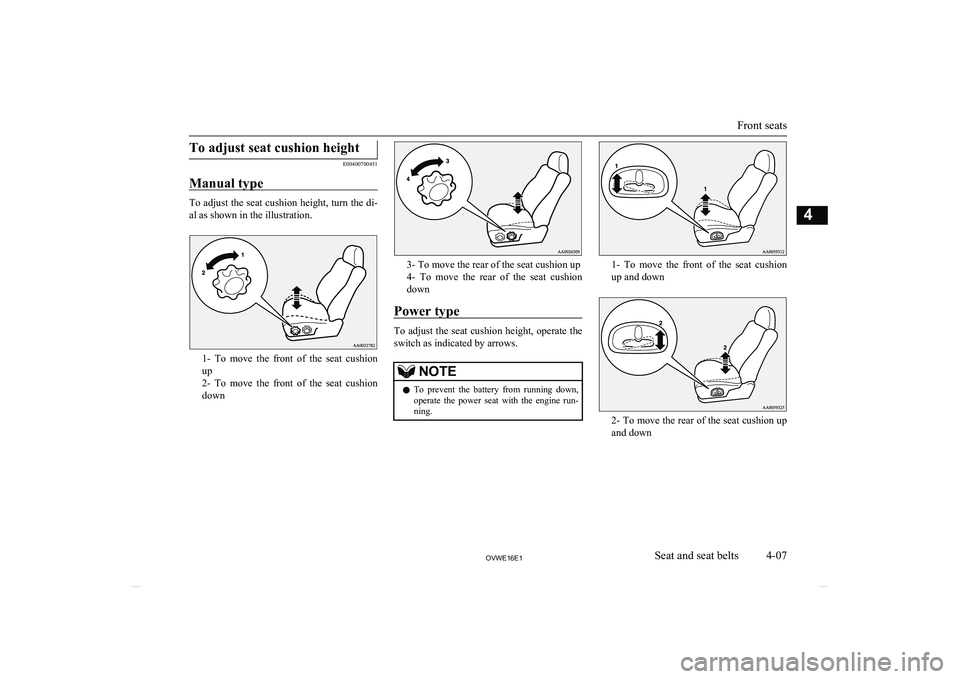
To adjust seat cushion height
E00400700451
Manual type
To adjust the seat cushion height, turn the di- al as shown in the illustration.
1- To move the front of the seat cushion
up
2- To move the front of the seat cushion down
3- To move the rear of the seat cushion up
4- To move the rear of the seat cushion
down
Power type
To adjust the seat cushion height, operate the switch as indicated by arrows.
NOTEl To prevent the battery from running down,
operate the power seat with the engine run-ning.
1- To move the front of the seat cushion
up and down
2- To move the rear of the seat cushion up
and down
Front seats
4-07OVWE16E1Seat and seat belts4
Page 49 of 404
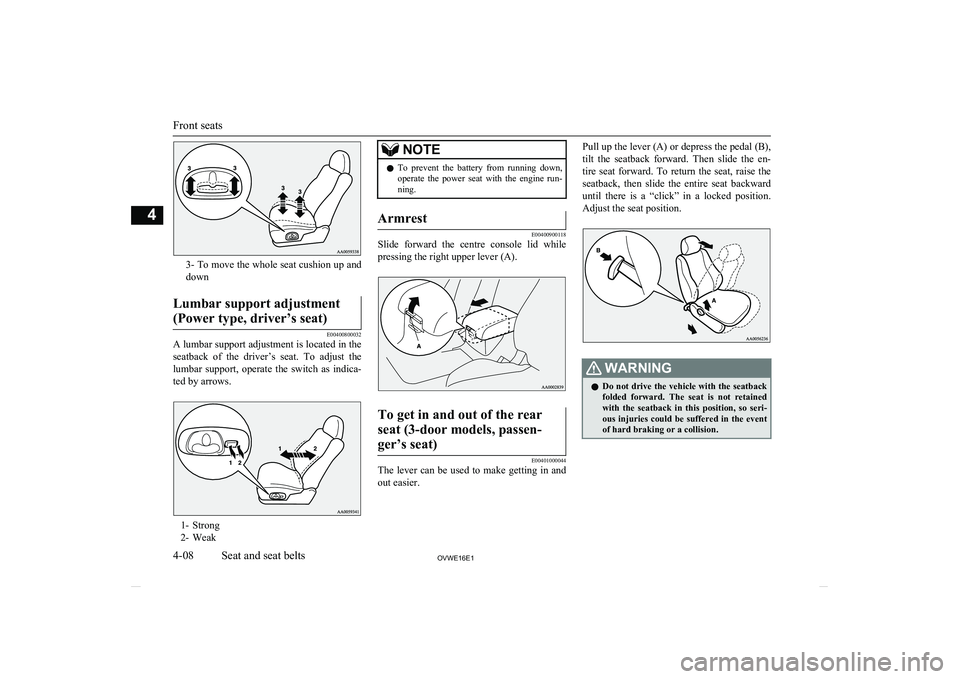
3- To move the whole seat cushion up and
down
Lumbar support adjustment
(Power type, driver’s seat)
E00400800032
A lumbar support adjustment is located in the seatback of the driver’s seat. To adjust the
lumbar support, operate the switch as indica-
ted by arrows.
1- Strong
2- Weak
NOTEl To prevent the battery from running down,
operate the power seat with the engine run-ning.Armrest
E00400900118
Slide forward the centre console lid while
pressing the right upper lever (A).
To get in and out of the rear
seat (3-door models, passen- ger’s seat)
E00401000044
The lever can be used to make getting in and out easier.
Pull up the lever (A) or depress the pedal (B),
tilt the seatback forward. Then slide the en-
tire seat forward. To return the seat, raise the seatback, then slide the entire seat backward until there is a “click” in a locked position.
Adjust the seat position.WARNINGl Do not drive the vehicle with the seatback
folded forward. The seat is not retainedwith the seatback in this position, so seri- ous injuries could be suffered in the event
of hard braking or a collision.
Front seats
4-08OVWE16E1Seat and seat belts4
Page 91 of 404
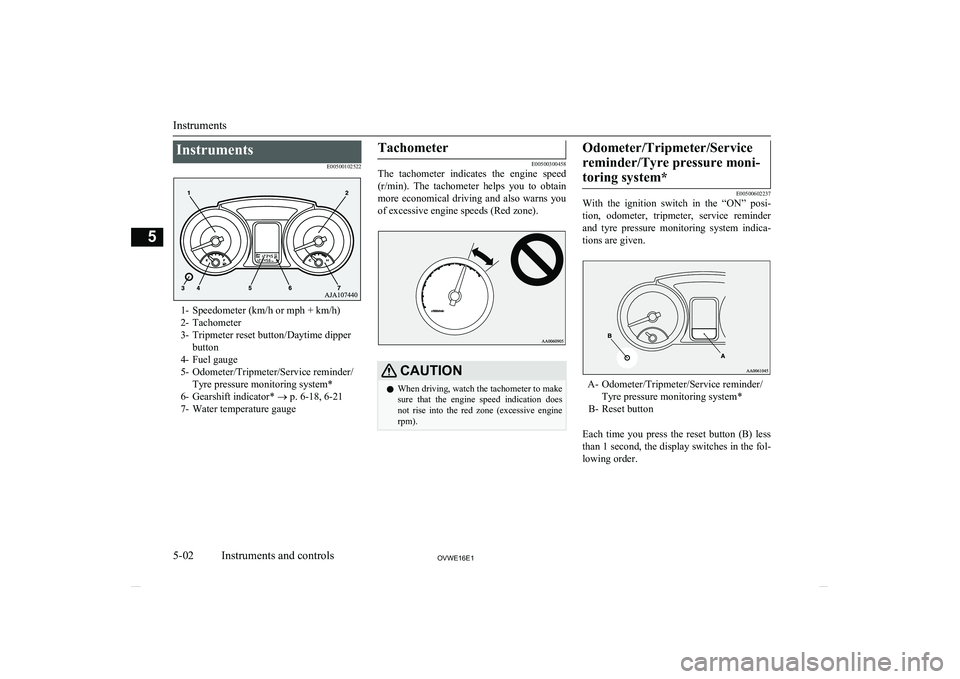
InstrumentsE00500102522
1- Speedometer (km/h or mph + km/h)
2- Tachometer
3- Tripmeter reset button/Daytime dipper button
4- Fuel gauge
5- Odometer/Tripmeter/Service reminder/ Tyre pressure monitoring system*
6- Gearshift indicator* ® p. 6-18, 6-21
7- Water temperature gauge
Tachometer
E00500300458
The tachometer indicates the engine speed
(r/min). The tachometer helps you to obtain
more economical driving and also warns you
of excessive engine speeds (Red zone).
CAUTIONl When driving, watch the tachometer to make
sure that the engine speed indication does not rise into the red zone (excessive enginerpm).Odometer/Tripmeter/Service
reminder/Tyre pressure moni-toring system*
E00500602237
With the ignition switch in the “ON” posi-
tion, odometer, tripmeter, service reminder
and tyre pressure monitoring system indica-
tions are given.
A- Odometer/Tripmeter/Service reminder/ Tyre pressure monitoring system*
B- Reset button
Each time you press the reset button (B) less
than 1 second, the display switches in the fol- lowing order.
Instruments
5-02OVWE16E1Instruments and controls5
Page 95 of 404
NOTElWhen the vehicle has been refuelled, the
pointer in the fuel gauge takes a short while
to stabilize.
l The fuel gauge will not give an accurate in-
dication if the vehicle is refuelled with the ignition switch in the “ON” position.
l When the engine on diesel-powered vehicles
fails to operate due to running out of fuel, it may sometimes be difficult to start after re-
fueling. This is due to air entering the fuel
system. Therefore, air must be bled from the system. (Refer to “Bleeding the fuel system” on page 8-06.)
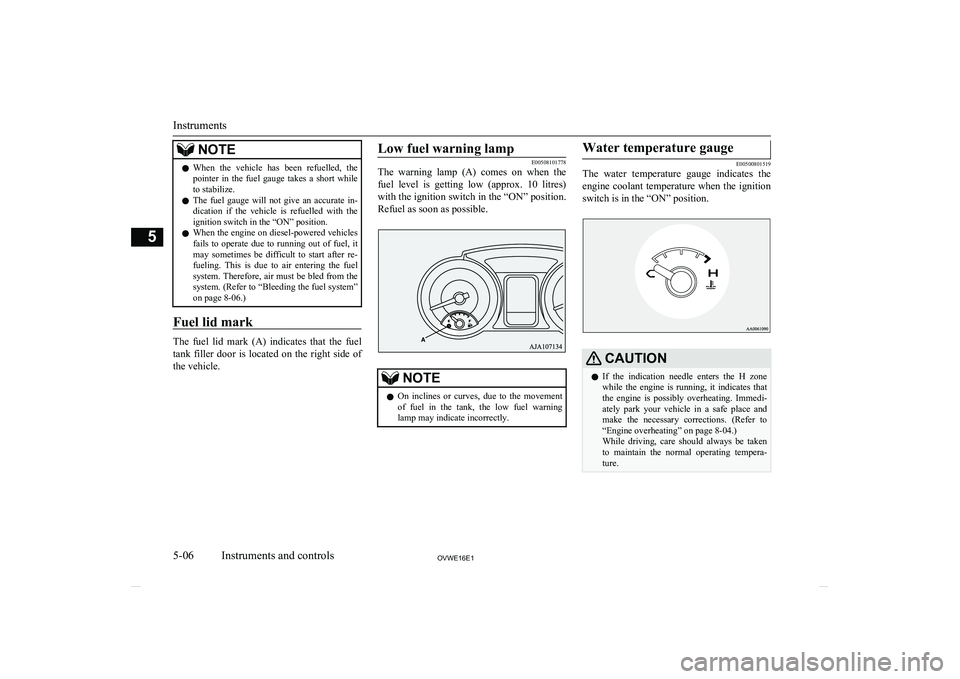
Fuel lid mark
The fuel lid mark (A) indicates that the fuel
tank filler door is located on the right side of the vehicle.
Low fuel warning lamp
E00508101778
The warning lamp (A) comes on when the
fuel level is getting low (approx. 10 litres )
with the ignition switch in the “ON” position.
Refuel as soon as possible.NOTEl On inclines or curves, due to the movement
of fuel in the tank, the low fuel warning lamp may indicate incorrectly.Water temperature gauge
E00500801519
The water temperature gauge indicates the
engine coolant temperature when the ignition
switch is in the “ON” position.
CAUTIONl If the indication needle enters the H zone
while the engine is running, it indicates that
the engine is possibly overheating. Immedi-
ately park your vehicle in a safe place and make the necessary corrections. (Refer to“Engine overheating” on page 8-04.)
While driving, care should always be taken
to maintain the normal operating tempera- ture.
Instruments
5-06OVWE16E1Instruments and controls5
Page 97 of 404
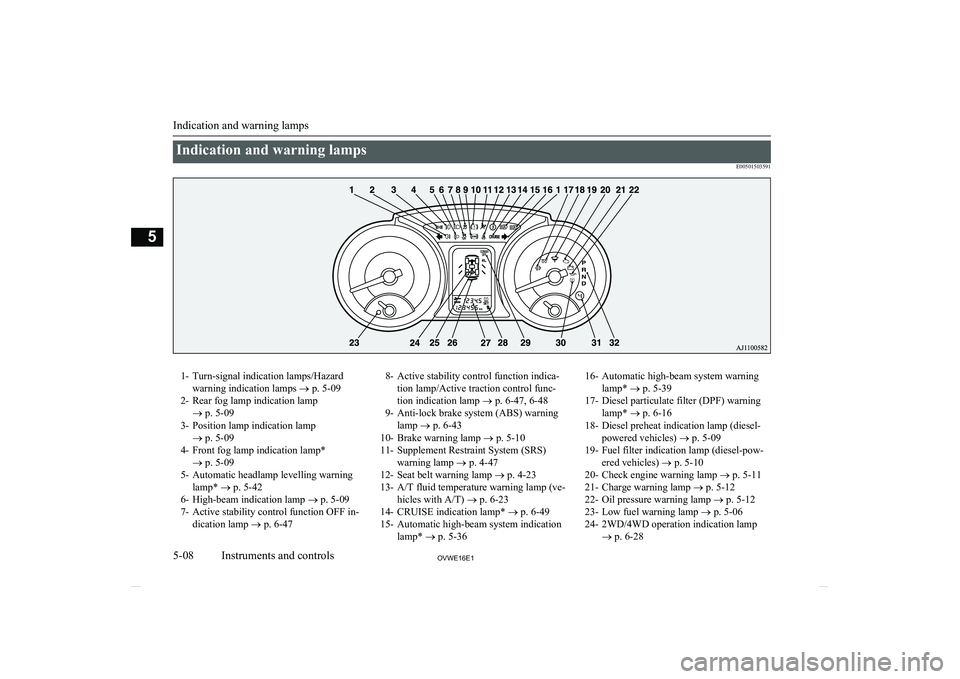
Indication and warning lampsE005015035911- Turn-signal indication lamps/Hazardwarning indication lamps ® p. 5-09
2- Rear fog lamp indication lamp ® p. 5-09
3- Position lamp indication lamp ® p. 5-09
4- Front fog lamp indication lamp* ® p. 5-09
5- Automatic headlamp levelling warning lamp* ® p. 5-42
6- High-beam indication lamp ® p. 5-09
7- Active stability control function OFF in- dication lamp ® p. 6-478- Active stability control function indica-
tion lamp/Active traction control func-
tion indication lamp ® p. 6-47, 6-48
9- Anti-lock brake system (ABS) warning lamp ® p. 6-43
10- Brake warning lamp ® p. 5-10
11- Supplement Restraint System (SRS) warning lamp ® p. 4-47
12- Seat belt warning lamp ® p. 4-23
13- A/T fluid temperature warning lamp (ve- hicles with A/T) ® p. 6-23
14- CRUISE indication lamp* ® p. 6-49
15- Automatic high-beam system indication lamp* ® p. 5-3616- Automatic high-beam system warning
lamp* ® p. 5-39
17- Diesel particulate filter (DPF) warning lamp* ® p. 6-16
18- Diesel preheat indication lamp (diesel- powered vehicles) ® p. 5-09
19- Fuel filter indication lamp (diesel-pow- ered vehicles) ® p. 5-10
20- Check engine warning lamp ® p. 5-11
21- Charge warning lamp ® p. 5-12
22- Oil pressure warning lamp ® p. 5-12
23- Low fuel warning lamp ® p. 5-06
24- 2WD/4WD operation indication lamp ® p. 6-28
Indication and warning lamps
5-08OVWE16E1Instruments and controls5
Page 98 of 404
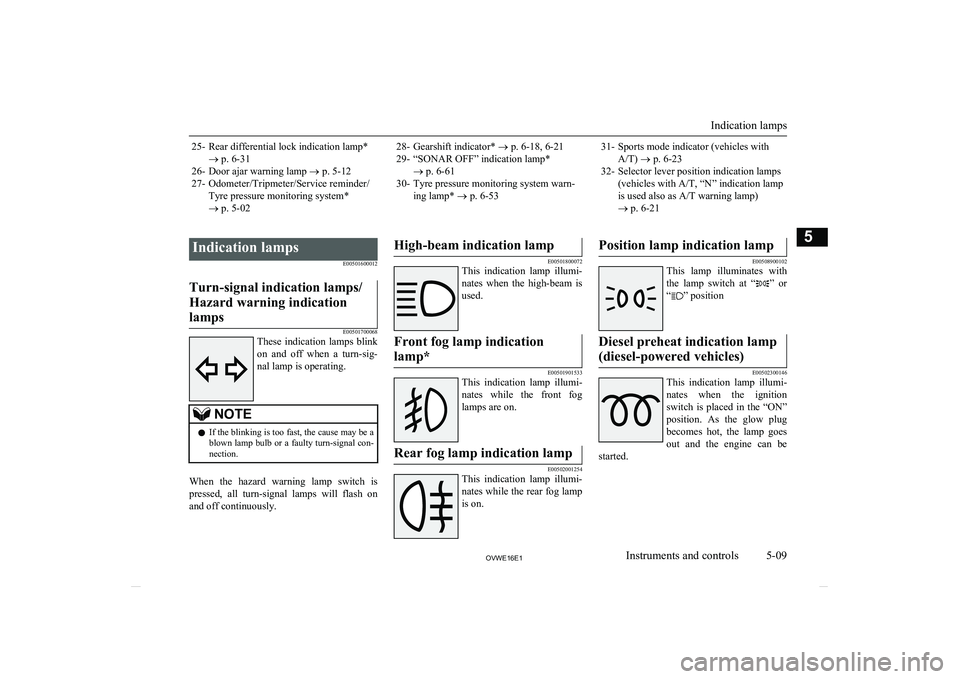
25- Rear differential lock indication lamp*® p. 6-31
26- Door ajar warning lamp ® p. 5-12
27- Odometer/Tripmeter/Service reminder/ Tyre pressure monitoring system*
® p. 5-0228- Gearshift indicator* ® p. 6-18, 6-21
29- “SONAR OFF” indication lamp* ® p. 6-61
30- Tyre pressure monitoring system warn- ing lamp* ® p. 6-5331- Sports mode indicator (vehicles with
A/T) ® p. 6-23
32- Selector lever position indication lamps (vehicles with A/T, “N” indication lamp
is used also as A/T warning lamp)
® p. 6-21
Indication lamps
E00501600012Turn-signal indication lamps/
Hazard warning indication lamps
E00501700068
These indication lamps blink
on and off when a turn-sig-
nal lamp is operating.
NOTEl If the blinking is too fast, the cause may be a
blown lamp bulb or a faulty turn-signal con-
nection.
When the hazard warning lamp switch is
pressed, all turn-signal lamps will flash on and off continuously.
High-beam indication lamp
E00501800072
This indication lamp illumi-
nates when the high-beam is used.
Front fog lamp indication
lamp*
E00501901533
This indication lamp illumi-
nates while the front fog lamps are on.
Rear fog lamp indication lamp
E00502001254
This indication lamp illumi-
nates while the rear fog lamp is on.
Position lamp indication lamp
E00508900102
This lamp illuminates with
the lamp switch at “
” or
“
” position
Diesel preheat indication lamp
(diesel-powered vehicles)
E00502300146
This indication lamp illumi-
nates when the ignition
switch is placed in the “ON”
position. As the glow plug becomes hot, the lamp goes
out and the engine can be
started.
Indication lamps
5-09OVWE16E1Instruments and controls5
Page 99 of 404
CAUTIONlIf the diesel preheat indication lamp comes
on after the engine is started, the engine speed may not rise above the idling speedbecause of fuel freezing. In this case, keep
the engine idling for about ten minutes, then turn off the ignition switch and immediately
turn it on again to confirm that the diesel
preheat indication lamp is off.NOTEl If the engine is cold, the diesel preheat indi-
cation lamp is on for a longer time.
l When the engine has not been started within
about 5 seconds after the diesel preheat indi- cation lamp went out, return the ignition
switch to the “LOCK” position. Then, turn
the switch to the “ON” position to preheat the engine again.
l When the engine is warm, the diesel preheat
indication lamp does not come on even if the
ignition switch is placed in the “ON” posi-
tion.Fuel filter indication lamp (die-
sel-powered vehicles)
E00509901337
This indication lamp illumi-
nates when the ignition
switch is turned to the “ON” position and goes off after
the engine has started. If it lights up while the engine is
running, it indicates that water has accumula-
ted inside the fuel filter; if this happens, re- move the water from the fuel filter. Refer to
“ Removal of water from the fuel filter (die- sel-powered vehicles only) ” on page 8-06.
When the lamp goes out, you can resume
driving. If it either does not go out or comes on from time to time, we recommend you to
have the vehicle inspected.
Warning lamps
E00502400017Brake warning lamp (brake
warning buzzer)
E00502501712
This lamp illuminates when
the ignition switch is turned to the “ON” position, and goes off after a few seconds.
Always make sure that the
lamp goes off before driving.
With the ignition switch in the “ON” posi-
tion, the brake warning lamp illuminates un- der the following conditions:
l When the parking brake lever has been
engaged.
l When the brake fluid level in the reser-
voir falls to a low level.
l When the brake force distribution func-
tion or the brake system is not operating
correctly.Brake warning buzzer
When there is a danger of brake performance
becoming compromised, a buzzer will sound
to alert the driver. If this buzzer should con-
tinue to sound, park your vehicle in a safe place and we recommend you to have itchecked.
NOTEl Depressing the brake pedal repeatedly may
turn on the brake warning lamp, ABS warn-ing lamp and brake warning buzzer. It is
normal if the lamp goes out and the buzzer stops sounding after a few seconds.CAUTIONl In the situations listed below, brake perform-
ance may be compromised or the vehicle may become unstable if brakes are applied
Warning lamps
5-10OVWE16E1Instruments and controls5
Page 100 of 404
CAUTIONsuddenly; consequently, avoid driving athigh speeds or applying the brakes suddenly.
Furthermore, the vehicle should be brought
to a stop in a safe location and to have it checked.
• The brake warning lamp does not illumi-
nate when the parking brake is applied ordoes not turn off when the parking brake
is released.
• The ABS warning lamp and brake warn-
ing lamp illuminate at the same time.
For details, refer to “ABS warning lamp” on page 6-43.
• The brake warning lamp remains illumi-
nated during driving.
• The brake warning buzzer does not turn
off.
l The vehicle should be brought to a halt in
the following manner when brake perform-
ance has deteriorated.
• Depress the brake pedal harder than usual.
Even if the brake pedal moves down to
the very end of its possible stroke, keep it pressed down hard.
• Should the brakes fail, use engine braking
to reduce your speed and pull the parking
brake lever.
Depress the brake pedal to operate the
stop lamp to alert the vehicles behind you.NOTEl In certain cases immediately after the engine
has been started or when the brake pedal is
depressed repeatedly, a noise generated by operation of brake devices may be heard coming from the engine compartment. At
this time, you may feel a shock from the brake pedal if you depress it. This type of
noise or shock is normal and there is no need for concern. In fact, they indicate that the
corresponding devices are operating normal- ly.
l The brake system uses brake fluid pressur-
ized by the pump.
Please refer to “Braking” on page 6-39.Check engine warning lamp
E00502603052
This lamp is a part of an on-
board diagnostic system
which monitors the emis-
sions, engine control system or automatic transmission
control systems.
If a problem is detected in one of these sys-
tems, this lamp illuminates.
Although your vehicle will usually be driva-
ble and not need towing, we recommend you to have the system checked as soon as possi-
ble.
[Vehicles to comply with the Euro 4 regula-
tion]
This lamp will also illuminate for a few sec-
onds when the ignition switch is turned to the
“ON” position. If it does not go off after a few seconds, we recommend you to have the vehicle checked.
[Vehicles to comply with the Euro 5 and Eu-
ro 6]
This lamp will also illuminate when the igni-
tion switch is turned “ON”, and goes off after the engine has started. If it does not go off af- ter the engine has started, we recommend youto have the system checked.CAUTIONl Prolonged driving with this lamp on may
cause further damage to the emission control system. It could also affect fuel economy
and drivability.
l If the lamp does not illuminate when the ig-
nition switch is turned to the “ON” position,
we recommend you to have the system
checked.
l If the lamp illuminates while the engine is
running, avoid driving at high speeds and we recommend you to have the system checked.
Accelerator pedal and brake pedal response may be negatively influenced under these
conditions.
Warning lamps
5-11OVWE16E1Instruments and controls5