fuel MITSUBISHI SHOGUN 2016 (in English) User Guide
[x] Cancel search | Manufacturer: MITSUBISHI, Model Year: 2016, Model line: SHOGUN, Model: MITSUBISHI SHOGUN 2016Pages: 404, PDF Size: 18.95 MB
Page 91 of 404
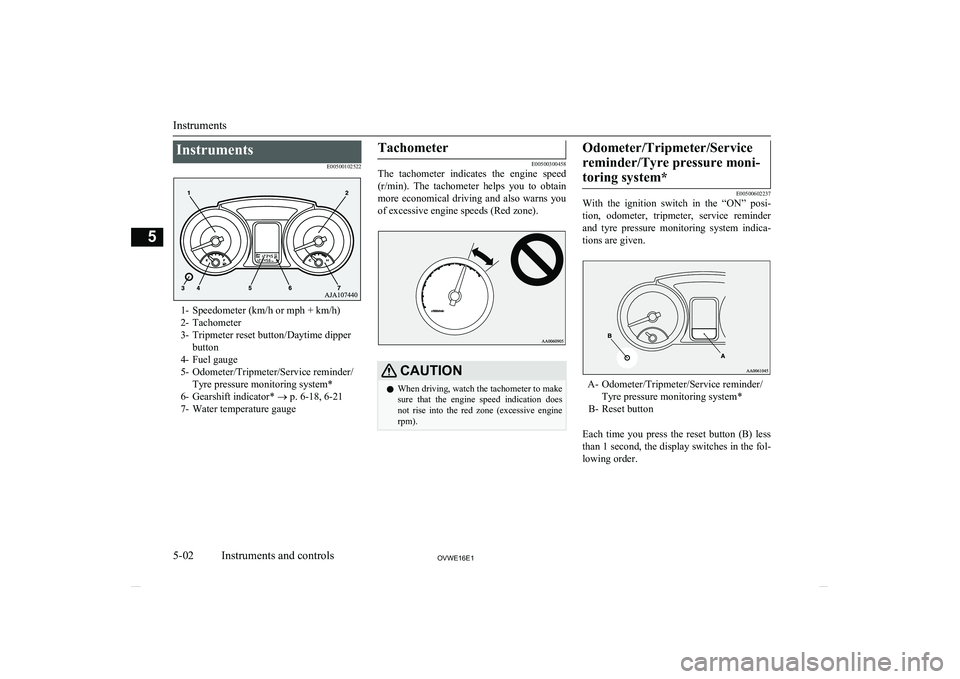
InstrumentsE00500102522
1- Speedometer (km/h or mph + km/h)
2- Tachometer
3- Tripmeter reset button/Daytime dipper button
4- Fuel gauge
5- Odometer/Tripmeter/Service reminder/ Tyre pressure monitoring system*
6- Gearshift indicator* ® p. 6-18, 6-21
7- Water temperature gauge
Tachometer
E00500300458
The tachometer indicates the engine speed
(r/min). The tachometer helps you to obtain
more economical driving and also warns you
of excessive engine speeds (Red zone).
CAUTIONl When driving, watch the tachometer to make
sure that the engine speed indication does not rise into the red zone (excessive enginerpm).Odometer/Tripmeter/Service
reminder/Tyre pressure moni-toring system*
E00500602237
With the ignition switch in the “ON” posi-
tion, odometer, tripmeter, service reminder
and tyre pressure monitoring system indica-
tions are given.
A- Odometer/Tripmeter/Service reminder/ Tyre pressure monitoring system*
B- Reset button
Each time you press the reset button (B) less
than 1 second, the display switches in the fol- lowing order.
Instruments
5-02OVWE16E1Instruments and controls5
Page 94 of 404
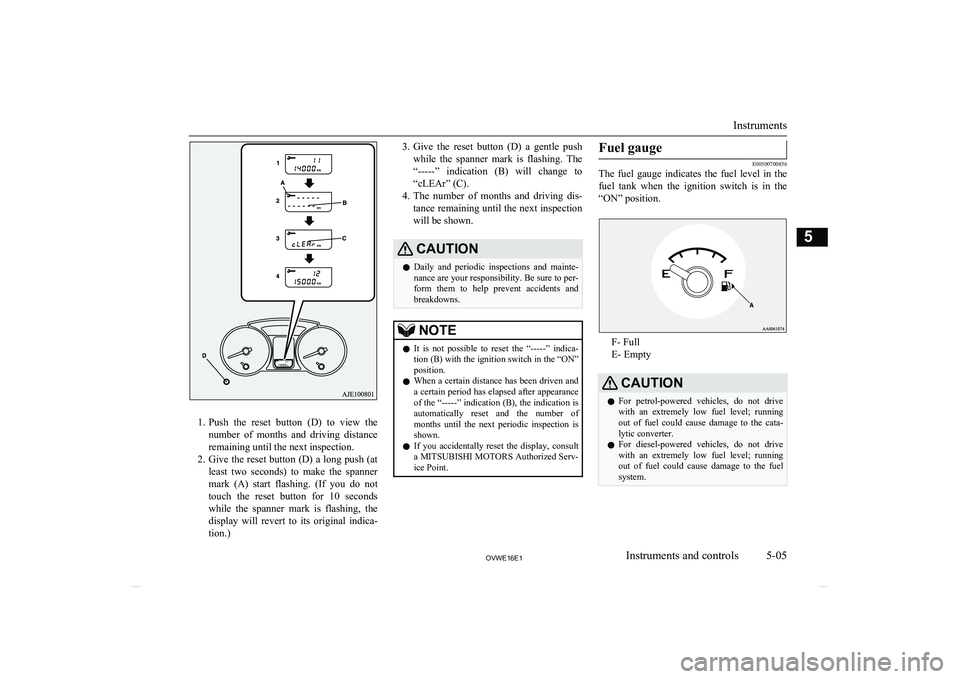
1.Push the reset button (D) to view the
number of months and driving distance
remaining until the next inspection.
2. Give the reset button (D) a long push (at
least two seconds) to make the spanner
mark (A) start flashing. (If you do not
touch the reset button for 10 seconds while the spanner mark is flashing, the display will revert to its original indica-
tion.)
3. Give the reset button (D) a gentle push
while the spanner mark is flashing. The “-----” indication (B) will change to“cLEAr” (C).
4. The number of months and driving dis-
tance remaining until the next inspection will be shown.CAUTIONl Daily and periodic inspections and mainte-
nance are your responsibility. Be sure to per-
form them to help prevent accidents and
breakdowns.NOTEl It is not possible to reset the “-----” indica-
tion (B) with the ignition switch in the “ON”position.
l When a certain distance has been driven and
a certain period has elapsed after appearanceof the “-----” indication (B), the indication is
automatically reset and the number of
months until the next periodic inspection is shown.
l If you accidentally reset the display, consult
a MITSUBISHI MOTORS Authorized Serv-
ice Point.Fuel gauge
E00500700856
The fuel gauge indicates the fuel level in the
fuel tank when the ignition switch is in the
“ON” position.
F- Full
E- Empty
CAUTIONl For petrol-powered vehicles, do not drive
with an extremely low fuel level; running
out of fuel could cause damage to the cata-
lytic converter.
l For diesel-powered vehicles, do not drive
with an extremely low fuel level; running out of fuel could cause damage to the fuel
system.
Instruments
5-05OVWE16E1Instruments and controls5
Page 95 of 404
NOTElWhen the vehicle has been refuelled, the
pointer in the fuel gauge takes a short while
to stabilize.
l The fuel gauge will not give an accurate in-
dication if the vehicle is refuelled with the ignition switch in the “ON” position.
l When the engine on diesel-powered vehicles
fails to operate due to running out of fuel, it may sometimes be difficult to start after re-
fueling. This is due to air entering the fuel
system. Therefore, air must be bled from the system. (Refer to “Bleeding the fuel system” on page 8-06.)
Fuel lid mark
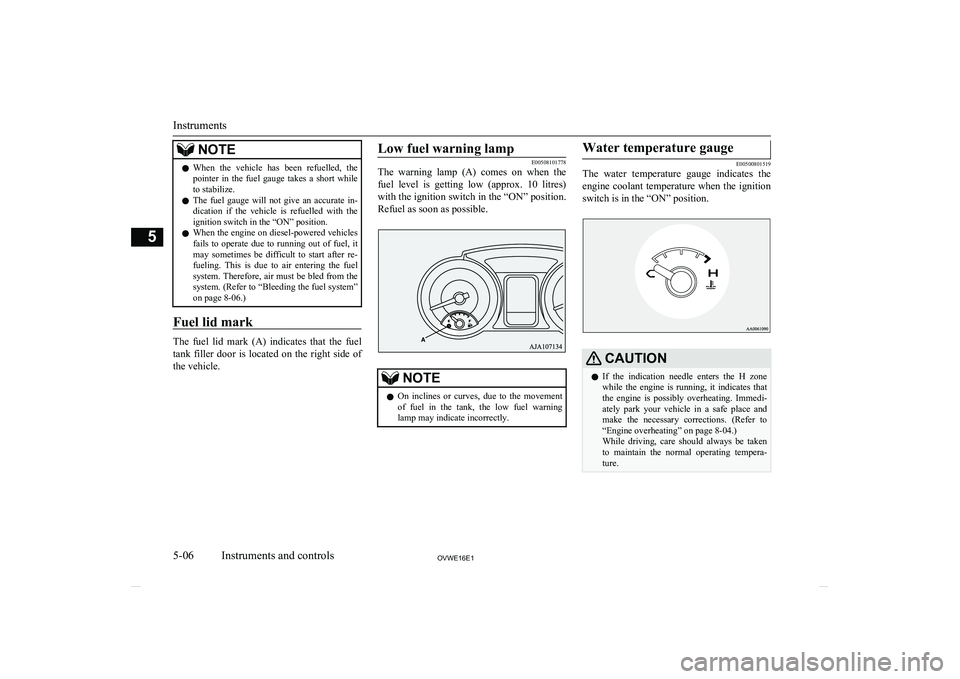
The fuel lid mark (A) indicates that the fuel
tank filler door is located on the right side of the vehicle.
Low fuel warning lamp
E00508101778
The warning lamp (A) comes on when the
fuel level is getting low (approx. 10 litres )
with the ignition switch in the “ON” position.
Refuel as soon as possible.NOTEl On inclines or curves, due to the movement
of fuel in the tank, the low fuel warning lamp may indicate incorrectly.Water temperature gauge
E00500801519
The water temperature gauge indicates the
engine coolant temperature when the ignition
switch is in the “ON” position.
CAUTIONl If the indication needle enters the H zone
while the engine is running, it indicates that
the engine is possibly overheating. Immedi-
ately park your vehicle in a safe place and make the necessary corrections. (Refer to“Engine overheating” on page 8-04.)
While driving, care should always be taken
to maintain the normal operating tempera- ture.
Instruments
5-06OVWE16E1Instruments and controls5
Page 97 of 404
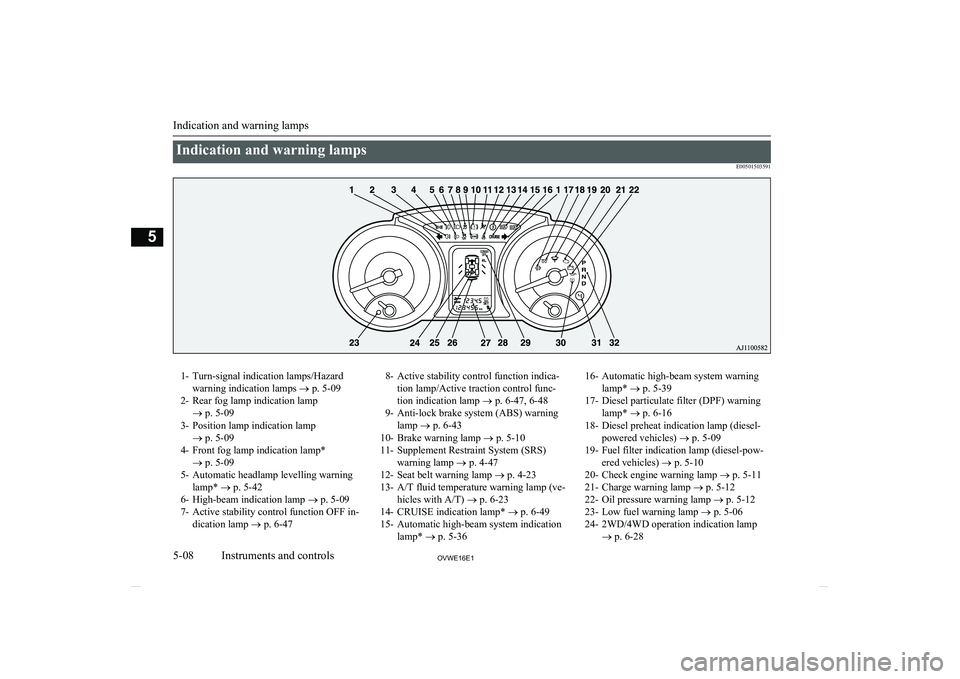
Indication and warning lampsE005015035911- Turn-signal indication lamps/Hazardwarning indication lamps ® p. 5-09
2- Rear fog lamp indication lamp ® p. 5-09
3- Position lamp indication lamp ® p. 5-09
4- Front fog lamp indication lamp* ® p. 5-09
5- Automatic headlamp levelling warning lamp* ® p. 5-42
6- High-beam indication lamp ® p. 5-09
7- Active stability control function OFF in- dication lamp ® p. 6-478- Active stability control function indica-
tion lamp/Active traction control func-
tion indication lamp ® p. 6-47, 6-48
9- Anti-lock brake system (ABS) warning lamp ® p. 6-43
10- Brake warning lamp ® p. 5-10
11- Supplement Restraint System (SRS) warning lamp ® p. 4-47
12- Seat belt warning lamp ® p. 4-23
13- A/T fluid temperature warning lamp (ve- hicles with A/T) ® p. 6-23
14- CRUISE indication lamp* ® p. 6-49
15- Automatic high-beam system indication lamp* ® p. 5-3616- Automatic high-beam system warning
lamp* ® p. 5-39
17- Diesel particulate filter (DPF) warning lamp* ® p. 6-16
18- Diesel preheat indication lamp (diesel- powered vehicles) ® p. 5-09
19- Fuel filter indication lamp (diesel-pow- ered vehicles) ® p. 5-10
20- Check engine warning lamp ® p. 5-11
21- Charge warning lamp ® p. 5-12
22- Oil pressure warning lamp ® p. 5-12
23- Low fuel warning lamp ® p. 5-06
24- 2WD/4WD operation indication lamp ® p. 6-28
Indication and warning lamps
5-08OVWE16E1Instruments and controls5
Page 99 of 404
CAUTIONlIf the diesel preheat indication lamp comes
on after the engine is started, the engine speed may not rise above the idling speedbecause of fuel freezing. In this case, keep
the engine idling for about ten minutes, then turn off the ignition switch and immediately
turn it on again to confirm that the diesel
preheat indication lamp is off.NOTEl If the engine is cold, the diesel preheat indi-
cation lamp is on for a longer time.
l When the engine has not been started within
about 5 seconds after the diesel preheat indi- cation lamp went out, return the ignition
switch to the “LOCK” position. Then, turn
the switch to the “ON” position to preheat the engine again.
l When the engine is warm, the diesel preheat
indication lamp does not come on even if the
ignition switch is placed in the “ON” posi-
tion.Fuel filter indication lamp (die-
sel-powered vehicles)
E00509901337
This indication lamp illumi-
nates when the ignition
switch is turned to the “ON” position and goes off after
the engine has started. If it lights up while the engine is
running, it indicates that water has accumula-
ted inside the fuel filter; if this happens, re- move the water from the fuel filter. Refer to
“ Removal of water from the fuel filter (die- sel-powered vehicles only) ” on page 8-06.
When the lamp goes out, you can resume
driving. If it either does not go out or comes on from time to time, we recommend you to
have the vehicle inspected.
Warning lamps
E00502400017Brake warning lamp (brake
warning buzzer)
E00502501712
This lamp illuminates when
the ignition switch is turned to the “ON” position, and goes off after a few seconds.
Always make sure that the
lamp goes off before driving.
With the ignition switch in the “ON” posi-
tion, the brake warning lamp illuminates un- der the following conditions:
l When the parking brake lever has been
engaged.
l When the brake fluid level in the reser-
voir falls to a low level.
l When the brake force distribution func-
tion or the brake system is not operating
correctly.Brake warning buzzer
When there is a danger of brake performance
becoming compromised, a buzzer will sound
to alert the driver. If this buzzer should con-
tinue to sound, park your vehicle in a safe place and we recommend you to have itchecked.
NOTEl Depressing the brake pedal repeatedly may
turn on the brake warning lamp, ABS warn-ing lamp and brake warning buzzer. It is
normal if the lamp goes out and the buzzer stops sounding after a few seconds.CAUTIONl In the situations listed below, brake perform-
ance may be compromised or the vehicle may become unstable if brakes are applied
Warning lamps
5-10OVWE16E1Instruments and controls5
Page 100 of 404
CAUTIONsuddenly; consequently, avoid driving athigh speeds or applying the brakes suddenly.
Furthermore, the vehicle should be brought
to a stop in a safe location and to have it checked.
• The brake warning lamp does not illumi-
nate when the parking brake is applied ordoes not turn off when the parking brake
is released.
• The ABS warning lamp and brake warn-
ing lamp illuminate at the same time.
For details, refer to “ABS warning lamp” on page 6-43.
• The brake warning lamp remains illumi-
nated during driving.
• The brake warning buzzer does not turn
off.
l The vehicle should be brought to a halt in
the following manner when brake perform-
ance has deteriorated.
• Depress the brake pedal harder than usual.
Even if the brake pedal moves down to
the very end of its possible stroke, keep it pressed down hard.
• Should the brakes fail, use engine braking
to reduce your speed and pull the parking
brake lever.
Depress the brake pedal to operate the
stop lamp to alert the vehicles behind you.NOTEl In certain cases immediately after the engine
has been started or when the brake pedal is
depressed repeatedly, a noise generated by operation of brake devices may be heard coming from the engine compartment. At
this time, you may feel a shock from the brake pedal if you depress it. This type of
noise or shock is normal and there is no need for concern. In fact, they indicate that the
corresponding devices are operating normal- ly.
l The brake system uses brake fluid pressur-
ized by the pump.
Please refer to “Braking” on page 6-39.Check engine warning lamp
E00502603052
This lamp is a part of an on-
board diagnostic system
which monitors the emis-
sions, engine control system or automatic transmission
control systems.
If a problem is detected in one of these sys-
tems, this lamp illuminates.
Although your vehicle will usually be driva-
ble and not need towing, we recommend you to have the system checked as soon as possi-
ble.
[Vehicles to comply with the Euro 4 regula-
tion]
This lamp will also illuminate for a few sec-
onds when the ignition switch is turned to the
“ON” position. If it does not go off after a few seconds, we recommend you to have the vehicle checked.
[Vehicles to comply with the Euro 5 and Eu-
ro 6]
This lamp will also illuminate when the igni-
tion switch is turned “ON”, and goes off after the engine has started. If it does not go off af- ter the engine has started, we recommend youto have the system checked.CAUTIONl Prolonged driving with this lamp on may
cause further damage to the emission control system. It could also affect fuel economy
and drivability.
l If the lamp does not illuminate when the ig-
nition switch is turned to the “ON” position,
we recommend you to have the system
checked.
l If the lamp illuminates while the engine is
running, avoid driving at high speeds and we recommend you to have the system checked.
Accelerator pedal and brake pedal response may be negatively influenced under these
conditions.
Warning lamps
5-11OVWE16E1Instruments and controls5
Page 104 of 404
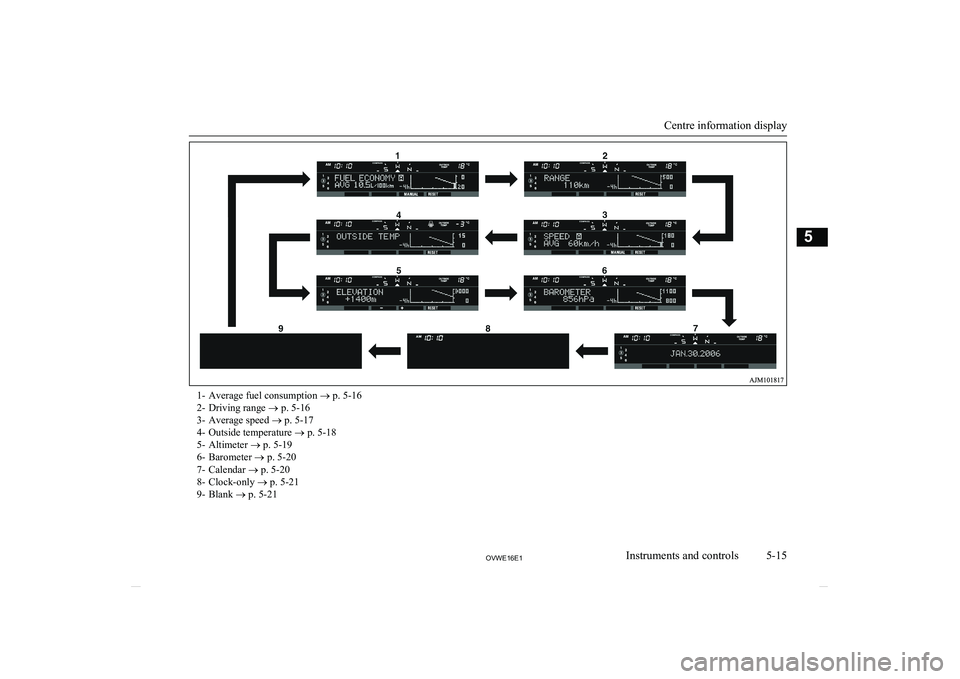
1- Average fuel consumption ® p. 5-16
2- Driving range ® p. 5-16
3- Average speed ® p. 5-17
4- Outside temperature ® p. 5-18
5- Altimeter ® p. 5-19
6- Barometer ® p. 5-20
7- Calendar ® p. 5-20
8- Clock-only ® p. 5-21
9- Blank ® p. 5-21
Centre information display
5-15OVWE16E1Instruments and controls5
Page 105 of 404
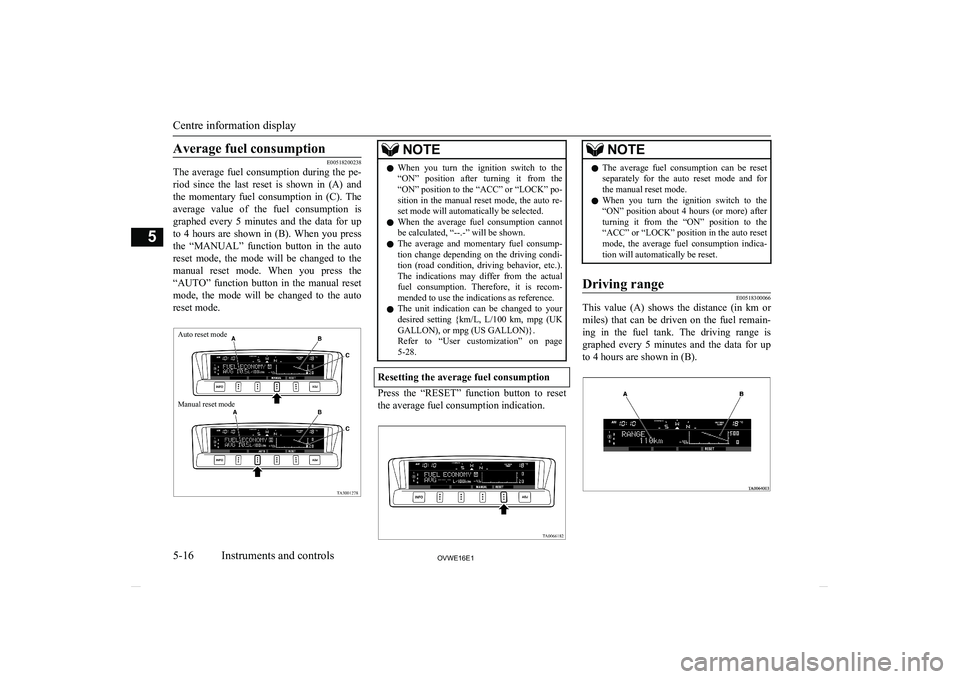
Average fuel consumption
E00518200238
The average fuel consumption during the pe-
riod since the last reset is shown in (A) and
the momentary fuel consumption in (C). The average value of the fuel consumption is
graphed every 5 minutes and the data for up
to 4 hours are shown in (B). When you press
the “MANUAL” function button in the auto reset mode, the mode will be changed to the manual reset mode. When you press the
“AUTO” function button in the manual reset
mode, the mode will be changed to the auto reset mode.NOTEl When you turn the ignition switch to the
“ON” position after turning it from the “ON” position to the “ACC” or “LOCK” po-
sition in the manual reset mode, the auto re- set mode will automatically be selected.
l When the average fuel consumption cannot
be calculated, “--.-” will be shown.
l The average and momentary fuel consump-
tion change depending on the driving condi- tion (road condition, driving behavior, etc.). The indications may differ from the actual
fuel consumption. Therefore, it is recom- mended to use the indications as reference.
l The unit indication can be changed to your
desired setting {km/L, L/100 km, mpg (UK
GALLON), or mpg (US GALLON)}. Refer to “User customization” on page 5-28.
Resetting the average fuel consumption
Press the “RESET” function button to reset
the average fuel consumption indication.
NOTEl The average fuel consumption can be reset
separately for the auto reset mode and forthe manual reset mode.
l When you turn the ignition switch to the
“ON” position about 4 hours (or more) after turning it from the “ON” position to the
“ACC” or “LOCK” position in the auto reset
mode, the average fuel consumption indica-
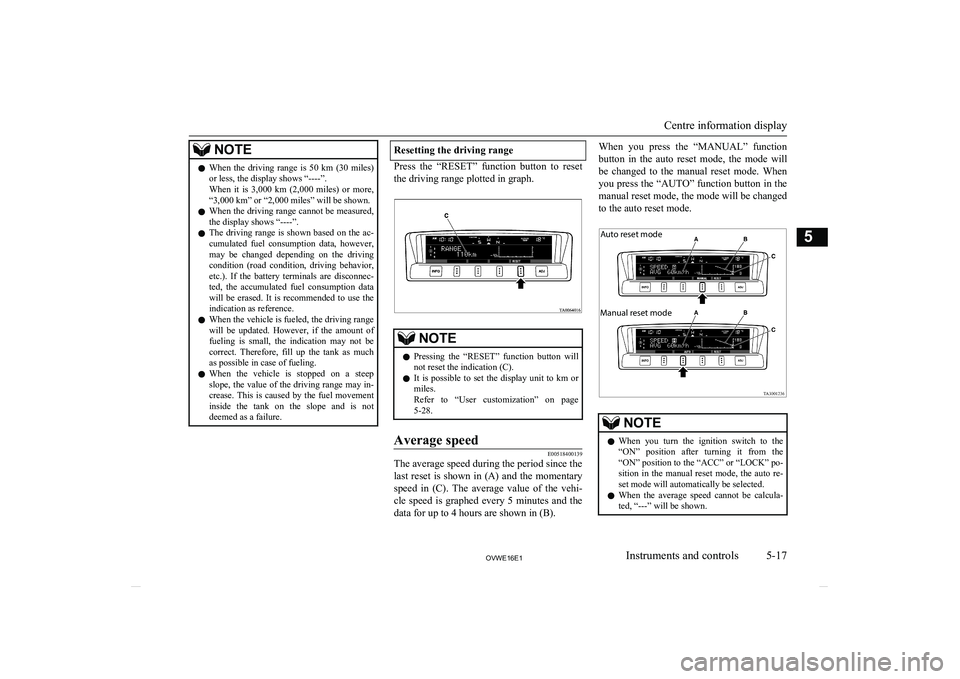
tion will automatically be reset.Driving range
E00518300066
This value (A) shows the distance (in km or
miles) that can be driven on the fuel remain- ing in the fuel tank. The driving range is
graphed every 5 minutes and the data for up
to 4 hours are shown in (B).
Centre information display
5-16OVWE16E1Instruments and controls5Auto reset mode
Manual reset mode
Page 106 of 404
NOTElWhen the driving range is 50 km (30 miles)
or less, the display shows “----”.
When it is 3,000 km (2,000 miles) or more,
“3,000 km” or “2,000 miles” will be shown.
l When the driving range cannot be measured,
the display shows “----”.
l The driving range is shown based on the ac-
cumulated fuel consumption data, however,
may be changed depending on the driving condition (road condition, driving behavior, etc.). If the battery terminals are disconnec-
ted, the accumulated fuel consumption data will be erased. It is recommended to use the indication as reference.
l When the vehicle is fueled, the driving range
will be updated. However, if the amount of
fueling is small, the indication may not be
correct. Therefore, fill up the tank as much as possible in case of fueling.
l When the vehicle is stopped on a steep
slope, the value of the driving range may in-
crease. This is caused by the fuel movement inside the tank on the slope and is not
deemed as a failure.Resetting the driving range
Press the “RESET” function button to reset
the driving range plotted in graph.
NOTEl Pressing the “RESET” function button will
not reset the indication (C).
l It is possible to set the display unit to km or
miles.
Refer to “User customization” on page 5-28.Average speed
E00518400139
The average speed during the period since the
last reset is shown in (A) and the momentary speed in (C). The average value of the vehi-cle speed is graphed every 5 minutes and the
data for up to 4 hours are shown in (B).
When you press the “MANUAL” function
button in the auto reset mode, the mode will
be changed to the manual reset mode. When you press the “AUTO” function button in themanual reset mode, the mode will be changed
to the auto reset mode.NOTEl When you turn the ignition switch to the
“ON” position after turning it from the “ON” position to the “ACC” or “LOCK” po-
sition in the manual reset mode, the auto re- set mode will automatically be selected.
l When the average speed cannot be calcula-
ted, “---” will be shown.
Centre information display
5-17OVWE16E1Instruments and controls5 Auto reset mode
Manual reset mode
Page 118 of 404

Push the function button “SELECT”.
The setting display for your selected
item will appear.
Changing display units
It is possible to change the display units for the fuel consumption, driving range, average
speed, outside temperature, elevation, and at- mospheric pressure as shown below.
FUEL ECONO-
MYkm/L → L/100 km →
mpg (UK GALLON) → mpg (US GALLON)RANGEkm → milesSPEEDkm/h → mphOUTSIDE TEM-
PERATURE°C → °FELEVATIONm → ftBAROMETERhPa → mb → kPa → inHg
l Changing the display unit for fuel con-
sumption
1. Press the “←” or “→” function button to
select “FUEL ECONOMY”. Then press the “SELECT” function button.
2. Press the “←” or “→” function button to
select “km/L”. Then press the “SET” function button. The display will flash
twice, and the display unit will be upda- ted to the selected one.
NOTEl You can return to the previous display by
pressing the “BACK” function button.
3. After setting, press the “INFO” button to
return to the information display.
Changing the language
It is possible to set the display language of
the centre information display.
Centre information display
5-29OVWE16E1Instruments and controls5