fuel MITSUBISHI SHOGUN 2016 (in English) Owner's Guide
[x] Cancel search | Manufacturer: MITSUBISHI, Model Year: 2016, Model line: SHOGUN, Model: MITSUBISHI SHOGUN 2016Pages: 404, PDF Size: 18.95 MB
Page 120 of 404
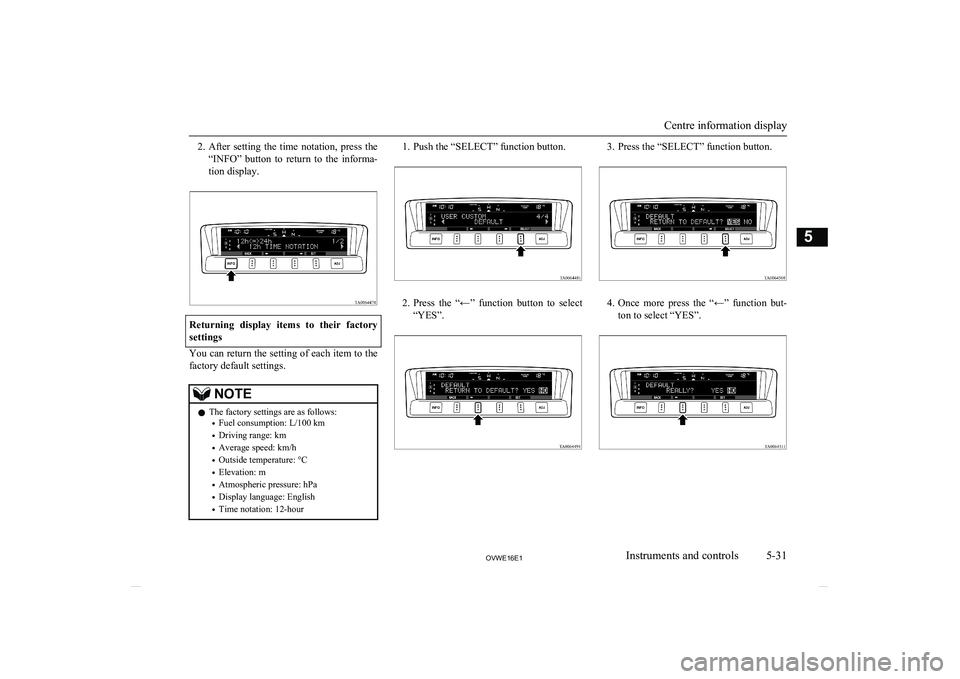
2.After setting the time notation, press the
“INFO” button to return to the informa- tion display.
Returning display items to their factorysettings
You can return the setting of each item to the
factory default settings.
NOTEl The factory settings are as follows:
• Fuel consumption: L/100 km
• Driving range: km
• Average speed: km/h
• Outside temperature: °C
• Elevation: m
• Atmospheric pressure: hPa
• Display language: English
• Time notation: 12-hour1. Push the “SELECT” function button.
2.
Press the “←” function button to select
“YES”.
3. Press the “SELECT” function button.
4. Once more press the “←” function but-
ton to select “YES”.
Centre information display
5-31OVWE16E1Instruments and controls5
Page 141 of 404
Economical drivingE00600100561
For economical driving, there are some tech- nical requirements that have to be met. Theprerequisite for low fuel consumption is a
properly adjusted engine. In order to achieve longer life of the vehicle and the most eco- nomical operation, we recommend you tohave the vehicle checked at regular intervals in accordance with the service standards.
Fuel economy and generation of exhaust gas
and noise are highly influenced by personal
driving habits as well as the particular operat- ing conditions. The following points shouldbe observed in order to minimize wear of
brakes, tyres and engine as well as to reduce
environmental pollution.
Starting
Avoid rapid acceleration and sudden starts;
such operation will result in higher fuel con-
sumption.
Shifting
Shift only at an appropriate speed and engine speed. Always use the highest gear possible.
The transfer shift lever should be set to “2H” when driving on normal roads and express
ways to obtain best possible fuel economy.
City traffic
Frequent starting and stopping increases the
average fuel consumption. Use roads with smooth traffic flow whenever possible. When driving on congested roads, avoid use of a
low gear at high engine speeds.
Idling
The vehicle consumes fuel even during
idling. Avoid extended idling whenever pos- sible.
Speed
At higher vehicle speed, more fuel is con-
sumed. Avoid driving at full speed. Even a
slight release of the accelerator pedal will save a significant amount of fuel.
Tyre inflation pressure
Check the tyre inflation pressures at regularintervals. Low tyre inflation pressure increa-ses road resistance and fuel consumption. In addition, low tyre pressures adversely affect
tyre wear and driving stability.
Load
Do not drive with unnecessary articles in the
luggage compartment. Especially during city
driving where frequent starting and stopping is necessary, the increased weight of the ve-
hicle will greatly affect fuel consumption. Al- so avoid driving with unnecessary luggage or carriers, etc., on the roof; the increased air re- sistance will increase fuel consumption.
Cold engine starting
Starting of a cold engine consumes more fuel.
Unnecessary fuel consumption is also caused by keeping a hot engine running. After the
engine is started, commence driving as soon
as possible.
Air conditioning
The use of the air conditioning will increase the fuel consumption.
Driving, alcohol and drugs
E00600200067
Driving after drinking alcohol is one of the
most frequent causes of accidents.
Economical driving
6-02OVWE16E1Starting and driving6
Page 155 of 404
NOTElWhen the engine is warm, the diesel preheat
indication lamp does not come on even if the
ignition key is placed in the “ON” position.
Start the engine by turning the ignition key
right to the “START” position.
7. Turn the ignition key to the “START”
position without depressing the accelera- tor pedal, and release it when the engine
starts.
Fuel injection amount learning
process (diesel-powered vehi-cles)
E00616000044
To keep exhaust emissions and engine noise low, the engine very occasionally performs a
learning process for the fuel injection
amount.
The engine sounds slightly different from
usual while the learning process is taking place. The change in the engine sound does
not indicate a fault.
NOx trap catalyst
(dieselpowered vehicles)* E00649200020
A NOx (nitrogen oxide) trap catalyst absorbs
the NOx contained in the exhaust gas of the diesel engine.
To maintain the NOx absorbing function, the
fuel is supplied regularly to the catalyst while
driving, and the catalyst reduces NOx to harmless N2 (nitrogen).
The bar graph of momentary fuel consump-
tion in the centre information display and en- gine sound change while NOx is being
purged automatically by the catalyst. These
do not indicate a fault.Diesel particulate filter
(DPF)* E00619800027
The diesel particulate filter (DPF) is a devicethat captures most of the particulate matter
(PM) in the exhaust emissions of the diesel engine. The DPF automatically burns away trapped PM during vehicle operation. Under
certain driving conditions, however, the DPF is not able to burn away all of the trapped PM
and, as a result, an excessive amount of PM accumulates inside it.
WARNINGl The DPF reaches very high temperatures.
Do not park your vehicle in areas where combustible materials such as dry grass
or leaves can come in contact with a hot exhaust system since a fire could occur.CAUTIONl Do not use any type of fuel or engine oil that
is not specified for your vehicle. Also, do not use any moisture-removing agent or oth-
er fuel additive. Such substances could have a detrimental effect on the DPF.
Refer to “Fuel selection” on page 2-02 and
“Engine oil” on page 10-04.NOTEl To minimize the likelihood of excessive ac-
cumulation of PM, try to avoid driving for long periods at low speeds and repeatedly
driving short distances.
NOx trap catalyst (dieselpowered vehicles)*
6-16OVWE16E1Starting and driving6
Page 157 of 404
CAUTIONlIf the clutch is engaged suddenly while the
engine revolution is high, an extremely large
load will be applied instantaneously to the
power train, possibly leading to the breakage of that component. Please ensure, therefore,that the clutch pedal is always applied in aslow yet firm manner.
Your vehicle has a special feature to protect
the power train from damage; the engine is controlled in such a way that excessive in-crease in engine revolution is prevented in
situations where the accelerator pedal is de-
pressed while the gearshift lever is in the 1st
position and the clutch pedal has been de- pressed.NOTEl If it is hard to shift into 1 st
, depress the
clutch pedal again; the shift will then be eas- ier to make.
l To shift into reverse from the
5th
gear , move
the gearshift lever to the “N” (Neutral) posi- tion, and then shift it into reverse.Changing gears
E00610601351
Always take care to change the gear with the
vehicle speed matched to the engine speed.
Proper shifting will improve fuel economy and prolong engine life.
Avoid shifting down at high speed, as this
may cause excessive engine speed and dam-
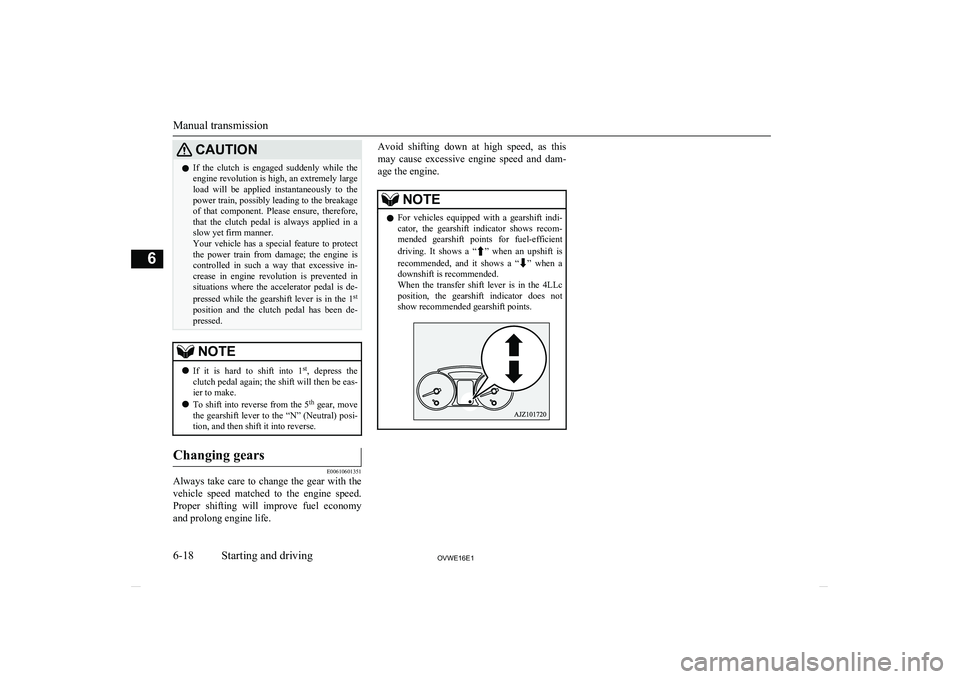
age the engine.NOTEl For vehicles equipped with a gearshift indi-
cator, the gearshift indicator shows recom-
mended gearshift points for fuel-efficient
driving. It shows a “
” when an upshift is
recommended, and it shows a “
” when a
downshift is recommended.
When the transfer shift lever is in the 4LLc
position, the gearshift indicator does not show recommended gearshift points.
Manual transmission
6-18OVWE16E1Starting and driving6
Page 158 of 404
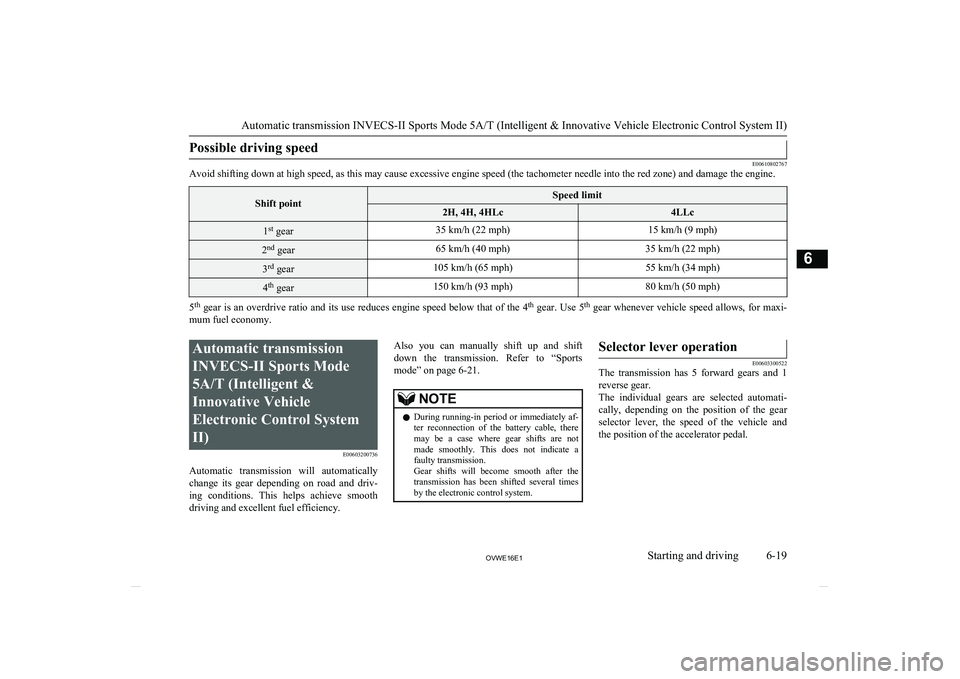
Possible driving speed
E00610802767
Avoid shifting down at high speed, as this may cause excessive engine speed (the tachometer needle into the red zone) and damage the engine.Shift pointSpeed limit2H, 4H, 4HLc4LLc1 st
gear35 km/h (22 mph)15 km/h (9 mph)2nd
gear65 km/h (40 mph)35 km/h (22 mph)3rd
gear105 km/h (65 mph)55 km/h (34 mph)4th
gear150 km/h (93 mph)80 km/h (50 mph)
5th
gear is an overdrive ratio and its use reduces engine speed below that of the 4th
gear . Use 5th
gear whenever vehicle speed allows, for maxi-
mum fuel economy.
Automatic transmission
INVECS-II Sports Mode5A/T (Intelligent &
Innovative Vehicle
Electronic Control System
II) E00603200736
Automatic transmission will automatically
change its gear depending on road and driv- ing conditions. This helps achieve smooth
driving and excellent fuel efficiency.Also you can manually shift up and shift
down the transmission. Refer to “Sports
mode” on page 6-21.NOTEl During running-in period or immediately af-
ter reconnection of the battery cable, there may be a case where gear shifts are not
made smoothly. This does not indicate a faulty transmission.
Gear shifts will become smooth after the transmission has been shifted several times
by the electronic control system.Selector lever operation
E00603300522
The transmission has 5 forward gears and 1
reverse gear.
The individual gears are selected automati- cally, depending on the position of the gear selector lever, the speed of the vehicle and
the position of the accelerator pedal.
Automatic transmission INVECS-II Sports Mode 5A/T (Intelligent & Innovative Vehicle Electronic Control System II)
6-19OVWE16E1Starting and driving6
Page 161 of 404
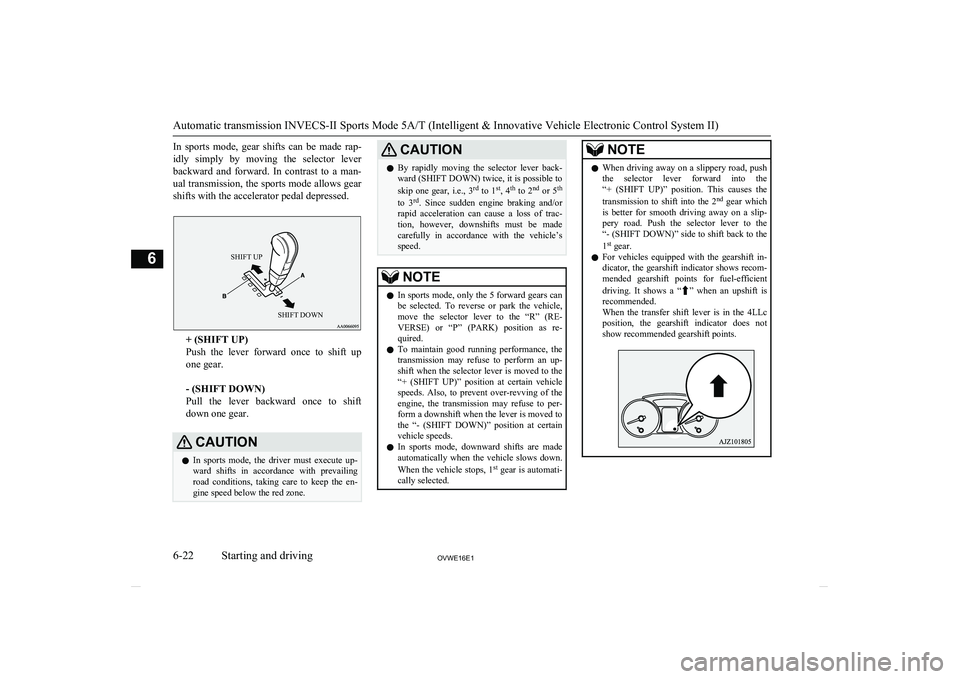
In sports mode, gear shifts can be made rap-idly simply by moving the selector leverbackward and forward. In contrast to a man-
ual transmission, the sports mode allows gear shifts with the accelerator pedal depressed.SHIFT UPSHIFT DOWN
+ (SHIFT UP)
Push the lever forward once to shift up
one gear.
- (SHIFT DOWN)
Pull the lever backward once to shift
down one gear.
CAUTIONl In sports mode, the driver must execute up-
ward shifts in accordance with prevailingroad conditions, taking care to keep the en-
gine speed below the red zone.CAUTIONl By rapidly moving the selector lever back-
ward (SHIFT DOWN) twice, it is possible to
skip one gear, i.e., 3 rd
to 1 st
, 4 th
to 2 nd
or 5 th
to 3 rd
. Since sudden engine braking and/or
rapid acceleration can cause a loss of trac-
tion, however, downshifts must be made carefully in accordance with the vehicle’s
speed.NOTEl In sports mode, only the 5 forward gears can
be selected. To reverse or park the vehicle, move the selector lever to the “R” (RE-
VERSE) or “P” (PARK) position as re- quired.
l To maintain good running performance, the
transmission may refuse to perform an up- shift when the selector lever is moved to the“+ (SHIFT UP)” position at certain vehicle
speeds. Also, to prevent over-revving of the engine, the transmission may refuse to per-
form a downshift when the lever is moved to
the “- (SHIFT DOWN)” position at certain vehicle speeds.
l In sports mode, downward shifts are made
automatically when the vehicle slows down.
When the vehicle stops, 1st
gear is automati-
cally selected.NOTEl When driving away on a slippery road, push
the selector lever forward into the“+ (SHIFT UP)” position. This causes the
transmission to shift into the 2nd
gear which
is better for smooth driving away on a slip-
pery road. Push the selector lever to the
“- (SHIFT DOWN)” side to shift back to the
1 st
gear.
l For vehicles equipped with the gearshift in-
dicator, the gearshift indicator shows recom-
mended gearshift points for fuel-efficient
driving. It shows a “
” when an upshift is
recommended.
When the transfer shift lever is in the 4LLc
position, the gearshift indicator does not show recommended gearshift points.
Automatic transmission INVECS-II Sports Mode 5A/T (Intelligent & Innovative Vehicle Electronic Control System II)
6-22OVWE16E1Starting and driving6
Page 165 of 404
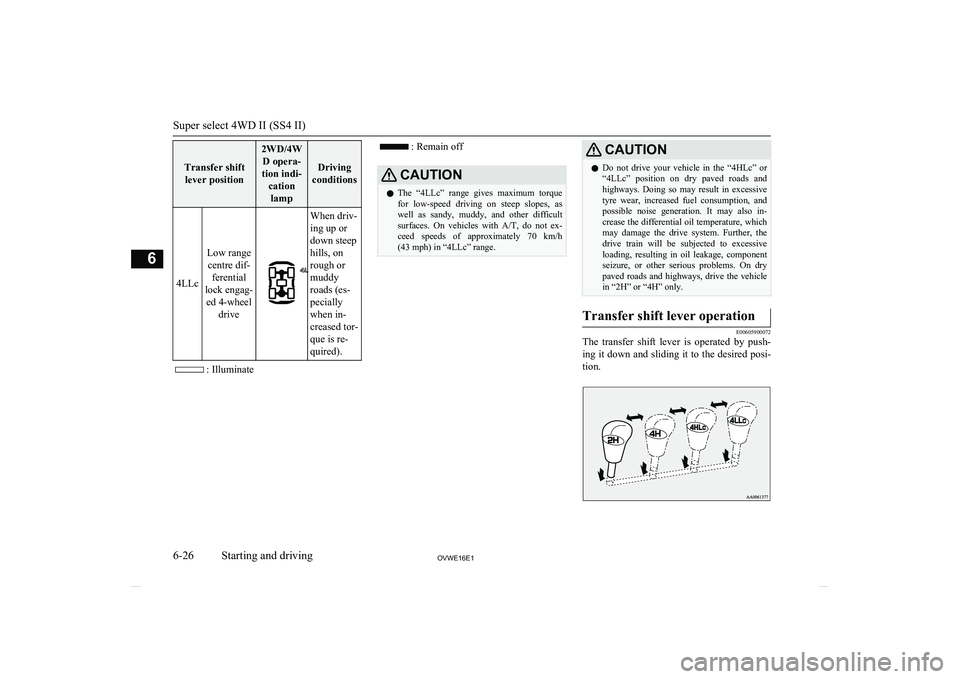
Transfer shiftlever position
2WD/4W D opera-
tion indi- cationlamp
Driving
conditions
4LLc
Low range centre dif- ferential
lock engag- ed 4-wheel drive
When driv-
ing up or
down steep
hills, on
rough or
muddy
roads (es-
pecially
when in-
creased tor-
que is re-
quired).
: Illuminate
: Remain offCAUTIONl The “4LLc” range gives maximum torque
for low-speed driving on steep slopes, as
well as sandy, muddy, and other difficult
surfaces. On vehicles with A/T, do not ex-
ceed speeds of approximately 70 km/h
(43 mph) in “4LLc” range.CAUTIONl Do not drive your vehicle in the “4HLc” or
“4LLc” position on dry paved roads and highways. Doing so may result in excessivetyre wear, increased fuel consumption, and
possible noise generation. It may also in-
crease the differential oil temperature, which
may damage the drive system. Further, the drive train will be subjected to excessive loading, resulting in oil leakage, component
seizure, or other serious problems. On dry
paved roads and highways, drive the vehicle
in “2H” or “4H” only.Transfer shift lever operation
E00605900072
The transfer shift lever is operated by push-
ing it down and sliding it to the desired posi-
tion.
Super select 4WD II (SS4 II)
6-26OVWE16E1Starting and driving6
Page 174 of 404
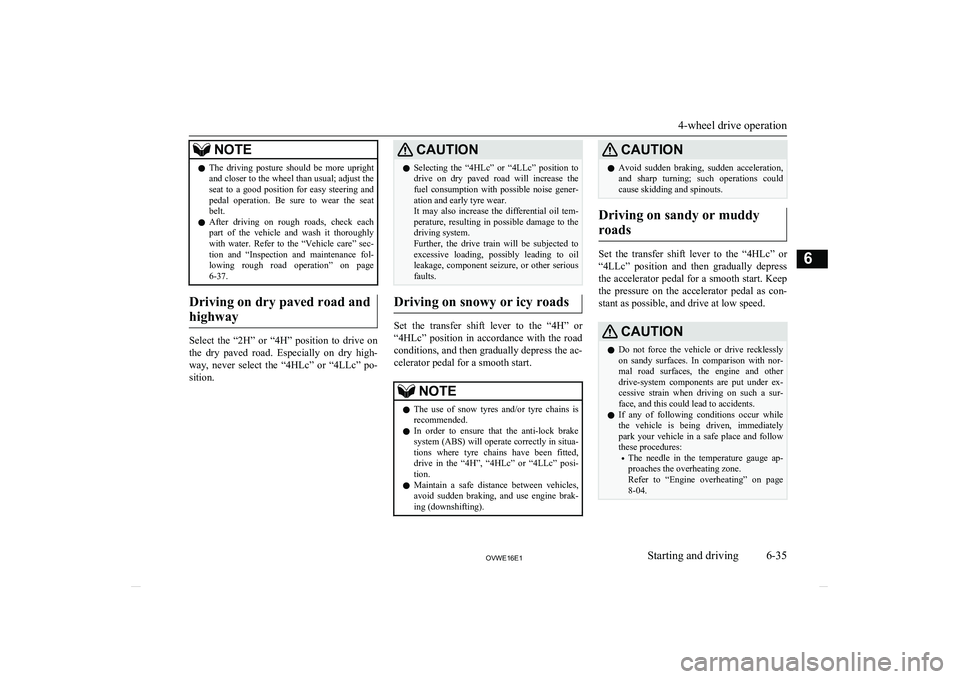
NOTElThe driving posture should be more upright
and closer to the wheel than usual; adjust the
seat to a good position for easy steering and pedal operation. Be sure to wear the seatbelt.
l After driving on rough roads, check each
part of the vehicle and wash it thoroughlywith water. Refer to the “Vehicle care” sec-
tion and “Inspection and maintenance fol-
lowing rough road operation” on page 6-37.
Driving on dry paved road and
highway
Select the “2H” or “4H” position to drive on
the dry paved road. Especially on dry high- way, never select the “4HLc” or “4LLc” po-sition.
CAUTIONl Selecting the “4HLc” or “4LLc” position to
drive on dry paved road will increase the
fuel consumption with possible noise gener- ation and early tyre wear.
It may also increase the differential oil tem-
perature, resulting in possible damage to the driving system.
Further, the drive train will be subjected to
excessive loading, possibly leading to oil leakage, component seizure, or other serious faults.
Driving on snowy or icy roads
Set the transfer shift lever to the “4H” or
“4HLc” position in accordance with the road conditions, and then gradually depress the ac-
celerator pedal for a smooth start.
NOTEl The use of snow tyres and/or tyre chains is
recommended.
l In order to ensure that the anti-lock brake
system (ABS) will operate correctly in situa-tions where tyre chains have been fitted, drive in the “4H”, “4HLc” or “4LLc” posi-tion.
l Maintain a safe distance between vehicles,
avoid sudden braking, and use engine brak- ing (downshifting).CAUTIONl Avoid sudden braking, sudden acceleration,
and sharp turning; such operations could
cause skidding and spinouts.
Driving on sandy or muddy
roads
Set the transfer shift lever to the “4HLc” or “4LLc” position and then gradually depress
the accelerator pedal for a smooth start. Keep
the pressure on the accelerator pedal as con- stant as possible, and drive at low speed.
CAUTIONl Do not force the vehicle or drive recklessly
on sandy surfaces. In comparison with nor-
mal road surfaces, the engine and other
drive-system components are put under ex- cessive strain when driving on such a sur-
face, and this could lead to accidents.
l If any of following conditions occur while
the vehicle is being driven, immediately park your vehicle in a safe place and follow these procedures:
• The needle in the temperature gauge ap-
proaches the overheating zone.
Refer to “Engine overheating” on page
8-04.
4-wheel drive operation
6-35OVWE16E1Starting and driving6
Page 193 of 404
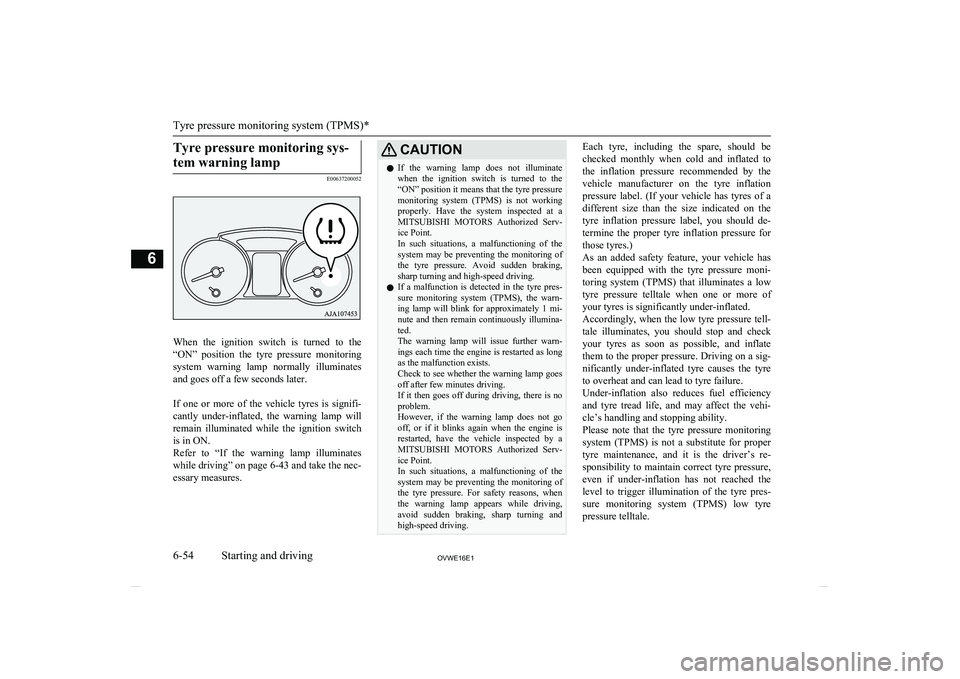
Tyre pressure monitoring sys-tem warning lamp
E00637200052
When the ignition switch is turned to the
“ON” position the tyre pressure monitoring system warning lamp normally illuminates
and goes off a few seconds later.
If one or more of the vehicle tyres is signifi- cantly under-inflated, the warning lamp will
remain illuminated while the ignition switch is in ON.
Refer to “If the warning lamp illuminates while driving” on page 6-43 and take the nec-essary measures.
CAUTIONl If the warning lamp does not illuminate
when the ignition switch is turned to the
“ON” position it means that the tyre pressure monitoring system (TPMS) is not working
properly. Have the system inspected at a MITSUBISHI MOTORS Authorized Serv-
ice Point.
In such situations, a malfunctioning of the system may be preventing the monitoring of the tyre pressure. Avoid sudden braking,
sharp turning and high-speed driving.
l If a malfunction is detected in the tyre pres-
sure monitoring system (TPMS), the warn-
ing lamp will blink for approximately 1 mi-
nute and then remain continuously illumina- ted.
The warning lamp will issue further warn-
ings each time the engine is restarted as long
as the malfunction exists.
Check to see whether the warning lamp goes
off after few minutes driving.
If it then goes off during driving, there is no problem.
However, if the warning lamp does not go off, or if it blinks again when the engine is
restarted, have the vehicle inspected by a
MITSUBISHI MOTORS Authorized Serv-
ice Point.
In such situations, a malfunctioning of the system may be preventing the monitoring of
the tyre pressure. For safety reasons, when the warning lamp appears while driving,
avoid sudden braking, sharp turning and high-speed driving.Each tyre, including the spare, should be
checked monthly when cold and inflated to the inflation pressure recommended by thevehicle manufacturer on the tyre inflation
pressure label. (If your vehicle has tyres of a different size than the size indicated on the
tyre inflation pressure label, you should de-
termine the proper tyre inflation pressure for those tyres.)
As an added safety feature, your vehicle has been equipped with the tyre pressure moni-
toring system (TPMS) that illuminates a low
tyre pressure telltale when one or more of
your tyres is significantly under-inflated.
Accordingly, when the low tyre pressure tell-
tale illuminates, you should stop and check your tyres as soon as possible, and inflate
them to the proper pressure. Driving on a sig- nificantly under-inflated tyre causes the tyre to overheat and can lead to tyre failure.
Under-inflation also reduces fuel efficiency
and tyre tread life, and may affect the vehi- cle’s handling and stopping ability.
Please note that the tyre pressure monitoring
system (TPMS) is not a substitute for proper tyre maintenance, and it is the driver’s re-sponsibility to maintain correct tyre pressure,
even if under-inflation has not reached the level to trigger illumination of the tyre pres-
sure monitoring system (TPMS) low tyre pressure telltale.
Tyre pressure monitoring system (TPMS)*
6-54OVWE16E1Starting and driving6
Page 204 of 404
NOTElTo prevent wind noise or reduction in fuel
economy, remove the roof carrier when not
in use.
l Before using an automatic car wash, remove
the roof carrier.
l Be sure that adequate clearance is main-
tained for raising the sunroof (if so equip-
ped) when installing a roof carrier.Trailer towing
E00610000550
In order to tow a trailer with your vehicle,
when having a trailer towing device mounted that meets all relevant regulations in your
area, consult a MITSUBISHI MOTORS Au-
thorized Service Point.
The regulations concerning the towing of a
trailer may differ from country to country. You are advised to obey the regulations in
each area.
CAUTIONl Danger of Accident!
A towing bar should be fitted according to MITSUBISHI MOTORS guidelines.
When you are going to tow a trailer, move
the transfer shift lever to “4H” position.
Selecting the “2H” drive may increase the differential oil temperature, resulting in pos-sible damage to the driving system.
Further, the drive train will be subjected to
excessive loading possibly leading to oil leakage, component seizure, or other serious faults.
Maximum towable weight with
brake and maximum trailer- nose weight
Never exceed the maximum towable weight
with brake and the maximum trailer-nose weight as listed in the specifications. (Referto “Vehicle weight” on page 11-07 .)
If you tow a trailer at an altitude of more than
1,000 m above sea-level, reduce your weight
by 10 % of the gross combination weight for
every increase of 1,000 m above sea-level, as the engine output is lowered owing to de-
crease in atmospheric pressure.
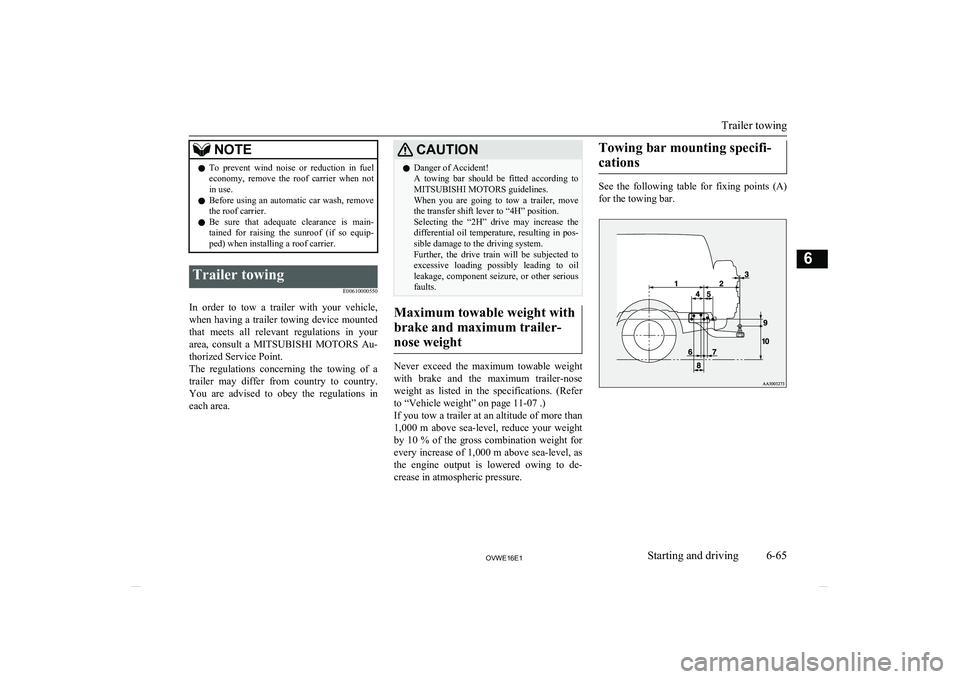
Towing bar mounting specifi-
cations
See the following table for fixing points (A) for the towing bar.
Trailer towing
6-65OVWE16E1Starting and driving6