warning MITSUBISHI SHOGUN 2016 (in English) Owner's Guide
[x] Cancel search | Manufacturer: MITSUBISHI, Model Year: 2016, Model line: SHOGUN, Model: MITSUBISHI SHOGUN 2016Pages: 404, PDF Size: 18.95 MB
Page 77 of 404

2.Fasten the seat belt to secure the child
restraint system. Make sure you hear a “click” when you insert the latch plate in
the buckle.
3. Remove all slack by using the locking
clip.
4. Push and pull the child restraint in all di-
rections to be sure it is secure.WARNINGl For some types of child restraint, the lock-
ing clip (A) should be used to help avoid personal injury during a collision or sud-den manoeuvre.
It must be fitted and used in accordance
with the child restraint manufacturer’s instructions.
The locking clip must be removed when the child restraint is removed.Seat belt inspection
E00406300475
l Check the belts for cuts, worn or frayed
webbing and for cracked or deformed metallic parts. Replace the belt assembly
if it is defective.
l A dirty belt should be cleaned with neu-
tral detergent in warm water. After rins-
ing in water, let it dry in the shade. Do
not attempt to bleach or re-dye the belts
because this will affect their characteris-
tics.WARNINGl We recommend you to have all seat belt
assemblies including retractors and at- taching hardware inspected after any col- lision. We recommend that seat belt as-
semblies in use during a collision be re- placed unless the collision was minor and
the belts show no damage and continue to operate properly.
l Do not attempt to repair or replace any
part of the seat belt assemblies; we recom- mend you to have this work done by aMITSUBISHI MOTORS Authorized
Service Point. Incorrect repair or replace- ment could reduce the effectiveness of the
belts and could result in serious injury in
the event of a collision.WARNINGl Once the pretensioner has been activated,
it cannot be re-used.
It must be replaced together with the re- tractor.Supplemental restraint
system (SRS) - airbag E00407203397
The information written in this Supplemental
Restraint System (SRS) section contains im- portant points concerning the driver, front
passenger, side and curtain airbags.
The SRS driver’s and front passenger’s air- bags are designed to supplement the primary
protection of the driver and front passenger
side seat belt systems by providing those oc- cupants with protection against head and
chest injuries in certain moderate-to-severe
frontal collisions.
The SRS driver’s and front passenger’s air- bags employ a dual stage airbag system. The
SRS driver’s and front passenger’s airbag is controlled by the impact sensors (at the frontof the vehicle) and the control unit (near the
centre of the vehicle at floor level).
Seat belt inspection
4-36OVWE16E1Seat and seat belts4
Page 79 of 404

WARNINGlIT IS VERY IMPORTANT TO BE
PROPERLY SEATED.
A driver or front passenger too close to the steering wheel or instrument panel
during airbag deployment can be killed or seriously injured.
Airbags inflate very fast, and with great force.
If the driver and passengers are not prop-
erly seated and restrained, the airbags may not protect you properly, and could
cause serious or fatal injuries when it in- flates.
l Do not sit on the edge of the seat, or lean
head or chest close to the steering wheel
or instrument panel. Do not put feet or
legs on or against the instrument panel.
l Place all infants and small children in the
rear seat and properly restrained using an
appropriate child restraint system.
The rear seat is the safest place for infants
and children.WARNINGl Infants and small children should never
be unrestrained, stand up against the in-strument panel or be held in your arms or on your lap. They could be seriously in-jured or killed in a collision, including when the airbag inflates. They should be
properly seated in the rear seat in an ap- propriate child restraint system. See the
“Child restraint” section of this owner’s
manual.Use rearward facing child restraints in the
rear seat or turn off the front passenger’s air- bag ON-OFF switch. (Refer to “To turn an airbag off” on page 4-40.)Front passenger’s airbag ON
WARNINGl A REARWARD FACING CHILD RE-
STRAINT must NOT be used in the front passenger seat if the front passenger’s air-
bag has not been deactivated. The force of an inflating airbag could kill or cause se-
rious injuries to the child.
A rearward facing child restraint must only be used in the rear seat.
l A FORWARD FACING CHILD RE-
STRAINT should be used in the rear seat
whenever possible; if it must be used in
the front passenger seat, adjust the seat to the most rearward position. Failure to do
so could kill or cause serious injuries to the child.
Supplemental restraint system (SRS) - airbag
4-38OVWE16E1Seat and seat belts4
Page 80 of 404

WARNINGlOlder children should be seated in the
rear seat, properly wearing the seat belt,with an appropriate booster seat if nee- ded.Caution for installing the child
restraint on vehicle with a front passenger’s airbag
E00408801947
The label shown here is attached on vehicles
with front passenger’s airbag.
WARNINGl Extreme Hazard!
NEVER use a rearward facing child re- straint on a seat protected by an ACTIVEAIRBAG in front of it, DEATH or SERI- OUS INJURY to the CHILD can occur.NOTEl The labels may be in different positions de-
pending on the vehicle model.Front passenger’s airbag ON-
OFF switch
E00410100344
The front passenger’s airbag ON-OFF switch
can be used to disable the front passenger’s airbag. If you have a rearward facing child
restraint system that cannot be fitted to any seat other than the front passenger seat, be
sure to turn OFF the front passenger’s airbag ON-OFF switch before using it. (Refer to
“To turn an airbag off” on page 4-40.)
The front passenger’s airbag ON-OFF switch is located in the glove box.Supplemental restraint system (SRS) - airbag
4-39OVWE16E1Seat and seat belts4 LHD
RHD
Page 81 of 404

Front passenger’s airbag OFFindication lamp
E00411500068
The front passenger’s airbag OFF indication
lamp is located in the instrument panel.
The indication lamp normally comes on when the ignition switch is turned to the
“ON” position, and goes off a few seconds later.
When the front passenger’s airbag ON-OFF switch is turned OFF, the indication lamp
will stay on to show that the front passen-
ger’s airbag is not operational. When the
front passenger’s airbag ON-OFF switch is turned ON, the indication lamp goes off to
show that the front passenger’s airbag is op-
erational.
WARNINGl Do not fit any accessory that makes the
indication lamp impossible to see, and do
not cover the indication lamp with a stick- er. You would not be able to verify thestatus of the passenger airbag system.To turn an airbag off
E00410600453WARNINGl To reduce risk of serious or fatal injury:
• Always remove the key from the igni-
tion switch before operating a front
passenger’s airbag ON-OFF switch. Failure to do so could adversely affect
the airbag performance.
• Wait at least 60 seconds to operate the
front passenger’s airbag ON-OFF switch after turning the ignition switch
from “ON” position to “LOCK” posi- tion.
The SRS airbag system is designed to retain enough voltage to deploy the air-
bag.
• Always remove the key from the front
passenger’s airbag ON-OFF switch af-ter operating that switch. Failure to do
so could lead to improper position of the front passenger’s airbag ON-OFF switch.WARNING• Do not turn OFF the front passenger’s
airbag ON-OFF switch except when a rearward facing child restraint system
is fitted to the front passenger seat.
• If the indication lamp does not come on
when the front passenger’s airbag ON-
OFF switch is turned OFF, do not fit a rearward facing child restraint system
to the front passenger seat. We recom- mend you to have the system inspected
by a MITSUBISHI MOTORS Author-
ized Service Point.
• If the indication lamp remains on when
the front passenger’s airbag ON-OFF switch is turned ON, do not allow any-
one to sit on the front passenger seat. We recommend you to have the systeminspected by a MITSUBISHI
MOTORS Authorized Service Point.
To turn an airbag off, follow these steps:
1. Insert the key into the front passenger’s
airbag ON-OFF switch, and turn it to the “OFF” position.
2. Remove the key from the key opening of
the front passenger’s airbag ON-OFF switch.
Supplemental restraint system (SRS) - airbag
4-40OVWE16E1Seat and seat belts4
Page 84 of 404

The front airbags MAY DE-PLOY when…
The front airbags may deploy if the bottom ofthe vehicle suffers a moderate-to-severe im-
pact (undercarriage damage).
Examples of some typical conditions are shown in the illustration.
1- Collision with an elevated median/island
or kerb
2- Vehicle travels over a deep hole/pothole
3- Vehicle drives down a steep slope and
hits the ground
Because the front airbags may deploy in cer- tain types of unexpected impacts as shown in
the illustration that can easily move you out
of position, it is important to always properly wear your seat belts. Your seat belts will help
keep you a safe distance from the steering
wheel and instrument panel during the initial
stages of airbag deployment. The initial stage of airbag inflation is the most forceful andcan possibly cause serious or fatal injuries if
you contact it at this stage.WARNINGl Do not attach anything to the steering
wheel padded cover, such as trim materi- al, badges, etc. It might strike and injure
an occupant if the airbag inflates.
l Do not set anything on, or attach anything
to, the instrument panel above the glove box. It might strike and injure an occu- pant if the airbag inflates.WARNINGl Do not attach accessories to, or put them
in front of, the windscreen. These objects
could restrict the airbag inflation, or strike and injure an occupant if the air-
bags inflate.
l Do not put packages, pets or other objects
between the airbags and the driver orfront passenger. It could affect airbagperformance, or could cause injury when the airbag inflates.
l Right after the airbag inflation, several
airbag system components will be hot. Do
not touch them; you could be burned.
l The airbag system is designed to work on-
ly once. Once the airbags have deployed, they will not work again. They must
promptly be replaced, and we recommend
you to have the entire airbag system in- spected by a MITSUBISHI MOTORS
Authorized Service Point.Side airbag system*
E00407600198
The side airbags (A) are contained in the
driver and front passenger seatbacks.
Supplemental restraint system (SRS) - airbag
4-43OVWE16E1Seat and seat belts4
Page 87 of 404
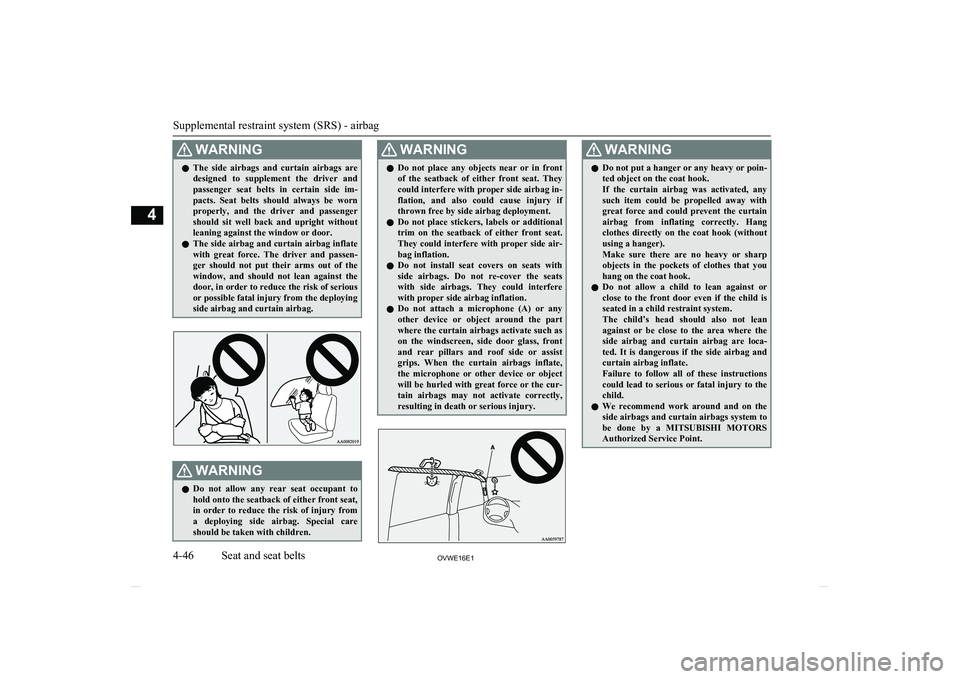
WARNINGlThe side airbags and curtain airbags are
designed to supplement the driver and passenger seat belts in certain side im-
pacts. Seat belts should always be worn properly, and the driver and passenger
should sit well back and upright without
leaning against the window or door.
l The side airbag and curtain airbag inflate
with great force. The driver and passen- ger should not put their arms out of the window, and should not lean against the
door, in order to reduce the risk of serious
or possible fatal injury from the deploying
side airbag and curtain airbag.WARNINGl Do not allow any rear seat occupant to
hold onto the seatback of either front seat,
in order to reduce the risk of injury from
a deploying side airbag. Special care
should be taken with children.WARNINGl Do not place any objects near or in front
of the seatback of either front seat. They could interfere with proper side airbag in-
flation, and also could cause injury if thrown free by side airbag deployment.
l Do not place stickers, labels or additional
trim on the seatback of either front seat.
They could interfere with proper side air- bag inflation.
l Do not install seat covers on seats with
side airbags. Do not re-cover the seats with side airbags. They could interfere
with proper side airbag inflation.
l Do not attach a microphone (A) or any
other device or object around the part where the curtain airbags activate such as
on the windscreen, side door glass, front and rear pillars and roof side or assistgrips. When the curtain airbags inflate,
the microphone or other device or object will be hurled with great force or the cur- tain airbags may not activate correctly,resulting in death or serious injury.WARNINGl Do not put a hanger or any heavy or poin-
ted object on the coat hook.
If the curtain airbag was activated, any
such item could be propelled away with
great force and could prevent the curtain
airbag from inflating correctly. Hang clothes directly on the coat hook (withoutusing a hanger).
Make sure there are no heavy or sharp objects in the pockets of clothes that you
hang on the coat hook.
l Do not allow a child to lean against or
close to the front door even if the child is seated in a child restraint system.
The child’s head should also not lean
against or be close to the area where the side airbag and curtain airbag are loca-
ted. It is dangerous if the side airbag and
curtain airbag inflate.
Failure to follow all of these instructions
could lead to serious or fatal injury to the child.
l We recommend work around and on the
side airbags and curtain airbags system to
be done by a MITSUBISHI MOTORS
Authorized Service Point.
Supplemental restraint system (SRS) - airbag
4-46OVWE16E1Seat and seat belts4
Page 88 of 404
SRS warning lamp
E00407801706
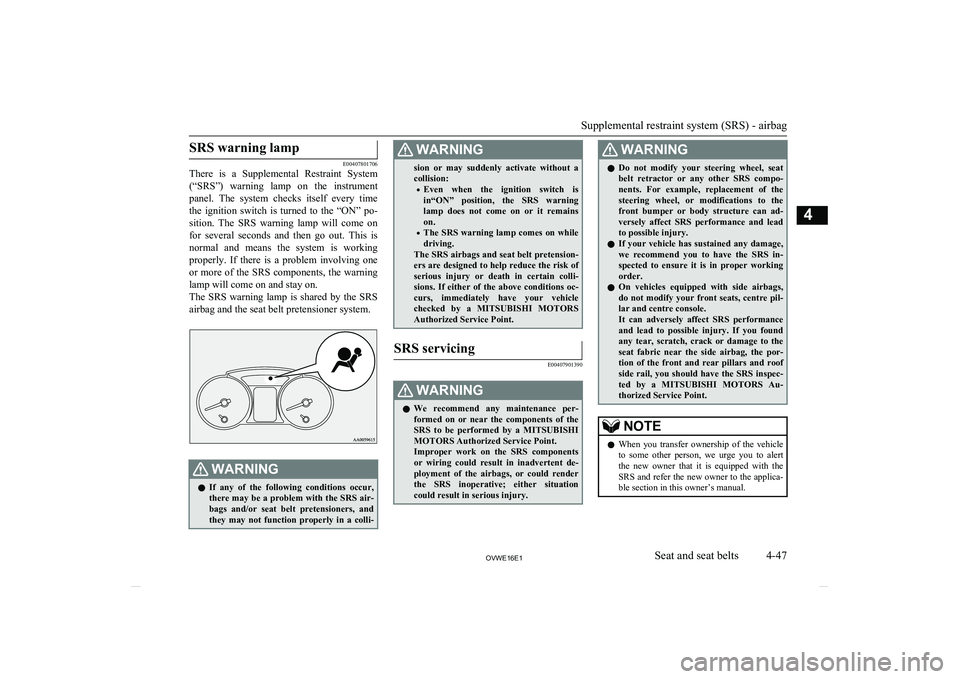
There is a Supplemental Restraint System
(“SRS”) warning lamp on the instrument panel. The system checks itself every time the ignition switch is turned to the “ON” po-
sition. The SRS warning lamp will come on
for several seconds and then go out. This is
normal and means the system is working properly. If there is a problem involving one or more of the SRS components, the warning
lamp will come on and stay on.
The SRS warning lamp is shared by the SRS
airbag and the seat belt pretensioner system.
WARNINGl If any of the following conditions occur,
there may be a problem with the SRS air- bags and/or seat belt pretensioners, and they may not function properly in a colli-WARNINGsion or may suddenly activate without a
collision:
• Even when the ignition switch is
in“ON” position, the SRS warning lamp does not come on or it remains
on.
• The SRS warning lamp comes on while
driving.
The SRS airbags and seat belt pretension- ers are designed to help reduce the risk of
serious injury or death in certain colli- sions. If either of the above conditions oc-
curs, immediately have your vehicle checked by a MITSUBISHI MOTORS
Authorized Service Point.SRS servicing
E00407901390
WARNINGl We recommend any maintenance per-
formed on or near the components of the
SRS to be performed by a MITSUBISHI
MOTORS Authorized Service Point.
Improper work on the SRS components
or wiring could result in inadvertent de- ployment of the airbags, or could render
the SRS inoperative; either situation could result in serious injury.WARNINGl Do not modify your steering wheel, seat
belt retractor or any other SRS compo- nents. For example, replacement of the
steering wheel, or modifications to the
front bumper or body structure can ad- versely affect SRS performance and lead
to possible injury.
l If your vehicle has sustained any damage,
we recommend you to have the SRS in- spected to ensure it is in proper workingorder.
l On vehicles equipped with side airbags,
do not modify your front seats, centre pil- lar and centre console.
It can adversely affect SRS performance and lead to possible injury. If you found
any tear, scratch, crack or damage to the
seat fabric near the side airbag, the por-
tion of the front and rear pillars and roof side rail, you should have the SRS inspec- ted by a MITSUBISHI MOTORS Au-
thorized Service Point.NOTEl When you transfer ownership of the vehicle
to some other person, we urge you to alert
the new owner that it is equipped with the SRS and refer the new owner to the applica- ble section in this owner’s manual.
Supplemental restraint system (SRS) - airbag
4-47OVWE16E1Seat and seat belts4
Page 90 of 404

Instruments.......................................................................................... 5-02
Indication and warning lamps............................................................. 5-08
Indication lamps.................................................................................. 5-09
Warning lamps.................................................................................... 5-10
Centre information display..................................................................5-12
Combination headlamps and dipper switch........................................ 5-34
Headlamp levelling............................................................................. 5-40
Turn-signal lever................................................................................. 5-42
Hazard warning flasher switch............................................................5-42 Fog lamp switch.................................................................................. 5-43
Wiper and washer switch.................................................................... 5-44
Wiper de-icer switch*......................................................................... 5-49
Rear window demister switch............................................................. 5-50
Horn switch......................................................................................... 5-50Instruments and controls
OVWE16E15
Page 95 of 404
NOTElWhen the vehicle has been refuelled, the
pointer in the fuel gauge takes a short while
to stabilize.
l The fuel gauge will not give an accurate in-
dication if the vehicle is refuelled with the ignition switch in the “ON” position.
l When the engine on diesel-powered vehicles
fails to operate due to running out of fuel, it may sometimes be difficult to start after re-
fueling. This is due to air entering the fuel
system. Therefore, air must be bled from the system. (Refer to “Bleeding the fuel system” on page 8-06.)
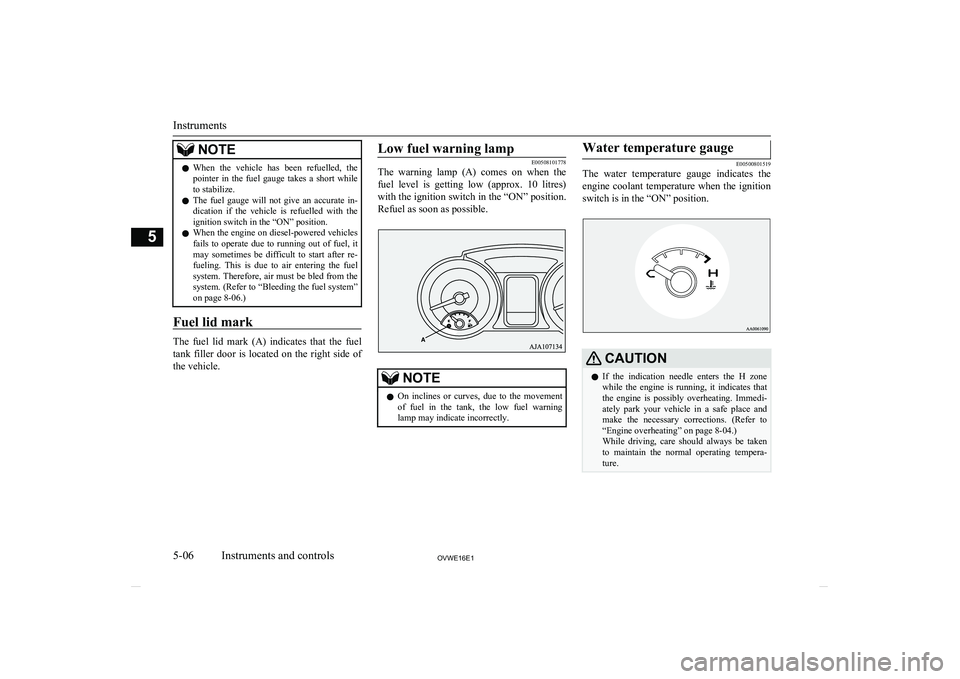
Fuel lid mark
The fuel lid mark (A) indicates that the fuel
tank filler door is located on the right side of the vehicle.
Low fuel warning lamp
E00508101778
The warning lamp (A) comes on when the
fuel level is getting low (approx. 10 litres )
with the ignition switch in the “ON” position.
Refuel as soon as possible.NOTEl On inclines or curves, due to the movement
of fuel in the tank, the low fuel warning lamp may indicate incorrectly.Water temperature gauge
E00500801519
The water temperature gauge indicates the
engine coolant temperature when the ignition
switch is in the “ON” position.
CAUTIONl If the indication needle enters the H zone
while the engine is running, it indicates that
the engine is possibly overheating. Immedi-
ately park your vehicle in a safe place and make the necessary corrections. (Refer to“Engine overheating” on page 8-04.)
While driving, care should always be taken
to maintain the normal operating tempera- ture.
Instruments
5-06OVWE16E1Instruments and controls5
Page 97 of 404
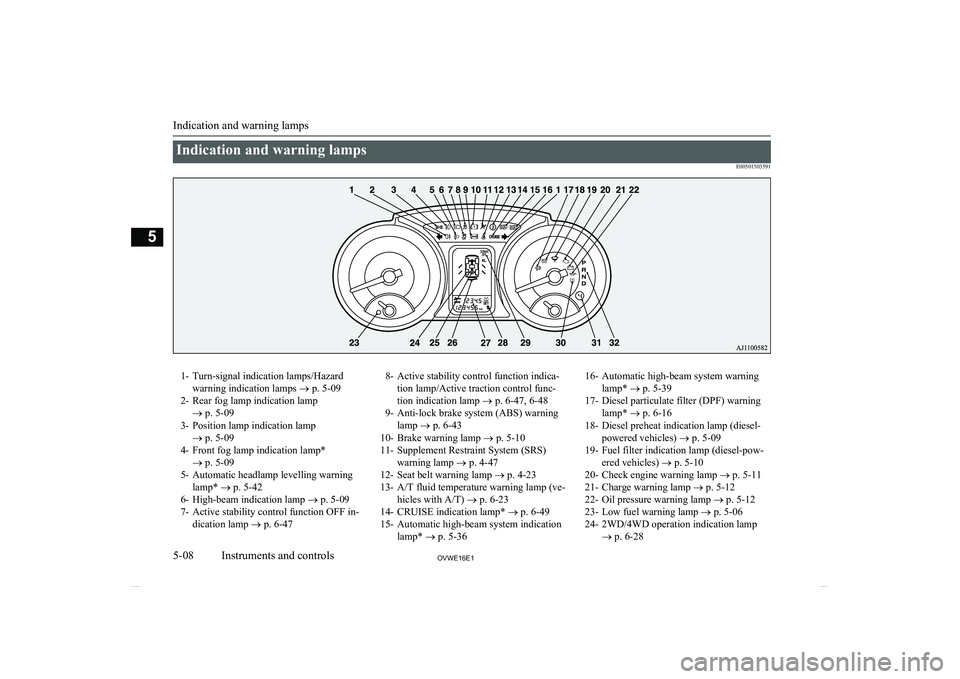
Indication and warning lampsE005015035911- Turn-signal indication lamps/Hazardwarning indication lamps ® p. 5-09
2- Rear fog lamp indication lamp ® p. 5-09
3- Position lamp indication lamp ® p. 5-09
4- Front fog lamp indication lamp* ® p. 5-09
5- Automatic headlamp levelling warning lamp* ® p. 5-42
6- High-beam indication lamp ® p. 5-09
7- Active stability control function OFF in- dication lamp ® p. 6-478- Active stability control function indica-
tion lamp/Active traction control func-
tion indication lamp ® p. 6-47, 6-48
9- Anti-lock brake system (ABS) warning lamp ® p. 6-43
10- Brake warning lamp ® p. 5-10
11- Supplement Restraint System (SRS) warning lamp ® p. 4-47
12- Seat belt warning lamp ® p. 4-23
13- A/T fluid temperature warning lamp (ve- hicles with A/T) ® p. 6-23
14- CRUISE indication lamp* ® p. 6-49
15- Automatic high-beam system indication lamp* ® p. 5-3616- Automatic high-beam system warning
lamp* ® p. 5-39
17- Diesel particulate filter (DPF) warning lamp* ® p. 6-16
18- Diesel preheat indication lamp (diesel- powered vehicles) ® p. 5-09
19- Fuel filter indication lamp (diesel-pow- ered vehicles) ® p. 5-10
20- Check engine warning lamp ® p. 5-11
21- Charge warning lamp ® p. 5-12
22- Oil pressure warning lamp ® p. 5-12
23- Low fuel warning lamp ® p. 5-06
24- 2WD/4WD operation indication lamp ® p. 6-28
Indication and warning lamps
5-08OVWE16E1Instruments and controls5