maintenance MITSUBISHI SHOGUN 2016 Owner's Manual (in English)
[x] Cancel search | Manufacturer: MITSUBISHI, Model Year: 2016, Model line: SHOGUN, Model: MITSUBISHI SHOGUN 2016Pages: 404, PDF Size: 18.95 MB
Page 2 of 404
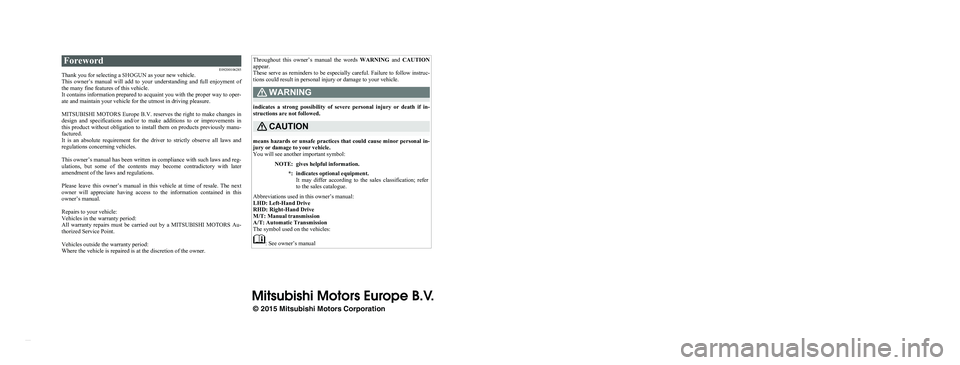
Foreword
E09200106285Thank you for selecting a
SHOGUN as your new vehicle.
This owner’s manual will add to your understanding and full enjoyment of
the many fine features of this vehicle.
It contains information prepared to acquaint you with the proper way to oper-
ate and maintain your vehicle for the utmost in driving pleasure.
MITSUBISHI MOTORS Europe B.V. reserves the right to make changes in
design and specifications and/or to make additions to or improvements in
this product without obligation to install them on products previously manu-
factured.
It is an absolute requirement for the driver to strictly observe all laws and
regulations concerning vehicles.
This owner’s manual has been written in compliance with such laws and reg-
ulations, but some of the contents may become contradictory with later amendment of the laws and regulations.
Please leave this owner’s manual in this vehicle at time of resale. The next
owner will appreciate having access to the information contained in this
owner’s manual.
Repairs to your vehicle:
Vehicles in the warranty period:
All warranty repairs must be carried out by a MITSUBISHI MOTORS Au-
thorized Service Point.
Vehicles outside the warranty period:
Where the vehicle is repaired is at the discretion of the owner. Throughout this owner’s manual the words
WARNING and CAUTION
appear.
These
serve as reminders to be especially careful. Failure to follow instruc-
tions could result in personal injury or damage to your vehicle. WARNING
indicates a strong possibility of severe personal injury or death if in- structions are not followed. CAUTION
means hazards or unsafe practices that could cause minor personal in-
jury or damage to your vehicle.
You will see another important symbol: NOTE: gives helpful information.
*: indicates optional equipment.It may
differ according to the sales classification; refer
to the sales catalogue.
Abbreviations used in this owner’s manual:
LHD: Left-Hand Drive
RHD: Right-Hand Drive
M/T : Manual transmission
A/T: Automatic Transmission
The symbol used on the vehicles: : See owner’s manual Information for station service
E09300103937 Fuel Fuel tank capacity
3-door models
69 litres
5-door models 88 litres Fuel requirements
Petrol-powered vehicles
Unleaded petrol octane number (EN228)90 RON or higher (3000 models)
95 RON or higher (3800 models)
If the “PREMIUM FUEL ONLY” label is attached to the fuel tank filler door,
fill it up with premium fuel.
Diesel-powered vehicles
Vehicles to comply with the Euro 4 and Euro 5 regulation Cetane number (EN590)51 or higher
Refer to the “General information” section for the fuel selection. Engine oil
Refer to the “Maintenance” section for the selection of engine oil. Tyre inflation pressure
Refer to the “Maintenance” section for the tyre inflation pressure. © 2015 Mitsubishi Motors Corporation
16 OVWE16E1
BLO-15-000559
Page 3 of 404
Foreword
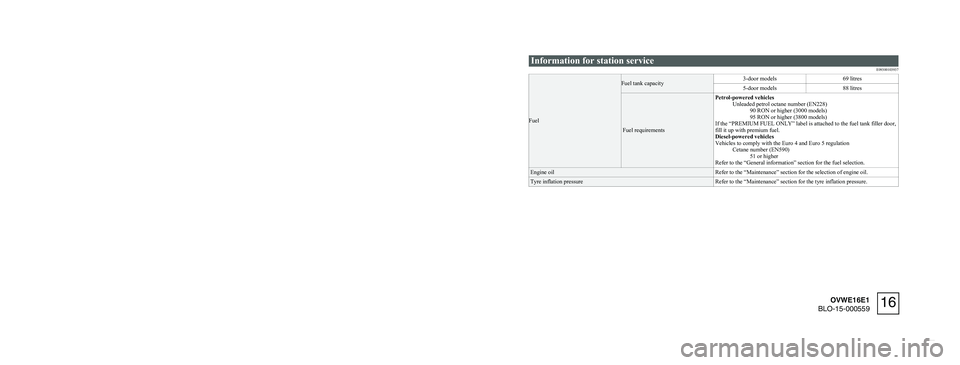
E09200106285
Thank you for selecting a PAJERO as your new vehicle.
This
owner’s manual will add to your understanding and full enjoyment of
the many fine features of this vehicle.
It contains information prepared to acquaint you with the proper way to oper-
ate and maintain your vehicle for the utmost in driving pleasure.
MITSUBISHI MOTORS Europe B.V. reserves the right to make changes in
design and specifications and/or to make additions to or improvements in
this product without obligation to install them on products previously manu- factured.
It is an absolute requirement for the driver to strictly observe all laws and
regulations concerning vehicles.
This owner’s manual has been written in compliance with such laws and reg-
ulations, but some of the contents may become contradictory with later amendment of the laws and regulations.
Please leave this owner’s manual in this vehicle at time of resale. The next
owner will appreciate having access to the information contained in this
owner’s manual.
Repairs to your vehicle:
Vehicles in the warranty period:
All warranty repairs must be carried out by a MITSUBISHI MOTORS Au- thorized Service Point.
Vehicles outside the warranty period:
Where the vehicle is repaired is at the discretion of the owner. Throughout this owner’s manual the words
WARNING and CAUTION
appear.
These serve as reminders to be especially careful. Failure to follow instruc-
tions could result in personal injury or damage to your vehicle. WARNING
indicates a strong possibility of severe personal injury or death if in- structions are not followed. CAUTION
means hazards or unsafe practices that could cause minor personal in-
jury or damage to your vehicle.
You will see another important symbol: NOTE: gives helpful information.
*: indicates optional equipment.It
may differ according to the sales classification; refer
to the sales catalogue.
Abbreviations used in this owner’s manual:
LHD: Left-Hand Drive
RHD: Right-Hand Drive
M/T
: Manual transmission
A/T: Automatic Transmission
The symbol used on the vehicles: : See owner’s manual Information for station service
E09300103937 Fuel Fuel tank capacity
3-door models
69 litres
5-door models 88 litres Fuel requirements
Petrol-powered vehicles
Unleaded petrol octane number (EN228)90 RON or higher (3000 models)
95 RON or higher (3800 models)
If the “PREMIUM FUEL ONLY” label is attached to the fuel tank filler door,
fill it up with premium fuel.
Diesel-powered vehicles
Vehicles to comply with the Euro 4 and Euro 5 regulation Cetane number (EN590)51 or higher
Refer to the “General information” section for the fuel selection. Engine oil
Refer to the “Maintenance” section for the selection of engine oil. Tyre inflation pressure
Refer to the “Maintenance” section for the tyre inflation pressure. © 2015 Mitsubishi Motors Corporation
16 OVWE16E1
BLO-15-000559
Page 4 of 404
Table of contents
Overview
1
General information
2
Locking and unlocking
3
Seat and seat belts
4
Instruments and controls
5
Starting and driving
6
For pleasant driving
7
For emergencies
8
Vehicle care
9
Maintenance
10
Specifications
11
Alphabetical index
12
Declaration of Conformity
13
OVWE16E1
Page 88 of 404
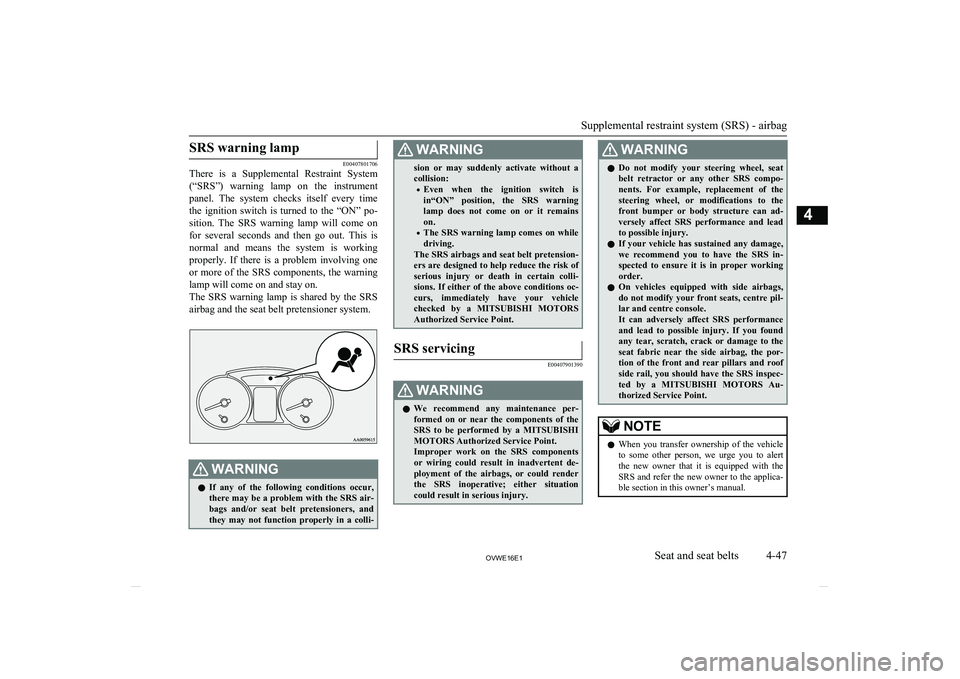
SRS warning lamp
E00407801706
There is a Supplemental Restraint System
(“SRS”) warning lamp on the instrument panel. The system checks itself every time the ignition switch is turned to the “ON” po-
sition. The SRS warning lamp will come on
for several seconds and then go out. This is
normal and means the system is working properly. If there is a problem involving one or more of the SRS components, the warning
lamp will come on and stay on.
The SRS warning lamp is shared by the SRS
airbag and the seat belt pretensioner system.
WARNINGl If any of the following conditions occur,
there may be a problem with the SRS air- bags and/or seat belt pretensioners, and they may not function properly in a colli-WARNINGsion or may suddenly activate without a
collision:
• Even when the ignition switch is
in“ON” position, the SRS warning lamp does not come on or it remains
on.
• The SRS warning lamp comes on while
driving.
The SRS airbags and seat belt pretension- ers are designed to help reduce the risk of
serious injury or death in certain colli- sions. If either of the above conditions oc-
curs, immediately have your vehicle checked by a MITSUBISHI MOTORS
Authorized Service Point.SRS servicing
E00407901390
WARNINGl We recommend any maintenance per-
formed on or near the components of the
SRS to be performed by a MITSUBISHI
MOTORS Authorized Service Point.
Improper work on the SRS components
or wiring could result in inadvertent de- ployment of the airbags, or could render
the SRS inoperative; either situation could result in serious injury.WARNINGl Do not modify your steering wheel, seat
belt retractor or any other SRS compo- nents. For example, replacement of the
steering wheel, or modifications to the
front bumper or body structure can ad- versely affect SRS performance and lead
to possible injury.
l If your vehicle has sustained any damage,
we recommend you to have the SRS in- spected to ensure it is in proper workingorder.
l On vehicles equipped with side airbags,
do not modify your front seats, centre pil- lar and centre console.
It can adversely affect SRS performance and lead to possible injury. If you found
any tear, scratch, crack or damage to the
seat fabric near the side airbag, the por-
tion of the front and rear pillars and roof side rail, you should have the SRS inspec- ted by a MITSUBISHI MOTORS Au-
thorized Service Point.NOTEl When you transfer ownership of the vehicle
to some other person, we urge you to alert
the new owner that it is equipped with the SRS and refer the new owner to the applica- ble section in this owner’s manual.
Supplemental restraint system (SRS) - airbag
4-47OVWE16E1Seat and seat belts4
Page 140 of 404
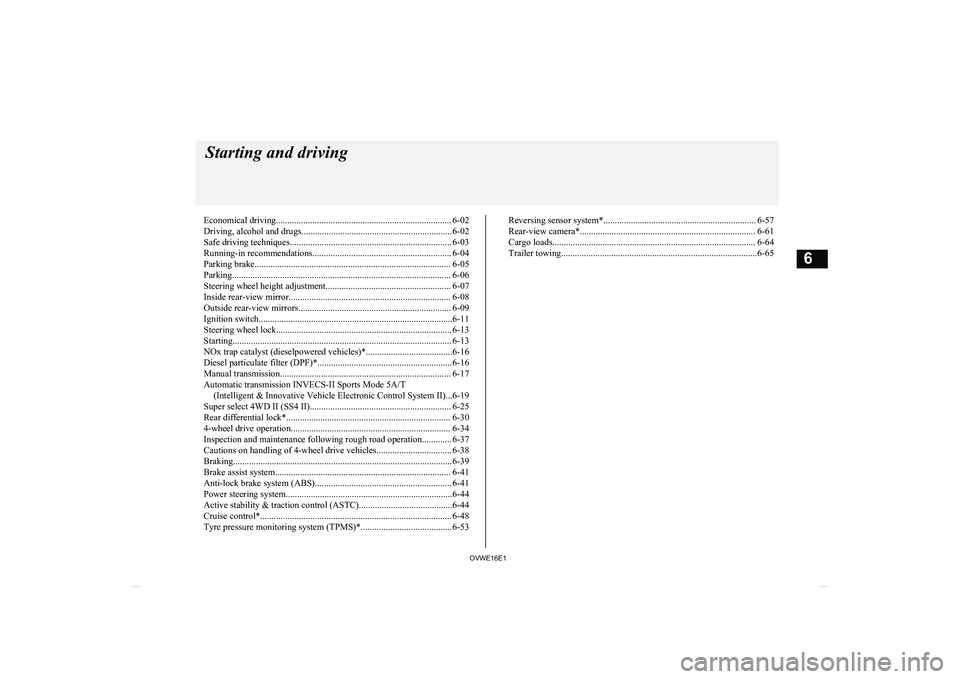
Economical driving............................................................................. 6-02
Driving, alcohol and drugs.................................................................. 6-02
Safe driving techniques....................................................................... 6-03
Running-in recommendations............................................................. 6-04 Parking brake...................................................................................... 6-05
Parking................................................................................................ 6-06
Steering wheel height adjustment....................................................... 6-07
Inside rear-view mirror....................................................................... 6-08 Outside rear-view mirrors................................................................... 6-09
Ignition switch.....................................................................................6-11 Steering wheel lock............................................................................. 6-13
Starting................................................................................................ 6-13 NOx trap catalyst (dieselpowered vehicles)*......................................6-16
Diesel particulate filter (DPF)*........................................................... 6-16 Manual transmission........................................................................... 6-17Automatic transmission INVECS-II Sports Mode 5A/T (Intelligent & Innovative Vehicle Electronic Control System II)...6-19
Super select 4WD II (SS4 II).............................................................. 6-25
Rear differential lock*........................................................................ 6-30 4-wheel drive operation...................................................................... 6-34
Inspection and maintenance following rough road operation............. 6-37
Cautions on handling of 4-wheel drive vehicles................................. 6-38
Braking................................................................................................ 6-39
Brake assist system............................................................................. 6-41
Anti-lock brake system (ABS)............................................................ 6-41
Power steering system.........................................................................6-44
Active stability & traction control (ASTC).........................................6-44
Cruise control*.................................................................................... 6-48 Tyre pressure monitoring system (TPMS)*........................................ 6-53Reversing sensor system*................................................................... 6-57
Rear-view camera*............................................................................. 6-61Cargo loads......................................................................................... 6-64Trailer towing......................................................................................6-65Starting and driving
OVWE16E16
Page 174 of 404
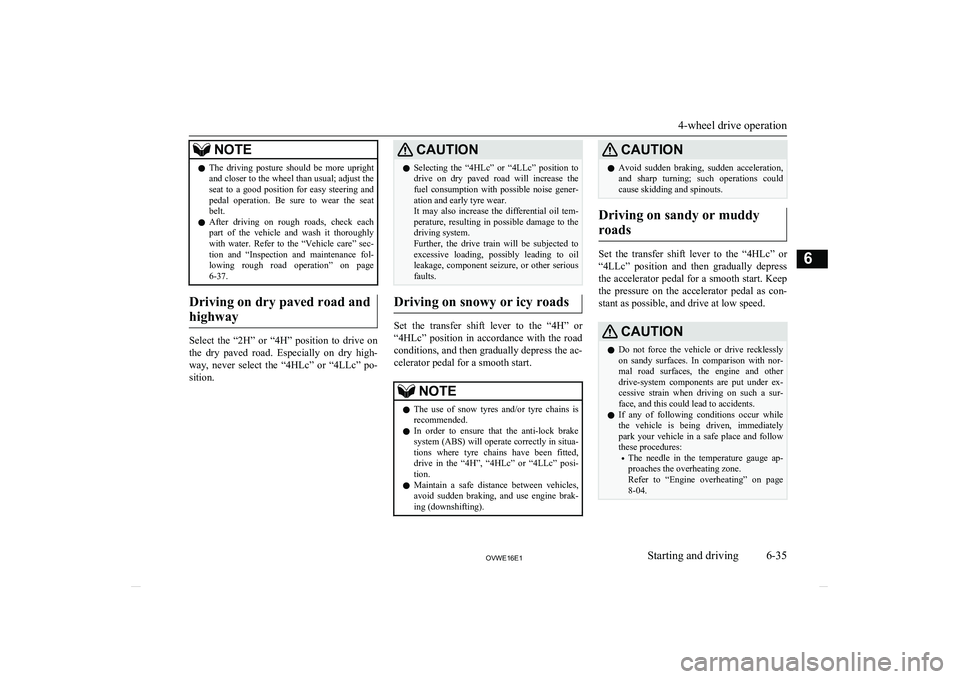
NOTElThe driving posture should be more upright
and closer to the wheel than usual; adjust the
seat to a good position for easy steering and pedal operation. Be sure to wear the seatbelt.
l After driving on rough roads, check each
part of the vehicle and wash it thoroughlywith water. Refer to the “Vehicle care” sec-
tion and “Inspection and maintenance fol-
lowing rough road operation” on page 6-37.
Driving on dry paved road and
highway
Select the “2H” or “4H” position to drive on
the dry paved road. Especially on dry high- way, never select the “4HLc” or “4LLc” po-sition.
CAUTIONl Selecting the “4HLc” or “4LLc” position to
drive on dry paved road will increase the
fuel consumption with possible noise gener- ation and early tyre wear.
It may also increase the differential oil tem-
perature, resulting in possible damage to the driving system.
Further, the drive train will be subjected to
excessive loading, possibly leading to oil leakage, component seizure, or other serious faults.
Driving on snowy or icy roads
Set the transfer shift lever to the “4H” or
“4HLc” position in accordance with the road conditions, and then gradually depress the ac-
celerator pedal for a smooth start.
NOTEl The use of snow tyres and/or tyre chains is
recommended.
l In order to ensure that the anti-lock brake
system (ABS) will operate correctly in situa-tions where tyre chains have been fitted, drive in the “4H”, “4HLc” or “4LLc” posi-tion.
l Maintain a safe distance between vehicles,
avoid sudden braking, and use engine brak- ing (downshifting).CAUTIONl Avoid sudden braking, sudden acceleration,
and sharp turning; such operations could
cause skidding and spinouts.
Driving on sandy or muddy
roads
Set the transfer shift lever to the “4HLc” or “4LLc” position and then gradually depress
the accelerator pedal for a smooth start. Keep
the pressure on the accelerator pedal as con- stant as possible, and drive at low speed.
CAUTIONl Do not force the vehicle or drive recklessly
on sandy surfaces. In comparison with nor-
mal road surfaces, the engine and other
drive-system components are put under ex- cessive strain when driving on such a sur-
face, and this could lead to accidents.
l If any of following conditions occur while
the vehicle is being driven, immediately park your vehicle in a safe place and follow these procedures:
• The needle in the temperature gauge ap-
proaches the overheating zone.
Refer to “Engine overheating” on page
8-04.
4-wheel drive operation
6-35OVWE16E1Starting and driving6
Page 176 of 404
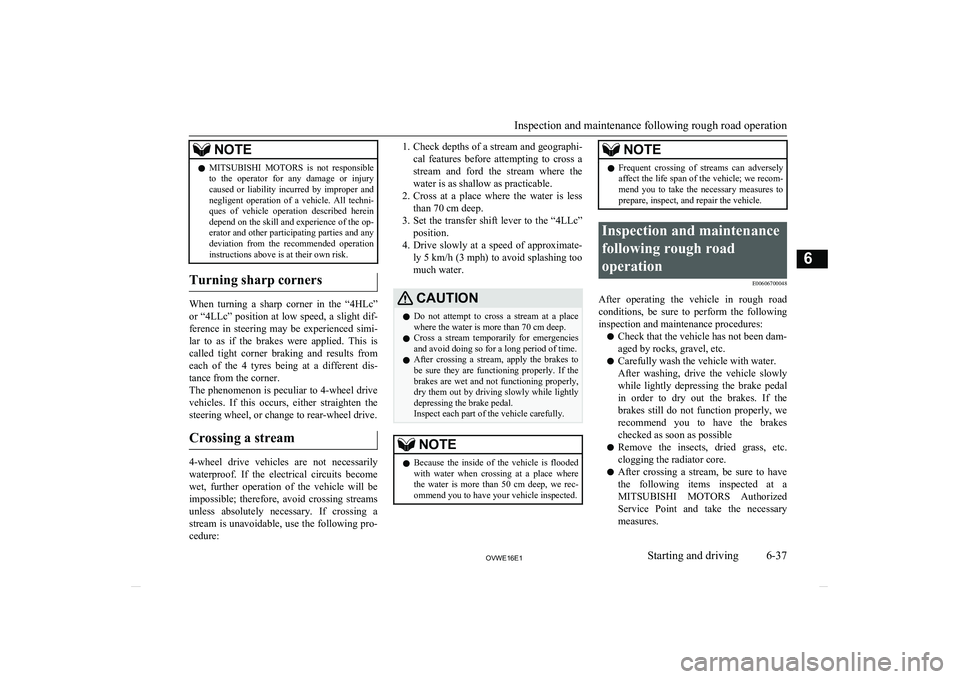
NOTElMITSUBISHI
MOTORS is not responsible
to the operator for any damage or injury caused or liability incurred by improper and negligent operation of a vehicle. All techni-
ques of vehicle operation described herein depend on the skill and experience of the op- erator and other participating parties and any
deviation from the recommended operation
instructions above is at their own risk.
Turning sharp corners
When turning a sharp corner in the “4HLc”
or “4LLc” position at low speed, a slight dif-
ference in steering may be experienced simi- lar to as if the brakes were applied. This is
called tight corner braking and results from each of the 4 tyres being at a different dis-tance from the corner.
The phenomenon is peculiar to 4-wheel drive vehicles. If this occurs, either straighten the steering wheel, or change to rear-wheel drive.
Crossing a stream
4-wheel drive vehicles are not necessarily waterproof. If the electrical circuits become
wet, further operation of the vehicle will be impossible; therefore, avoid crossing streams
unless absolutely necessary. If crossing a
stream is unavoidable, use the following pro- cedure:
1. Check depths of a stream and geographi-
cal features before attempting to cross a
stream and ford the stream where the
water is as shallow as practicable.
2. Cross at a place where the water is less
than 70 cm deep.
3. Set the transfer shift lever to the “4LLc”
position.
4. Drive slowly at a speed of approximate-
ly 5 km/h (3 mph) to avoid splashing too
much water.CAUTIONl Do not attempt to cross a stream at a place
where the water is more than 70 cm deep.
l Cross a stream temporarily for emergencies
and avoid doing so for a long period of time.
l After crossing a stream, apply the brakes to
be sure they are functioning properly. If the
brakes are wet and not functioning properly,
dry them out by driving slowly while lightly
depressing the brake pedal.
Inspect each part of the vehicle carefully.NOTEl Because the inside of the vehicle is flooded
with water when crossing at a place where
the water is more than 50 cm deep, we rec- ommend you to have your vehicle inspected.NOTEl Frequent crossing of streams can adversely
affect the life span of the vehicle; we recom-mend you to take the necessary measures toprepare, inspect, and repair the vehicle.Inspection and maintenance
following rough roadoperation E00606700048
After operating the vehicle in rough road
conditions, be sure to perform the following inspection and maintenance procedures:
l Check that the vehicle has not been dam-
aged by rocks, gravel, etc.
l Carefully wash the vehicle with water.
After washing, drive the vehicle slowly
while lightly depressing the brake pedal in order to dry out the brakes. If the brakes still do not function properly, we
recommend you to have the brakes
checked as soon as possible
l Remove the insects, dried grass, etc.
clogging the radiator core.
l After crossing a stream, be sure to have
the following items inspected at a
MITSUBISHI MOTORS Authorized
Service Point and take the necessary
measures.
Inspection and maintenance following rough road operation
6-37OVWE16E1Starting and driving6
Page 193 of 404
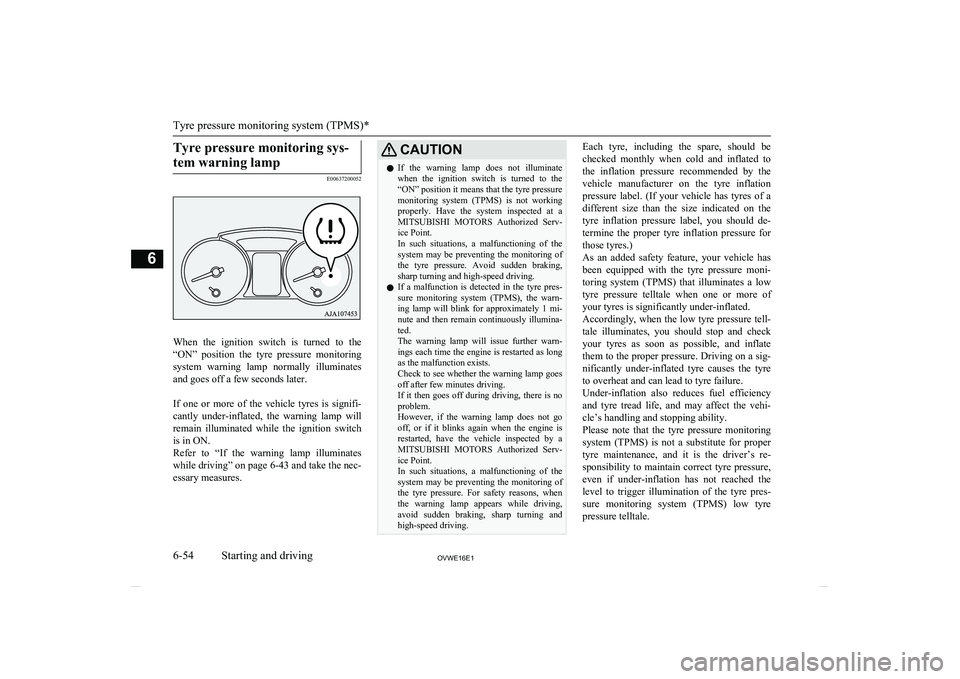
Tyre pressure monitoring sys-tem warning lamp
E00637200052
When the ignition switch is turned to the
“ON” position the tyre pressure monitoring system warning lamp normally illuminates
and goes off a few seconds later.
If one or more of the vehicle tyres is signifi- cantly under-inflated, the warning lamp will
remain illuminated while the ignition switch is in ON.
Refer to “If the warning lamp illuminates while driving” on page 6-43 and take the nec-essary measures.
CAUTIONl If the warning lamp does not illuminate
when the ignition switch is turned to the
“ON” position it means that the tyre pressure monitoring system (TPMS) is not working
properly. Have the system inspected at a MITSUBISHI MOTORS Authorized Serv-
ice Point.
In such situations, a malfunctioning of the system may be preventing the monitoring of the tyre pressure. Avoid sudden braking,
sharp turning and high-speed driving.
l If a malfunction is detected in the tyre pres-
sure monitoring system (TPMS), the warn-
ing lamp will blink for approximately 1 mi-
nute and then remain continuously illumina- ted.
The warning lamp will issue further warn-
ings each time the engine is restarted as long
as the malfunction exists.
Check to see whether the warning lamp goes
off after few minutes driving.
If it then goes off during driving, there is no problem.
However, if the warning lamp does not go off, or if it blinks again when the engine is
restarted, have the vehicle inspected by a
MITSUBISHI MOTORS Authorized Serv-
ice Point.
In such situations, a malfunctioning of the system may be preventing the monitoring of
the tyre pressure. For safety reasons, when the warning lamp appears while driving,
avoid sudden braking, sharp turning and high-speed driving.Each tyre, including the spare, should be
checked monthly when cold and inflated to the inflation pressure recommended by thevehicle manufacturer on the tyre inflation
pressure label. (If your vehicle has tyres of a different size than the size indicated on the
tyre inflation pressure label, you should de-
termine the proper tyre inflation pressure for those tyres.)
As an added safety feature, your vehicle has been equipped with the tyre pressure moni-
toring system (TPMS) that illuminates a low
tyre pressure telltale when one or more of
your tyres is significantly under-inflated.
Accordingly, when the low tyre pressure tell-
tale illuminates, you should stop and check your tyres as soon as possible, and inflate
them to the proper pressure. Driving on a sig- nificantly under-inflated tyre causes the tyre to overheat and can lead to tyre failure.
Under-inflation also reduces fuel efficiency
and tyre tread life, and may affect the vehi- cle’s handling and stopping ability.
Please note that the tyre pressure monitoring
system (TPMS) is not a substitute for proper tyre maintenance, and it is the driver’s re-sponsibility to maintain correct tyre pressure,
even if under-inflation has not reached the level to trigger illumination of the tyre pres-
sure monitoring system (TPMS) low tyre pressure telltale.
Tyre pressure monitoring system (TPMS)*
6-54OVWE16E1Starting and driving6
Page 216 of 404
NOTElThe rear air conditioning will not operate
unless the front air conditioning compressor
is operating.
Always switch the front air conditioning
compressor on before using the rear air con- ditioning. If the front air conditioning com-
pressor is not operating, the system will just operate as a blower.Important operation tips for
the air conditioning E00708300889
lPark the vehicle in the shade.
Parking in the hot sun will make the ve-
hicle inside extremely hot, and it will re-
quire more time to cool the interior.
If it is necessary to park in the sun, open the windows for the first few minutes of
air conditioning operation to expel the
hot air.
l Close the windows when the air condi-
tioning is in use. The entry of outside air
through open windows will reduce the cooling efficiency.
l Too much cooling is not good for the
health. The inside air temperature should
only be 5 to 6 °C below the outside air temperature.
l When operating the system, make sure
the air intake, which is located in front
of the windscreen, is free of obstructions such as leaves and snow. Leaves collec- ted in the air-intake plenum may reduce
air flow and plug the plenum water
drains.
Air conditioning system refrig- erant and lubricant recommen-dations
If the air conditioning seems less effective than usual, the cause might be a refrigerant
leak. We recommend you to have the system inspected.
The air conditioning system in your vehicle must be charged with the refrigerant
HFC-134a and the lubricant ND-OIL8.
Use of any other refrigerant or lubricant will
cause severe damage which will result in the need to replace your vehicle’s entire air con-
ditioning system. The release of refrigerant into the atmosphere should be prevented.
The new refrigerant HFC-134a in your vehi-
cle will not harm the ozone layer.
It is recommended that the refrigerant be re-
covered and recycled for further use.
During a long period of disuse
The air conditioning should be operated for at
least five minutes each week, even in cold weather. This is to prevent the compressor
from seizing and to maintain the air condi- tioning in the best operating condition.
Air purifier (with
deodorizing function) E00708400183
An air filter is incorporated into the air condi-tioning system to remove pollen, dust, tobac-
co smells and exhaust smells.
The air filter’s ability to collect pollen and
dirt is reduced as it becomes dirty, so replace it periodically. For the maintenance interval, refer to the “SERVICE BOOKLET”.
NOTEl Operation in certain conditions such as driv-
ing on a dusty road and frequent use of the air conditioning can lead to reduction of
service life of the filter. When the air flow rate suddenly drops or when the windscreenor windows start to fog up easily, the air fil-
ter requires replacement. We recommend
you to have it checked.
Important operation tips for the air conditioning
7-11OVWE16E1For pleasant driving7
Page 300 of 404
3.Confirm that the cooling fan is turning.
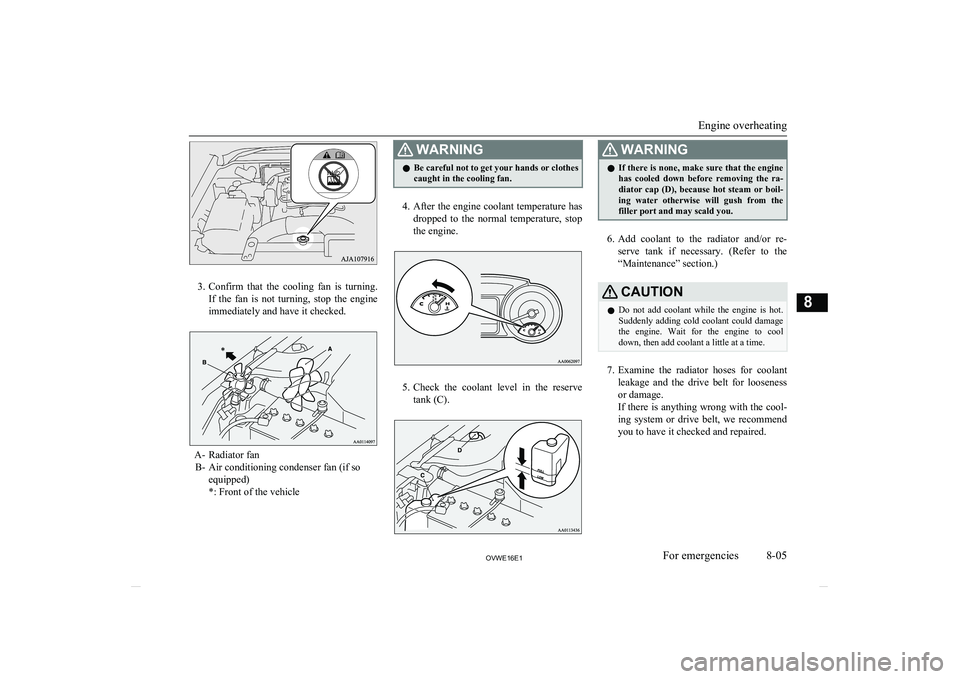
If the fan is not turning, stop the engine
immediately and have it checked.
A- Radiator fan B- Air conditioning condenser fan (if so equipped)
*: Front of the vehicle
WARNINGl Be careful not to get your hands or clothes
caught in the cooling fan.
4. After the engine coolant temperature has
dropped to the normal temperature, stop the engine.
5. Check the coolant level in the reserve
tank (C).
WARNINGl If there is none, make sure that the engine
has cooled down before removing the ra-
diator cap (D), because hot steam or boil- ing water otherwise will gush from the filler port and may scald you.
6. Add coolant to the radiator and/or re-
serve tank if necessary. (Refer to the
“Maintenance” section.)
CAUTIONl Do not add coolant while the engine is hot.
Suddenly adding cold coolant could damage
the engine. Wait for the engine to cool
down, then add coolant a little at a time.
7. Examine the radiator hoses for coolant
leakage and the drive belt for looseness
or damage.
If there is anything wrong with the cool-
ing system or drive belt, we recommend
you to have it checked and repaired.
Engine overheating
8-05OVWE16E1For emergencies8