differential MITSUBISHI SHOGUN 2017 (in English) User Guide
[x] Cancel search | Manufacturer: MITSUBISHI, Model Year: 2017, Model line: SHOGUN, Model: MITSUBISHI SHOGUN 2017Pages: 394, PDF Size: 19 MB
Page 167 of 394

When getting out of snow
When the vehicle is unable to get going be-cause one of the wheels is on the snow and
the other on a paved road.
Examples of incorrect use of
the rear differential lock
E00606500046
WARNINGl If the “4LLc” or “4HLc” position is selec-
ted along with the rear differential lock,the following phenomena appear and it is
very dangerous.
Please be sure to release the rear differen-
tial lock on normal roads.WARNING• If the rear differential lock is used by
mistake when driving on a paved road: With the rear differential lock on, thepower to drive the vehicle straight
ahead becomes very strong, which may
make it difficult to turn the steering
wheel.WARNINGl If the rear differential lock is used by mis-
take when turning a curve or making a
right or left turn at a crossing or the like:
The vehicle is unable to make a turn and may go straight ahead.WARNINGl If the rear differential lock is used by mis-
take except when making an emergencyescape on snow or frozen road: It be-
comes difficult to make a steady turn.
l In the case where the condition of the
road is different for the right tyre to drive from the left tyre (such as one tyre on a
paved road and the other on ice), direc- tion of the vehicle may change abruptly
when engine braking or accelerating.
Do not use the rear differential lock ex- cept when making an emergency escape
on a snow or frozen road, but drive with 4WD.
Rear differential lock*
6-29OVWX17E1Starting and driving6
Page 168 of 394
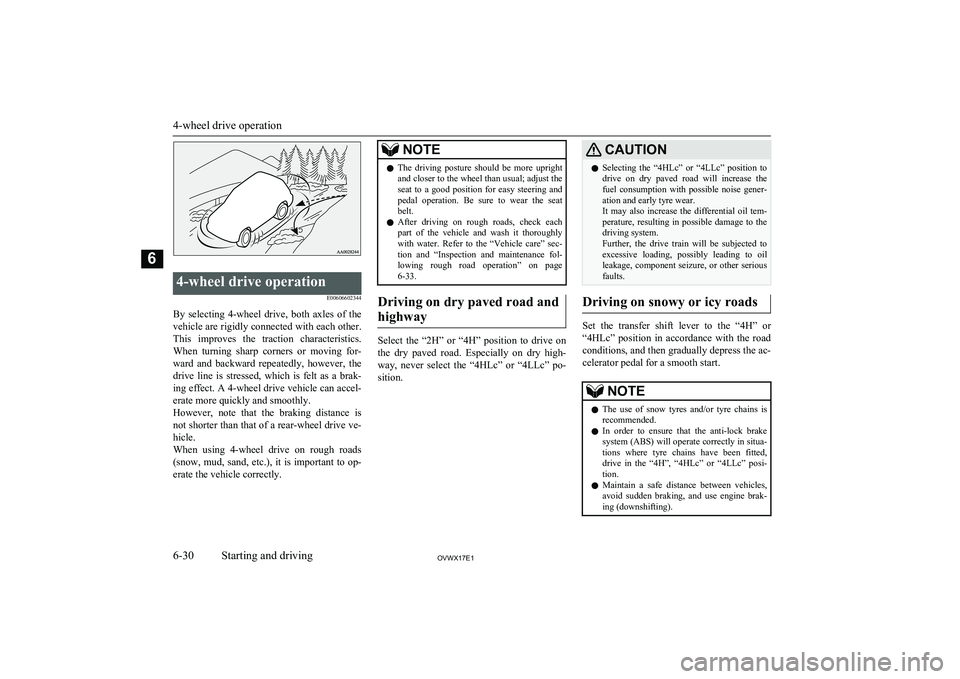
4-wheel drive operationE00606602344
By selecting 4-wheel drive, both axles of the
vehicle are rigidly connected with each other. This improves the traction characteristics. When turning sharp corners or moving for-
ward and backward repeatedly, however, the drive line is stressed, which is felt as a brak-
ing effect. A 4-wheel drive vehicle can accel-
erate more quickly and smoothly.
However, note that the braking distance is not shorter than that of a rear-wheel drive ve-hicle.
When using 4-wheel drive on rough roads
(snow, mud, sand, etc.), it is important to op- erate the vehicle correctly.
NOTEl The driving posture should be more upright
and closer to the wheel than usual; adjust the
seat to a good position for easy steering and pedal operation. Be sure to wear the seatbelt.
l After driving on rough roads, check each
part of the vehicle and wash it thoroughlywith water. Refer to the “Vehicle care” sec-
tion and “Inspection and maintenance fol-
lowing rough road operation” on page 6-33.
Driving on dry paved road and
highway
Select the “2H” or “4H” position to drive on
the dry paved road. Especially on dry high- way, never select the “4HLc” or “4LLc” po-sition.
CAUTIONl Selecting the “4HLc” or “4LLc” position to
drive on dry paved road will increase the
fuel consumption with possible noise gener- ation and early tyre wear.
It may also increase the differential oil tem-
perature, resulting in possible damage to the driving system.
Further, the drive train will be subjected to
excessive loading, possibly leading to oil leakage, component seizure, or other serious faults.
Driving on snowy or icy roads
Set the transfer shift lever to the “4H” or
“4HLc” position in accordance with the road conditions, and then gradually depress the ac-
celerator pedal for a smooth start.
NOTEl The use of snow tyres and/or tyre chains is
recommended.
l In order to ensure that the anti-lock brake
system (ABS) will operate correctly in situa-tions where tyre chains have been fitted, drive in the “4H”, “4HLc” or “4LLc” posi-tion.
l Maintain a safe distance between vehicles,
avoid sudden braking, and use engine brak- ing (downshifting).
4-wheel drive operation
6-30OVWX17E1Starting and driving6
Page 171 of 394
NOTElFrequent crossing of streams can adversely
affect the life span of the vehicle; we recom-mend you to take the necessary measures toprepare, inspect, and repair the vehicle.Inspection and maintenance
following rough roadoperation E00606700048
After operating the vehicle in rough road
conditions, be sure to perform the following inspection and maintenance procedures:
l Check that the vehicle has not been dam-
aged by rocks, gravel, etc.
l Carefully wash the vehicle with water.
After washing, drive the vehicle slowly
while lightly depressing the brake pedal in order to dry out the brakes. If the brakes still do not function properly, we
recommend you to have the brakes
checked as soon as possible
l Remove the insects, dried grass, etc.
clogging the radiator core.
l After crossing a stream, be sure to have
the following items inspected at a
MITSUBISHI MOTORS Authorized
Service Point and take the necessary
measures.
• Check the brake system and, if neces-
sary, have it serviced.
• Check the engine, transmission, trans-
fer, and differential oil or grease level
and turbidity. If the oil or grease is
milky, it indicates water contamina-
tion. Replace it with new oil or grease.
• Grease the propeller shaft.
• Check the inside of the vehicle. If in-
gress of water is found, dry the carpetetc.
• Inspect the headlamps. If the head-
lamp bulb is flooded with water, we
recommend you to have it drained.Cautions on handling of 4-
wheel drive vehicles E00606802144
Tyres and wheels
Since the driving torque can be applied to the
4 wheels, the performance of the vehicle when operating in 4-wheel drive is greatly af- fected by the condition of the tyres.
Pay close attention to the tyres.
l Install specified tyres on all wheels. Re-
fer to “Tyres and wheels” on page
11-11.
l Be sure to fit all 4 tyres and wheels of
the same size and type.
When replacement of any of the tyres or
wheels is necessary, replace all of them.
l All tyres should be rotated whenever the
wear difference between the front and
rear tyres is recognizable.
Good vehicle performance cannot be expec- ted if there is a difference in wear between
tyres. Refer to “Tyre rotation” on page 10-13.
l Check the tyre inflation pressure regular-
ly.
l If the tyre inflation pressure is inappro-
priate, the transfer gear may make some
noise and shock while changing the drive mode.CAUTIONl Always use tyres of the same size, same
type, and same brand, and which have no wear differences. Using tyres which differ in
size, type, brand or the degree of wear will
cause excessive loading, resulting in possi- ble damage to the drive system.
Inspection and maintenance following rough road operation
6-33OVWX17E1Starting and driving6
Page 174 of 394

lOn vehicles with the rear differential
lock, the active stability & traction con- trol (ASTC) and anti-lock brake system
(ABS) functions are suspended while the
rear differential lock is activated. ASTC indication lamp, Active Stability Controlfunction OFF indication lamp, ABS
warning lamp and brake warning lamp are illuminated while these functions are
suspended. It does not indicate a prob- lem. When the rear differential lock is
disengaged, these lamps go out and function again.
Refer to “Brake warning lamp” on page
5-10 , “ABS warning lamp” on page
6-38 , “ASTC indication lamp” on page
6-40 , “Active stability control function
OFF indication lamp” on page 6-42.
When brakes are wet
Check the brake system while driving at a
low speed immediately after starting, espe- cially when the brakes are wet, to confirmthey work normally.
A film of water can be formed on the brake
discs and prevent normal braking after driv-
ing in heavy rain or through large puddles, or after the vehicle is washed. If this occurs, dry
the brakes out by driving slowly while lightly depressing the brake pedal.
When driving downhill
It is important to take advantage of the en-
gine braking by shifting to a lower shift posi- tion while driving on steep downhill roads in order to prevent the brakes from overheating.
WARNINGl Do not leave any objects near the brake
pedal or let a floor mat slide under it; do- ing so could prevent the full pedal strokethat would be necessary in an emergency.
Make sure that the pedal can be operated freely at all times. Make sure the floor mat is securely held in place.
Brake pads
l Avoid hard braking situations.
New brakes need to be broken-in by
moderate use for the first 200 km (125 miles).
l The disc brakes are provided with a
warning device which emits a shrieking
metallic sound while braking if the brake pads have reached their wear limit.
If you hear this sound, have the brake pads replaced immediately.
WARNINGl Driving with worn brake pads will make
it harder to stop, and can cause an acci-
dent.Brake assist system
E00627001852
The brake assist system is a device assistingdrivers who cannot depress the brake pedalfirmly when it is necessary to do so (such as
in emergency stop situations) and provides
greater braking force.
If the brake pedal is depressed suddenly, the brakes will be applied with more force thanusual.
CAUTIONl The brake assist system is not a device de-
signed to exercise braking force greater than its capacity. Make sure to always keep a suf-
ficient distance between your vehicle and a
vehicle in front of you without relying too much on the brake assist system.
Brake assist system
6-36OVWX17E1Starting and driving6
Page 176 of 394
CAUTIONlEven the ABS cannot prevent the natural
laws of physics from acting on the vehicle. Itcannot for instance avoid accidents that may
result from excessive speed on bends or fol- lowing another vehicle too closely or aqua- planing. It should remain the driver’s task to
observe safety precautions to judge speeds and brake applications correctly in such con-
ditions.
l Be sure to use tyres of the same type and
size on 4 wheels.
If tyre types or sizes are mixed, ABS may not function normally.
l Never install a limited-slip differential,
which is not a MITSUBISHI MOTORS gen-
uine part, as the ABS may not function nor-
mally.
We recommend you to consult a MITSUBISHI MOTORS Authorized Serv-
ice Point.ABS warning lamp
E00607200532
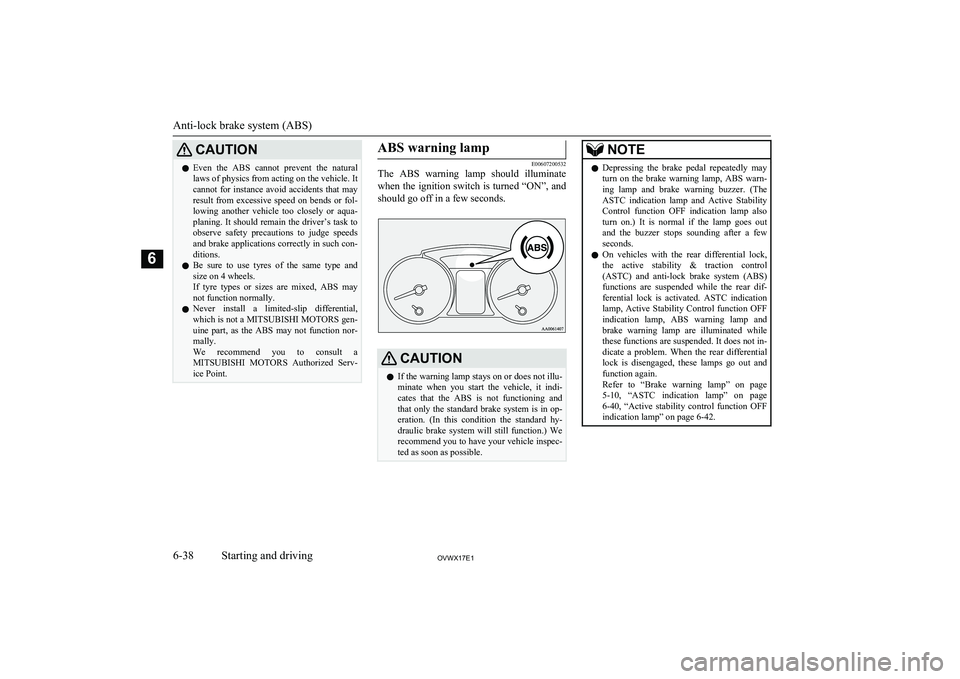
The ABS warning lamp should illuminate
when the ignition switch is turned “ON”, and
should go off in a few seconds.
CAUTIONl If the warning lamp stays on or does not illu-
minate when you start the vehicle, it indi-
cates that the ABS is not functioning and
that only the standard brake system is in op-
eration. (In this condition the standard hy- draulic brake system will still function.) We
recommend you to have your vehicle inspec- ted as soon as possible.NOTEl Depressing the brake pedal repeatedly may
turn on the brake warning lamp, ABS warn-ing lamp and brake warning buzzer. (The
ASTC indication lamp and Active Stability
Control function OFF indication lamp also
turn on.) It is normal if the lamp goes out and the buzzer stops sounding after a few
seconds.
l On vehicles with the rear differential lock,
the active stability & traction control
(ASTC) and anti-lock brake system (ABS)
functions are suspended while the rear dif- ferential lock is activated. ASTC indication
lamp, Active Stability Control function OFF indication lamp, ABS warning lamp and
brake warning lamp are illuminated while these functions are suspended. It does not in-
dicate a problem. When the rear differential lock is disengaged, these lamps go out and
function again.
Refer to “Brake warning lamp” on page
5-10 , “ASTC indication lamp” on page
6-40 , “Active stability control function OFF
indication lamp” on page 6-42.
Anti-lock brake system (ABS)
6-38OVWX17E1Starting and driving6
Page 178 of 394
CAUTIONlDo not leave the steering wheel turned all
the way in one direction. This can causedamage to the power steering system.Active stability & traction
control (ASTC) E00613800230
The active stability & traction control(ASTC) takes overall control of the anti-lockbrake system, Active Stability Control func-
tion and active traction control function to
maintain the vehicle’s stability and traction. Please read this section in conjunction withthe pages on the anti-lock brake system, Ac-
tive Stability Control function and active
traction control function.
Anti-lock brake system (ABS) ® p. 6-37
Active stability control function ® p. 6-42
Active traction control function ® p. 6-43
CAUTIONl Do not over-rely on the ASTC. Even when
the ASTC is operating, there are limits to how far it can ensure vehicle stability; reck-
less driving may lead to accidents. Always
drive carefully, taking account of the road conditions.CAUTIONl Be sure to use the same specified type and
size of tyre on all 4 wheels. Otherwise, there
is a possibility that the ASTC will not work properly.NOTEl An operation noise may be emitted from the
engine compartment in the following situa-
tions. The sound is associated with checking the operations of the ASTC. At this time,
you may feel a shock from the brake pedal if
you depress it. These do not indicate a mal- function.
• When the ignition switch is set to the
“ON” position.
• When the vehicle is driven for a while af-
ter the engine is turned on.
l When the ASTC is activated, you may feel a
vibration in the vehicle body or hear a whin-ing sound from the engine compartment.
This indicates that the system is operating
normally. It does not indicate a malfunction.
l When the anti-lock brake system warning
lamp is illuminated, the ASTC is not active.NOTEl On vehicles with the rear differential lock,
the ASTC and ABS functions are suspended
while the rear differential lock is activated. ASTC indication lamp, Active Stability
Control function OFF indication lamp, ABS warning lamp and brake warning lamp are
illuminated while these functions are sus- pended. It does not indicate a problem.
When the rear differential lock is disengag- ed, these lamps go out and function again.
Refer to “Brake warning lamp” on page
5-10 , “ABS warning lamp” on page 6-38,
“Active stability control function OFF indi- cation lamp” on page 6-42.ASTC indication lamp
E00618000035
The ASTC indication lamp shows the operat-
ing status of the Active Stability Controlfunction and active traction control function.
For details, see these sections of this owner’s
manual:
Active stability control function indication
lamp ® p. 6-42
Active stability & traction control (ASTC)
6-40OVWX17E1Starting and driving6
Page 180 of 394
Active stability control func-tion
E00613900097
The Active Stability Control function is de-
signed to help maintain the vehicle’s control
in slippery conditions, or during rapid steer- ing manoeuvres. It works by controlling theengine output and brake on each wheel.
NOTEl The Active Stability Control function does
not operate when the transfer shift lever is inthe “4LLc” position.
When the Active Stability Control function
is operating with the transfer shift lever in the “2H”, “4H” or “4HLc” position, moving
the shift lever to the “4LLc” position makes
the Active Stability Control function deacti- vate automatically.
l On vehicles with rear differential lock, the
Active Stability Control function does not operate when the rear differential lock is ac-
tivated.Active stability control function
indication lamp
E00614000183
Active stability control function in- dication lampActive stability control function
OFF indication lamp
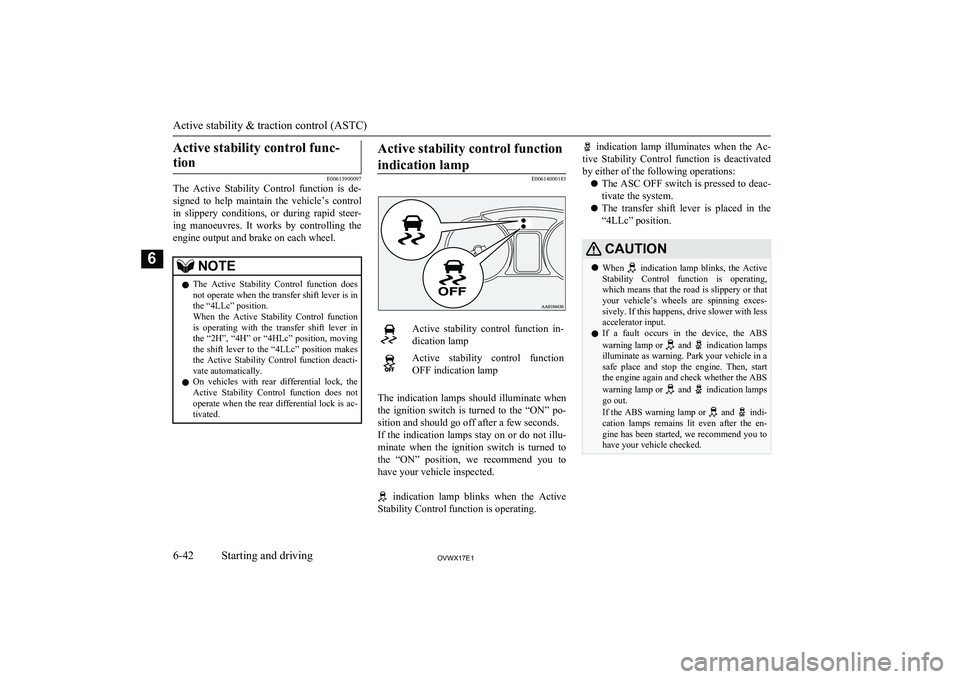
The indication lamps should illuminate when
the ignition switch is turned to the “ON” po- sition and should go off after a few seconds.
If the indication lamps stay on or do not illu-
minate when the ignition switch is turned to the “ON” position, we recommend you to
have your vehicle inspected.
indication lamp blinks when the Active
Stability Control function is operating.
indication lamp illuminates when the Ac-
tive Stability Control function is deactivated by either of the following operations:
l The ASC OFF switch is pressed to deac-
tivate the system.
l The transfer shift lever is placed in the
“4LLc” position.CAUTIONl When indication lamp blinks, the Active
Stability Control function is operating,
which means that the road is slippery or that your vehicle’s wheels are spinning exces- sively. If this happens, drive slower with lessaccelerator input.
l If a fault occurs in the device, the ABS
warning lamp or
and indication lamps
illuminate as warning. Park your vehicle in a
safe place and stop the engine. Then, start the engine again and check whether the ABS
warning lamp or
and indication lamps
go out.
If the ABS warning lamp or
and indi-
cation lamps remains lit even after the en- gine has been started, we recommend you tohave your vehicle checked.
Active stability & traction control (ASTC)
6-42OVWX17E1Starting and driving6
Page 198 of 394
Roof carrier precautionCAUTIONlMake sure that the weight of the luggage
does not exceed the allowable roof load.
If the allowable roof load is exceeded, this may cause damage to the vehicle.
The roof load is the total allowable load on
the roof (the weight of the roof carrier plus
the weight of luggage placed on the roof car- rier).
For specific figures, please refer to “Maxi-
mum roof load” on page 11-06 .
l When luggage is loaded onto the vehicle,
please make sure to drive slowly and avoid
excessive manoeuvres such as sudden brak- ing or quick turning.
In addition, place the luggage on the carrier
so that its weight is distributed evenly with the heaviest items on the bottom. Do not load items that are wider than the roof carri-
er.
The additional weight on the roof could raise
the vehicle’s centre of gravity and affect ve- hicle handling characteristics.
As a result, driving errors or emergency ma-
noeuvres could lead to a loss of control and
result in an accident.
l Before driving and after travelling a short
distance, always check the load to make sure it is securely fastened to the roof carrier.
Check periodically during your travel that
the load remains secure.NOTEl To prevent wind noise or reduction in fuel
economy, remove the roof carrier when not
in use.
l Before using an automatic car wash, remove
the roof carrier.
l Be sure that adequate clearance is main-
tained for raising the sunroof (if so equip-
ped) when installing a roof carrier.Trailer towing
E00610001850
In order to tow a trailer with your vehicle,
when having a trailer towing device mounted that meets all relevant regulations in your
area, consult a MITSUBISHI MOTORS Au-
thorized Service Point.
The regulations concerning the towing of a
trailer may differ from country to country. You are advised to obey the regulations in
each area.
CAUTIONl Danger of Accident!
A towing bar should be fitted according to MITSUBISHI MOTORS guidelines.
When you are going to tow a trailer, move
the transfer shift lever to “4H” position.
Selecting the “2H” drive may increase the differential oil temperature, resulting in pos-sible damage to the driving system.
Further, the drive train will be subjected to
excessive loading possibly leading to oil leakage, component seizure, or other serious faults.
Maximum towable weight with
brake and maximum trailer- nose weight
Never exceed the maximum towable weight
with brake and the maximum trailer-nose weight as listed in the specifications. (Referto “Vehicle weight” on page 11-06 .)
If you tow a trailer at an altitude of more than
1,000 m above sea-level, reduce your weight
by 10 % of the gross combination weight for
every increase of 1,000 m above sea-level, as the engine output is lowered owing to de-
crease in atmospheric pressure.
Trailer towing
6-60OVWX17E1Starting and driving6
Page 330 of 394
Vehicles for Russia, Kazakhstan, Belarus and UkraineTyre sizeUp to 5 passengersUp to max. loadAt trailer towingFrontRearFrontRearFrontRear265/65R17 112H2.0 bar (200 kPa) *
2.2 bar (220 kPa)2.2 bar (220 kPa) *
2.4 bar (240 kPa)2.4 bar (240 kPa)2.8 bar (280 kPa)2.6 bar (260 kPa)3.0 bar (300 kPa)265/60R18 110H2.0 bar (200 kPa) *
2.2 bar (220 kPa)2.2 bar (220 kPa) *
2.4 bar (240 kPa)2.4 bar (240 kPa)2.8 bar (280 kPa)2.6 bar (260 kPa)3.0 bar (300 kPa)* : Vehicles for 3000 models
Check the tyre inflation pressure of all the tyres while they are cold; if insufficient or excessive, adjust to the specified value.
After the tyre inflation pressure has been adjusted, check the tyres for damage and air leaks. Be sure to put caps on the valves.
Wheel condition
E01001800478
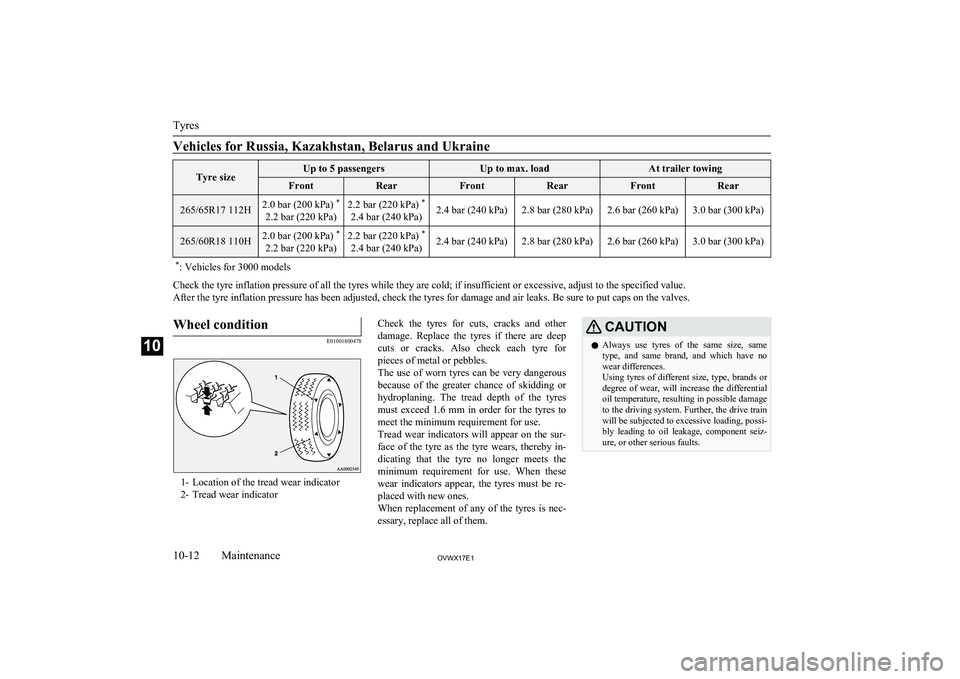
1- Location of the tread wear indicator
2- Tread wear indicator
Check the tyres for cuts, cracks and other
damage. Replace the tyres if there are deep
cuts or cracks. Also check each tyre for pieces of metal or pebbles.
The use of worn tyres can be very dangerous
because of the greater chance of skidding or
hydroplaning. The tread depth of the tyres
must exceed 1.6 mm in order for the tyres to meet the minimum requirement for use.
Tread wear indicators will appear on the sur-
face of the tyre as the tyre wears, thereby in-
dicating that the tyre no longer meets the
minimum requirement for use. When these
wear indicators appear, the tyres must be re-
placed with new ones.
When replacement of any of the tyres is nec- essary, replace all of them.CAUTIONl Always use tyres of the same size, same
type, and same brand, and which have no wear differences.
Using tyres of different size, type, brands or
degree of wear, will increase the differential
oil temperature, resulting in possible damage to the driving system. Further, the drive train
will be subjected to excessive loading, possi- bly leading to oil leakage, component seiz-ure, or other serious faults.
Tyres
10-12OVWX17E1Maintenance10
Page 365 of 394

CAUTIONlFor the automatic transmission fluid, use only the MITSUBISHI MOTORS GENUINE ATF.
Use of a different fluid could damage the transmission.No.ItemQuantityLubricants3Brake fluidAs requiredBrake fluid DOT3 or DOT4
4Washer fluid
Front5.1 litres
—Rear *11.4 litres5Power steering fluidAs requiredMITSUBISHI MOTORS GENUINE PSF (Power
Steering Fluid)
6
Engine coolant
(Includes 0.65 litre in the
reserve tank)Without rear air conditioning9.0 litresMITSUBISHI MOTORS GENUINE SUPER LONG LIFE COOLANT or equivalentWith rear air conditioning10.5 litres7Refrigerant
(air conditioning)Without rear air conditioning530 - 570 g
HFC-134a, HFO-1234yf *2
With rear air conditioning850 - 890 g
8Transfer oil2.8 litres
MITSUBISHI MOTORS GENUINE MTF API
classification GL-3 SAE 75W-85 or MITSUBISHI MOTORS GENUINE Multi Gear Oil API classifi- cation GL-4 SAE 75W-859Differential oilFront1.15 litresMITSUBISHI MOTORS GENUINE Super HypoidGear Oil API classification GL-5 SAE 80Rear1.6 litres*1: Rear washer fluid container is located on the backdoor. (Refer to “Rear window washer fluid” on page 10-08.)
*2 : Vehicles equipped with air conditioning refrigerant (HFO-1234yf) label.
Refill capacities
11-15OVWX17E1Specifications11