engine MITSUBISHI SHOGUN 2017 (in English) Owner's Guide
[x] Cancel search | Manufacturer: MITSUBISHI, Model Year: 2017, Model line: SHOGUN, Model: MITSUBISHI SHOGUN 2017Pages: 394, PDF Size: 19 MB
Page 122 of 394
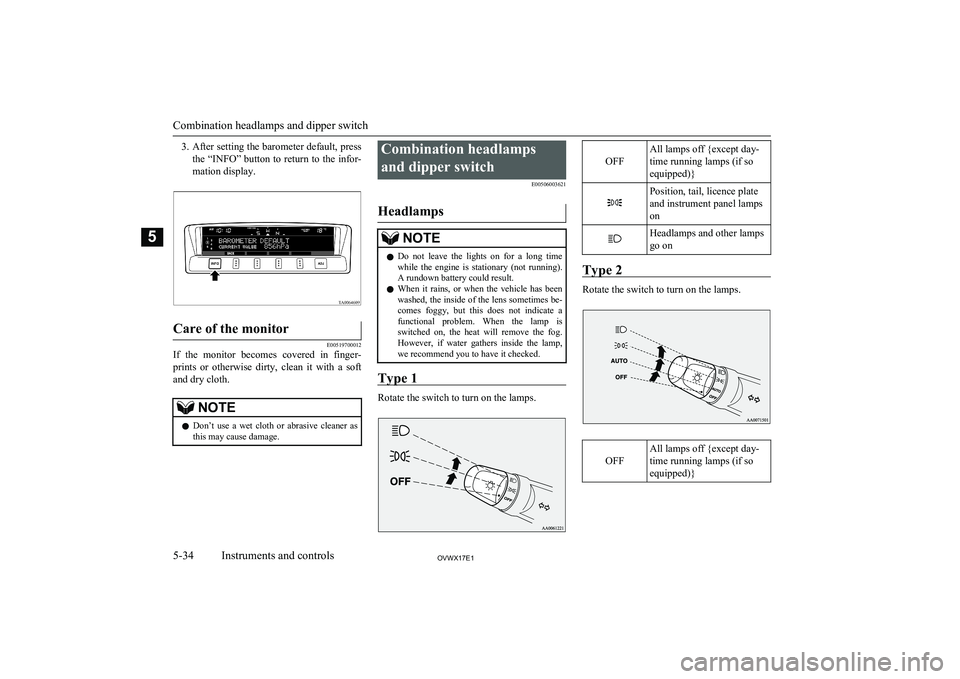
3.After setting the barometer default, press
the “INFO” button to return to the infor-
mation display.Care of the monitor
E00519700012
If the monitor becomes covered in finger-
prints or otherwise dirty, clean it with a soft and dry cloth.
NOTEl Don’t use a wet cloth or abrasive cleaner as
this may cause damage.Combination headlamps
and dipper switch E00506003621
HeadlampsNOTEl Do not leave the lights on for a long time
while the engine is stationary (not running).A rundown battery could result.
l When it rains, or when the vehicle has been
washed, the inside of the lens sometimes be-
comes foggy, but this does not indicate a functional problem. When the lamp is
switched on, the heat will remove the fog. However, if water gathers inside the lamp,
we recommend you to have it checked.
Type 1
Rotate the switch to turn on the lamps.
OFF
All lamps off {except day-
time running lamps (if so
equipped)}Position, tail, licence plate
and instrument panel lamps
onHeadlamps and other lamps
go on
Type 2
Rotate the switch to turn on the lamps.
OFF
All lamps off {except day-
time running lamps (if so
equipped)}
Combination headlamps and dipper switch
5-34OVWX17E1Instruments and controls5
Page 123 of 394
AUTO
With the ignition switch in
the “ON” position, head-
lamps, position, tail, licence
plate, and instrument panel
lamps turn on and off auto-
matically in accordance with
outside light level. {Day-
time running lamps (if so
equipped) will be turned on
while the tail lamps are off.}
All lamps turn off automati-
cally when the ignition
switch is turned to the
“OFF” position.Position, tail, licence plate
and instrument panel lamps
onHeadlamps and other lamps
onNOTEl The sensitivity of the automatic on/off con-
trol can be adjusted.
For further information, we recommend you
to consult a MITSUBISHI MOTORS Au-
thorized Service Point.NOTEl When the headlamps are turned off by the
automatic on/off control with the ignition
switch in the “ON” position, the front fog lamps (if so equipped) and rear fog lamp al-
so go off. When the headlamps are subse- quently turned back on by the automatic
on/off control, the front fog lamps also come on but the rear fog lamp stays off. If you wish to turn the rear fog lamp back on, oper-
ate the switch again.
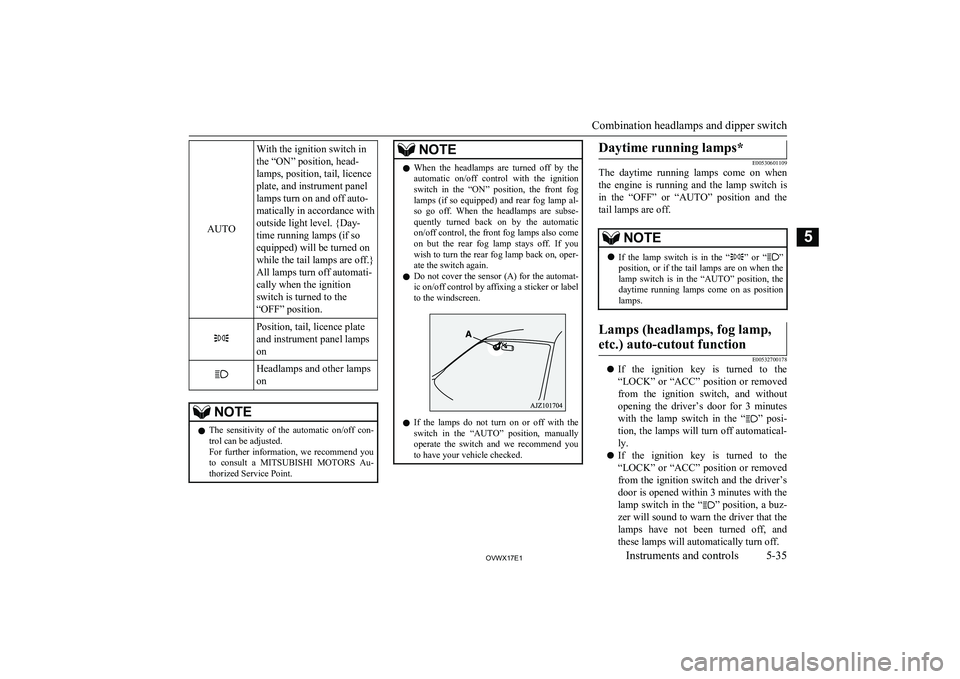
l Do not cover the sensor (A) for the automat-
ic on/off control by affixing a sticker or label
to the windscreen.
l If the lamps do not turn on or off with the
switch in the “AUTO” position, manually
operate the switch and we recommend you
to have your vehicle checked.
Daytime running lamps*
E00530601109
The daytime running lamps come on when
the engine is running and the lamp switch is in the “OFF” or “AUTO” position and the
tail lamps are off.NOTEl If the lamp switch is in the “” or “”
position, or if the tail lamps are on when the lamp switch is in the “AUTO” position, the
daytime running lamps come on as position lamps.Lamps (headlamps, fog lamp,
etc.) auto-cutout function
E00532700178
l If the ignition key is turned to the
“LOCK” or “ACC” position or removed from the ignition switch, and without
opening the driver’s door for 3 minutes with the lamp switch in the “
” posi-
tion, the lamps will turn off automatical-
ly.
l If the ignition key is turned to the
“LOCK” or “ACC” position or removed from the ignition switch and the driver’s
door is opened within 3 minutes with the
lamp switch in the “
” position, a buz-
zer will sound to warn the driver that the
lamps have not been turned off, and these lamps will automatically turn off.
Combination headlamps and dipper switch
5-35OVWX17E1Instruments and controls5
Page 138 of 394
NOTElThe switch is automatically turned off after
operating for approximately 20 minutes. To
turn off the switch while it is operating,
press the switch again.Rear window demister
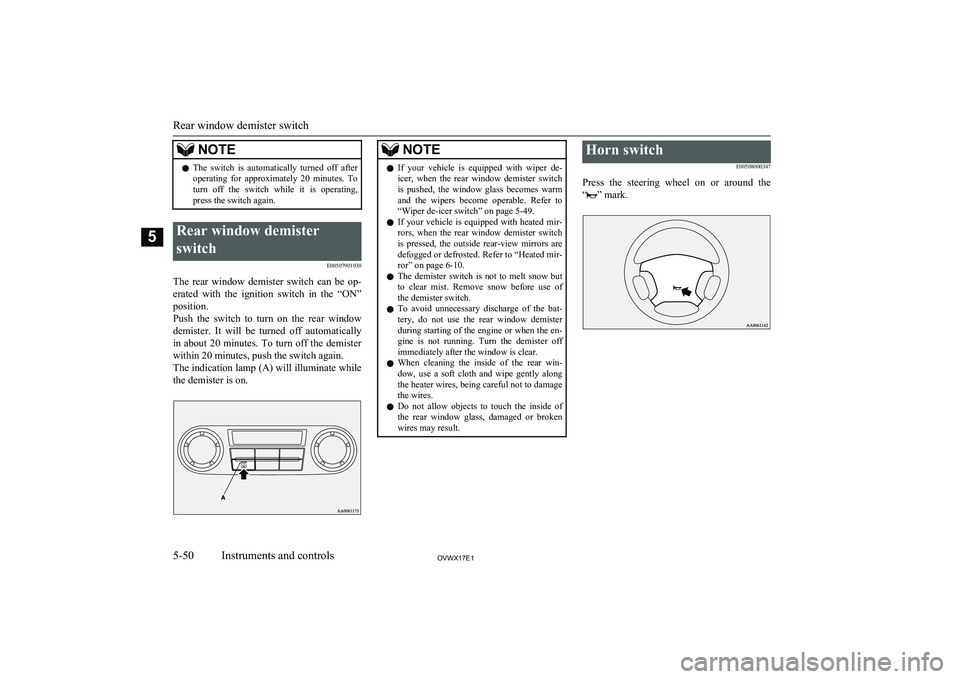
switch E00507901030
The rear window demister switch can be op-erated with the ignition switch in the “ON”position.
Push the switch to turn on the rear window
demister. It will be turned off automatically
in about 20 minutes. To turn off the demister
within 20 minutes, push the switch again.
The indication lamp (A) will illuminate while the demister is on.
NOTEl If your vehicle is equipped with wiper de-
icer, when the rear window demister switch
is pushed, the window glass becomes warm
and the wipers become operable. Refer to “Wiper de-icer switch” on page 5-49.
l If your vehicle is equipped with heated mir-
rors, when the rear window demister switchis pressed, the outside rear-view mirrors are defogged or defrosted. Refer to “Heated mir-
ror” on page 6-10.
l The demister switch is not to melt snow but
to clear mist. Remove snow before use of the demister switch.
l To avoid unnecessary discharge of the bat-
tery, do not use the rear window demister
during starting of the engine or when the en- gine is not running. Turn the demister off
immediately after the window is clear.
l When cleaning the inside of the rear win-
dow, use a soft cloth and wipe gently along
the heater wires, being careful not to damage
the wires.
l Do not allow objects to touch the inside of
the rear window glass, damaged or broken
wires may result.Horn switch
E00508000347
Press the steering wheel on or around the
“
” mark.
Rear window demister switch
5-50OVWX17E1Instruments and controls5
Page 140 of 394
Economical drivingE00600100561
For economical driving, there are some tech- nical requirements that have to be met. Theprerequisite for low fuel consumption is a
properly adjusted engine. In order to achieve longer life of the vehicle and the most eco- nomical operation, we recommend you tohave the vehicle checked at regular intervals in accordance with the service standards.
Fuel economy and generation of exhaust gas
and noise are highly influenced by personal
driving habits as well as the particular operat- ing conditions. The following points shouldbe observed in order to minimize wear of
brakes, tyres and engine as well as to reduce
environmental pollution.
Starting
Avoid rapid acceleration and sudden starts;
such operation will result in higher fuel con-
sumption.
Shifting
Shift only at an appropriate speed and engine speed. Always use the highest gear possible.
The transfer shift lever should be set to “2H” when driving on normal roads and express
ways to obtain best possible fuel economy.
City traffic
Frequent starting and stopping increases the
average fuel consumption. Use roads with smooth traffic flow whenever possible. When driving on congested roads, avoid use of a
low gear at high engine speeds.
Idling
The vehicle consumes fuel even during
idling. Avoid extended idling whenever pos- sible.
Speed
At higher vehicle speed, more fuel is con-
sumed. Avoid driving at full speed. Even a
slight release of the accelerator pedal will save a significant amount of fuel.
Tyre inflation pressure
Check the tyre inflation pressures at regularintervals. Low tyre inflation pressure increa-ses road resistance and fuel consumption. In addition, low tyre pressures adversely affect
tyre wear and driving stability.
Load
Do not drive with unnecessary articles in the
luggage compartment. Especially during city
driving where frequent starting and stopping is necessary, the increased weight of the ve-
hicle will greatly affect fuel consumption. Al- so avoid driving with unnecessary luggage or carriers, etc., on the roof; the increased air re- sistance will increase fuel consumption.
Cold engine starting
Starting of a cold engine consumes more fuel.
Unnecessary fuel consumption is also caused by keeping a hot engine running. After the
engine is started, commence driving as soon
as possible.
Air conditioning
The use of the air conditioning will increase the fuel consumption.
Driving, alcohol and drugs
E00600200067
Driving after drinking alcohol is one of the
most frequent causes of accidents.
Economical driving
6-02OVWX17E1Starting and driving6
Page 142 of 394
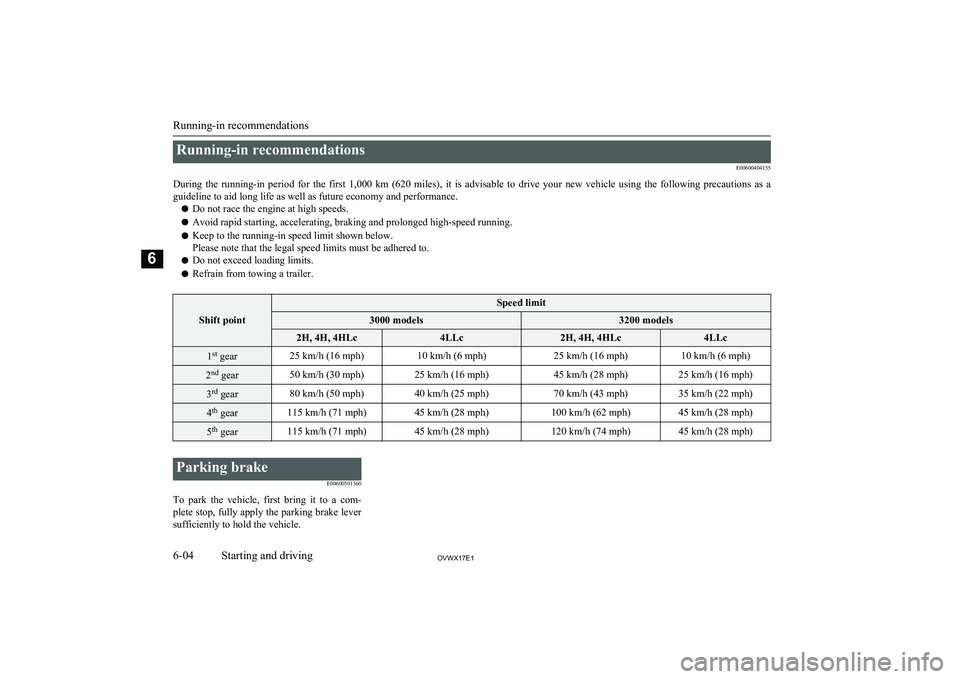
Running-in recommendationsE00600404155
During the running-in period for the first 1,000 km (620 miles), it is advisable to drive your new vehicle using the following precautions as a guideline to aid long life as well as future economy and performance.
l Do not race the engine at high speeds.
l Avoid rapid starting, accelerating, braking and prolonged high-speed running.
l Keep to the running-in speed limit shown below.
Please note that the legal speed limits must be adhered to.
l Do not exceed loading limits.
l Refrain from towing a trailer.
Shift point
Speed limit3000 models3200 models2H, 4H, 4HLc4LLc2H, 4H, 4HLc4LLc1st
gear25 km/h (16 mph)10 km/h (6 mph)25 km/h (16 mph)10 km/h (6 mph)2nd
gear50 km/h (30 mph)25 km/h (16 mph)45 km/h (28 mph)25 km/h (16 mph)3rd
gear80 km/h (50 mph)40 km/h (25 mph)70 km/h (43 mph)35 km/h (22 mph)4th
gear115 km/h (71 mph)45 km/h (28 mph)100 km/h (62 mph)45 km/h (28 mph)5th
gear115 km/h (71 mph)45 km/h (28 mph)120 km/h (74 mph)45 km/h (28 mph)
Parking brake
E00600501360
To park the vehicle, first bring it to a com- plete stop, fully apply the parking brake leversufficiently to hold the vehicle.
Running-in recommendations
6-04OVWX17E1Starting and driving6
Page 144 of 394
Apply the parking brake and place the selec-tor lever into the “P” (PARK) position.
If necessary, apply chocks to wheels.NOTEl Be sure to apply the parking brake before
moving the selector lever to the “P” (PARK)
position. If you move the selector lever to the “P” (Park) position before applying the
parking brake, it may be difficult to disen-
gage the selector lever from the “P” (Park) position when next you drive the vehicle, re-quiring application of a strong force to the
selector lever to move from the “P” (Park) position.
Parking with the engine run-
ning
Never leave the engine running while you
take a short sleep/rest, or you open or close a gate or garage door, etc. Also, never leave the
engine running in a closed or poorly ventila-
ted place.
WARNINGl Leaving the engine running risks injury
or death from accidentally moving the se- lector lever or the accumulation of toxic
exhaust fumes in the passenger compart-
ment.Where you parkWARNINGl Do not park your vehicle in areas where
combustible materials such as dry grass
or leaves can come in contact with a hot exhaust, since a fire could occur.
When leaving the vehicle
Always remove the key from the ignition
switch and lock all doors (including the back-
door) when leaving the vehicle unattended. Always try to park your vehicle in a well lit area.
Steering wheel height
adjustment E00600700222
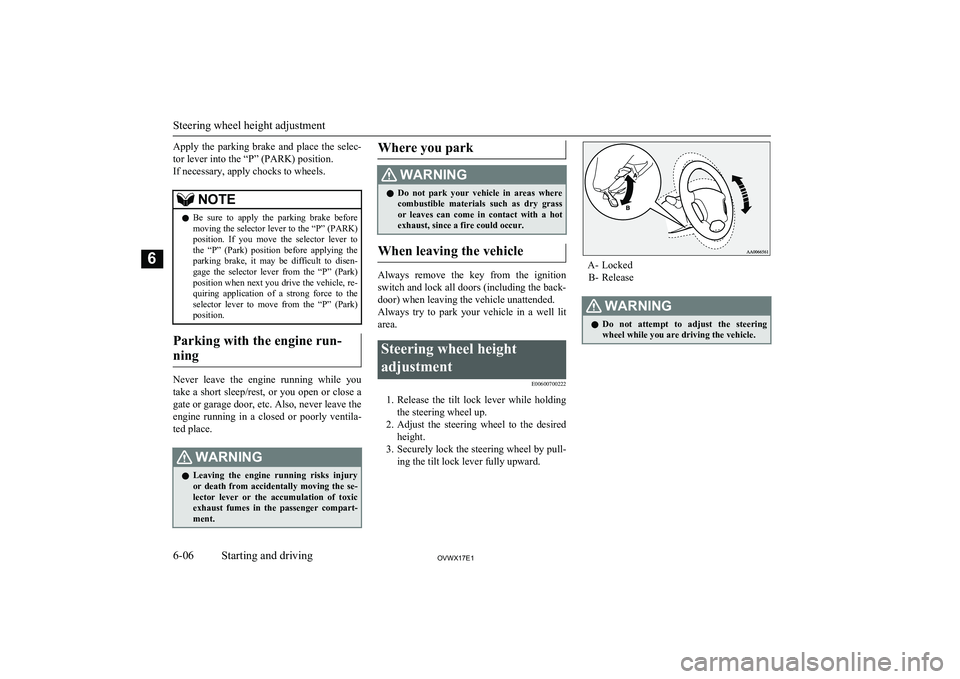
1.Release the tilt lock lever while holding
the steering wheel up.
2. Adjust the steering wheel to the desired
height.
3. Securely lock the steering wheel by pull-
ing the tilt lock lever fully upward.
A- Locked
B- Release
WARNINGl Do not attempt to adjust the steering
wheel while you are driving the vehicle.
Steering wheel height adjustment
6-06OVWX17E1Starting and driving6
Page 148 of 394
NOTElBe careful not to get your hands trapped
while a mirror is moving.
l If you move a mirror by hand or it moves af-
ter hitting a person or object, you may not be
able to return it to its original position using the mirror retractor switch. If this happens,
push the mirror retractor switch to place the mirror in its retracted position and then push
the switch again to return the mirror to its original position.
l If the battery voltage is low and you start the
engine while extending the mirrors, the mir- rors may stop part-way. If this happens, push
the mirror retractor switch to retract the mir- rors and then push the switch again to extend
them.
l When freezing has occurred and mirrors fail
to operate as intended, please refrain from
repeated pushing of the retractor switch as
this action can result in burn-out of the mir- ror motor circuits.
Automatic extension of mirrors
If the engine is stopped and started with the
mirrors retracted, the mirrors automatically
extend for safety when the vehicle speed rea-
ches 30 km/h (19 mph).
Heated mirror*
E00601200312
To demist or defrost the outside rear-view
mirrors, press the rear window demister
switch.
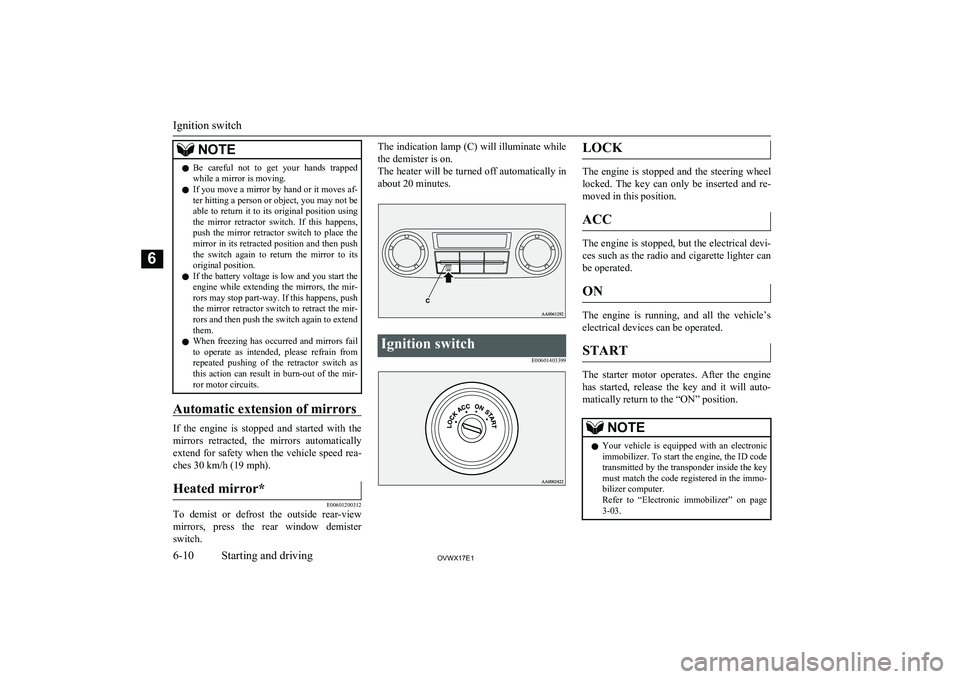
The indication lamp (C) will illuminate while
the demister is on.
The heater will be turned off automatically in about 20 minutes.Ignition switch
E00601403399LOCK
The engine is stopped and the steering wheel
locked. The key can only be inserted and re- moved in this position.
ACC
The engine is stopped, but the electrical devi-
ces such as the radio and cigarette lighter can be operated.
ON
The engine is running, and all the vehicle’s
electrical devices can be operated.
START
The starter motor operates. After the engine has started, release the key and it will auto- matically return to the “ON” position.
NOTEl Your vehicle is equipped with an electronic
immobilizer. To start the engine, the ID codetransmitted by the transponder inside the key must match the code registered in the immo-bilizer computer.
Refer to “Electronic immobilizer” on page
3-03.
Ignition switch
6-10OVWX17E1Starting and driving6
Page 149 of 394
Ignition switch illumination
In the situations listed below, the ignitionswitch illumination comes on to facilitate in-
sertion or removal of the ignition key.
l When any door or the backdoor is
opened, the ignition switch illumination
comes on. When it is closed, the ignition switch illumination becomes steadily
dimmer until completely going off about 15 seconds later.
l When the ignition key is removed with
all the doors and the backdoor closed, the ignition switch illumination comes
on and stays on for about 15 seconds.
The ignition switch illumination immediately goes off if any of the following actions is tak-
en while it is on.
l All of the doors and the backdoor are
closed, and the ignition switch is turned
to the “ON” position.
l All of the doors and the backdoor are
locked using the central door lock func-
tion.
l All of the doors and the backdoor are
locked using the keyless entry system (if so equipped).
NOTEl If the interior lamp switch is in the “()”
position, the ignition switch illumination
will not come on.
l It is possible to adjust the period of ignition
switch illumination (the period until the igni-
tion switch illumination goes off). For de-
tails, we recommend you to consult a
MITSUBISHI MOTORS Authorized Serv-
ice Point.
l If the illumination period of the room & map
lamps or rear personal lamps (the period un-
til these lamps go off) is adjusted, the period
of ignition switch illumination (the period until the ignition switch illumination goes
off) will automatically be changed at the same time.
If the illumination period of the room & map
lamps or rear personal lamps is set to zero
(in other words, the illumination keep-on function is deactivated), the ignition switch
illumination will not come on when the igni-
tion switch is removed.
For information, we recommend you to con-
sult a MITSUBISHI MOTORS Authorized
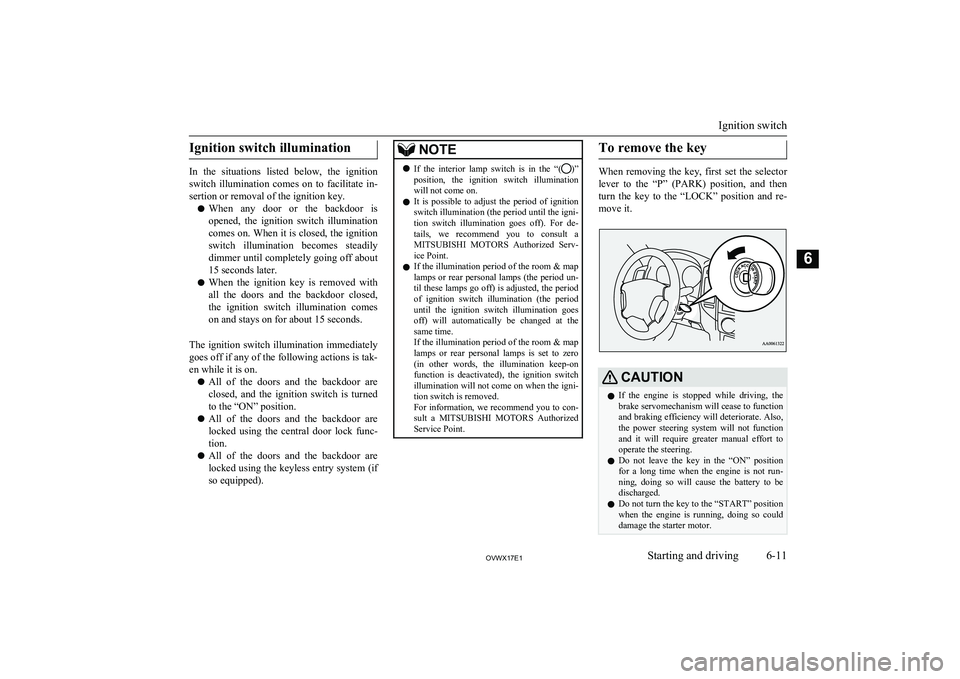
Service Point.To remove the key
When removing the key, first set the selector
lever to the “P” (PARK) position, and thenturn the key to the “LOCK” position and re-
move it.
CAUTIONl If the engine is stopped while driving, the
brake servomechanism will cease to function and braking efficiency will deteriorate. Also,
the power steering system will not function
and it will require greater manual effort to
operate the steering.
l Do not leave the key in the “ON” position
for a long time when the engine is not run- ning, doing so will cause the battery to bedischarged.
l Do not turn the key to the “START” position
when the engine is running, doing so could damage the starter motor.
Ignition switch
6-11OVWX17E1Starting and driving6
Page 150 of 394
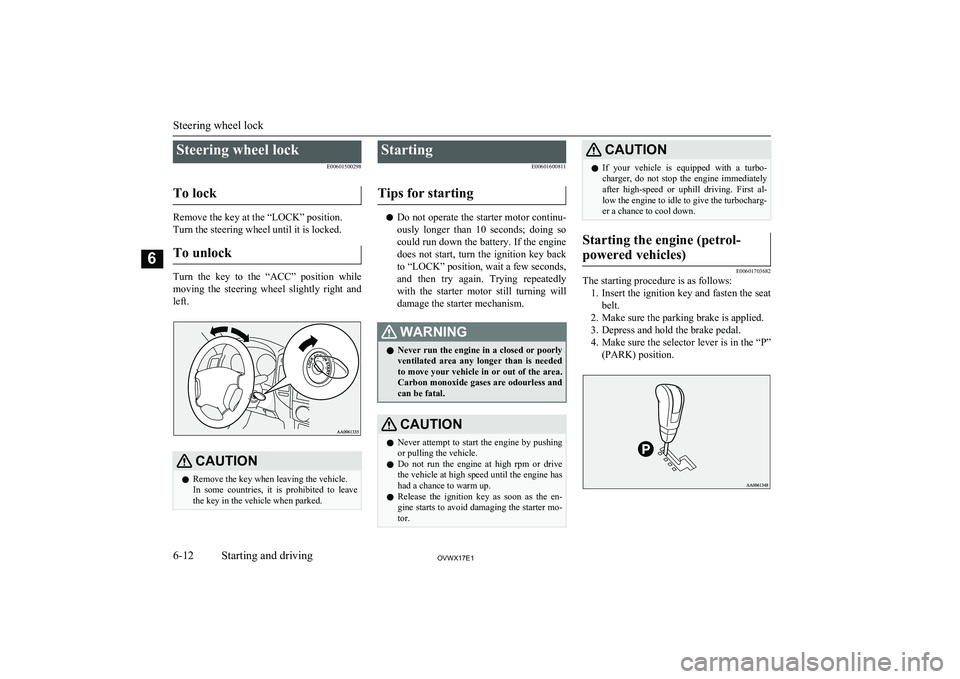
Steering wheel lockE00601500298
To lock
Remove the key at the “LOCK” position.
Turn the steering wheel until it is locked.
To unlock
Turn the key to the “ACC” position while
moving the steering wheel slightly right and left.
CAUTIONl Remove the key when leaving the vehicle.
In some countries, it is prohibited to leave the key in the vehicle when parked.Starting
E00601600811
Tips for starting
l Do not operate the starter motor continu-
ously longer than 10 seconds; doing so
could run down the battery. If the engine
does not start, turn the ignition key back to “LOCK” position, wait a few seconds,and then try again. Trying repeatedly with the starter motor still turning will
damage the starter mechanism.
WARNINGl Never run the engine in a closed or poorly
ventilated area any longer than is needed to move your vehicle in or out of the area.Carbon monoxide gases are odourless and
can be fatal.CAUTIONl Never attempt to start the engine by pushing
or pulling the vehicle.
l Do not run the engine at high rpm or drive
the vehicle at high speed until the engine has had a chance to warm up.
l Release the ignition key as soon as the en-
gine starts to avoid damaging the starter mo-
tor.CAUTIONl If your vehicle is equipped with a turbo-
charger, do not stop the engine immediately
after high-speed or uphill driving. First al-
low the engine to idle to give the turbocharg-
er a chance to cool down.Starting the engine (petrol-
powered vehicles)
E00601703682
The starting procedure is as follows: 1. Insert the ignition key and fasten the seat
belt.
2. Make sure the parking brake is applied.
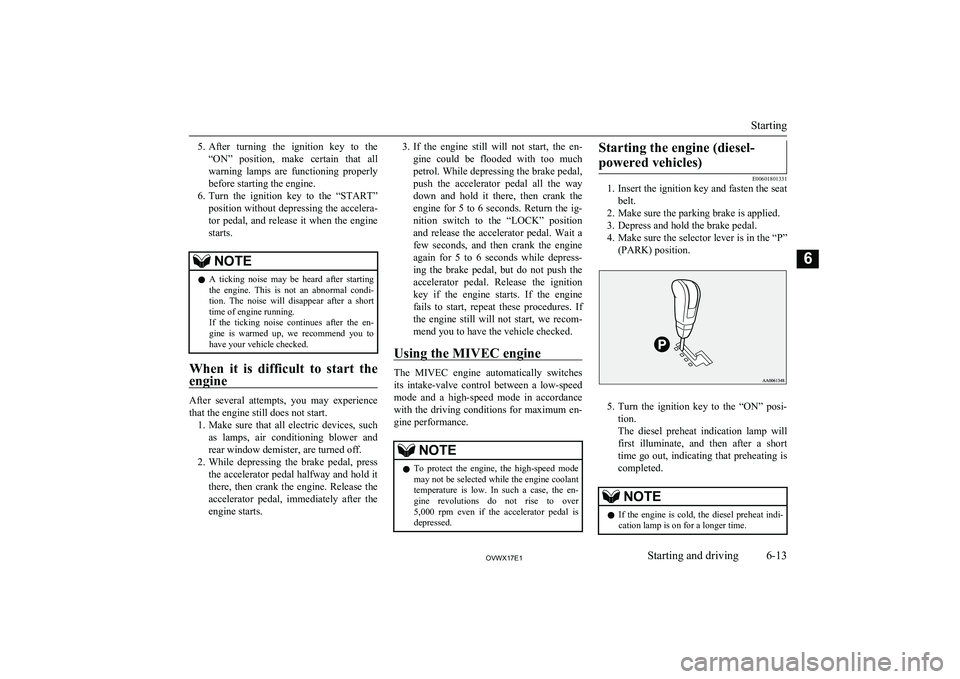
3. Depress and hold the brake pedal.
4. Make sure the selector lever is in the “P”
(PARK) position.
Steering wheel lock
6-12OVWX17E1Starting and driving6
Page 151 of 394
5.After turning the ignition key to the
“ON” position, make certain that all
warning lamps are functioning properly before starting the engine.
6. Turn the ignition key to the “START”
position without depressing the accelera-
tor pedal, and release it when the engine starts.NOTEl A ticking noise may be heard after starting
the engine. This is not an abnormal condi-tion. The noise will disappear after a shorttime of engine running.
If the ticking noise continues after the en-
gine is warmed up, we recommend you to have your vehicle checked.
When it is difficult to start the
engine
After several attempts, you may experience that the engine still does not start. 1. Make sure that all electric devices, such
as lamps, air conditioning blower and
rear window demister, are turned off.
2. While depressing the brake pedal, press
the accelerator pedal halfway and hold it
there, then crank the engine. Release the
accelerator pedal, immediately after the
engine starts.
3. If the engine still will not start, the en-
gine could be flooded with too much
petrol. While depressing the brake pedal, push the accelerator pedal all the way
down and hold it there, then crank the
engine for 5 to 6 seconds. Return the ig- nition switch to the “LOCK” position
and release the accelerator pedal. Wait a few seconds, and then crank the engine
again for 5 to 6 seconds while depress-
ing the brake pedal, but do not push the accelerator pedal. Release the ignition
key if the engine starts. If the engine
fails to start, repeat these procedures. If the engine still will not start, we recom-
mend you to have the vehicle checked.
Using the MIVEC engine
The MIVEC engine automatically switches its intake-valve control between a low-speed mode and a high-speed mode in accordancewith the driving conditions for maximum en-
gine performance.
NOTEl To protect the engine, the high-speed mode
may not be selected while the engine coolanttemperature is low. In such a case, the en-
gine revolutions do not rise to over
5,000 rpm even if the accelerator pedal is depressed.Starting the engine (diesel-
powered vehicles)
E00601801331
1. Insert the ignition key and fasten the seat
belt.
2. Make sure the parking brake is applied.
3. Depress and hold the brake pedal.
4. Make sure the selector lever is in the “P”
(PARK) position.
5. Turn the ignition key to the “ON” posi-
tion.
The diesel preheat indication lamp will
first illuminate, and then after a short
time go out, indicating that preheating is completed.
NOTEl If the engine is cold, the diesel preheat indi-
cation lamp is on for a longer time.
Starting
6-13OVWX17E1Starting and driving6