engine MITSUBISHI SPYDER 1990 Service Repair Manual
[x] Cancel search | Manufacturer: MITSUBISHI, Model Year: 1990, Model line: SPYDER, Model: MITSUBISHI SPYDER 1990Pages: 2103, PDF Size: 68.98 MB
Page 277 of 2103
On-vehicle Service
A/C COMPRESSOR DRIVE BELT TENSION ADJUSTMENT
1. Loosen tension pulley fixing nut A.
2. Adjust belt tension with adjusting bolt B.
Standard value:
When a new belt isWhen a used belt is
installed installed
Tension
382-411255-333
(Ibs.)
Deflection8.5-7.5
mm (in.)
3. Tighten fixing nut A. Tightening torque: 23-26 Nm
4.Check the belt deflection amount and readjust if ne ces-
sary.
Caution
This check should be carried out after turning the
crankshaft one full rotation or more
the forward
direction (to the right).
IGNITION TIMING CHECK
1.Before inspection and adjustment set vehicle in the follow-
ing condition.
lEngine coolant temperature:
lLights, electric cooling fan and all accessories: OFF
Transaxle: Neutral (P range on vehicles with
2. Turn the ignition switch to OFF and connect the scan
tool to the data link connector.
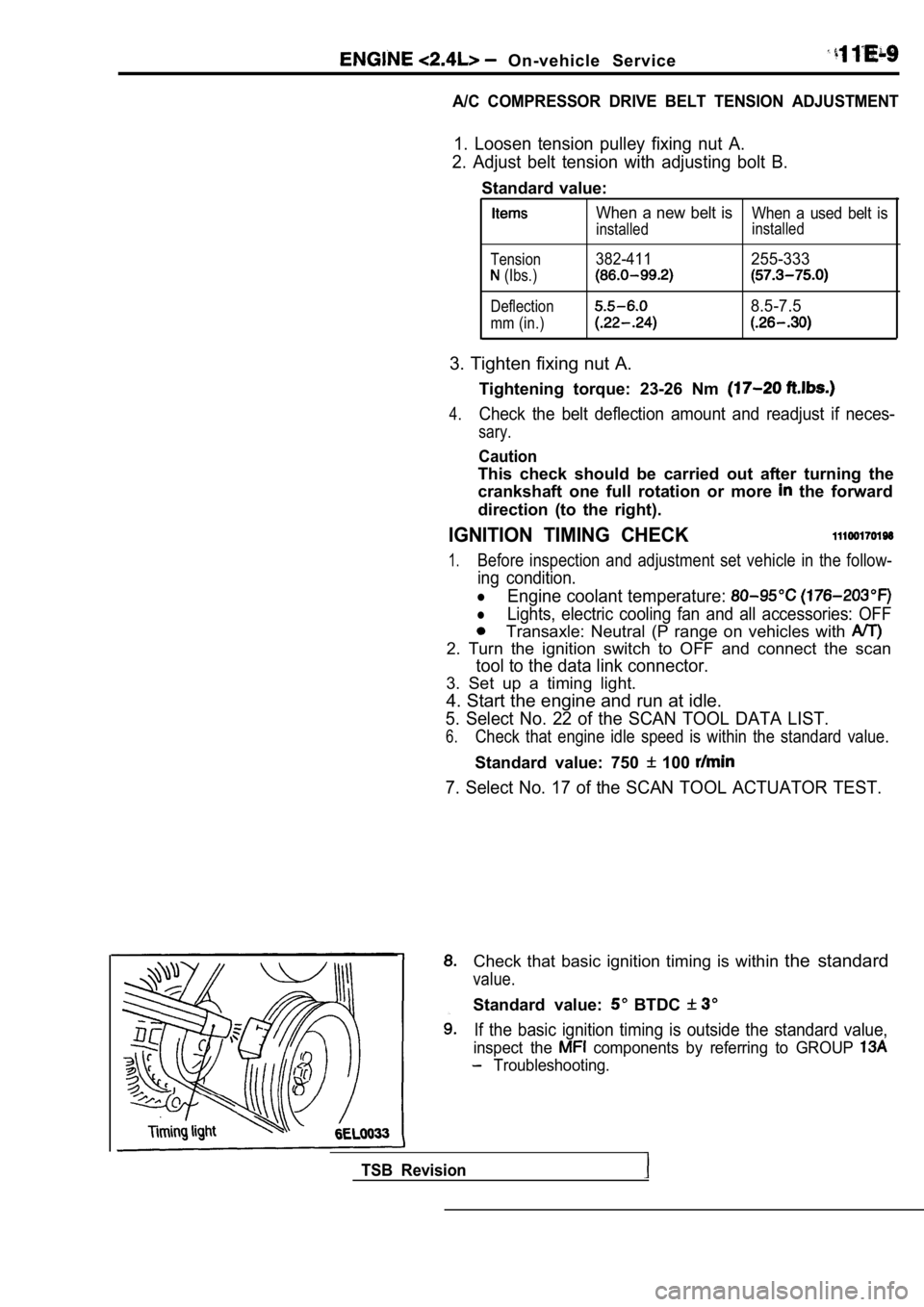
3. Set up a timing light.
4. Start the engine and run at idle.
5. Select No. 22 of the SCAN TOOL DATA LIST.
6.Check that engine idle speed is within the standard value.
Standard value: 750 100
7. Select No. 17 of the SCAN TOOL ACTUATOR TEST.
Check that basic ignition timing is within the standard
value.
Standard value: BTDC
If the basic ignition timing is outside the standar d value,
inspect the components by referring to GROUP
Troubleshooting.
TSB Revision
Page 278 of 2103
ENGINE O n - v e h i c l e
Press the scan tool clear key (select aforced driving
cancel mode) to release the ACTUATOR TEST
NOTE
If the test is not a forced driving will continue
for 27 minutes. Driving under this condition may damage
the engine.
Check that the actual ignition timing is at the st andard
value.
Standard value: Approx. BTDC
NOTE
Ignition timing is variable within about even under
normal operating.
2. And it is automatically further advanced by abou t
from BTDC at higher altitudes.
CURB IDLE SPEED CHECK
Before inspection and adjustment, set vehicles in the
following condition.
lEngine coolant temperature:
lLights, electric cooling fan and all accessories: OFF
lTransaxle: Neutral (P range on vehicles with A/T)
2. Turn the ignition switch to OFF and connect the scan
tool to the data link connector.
3. Select No. 17 of the SCAN TOOL ACTUATOR TEST
4. Check the basic ignition timing.
Standard value: BTDC
5. Run the engine at idle for 2 minutes.
6. Select No. 22 of the SCAN TOOL DATA LIST.
7. Check the curb idle speed.
Standard value: 750 100
NOTE
The idle speed is controlled automatically by the i dle air
control system.
8. If the idle speed is outside the standard value, check
the components by referring to GROUP Trou-
bleshooting.
IDLE MIXTURE CHECK
Before inspection, set vehicles in the following co ndition:
lEngine coolant temperature:
lLights, electric cooling fan and all accessories: O FF
lTransaxle: Neutral (P range on vehicles with
2. Turn the ignition switch to OFF and connect the scan
tool to the data link connector.
3. Select No. 17 of the SCAN TOOL ACTUATOR TEST.
4.Check that the basic ignition timing is within the standard
value..
Standard value:
TSB Revision
Page 279 of 2103
On-vehicle
Run the engine.
8. Set CO, HC tester.
7. Check the CO contents and the HC contents at idle.
Standard value:
CO contents: 0.5% or less
HC contents: 100 ppm or less
8. the standard value is exceeded, check the following
items:
l Diagnostic output
l Closed-loop control (When the closed-loop control
is carried out normally, the output signal of the heated
oxygen sensor and
at idle.)
l
Injector
lIgnition coil, spark plug
l system the
l Evaporative emission
Compression ,
NOTE,
Replace the three-way CO and
HC contents do not
the value.
(even though the
of the” on
all items.)
PRESSURE CHECK
1.Before inspection, check that the engine oil, start er and
battery are normal. Also, set the vehicle to the fo llowing
condition:
lEngine coolant temperature:
lLights, electric cooling fan and all accessories: O FF
lTransaxle: Neutral (P range on vehicles with
2. Disconnect the spark plug cables.
3. Remove all of the spark plugs.
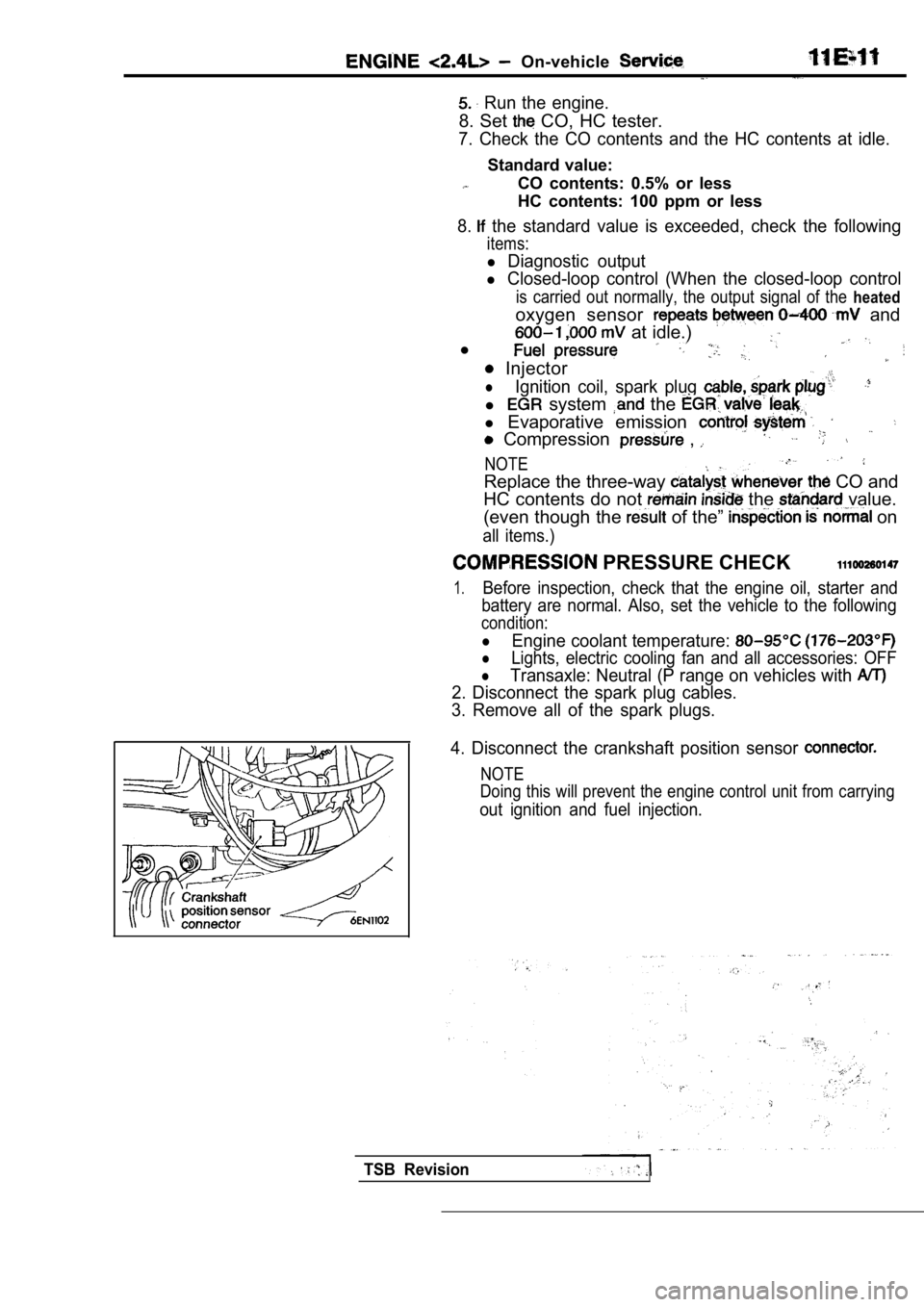
4. Disconnect the crankshaft position sensor
NOTE
Doing this will prevent the engine control unit fro m carrying
out ignition and fuel injection.
TSB Revision
Page 280 of 2103
ENGINEOn-vehicle
5. Cover the spark plug hole with a shop towel etc., and
after the engine has been cranked, check that no foreign
material is adhering to the shop towel.
Caution
1.Keep away from the spark plug hole when crank-
ing.
2. If compression is measured with water, fuel,
etc., that has come from cracks inside the
these materials will become heated and gush
out from the spark plug hole, which is dangerous.
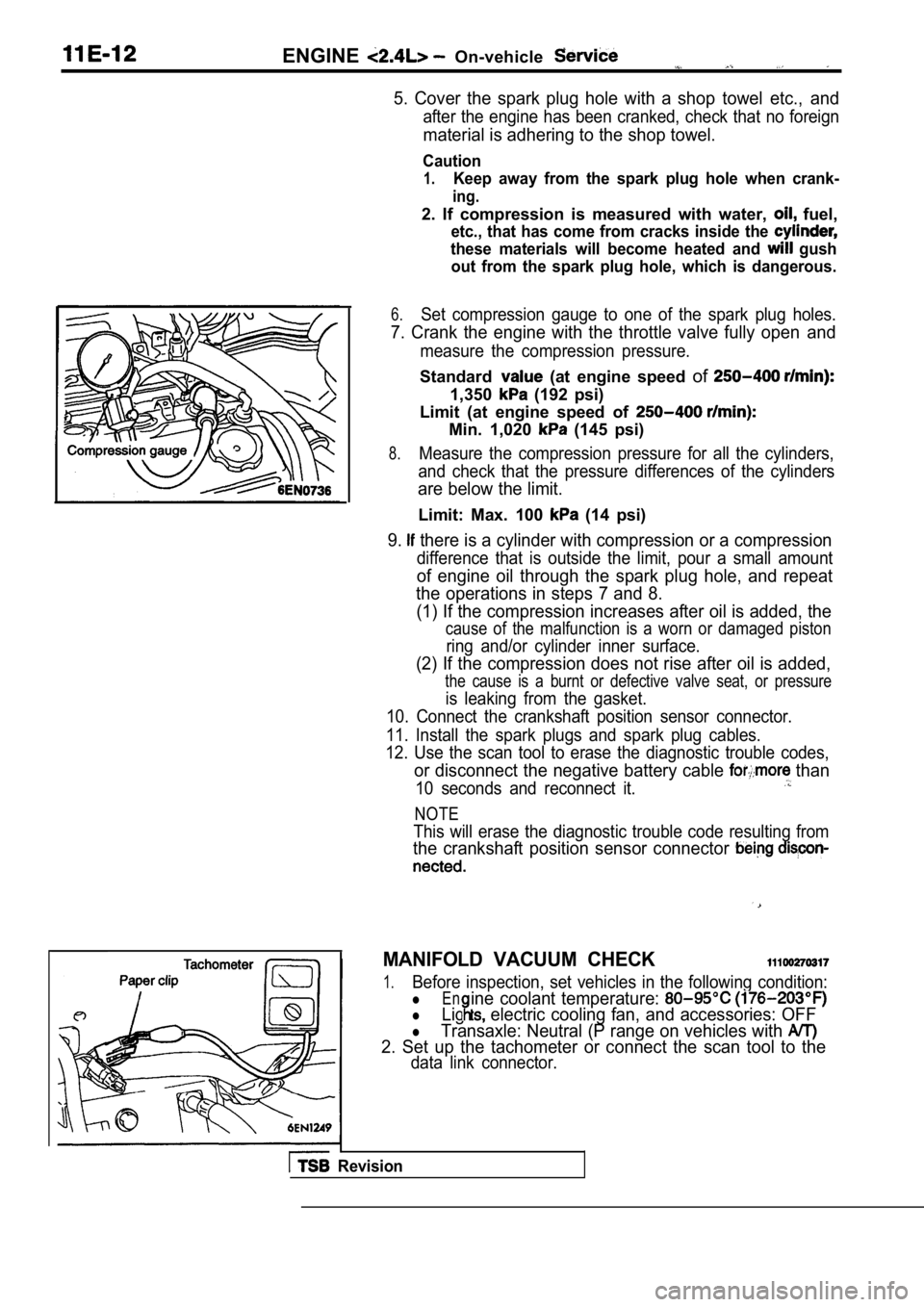
6.Set compression gauge to one of the spark plug hole s.
7. Crank the engine with the throttle valve fully open and
measure the compression pressure.
Standard (at engine speed of
1,350 (192 psi)
Limit (at engine speed of
Min. 1,020 (145 psi)
8.Measure the compression pressure for all the cylind ers,
and check that the pressure differences of the cyli nders
are below the limit.
Limit: Max. 100 (14 psi)
9. there is a cylinder with compression or a compression
difference that is outside the limit, pour a small amount
of engine oil through the spark plug hole, and repe at
the operations in steps 7 and 8.
(1) If the compression increases after oil is added , the
cause of the malfunction is a worn or damaged pisto n
ring and/or cylinder inner surface.
(2) If the compression does not rise after oil is added,
the cause is a burnt or defective valve seat, or pr essure
is leaking from the gasket.
10. Connect the crankshaft position sensor connecto r.
11. Install the spark plugs and spark plug cables.
12. Use the scan tool to erase the diagnostic troub le codes,
or disconnect the negative battery cable than
10 seconds and reconnect it.
NOTE
This will erase the diagnostic trouble code resulting from
the crankshaft position sensor connector
MANIFOLD VACUUM CHECK
1.Before inspection, set vehicles in the following co ndition:
lEn
lLig electric cooling fan, and accessories: OFF
ine coolant temperature:
lTransaxle: Neutral (P range on vehicles with
2. Set up the tachometer or connect the scan tool t o the
data link connector.
Revision
Page 281 of 2103
ENGINE On-vehicle Service’
Highpressurechamber
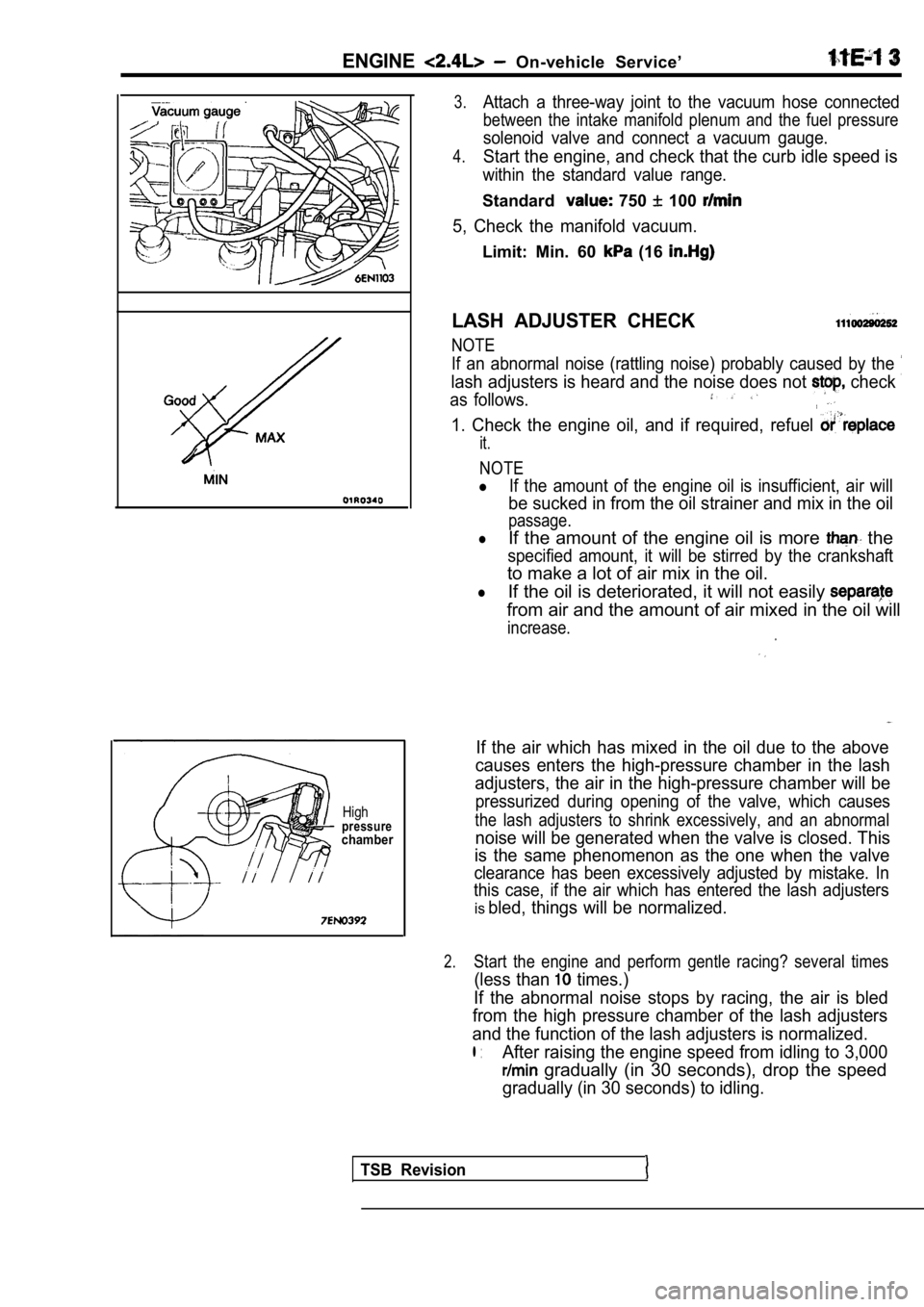
3.Attach a three-way joint to the vacuum hose connected
between the intake manifold plenum and the fuel pressure
solenoid valve and connect a vacuum gauge.
4.Start the engine, and check that the curb idle speed is
within the standard value range.
Standard 750 100
5, Check the manifold vacuum.
Limit: Min. 60 (16
LASH ADJUSTER CHECK
NOTE
If an abnormal noise (rattling noise) probably caus ed by the
lash adjusters is heard and the noise does not check
as follows.
1. Check the engine oil, and if required, refuel
it.
NOTE
lIf the amount of the engine oil is insufficient, air will
be sucked in from the oil strainer and mix in the o il
passage.
lIf the amount of the engine oil is more the
specified amount, it will be stirred by the cranksh aft
to make a lot of air mix in the oil.
lIf the oil is deteriorated, it will not easily
from air and the amount of air mixed in the oil will
increase.
If the air which has mixed in the oil due to the ab ove
causes enters the high-pressure chamber in the lash
adjusters, the air in the high-pressure chamber wil l be
pressurized during opening of the valve, which caus es
the lash adjusters to shrink excessively, and an abnormal
noise will be generated when the valve is closed. This
is the same phenomenon as the one when the valve
clearance has been excessively adjusted by mistake. In
this case, if the air which has entered the lash ad justers
isbled, things will be normalized.
2.Start the engine and perform gentle racing? several times
(less than times.)
If the abnormal noise stops by racing, the air is b led
from the high pressure chamber of the lash adjuster s
and the function of the lash adjusters is normalize d.
l :After raising the engine speed from idling to 3,000
gradually (in 30 seconds), drop the speed
gradually (in 30 seconds) to idling.
TSB Revision
Page 282 of 2103
ENGINE On-vehicle
NOTE
lIf the vehicle is parked on a slope for long, oil
in the lash adjusters will
and ‘air may
enter the high-pressure’ chamber when the vehicle
i s s t a r t e d .
lAfter the vehicle is parked for long, air may enter the high-pressure
because, the oil in the
oil passage will be gone it take a time before
the oil is supplied to the
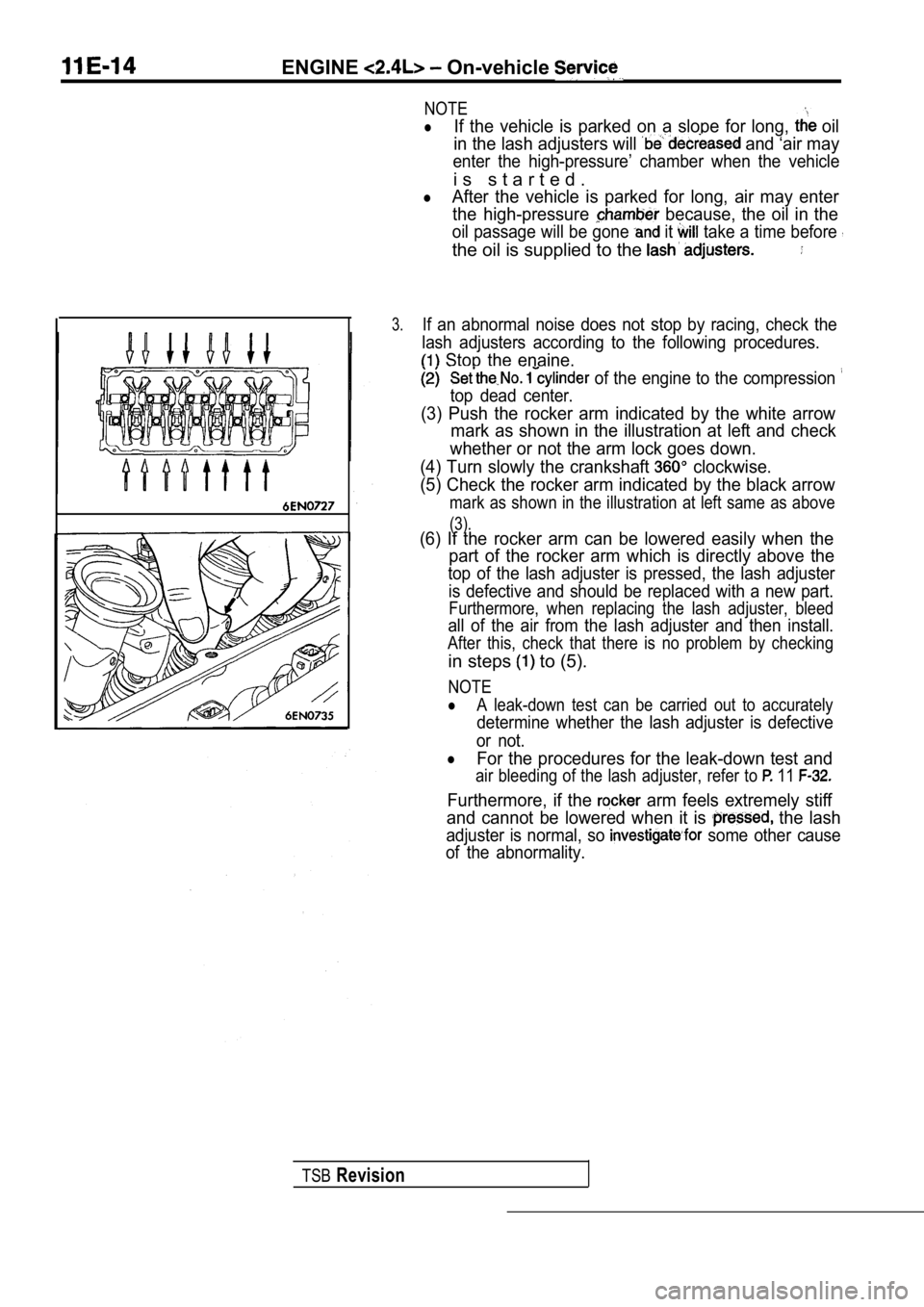
3.If an abnormal noise does not stop by racing, check the
lash adjusters according to the following procedure s.
Stop the enaine.
of the engine to the compression
top dead center.
(3) Push the rocker arm indicated by the white arrow
mark as shown in the illustration at left and check
whether or not the arm lock goes down.
(4) Turn slowly the crankshaft
clockwise.
(5) Check the rocker arm indicated by the black arr ow
mark as shown in the illustration at left same as above
(3).(6) If the rocker arm can be lowered easily when th e
part of the rocker arm which is directly above the
top of the lash adjuster is pressed, the lash adjus ter
is defective and should be replaced with a new part .
Furthermore, when replacing the lash adjuster, blee d
all of the air from the lash adjuster and then install.
After this, check that there is no problem by check ing
in steps to (5).
NOTE
lA leak-down test can be carried out to accurately
determine whether the lash adjuster is defective
or not.
lFor the procedures for the leak-down test and
air bleeding of the lash adjuster, refer to 11
Furthermore, if the arm feels extremely stiff
and cannot be lowered when it is
the lash
adjuster is normal, so some other cause
of the abnormality.
TSBRevision
Page 283 of 2103
Engine Assembly11
ENGINE ASSEMBLY
REMOVAL AND INSTALLATION
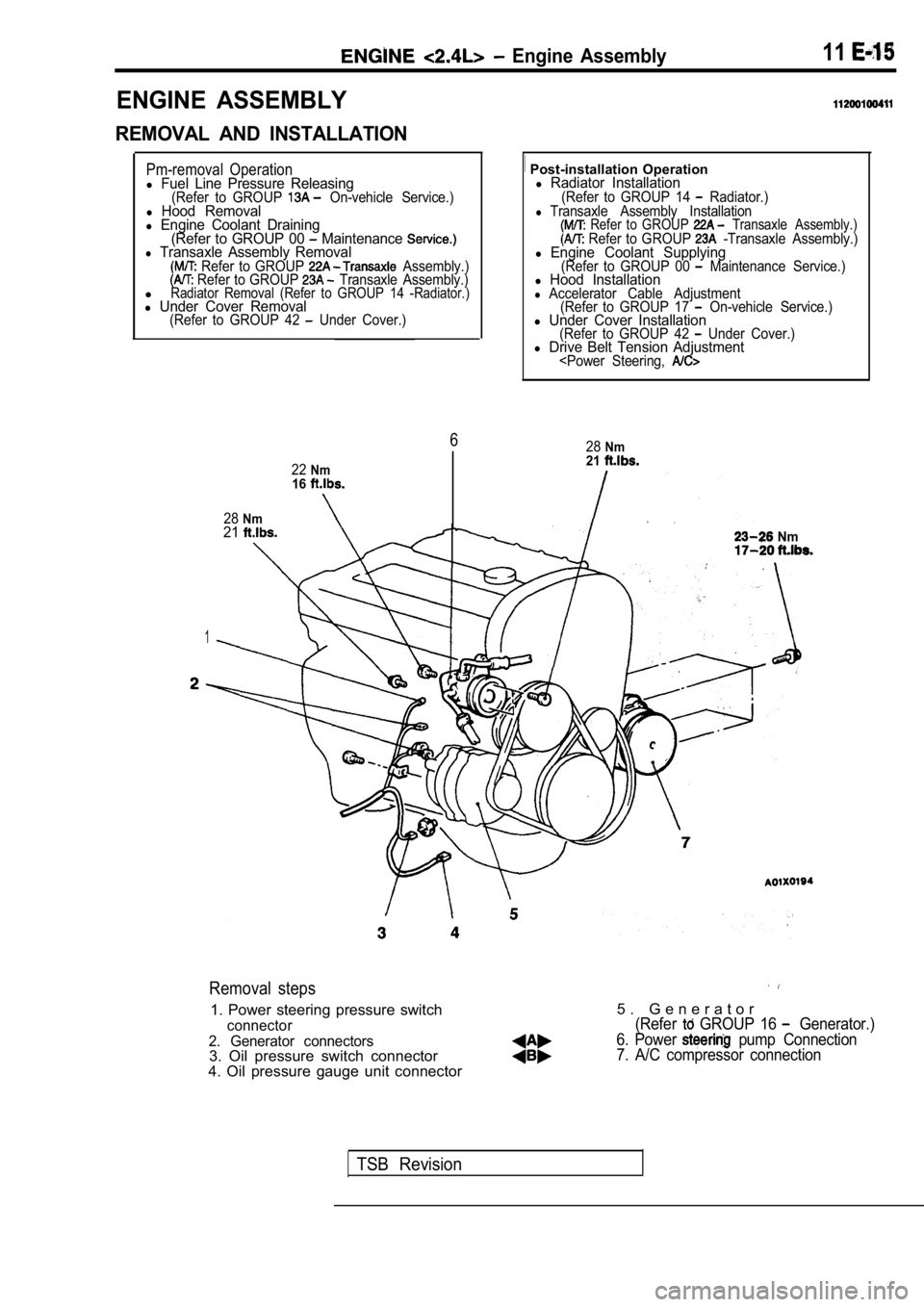
Pm-removal Operationl Fuel Line Pressure Releasing(Refer to GROUP On-vehicle Service.)l Hood Removall Engine Coolant Draining(Refer to GROUP 00 Maintenance l Transaxle Assembly Removal Refer to GROUP Assembly.) Refer to GROUP Transaxle Assembly.)lRadiator Removal (Refer to GROUP 14 -Radiator.)l Under Cover Removal(Refer to GROUP 42 Under Cover.)
1
22Nm16
6
28Nm
Post-installation Operationl Radiator Installation(Refer to GROUP 14 Radiator.)l Transaxle Assembly Installation Refer to GROUP Transaxle Assembly.) Refer to GROUP -Transaxle Assembly.)l Engine Coolant Supplying(Refer to GROUP 00 Maintenance Service.)l Hood Installationl Accelerator Cable Adjustment (Refer to GROUP 17 On-vehicle Service.)l Under Cover Installation(Refer to GROUP 42 Under Cover.)l Drive Belt Tension Adjustment
21 Nm
Removal steps
1. Power steering pressure switch
connector
2. Generator connectors
3. Oil pressure switch connector
4. Oil pressure gauge unit connector
5 . G e n e r a t o r(Refer GROUP 16 Generator.)
6. Power
pump Connection
7. A/C compressor connection
TSB Revision
Page 284 of 2103
.
4 . 9 N m
\ / X L - -3.6
. .
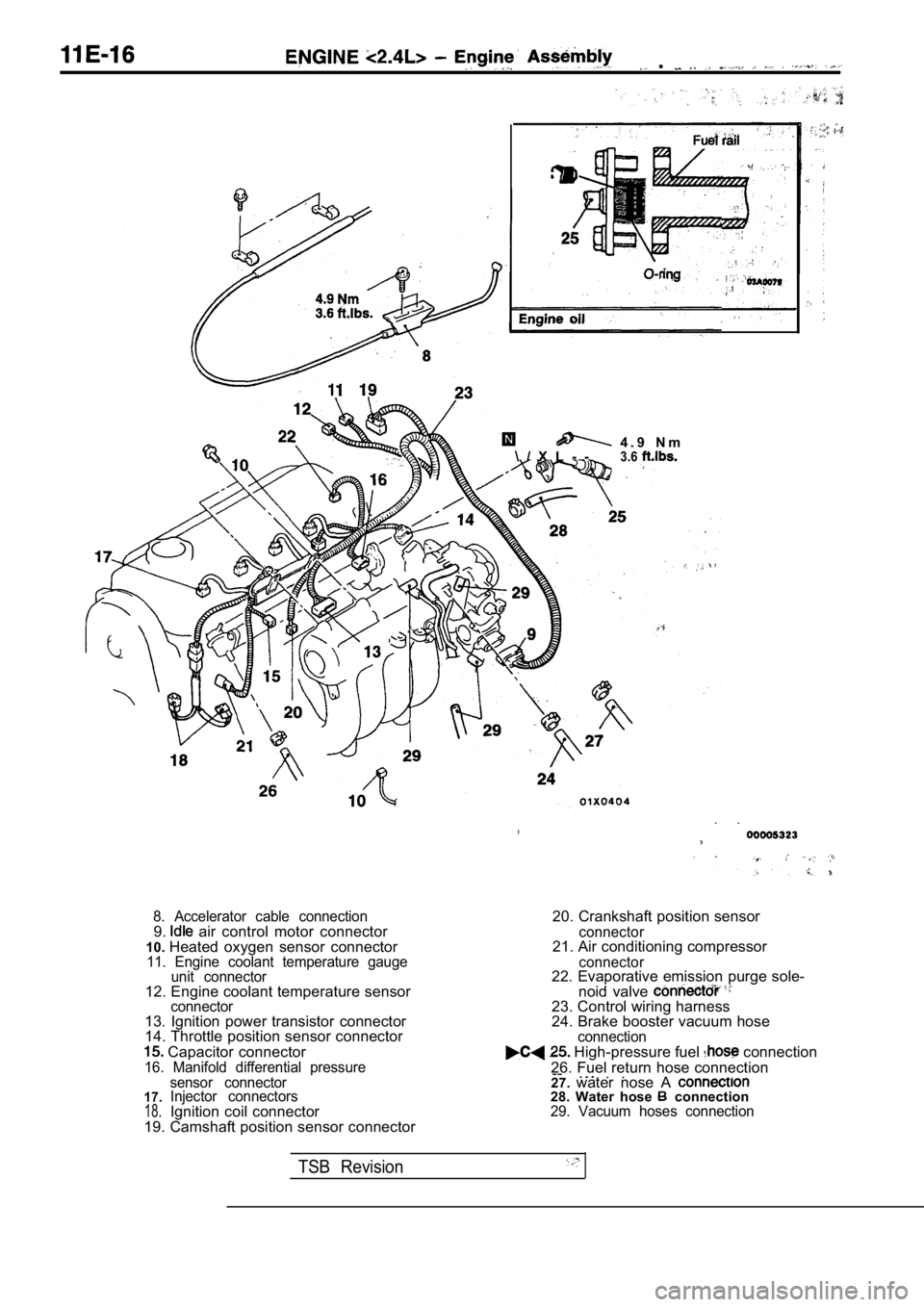
8. Accelerator cable connection9. air control motor connector
10. Heated oxygen sensor connector
11. Engine coolant temperature gauge
unit connector
12. Engine coolant temperature sensorconnector13. Ignition power transistor connector
14. Throttle position sensor connector
Capacitor connector16. Manifold differential pressure
20. Crankshaft position sensor
connector21. Air conditioning compressor
connector22. Evaporative emission purge sole-
noid valve
23. Control wiring harness
24. Brake booster vacuum hose
connection High-pressure fuel connection
26. Fuel return hose connection --
. .. .
17.18.
sensor connector
Injector connectors
Ignition coil connector
19. Camshaft position sensor connector 27.
water nose A 28. Water hose connection29. Vacuum hoses connection
TSB Revision
Page 285 of 2103
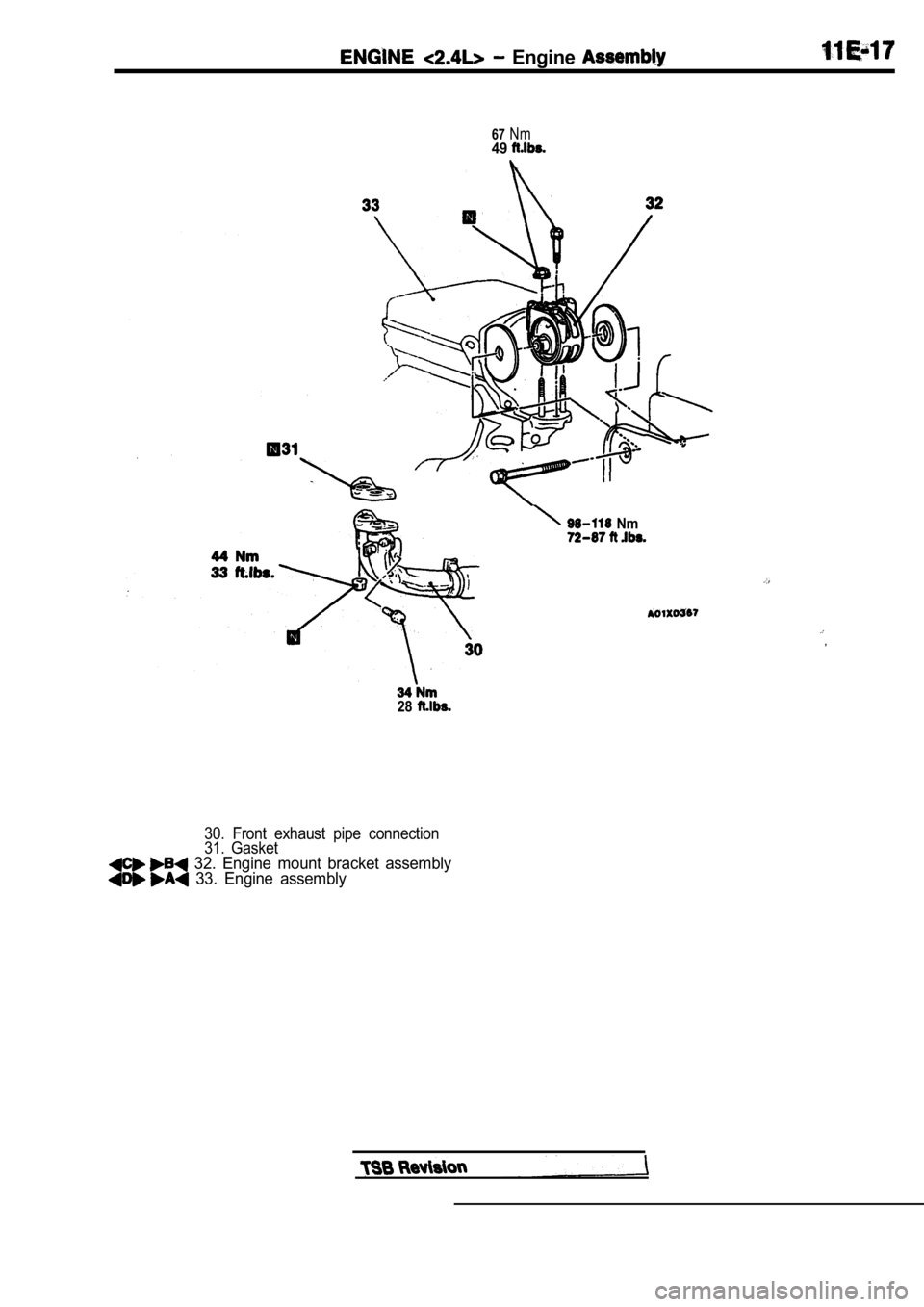
Engine
67Nm49
Nm
28
30. Front exhaust pipe connection
31. Gasket
32. Engine mount bracket assembly 33. Engine assembly
,
Page 286 of 2103
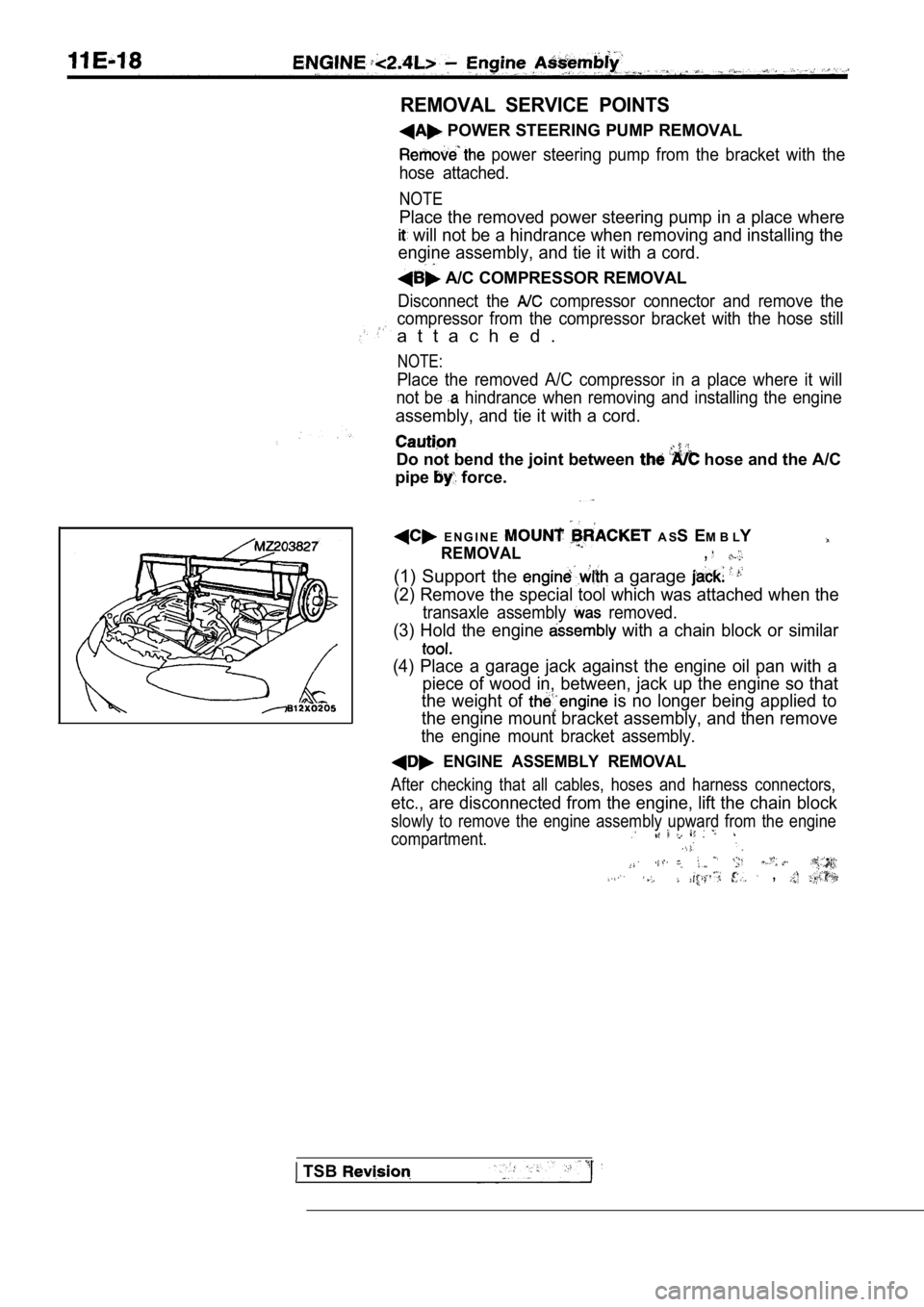
REMOVAL SERVICE POINTS
POWER STEERING PUMP REMOVAL
power steering pump from the bracket with the
hose attached.
NOTE
Place the removed power steering pump in a place wh ere
will not be a hindrance when removing and installing the
engine assembly, and tie it with a cord.
A/C COMPRESSOR REMOVAL
Disconnect the compressor connector and remove the
compressor from the compressor bracket with the hos e still
a t t a c h e d .
NOTE:
Place the removed A/C compressor in a place where i t will
not be
hindrance when removing and installing the engine
assembly, and tie it with a cord.
Do not bend the joint between hose and the A/C
pipe
force.
E N G I N E A S S E M B L Y
REMOVAL,
(1) Support the a garage
(2) Remove the special tool which was attached when the
transaxle assembly removed.
(3) Hold the engine with a chain block or similar
(4) Place a garage jack against the engine oil pan with a
piece of wood in, between, jack up the engine so th at
the weight of
is no longer being applied to
the engine mount bracket assembly, and then remove
the engine mount bracket assembly.
ENGINE ASSEMBLY REMOVAL
After checking that all cables, hoses and harness c onnectors,
etc., are disconnected from the engine, lift the chain block
slowly to remove the engine assembly upward from th e engine
compartment.
,
TSB