check engine MITSUBISHI SPYDER 1990 Service Repair Manual
[x] Cancel search | Manufacturer: MITSUBISHI, Model Year: 1990, Model line: SPYDER, Model: MITSUBISHI SPYDER 1990Pages: 2103, PDF Size: 68.98 MB
Page 629 of 2103
ENGINE (TURBO)
AND
ENGINE>
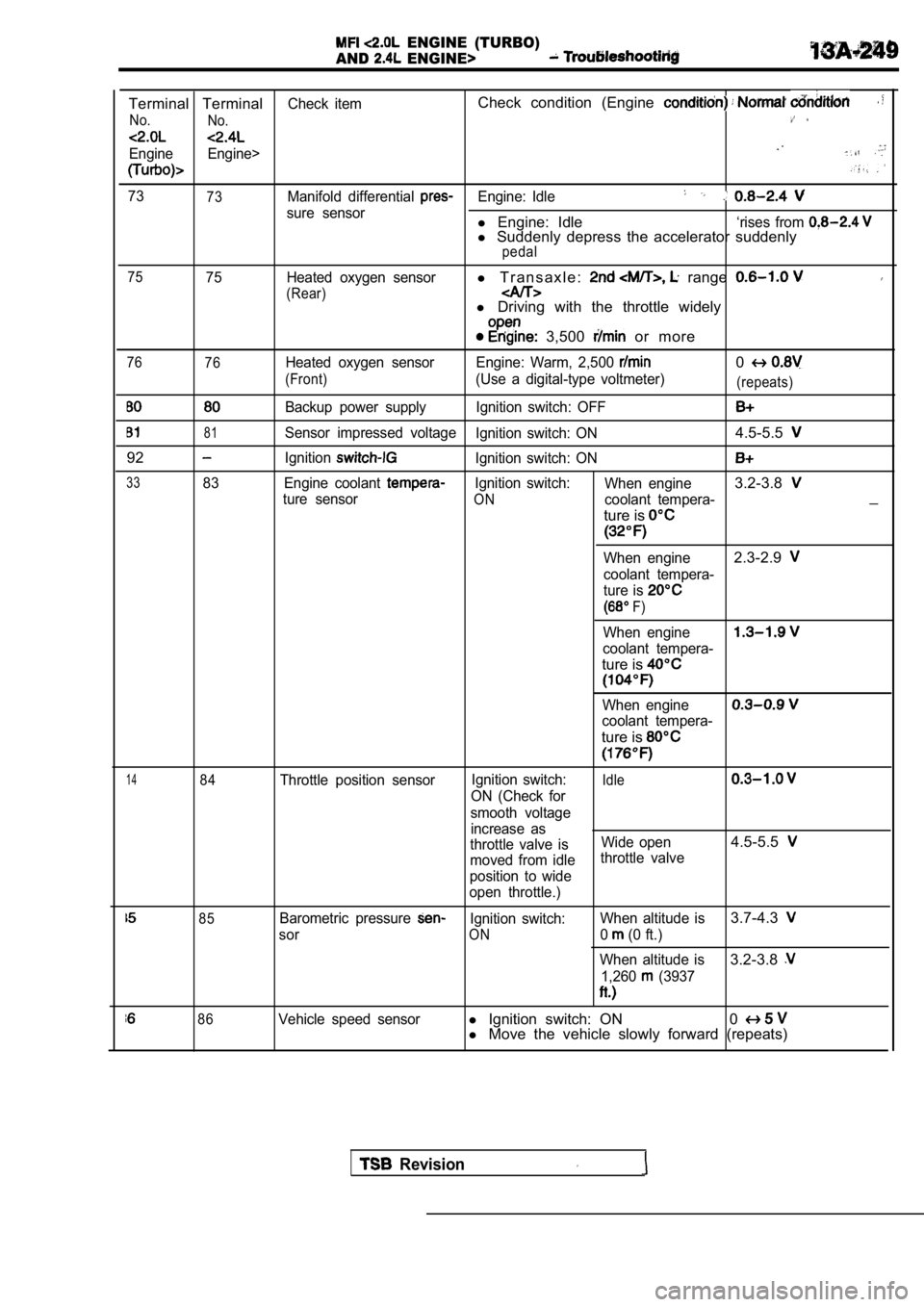
Terminal TerminalCheck itemCheck condition (Engine
No. No.
Engine Engine>
7373Manifold differential Engine: Idle
sure sensorl Engine: Idle‘rises from l Suddenly depress the accelerator suddenlypedal
75
75 Heated oxygen sensorl T r a n s a x l e : range
(Rear)l Driving with the throttle widely
3,500 or more
76
76Heated oxygen sensor Engine: Warm, 2,500 0
(Front)(Use a digital-type voltmeter)(repeats)
Backup power supply Ignition switch: OFF
81Sensor impressed voltage Ignition switch: ON4.5-5.5
92IgnitionIgnition switch: ON
3383 Engine coolant Ignition switch:When engine3.2-3.8
ture sensorONcoolant tempera-_
ture is
When engine2.3-2.9
coolant tempera-
ture is
F)
When engine
coolant tempera-
ture is
When engine
coolant tempera-
ture is
1484Throttle position sensor Ignition switch:Idle
ON (Check for
smooth voltage increase as
throttle valve is Wide open
4.5-5.5
moved from idlethrottle valve
position to wide
open throttle.)
85Barometric pressure Ignition switch: When altitude is3.7-4.3
sorON0 (0 ft.)
When altitude is
3.2-3.8
1,260 (3937
86Vehicle speed sensorl Ignition switch: ON 0l Move the vehicle slowly forward (repeats)
Revision
Page 630 of 2103
ENGINE (TURBO)
AND
ENGINE> Troubleshooting
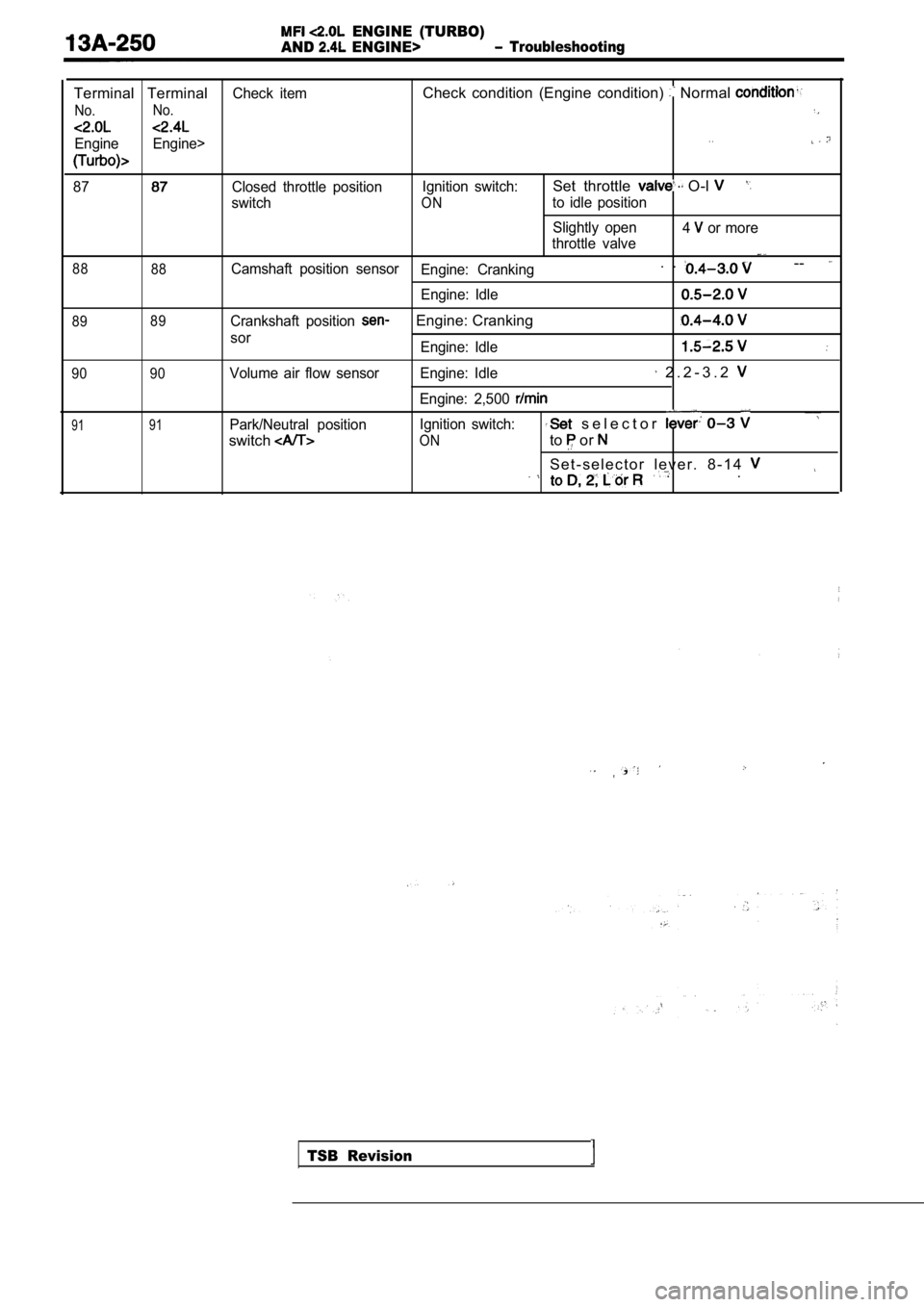
Terminal TerminalCheck itemCheck condition (Engine condition) Normal
No. No.
Engine Engine>. .
87Closed throttle position Ignition switch:Set throttle O-l
switchONto idle position
Slightly open 4
or more
throttle valve
88 88Camshaft position sensor
Engine: Cranking. . --
8989
90 90
9191
Engine: Idle
Crankshaft position Engine: Cranking
sor Engine: Idle
Volume air flow sensor Engine: Idle 2 . 2 - 3 . 2
Engine: 2,500 __
Park/Neutral positionIgnition switch: s e l e c t o r
switchONto or
S e t - s e l e c t o r l e v e r . 8 - 1 4 .
TSB Revision
Page 631 of 2103
ENGINE (TURBO)
AND ENGINE>
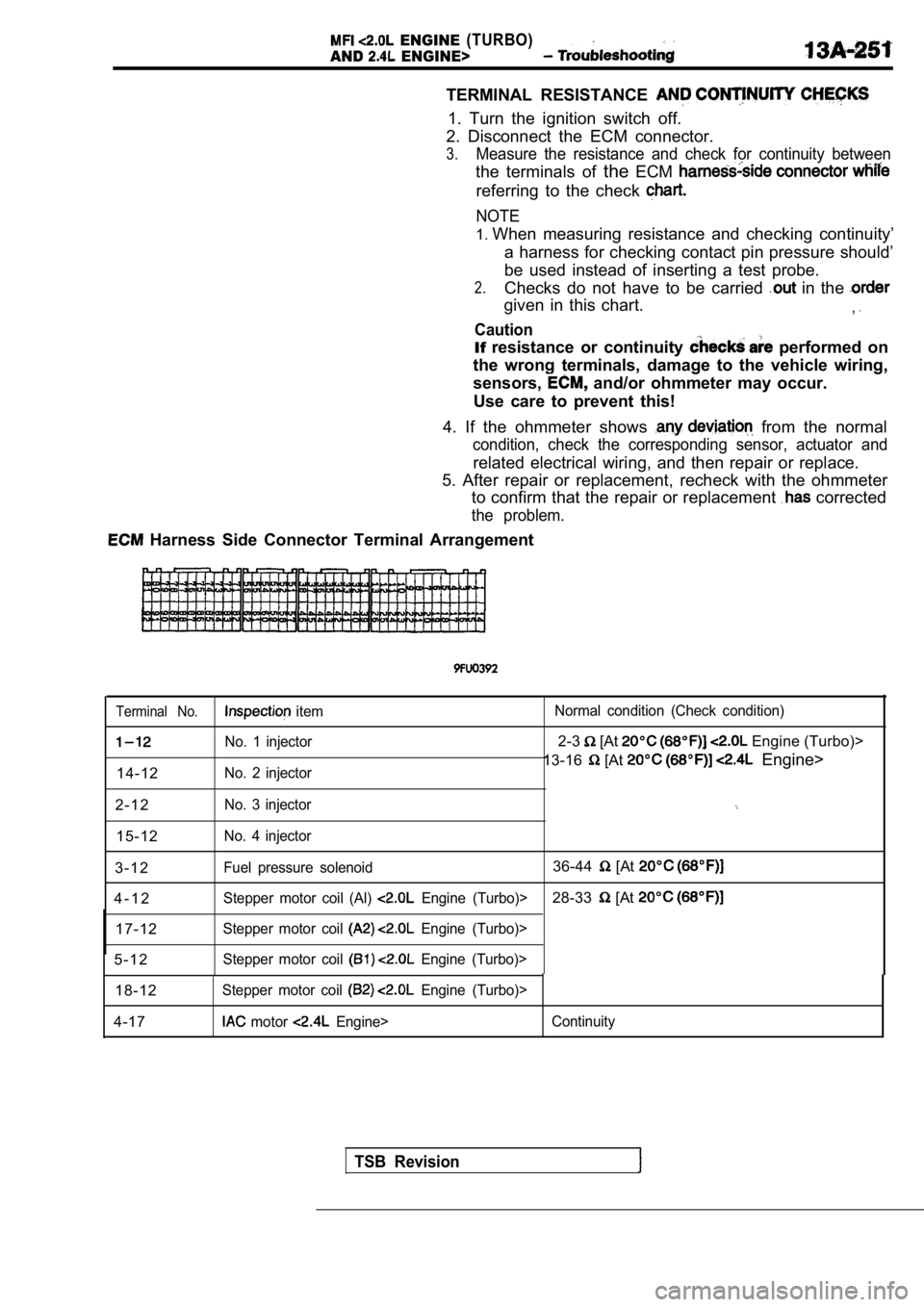
TERMINAL RESISTANCE
1. Turn the ignition switch off.
2. Disconnect the ECM connector.
3.Measure the resistance and check for continuity bet ween
the terminals of theECM
referring to the check
NOTE
1.When measuring resistance and checking continuity’
a harness for checking contact pin pressure should’
be used instead of inserting a test probe.
2.Checks do not have to be carried in the
given in this chart.,
Caution
If resistance or continuity performed on
the wrong terminals, damage to the vehicle wiring,
sensors,
and/or ohmmeter may occur.
Use care to prevent this!
4. If the ohmmeter shows
from the normal
condition, check the corresponding sensor, actuator and
related electrical wiring, and then repair or replace.
5. After repair or replacement, recheck with the oh mmeter
to confirm that the repair or replacement
corrected
the problem.
Harness Side Connector Terminal Arrangement
Terminal No. item Normal condition (Check condition)
No. 1 injector2-3 [At Engine (Turbo)>
No. 2 injector13-16 [At Engine>
14-12
2 - 1 2
No. 3 injector
15-12No. 4 injector
3 - 1 2Fuel pressure solenoid36-44 [At
4 - 1 2Stepper motor coil (Al) Engine (Turbo)>28-33 [At
17-12Stepper motor coil Engine (Turbo)>
5 - 1 2Stepper motor coil Engine (Turbo)>
18-12Stepper motor coil Engine (Turbo)>
4-17 motor Engine> Continuity
TSB Revision
Page 632 of 2103
ENGINE (TURBO)
AND ENGINE> Troubleshooting
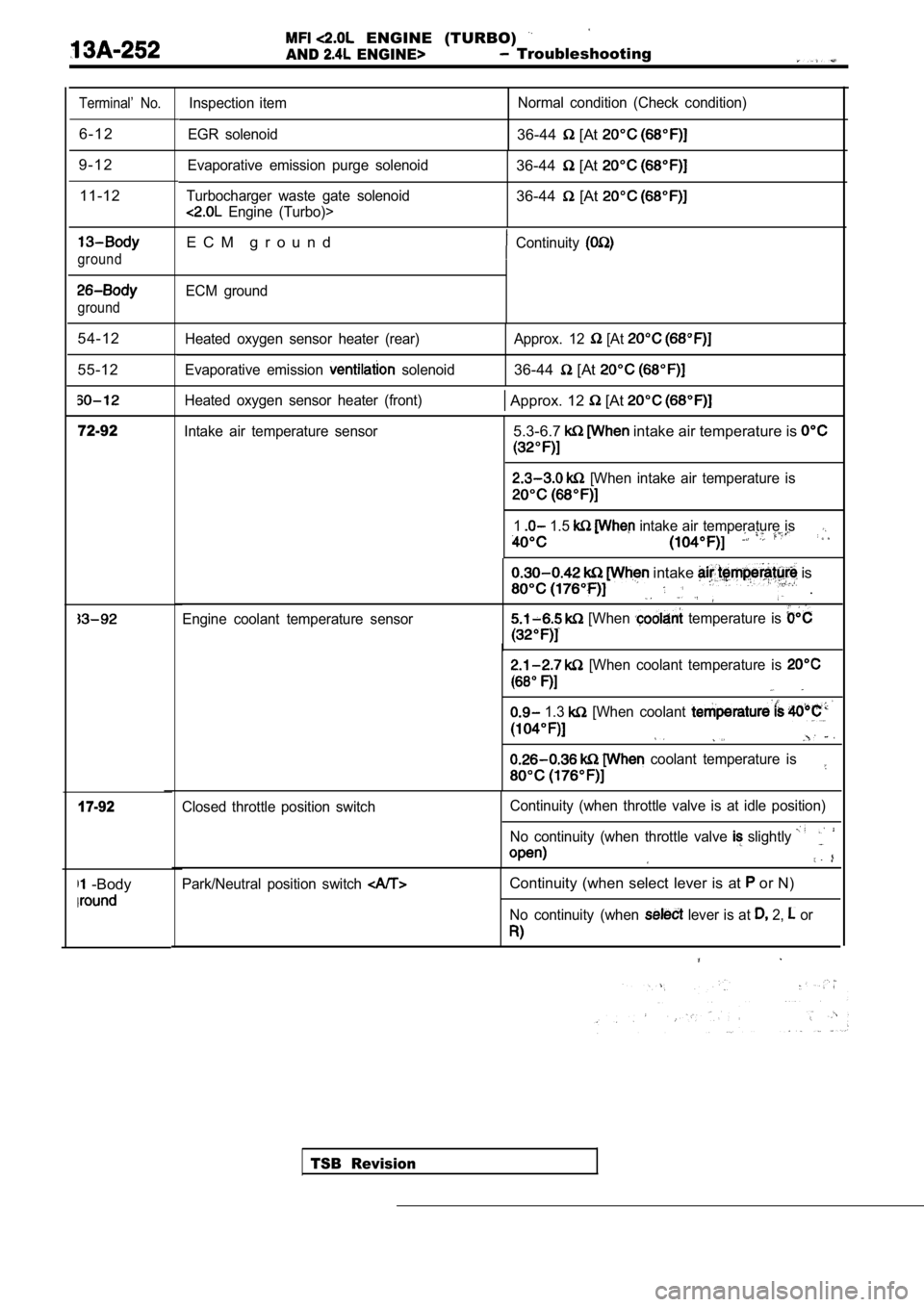
Terminal’ No.
6 - 1 2
9 - 1 2 11-12
ground
ground
54-12
55-12
72-92
17-92
-Body
Inspection item
EGR solenoid Normal condition (Check condition)
36-44 [At
Evaporative emission purge solenoid
Turbocharger waste gate solenoid
Engine (Turbo)>
36-44 [At
36-44 [At
E C M g r o u n dContinuity
ECM ground
Heated oxygen sensor heater (rear)
Evaporative emission
solenoid Approx. 12
[At
36-44 [At
Heated oxygen sensor heater (front) Approx. 12 [At
Intake air temperature sensor5.3-6.7 intake air temperature is
[When intake air temperature is
1 1.5 intake air temperature is
Engine coolant temperature sensor
intake is
.
[When temperature is
[When coolant temperature is
1.3 [When coolant
coolant temperature is
TSB Revision
Closed throttle position switch
Continuity (when throttle valve is at idle position
)
No continuity (when throttle valve
slightly
Park/Neutral position switch Continuity (when select lever is at or N)
No continuity (when lever is at 2, or
Page 634 of 2103
ENGINE (TURBO)
AND ENGINE> Troubleshooting . .
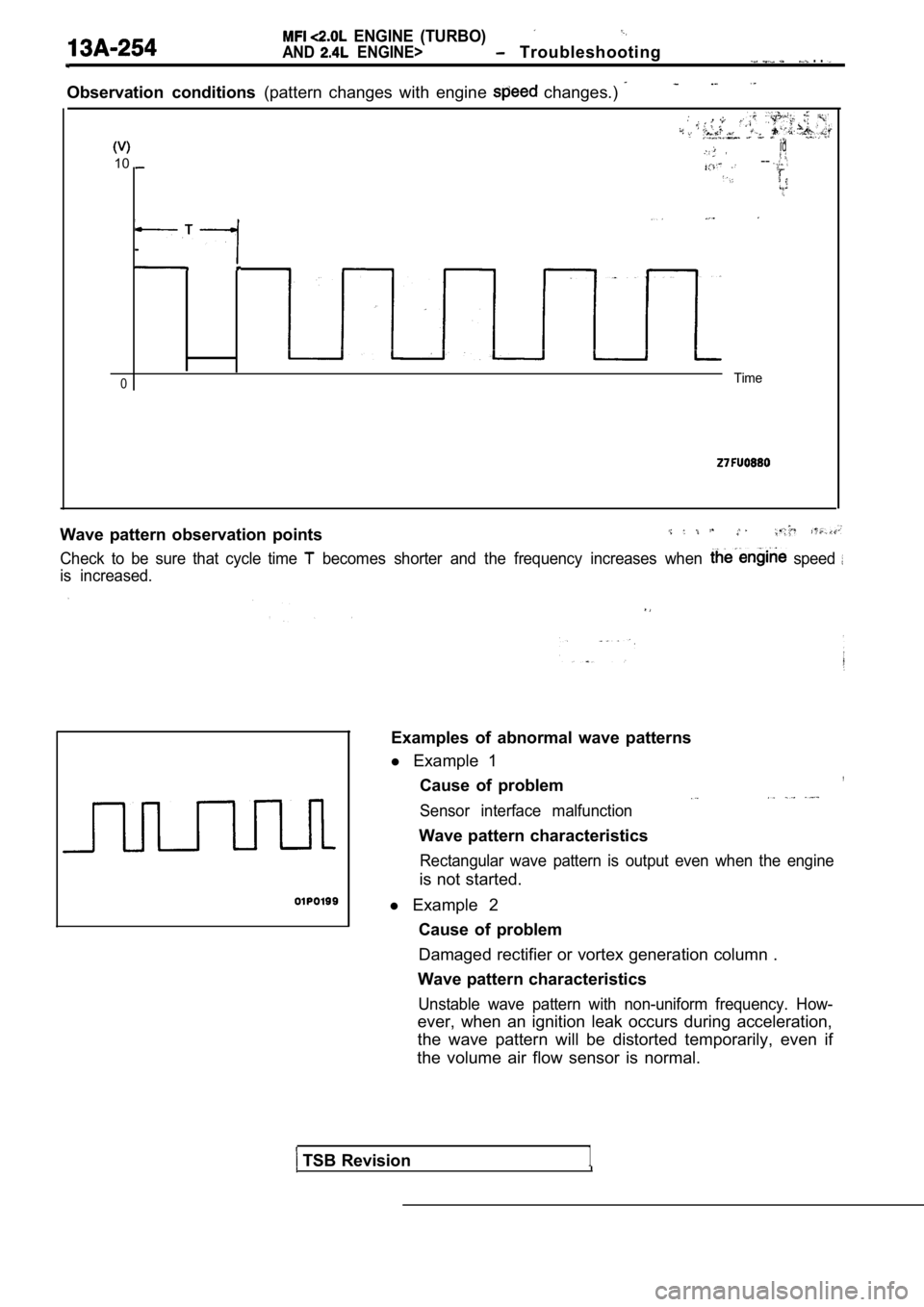
Observation conditions (pattern changes with engine changes.)
.
id
10--
0Time
Wave pattern observation points
Check to be sure that cycle time becomes shorter and the frequency increases when speed
is increased.
TSB Revision1
Examples of abnormal wave patterns
l Example 1
,Cause of problem
Sensor interface malfunction
Wave pattern characteristics
Rectangular wave pattern is output even when the en gine
is not started.
l Example 2
Cause of problem
Damaged rectifier or vortex generation column .
Wave pattern characteristics
Unstable wave pattern with non-uniform frequency. H ow-
ever, when an ignition leak occurs during acceleration,
the wave pattern will be distorted temporarily, eve n if
the volume air flow sensor is normal.
Page 635 of 2103
ENGINE (TURBO)
AND ENGINE>
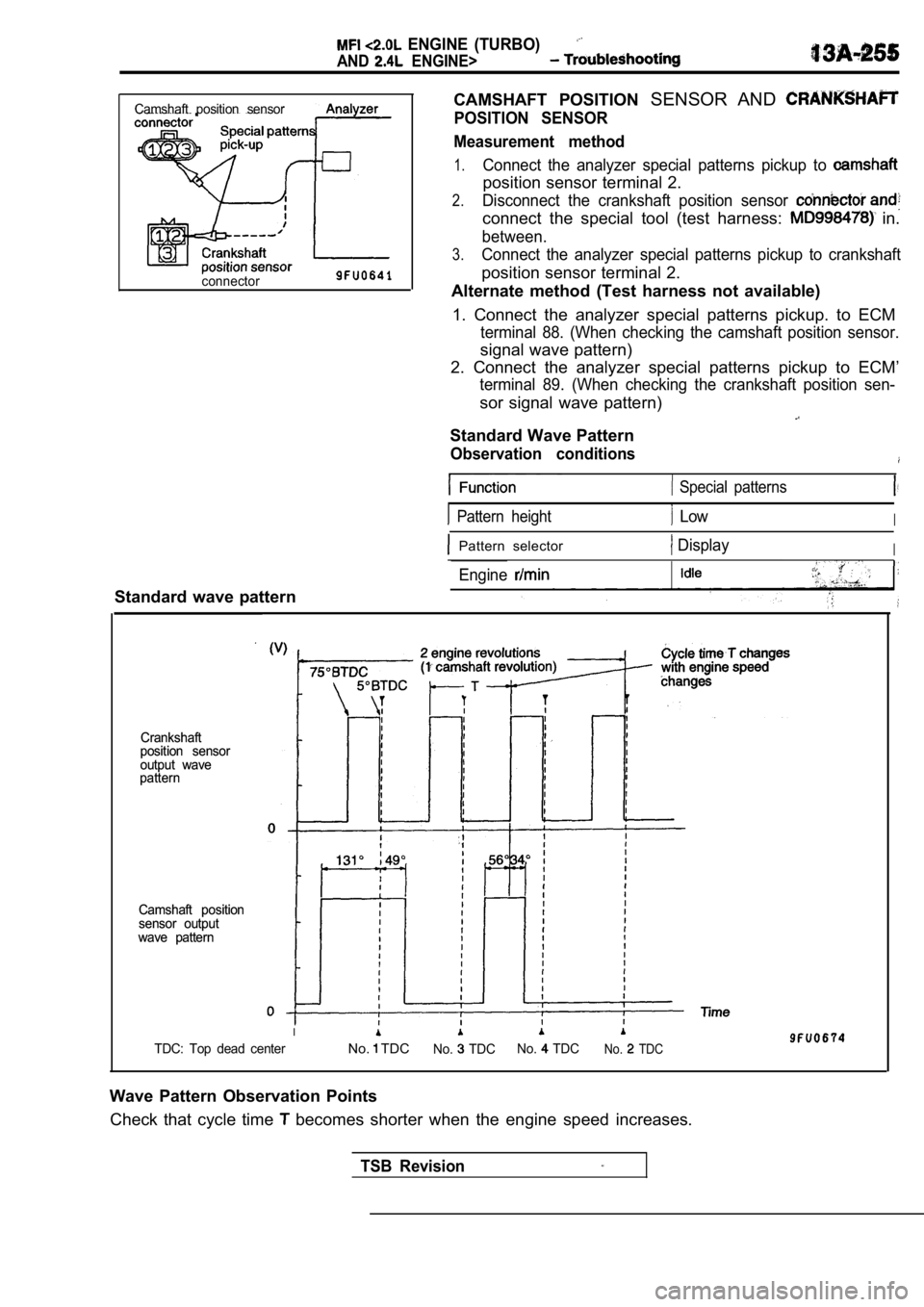
CAMSHAFT POSITION SENSOR AND
POSITION SENSOR
Measurement method
1.Connect the analyzer special patterns pickup to
position sensor terminal 2.
2.Disconnect the crankshaft position sensor
connect the special tool (test harness: in.
between.
3.Connect the analyzer special patterns pickup to cra nkshaft
position sensor terminal 2.
Alternate method (Test harness not available)
1. Connect the analyzer special patterns pickup. to ECM
terminal 88. (When checking the camshaft position sensor.
signal wave pattern)
2. Connect the analyzer special patterns pickup to ECM’
terminal 89. (When checking the crankshaft position sen-
sor signal wave pattern)
Standard Wave Pattern
Observation conditions
Camshaft position sensor
connector
Standard wave pattern
Crankshaft
Crankshaft
position sensor
position sensor
output wave
output wave
pattern
pattern
Camshaft position
Camshaft position
sensor output
sensor output
wave pattern
wave pattern
Special patterns
Pattern height LowI
Pattern selector DisplayI
Engine
I
TDC: Top dead centerNo. TDCNo. TDC No. TDCNo. TDC
Wave Pattern Observation Points
Check that cycle time
becomes shorter when the engine speed increases.
TSB Revision
Page 644 of 2103
Terminal 2Terminal 4
--
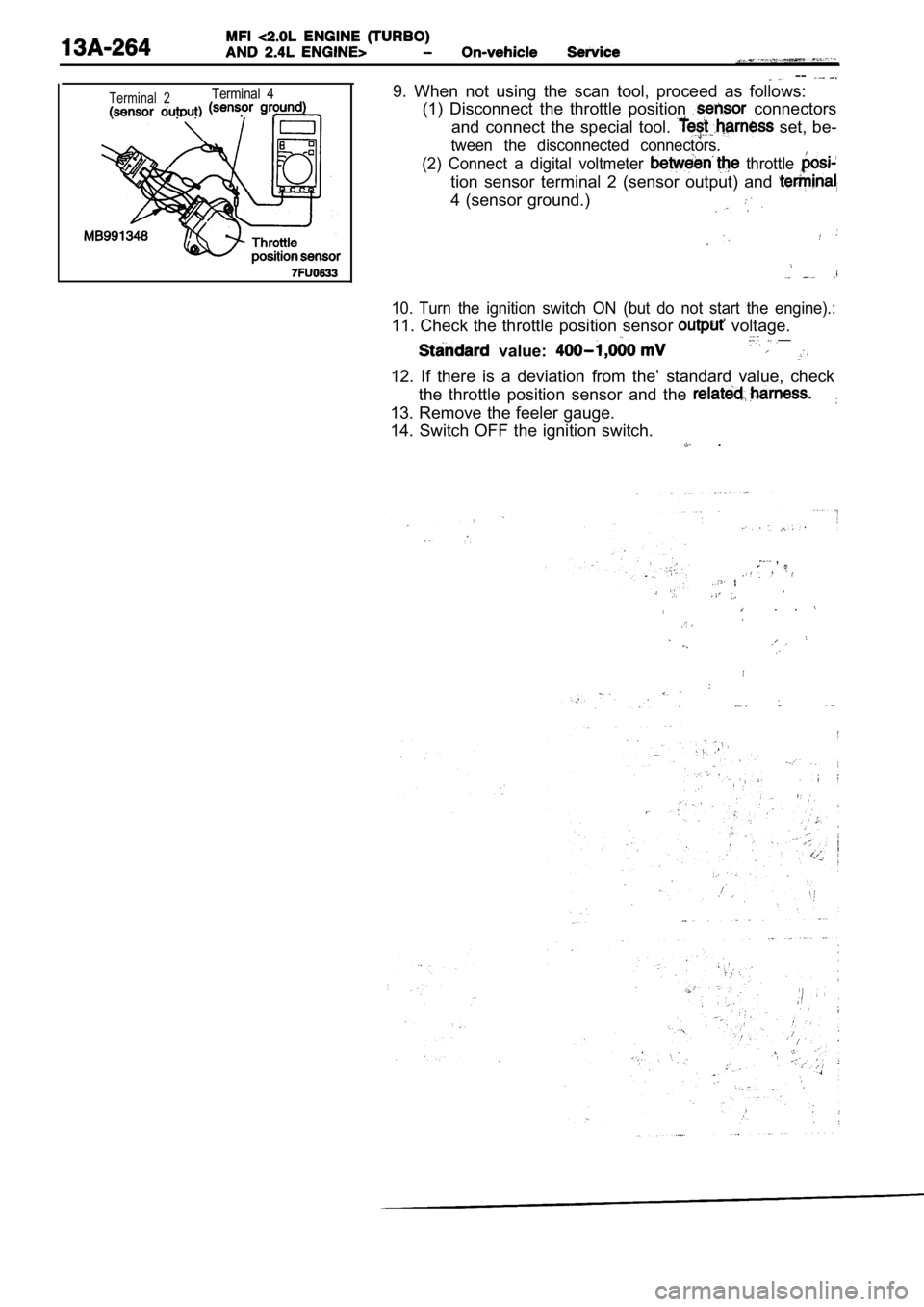
9. When not using the scan tool, proceed as follows :
(1) Disconnect the throttle position connectors
and connect the special tool.
set, be-
tween the disconnected connectors.
(2) Connect a digital voltmeter
throttle
tion sensor terminal 2 (sensor output) and
4 (sensor ground.)
10. Turn the ignition switch ON (but do not start th e engine).:
11. Check the throttle position sensor voltage.
value:
__
12. If there is a deviation from the’ standard value, check
the throttle position sensor and the
13. Remove the feeler gauge.
14. Switch OFF the ignition switch.
.
,
. .
Page 646 of 2103
SPEED
NOTE
1.The standard idle speed by,
engine speed the
and there should usually for readjustment.
2. The adjustment, after first:
confirming that the spark plugs; the
air control servo, the compression pressure,
all normal.
1.. The vehicle should be prepared as follows before the
i n s p e c t i o n a n d a d j u s t m e n t .
lEngine coolant temperature:
l Lights, cooling fan and accessories: OFF
‘2.
l Transaxle: Neutral (A/T for range)
Connect the scan tool to the data link connector
N O T E
When the scan tool is connected, the diagnostic tes t mode
control terminal should be grounded.
3. Start the engine and run at idle.
4. Select the item No. 30 of the SCAN TOOL (MUT-II)
Actuator test.
NOTE
This holds the motor at the basic step to adjust the
basic idle speed.
5. Check the idle speed. Standard value: 750
50
NOTE
1. The engine speed may be 20 to 100 lower
than indicated above for a new vehicle [driven appr oxi-
mately 500 km (300 mile) or less], but no adjustment
is necessary.
2.If the engine stalls or the is low even though
the vehicle has been driven approximately 500 km (300 mile) or more, it is probable that deposits ar e
adhered to the throttle valve, so clean it. (Refer to
Page 647 of 2103
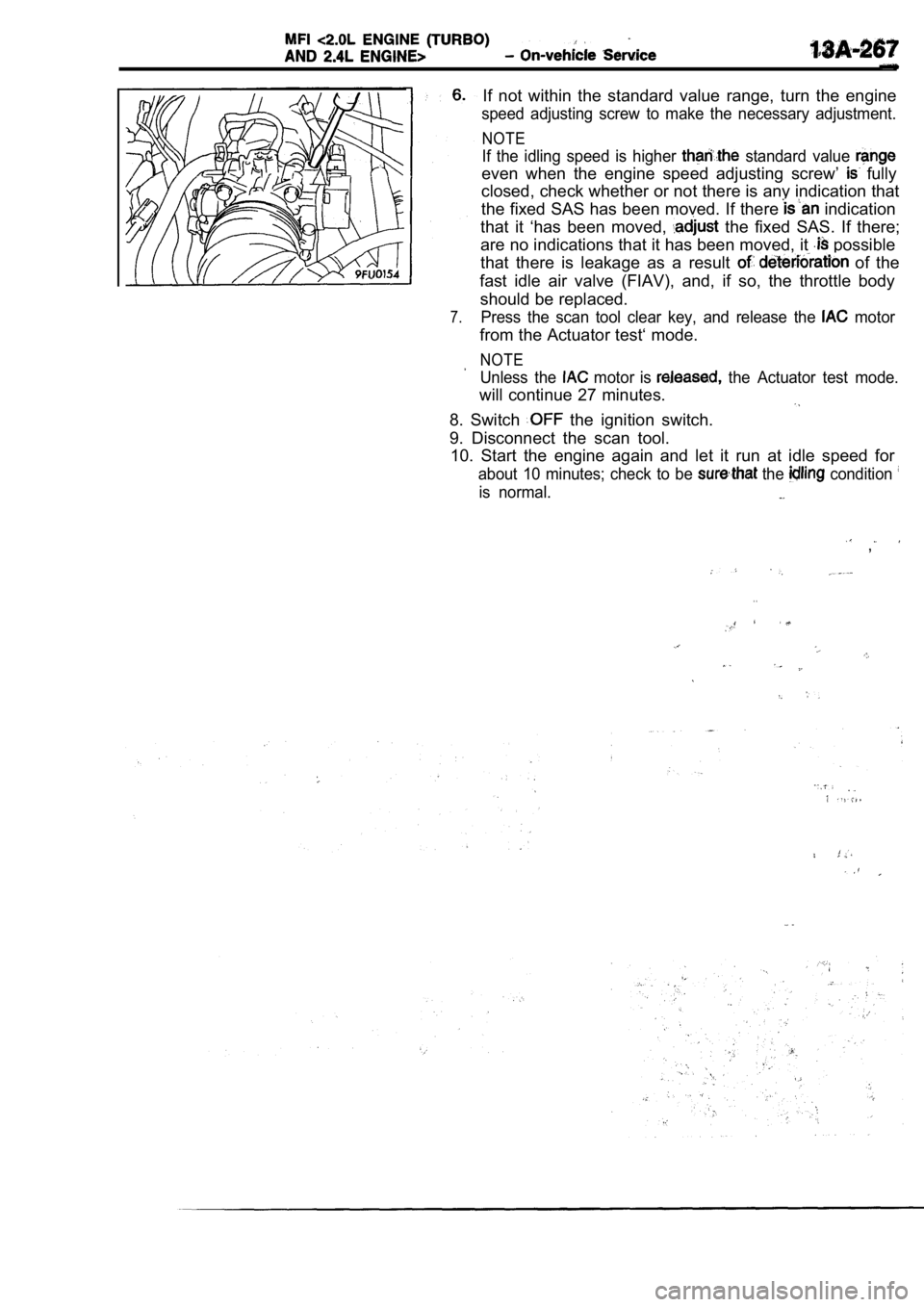
If not within the standard value range, turn the engine
speed adjusting screw to make the necessary adjustm ent.
NOTE
If the idling speed is higher standard value
even when the engine speed adjusting screw’ fully
closed, check whether or not there is any indicatio n that
the fixed SAS has been moved. If there
indication
that it ‘has been moved,
the fixed SAS. If there;
are no indications that it has been moved, it
possible
that there is leakage as a result
of the
fast idle air valve (FIAV), and, if so, the throttl e body
should be replaced.
7.Press the scan tool clear key, and release the motor
from the Actuator test‘ mode.
NOTE
Unless the motor is the Actuator test mode.
will continue 27 minutes.
8. Switch the ignition switch.
9. Disconnect the scan tool. 10. Start the engine again and let it run at idle s peed for
about 10 minutes; check to be the condition
is normal.
,
. .
Page 648 of 2103
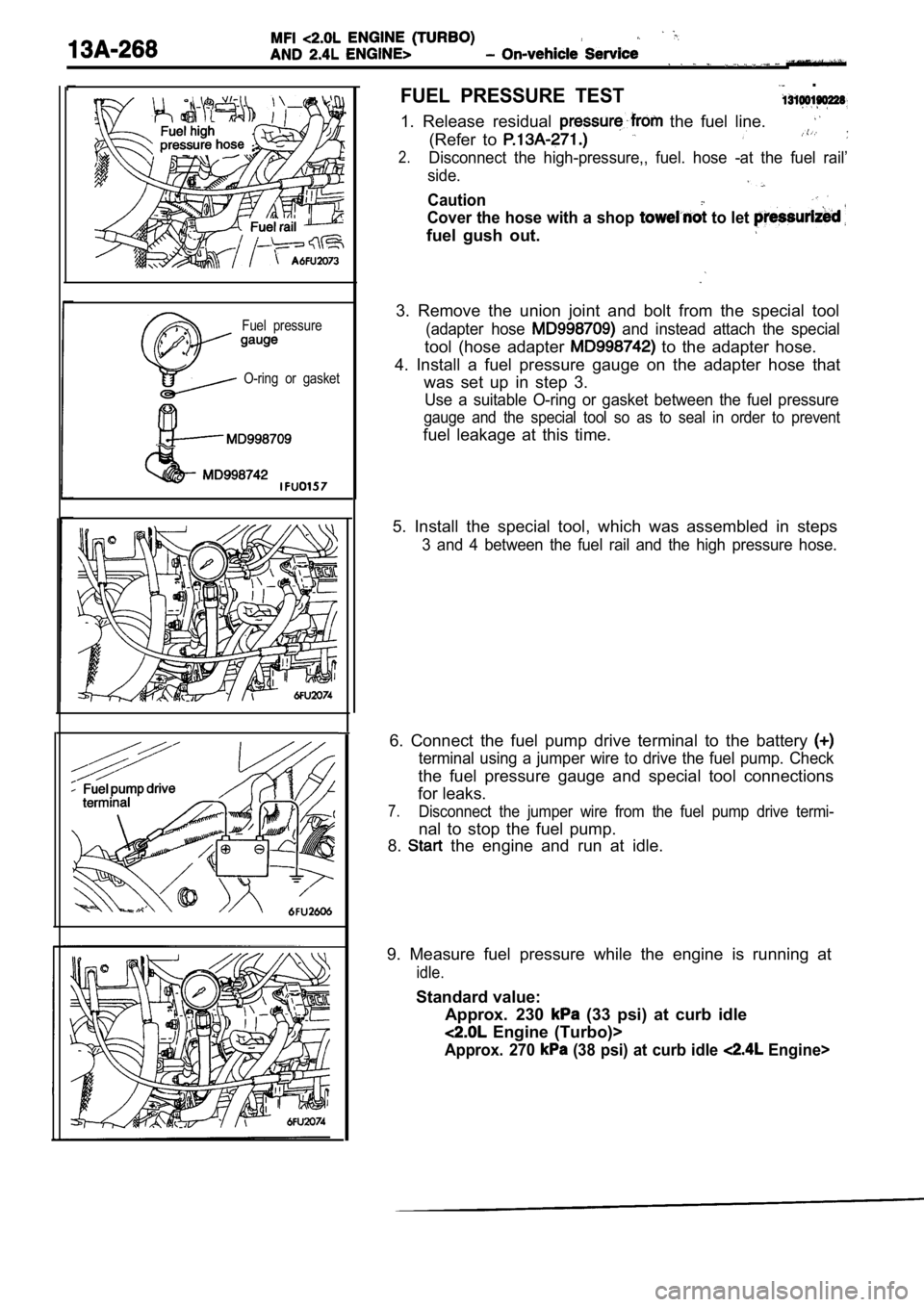
Fuel pressure
O-ring or gasket
.
FUEL PRESSURE TEST
1. Release residual the fuel line.
(Refer to
2.Disconnect the high-pressure,, fuel. hose -at the fuel rail’
side.
Caution
Cover the hose with a shop to let
fuel gush out.
3. Remove the union joint and bolt from the special tool
(adapter hose and instead attach the special
tool (hose adapter to the adapter hose.
4. Install a fuel pressure gauge on the adapter hos e that
was set up in step 3.
Use a suitable O-ring or gasket between the fuel pr essure
gauge and the special tool so as to seal in order t o prevent
fuel leakage at this time.
5. Install the special tool, which was assembled in steps
3 and 4 between the fuel rail and the high pressure hose.
6. Connect the fuel pump drive terminal to the batt ery
terminal using a jumper wire to drive the fuel pump. Check
the fuel pressure gauge and special tool connection s
for leaks.
7.Disconnect the jumper wire from the fuel pump drive termi-
nal to stop the fuel pump.
8.
the engine and run at idle.
9. Measure fuel pressure while the engine is runnin g at
idle.
Standard value:
Approx. 230
(33 psi) at curb idle
Engine (Turbo)>
Approx. 270 (38 psi) at curb idle Engine>