wheel MITSUBISHI TRITON 2011 User Guide
[x] Cancel search | Manufacturer: MITSUBISHI, Model Year: 2011, Model line: TRITON, Model: MITSUBISHI TRITON 2011Pages: 369, PDF Size: 26.15 MB
Page 77 of 369
WARNING
• The indication lamp does not come on when the front passenger’s
airbag ON-
OFF switch is turned OFF.
• The indication lamp stays on when the front passenger’s airbag ON-OFF
switch is turned ON. WARNING
l Do not fit any accessory that makes the in-
dication lamp impossible to see, and do
not cover the indication lamp with a stick-
er. You would not be able to verify the sta-
tus of the passenger airbag system.
Driver’s and passenger’s front airbag
system E00407400330
The driver’s airbag is located under the padded cov-
er in the
middle of
the steering wheel. The front pas-
senger’s airbag is contained in the instrument panel
above the glove box. The driver’s airbag and the front passenger’s air-
bag
are
designed to
inflate
at the same time even if
the passenger seat is not occupied. Deployment of front airbags
E00407501354
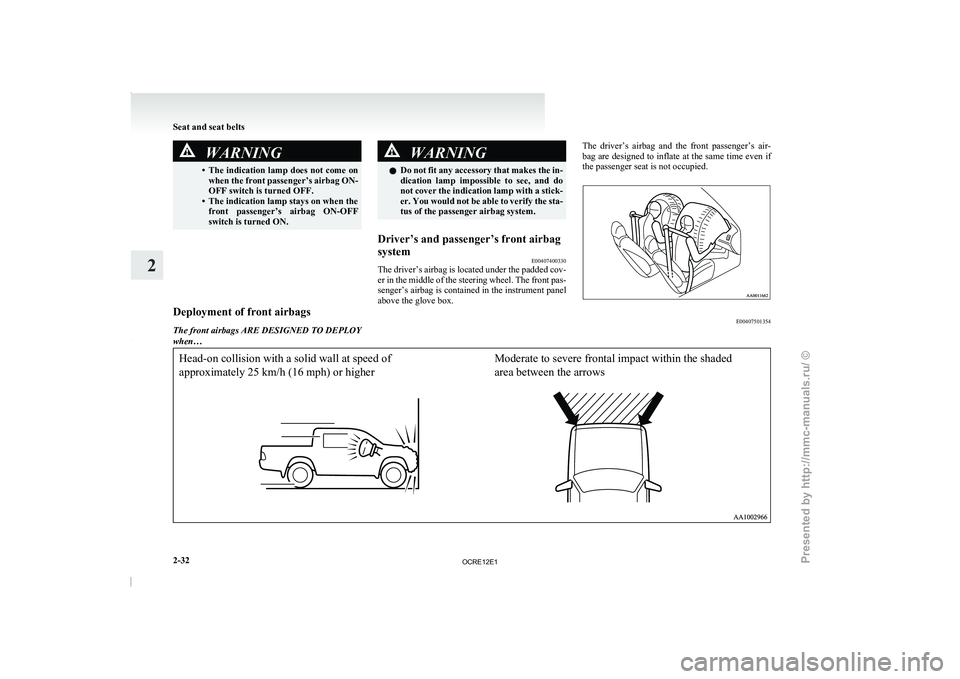
The front airbags ARE DESIGNED TO DEPLOY
when…
Head-on collision with a solid wall at speed of
approximately 25 km/h (16 mph) or higher Moderate to severe frontal impact within the shaded
area between the arrowsSeat and seat belts
2-32
2
OCRE12E1
Presented by http://mmc-manuals.ru/ \251
Page 78 of 369
The front airbags are designed to deploy when the
vehicle suffers a moderate to
severe frontal impact.
A typical condition is shown in the illustration.
The front airbags will deploy if the severity of im-
pact is above the designed threshold level, compa-
rable to an approximately 25 km/h (16 mph) colli-
sion when impacting straight into a solid wall that
does not move or deform. If the severity of the im-
pact is below the above threshold level, the front air-
bags may not deploy. However, this threshold
speed will be considerably higher if the vehicle
strikes an object that absorbs the impact by either
deforming or moving (for example, another station-
ary vehicle, pole or a guard rail).
Because frontal collisions can easily move you out
of position, it is important to always properly wear
your seat belts. Your seat belts will help keep you
in a safe distance from the steering wheel and in-
strument panel during the initial stages of airbag de-
ployment. The initial stage of airbag inflation is the
most forceful, and can possibly cause serious or fa-
tal injuries. Moreover, the seat belts in your vehicle
are your primary means of protection in a collision.
The SRS airbags are designed to provide additional
protection. Therefore, for your safety and the safe-
ty of all occupants, be sure to always properly wear
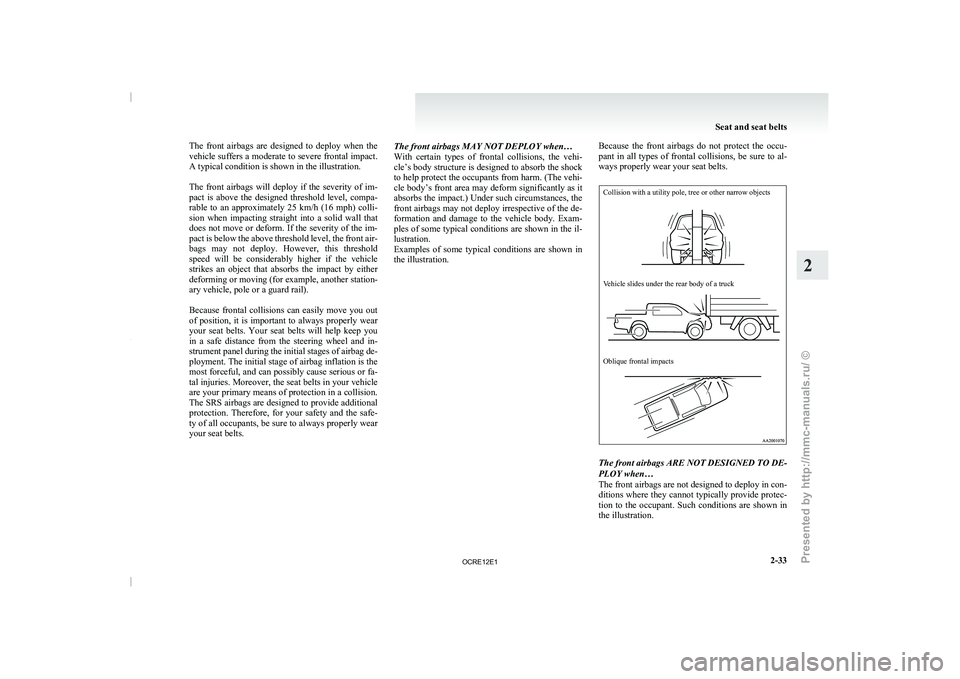
your seat belts. The front airbags MAY NOT DEPLOY when…
With certain types of frontal
collisions, the vehi-
cle’s body structure is designed to absorb the shock
to help protect the occupants from harm. (The vehi-
cle body’s front area may deform significantly as it
absorbs the impact.) Under such circumstances, the
front airbags may not deploy irrespective of the de-
formation and damage to the vehicle body. Exam-
ples of some typical conditions are shown in the il-
lustration.
Examples of some typical conditions are shown in
the illustration.
Because the front airbags do not protect the occu-
pant in all types of
frontal collisions, be sure to al-
ways properly wear your seat belts.
Collision with a utility pole, tree or other narrow objects
Vehicle slides under the rear body of a truck
Oblique frontal impacts The front airbags ARE NOT DESIGNED TO DE-
PLOY when…
The
front
airbags are
not
designed to deploy in con-
ditions where they cannot typically provide protec-
tion to the occupant. Such conditions are shown in
the illustration.
Seat and seat belts
2-33 2
OCRE12E1
Presented by http://mmc-manuals.ru/ \251
Page 79 of 369
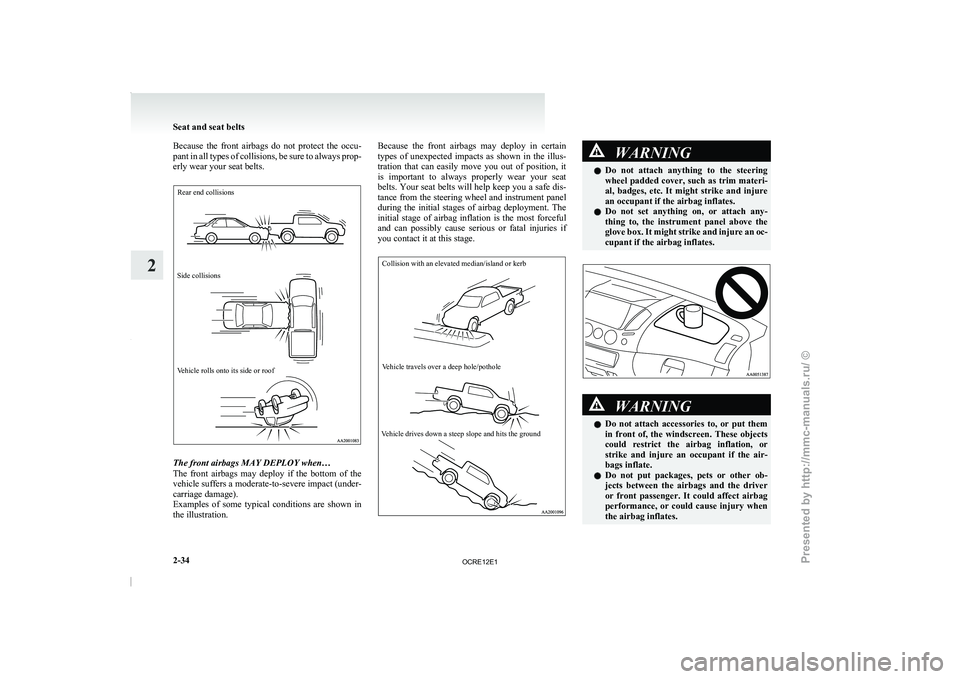
Because the front airbags do not protect the occu-
pant in all types of
collisions, be sure to always prop-
erly wear your seat belts.
Rear end collisions
Side collisions
Vehicle rolls onto its side or roof The front airbags MAY DEPLOY when…
The
front
airbags may
deploy
if the bottom of the
vehicle suffers a moderate-to-severe impact (under-
carriage damage).
Examples of some typical conditions are shown in
the illustration.
Because the front airbags may deploy in certain
types
of
unexpected impacts
as
shown in the illus-
tration that can easily move you out of position, it
is important to always properly wear your seat
belts. Your seat belts will help keep you a safe dis-
tance from the steering wheel and instrument panel
during the initial stages of airbag deployment. The
initial stage of airbag inflation is the most forceful
and can possibly cause serious or fatal injuries if
you contact it at this stage.
Collision with an elevated median/island or kerb
Vehicle travels over a deep hole/pothole
Vehicle drives down a steep slope and hits the ground WARNING
l Do not attach anything to
the steering
wheel padded cover, such as trim materi-
al, badges, etc. It might strike and injure
an occupant if the airbag inflates.
l Do not set anything on, or attach any-
thing to, the instrument panel above the
glove box. It might strike and injure an oc-
cupant if the airbag inflates. WARNING
l Do not attach accessories
to,
or put them
in front of, the windscreen. These objects
could restrict the airbag inflation, or
strike and injure an occupant if the air-
bags inflate.
l Do not put packages, pets or other ob-
jects between the airbags and the driver
or front passenger. It could affect airbag
performance, or could cause injury when
the airbag inflates. Seat and seat belts
2-34
2
OCRE12E1
Presented by http://mmc-manuals.ru/ \251
Page 84 of 369
WARNING
• The SRS warning lamp does not illu- minate when you start the vehicle.
• The SRS warning
lamp does not go
out after several seconds.
• The SRS warning lamp illuminates while driving.
SRS servicing E00407901244WARNING
l We recommend any maintenance
per-
formed
on or near the components of the
SRS to be performed by a MITSUBISHI
MOTORS Authorized Service Point.
Improper work on the SRS components
or wiring could result in inadvertent de-
ployment of the airbags, or could render
the SRS inoperative; either situation
could result in serious injury.
l Do not modify your steering wheel, seat
belt retractor or any other SRS compo-
nents. For example, replacement of the
steering wheel, or modifications to the
front bumper or body structure can ad-
versely affect SRS performance and lead
to possible injury.
l If your vehicle has sustained any damage,
we recommend you to have the SRS in-
spected to ensure it is in proper working
order. WARNING
l On vehicles equipped with side
airbags,
do not modify your front seats, centre pil-
lar and centre console.
It can adversely affect SRS performance
and lead to possible injury.
Also, if you have found any tear or open
seam in the seat fabric at the portion near
the side airbag, we recommend you to
have the seat inspected.
l On vehicles with the curtain airbags, if
you have found any scratch, crack or dam-
age to the portion of the front and rear pil-
lars and roof side rail, we recommend
you to have the SRS inspected by a
MITSUBISHI MOTORS Authorized
Service Point.
NOTE l When
you transfer ownership of
the vehicle
to some other person, we urge you to alert
the new owner that it is equipped with the
SRS and refer the new owner to the applica-
ble section in this owner’s manual.
l If you junk or scrap the vehicle, we urge you
to first take the vehicle to a MITSUBISHI
MOTORS Authorized Service Point so that
the SRS can be rendered safe. Seat and seat belts
2-39 2
OCRE12E1
Presented by http://mmc-manuals.ru/ \251
Page 118 of 369
Switch position 0- Driver only
Switch position 3- Driver + Full luggage load-
ing
{Vehicles with heavy duty
suspension}
Switch position 4- Driver
+ Full luggage load-
ing
{Vehicles without heavy du-
ty suspension}
Double cab Vehicle condi-
tion Switch position “0”
“2” or “3” or
“4” ●: 1 person
: Full luggage loading Switch position 0- Driver only
Switch position 2- Driver + Full luggage load-
ing
{Vehicles with heavy duty
suspension for
Russia, Ka-
zakhstan and Ukraine}
Switch position 3- Driver + Full luggage load- ing
{Vehicles with heavy duty
suspension except
for Rus-
sia, Kazakhstan and Uk-
raine}
{Vehicles without heavy du-
ty suspension for Russia,
Kazakhstan and Ukraine}
Switch position 4- Driver + Full luggage load- ing
{Vehicles without heavy du-
ty suspension
except for
Russia, Kazakhstan and Uk-
raine} Turn-signals lever
E00506501273
The turn-signal lamps flash when
the lever is oper-
ated (with the ignition switch in the “ON” posi-
tion). At the same time, the turn-signal indication
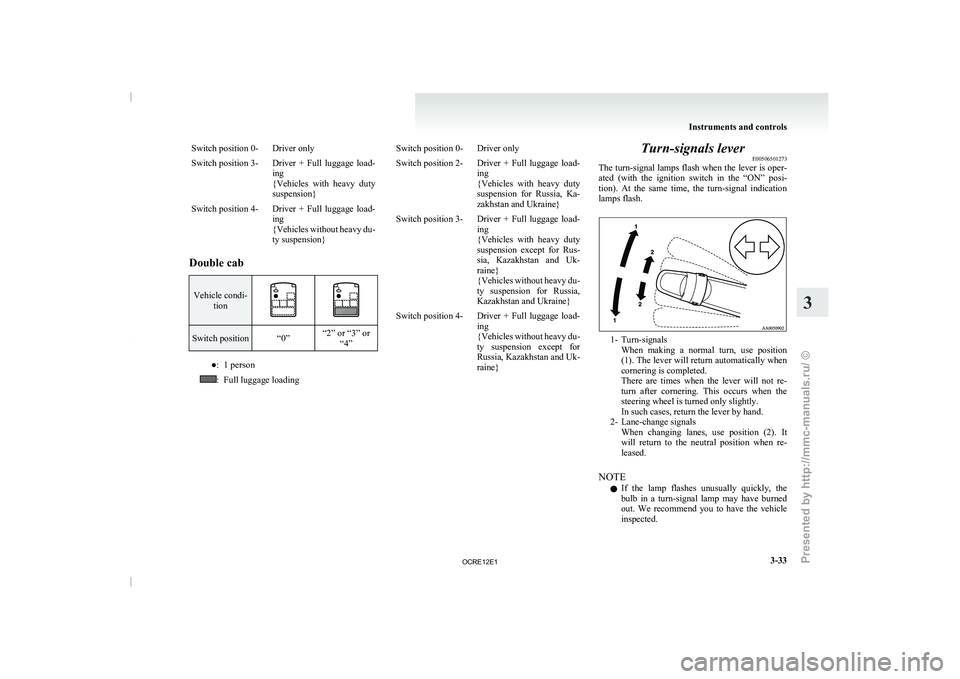
lamps flash. 1- Turn-signals
When making a normal turn,
use position
(1). The lever will return automatically when
cornering is completed.
There are times when the lever will not re-
turn after cornering. This occurs when the
steering wheel is turned only slightly.
In such cases, return the lever by hand.
2- Lane-change signals When changing lanes, use position (2). It
will return to the neutral position when re-
leased.
NOTE l If the lamp flashes unusually quickly, the
bulb in a turn-signal lamp may have burned
out. We recommend you to have the vehicle
inspected. Instruments and controls
3-33 3
OCRE12E1
Presented by http://mmc-manuals.ru/ \251
Page 125 of 369
Rear window demister switch
E00507900961
The rear window demister switch
can be operated
with the ignition switch in the “ON” position.
Push the switch to turn on the rear window demis-
ter. It will be turned off automatically in about 20
minutes. To turn off the demister within about 20
minutes, push the switch again.
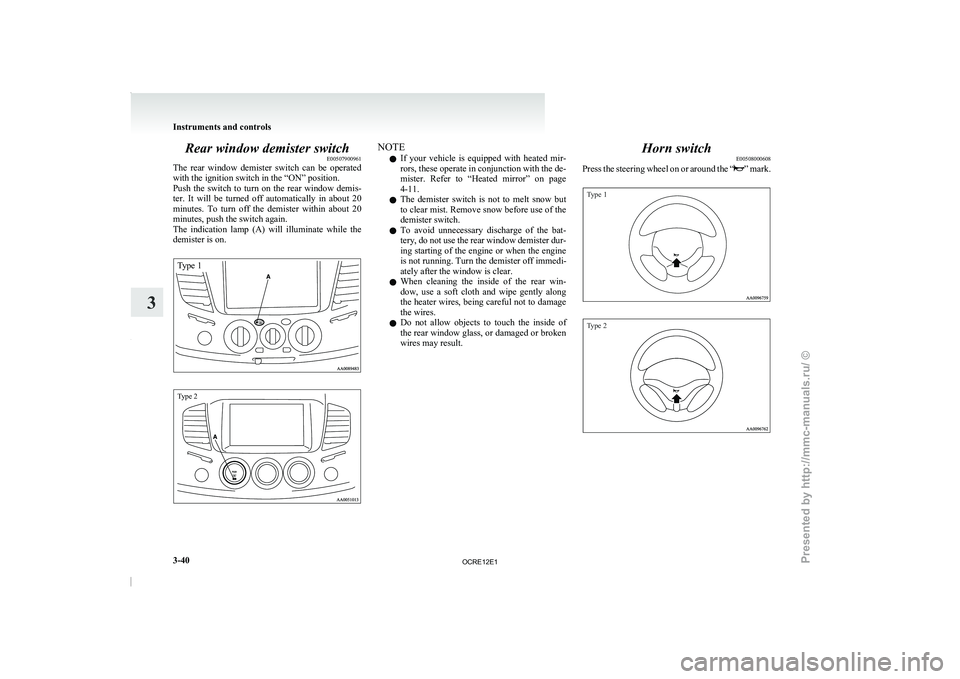
The indication lamp (A) will illuminate while the
demister is on.
Type 1
Type 2 NOTE
l If
your vehicle is equipped
with heated mir-
rors, these operate in conjunction with the de-
mister. Refer to “Heated mirror” on page
4-11.
l The demister switch is not to melt snow but
to clear mist. Remove snow before use of the
demister switch.
l To avoid unnecessary discharge of the bat-
tery, do not use the rear window demister dur-
ing starting of the engine or when the engine
is not running. Turn the demister off immedi-
ately after the window is clear.
l When cleaning the inside of the rear win-
dow, use a soft cloth and wipe gently along
the heater wires, being careful not to damage
the wires.
l Do not allow objects to touch the inside of
the rear window glass, or damaged or broken
wires may result. Horn switch
E00508000608
Press the steering wheel
on
or around the “ ” mark.
Type 1
Type 2Instruments and controls
3-40
3
OCRE12E1
Presented by http://mmc-manuals.ru/ \251
Page 126 of 369
Economical driving.......................................................................4-02
Driving, alcohol and drugs
........................................................... 4-02
Safe driving techniques ................................................................ 4-03
Running-in recommendations.......................................................4-04 Parking brake................................................................................ 4-07
Parking .......................................................................................... 4-08
Steering wheel height adjustment .................................................4-09
Inside rear-view mirror ................................................................. 4-09
Outside rear-view mirrors ............................................................. 4-10
Ignition switch .............................................................................. 4-11
Steering wheel lock ...................................................................... 4-12
Starting.......................................................................................... 4-13
Diesel particulate filter (DPF)* .................................................... 4-14
Manual transmission ..................................................................... 4-15
Automatic transmission
4A/T....................................................... 4-17
Automatic transmission Sports Mode 5A/T .................................4-21
Easy select 4WD* ......................................................................... 4-26
Super select 4WD* ....................................................................... 4-30
Rear differential lock* .................................................................. 4-35
4-wheel drive operation ................................................................ 4-39
Inspection and maintenance following rough road oper- ation.......................................................................................... 4-41
Cautions on handling of 4-wheel drive vehicles ..........................4-41
Limited-slip differential* .............................................................. 4-43
Braking......................................................................................... 4-43
Brake assist system*..................................................................... 4-44
Anti-lock brake system (ABS)* ................................................... 4-44
Power steering system.................................................................. 4-47
Active Stability & Traction Control (ASTC)* .............................4-47
Cruise control* ............................................................................. 4-50 Cargo loads...................................................................................
4-54
Trailer towing (Except for vehicles for Morocco)........................4-54 Starting and driving
4
OCRE12E1
Presented by http://mmc-manuals.ru/ \251
Page 132 of 369
Parking brake
E00600501562
To park the vehicle, first
bring it to a complete
stop, fully engage the parking brake, and then
move the gearshift lever to 1 st
(on an uphill) or Re-
verse (on a downhill) position for vehicles with man-
ual transmission or set the selector lever to “P”
(PARK) position on automatic transmission vehi-
cles. CAUTION
l
Before driving, be sure
that
the parking
brake is fully released and brake warning
lamp is off.
If a vehicle is driven without releasing the
parking brake, the brake will be overhea-
ted, resulting in ineffective braking and
possible brake failure.
l When you intend to apply the parking
brake, firmly press the brake pedal to
bring the vehicle to a complete stop be-
fore pulling the parking brake lever. Pull-
ing the parking brake lever with the vehi-
cle moving could make the rear wheels
lock up, thereby making the vehicle unsta-
ble. It could also make the parking brake
malfunction.
l If the brake warning lamp does not extin-
guish when the parking brake is fully re-
leased, the brake system may be abnormal.
Have your vehicle checked immediately.
For details, refer to “Brake warning
lamp” on page 3-08. Type 1
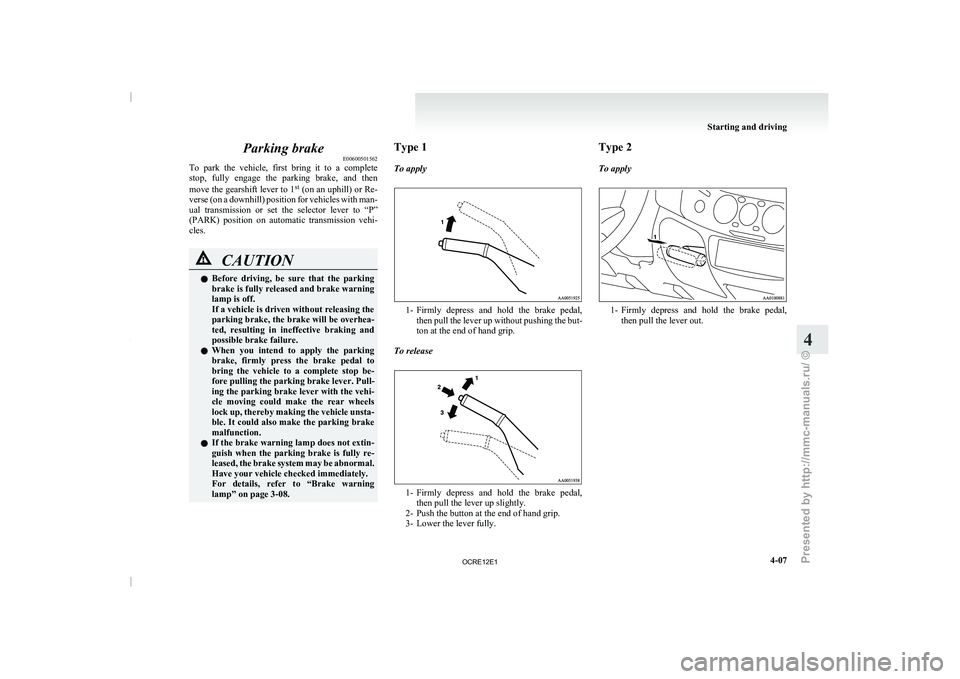
To apply
1- Firmly depress and hold the brake pedal,
then pull the lever
up without pushing the but-
ton at the end of hand grip.
To release 1- Firmly depress and hold the brake pedal,
then pull the lever up slightly.
2- Push the button at the end of hand grip.
3- Lower the lever fully. Type 2
To apply
1- Firmly depress and hold the brake pedal,
then pull the lever out. Starting and driving
4-07 4
OCRE12E1
Presented by http://mmc-manuals.ru/ \251
Page 133 of 369
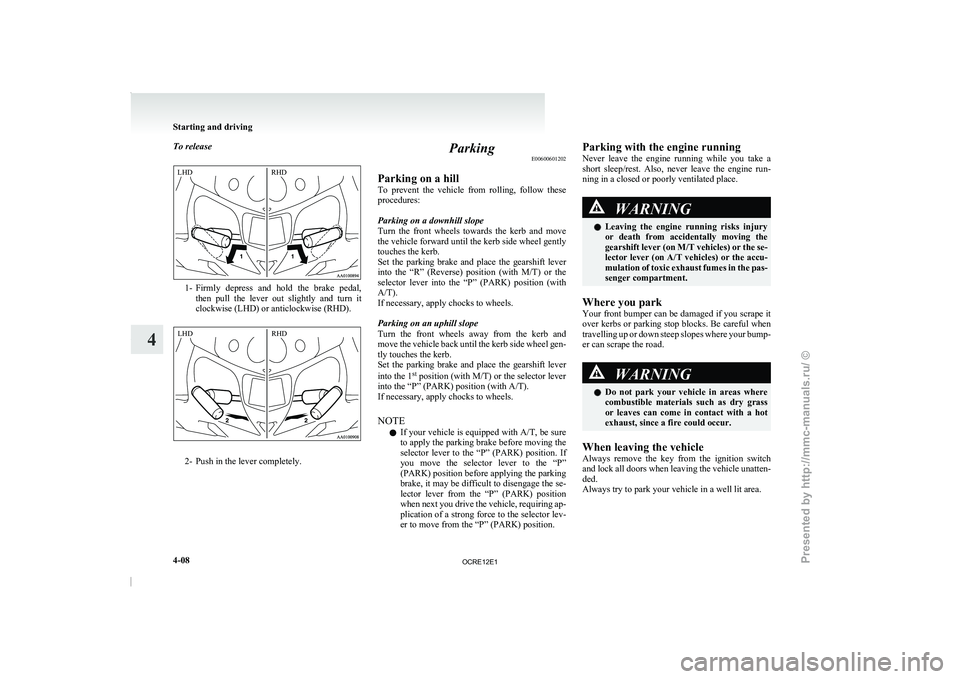
To release
1- Firmly depress and hold the brake pedal,
then pull the lever
out slightly and turn it
clockwise (LHD) or anticlockwise (RHD). 2- Push in the lever completely. Parking
E00600601202
Parking on a hill
To prevent the vehicle from
rolling, follow these
procedures:
Parking on a downhill slope
Turn the front wheels towards the kerb and move
the vehicle forward until the kerb side wheel gently
touches the kerb.
Set the parking brake and place the gearshift lever
into the “R” (Reverse) position (with M/T) or the
selector lever into the “P” (PARK) position (with
A/T).
If necessary, apply chocks to wheels.
Parking on an uphill slope
Turn the front wheels away from the kerb and
move the vehicle back until the kerb side wheel gen-
tly touches the kerb.
Set the parking brake and place the gearshift lever
into the 1 st
position (with M/T) or the selector lever
into the “P” (PARK) position (with A/T).
If necessary, apply chocks to wheels.
NOTE
l If your vehicle is equipped with A/T, be sure
to apply the parking brake before moving the
selector lever to the “P” (PARK) position. If
you move the selector lever to the “P”
(PARK) position before applying the parking
brake, it may be difficult to disengage the se-
lector lever from the “P” (PARK) position
when next you drive the vehicle, requiring ap-
plication of a strong force to the selector lev-
er to move from the “P” (PARK) position. Parking with the engine running
Never leave the engine
running
while you take a
short sleep/rest. Also, never leave the engine run-
ning in a closed or poorly ventilated place. WARNING
l Leaving the engine running
risks
injury
or death from accidentally moving the
gearshift lever (on M/T vehicles) or the se-
lector lever (on A/T vehicles) or the accu-
mulation of toxic exhaust fumes in the pas-
senger compartment.
Where you park
Your front bumper can be
damaged if you scrape it
over kerbs or parking stop blocks. Be careful when
travelling up or down steep slopes where your bump-
er can scrape the road. WARNING
l Do not park your vehicle
in areas where
combustible materials such as dry grass
or leaves can come in contact with a hot
exhaust, since a fire could occur.
When leaving the vehicle
Always remove the key from
the ignition switch
and lock all doors when leaving the vehicle unatten-
ded.
Always try to park your vehicle in a well lit area. Starting and driving
4-08
4LHD
RHD LHD
RHD
OCRE12E1
Presented by http://mmc-manuals.ru/ \251
Page 134 of 369
Steering wheel height adjustment
E00600700219
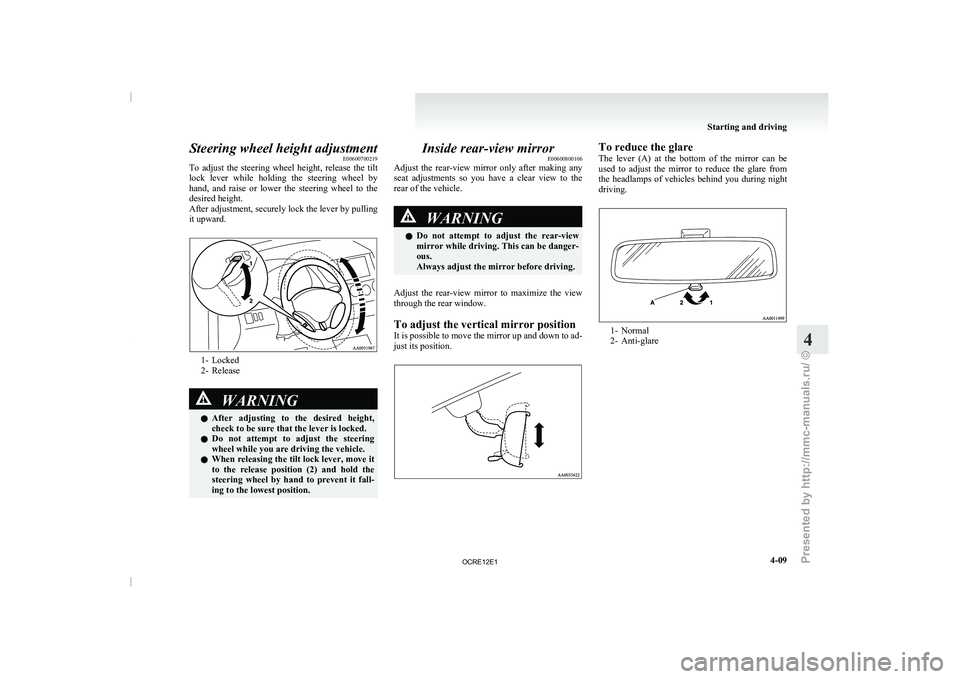
To adjust the steering wheel
height, release the tilt
lock lever while holding the steering wheel by
hand, and raise or lower the steering wheel to the
desired height.
After adjustment, securely lock the lever by pulling
it upward. 1- Locked
2- Release
WARNING
l After adjusting to the
desired
height,
check to be sure that the lever is locked.
l Do not attempt to adjust the steering
wheel while you are driving the vehicle.
l When releasing the tilt lock lever, move it
to the release position (2) and hold the
steering wheel by hand to prevent it fall-
ing to the lowest position. Inside rear-view mirror
E00600800106
Adjust the rear-view mirror only
after making any
seat adjustments so you have a clear view to the
rear of the vehicle. WARNING
l Do not attempt to
adjust
the rear-view
mirror while driving. This can be danger-
ous.
Always adjust the mirror before driving.
Adjust the rear-view mirror to maximize the view
through the rear window.
To adjust the vertical mirror position
It is possible
to move
the mirror up and down to ad-
just its position. To reduce the glare
The lever (A) at
the
bottom of the mirror can be
used to adjust the mirror to reduce the glare from
the headlamps of vehicles behind you during night
driving. 1- Normal
2- Anti-glare Starting and driving
4-09 4
OCRE12E1
Presented by http://mmc-manuals.ru/ \251