oil MITSUBISHI TRITON 2011 Owner's Manual
[x] Cancel search | Manufacturer: MITSUBISHI, Model Year: 2011, Model line: TRITON, Model: MITSUBISHI TRITON 2011Pages: 369, PDF Size: 26.15 MB
Page 301 of 369
CAUTION
l
Note that the support bar may disengage
the bonnet if the open bonnet is lifted by
a strong wind.
l Always insert the support bar into the
hole provided specifically for this pur-
pose. Supporting the bonnet at any other
location could result in the support bar
slipping out and lead to an accident.
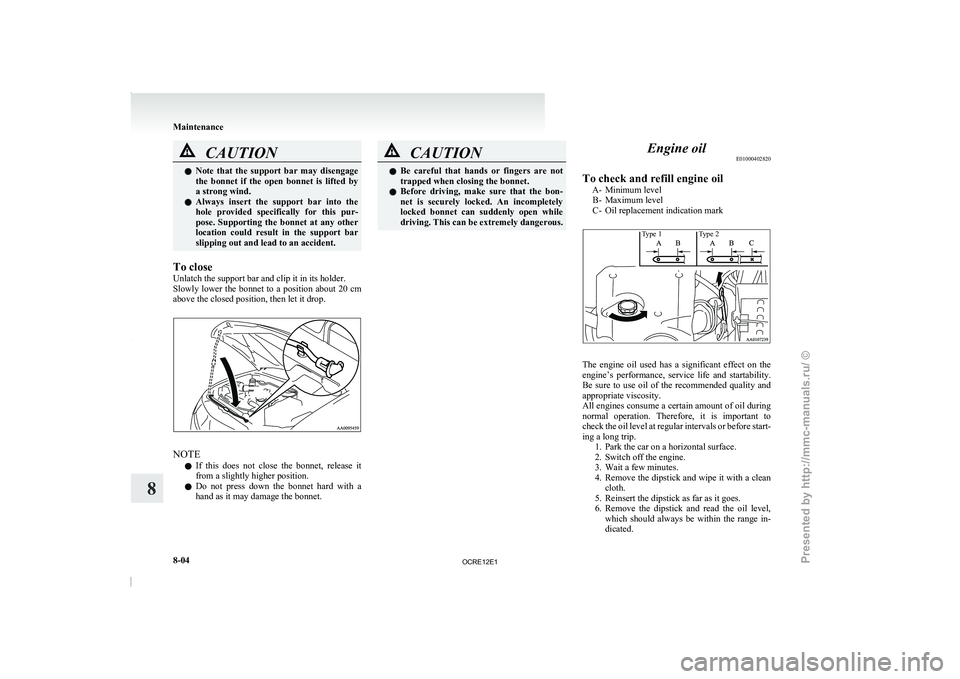
To close
Unlatch the support bar and clip it in its holder.
Slowly lower the bonnet to
a position about 20 cm
above the closed position, then let it drop. NOTE
l If
this does not close
the bonnet, release it
from a slightly higher position.
l Do not press down the bonnet hard with a
hand as it may damage the bonnet. CAUTION
l
Be careful that hands or
fingers are not
trapped when closing the bonnet.
l Before driving, make sure that the bon-
net is securely locked. An incompletely
locked bonnet can suddenly open while
driving. This can be extremely dangerous. Engine oil
E01000402820
To check and refill engine oil A- Minimum level
B- Maximum level
C- Oil replacement indication mark
Type 1Type 2 The engine oil used has a significant effect on the
engine’s performance, service life
and
startability.
Be sure to use oil of the recommended quality and
appropriate viscosity.
All engines consume a certain amount of oil during
normal operation. Therefore, it is important to
check the oil level at regular intervals or before start-
ing a long trip. 1. Park the car on a horizontal surface.
2. Switch off the engine.
3. Wait a few minutes.
4. Remove the dipstick and wipe it with a cleancloth.
5. Reinsert the dipstick as far as it goes.
6. Remove the dipstick and read the oil level, which should always be within the range in-
dicated. Maintenance
8-04
8
OCRE12E1
Presented by http://mmc-manuals.ru/ \251
Page 302 of 369
7. If the oil level is below the specified limit, re-
move the cap located on the cylinder head
cover and add enough oil to raise the level to
within the specified range. Do not overfill to
avoid engine damage. Be sure to use the speci-
fied engine oil and do not mix various types
of oil.
8. After adding oil, close the cap securely.
9. Confirm the oil level by repeating step 4 to 6.
Use only the recommended oils with an ACEA or
API classification as specified in this manual.
NOTE l Check or refill the oil according to the follow-
ing manner.
• When the oil level is checked in step 6above, check it on a low side of the dip-
stick because it is different in appearance
of oil level in the two sides of the dipstick.
• On vehicles without diesel particulate fil- ter (DPF), the oil level should be within
the range (A) to (B) on the dipstick.
• On vehicles with DPF, the oil level should be within the range (A) to (C) (oil
replacement indication mark) on the dip-
stick.
If the oil level is beyond the oil replace-
ment indication mark (C), replace the oil
as soon as possible.
Then, the oil should be refilled to the max-
imum level (B). • On vehicles with DPF, the engine oil will
increase due to a little fuel getting mixed
in the engine oil when the DPF regener-
ates to burn away the PM (particulate mat-
ter). However, it does not indicate a mal-
function.
l The engine oil will deteriorate rapidly if the
vehicle is subjected to severe conditions, re-
quiring earlier oil replacement. Please refer
to the maintenance schedule.
l For handling of used engine oils, refer to
page 05.
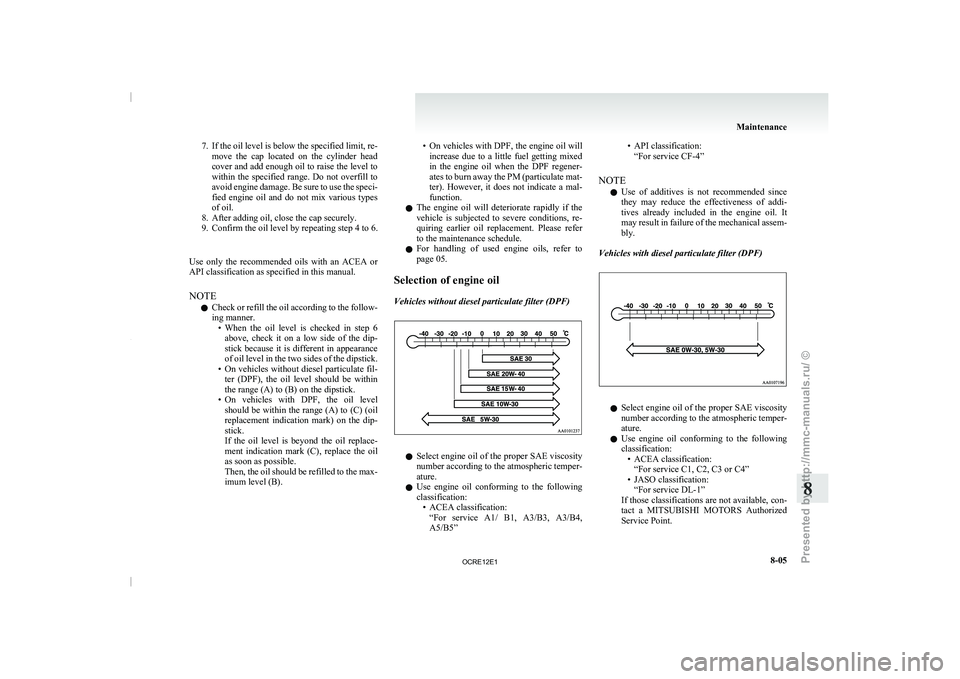
Selection of engine oil
Vehicles without diesel particulate filter (DPF) l
Select engine oil of
the
proper SAE viscosity
number according to the atmospheric temper-
ature.
l Use engine oil conforming to the following
classification:
• ACEA classification:“For service A1/ B1, A3/B3, A3/B4,
A5/B5” • API classification:
“For service CF-4”
NOTE l Use
of additives is not
recommended since
they may reduce the effectiveness of addi-
tives already included in the engine oil. It
may result in failure of the mechanical assem-
bly.
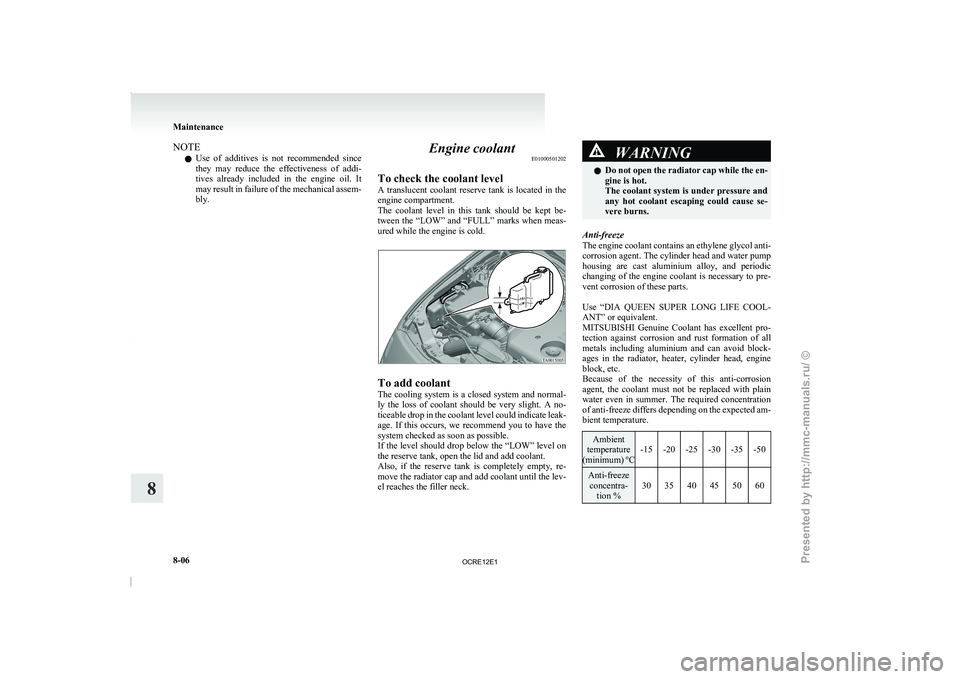
Vehicles with diesel particulate filter (DPF) l
Select engine oil of
the
proper SAE viscosity
number according to the atmospheric temper-
ature.
l Use engine oil conforming to the following
classification:
• ACEA classification:“For service C1, C2, C3 or C4”
• JASO classification: “For service DL-1”
If those classifications are not available, con-
tact a MITSUBISHI MOTORS Authorized
Service Point. Maintenance
8-05 8
OCRE12E1
Presented by http://mmc-manuals.ru/ \251
Page 303 of 369
NOTE
l Use
of additives is not
recommended since
they may reduce the effectiveness of addi-
tives already included in the engine oil. It
may result in failure of the mechanical assem-
bly. Engine coolant
E01000501202
To check the coolant level
A translucent coolant reserve
tank
is located in the
engine compartment.
The coolant level in this tank should be kept be-
tween the “LOW” and “FULL” marks when meas-
ured while the engine is cold. To add coolant
The
cooling
system is
a
closed system and normal-
ly the loss of coolant should be very slight. A no-
ticeable drop in the coolant level could indicate leak-
age. If this occurs, we recommend you to have the
system checked as soon as possible.
If the level should drop below the “LOW” level on
the reserve tank, open the lid and add coolant.
Also, if the reserve tank is completely empty, re-
move the radiator cap and add coolant until the lev-
el reaches the filler neck. WARNING
l Do not open the radiator
cap while the en-
gine is hot.
The coolant system is under pressure and
any hot coolant escaping could cause se-
vere burns.
Anti-freeze
The engine coolant contains an
ethylene glycol anti-
corrosion agent. The cylinder head and water pump
housing are cast aluminium alloy, and periodic
changing of the engine coolant is necessary to pre-
vent corrosion of these parts.
Use “DIA QUEEN SUPER LONG LIFE COOL-
ANT” or equivalent.
MITSUBISHI Genuine Coolant has excellent pro-
tection against corrosion and rust formation of all
metals including aluminium and can avoid block-
ages in the radiator, heater, cylinder head, engine
block, etc.
Because of the necessity of this anti-corrosion
agent, the coolant must not be replaced with plain
water even in summer. The required concentration
of anti-freeze differs depending on the expected am-
bient temperature. Ambient
temperature
(minimum) °C -15 -20 -25
-30
-35 -50 Anti-freeze
concentra- tion % 30 35 40 45 50 60Maintenance
8-06
8
OCRE12E1
Presented by http://mmc-manuals.ru/ \251
Page 304 of 369
CAUTION
l
Do not use alcohol or methanol anti-
freeze or any engine coolants mixed with
alcohol or methanol anti-freeze. The use
of an improper anti-freeze can cause cor-
rosion of the aluminium components.
l For effective anti-corrosion and anti-
freeze performance, keep the anti-freeze
concentration within the range of 30 to
60 %.
Concentrations exceeding 60 % will re-
sult in a reduction of both the anti-freeze
and cooling performance thus adversely
affecting the engine.
l Do not top up with water only.
Water by itself reduces the rust-protec-
tive and anti-freeze qualities of the cool-
ant and has a lower boiling point. It can
also cause damage to the cooling system if
it should freeze. Do not use tapwater, as it
can cause corrosion and rust formation.
During cold weather
If the temperatures in your
area drop below freez-
ing, there is the danger that the coolant in the en-
gine or radiator could freeze and cause severe dam-
age to the engine and/or radiator. The concentra-
tion should be checked before the start of cold weath-
er and anti-freeze added to the system if necessary.
Add a sufficient amount of anti-freeze to the cool-
ant to prevent it from freezing.
The concentration should be checked before the
start of cold weather and anti-freeze added to the
system if necessary. Automatic transmission fluid*
E01000600974
The proper amount of automatic
transmission fluid
is essential to the life and operation of the automat-
ic transmission. Either insufficient fluid or exces-
sive fluid could cause transmission trouble. The
transmission fluid filler port cap is equipped with a
dipstick. Use the following procedure to check the
fluid level.
Procedure for checking the fluid level
1. Check the fluid level after the vehicle hasbeen driven enough to warm up the transmis-
sion fluid.
2. Park the vehicle on a flat, level surface and apply the parking brake.
3. With the engine idling and the brake pedal fully depressed, move the transmission selec-
tor lever through all the positions from the
"P” (PARK) to “L” (LOW) (with 4A/T), the
“P” (PARK) to “D” (DRIVE) (with 5A/T),
stopping momentarily at each position.
4. Move the selector lever to the “P” (PARK) position.
5. Remove the dipstick and wipe it with a clean lint-free cloth.
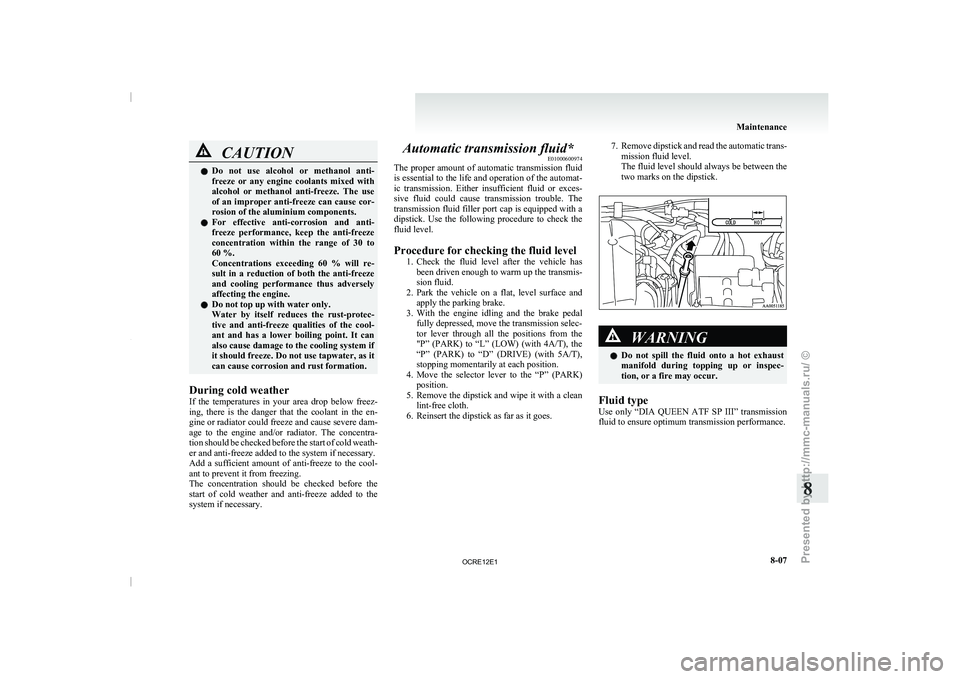
6. Reinsert the dipstick as far as it goes. 7. Remove dipstick and read the automatic trans-
mission fluid level.
The fluid level should
always be between the
two marks on the dipstick. WARNING
l Do not spill the
fluid
onto a hot exhaust
manifold during topping up or inspec-
tion, or a fire may occur.
Fluid type
Use only “DIA QUEEN ATF
SP III” transmission
fluid to ensure optimum transmission performance. Maintenance
8-07 8
OCRE12E1
Presented by http://mmc-manuals.ru/ \251
Page 310 of 369
Wheel condition
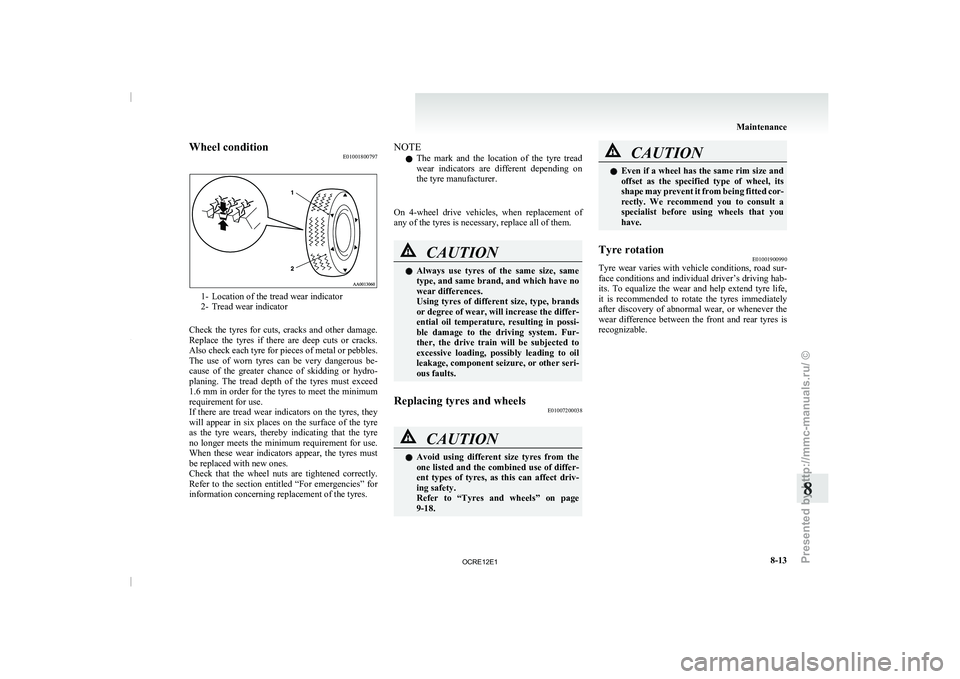
E010018007971- Location of the tread wear indicator
2- Tread wear indicator
Check the tyres for
cuts, cracks and other damage.
Replace the tyres if there are deep cuts or cracks.
Also check each tyre for pieces of metal or pebbles.
The use of worn tyres can be very dangerous be-
cause of the greater chance of skidding or hydro-
planing. The tread depth of the tyres must exceed
1.6 mm in order for the tyres to meet the minimum
requirement for use.
If there are tread wear indicators on the tyres, they
will appear in six places on the surface of the tyre
as the tyre wears, thereby indicating that the tyre
no longer meets the minimum requirement for use.
When these wear indicators appear, the tyres must
be replaced with new ones.
Check that the wheel nuts are tightened correctly.
Refer to the section entitled “For emergencies” for
information concerning replacement of the tyres. NOTE
l The
mark and the location
of the tyre tread
wear indicators are different depending on
the tyre manufacturer.
On 4-wheel drive vehicles, when replacement of
any of the tyres is necessary, replace all of them. CAUTION
l
Always use tyres of
the
same size, same
type, and same brand, and which have no
wear differences.
Using tyres of different size, type, brands
or degree of wear, will increase the differ-
ential oil temperature, resulting in possi-
ble damage to the driving system. Fur-
ther, the drive train will be subjected to
excessive loading, possibly leading to oil
leakage, component seizure, or other seri-
ous faults.
Replacing tyres and wheels E01007200038 CAUTION
l
Avoid using different size
tyres
from the
one listed and the combined use of differ-
ent types of tyres, as this can affect driv-
ing safety.
Refer to “Tyres and wheels” on page
9-18. CAUTION
l
Even if a wheel has
the same rim size and
offset as the specified type of wheel, its
shape may prevent it from being fitted cor-
rectly. We recommend you to consult a
specialist before using wheels that you
have.
Tyre rotation E01001900990
Tyre wear varies with vehicle conditions, road sur-
face conditions and
individual driver’s
driving hab-
its. To equalize the wear and help extend tyre life,
it is recommended to rotate the tyres immediately
after discovery of abnormal wear, or whenever the
wear difference between the front and rear tyres is
recognizable. Maintenance
8-13 8
OCRE12E1
Presented by http://mmc-manuals.ru/ \251
Page 315 of 369
NOTE
l Do
not allow the wiper
arm to fall onto the
windscreen; it could damage the glass.
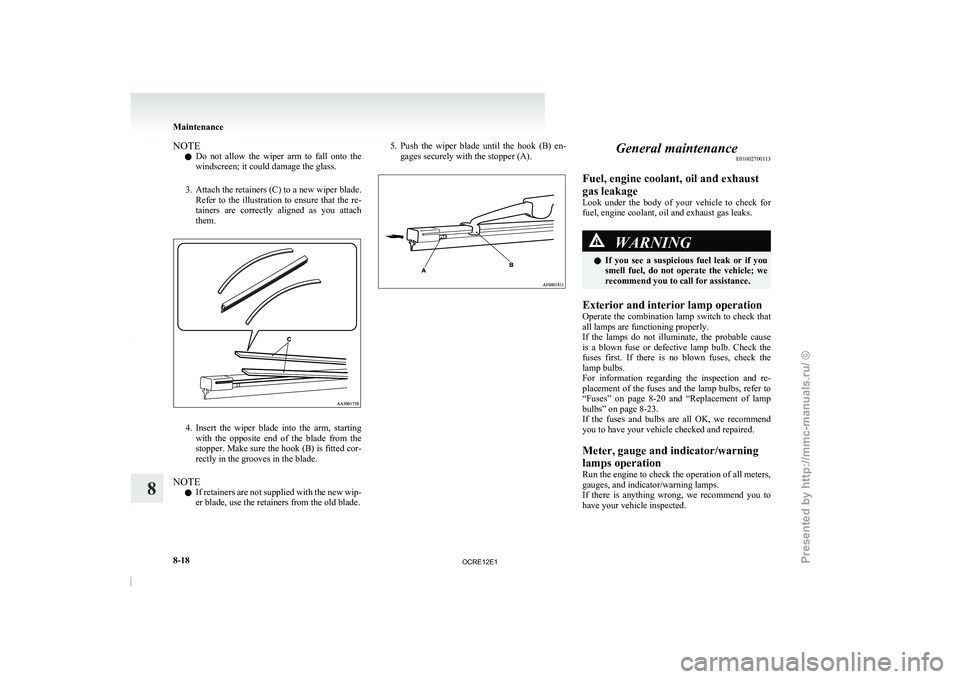
3. Attach the retainers (C) to a new wiper blade. Refer to the illustration to ensure that the re-
tainers are correctly aligned as you attach
them. 4. Insert the wiper blade into the arm, starting
with the opposite end
of the blade from the
stopper. Make sure the hook (B) is fitted cor-
rectly in the grooves in the blade.
NOTE l If retainers are not supplied with the new wip-
er blade, use the retainers from the old blade. 5. Push the wiper blade until the hook (B) en-
gages securely with the stopper (A). General maintenance
E01002700113
Fuel, engine coolant, oil and exhaust
gas leakage
Look under the body of
your vehicle to check for
fuel, engine coolant, oil and exhaust gas leaks. WARNING
l If
you
see a
suspicious
fuel leak or if you
smell fuel, do not operate the vehicle; we
recommend you to call for assistance.
Exterior and interior lamp operation
Operate the combination lamp switch
to check that
all lamps are functioning properly.
If the lamps do not illuminate, the probable cause
is a blown fuse or defective lamp bulb. Check the
fuses first. If there is no blown fuses, check the
lamp bulbs.
For information regarding the inspection and re-
placement of the fuses and the lamp bulbs, refer to
“Fuses” on page 8-20 and “Replacement of lamp
bulbs” on page 8-23.
If the fuses and bulbs are all OK, we recommend
you to have your vehicle checked and repaired.
Meter, gauge and indicator/warning
lamps operation
Run the engine to check the operation of all meters,
gauges, and indicator/warning lamps.
If there is anything wrong, we recommend you to
have your vehicle inspected. Maintenance
8-18
8
OCRE12E1
Presented by http://mmc-manuals.ru/ \251
Page 318 of 369
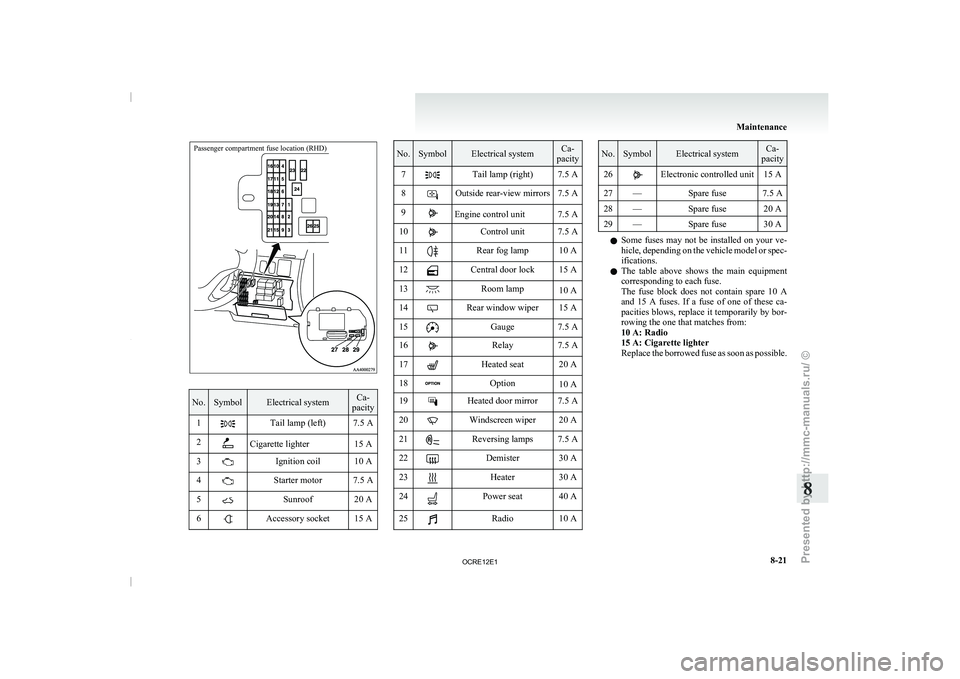
Passenger compartment fuse location (RHD)No. Symbol Electrical system Ca-
pacity
1 Tail lamp (left) 7.5 A
2 Cigarette lighter 15 A
3 Ignition coil 10 A
4 Starter motor 7.5 A
5 Sunroof 20 A
6 Accessory socket 15 A No. Symbol Electrical system Ca-
pacity
7 Tail lamp (right) 7.5 A
8 Outside rear-view mirrors 7.5 A
9 Engine control unit 7.5 A
10 Control unit 7.5 A
11 Rear fog lamp 10 A
12 Central door lock 15 A
13 Room lamp
10 A
14 Rear window wiper 15 A
15 Gauge 7.5 A
16 Relay 7.5 A
17 Heated seat 20 A
18 Option
10 A
19 Heated door mirror 7.5 A
20 Windscreen wiper 20 A
21 Reversing lamps 7.5 A
22 Demister 30 A
23 Heater 30 A
24 Power seat 40 A
25 Radio 10 A No. Symbol Electrical system Ca-
pacity
26 Electronic controlled unit 15 A
27 — Spare fuse 7.5 A
28 — Spare fuse 20 A
29 — Spare fuse 30 A l
Some fuses may not
be
installed on your ve-
hicle, depending on the vehicle model or spec-
ifications.
l The table above shows the main equipment
corresponding to each fuse.
The fuse block does not contain spare 10 A
and 15 A fuses. If a fuse of one of these ca-
pacities blows, replace it temporarily by bor-
rowing the one that matches from:
10 A: Radio
15 A: Cigarette lighter
Replace the borrowed fuse as soon as possible. Maintenance
8-21 8
OCRE12E1
Presented by http://mmc-manuals.ru/ \251
Page 320 of 369
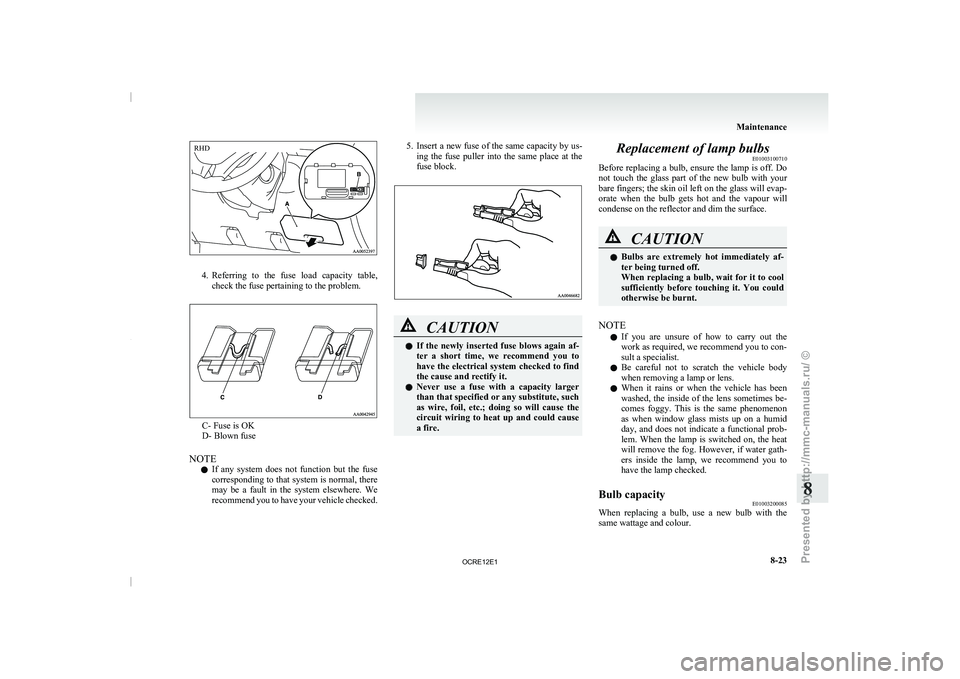
4. Referring to the fuse
load capacity table,
check the fuse pertaining to the problem. C- Fuse is OK
D- Blown fuse
NOTE l If
any system does not
function but the fuse
corresponding to that system is normal, there
may be a fault in the system elsewhere. We
recommend you to have your vehicle checked. 5. Insert
a new fuse of the same capacity by us-
ing the fuse puller
into the same place at the
fuse block. CAUTION
l
If the newly inserted
fuse
blows again af-
ter a short time, we recommend you to
have the electrical system checked to find
the cause and rectify it.
l Never use a fuse with a capacity larger
than that specified or any substitute, such
as wire, foil, etc.; doing so will cause the
circuit wiring to heat up and could cause
a fire. Replacement of lamp bulbs
E01003100710
Before replacing a bulb, ensure
the lamp is off. Do
not touch the glass part of the new bulb with your
bare fingers; the skin oil left on the glass will evap-
orate when the bulb gets hot and the vapour will
condense on the reflector and dim the surface. CAUTION
l
Bulbs are extremely hot
immediately
af-
ter being turned off.
When replacing a bulb, wait for it to cool
sufficiently before touching it. You could
otherwise be burnt.
NOTE l If
you are unsure of
how to carry out the
work as required, we recommend you to con-
sult a specialist.
l Be careful not to scratch the vehicle body
when removing a lamp or lens.
l When it rains or when the vehicle has been
washed, the inside of the lens sometimes be-
comes foggy. This is the same phenomenon
as when window glass mists up on a humid
day, and does not indicate a functional prob-
lem. When the lamp is switched on, the heat
will remove the fog. However, if water gath-
ers inside the lamp, we recommend you to
have the lamp checked.
Bulb capacity E01003200085
When replacing a bulb, use a new bulb with the
same wattage and colour. Maintenance
8-23 8RHD
OCRE12E1
Presented by http://mmc-manuals.ru/ \251
Page 322 of 369
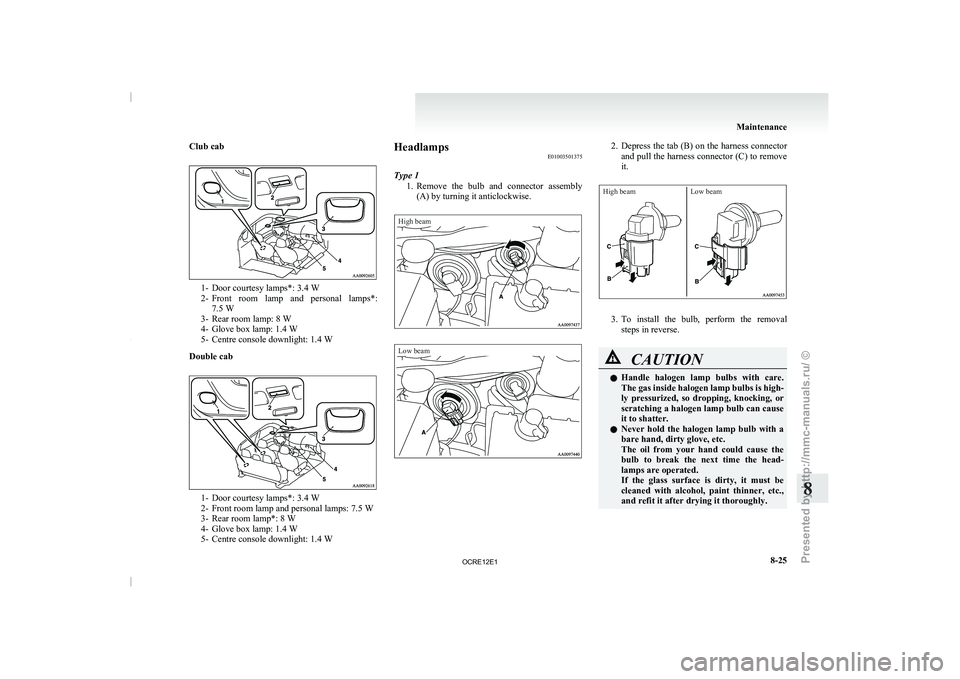
Club cab
1- Door courtesy lamps*: 3.4 W
2- Front room lamp and
personal
lamps*:
7.5 W
3- Rear room lamp: 8 W
4- Glove box lamp: 1.4 W
5- Centre console downlight: 1.4 W
Double cab 1- Door courtesy lamps*: 3.4 W
2- Front room lamp and personal lamps: 7.5 W
3- Rear room lamp*: 8 W
4-
Glove box lamp: 1.4 W
5- Centre console downlight: 1.4 W Headlamps
E01003501375
Type 1 1. Remove the bulb and connector
assembly
(A) by turning it anticlockwise.
High beam
Low beam 2. Depress the tab (B) on the harness connector
and pull the harness
connector (C) to remove
it.
High beam Low beam 3. To install the bulb, perform the removal
steps in reverse. CAUTION
l
Handle halogen lamp bulbs
with
care.
The gas inside halogen lamp bulbs is high-
ly pressurized, so dropping, knocking, or
scratching a halogen lamp bulb can cause
it to shatter.
l Never hold the halogen lamp bulb with a
bare hand, dirty glove, etc.
The oil from your hand could cause the
bulb to break the next time the head-
lamps are operated.
If the glass surface is dirty, it must be
cleaned with alcohol, paint thinner, etc.,
and refit it after drying it thoroughly. Maintenance
8-25 8
OCRE12E1
Presented by http://mmc-manuals.ru/ \251
Page 323 of 369
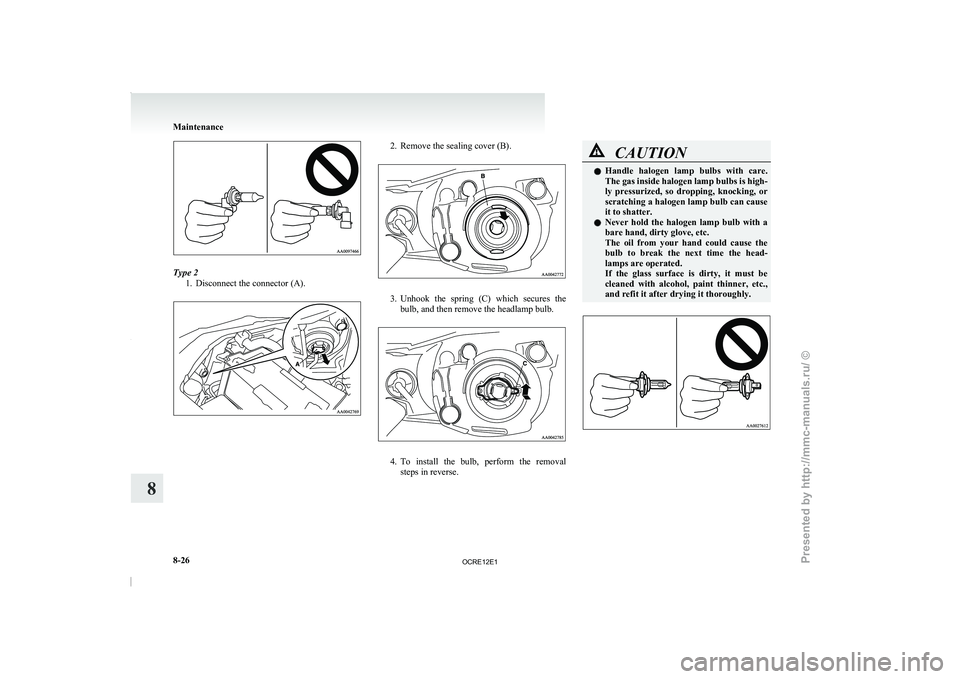
Type 2
1. Disconnect the connector (A). 2. Remove the sealing cover (B).
3. Unhook the spring (C) which secures the
bulb, and then remove the headlamp bulb. 4. To install the bulb, perform the removal
steps in reverse. CAUTION
l
Handle halogen lamp bulbs with care.
The gas inside halogen lamp bulbs is high-
ly pressurized, so dropping, knocking, or
scratching a halogen lamp bulb can cause
it to shatter.
l Never hold the halogen lamp bulb with a
bare hand, dirty glove, etc.
The oil from your hand could cause the
bulb to break the next time the head-
lamps are operated.
If the glass surface is dirty, it must be
cleaned with alcohol, paint thinner, etc.,
and refit it after drying it thoroughly. Maintenance
8-26
8
OCRE12E1
Presented by http://mmc-manuals.ru/ \251