ECO mode NISSAN 370Z COUPE 2010 User Guide
[x] Cancel search | Manufacturer: NISSAN, Model Year: 2010, Model line: 370Z COUPE, Model: NISSAN 370Z COUPE 2010Pages: 409, PDF Size: 3.56 MB
Page 31 of 409
Black plate (29,1)
Model "Z34-D" EDITED: 2009/ 9/ 10
CHILD SAFETYChildren need adults to help protect them.
They need to be properly restrained.
In addition to the general information in this
manual, child safety information is available from
many other sources, including doctors, teachers,
government traffic safety offices, and community
organizations. Every child is different, so be sure
to learn the best way to transport your child.
There are three basic types of child restraint
systems:
.Rear-facing child restraint
. Front-facing child restraint
. Booster seat
The proper restraint depends on the child’s size.
Generally, infants (up to about 1 year and less
than 20 lb (9 kg)) should be placed in rear-
facing child restraints. Front-facing child re-
straints are available for children who outgrow
rear-facing child restraints and are at least 1
year old. Booster seats are used to help position
a vehicle lap/shoulder belt on a child who can no
longer use a front-facing child restraint.
WARNING
Children need special protection. The
vehicle’s seat belts may not fit them properly. The shoulder belt may come
too close to the face or neck. The lap
belt may not fit over their small hip
bones. In an accident, an improperly
fitting seat belt could cause serious or
fatal injury. Always use appropriate
child restraints.
All U.S. states and Canadian provinces or
territories require the use of approved child
restraints for infants and small children. (See
“CHILD RESTRAINTS” later in this section.)
Also, there are other types of child restraints
available for larger children for additional pro-
tection.
InfantsInfants up to at least one year old should be
placed in a rear-facing child restraint. The
passenger seat is not suitable for use with a
rear-facing child restraint for infants. Therefore,
infants should not be transported in this vehicle.Small children (for Coupe models)Children that are over one year old and weigh at
least 20 lb (9 kg) can be placed in a front-facing
child restraint. Refer to the manufacturer’s
instructions for minimum and maximum weight
and height recommendations. NISSAN recom-
mends that small children be placed in child
restraints that comply with Federal Motor Vehicle Safety Standards or Canadian Motor
Vehicle Safety Standards. You should choose a
child restraint that fits your vehicle and always
follow the manufacturer’s instructions for instal-
lation and use.
Larger childrenChildren who are too large for child restraints
should be seated and restrained by the seat
belts which are provided. The seat belt may not
fit properly if the child is less than 4 ft 9 in (142.5
cm) tall and weighs between 40 lb (18 kg) and
80 lb (36 kg) . A booster seat should be used to
obtain proper seat belt fit.
NISSAN recommends that a child be placed in a
commercially availabl
eboosterseatifthe
shoulder belt in the child’s seating position fits
close to the face or neck or if the lap portion of
the seat belt goes across the abdomen. The
booster seat should raise the child so that the
shoulder belt is properly positioned across the
top, middle portion of the shoulder and the lap
belt is low on the hips. A booster seat can only
be used in seating positions that have a three-
point type seat belt. The booster seat should fit
the vehicle seat and have a label certifying that it
complies with Federal Motor Vehicle Safety
Standards or Canadian Motor Vehicle Safety
Standards. Once the child has grown so the
shoulder belt is no longer on or near the face
and neck, use the shoulder belt without the
booster seat.
Safety — Seats, seat belts and supplemental restraint system
1-11
Page 33 of 409
Black plate (31,1)
Model "Z34-D" EDITED: 2009/ 9/ 10
front-facing child restraint ride in
this vehicle. Do not attempt to hold
a child in your lap or arms.
. Roadster models do not have an
anchor for a top tether strap re-
quired for most child restraints.
Never let children who require the
use of rear or front-facing child
restraints ride in this vehicle.
. Larger children need special protec-
tion. The vehicle’s seat belts may
not fit them properly. The shoulder
belt may come too close to the face
or neck. The lap belt may not fit over
their small hip bones. In an acci-
dent, an improperly fitting seat belt
could cause serious or fatal injury.
Always use appropriate child re-
straints.
PREGNANT WOMENNISSAN recommends that pregnant women use
seat belts. The seat belt should be worn snug,
and always position the lap belt as low as
possible around the hips, not the waist, and
place the shoulder belt over your shoulder and
across your chest. Never run the lap/shoulder
belt over your abdominal area. Contact your
doctor for specific recommendations.
INJURED PERSONSNISSAN recommends that injured persons use
seat belts, depending on the injury. Check with
your doctor for specific recommendations.THREE-POINT TYPE SEAT BELT
WARNING
.Every person who drives or rides in
this vehicle should use a seat belt at
all times.
. Do not ride in a moving vehicle
when the seatback is reclined. This
can be dangerous. The shoulder belt
will not be against your body. In an
accident, you could be thrown into it
and receive neck or other serious
injuries. You could also slide under
the lap belt and receive serious
internal injuries.
. For the most effective protection
when the vehicle is in motion, the
seat should be upright. Always sit
well back in the seat with both feet
on the floor and adjust the seat belt
properly.
SSS0292
Fastening the seat belts1. Adjust the seat. (See “SEATS” earlier in this
section.)
2. Slowly pull the seat belt out of the retractor and insert the tongue into the buckle until
you hear and feel the latch engage.
.The retractor is designed to lock
during a sudden stop or on impact.
A slow pulling motion permits the
belt to move, and allows you some
freedom of movement in the seat.
. If the seat belt cannot be pulled
from its fully retracted position,
firmly pull the belt and release it.
Safety — Seats, seat belts and supplemental restraint system
1-13
Page 36 of 409
Black plate (34,1)
Model "Z34-D" EDITED: 2009/ 9/ 10
SSS0588
Shoulder belt arm (for Coupe models)Before fastening the seat belt, pull the shoulder
belt arm forward until it clicks at the detent
position.
Pulling the arm forward will allow an easy access
to the belt.SEAT BELT EXTENDERSIf, because of body size or driving position, it is
not possible to properly fit the lap-shoulder belt
and fasten it, an extender that is compatible with
the installed seat belts is available that can be
purchased. The extender adds approximately 8
in (200 mm) of length and may be used for either
the driver or front passenger seating position.See a NISSAN dealer for assistance with
purchasing an extender if an extender is
required.
WARNING
.
Only NISSAN seat belt extenders,
made by the same company which
made the original equipment seat
belts, should be used with the
NISSAN seat belts.
. Adults and children who can use the
standard seat belt should not use an
extender. Such unnecessary use
could result in serious personal
injury in the event of an accident.
. Never use seat belt extenders to
install child restraints. If the child
restraint is not secured properly, the
child could be seriously injured in a
collision or a sudden stop.SEAT BELT MAINTENANCE.To clean the seat belt webbings, apply a
mild soap solution or any solution recom-
mended for cleaning upholstery or carpets.
Then, wipe with a cloth and allow the seat
belts to dry in the shade. Do not allow the
seat belts to retract until they are completely dry.
. If dirt builds up in the shoulder belt
guide of the seat belt anchors, the seat
belts may retract slowly. Wipe the shoulder
belt guide with a clean, dry cloth.
. Periodically check to see that the seat
belt and the metal components such as
buckles, tongues, retractors, flexible wires
and anchors work properly. If loose parts,
deterioration, cuts or other damage on the
webbing is found, the entire seat belt
assembly should be replaced.
1-16
Safety — Seats, seat belts and supplemental restraint system
Page 38 of 409
Black plate (36,1)
Model "Z34-D" EDITED: 2009/ 9/ 10
seat belts or harnesses.
. Adjustable seatbacks should be
positioned to fit the child restraint,
but as upright as possible.
. After attaching the child restraint,
test it before you place the child in
it. Push it from side to side while
holding the seat by the seat belt
path. The child restraint should not
move more than 1 inch (25 mm) from
side to side. Try to tug it forward and
check to see if the belt holds the
restraint in place. If the restraint is
not secure, tighten the belt as
necessary, or put the restraint in
another seat and test it again. You
may need to try a different child
restraint. Not all child restraints fit
in all types of vehicles.
. When your child restraint is not in
use, keep it secured with a seat belt
to prevent it from being thrown
around in case of a sudden stop or
accident.
CAUTION
Remember that a child restraint left in a
closed vehicle can become very hot.
Check the seating surface and buckles
before placing your child in the child
restraint.
In general, child restraints are designed to be
installed with the lap portion of a lap/shoulder
seat belt.
Several manufacturers offer child restraints for
children of various sizes. When selecting any
child restraint, keep the following points in mind:
. Choose only a restraint with a label certifying
that it complies with Federal Motor Vehicle
Safety Standard 213 or Canadian Motor
Vehicle Safety Standard 213.
. Check the child restraint in your vehicle to
be sure it is compatible with the vehicle’s
seat and seat belt system.
. If the child restraint is compatible with your
vehicle, place your child in the child restraint
and check the various adjustments to be
sure the child restraint is compatible with
your child. Choose a child restraint that is
designed for your child’s height and weight.
Always follow all recommended procedures. The passenger seat is not suitable for use with a
rear-facing child restraint for infants. Therefore,
infants should not be transported in this vehicle.
All U.S. states and Canadian provinces or
territories require that infants and small
children be restrained in an approved child
restraint at all times while the vehicle is
being operated. Canadian law requires the
top tether strap on front-facing child
restraints to be secured to the designated
anchor point on the vehicle.
1-18
Safety — Seats, seat belts and supplemental restraint system
Page 44 of 409
Black plate (42,1)
Model "Z34-D" EDITED: 2009/ 9/ 10
used with a lap/shoulder belt. Boos-
ter seats are designed to properly
route the lap and shoulder portions
of the seat belt over the strongest
portions of a child’s body to provide
the maximum protection during a
collision.
. Follow all of the booster seat man-
ufacturer’s instructions for installa-
tion and use. When purchasing a
booster seat, be sure to select one
which will fit your child and vehicle.
It may not be possible to properly
install some types of booster seats
in your vehicle.
. If the booster seat and seat belt is
not used properly, the risk of a child
being injured in a collision or a
sudden stop greatly increases.
. Adjustable seatbacks should be
positioned to fit the booster seat,
but as up- right as possible.
. After placing the child in the booster
seat and fastening the seat belt,
make sure the shoulder portion of
the belt is away from the child’s face
and neck and the lap portion of the
belt does not cross the abdomen. .
Do not put the shoulder belt behind
the child or under the child’s arm. If
you must install a booster seat in
the front seat, see “BOOSTER SEAT
INSTALLATION” later in this section.
. When your booster seat is not in
use, keep it secured with a seat belt
to prevent it from being thrown
around in case of a sudden stop or
accident.
CAUTION
Remember that a booster seat left in a
closed vehicle can become very hot.
Check the seating surface and buckles
before placing your child in the booster
seat.
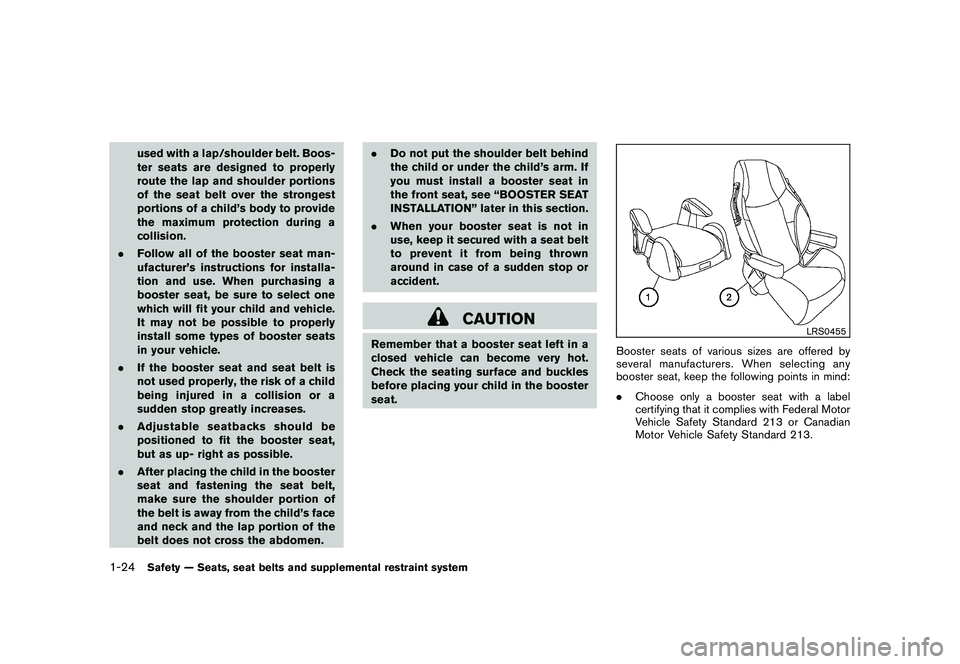
LRS0455
Booster seats of various sizes are offered by
several manufacturers. When selecting any
booster seat, keep the following points in mind:
.Choose only a booster seat with a label
certifying that it complies with Federal Motor
Vehicle Safety Standard 213 or Canadian
Motor Vehicle Safety Standard 213.
1-24
Safety — Seats, seat belts and supplemental restraint system
Page 45 of 409
Black plate (43,1)
Model "Z34-D" EDITED: 2009/ 9/ 10
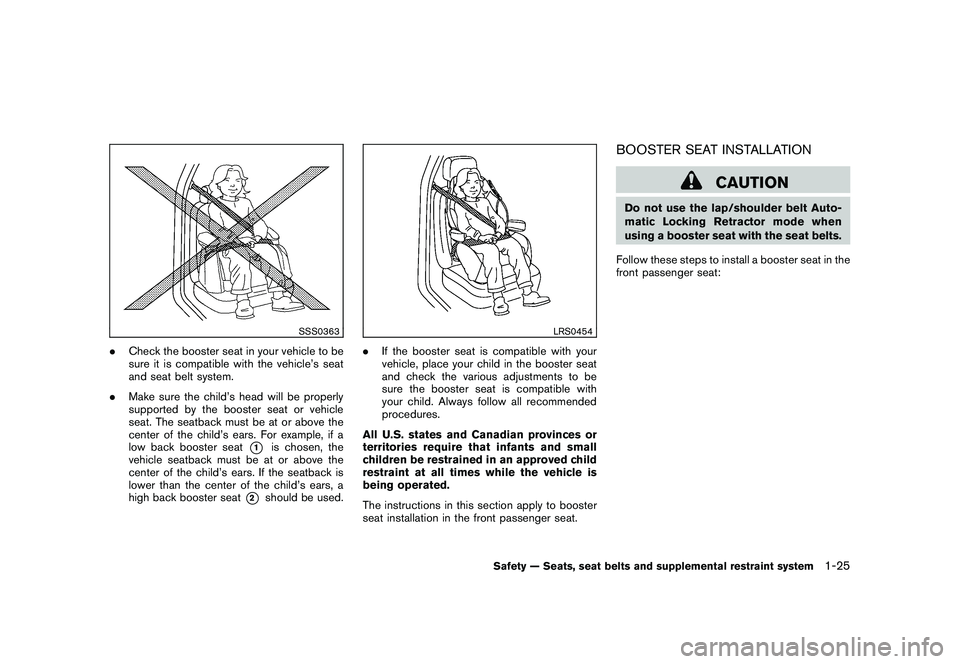
SSS0363
.Check the booster seat in your vehicle to be
sure it is compatible with the vehicle’s seat
and seat belt system.
. Make sure the child’s head will be properly
supported by the booster seat or vehicle
seat. The seatback must be at or above the
center of the child’s ears. For example, if a
low back booster seat
*1
is chosen, the
vehicle seatback must be at or above the
center of the child’s ears. If the seatback is
lower than the center of the child’s ears, a
high back booster seat
*2
should be used.
LRS0454
. If the booster seat is compatible with your
vehicle, place your child in the booster seat
and check the various adjustments to be
sure the booster seat is compatible with
your child. Always follow all recommended
procedures.
All U.S. states and Canadian provinces or
territories require that infants and small
children be restrained in an approved child
restraint at all times while the vehicle is
being operated.
The instructions in this section apply to booster
seat installation in the front passenger seat.
BOOSTER SEAT INSTALLATION
CAUTION
Do not use the lap/shoulder belt Auto-
matic Locking Retractor mode when
using a booster seat with the seat belts.
Follow these steps to install a booster seat in the
front passenger seat:
Safety — Seats, seat belts and supplemental restraint system
1-25
Page 47 of 409

Black plate (45,1)
Model "Z34-D" EDITED: 2009/ 9/ 10
SSS0988
7. If the booster seat is installed in the frontpassenger seat, push the ignition switch to
the ON position. The front passenger air bag
status light
may or may not illuminate
depending on the size of the child and the
type of booster seat used. (See “Front
passenger air bag and status light” later in
this section.)
PRECAUTIONS ON SUPPLEMENTAL
RESTRAINT SYSTEMThis Supplemental Restraint System (SRS)
section contains important information concern-
ing the driver and passenger front impact
supplemental air bags (NISSAN Advanced Air
Bag System) , front seat-mounted side-impact
supplemental air bag system, roof-mounted
(Coupe models) or door-mounted (Roadster
models) curtain side-impact supplemental air
bag and seat belt with pretensioners.
Supplemental front-impact air bag system:
The NISSAN Advanced Air Bag System can
help cushion the impact force to the head and
chest of the driver and front passenger in certain
frontal collisions.
Front seat-mounted side-impact supple-
mental air bag system: This system can help
cushion the impact force to the chest and pelvis
area of the driver and front passenger in certain
side impact collisions. The front seat side-
impact supplemental air bags are designed to
inflate on the side where the vehicle is impacted.
Roof-mounted curtain side-impact supple-
mental air bag system (for Coupe models):
This system can help cushion the impact force
to the head of the driver and front passenger in
certain side impact collisions. The curtain air
bags are designed to inflate on the side where
the vehicle is impacted. Door-mounted curtain side-impact supple-
mental air bag system (for Roadster mod-
els):
This system can help cushion the impact
force to the heads of occupants in front seating
positions during certain side impact collisions.
The curtain air bags are designed to inflate on
the side where the vehicle is impacted.
These supplemental restraint systems are de-
signed to supplement the crash protection
provided by the driver and passenger seat belts
and are not a substitute for them. Seat belts
should always be correctly worn and the
occupant seated a suitable distance away from
the steering wheel, instrument panel and door
finishers. (See “SEAT BELTS” earlier in this
section for instructions and precautions on seat
belt usage.)
The supplemental air bags operate only
when the ignition switch is in the ON
position.
After pushing the ignition switch to the ON
position, the supplemental air bag warning
light illuminates. The supplemental air bag
warning light will turn off after about 7
seconds if the systems are operational.SUPPLEMENTAL RESTRAINT
SYSTEM
Safety — Seats, seat belts and supplemental restraint system
1-27
Page 53 of 409

Black plate (51,1)
Model "Z34-D" EDITED: 2009/ 9/ 10
switches and the occupant classification sensor
(pattern sensor) . Inflator operation is based on
the severity of a collision and seat belt usage for
the driver. For the front passenger, the occupant
classification sensor is also monitored. Based
on information from the sensors, only one front
air bag may inflate in a crash, depending on the
crash severity and whether the front occupants
are belted or unbelted. Additionally, the front
passenger air bag may be automatically turned
OFF under some conditions, depending on the
information provided by the occupant classifica-
tion sensor. If the front passenger air bag is OFF,
the passenger air bag status light will be
illuminated (if the seat is unoccupied, the light
will not be illuminated, but the air bag will be off) .
(See “Front passenger air bag and status light”
later in this section for further details.) One front
air bag inflating does not indicate improper
performance of the system.
If you have any questions about your air bag
system, contact a NISSAN dealer. If you are
considering modification of your vehicle due to a
disability, you may also contact a NISSAN
dealer. Contact information is contained in the
front of this Owner’s Manual.
When a front air bag inflates, a fairly loud noise
may be heard, followed by release of smoke.
This smoke is not harmful and does not indicate
a fire. Care should be taken not to inhale it, as it
may cause irritation and choking. Those with ahistory of a breathing condition should get fresh
air promptly.
Front air bags, along with the use of seat belts,
help to cushion the impact force on the head
and chest of the front occupants. They can help
save lives and reduce serious injuries. However,
an inflating front air bag may cause facial
abrasions or other injuries. Front air bags do
not provide restraint to the lower body.
Even with NISSAN advanced air bags, seat
belts should be correctly worn and the driver
and passenger seated upright as far as practical
away from the steering wheel or instrument
panel. The front air bags inflate quickly in order
to help protect the front occupants. Because of
this, the force of the front air bag inflating can
increase the risk of injury if the occupant is too
close to, or is against, the air bag module during
inflation.
The front air bags deflate quickly after a collision.
The supplemental front air bags operate
only when the ignition switch is in the ON
position.
After pushing the ignition switch to the ON
position, the supplemental air bag warning
light illuminates. The supplemental air bag
warning light will turn off after about 7
seconds if the system is operational.
SSS0988
Front passenger air bag status light
Front passenger air bag and status light
WARNING
The front passenger air bag is designed
to automatically turn OFF under some
conditions. Read this section carefully
to learn how it operates. Proper use of
the seat, seat belt and child restraints is
necessary for most effective protection.
Failure to follow all instructions in this
manual concerning the use of seats,
seat belts and child restraints can
increase the risk or severity of injury in
an accident.
Safety — Seats, seat belts and supplemental restraint system
1-33
Page 55 of 409
Black plate (53,1)
Model "Z34-D" EDITED: 2009/ 9/ 10
child and the type of child restraint being used. If
the passenger air bag status light is not
illuminated (indicating that the air bag might
inflate in a crash) , it could be that the child
restraint or seat belt is not being used properly.
Make sure that the child restraint is installed
properly, the seat belt is used properly and the
occupant is positioned properly. If the passen-
ger air bag status light is still not illuminated, try
a different child restraint.
If the passenger air bag status light will not
illuminate even though you believe that the child
restraint, the seat belts and the occupant are
properly positioned, the system may be sensing
an unoccupied seat (in which case the air bag is
OFF) . Your NISSAN dealer can check that the
system is OFF by using a special tool. However,
until you have confirmed with your dealer that
your air bag is working properly, do not transport
a child in this vehicle.
The NISSAN Advanced Air Bag System and
passenger air bag status light will take a few
seconds to register a change in the passenger
seat status. However, if the seat becomes
unoccupied, the air bag status light will remain
off.
If a malfunction occurs in the front passenger air
bag system, the supplemental air bag warning
light
, located in the meter and gauges area
will blink. Have the system checked by a
NISSAN dealer.
Other supplemental front-impact air bag
precautions
WARNING
. Do not place any objects on the
steering wheel pad or on the instru-
ment panel. Also, do not place any
objects between any occupant and
the steering wheel or instrument
panel. Such objects may become
dangerous projectiles and cause
injury if the front air bag inflates.
. Do not place objects with sharp
edges on the seat. Also, do not
place heavy objects on the seat that
will leave permanent impressions in
the seat. Such objects can damage
the seat or occupant classification
sensor (pattern sensor) . This can
affect the operation of the air bag
system and result in serious perso-
nal injury.
. Do not use water or acidic cleaners
(hot steam cleaners) on the seat.
This can damage the seat or occu-
pant classification sensor. This can
also affect the operation of the air
bag system and result in serious personal injury.
. Immediately after inflation, several
front air bag system components
will be hot. Do not touch them; you
may severely burn yourself.
. No unauthorized changes should be
made to any components or wiring
of the air bag system. This is to
prevent accidental inflation of the
supplemental air bag or damage to
the supplemental air bag system.
. Do not make unauthorized changes
to your vehicle’s electrical system,
suspension system or front end
structure. This could affect proper
operation of the front air bag sys-
tem.
. Tampering with the front air bag
system may result in serious perso-
nal injury. Tampering includes
changes to the steering wheel and
the instrument panel assembly by
placing material over the steering
wheel pad and above the instrument
panel or by installing additional trim
material around the air bag system.
. Modifying or tampering with the
front passenger seat may result in
Safety — Seats, seat belts and supplemental restraint system
1-35
Page 57 of 409

Black plate (55,1)
Model "Z34-D" EDITED: 2009/ 9/ 10
in another type of collision are similar to those of
a higher severity side impact. They are designed
to inflate on the side where the vehicle is
impacted. They may not inflate in certain side
collisions on the side where the vehicle is
impacted.
Vehicle damage (or lack of it) is not always an
indication of proper supplemental side air bag
and curtain air bag operation.
When side air bags and curtain air bags inflate, a
fairly loud noise may be heard, followed by
release of smoke. This smoke is not harmful and
does not indicate a fire. Care should be taken
not to inhale it, as it may cause irritation and
choking. Those with a history of a breathing
condition should get fresh air promptly.
Side air bags, along with the use of seat belts,
help to cushion the impact force on the chest
and pelvis of the front occupants. Curtain air
bags help to cushion the impact force to the
head of occupants. They can help save lives and
reduce serious injuries. However, an inflating
side air bags and curtain air bags may cause
abrasions or other injuries. Side air bags and
curtain air bags do not provide restraint to the
lower body.
The seat belts should be correctly worn and the
driver and passenger seated upright as far as
practical away from the side air bag, and seated
as far away as practical from the door finishersand side roof rails. The side air bags and curtain
air bags inflate quickly in order to help protect
the out-of-position occupants. Because of this,
the force of the side air bags and curtain air
bags inflating can increase the risk of injury if the
occupant is too close to, or is against, these air
bag modules during inflation. The side air bags
and curtain air bags will deflate quickly after the
collision is over.
The side air bags and curtain air bags operate
only when the ignition switch is in the ON
position.
After pushing the ignition switch to the ON
position, the supplemental air bag warning
light illuminates. The air bag warning light
will turn off after about 7 seconds if the
systems are operational.
WARNING
.
Do not place any objects near the
seatback of the front seats. Also, do
not place any objects (an umbrella,
bag, etc.) between the front door
finisher and the front seat. Such
objects may become dangerous
projectiles and cause injury if a side
air bag inflates.
. Right after inflation, several side air
bags and curtain air bag system components will be hot. Do not
touch them; you may severely burn
yourself.
. No unauthorized changes should be
made to any components or wiring
of side air bag and curtain air bag
systems. This is to prevent acciden-
tal inflation of the side air bag and
curtain air bag or damage to side air
bag and curtain air bag systems.
. Do not make unauthorized changes
to your vehicle’s electrical system,
suspension system or side panel.
This could affect proper operation
of the side air bag and curtain air
bag systems.
. Tampering with the air bag system
may result in serious personal in-
jury. For example, do not change the
front seats by placing material near
the seatback or by installing addi-
tional trim material, such as seat
covers, around the side air bags.
. Work around and on the side air bag
and curtain air bag systems should
be done by a NISSAN dealer. In-
stallation of electrical equipment
should also be done by a NISSAN
Safety — Seats, seat belts and supplemental restraint system
1-37