warning light NISSAN 370Z COUPE 2010 Repair Manual
[x] Cancel search | Manufacturer: NISSAN, Model Year: 2010, Model line: 370Z COUPE, Model: NISSAN 370Z COUPE 2010Pages: 409, PDF Size: 3.56 MB
Page 339 of 409
Black plate (25,1)
8 Maintenance and do-it-yourself
Model "Z34-D" EDITED: 2009/ 9/ 10
Maintenance requirement..................................... 8-2
Scheduled maintenance ................................... 8-2
General maintenance ...................................... 8-2
Where to go for service ................................... 8-2
General maintenance .......................................... 8-2
Explanation of maintenance items ....................... 8-2
Maintenance precautions ..................................... 8-5
Engine compartment check locations ...................... 8-7
VQ37VHR engine model. ................................. 8-7
Engine cooling system ......................................... 8-8
Checking engine coolant level ........................... 8-8
Changing engine coolant ................................. 8-9
Engine oil ......................................................... 8-9
Checking engine oil level ................................. 8-9
Changing engine oil and filter ............................ 8-9
Automatic transmission fluid ................................ 8-11
Power steering fluid .......................................... 8-12
Brake and clutch fluid ....................................... 8-12
Brake fluid .................................................. 8-13
Clutch fluid ................................................. 8-13
Window washer fluid ........................................ 8-13
Battery .......................................................... 8-14
Jump starting .............................................. 8-16
Variable voltage control system ............................ 8-16
Drive belts ...................................................... 8-16 Spark plugs
.................................................... 8-17
Replacing spark plugs ................................... 8-17
Air cleaner ...................................................... 8-18
Windshield wiper blades .................................... 8-18
Cleaning .................................................... 8-18
Replacing ................................................... 8-19
Brakes ........................................................... 8-20
Self-adjusting brakes .................................... 8-20
Brake pad wear warning ................................ 8-20
Fuses ............................................................ 8-20
Engine compartment ..................................... 8-20
Passenger compartment ................................ 8-22
Intelligent Key battery replacement ....................... 8-22
Lights ............................................................ 8-24
Coupe ....................................................... 8-24
Roadster .................................................... 8-25
Headlights .................................................. 8-26
Exterior and interior lights ............................... 8-26
Wheels and tires .............................................. 8-28
Tire pressure ............................................... 8-28
Tire labeling ................................................ 8-31
Types of tires .............................................. 8-33
Tire chains .................................................. 8-34
Changing wheels and tires ............................. 8-35
Emergency tire puncture repair kit
(if so equipped) ........................................... 8-37
Page 342 of 409
Black plate (344,1)
Model "Z34-D" EDITED: 2009/ 9/ 10
Warning lights and chimes:Make sure that
all warning lights and chimes are operating
properly.
Windshield defroster: Check that the air
comes out of the defroster outlets properly and
in sufficient quantity when operating the heater
or air conditioner.
Windshield wiper and washer*: Check that
the wipers and washer operate properly and that
the wipers do not streak.Under the hood and vehicleThe maintenance items listed here should be
checked periodically (for example, each time you
check the engine oil or refuel) .
Battery*: Check the fluid level in each cell. It
should be between the MAX and MIN lines.
Vehicles operated in high temperatures or under
severe condition require frequent checks of the
battery fluid level.
Brake and clutch fluid levels*: Make sure
that the brake and clutch fluid levels are
between the MAX and MIN lines on the
reservoirs.
Engine coolant level*: Check the coolant level
when the engine is cold.
Engine drive belts*: Make sure that no belt is
frayed, worn, cracked or oily. Engine oil level*:
Check the level after parking
the vehicle on a level spot and turning off the
engine. Wait more than 15 minutes for the oil to
drain back into the oil pan.
Exhaust system: Make sure there are no loose
supports, cracks or holes. If the sound of the
exhaust seems unusual or there is a smell of
exhaust fumes, immediately have the exhaust
system inspected by a NISSAN dealer. (See
“PRECAUTIONS WHEN STARTING AND
DRIVING” in the “5. St arting and driving”
section for exhaust gas (carbon monoxide) .)
Fluid leaks: Check under the vehicle for fuel,
oil, water or other fluid leaks after the vehicle has
been parked for a while. Water dripping from the
air conditioner after use is normal. If you should
notice any leaks or if gasoline fumes are evident,
check for the cause and have it corrected
immediately.
Power steering fluid level* and lines: Check
the level with the engine off. Check the lines for
proper attachment, leaks, cracks, etc.
Radiator and hoses: Check the front of the
radiator and clean off any dirt, insects, leaves,
etc., that may have accumulated. Make sure the
hoses have no cracks, deformation, rot or loose
connections. Underbody:
The underbody is frequently ex-
posed to corrosive substances such as those
used on icy roads or to control dust. It is very
important to remove these substances, other-
wise rust will form on the floor pan, frame, fuel
lines and around the exhaust system. At the end
of winter, the underbody should be thoroughly
flushed with plain water, being careful to clean
those areas where mud and dirt may accumu-
late. For additional information, see “CLEANING
EXTERIOR” in the “7. Appearance and care”
section.
Windshield washer fluid*: Check that there is
adequate fluid in the reservoir.8-4
Maintenance and do-it-yourself
Page 351 of 409
Black plate (353,1)
Model "Z34-D" EDITED: 2009/ 9/ 10
SDI2025A
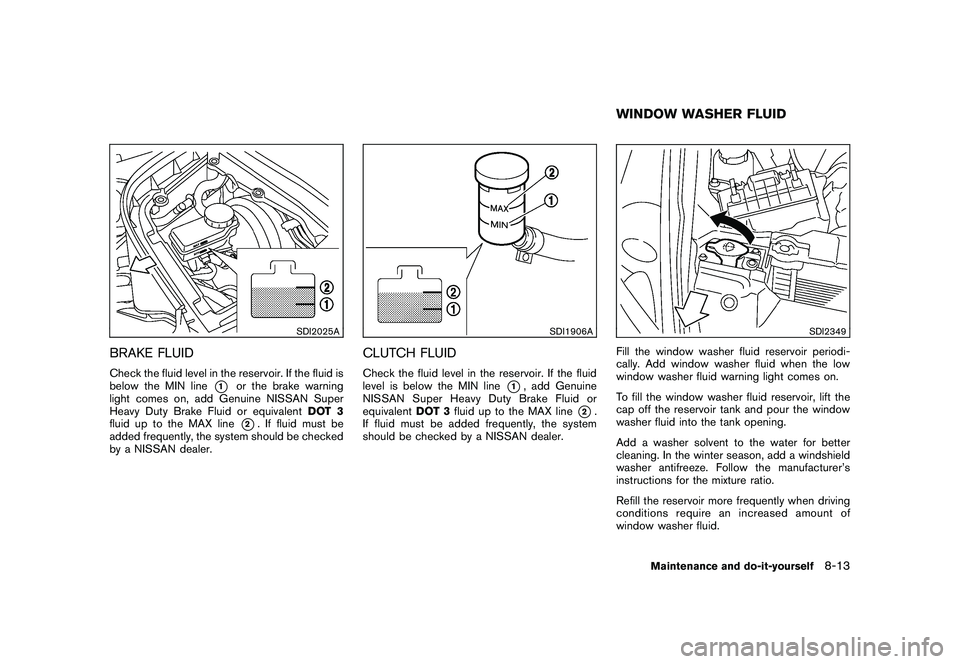
BRAKE FLUIDCheck the fluid level in the reservoir. If the fluid is
below the MIN line
*1
or the brake warning
light comes on, add Genuine NISSAN Super
Heavy Duty Brake Fluid or equivalent DOT 3
fluid up to the MAX line*2. If fluid must be
added frequently, the system should be checked
by a NISSAN dealer.
SDI1906A
CLUTCH FLUIDCheck the fluid level in the reservoir. If the fluid
level is below the MIN line
*1, add Genuine
NISSAN Super Heavy Duty Brake Fluid or
equivalent DOT 3fluid up to the MAX line
*2.
If fluid must be added frequently, the system
should be checked by a NISSAN dealer.
SDI2349
Fill the window washer fluid reservoir periodi-
cally. Add window washer fluid when the low
window washer fluid warning light comes on.
To fill the window washer fluid reservoir, lift the
cap off the reservoir tank and pour the window
washer fluid into the tank opening.
Add a washer solvent to the water for better
cleaning. In the winter season, add a windshield
washer antifreeze. Follow the manufacturer’s
instructions for the mixture ratio.
Refill the reservoir more frequently when driving
conditions require an increased amount of
window washer fluid.WINDOW WASHER FLUID
Maintenance and do-it-yourself
8-13
Page 358 of 409
Black plate (360,1)
Model "Z34-D" EDITED: 2009/ 9/ 10
If the brakes do not operate properly, have the
brakes checked by a NISSAN dealer.SELF-ADJUSTING BRAKESYour vehicle is equipped with self-adjusting
brakes.
The disc-type brakes self-adjust every time the
brake pedal is applied.
WARNING
See a NISSAN dealer for a brake
system check if the brake pedal height
does not return to normal.BRAKE PAD WEAR WARNINGThe disc brake pads have audible wear warn-
ings. When a brake pad requires replacement, it
will make a high pitched scraping sound when
the vehicle is in motion. This scraping sound will
first occur only when the brake pedal is
depressed. After more wear of the brake pad
the sound will always be heard even if the brake
pedal is not depressed. Have the brakes
checked as soon as possible if the wear warning
sound is heard.
Under some driving or climate conditions,
occasional brake squeak, squeal or other noise
may be heard. Occasional brake noise during
light to moderate stops is normal and does not affect the function or performance of the brake
system.
Proper brake inspection intervals should
be followed.
For additional information, see the
maintenance log section of your “NISSAN
Service and Maintenance Guide”.
SDI1479A
ENGINE COMPARTMENT
CAUTION
Never use a fuse of a higher or lower
amperage rating than that specified on
the fuse box cover. This could damage
the electrical system or cause a fire.
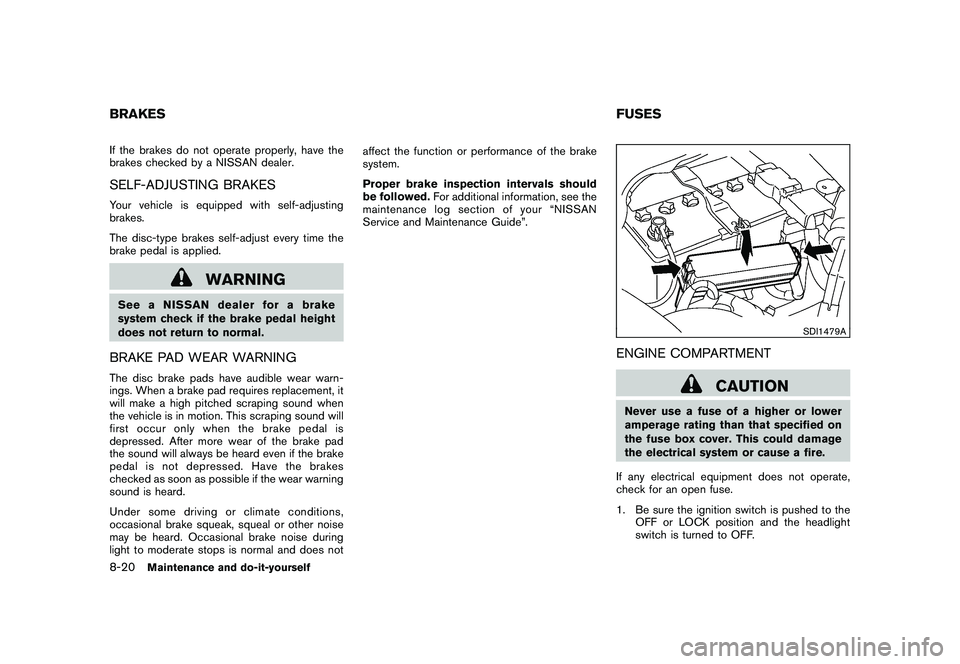
If any electrical equipment does not operate,
check for an open fuse.
1. Be sure the ignition switch is pushed to the OFF or LOCK position and the headlight
switch is turned to OFF.
BRAKES FUSES8-20
Maintenance and do-it-yourself
Page 364 of 409
Black plate (366,1)
Model "Z34-D" EDITED: 2009/ 9/ 10
HEADLIGHTSFog may temporarily form inside the lens of the
exterior lights in the rain or in a car wash. A
temperature difference between the inside and
the outside of the lens causes the fog. This is
not a malfunction. If large drops of water collect
inside the lens, contact a NISSAN dealer.Replacing
WARNINGHIGH VOLTAGE
When xenon headlights are on, they
produce a high voltage. To prevent an
electric shock, never attempt to modify
or disassemble. Always have your xe-
non headlights replaced at a NISSAN
dealer. For additional information, see
“HEADLIGHT AND TURN SIGNAL
SWITCH” in the “2. Instruments and
controls” section.
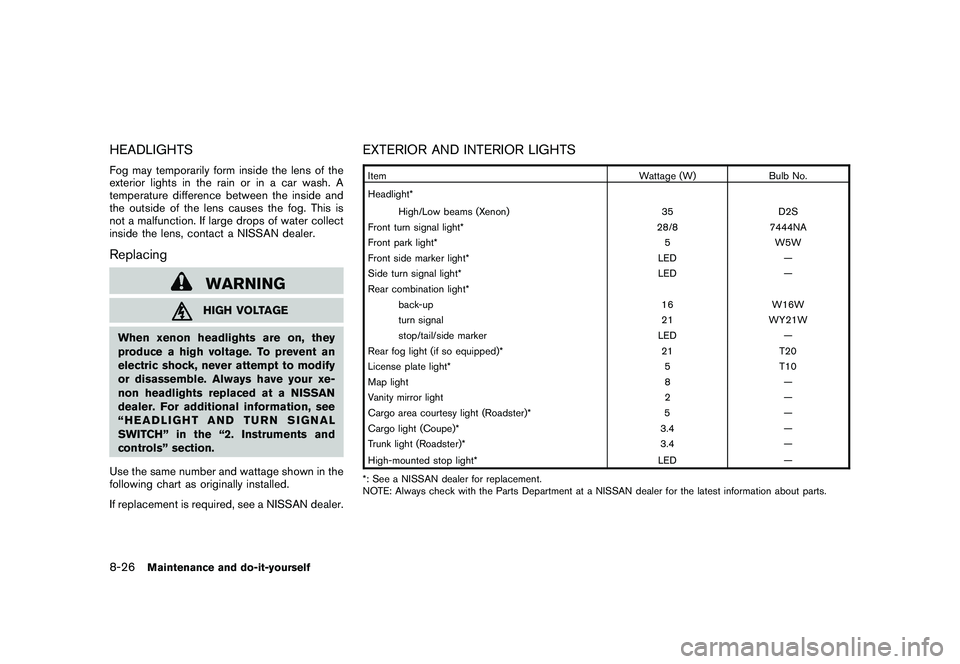
Use the same number and wattage shown in the
following chart as originally installed.
If replacement is required, see a NISSAN dealer.
EXTERIOR AND INTERIOR LIGHTSItem Wattage (W)Bulb No.
Headlight* High/Low beams (Xenon) 35D2S
Front turn signal light* 28/87444NA
Front park light* 5W5W
Front side marker light* LED—
Side turn signal light* LED—
Rear combination light* back-up 16W16W
turn signal 21WY21W
stop/tail/side marker LED—
Rear fog light (if so equipped)* 21T20
License plate light* 5T10
Map light 8—
Vanity mirror light 2—
Cargo area courtesy light (Roadster)* 5—
Cargo light (Coupe)* 3.4—
Trunk light (Roadster)* 3.4—
High-mounted stop light* LED
—
*: See a NISSAN dealer for replacement.
NOTE: Always check with the Parts Department at a NISSAN dealer for the latest information about parts.
8-26
Maintenance and do-it-yourself
Page 366 of 409
Black plate (368,1)
Model "Z34-D" EDITED: 2009/ 9/ 10
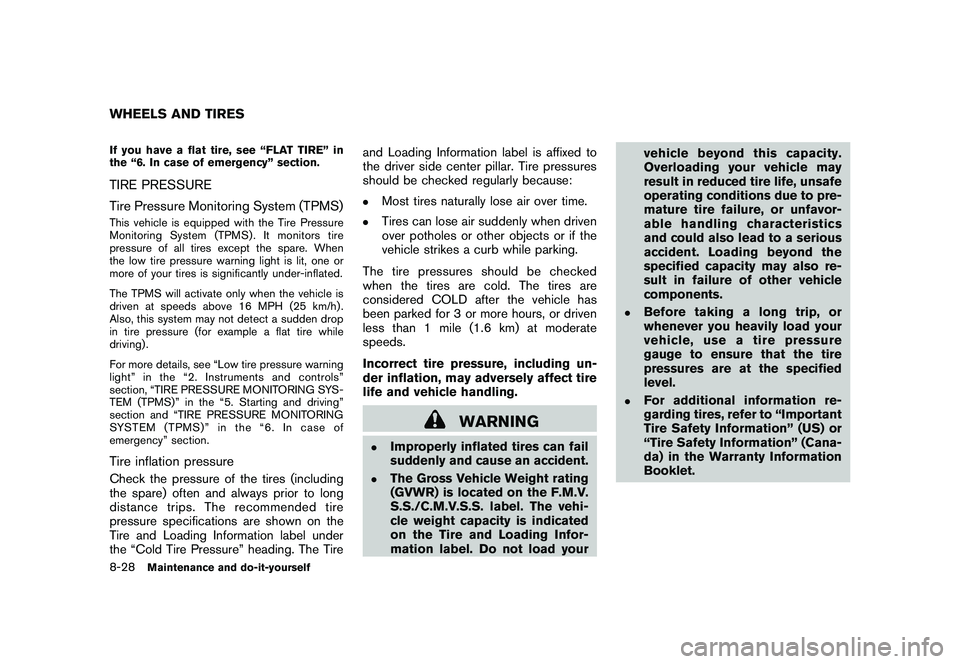
If you have a flat tire, see “FLAT TIRE” in
the “6. In case of emergency” section.TIRE PRESSURE
Tire Pressure Monitoring System (TPMS)This vehicle is equipped with the Tire Pressure
Monitoring System (TPMS) . It monitors tire
pressure of all tires except the spare. When
the low tire pressure warning light is lit, one or
more of your tires is significantly under-inflated.
The TPMS will activate only when the vehicle is
driven at speeds above 16 MPH (25 km/h) .
Also, this system may not detect a sudden drop
in tire pressure (for example a flat tire while
driving) .
For more details, see “Low tire pressure warning
light” in the “2. Instruments and controls”
section, “TIRE PRESSURE MONITORING SYS-
TEM (TPMS)” in the “5. Starting and driving”
section and “TIRE PRESSURE MONITORING
SYSTEM (TPMS)” in the “6. In case of
emergency” section.Tire inflation pressureCheck the pressure of the tires (including
the spare) often and always prior to long
distance trips. The recommended tire
pressure specifications are shown on the
Tire and Loading Information label under
the “Cold Tire Pressure” heading. The Tireand Loading Information label is affixed to
the driver side center pillar. Tire pressures
should be checked regularly because:
.
Most tires naturally lose air over time.
.
Tires can lose air suddenly when driven
over potholes or other objects or if the
vehicle strikes a curb while parking.
The tire pressures should be checked
when the tires are cold. The tires are
considered COLD after the vehicle has
been parked for 3 or more hours, or driven
less than 1 mile (1.6 km) at moderate
speeds.
Incorrect tire pressure, including un-
der inflation, may adversely affect tire
life and vehicle handling.
WARNING
.
Improperly inflated tires can fail
suddenly and cause an accident.
.
The Gross Vehicle Weight rating
(GVWR) is located on the F.M.V.
S.S./C.M.V.S.S. label. The vehi-
cle weight capacity is indicated
on the Tire and Loading Infor-
mation label. Do not load your vehicle beyond this capacity.
Overloading your vehicle may
result in reduced tire life, unsafe
operating conditions due to pre-
mature tire failure, or unfavor-
able handling characteristics
and could also lead to a serious
accident. Loading beyond the
specified capacity may also re-
sult in failure of other vehicle
components.
.
Before taking a long trip, or
whenever you heavily load your
vehicle, use a tire pressure
gauge to ensure that the tire
pressures are at the specified
level.
.
For additional information re-
garding tires, refer to “Important
Tire Safety Information” (US) or
“Tire Safety Information” (Cana-
da) in the Warranty Information
Booklet.
WHEELS AND TIRES8-28
Maintenance and do-it-yourself
Page 374 of 409
Black plate (376,1)
Model "Z34-D" EDITED: 2009/ 9/ 10
WARNING
.The use of tires other than those
recommended or the mixed use of
tires of different brands, construc-
tion (bias, bias-belted or radial) , or
tread patterns can adversely affect
the ride, braking, handling, ground
clearance, body-to-tire clearance,
tire chain clearance, speedometer
calibration, headlight aim and bum-
per height. Some of these effects
may lead to accidents and could
result in serious personal injury.
. If the wheels are changed for any
reason, always replace with wheels
which have the same off-set dimen-
sion. Wheels of a different off-set
could cause premature tire wear,
degrade vehicle handling character-
istics and/or interference with the
brake discs/drums. Such interfer-
ence can lead to decreased braking
efficiency and/or early brake pad/
shoe wear. See “WHEELS AND
TIRES” in the “9. Technical and
consumer information” section of
this manual for wheel off-set dimen-
sions. .
When a spare tire is mounted or a
wheel is replaced, the TPMS will not
function and the low tire pressure
warning light will flash for approxi-
mately 1 minute. The light will
remain on after 1 minute. Contact
your NISSAN dealer as soon as
possible for tire replacement and/
or system resetting.
. Replacing tires with those not ori-
ginally specified by NISSAN could
affect the proper operation of the
TPMS.
. Do not install a deformed wheel or
tire even if it has been repaired.
Such wheels or tires could have
structural damage and could fail
without warning.
. The use of retread tire is not re-
commended.
. For additional information regard-
ing tires, refer to “Important Tire
Safety Information” (US) or “Tire
Safety Information” (Canada) in the
Warranty Information Booklet.
Wheel balanceUnbalanced wheels may affect vehicle handling
and tire life. Even with regular use, wheels can
get out of balance. Therefore, they should be
balanced as required.
Wheel balance service should be per-
formed with the wheels off the vehicle.
Spin balancing the wheels on the vehicle
could lead to mechanical damage.
For additional information regarding tires, refer
to “Important Tire Safety Information” (US) or
“Tire Safety Information” (Canada) in the
NISSAN Warranty Information Booklet.Care of wheelsSee “CLEANING EXTERIOR” in the “7. Ap-
pearance and care” section for details about
care of the wheels.Spare tire (TEMPORARY USE ONLY (T-
type) spare tire) (if so equipped)Observe the following precautions if the T-type
spare tire must be used, otherwise your vehicle
could be damaged or involved in an accident.
WARNING
.The T-type spare tire should be used
for emergency use. It should be
replaced with the standard tire at
8-36
Maintenance and do-it-yourself
Page 375 of 409
Black plate (377,1)
Model "Z34-D" EDITED: 2009/ 9/ 10
the first opportunity to avoid possi-
ble tire or differential damage.
. Drive carefully while the TEMPOR-
ARY USE ONLY spare tire is in-
stalled. Avoid sharp turns and
abrupt braking while driving.
. Periodically check spare tire infla-
tion pressure. Always keep the
pressure of the TEMPORARY USE
ONLY spare tire at 60 psi (420 kPa,
4.2 bar) . Always keep the pressure
of the full size spare tire (if so
equipped) at the recommended
pressure for standard tires, as in-
dicated on the Tire and Loading
Information label. For Tire and
Loading Information label location,
see “Tire and Loading Information
label” in the index of this manual.
. With the TEMPORARY USE ONLY
spare tire installed do not drive your
vehicle at speeds faster than 50
MPH (80 km/h) .
. When driving on roads covered with
snow or ice, the TEMPORARY USE
ONLY spare tire should be used on
the front wheels and original tire
used on the rear wheels (drive wheels) . Use tire chains only on the
two rear original tires.
. Tire tread of the TEMPORARY USE
ONLY spare tire will wear at a faster
rate than the standard tire. Replace
the spare tire as soon as the tread
wear indicators appear.
. Do not use the spare tire on other
vehicles.
. Do not use more than one spare tire
at the same time.
CAUTION
.Do not use tire chains on a TEM-
PORARY USE ONLY spare tire. Tire
chains will not fit properly and may
cause damage to the vehicle.
. Because the TEMPORARY USE
ONLY spare tire is smaller than the
original tire, ground clearance is
reduced. To avoid damage to the
vehicle, do not drive over obstacles.
Also do not drive the vehicle
through an automatic car wash
since it may get caught.
EMERGENCY TIRE PUNCTURE RE-
PAIR KIT (if so equipped)The emergency tire puncture repair kit (Emer-
gency Tire Sealant) is supplied with the vehicle
instead of a spare tire. It can be used to
temporarily repair minor tire punctures.
If possible, have the vehicle towed to a facility
that can repair or replace the flat tire. Using the
emergency tire puncture repair kit may cause a
malfunction of the tire pressure sensor and
cause the low tire pressure warning light to
illuminate.
See “FLAT TIRE” in the “6. In case of
emergency” section for more details.
Maintenance and do-it-yourself
8-37
Page 398 of 409
Black plate (400,1)
Model "Z34-D" EDITED: 2009/ 9/ 10
If you believe that your vehicle has a defect
which could cause a crash or could cause
injury or death, you should immediately
inform the National Highway Traffic Safety
Administration (NHTSA) in addition to
notifying NISSAN.
If NHTSA receives similar complaints, it
may open an investigation, and if it finds
that a safety defect exists in a group of
vehicles, it may order a recall and remedy
campaign. However, NHTSA cannot be-
come involved in individual problems be-
tween you, your dealer, or NISSAN.
To contact NHTSA, you may call the
Vehicle Safety Hotline toll-free at 1-888-
327-4236 (TTY: 1-800-424-9153); go to
http://www.safercar.gov; or write to: Ad-
ministrator, NHTSA, 400 Seventh Street,
SW., Washington DC 20590. You can also
obtain other information about motor vehi-
cle safety from http://www.safercar.gov.
You may notify NISSAN by contacting our
Consumer Affairs Department, toll-free, at
1-800-662-6200.
Due to legal requirements in some states/ areas,
your vehicle may be required to be in what is
called the “ready condition” for an Inspection/
Maintenance (I/M) test of the emission control
system.
The vehicle is set to the “ready condition” when
it is driven through certain driving patterns.
Usually, the “ready condition” can be obtained
by ordinary usage of the vehicle.
If a powertrain system component is repaired or
the battery is disconnected, the vehicle may be
reset to a “not ready condition”. Before taking
the I/M test, check the vehicle’s inspection/
maintenance test readiness condition. Push the
ignition switch to the ON position without
starting the engine. If the Malfunction Indicator
Light (MIL) comes on steady for 20 seconds and
then blinks for 10 seconds, the I/M test
condition is “not ready”. If the MIL does not
blink after 20 seconds, the I/M test condition is
“ready”.
If your vehicle does not pass an I/M test, the MIL
may not come on. Contact a NISSAN dealer to
prepare the vehicle for retesting.
If the MIL indicates the vehicle is in a “not ready”
condition, drive the vehicle through the following
pattern to set the vehicle to the “ready condi-
tion”. If you cannot or do not want to perform the
driving pattern, a NISSAN dealer can conduct it
for you.
WARNING
Always drive the vehicle in a safe and
prudent manner according to traffic
conditions and obey all traffic laws.
1. Start the engine. Allow the engine to idle until the engine coolant temperature gauge
needle points between the C and H (normal
operating temperature) .
2. Accelerate the vehicle to 55 MPH (88 km/h) , then quickly release the accelerator
pedal completely and keep it released for at
least 10 seconds.
3. Quickly depress the accelerator pedal for a moment, then drive the vehicle at a speed of
53 to 60 MPH (86 to 96 km/h) for at least 9
minutes.
4. Stop the vehicle. Leave the engine running.
5. Accelerate the vehicle to 55 MPH (88 km/h) and maintain the speed for 2 minutes.
6. Repeat steps 4 and 5 at least 10 times.
7. Quickly release the accelerator pedal com- pletely and keep it released for at least for 1
minute. Maintain the speed for at least 5
minutes.
REPORTING SAFETY DEFECTS (US
only) READINESS FOR INSPECTION/
MAINTENANCE (I/M) TEST (US only)9-22
Technical and consumer information
Page 401 of 409

Black plate (1,1)
10 Index
A
ABS (Anti-lock Braking System) .................. 5-26
Advanced air bag system ......................... 1-32
Air bag system Advanced air bag system ..................... 1-32
Front passenger air bag and status light .... 1-33
Front-seat mounted side-impact
supplemental air bag system .................. 1-36
Roof-mounted curtain side-impact
supplemental air bag system .................. 1-36
Air bag warning labels ............................. 1-39
Air bag warning light ....................... 1-39, 2-12
Air cleaner housing filter .......................... 8-18
Air conditioner Air conditioner operation ...................... 4-17
Air conditioner service ......................... 4-24
Air conditioner specification label ............ 9-12
Air conditioning system refrigerant and
lubricant recommendations .............. 4-24, 9-6
In-cabin microfilter ............................. 4-23
Air deflectors ....................................... 9-16
Alarm, How to stop alarm
(see vehicle security system) ..................... 2-26
Alcohol, drugs and driving .......................... 5-7
Antenna ............................................. 4-73
Anti-lock Braking System (ABS) .................. 5-26
Anti-lock braking system (ABS) warning light ..... 2-9
Appearance care Exterior appearance care ........................ 7-2
Interior appearance care ........................ 7-5
Audible reminders ................................. 2-15
Audio operation precautions ...................... 4-24 Audio system
....................................... 4-24
Steering wheel audio controls ................ 4-71
Autochanger Compact Disc (CD) ........................... 4-42
Autolight system ................................... 2-30
Automatic Air conditioner (Type A) ....................... 4-18
Automatic adjusting function
(front windows) ................................ 2-43
Automatic transmission fluid (ATF) ........... 8-11
Door locks ........................................ 3-5
Driving with automatic transmission .......... 5-12
Auxiliary input jacks ................................ 4-69
Avoiding collision and rollover ...................... 5-5
B
Battery .............................................. 8-14
Battery saver system .......................... 2-31
Intelligent Key .................................. 8-22
Variable voltage control system ............... 8-16
Before starting the engine ........................ 5-10
Belts (See drive belts) ............................. 8-16
Bluetooth
®hands-free phone system
(models with navigation system) .................. 4-74
Bluetooth®hands-free phone system
(models without navigation system) .............. 4-85
Booster seats ...................................... 1-23
Brake Anti-lock Braking System (ABS) .............. 5-26
Brake and clutch fluid ......................... 8-12
Brake fluid ...................................... 8-13
Brake system ................................... 5-25 Parking brake operation
....................... 5-20
Warning light ..................................... 2-9
Break-in schedule .................................. 5-22
Brightness control Display ON/OFF button ......................... 4-6
Instrument panel ............................... 2-32
Bulb check/instrument panel ........................ 2-8
Bulb replacement .................................. 8-24
C
Cabin air filter ...................................... 4-23
Capacities and recommended fuel/lubricants ..... 9-2
Car phone or CB radio ............................ 4-74
Cargo cover ........................................ 2-41
Catalytic converter, Three way catalyst ............ 5-2
Center multi-function control panel
(models with navigation system) .................... 4-2
Child restraint, Installation using the seat
belts ................................................. 1-19
Child restraints ..................................... 1-17
Booster seats .................................. 1-23
Precautions on child restraints ................ 1-17
Top tether strap ................................ 1-19
Child safety ......................................... 1-11
Chimes Audible reminders ............................. 2-15
Seat belt warning light and chime ............ 2-11
Circuit breaker, Fusible link ....................... 8-21
Cleaning exterior and interior ................. 7-2, 7-5
Clock .......................................... 2-7, 2-23
Clutch fluid ......................................... 8-12
Cockpit ............................................... 2-2
Model "Z34-D" EDITED: 2009/ 9/ 10