Engine NISSAN ALMERA 2001 Owner's Guide
[x] Cancel search | Manufacturer: NISSAN, Model Year: 2001, Model line: ALMERA, Model: NISSAN ALMERA 2001Pages: 2898, PDF Size: 60.76 MB
Page 57 of 2898
SAT014K
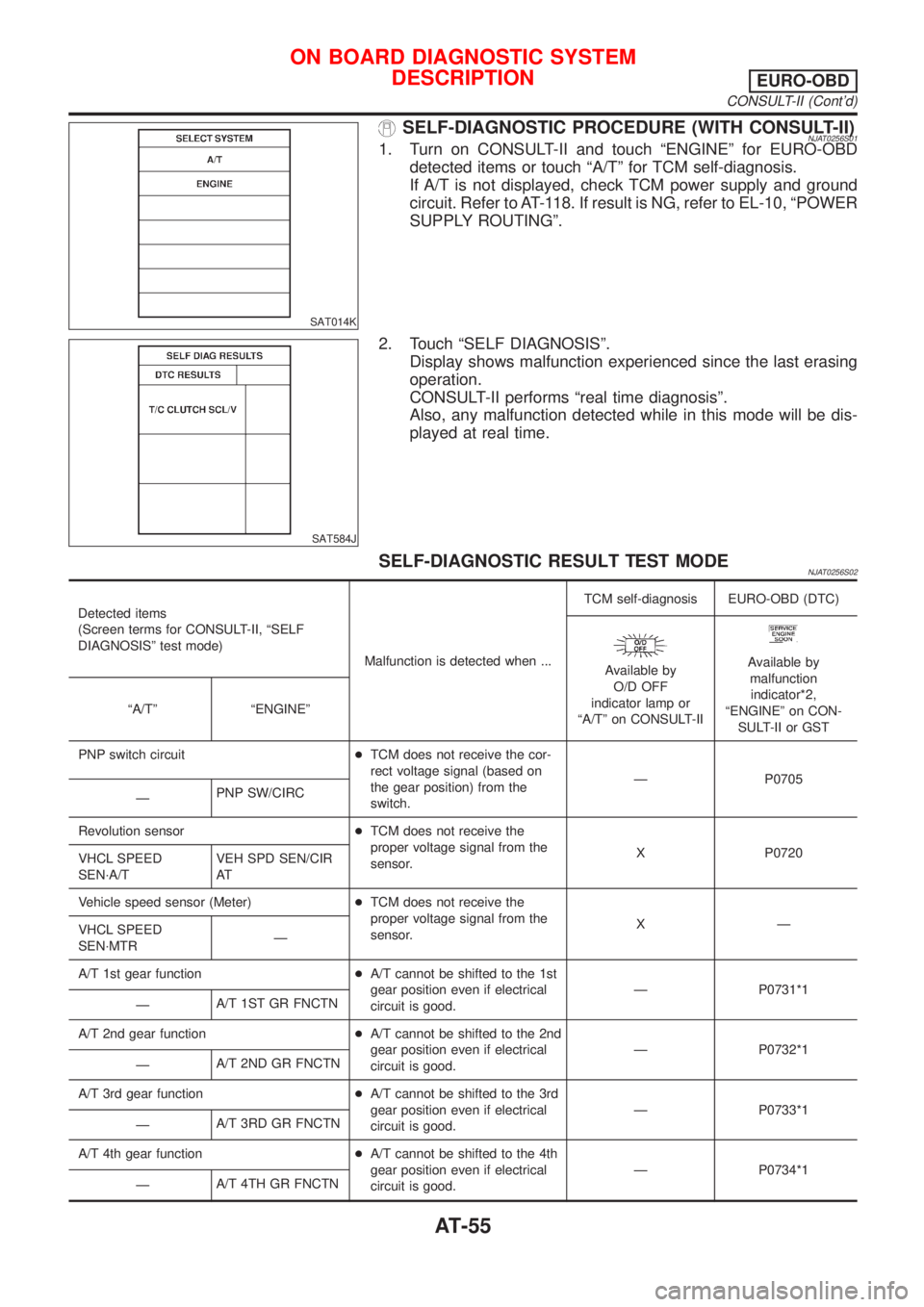
SELF-DIAGNOSTIC PROCEDURE (WITH CONSULT-II)NJAT0256S011. Turn on CONSULT-II and touch ªENGINEº for EURO-OBD
detected items or touch ªA/Tº for TCM self-diagnosis.
If A/T is not displayed, check TCM power supply and ground
circuit. Refer to AT-118. If result is NG, refer to EL-10, ªPOWER
SUPPLY ROUTINGº.
SAT584J
2. Touch ªSELF DIAGNOSISº.
Display shows malfunction experienced since the last erasing
operation.
CONSULT-II performs ªreal time diagnosisº.
Also, any malfunction detected while in this mode will be dis-
played at real time.
SELF-DIAGNOSTIC RESULT TEST MODENJAT0256S02
Detected items
(Screen terms for CONSULT-II, ªSELF
DIAGNOSISº test mode)
Malfunction is detected when ...TCM self-diagnosis EURO-OBD (DTC)
Available by
O/D OFF
indicator lamp or
ªA/Tº on CONSULT-IIAvailable by
malfunction
indicator*2,
ªENGINEº on CON-
SULT-II or GST ªA/Tº ªENGINEº
PNP switch circuit+TCM does not receive the cor-
rect voltage signal (based on
the gear position) from the
switch.Ð P0705
ÐPNP SW/CIRC
Revolution sensor+TCM does not receive the
proper voltage signal from the
sensor.X P0720
VHCL SPEED
SEN´A/TVEH SPD SEN/CIR
AT
Vehicle speed sensor (Meter)+TCM does not receive the
proper voltage signal from the
sensor.XÐ
VHCL SPEED
SEN´MTRÐ
A/T 1st gear function+A/T cannot be shifted to the 1st
gear position even if electrical
circuit is good.Ð P0731*1
ÐA/T 1ST GR FNCTN
A/T 2nd gear function+A/T cannot be shifted to the 2nd
gear position even if electrical
circuit is good.Ð P0732*1
ÐA/T 2ND GR FNCTN
A/T 3rd gear function+A/T cannot be shifted to the 3rd
gear position even if electrical
circuit is good.Ð P0733*1
ÐA/T 3RD GR FNCTN
A/T 4th gear function+A/T cannot be shifted to the 4th
gear position even if electrical
circuit is good.Ð P0734*1
ÐA/T 4TH GR FNCTN
ON BOARD DIAGNOSTIC SYSTEM
DESCRIPTION
EURO-OBD
CONSULT-II (Cont'd)
AT-55
Page 58 of 2898
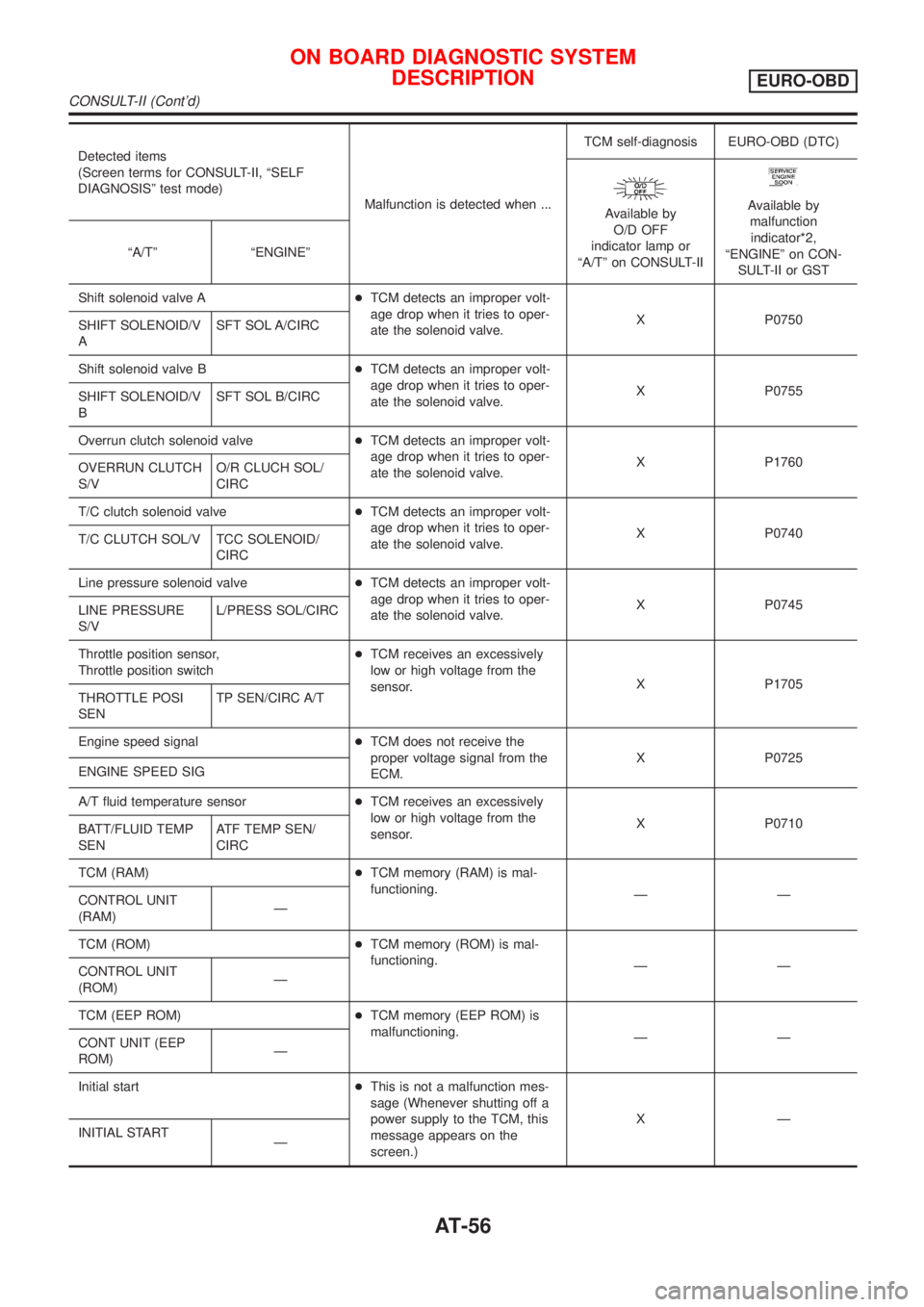
Detected items
(Screen terms for CONSULT-II, ªSELF
DIAGNOSISº test mode)
Malfunction is detected when ...TCM self-diagnosis EURO-OBD (DTC)
Available by
O/D OFF
indicator lamp or
ªA/Tº on CONSULT-IIAvailable by
malfunction
indicator*2,
ªENGINEº on CON-
SULT-II or GST ªA/Tº ªENGINEº
Shift solenoid valve A+TCM detects an improper volt-
age drop when it tries to oper-
ate the solenoid valve.X P0750
SHIFT SOLENOID/V
ASFT SOL A/CIRC
Shift solenoid valve B+TCM detects an improper volt-
age drop when it tries to oper-
ate the solenoid valve.X P0755
SHIFT SOLENOID/V
BSFT SOL B/CIRC
Overrun clutch solenoid valve+TCM detects an improper volt-
age drop when it tries to oper-
ate the solenoid valve.X P1760
OVERRUN CLUTCH
S/VO/R CLUCH SOL/
CIRC
T/C clutch solenoid valve+TCM detects an improper volt-
age drop when it tries to oper-
ate the solenoid valve.X P0740
T/C CLUTCH SOL/V TCC SOLENOID/
CIRC
Line pressure solenoid valve+TCM detects an improper volt-
age drop when it tries to oper-
ate the solenoid valve.X P0745
LINE PRESSURE
S/VL/PRESS SOL/CIRC
Throttle position sensor,
Throttle position switch+TCM receives an excessively
low or high voltage from the
sensor.X P1705
THROTTLE POSI
SENTP SEN/CIRC A/T
Engine speed signal+TCM does not receive the
proper voltage signal from the
ECM.X P0725
ENGINE SPEED SIG
A/T fluid temperature sensor+TCM receives an excessively
low or high voltage from the
sensor.X P0710
BATT/FLUID TEMP
SENATF TEMP SEN/
CIRC
TCM (RAM)+TCM memory (RAM) is mal-
functioning.
ÐÐ
CONTROL UNIT
(RAM)Ð
TCM (ROM)+TCM memory (ROM) is mal-
functioning.
ÐÐ
CONTROL UNIT
(ROM)Ð
TCM (EEP ROM)+TCM memory (EEP ROM) is
malfunctioning.
ÐÐ
CONT UNIT (EEP
ROM)Ð
Initial start+This is not a malfunction mes-
sage (Whenever shutting off a
power supply to the TCM, this
message appears on the
screen.)XÐ
INITIAL START
Ð
ON BOARD DIAGNOSTIC SYSTEM
DESCRIPTION
EURO-OBD
CONSULT-II (Cont'd)
AT-56
Page 59 of 2898
Detected items
(Screen terms for CONSULT-II, ªSELF
DIAGNOSISº test mode)
Malfunction is detected when ...TCM self-diagnosis EURO-OBD (DTC)
Available by
O/D OFF
indicator lamp or
ªA/Tº on CONSULT-IIAvailable by
malfunction
indicator*2,
ªENGINEº on CON-
SULT-II or GST ªA/Tº ªENGINEº
No failure
(NO SELF DIAGNOSTIC FAILURE INDI-
CATED FURTHER TESTING MAY BE
REQUIRED**)+No failure has been detected.
XX
X: Applicable
Ð: Not applicable
*1: These malfunctions cannot be displayed by MI
if another malfunction is assigned to MI.
*2: Refer to EC-74, ªMalfunction Indicator (MI)º.
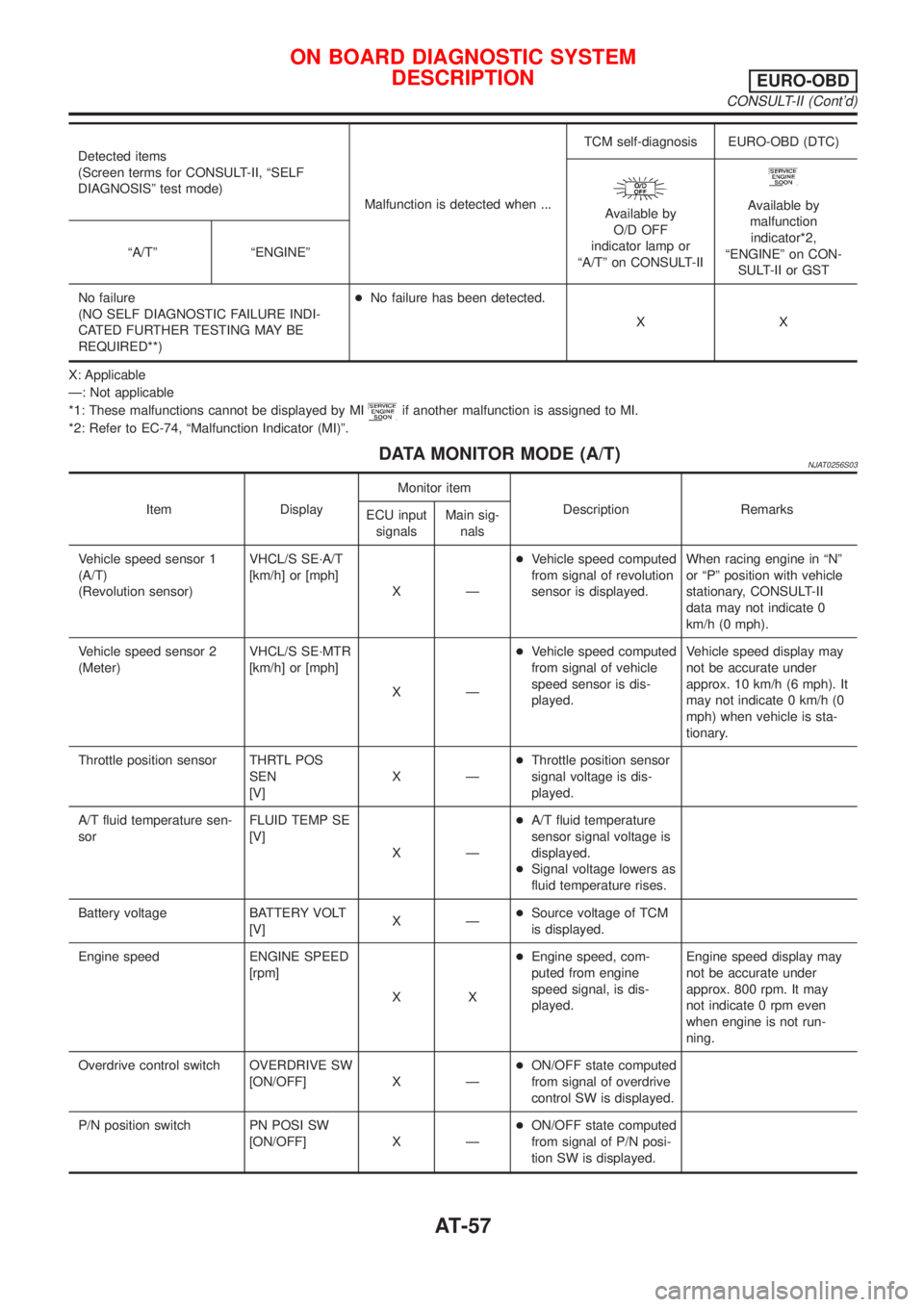
DATA MONITOR MODE (A/T)NJAT0256S03
Item DisplayMonitor item
Description Remarks
ECU input
signalsMain sig-
nals
Vehicle speed sensor 1
(A/T)
(Revolution sensor)VHCL/S SE´A/T
[km/h] or [mph]
XÐ+Vehicle speed computed
from signal of revolution
sensor is displayed.When racing engine in ªNº
or ªPº position with vehicle
stationary, CONSULT-II
data may not indicate 0
km/h (0 mph).
Vehicle speed sensor 2
(Meter)VHCL/S SE´MTR
[km/h] or [mph]
XÐ+Vehicle speed computed
from signal of vehicle
speed sensor is dis-
played.Vehicle speed display may
not be accurate under
approx. 10 km/h (6 mph). It
may not indicate 0 km/h (0
mph) when vehicle is sta-
tionary.
Throttle position sensor THRTL POS
SEN
[V]XÐ+Throttle position sensor
signal voltage is dis-
played.
A/T fluid temperature sen-
sorFLUID TEMP SE
[V]
XÐ+A/T fluid temperature
sensor signal voltage is
displayed.
+Signal voltage lowers as
fluid temperature rises.
Battery voltage BATTERY VOLT
[V]XÐ+Source voltage of TCM
is displayed.
Engine speed ENGINE SPEED
[rpm]
XX+Engine speed, com-
puted from engine
speed signal, is dis-
played.Engine speed display may
not be accurate under
approx. 800 rpm. It may
not indicate 0 rpm even
when engine is not run-
ning.
Overdrive control switch OVERDRIVE SW
[ON/OFF] X Ð+ON/OFF state computed
from signal of overdrive
control SW is displayed.
P/N position switch PN POSI SW
[ON/OFF] X Ð+ON/OFF state computed
from signal of P/N posi-
tion SW is displayed.
ON BOARD DIAGNOSTIC SYSTEM
DESCRIPTION
EURO-OBD
CONSULT-II (Cont'd)
AT-57
Page 66 of 2898
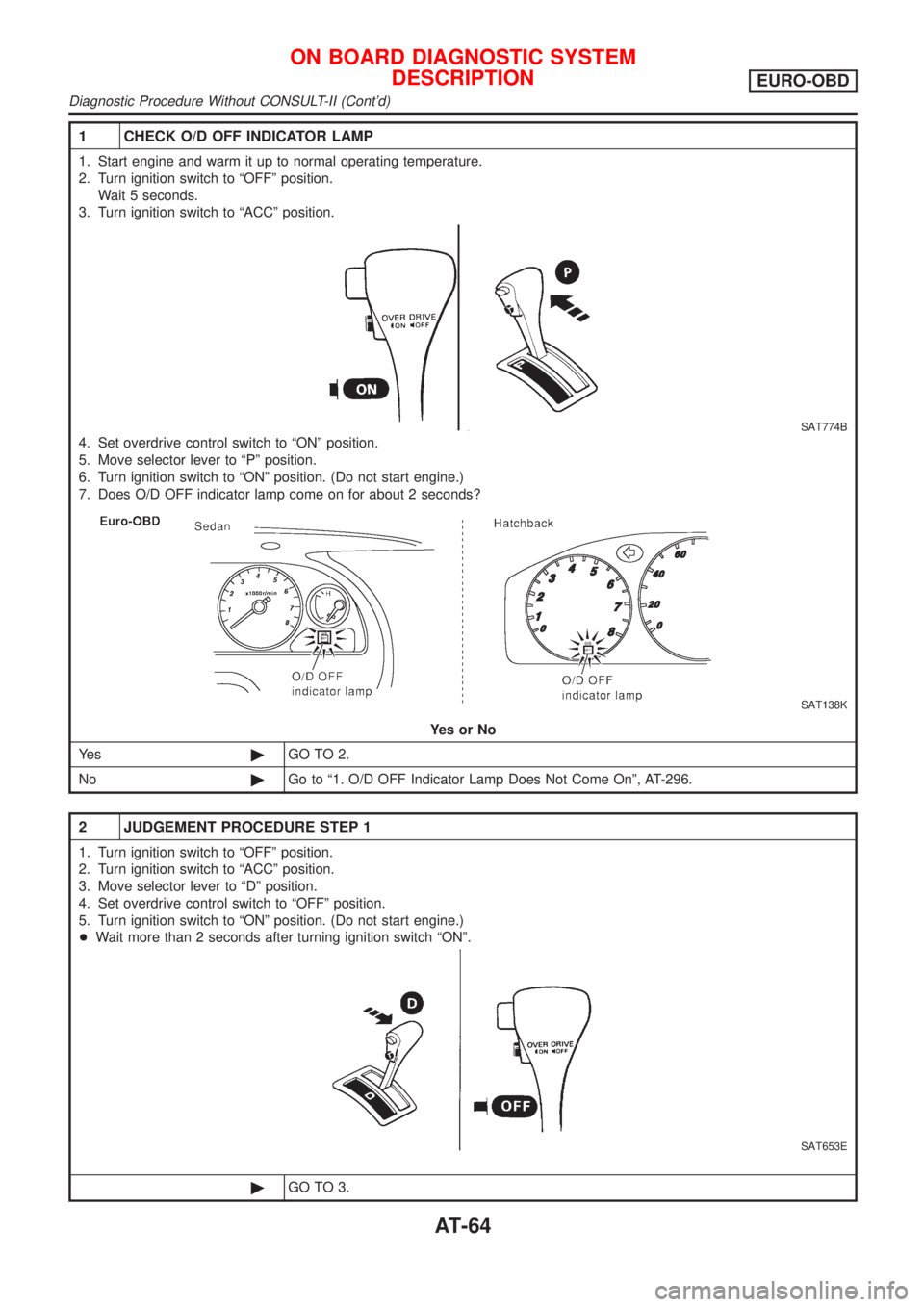
1 CHECK O/D OFF INDICATOR LAMP
1. Start engine and warm it up to normal operating temperature.
2. Turn ignition switch to ªOFFº position.
Wait 5 seconds.
3. Turn ignition switch to ªACCº position.
SAT774B
4. Set overdrive control switch to ªONº position.
5. Move selector lever to ªPº position.
6. Turn ignition switch to ªONº position. (Do not start engine.)
7. Does O/D OFF indicator lamp come on for about 2 seconds?
SAT138K
YesorNo
Ye s©GO TO 2.
No©Go to ª1. O/D OFF Indicator Lamp Does Not Come Onº, AT-296.
2 JUDGEMENT PROCEDURE STEP 1
1. Turn ignition switch to ªOFFº position.
2. Turn ignition switch to ªACCº position.
3. Move selector lever to ªDº position.
4. Set overdrive control switch to ªOFFº position.
5. Turn ignition switch to ªONº position. (Do not start engine.)
+Wait more than 2 seconds after turning ignition switch ªONº.
SAT653E
©GO TO 3.
ON BOARD DIAGNOSTIC SYSTEM
DESCRIPTION
EURO-OBD
Diagnostic Procedure Without CONSULT-II (Cont'd)
AT-64
Page 69 of 2898
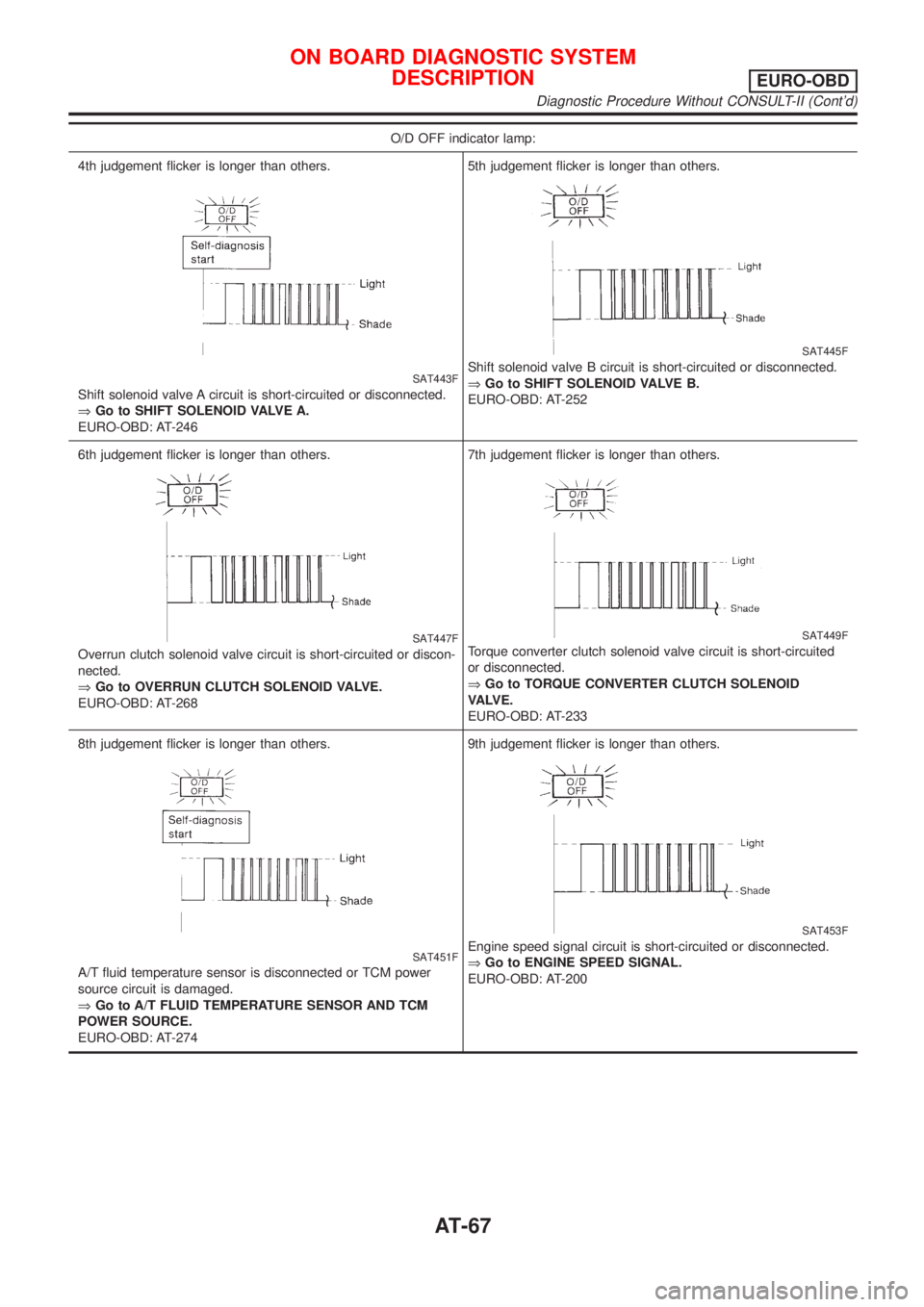
O/D OFF indicator lamp:
4th judgement flicker is longer than others.
SAT443F
Shift solenoid valve A circuit is short-circuited or disconnected.
ÞGo to SHIFT SOLENOID VALVE A.
EURO-OBD: AT-2465th judgement flicker is longer than others.
SAT445F
Shift solenoid valve B circuit is short-circuited or disconnected.
ÞGo to SHIFT SOLENOID VALVE B.
EURO-OBD: AT-252
6th judgement flicker is longer than others.
SAT447F
Overrun clutch solenoid valve circuit is short-circuited or discon-
nected.
ÞGo to OVERRUN CLUTCH SOLENOID VALVE.
EURO-OBD: AT-2687th judgement flicker is longer than others.
SAT449F
Torque converter clutch solenoid valve circuit is short-circuited
or disconnected.
ÞGo to TORQUE CONVERTER CLUTCH SOLENOID
VA LV E .
EURO-OBD: AT-233
8th judgement flicker is longer than others.
SAT451F
A/T fluid temperature sensor is disconnected or TCM power
source circuit is damaged.
ÞGo to A/T FLUID TEMPERATURE SENSOR AND TCM
POWER SOURCE.
EURO-OBD: AT-2749th judgement flicker is longer than others.
SAT453F
Engine speed signal circuit is short-circuited or disconnected.
ÞGo to ENGINE SPEED SIGNAL.
EURO-OBD: AT-200
ON BOARD DIAGNOSTIC SYSTEM
DESCRIPTION
EURO-OBD
Diagnostic Procedure Without CONSULT-II (Cont'd)
AT-67
Page 71 of 2898
SAT631IA
SAT632I
SEF234G
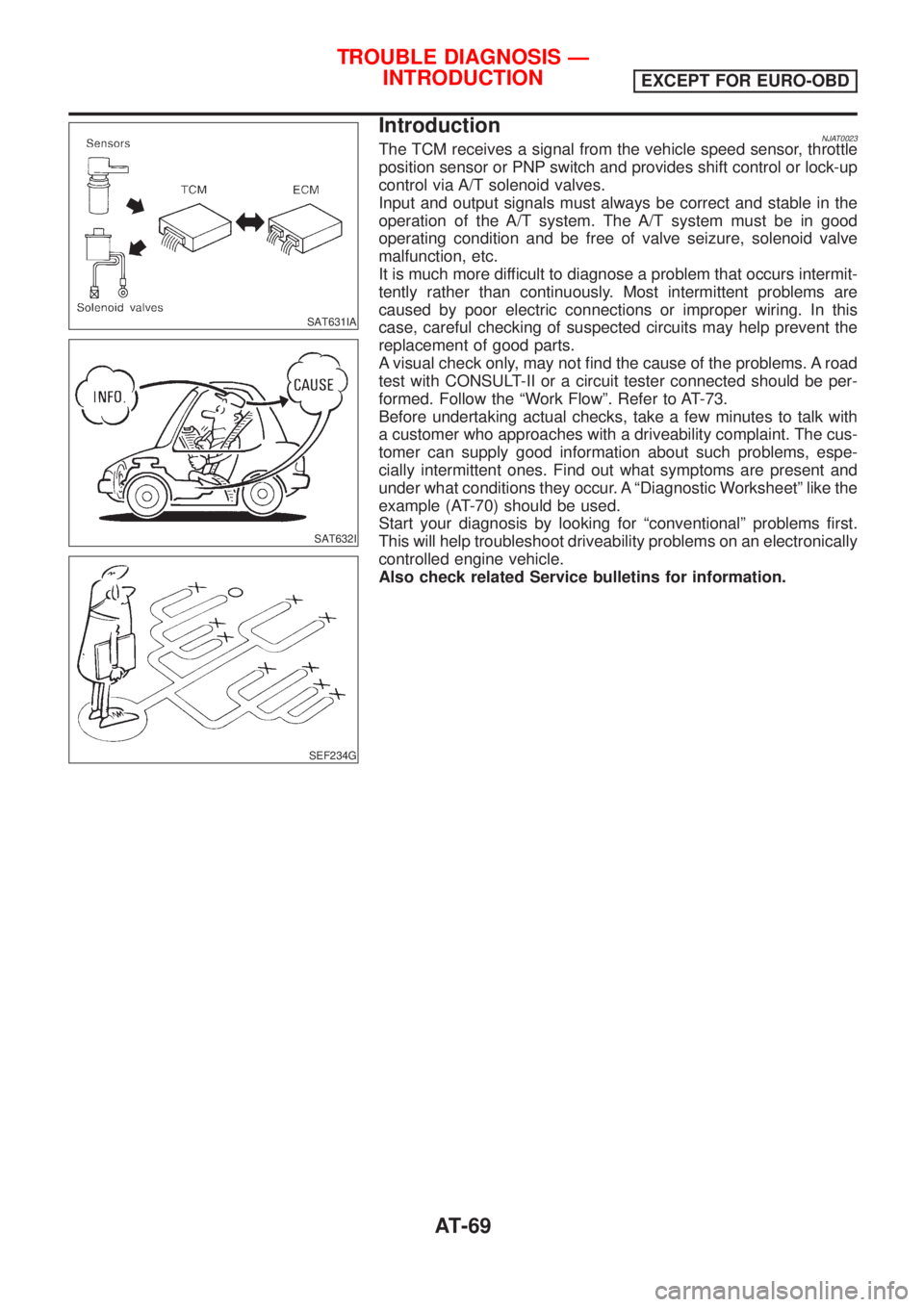
IntroductionNJAT0023The TCM receives a signal from the vehicle speed sensor, throttle
position sensor or PNP switch and provides shift control or lock-up
control via A/T solenoid valves.
Input and output signals must always be correct and stable in the
operation of the A/T system. The A/T system must be in good
operating condition and be free of valve seizure, solenoid valve
malfunction, etc.
It is much more difficult to diagnose a problem that occurs intermit-
tently rather than continuously. Most intermittent problems are
caused by poor electric connections or improper wiring. In this
case, careful checking of suspected circuits may help prevent the
replacement of good parts.
A visual check only, may not find the cause of the problems. A road
test with CONSULT-II or a circuit tester connected should be per-
formed. Follow the ªWork Flowº. Refer to AT-73.
Before undertaking actual checks, take a few minutes to talk with
a customer who approaches with a driveability complaint. The cus-
tomer can supply good information about such problems, espe-
cially intermittent ones. Find out what symptoms are present and
under what conditions they occur. A ªDiagnostic Worksheetº like the
example (AT-70) should be used.
Start your diagnosis by looking for ªconventionalº problems first.
This will help troubleshoot driveability problems on an electronically
controlled engine vehicle.
Also check related Service bulletins for information.
TROUBLE DIAGNOSIS Ð
INTRODUCTION
EXCEPT FOR EURO-OBD
AT-69
Page 72 of 2898
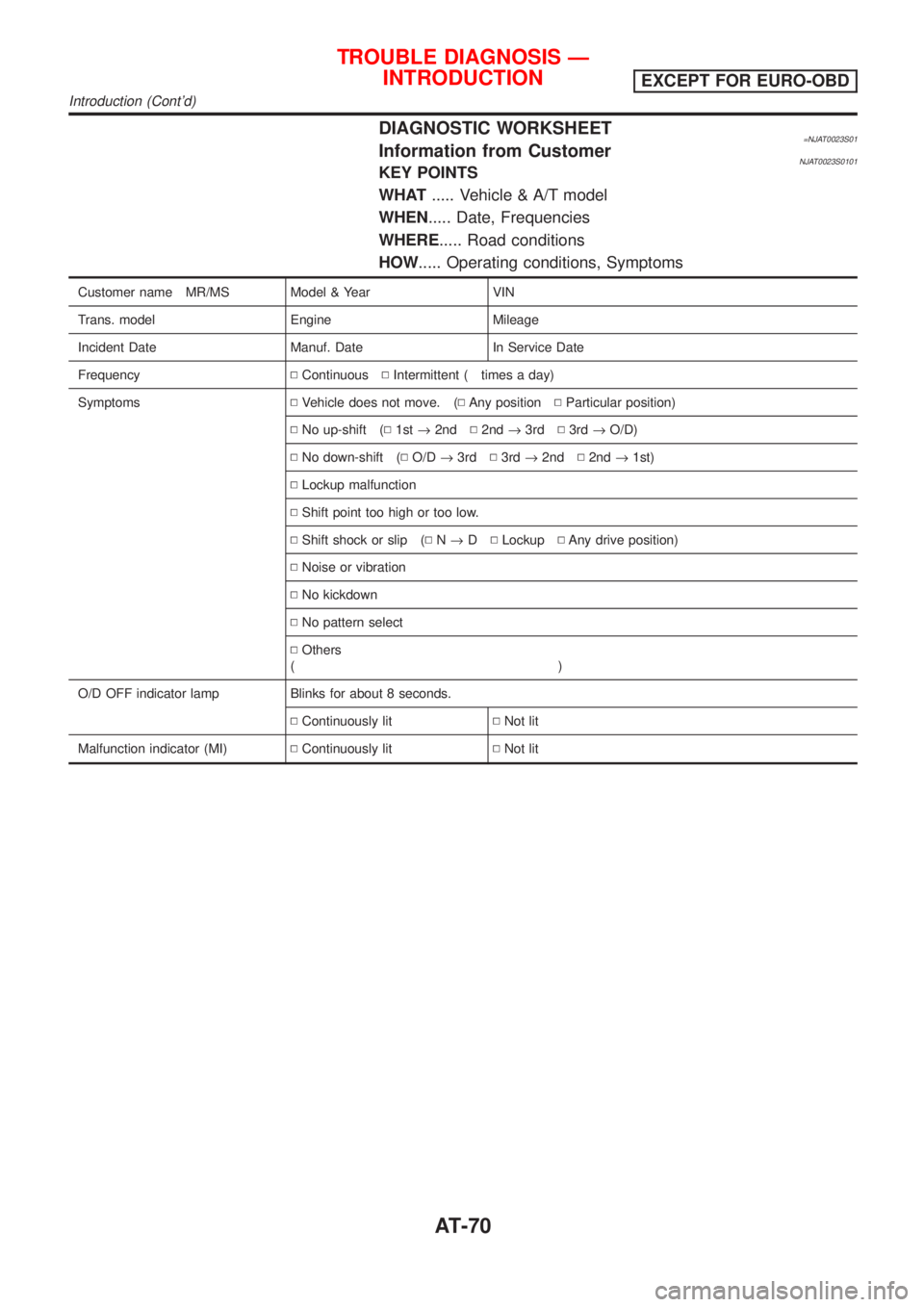
DIAGNOSTIC WORKSHEET=NJAT0023S01Information from CustomerNJAT0023S0101KEY POINTS
WHAT..... Vehicle & A/T model
WHEN..... Date, Frequencies
WHERE..... Road conditions
HOW..... Operating conditions, Symptoms
Customer name MR/MS Model & Year VIN
Trans. model Engine Mileage
Incident Date Manuf. Date In Service Date
FrequencyNContinuousNIntermittent ( times a day)
SymptomsNVehicle does not move. (NAny positionNParticular position)
NNo up-shift (N1st®2ndN2nd®3rdN3rd®O/D)
NNo down-shift (NO/D®3rdN3rd®2ndN2nd®1st)
NLockup malfunction
NShift point too high or too low.
NShift shock or slip (NN®DNLockupNAny drive position)
NNoise or vibration
NNo kickdown
NNo pattern select
NOthers
()
O/D OFF indicator lamp Blinks for about 8 seconds.
NContinuously litNNot lit
Malfunction indicator (MI)NContinuously litNNot lit
TROUBLE DIAGNOSIS Ð
INTRODUCTION
EXCEPT FOR EURO-OBD
Introduction (Cont'd)
AT-70
Page 73 of 2898
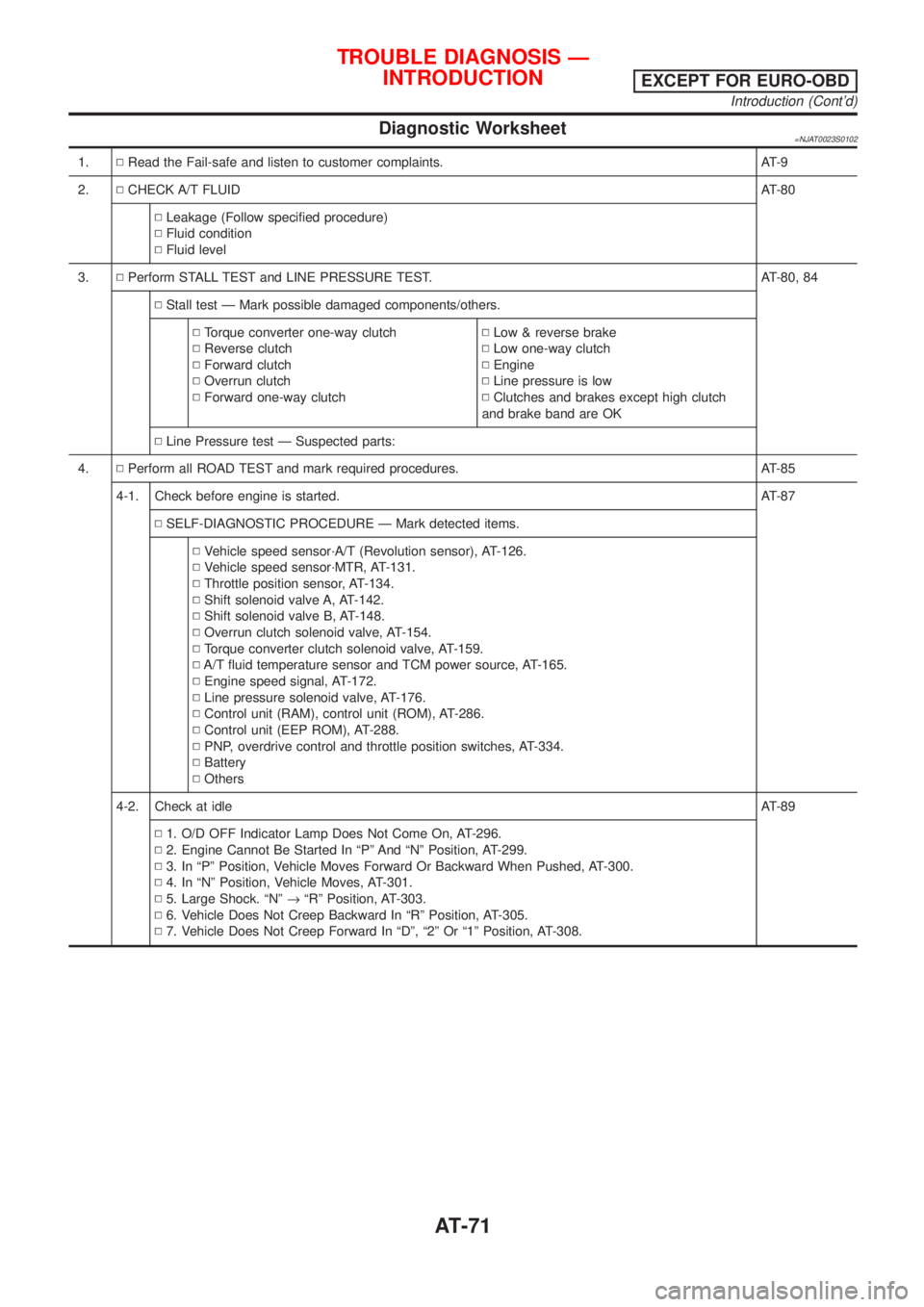
Diagnostic Worksheet=NJAT0023S0102
1.NRead the Fail-safe and listen to customer complaints. AT-9
2.NCHECK A/T FLUIDAT-80
NLeakage (Follow specified procedure)
NFluid condition
NFluid level
3.NPerform STALL TEST and LINE PRESSURE TEST. AT-80, 84
NStall test Ð Mark possible damaged components/others.
NTorque converter one-way clutch
NReverse clutch
NForward clutch
NOverrun clutch
NForward one-way clutchNLow & reverse brake
NLow one-way clutch
NEngine
NLine pressure is low
NClutches and brakes except high clutch
and brake band are OK
NLine Pressure test Ð Suspected parts:
4.NPerform all ROAD TEST and mark required procedures. AT-85
4-1. Check before engine is started. AT-87
NSELF-DIAGNOSTIC PROCEDURE Ð Mark detected items.
NVehicle speed sensor´A/T (Revolution sensor), AT-126.
NVehicle speed sensor´MTR, AT-131.
NThrottle position sensor, AT-134.
NShift solenoid valve A, AT-142.
NShift solenoid valve B, AT-148.
NOverrun clutch solenoid valve, AT-154.
NTorque converter clutch solenoid valve, AT-159.
NA/T fluid temperature sensor and TCM power source, AT-165.
NEngine speed signal, AT-172.
NLine pressure solenoid valve, AT-176.
NControl unit (RAM), control unit (ROM), AT-286.
NControl unit (EEP ROM), AT-288.
NPNP, overdrive control and throttle position switches, AT-334.
NBattery
NOthers
4-2. Check at idleAT-89
N1. O/D OFF Indicator Lamp Does Not Come On, AT-296.
N2. Engine Cannot Be Started In ªPº And ªNº Position, AT-299.
N3. In ªPº Position, Vehicle Moves Forward Or Backward When Pushed, AT-300.
N4. In ªNº Position, Vehicle Moves, AT-301.
N5. Large Shock. ªNº®ªRº Position, AT-303.
N6. Vehicle Does Not Creep Backward In ªRº Position, AT-305.
N7. Vehicle Does Not Creep Forward In ªDº, ª2º Or ª1º Position, AT-308.
TROUBLE DIAGNOSIS Ð
INTRODUCTION
EXCEPT FOR EURO-OBD
Introduction (Cont'd)
AT-71
Page 74 of 2898
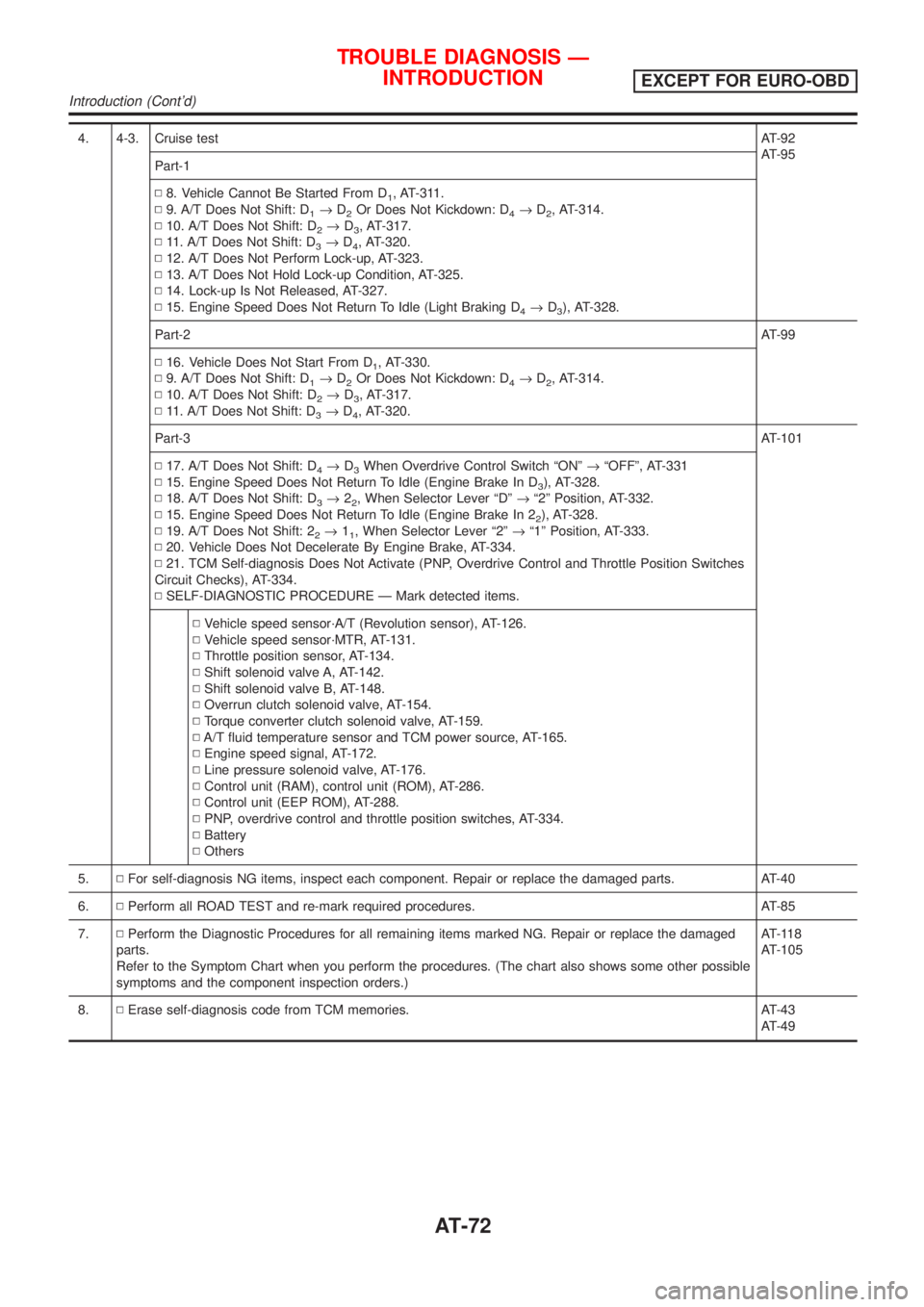
4. 4-3. Cruise testAT-92
AT-95
Part-1
N8. Vehicle Cannot Be Started From D
1, AT-311.
N9. A/T Does Not Shift: D
1®D2Or Does Not Kickdown: D4®D2, AT-314.
N10. A/T Does Not Shift: D
2®D3, AT-317.
N11. A/T Does Not Shift: D
3®D4, AT-320.
N12. A/T Does Not Perform Lock-up, AT-323.
N13. A/T Does Not Hold Lock-up Condition, AT-325.
N14. Lock-up Is Not Released, AT-327.
N15. Engine Speed Does Not Return To Idle (Light Braking D
4®D3), AT-328.
Part-2AT-99
N16. Vehicle Does Not Start From D
1, AT-330.
N9. A/T Does Not Shift: D
1®D2Or Does Not Kickdown: D4®D2, AT-314.
N10. A/T Does Not Shift: D
2®D3, AT-317.
N11. A/T Does Not Shift: D
3®D4, AT-320.
Part-3AT-101
N17. A/T Does Not Shift: D
4®D3When Overdrive Control Switch ªONº®ªOFFº, AT-331
N15. Engine Speed Does Not Return To Idle (Engine Brake In D
3), AT-328.
N18. A/T Does Not Shift: D
3®22, When Selector Lever ªDº®ª2º Position, AT-332.
N15. Engine Speed Does Not Return To Idle (Engine Brake In 2
2), AT-328.
N19. A/T Does Not Shift: 2
2®11, When Selector Lever ª2º®ª1º Position, AT-333.
N20. Vehicle Does Not Decelerate By Engine Brake, AT-334.
N21. TCM Self-diagnosis Does Not Activate (PNP, Overdrive Control and Throttle Position Switches
Circuit Checks), AT-334.
NSELF-DIAGNOSTIC PROCEDURE Ð Mark detected items.
NVehicle speed sensor´A/T (Revolution sensor), AT-126.
NVehicle speed sensor´MTR, AT-131.
NThrottle position sensor, AT-134.
NShift solenoid valve A, AT-142.
NShift solenoid valve B, AT-148.
NOverrun clutch solenoid valve, AT-154.
NTorque converter clutch solenoid valve, AT-159.
NA/T fluid temperature sensor and TCM power source, AT-165.
NEngine speed signal, AT-172.
NLine pressure solenoid valve, AT-176.
NControl unit (RAM), control unit (ROM), AT-286.
NControl unit (EEP ROM), AT-288.
NPNP, overdrive control and throttle position switches, AT-334.
NBattery
NOthers
5.NFor self-diagnosis NG items, inspect each component. Repair or replace the damaged parts. AT-40
6.NPerform all ROAD TEST and re-mark required procedures. AT-85
7.NPerform the Diagnostic Procedures for all remaining items marked NG. Repair or replace the damaged
parts.
Refer to the Symptom Chart when you perform the procedures. (The chart also shows some other possible
symptoms and the component inspection orders.)AT-118
AT-105
8.NErase self-diagnosis code from TCM memories. AT-43
AT-49
TROUBLE DIAGNOSIS Ð
INTRODUCTION
EXCEPT FOR EURO-OBD
Introduction (Cont'd)
AT-72
Page 76 of 2898
SAT631IA
SAT632I
SEF234G
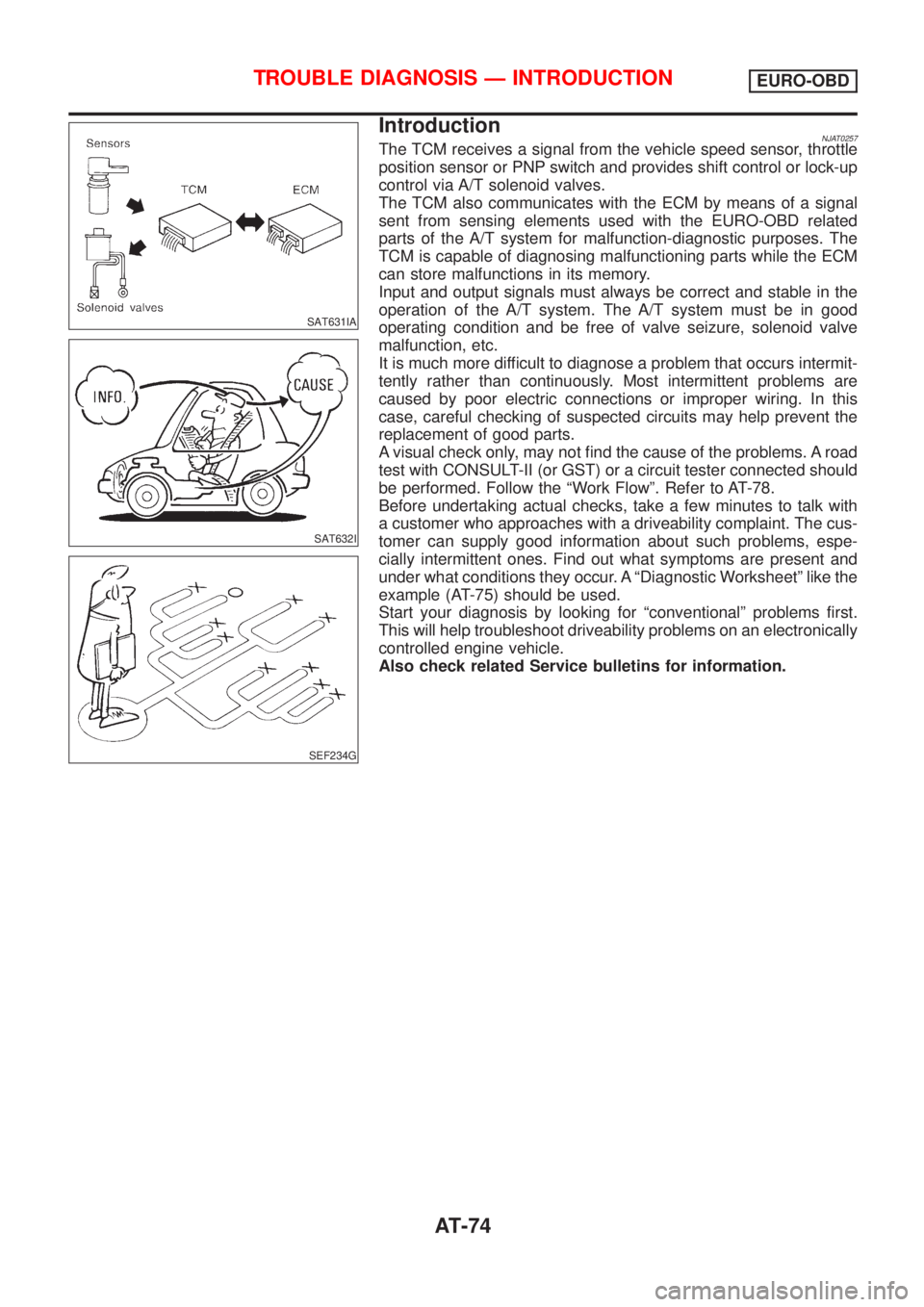
IntroductionNJAT0257The TCM receives a signal from the vehicle speed sensor, throttle
position sensor or PNP switch and provides shift control or lock-up
control via A/T solenoid valves.
The TCM also communicates with the ECM by means of a signal
sent from sensing elements used with the EURO-OBD related
parts of the A/T system for malfunction-diagnostic purposes. The
TCM is capable of diagnosing malfunctioning parts while the ECM
can store malfunctions in its memory.
Input and output signals must always be correct and stable in the
operation of the A/T system. The A/T system must be in good
operating condition and be free of valve seizure, solenoid valve
malfunction, etc.
It is much more difficult to diagnose a problem that occurs intermit-
tently rather than continuously. Most intermittent problems are
caused by poor electric connections or improper wiring. In this
case, careful checking of suspected circuits may help prevent the
replacement of good parts.
A visual check only, may not find the cause of the problems. A road
test with CONSULT-II (or GST) or a circuit tester connected should
be performed. Follow the ªWork Flowº. Refer to AT-78.
Before undertaking actual checks, take a few minutes to talk with
a customer who approaches with a driveability complaint. The cus-
tomer can supply good information about such problems, espe-
cially intermittent ones. Find out what symptoms are present and
under what conditions they occur. A ªDiagnostic Worksheetº like the
example (AT-75) should be used.
Start your diagnosis by looking for ªconventionalº problems first.
This will help troubleshoot driveability problems on an electronically
controlled engine vehicle.
Also check related Service bulletins for information.
TROUBLE DIAGNOSIS Ð INTRODUCTIONEURO-OBD
AT-74