Engine Control NISSAN ALMERA N16 2003 Electronic Owner's Guide
[x] Cancel search | Manufacturer: NISSAN, Model Year: 2003, Model line: ALMERA N16, Model: NISSAN ALMERA N16 2003Pages: 3189, PDF Size: 54.76 MB
Page 339 of 3189
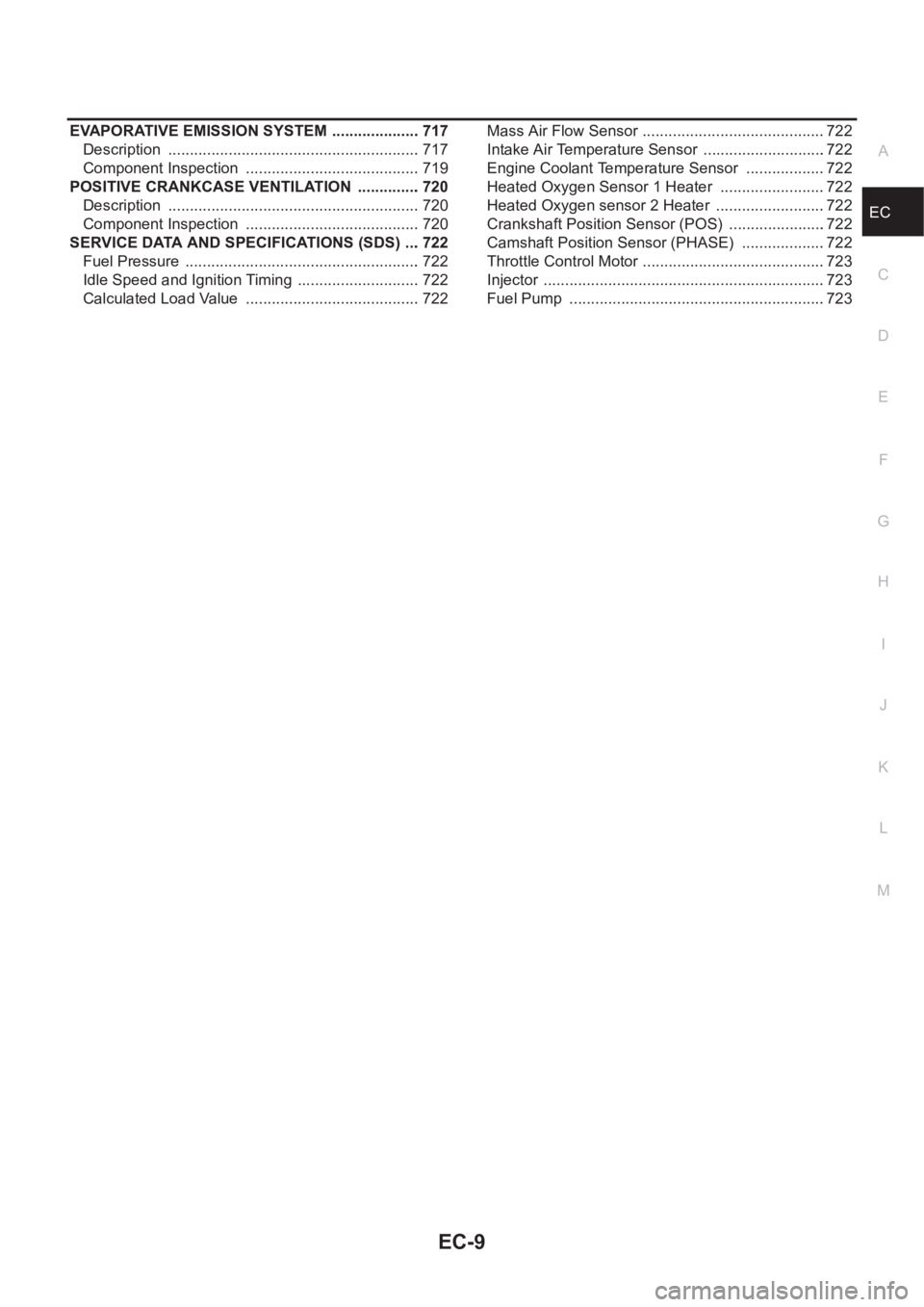
EC-9
C
D
E
F
G
H
I
J
K
L
M
ECA EVAPORATIVE EMISSION SYSTEM ..................... 717
Description ........................................................... 717
Component Inspection ......................................... 719
POSITIVE CRANKCASE VENTILATION ............... 720
Description ........................................................... 720
Component Inspection ......................................... 720
SERVICE DATA AND SPECIFICATIONS (SDS) .... 722
Fuel Pressure ....................................................... 722
Idle Speed and Ignition Timing ............................. 722
Calculated Load Value ......................................... 722Mass Air Flow Sensor ...........................................722
Intake Air Temperature Sensor .............................722
Engine Coolant Temperature Sensor ...................722
Heated Oxygen Sensor 1 Heater .........................722
Heated Oxygen sensor 2 Heater ..........................722
Crankshaft Position Sensor (POS) .......................722
Camshaft Position Sensor (PHASE) ....................722
Throttle Control Motor ...........................................723
Injector ..................................................................723
Fuel Pump ............................................................723
Page 342 of 3189
![NISSAN ALMERA N16 2003 Electronic Owners Guide EC-12
[QG (WITH EURO-OBD)]
INDEX FOR DTC
*1: 1st trip DTC No. is the same as DTC No.
*2: These numbers are prescribed by ISO 15031-5.
*3: In Diagnostic Test Mode II (Self-diagnostic results), these nu](/img/5/57350/w960_57350-341.png "NISSAN ALMERA N16 2003 Electronic Owners Guide EC-12
[QG (WITH EURO-OBD)]
INDEX FOR DTC
*1: 1st trip DTC No. is the same as DTC No.
*2: These numbers are prescribed by ISO 15031-5.
*3: In Diagnostic Test Mode II (Self-diagnostic results), these nu")
EC-12
[QG (WITH EURO-OBD)]
INDEX FOR DTC
*1: 1st trip DTC No. is the same as DTC No.
*2: These numbers are prescribed by ISO 15031-5.
*3: In Diagnostic Test Mode II (Self-diagnostic results), these numbers are controlled by NISSAN.
*4: When engine is running.
*5: The troubleshooting for this DTC needs CONSULT-II.
*6: When the fail-safe operations for both self-diagnoses occur, the MI illuminates.
DTC No. IndexEBS00K2U
Check if the vehicle is a model with Euro-OBD (E-OBD) system or not by the “Type approval number” on the
identification plate. Refer to GI-39.
NOTE:
If DTC U1000 or U1001 is displayed with other DTC, first perform the trouble diagnosis for DTC U1000,
U1001. Refer to EC-116, "
DTC U1000, U1001 CAN COMMUNICATION LINE" .
×: Applicable –: Not applicable TW CATALYST SYS-B1 P0420 0420 2×EC-246
VEH SPD SEN/CIR AT*6P0720 0720 2×AT-123
VEH SPEED SEN/CIRC P0500 0500 2×EC-257
Items
(CONSULT-II screen terms)DTC*
1
TripMI lighting
upReference page
CONSULT-II
GST*
2ECM*3
DTC*1
Items
(CONSULT-II screen terms)TripMI lighting
upReference page
CONSULT-II
GST*
2ECM*3
No DTC
Flashing*4NO DTC IS DETECTED.
FURTHER TESTING
MAY BE REQUIRED.–
Flashing*4EC-50
U1000
1000*5CAN COMM CIRCUIT 1×EC-116
U1001
1001*5CAN COMM CIRCUIT 2 –EC-116
P0000 0000NO DTC IS DETECTED.
FURTHER TESTING
MAY BE REQUIRED.––—
P0011 0011 INT/V TIM CONT-B1 2 –EC-119
P0031 0031 HO2S1 HTR (B1) 2×EC-122
P0032 0032 HO2S1 HTR (B1) 2×EC-122
P0037 0037 HO2S2 HTR (B1) 2×EC-128
P0038 0038 HO2S2 HTR (B1) 2×EC-128
P0102 0102 MAF SEN/CIRCUIT 1×EC-134
P0103 0103 MAF SEN/CIRCUIT 1×EC-134
P0112 0112 IAT SEN/CIRCUIT 2×EC-140
P0113 0113 IAT SEN/CIRCUIT 2×EC-140
P0117 0117 ECT SEN/CIRCUIT 1×EC-144
P0118 0118 ECT SEN/CIRCUIT 1×EC-144
P0132 0132 HO2S1 (B1) 2×EC-149
P0133 0133 HO2S1 (B1) 2×EC-155
P0134 0134 HO2S1 (B1) 2×EC-165
P0138 0138 HO2S2 (B1) 2×EC-172
P0139 0139 HO2S2 (B1) 2×EC-178
P0171 0171 FUEL SYS-LEAN-B1 2×EC-186
P0172 0172 FUEL SYS-RICH-B1 2×EC-193
P0221 0221 TP SENSOR 1×EC-199
Page 344 of 3189
![NISSAN ALMERA N16 2003 Electronic Owners Guide EC-14
[QG (WITH EURO-OBD)]
INDEX FOR DTC
*1: 1st trip DTC No. is the same as DTC No.
*2: These numbers are prescribed by ISO 15031-5.
*3: In Diagnostic Test Mode II (Self-diagnostic results), these nu](/img/5/57350/w960_57350-343.png "NISSAN ALMERA N16 2003 Electronic Owners Guide EC-14
[QG (WITH EURO-OBD)]
INDEX FOR DTC
*1: 1st trip DTC No. is the same as DTC No.
*2: These numbers are prescribed by ISO 15031-5.
*3: In Diagnostic Test Mode II (Self-diagnostic results), these nu")
EC-14
[QG (WITH EURO-OBD)]
INDEX FOR DTC
*1: 1st trip DTC No. is the same as DTC No.
*2: These numbers are prescribed by ISO 15031-5.
*3: In Diagnostic Test Mode II (Self-diagnostic results), these numbers are controlled by NISSAN.
*4: When engine is running.
*5: The trouble shooting for this DTC needs CONSULT-II.
*6: When the fail-safe operations for both self-diagnoses occur, the MI illuminates. P1217 1217 ENG OVER TEMP 1×EC-324
P1223 1223 TP SEN 2/CIRC 1×EC-335
P1224 1224 TP SEN 2/CIRC 1×EC-335
P1225 1225 CTP LEARNING 2 –EC-341
P1226 1226 CTP LEARNING 2 –EC-343
P1227 1227 APP SEN 2/CIRC 1×EC-345
P1228 1228 APP SEN 2/CIRC 1×EC-345
P1229 1229 SENSOR POWER/CIRC 1×EC-352
P1610 - P1615 1610 - 1615 NATS MALFUNCTION 2 –EC-49
P1705 1705 TPV SEN/CIRC A/T 1×AT-181
P1706 1706 P-N POS SW/CIRCUIT 2×EC-356
P1760 1760 O/R CLTCH SOL/CIRC 2×AT-187
P1805 1805 BRAKE SW/CIRCUIT 2 –EC-360
DTC*1
Items
(CONSULT-II screen terms)TripMI lighting
upReference page
CONSULT-II
GST*
2ECM*3
Page 345 of 3189
![NISSAN ALMERA N16 2003 Electronic Owners Guide PRECAUTIONS
EC-15
[QG (WITH EURO-OBD)]
C
D
E
F
G
H
I
J
K
L
MA
EC
PRECAUTIONSPFP:00001
Precautions for Supplemental Restraint System (SRS) “AIR BAG” and “SEAT
BELT PRE-TENSIONER”
EBS00K2V
The](/img/5/57350/w960_57350-344.png "NISSAN ALMERA N16 2003 Electronic Owners Guide PRECAUTIONS
EC-15
[QG (WITH EURO-OBD)]
C
D
E
F
G
H
I
J
K
L
MA
EC
PRECAUTIONSPFP:00001
Precautions for Supplemental Restraint System (SRS) “AIR BAG” and “SEAT
BELT PRE-TENSIONER”
EBS00K2V
The")
PRECAUTIONS
EC-15
[QG (WITH EURO-OBD)]
C
D
E
F
G
H
I
J
K
L
MA
EC
PRECAUTIONSPFP:00001
Precautions for Supplemental Restraint System (SRS) “AIR BAG” and “SEAT
BELT PRE-TENSIONER”
EBS00K2V
The Supplemental Restraint System such as “AIR BAG” and “SEAT BELT PRE-TENSIONER”, used along
with a front seat belt, helps to reduce the risk or severity of injury to the driver and front passenger for certain
types of collision. Information necessary to service the system safely is included in the SRS and SB section of
this Service Manual.
WARNING:
●To avoid rendering the SRS inoperative, which could increase the risk of personal injury or death
in the event of a collision which would result in air bag inflation, all maintenance must be per-
formed by an authorized NISSAN/INFINITI dealer.
●Improper maintenance, including incorrect removal and installation of the SRS, can lead to per-
sonal injury caused by unintentional activation of the system. For removal of Spiral Cable and Air
Bag Module, see the SRS section.
●Do not use electrical test equipment on any circuit related to the SRS unless instructed to in this
Service Manual. SRS wiring harnesses can be identified by yellow and/or orange harness connec-
tors.
On Board Diagnostic (OBD) System of Engine and A/TEBS00K2W
The ECM has an on board diagnostic system. It will light up the malfunction indicator (MI) to warn the driver of
a malfunction causing emission deterioration.
CAUTION:
●Be sure to turn the ignition switch OFF and disconnect the battery ground cable before any repair
or inspection work. The open/short circuit of related switches, sensors, solenoid valves, etc. will
cause the MI to light up.
●Be sure to connect and lock the connectors securely after work. A loose (unlocked) connector will
cause the MI to light up due to the open circuit. (Be sure the connector is free from water, grease,
dirt, bent terminals, etc.)
●Certain systems and components, especially those related to OBD, may use a new style slide-
locking type harness connector. For description and how to disconnect, refer to EL-7.
●Be sure to route and secure the harnesses properly after work. The interference of the harness
with a bracket, etc. may cause the MI to light up due to the short circuit.
●Be sure to connect rubber tubes properly after work. A misconnected or disconnected rubber tube
may cause the MI to light up due to the malfunction of the fuel injection system, etc.
●Be sure to erase the unnecessary malfunction information (repairs completed) from the ECM and
TCM (Transmission control module) before returning the vehicle to the customer.
PrecautionEBS00K2X
●Always use a 12 volt battery as power source.
●Do not attempt to disconnect battery cables while engine is
running.
●Before connecting or disconnecting the ECM harness con-
nector, turn ignition switch OFF and disconnect battery
ground cable. Failure to do so may damage the ECM
because battery voltage is applied to ECM even if ignition
switch is turned off.
●Before removing parts, turn ignition switch OFF and then
disconnect battery ground cable.
SEF289H
Page 346 of 3189
![NISSAN ALMERA N16 2003 Electronic Owners Guide EC-16
[QG (WITH EURO-OBD)]
PRECAUTIONS
●Do not disassemble ECM.
●If battery cable is disconnected, the memory will return to
the initial ECM values.
The ECM will now start to self-c](/img/5/57350/w960_57350-345.png "NISSAN ALMERA N16 2003 Electronic Owners Guide EC-16
[QG (WITH EURO-OBD)]
PRECAUTIONS
●Do not disassemble ECM.
●If battery cable is disconnected, the memory will return to
the initial ECM values.
The ECM will now start to self-c")
EC-16
[QG (WITH EURO-OBD)]
PRECAUTIONS
●Do not disassemble ECM.
●If battery cable is disconnected, the memory will return to
the initial ECM values.
The ECM will now start to self-control at its initial values.
Engine operation can vary slightly when the cable is dis-
connected. However, this is not an indication of a malfunc-
tion. Do not replace parts because of a slight variation.
●When connecting ECM harness connector, fasten it
securely with levers as far as they will go as shown at right.
●When connecting or disconnecting pin connectors into or
from ECM, take care not to damage pin terminals (bend or
break).
Make sure that there are not any bends or breaks on ECM
pin terminal, when connecting pin connectors.
●Securely connect ECM harness connectors.
A poor connection can cause an extremely high (surge)
voltage to develop in coil and condenser, thus resulting in
damage to ICs.
●Keep engine control system harness at least 10 cm (4 in)
away from adjacent harness, to prevent engine control sys-
tem malfunctions due to receiving external noise, degraded
operation of ICs, etc.
●Keep engine control system parts and harness dry.
●Before replacing ECM, perform “ECM Terminals and Refer-
ence Value” inspection and make sure ECM functions prop-
erly. Refer to EC-80, "
ECM Terminals and Reference Value" .
●Handle mass air flow sensor carefully to avoid damage.
●Do not disassemble mass air flow sensor.
●Do not clean mass air flow sensor with any type of deter-
gent.
●Do not disassemble electric throttle control actuator.
●Even a slight leak in the air intake system can cause seri-
ous incidents.
●Do not shock or jar the camshaft position sensor (PHASE),
crankshaft position sensor (POS).
PBIB1164E
MBIB0145E
PBIB0090E
MEF040D
Page 348 of 3189
![NISSAN ALMERA N16 2003 Electronic Owners Guide EC-18
[QG (WITH EURO-OBD)]
PRECAUTIONS
●Do not depress accelerator pedal when starting.
●Immediately after starting, do not rev up engine unneces-
sarily.
●Do not rev up engine just prio](/img/5/57350/w960_57350-347.png "NISSAN ALMERA N16 2003 Electronic Owners Guide EC-18
[QG (WITH EURO-OBD)]
PRECAUTIONS
●Do not depress accelerator pedal when starting.
●Immediately after starting, do not rev up engine unneces-
sarily.
●Do not rev up engine just prio")
EC-18
[QG (WITH EURO-OBD)]
PRECAUTIONS
●Do not depress accelerator pedal when starting.
●Immediately after starting, do not rev up engine unneces-
sarily.
●Do not rev up engine just prior to shutdown.
●When installing C.B. ham radio or a mobile phone, be sure
to observe the following as it may adversely affect elec-
tronic control systems depending on installation location.
–Keep the antenna as far as possible from the electronic
control units.
–Keep the antenna feeder line more than 20 cm (8 in) away
from the harness of electronic controls.
Do not let them run parallel for a long distance.
–Adjust the antenna and feeder line so that the standing-
wave radio can be kept smaller.
–Be sure to ground the radio to vehicle body.
Wiring Diagrams and Trouble DiagnosisEBS00K2Y
When you read wiring diagrams, refer to the following:
●GI-12
●EL-11 for power distribution circuit
When you perform trouble diagnosis, refer to the following:
●GI-32
●GI-22
SEF709Y
SEF708Y
Page 351 of 3189
![NISSAN ALMERA N16 2003 Electronic Owners Guide ENGINE CONTROL SYSTEM
EC-21
[QG (WITH EURO-OBD)]
C
D
E
F
G
H
I
J
K
L
MA
EC
ENGINE CONTROL SYSTEMPFP:23710
System DiagramEBS00K31
MBIB0239E](/img/5/57350/w960_57350-350.png "NISSAN ALMERA N16 2003 Electronic Owners Guide ENGINE CONTROL SYSTEM
EC-21
[QG (WITH EURO-OBD)]
C
D
E
F
G
H
I
J
K
L
MA
EC
ENGINE CONTROL SYSTEMPFP:23710
System DiagramEBS00K31
MBIB0239E")
ENGINE CONTROL SYSTEM
EC-21
[QG (WITH EURO-OBD)]
C
D
E
F
G
H
I
J
K
L
MA
EC
ENGINE CONTROL SYSTEMPFP:23710
System DiagramEBS00K31
MBIB0239E
Page 352 of 3189
![NISSAN ALMERA N16 2003 Electronic Owners Guide EC-22
[QG (WITH EURO-OBD)]
ENGINE CONTROL SYSTEM
Vacuum Hose Drawing
EBS00K33
Refer to EC-21, "System Diagram" for Vacuum Control System.
MBIB0013E](/img/5/57350/w960_57350-351.png "NISSAN ALMERA N16 2003 Electronic Owners Guide EC-22
[QG (WITH EURO-OBD)]
ENGINE CONTROL SYSTEM
Vacuum Hose Drawing
EBS00K33
Refer to EC-21, \"System Diagram\" for Vacuum Control System.
MBIB0013E")
EC-22
[QG (WITH EURO-OBD)]
ENGINE CONTROL SYSTEM
Vacuum Hose Drawing
EBS00K33
Refer to EC-21, "System Diagram" for Vacuum Control System.
MBIB0013E
Page 353 of 3189
![NISSAN ALMERA N16 2003 Electronic Owners Guide ENGINE CONTROL SYSTEM
EC-23
[QG (WITH EURO-OBD)]
C
D
E
F
G
H
I
J
K
L
MA
EC
System ChartEBS00K34
*1: This sensor is not used to control the engine system under normal conditions.
*2: The signals are se](/img/5/57350/w960_57350-352.png "NISSAN ALMERA N16 2003 Electronic Owners Guide ENGINE CONTROL SYSTEM
EC-23
[QG (WITH EURO-OBD)]
C
D
E
F
G
H
I
J
K
L
MA
EC
System ChartEBS00K34
*1: This sensor is not used to control the engine system under normal conditions.
*2: The signals are se")
ENGINE CONTROL SYSTEM
EC-23
[QG (WITH EURO-OBD)]
C
D
E
F
G
H
I
J
K
L
MA
EC
System ChartEBS00K34
*1: This sensor is not used to control the engine system under normal conditions.
*2: The signals are sent to the ECM through CAN communication line.
*3: The output signals are sent from the ECM through CAN communication line.
Multiport Fuel Injection (MFI) SystemEBS00K35
INPUT/OUTPUT SIGNAL CHART
*1: Under normal conditions, this sensor is not for engine control operation.
*2: This signal is sent to the ECM through CAN communication line.
*3: ECM determines the start signal status by the signals of engine speed and battery voltage.
SYSTEM DESCRIPTION
The amount of fuel injected from the fuel injector is determined by the ECM. The ECM controls the length of
time the valve remains open (injection pulse duration). The amount of fuel injected is a program value in the
Input (Sensor) ECM Function Output (Actuator)
●Camshaft position sensor (PHASE)
●Crankshaft position sensor (POS)
●Mass air flow sensor
●Engine coolant temperature sensor
●Heated oxygen sensor 1
●Throttle position sensor
●Accelerator pedal position sensor
●Park/neutral position (PNP) switch
●Intake air temperature sensor
●Power steering pressure sensor
●Ignition switch
●Stop lamp switch
●Battery voltage
●Knock sensor
●Refrigerant pressure sensor
●Heated oxygen sensor 2*1
●TCM (Transmission control module)*2
●Air conditioner switch*2
●Vehicle speed signal*2
●Electrical load signal*2
Fuel injection & mixture ratio control Fuel injectors
Electronic ignition system Power transistor
Fuel pump control Fuel pump relay
On board diagnostic system
MI (On the instrument panel)
*3
Intake valve timing controlIntake valve timing control solenoid
valve
Heated oxygen sensor 1 heater control Heated oxygen sensor 1 heater
Heated oxygen sensor 2 heater control Heated oxygen sensor 2 heater
EVAP canister purge flow controlEVAP canister purge volume control
solenoid valve
Air conditioning cut control
Air conditioner relay
*3
Cooling fan control
Cooling fan relay*3
Sensor Input Signal to ECM ECM Function Actuator
Crankshaft position sensor (POS)
Camshaft position sensor (PHASE)Engine speed
*3 and piston position
Fuel injection & mixture
ratio controlFuel injectors Mass air flow sensor Amount of intake air
Engine coolant temperature sensor Engine coolant temperature
Heated oxygen sensor 1 Density of oxygen in exhaust gas
Throttle position sensor Throttle position
Accelerator pedal position sensor Accelerator pedal position
Park/neutral position (PNP) switch Gear position
Knock sensor Engine knocking condition
Battery
Battery voltage
*3
Power steering pressure sensor Power steering operation
Heated oxygen sensor 2
*1Density of oxygen in exhaust gas
Vehicle speed signal
*2Vehicle speed
Air conditioner switch
*2Air conditioner operation
Page 354 of 3189
![NISSAN ALMERA N16 2003 Electronic Owners Guide EC-24
[QG (WITH EURO-OBD)]
ENGINE CONTROL SYSTEM
ECM memory. The program value is preset by engine operating conditions. These conditions are determined
by input signals (for engine speed and i](/img/5/57350/w960_57350-353.png "NISSAN ALMERA N16 2003 Electronic Owners Guide EC-24
[QG (WITH EURO-OBD)]
ENGINE CONTROL SYSTEM
ECM memory. The program value is preset by engine operating conditions. These conditions are determined
by input signals (for engine speed and i")
EC-24
[QG (WITH EURO-OBD)]
ENGINE CONTROL SYSTEM
ECM memory. The program value is preset by engine operating conditions. These conditions are determined
by input signals (for engine speed and intake air) from the crankshaft position sensor (POS), the camshaft
position sensor (PHASE) and the mass air flow sensor.
VARIOUS FUEL INJECTION INCREASE/DECREASE COMPENSATION
In addition, the amount of fuel injected is compensated to improve engine performance under various operat-
ing conditions as listed below.
●During warm-up
●When starting the engine
●During acceleration
●Hot-engine operation
●When selector lever is changed from “N” to “D” (A/T models)
●High-load, high-speed operation
●During deceleration
●During high engine speed operation
MIXTURE RATIO FEEDBACK CONTROL (CLOSED LOOP CONTROL)
The mixture ratio feedback system provides the best air-fuel mixture ratio for driveability and emission control.
The three way catalyst (manifold) can then better reduce CO, HC and NOx emissions. This system uses
heated oxygen sensor 1 in the exhaust manifold to monitor if the engine operation is rich or lean. The ECM
adjusts the injection pulse width according to the sensor voltage signal. For more information about heated
oxygen sensor 1, refer to EC-155
. This maintains the mixture ratio within the range of stoichiometric (ideal air-
fuel mixture).
This stage is referred to as the closed loop control condition.
Heated oxygen sensor 2 is located downstream of the three way catalyst (manifold). Even if the switching
characteristics of heated oxygen sensor 1 shift, the air-fuel ratio is controlled to stoichiometric by the signal
from heated oxygen sensor 2.
Open Loop Control
The open loop system condition refers to when the ECM detects any of the following conditions. Feedback
control stops in order to maintain stabilized fuel combustion.
●Deceleration and acceleration
●High-load, high-speed operation
●Malfunction of heated oxygen sensor 1 or its circuit
●Insufficient activation of heated oxygen sensor 1 at low engine coolant temperature
●High engine coolant temperature
●During warm-up
●After shifting from “N” to “D” (A/T models)
●When starting the engine
MIXTURE RATIO SELF-LEARNING CONTROL
The mixture ratio feedback control system monitors the mixture ratio signal transmitted from heated oxygen
sensor 1. This feedback signal is then sent to the ECM. The ECM controls the basic mixture ratio as close to
the theoretical mixture ratio as possible. However, the basic mixture ratio is not necessarily controlled as orig-
PBIB0121E