ECO NISSAN ALTIMA 2019 Owner´s Manual
[x] Cancel search | Manufacturer: NISSAN, Model Year: 2019, Model line: ALTIMA, Model: NISSAN ALTIMA 2019Pages: 592, PDF Size: 7.4 MB
Page 541 of 592
Oil viscosity
The engine oil viscosity or thickness
changes with temperature. Because of
this, it is important to select the engine oil
viscosity based on the temperatures at
which the vehicle will be operated before
the next oil change. Choosing an oil viscos-
ity other than that recommended could
cause serious engine damage.
Selecting the correct oil filter
Your new NISSAN vehicle is equipped with a
high-quality Genuine NISSAN oil filter. When
replacing, use a Genuine NISSAN oil filter or
its equivalent for the reason described in
“Change intervals.”
Change intervals
The oil and oil filter change intervals for
your engine are based on the use of the
specified quality oils and filters. Using en-
gine oil and filters that are not of the speci-
fied quality, or exceeding recommended oil
and filter change intervals could reduce
engine life. Damage to the engine caused
by improper maintenance or use of incor-
rect oil and filter quality and/or viscosity is
not covered by the NISSAN New Vehicle
Limited Warranty.Your engine was filled with a high-quality
engine oil when it was built. You do not have
to change the oil before the first recom-
mended change interval. Oil and filter
change intervals depend upon how you
use your vehicle.
Operation under the following conditions
may require more frequent oil and filter
changes:
∙ repeated short distance driving at cold outside temperatures
∙ driving in dusty conditions
∙ extensive idling
∙ stop and go commuting
For additional information, refer to the
“Maintenance and schedules” section of
this manual.
AIR CONDITIONER SYSTEM
REFRIGERANT AND OIL
RECOMMENDATIONS
The air conditioner system in your
NISSAN vehicle must be charged with
the refrigerant HFO-1234yf (R-1234yf )
and NISSAN A/C system oil Type PAG
(VC100YF oil) or the exact equivalents.
CAUTION
The use of any other refrigerant or oil
will cause severe damage to the air con-
ditioning system and will require the re-
placement of all air conditioner system
components.
The refrigerant HFO-1234yf (R-1234yf ) in your
NISSAN vehicle does not harm the earth’s
ozone layer. Although this refrigerant does
not affect the earth’s atmosphere, certain
government regulations require the recovery
and recycling of any refrigerant during auto-
motive air conditioner system service. Air
conditioner system should only be serviced
by trained and certified technicians to ensure
proper and safe operation (SAE J2845). A
NISSAN dealer has the trained technicians
and equipment needed to recover and re-
cycle your air conditioner system refrigerant.
Only new and SAEJ2842 certified evapora-
tor(s) shall be used as replacement parts.
A damaged or leaking air conditioning
evaporator shall never be repaired or re-
placed with one removed from a used or
salvaged vehicle. To replace a damaged or
leaking evaporator, use only new and SAE
J2842 certified evaporator(s). It is recom-
mended that you visit a NISSAN dealer when
servicing your air conditioner system.
Technical and consumer information10-7
Page 551 of 592
Do not tow a trailer with your vehicle.
FLAT TOWING
Towing your vehicle with all four wheels on
the ground is sometimes called flat towing.
This method is sometimes used when
towing a vehicle behind a recreational ve-
hicle, such as a motor home.
CAUTION
∙ Failure to follow these guidelines canresult in severe transmission damage.
∙ Whenever flat towing your vehicle, al- ways tow forward, never backward.
∙ Never tow your front wheel drive ve- hicle with the front tires on the
ground. Doing so may cause serious
and expensive damage to the
powertrain.
∙ DO NOT tow any continuously variable transmission vehicle with all four
wheels on the ground (flat towing).
Doing so WILL DAMAGE internal trans-
mission parts due to lack of transmis-
sion lubrication. ∙ For emergency towing procedures
refer to “Towing recommended by
NISSAN” in the “In case of emergency ”
section of this manual.
Continuously Variable
Transmission (CVT)
To tow a vehicle equipped with a CVT, an
appropriate vehicle dolly MUSTbe placed
under the towed vehicle’s drive wheels.
Alwaysfollow the dolly manufacturer’s rec-
ommendations when using their product. DOT (Department of Transportation) Qual-
ity Grades: All passenger car tires must
conform to federal safety requirements in
addition to these grades.
Quality grades can be found where appli-
cable on the tire sidewall between tread
shoulder and maximum section width. For
example:
Treadwear 200 Traction AA Temperature A
Treadwear
The treadwear grade is a comparative rat-
ing based on the wear rate of the tire when
tested under controlled conditions on a
specified government test course. For ex-
ample, a tire graded 150 would wear one
and one-half (1 1/2) times as well on the
government course as a tire graded 100.
The relative performance of tires depends
upon the actual conditions of their use,
however, and may depart significantly from
the norm due to variations in driving habits,
service practices and differences in road
characteristics and climate.
TOWING A TRAILER
UNIFORM TIRE QUALITY GRADING
Technical and consumer information10-17
Page 553 of 592
For USA
If you believe that your vehicle has a
defect which could cause a crash or
could cause injury or death, you
should immediately inform the Na-
tional Highway Traffic Safety Admin-
istration (NHTSA) in addition to noti-
f ying NISSAN.
If NHTSA receives similar complaints,
it may open an investigation, and if it
finds that a safety defect exists in a
group of vehicles, it may order a re-
call and remedy campaign. However,
NHTSA cannot become involved in
individual problems between you,
your dealer, or NISSAN.
To contact NHTSA, you may call the
Vehicle Safety Hotline toll-free at
1-888-327-4236 (TTY: 1-800-424-9153);
go to http://www.safercar.gov; or
write to: Administrator, NHTSA, 400
Seventh Street, SW., Washington, D.C.
20590. You can also obtain other in-
formation about motor vehicle safety
from http://www.safercar.gov.
You may notif y NISSAN by contact-
ing our Consumer Affairs Depart-
ment, toll-free, at 1-800-NISSAN-1.
For Canada
If you believe that your vehicle has a
defect which could cause a crash or
could cause injury or death, you
should immediately inform Trans-
port Canada in addition to notif ying
NISSAN.
If Transport Canada receives com-
plaints, it may open an investigation,
and if it finds that a safety defect
exists in a group of vehicles, it may
request that NISSAN conduct a
recall campaign. However, Transport
Canada cannot become involved in
individual problems between you,
your dealer, or NISSAN.You may contact Transport Canada’s
Defect Investigations and Recalls
Division toll free at 1-800-333-0510.
You may also report safety defects
online at: https://wwwapps.tc.gc.ca/
Saf-Sec-Sur/7/PCDB-BDPP/fc-
cp.aspx?lang=eng (English speakers)
or https://wwwapps.tc.gc.ca/
Saf-Sec-Sur/7/PCDB-BDPP/fc-
cp.aspx?lang=fra (French speakers)
Additional information concerning
motor vehicle safety may be obtained
from Transport Canada’s Road Safety
Information Centre at 1-800-333-0371
or online at www.tc.gc.ca/roadsafety
(English speakers) or www.tc.gc.ca/
securiteroutiere (French speakers).
To notif y NISSAN of any safety con-
cerns please contact our Consumer
Information Centre toll free at 1-800-
387-0122.
REPORTING SAFETY DEFECTS
Technical and consumer information10-19
Page 554 of 592
WARNING
A vehicle equipped with All -Wheel Drive
(AWD) should never be tested using a
two wheel dynamometer (such as the
dynamometers used by some states for
emissions testing), or similar equip-
ment. Make sure you inform the test fa-
cility personnel that your vehicle is
equipped with AWD before it is placed
on a dynamometer. Using the wrong
test equipment may result in drivetrain
damage or unexpected vehicle move-
ment which could result in serious ve-
hicle damage or personal injury.
Due to legal requirements in some states
and Canadian Provinces, your vehicle
may be required to be in what is called
the “ready condition” for an Inspection/
Maintenance (I/M) test of the emission
control system.
The vehicle is set to the “ready condition”
when it is driven through certain driving
patterns. Usually, the ready condition can
be obtained by ordinary usage of the ve-
hicle. If a powertrain system component is re-
paired or the battery is disconnected, the
vehicle may be reset to a “not ready” condi-
tion. Before taking the I/M test, check the
vehicle’s inspection/maintenance test
readiness condition. Place the ignition
switch in the ON position without starting
the engine. If the Malfunction Indicator
Light (MIL) comes on steady for 20 seconds
and then blinks for 10 seconds , the I/M test
condition is “not ready”. If the MIL does not
blink af ter 20 seconds, the I/M test condi-
tion is “ready”. It is recommended that you
visit a NISSAN dealer to set the “ready con-
dition” or to prepare the vehicle for testing.
This vehicle is equipped with an EDR. The
main purpose of an EDR is to record, in
certain collision or near collision-like situa-
tions, such as an air bag deployment or
hitting a road obstacle, data that will assist
in understanding how a vehicle’s systems
performed. The EDR is designed to record
data related to vehicle dynamics and
safety systems for a short period of time,
typically 30 seconds or less. The EDR in this
vehicle is designed to record such data as:
∙ How various systems in your vehicle were operating;
∙ Whether or not the driver and passen- ger safety belts were buckled/fastened;
∙ How far (if at all) the driver was depress- ing the accelerator and/or brake pedal;
and,
∙ How fast the vehicle was traveling.
∙ Sounds are not recorded.
READINESS FOR INSPECTION/
MAINTENANCE (I/M) TEST EVENT DATA RECORDERS (EDR)
10-20Technical and consumer information
Page 555 of 592
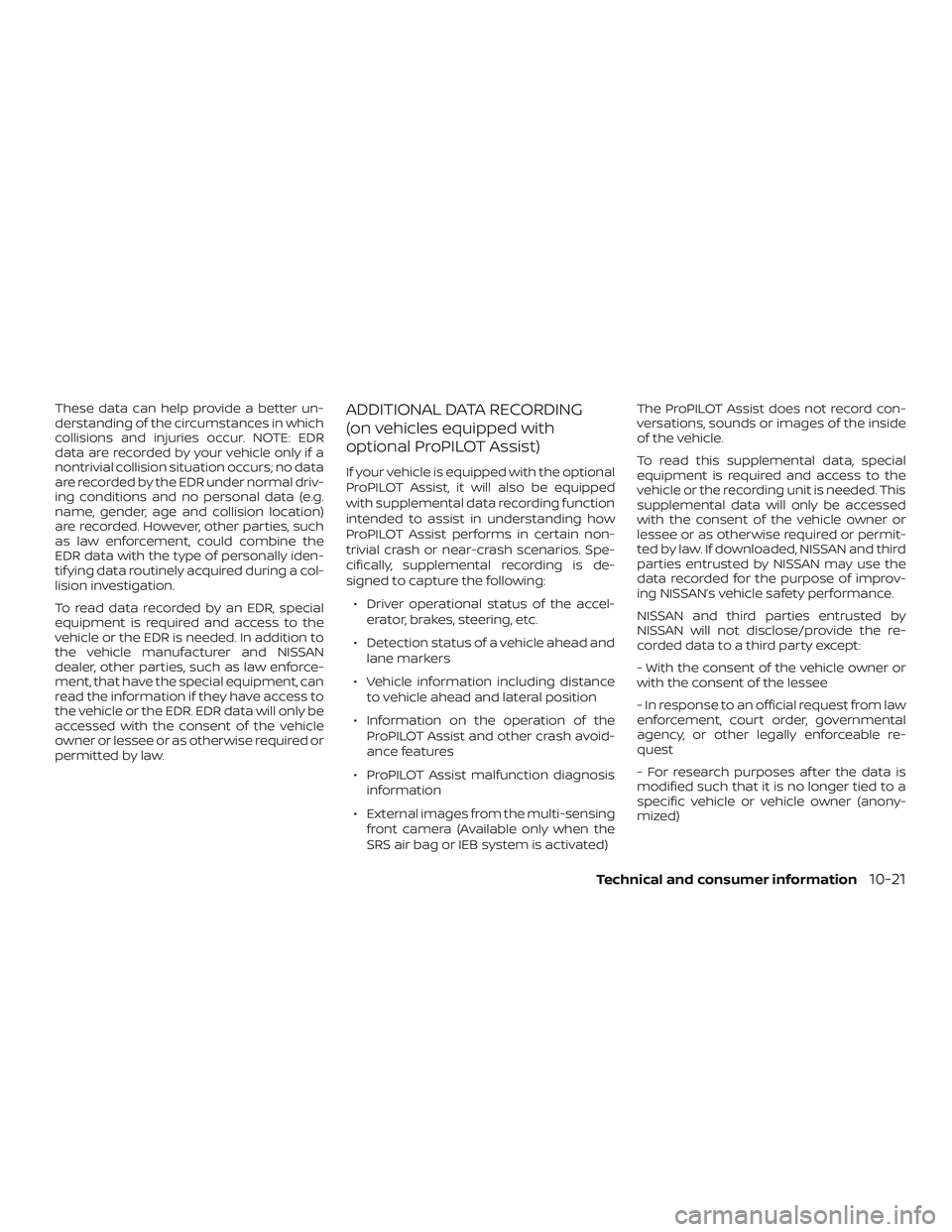
These data can help provide a better un-
derstanding of the circumstances in which
collisions and injuries occur. NOTE: EDR
data are recorded by your vehicle only if a
nontrivial collision situation occurs; no data
are recorded by the EDR under normal driv-
ing conditions and no personal data (e.g.
name, gender, age and collision location)
are recorded. However, other parties, such
as law enforcement, could combine the
EDR data with the type of personally iden-
tif ying data routinely acquired during a col-
lision investigation.
To read data recorded by an EDR, special
equipment is required and access to the
vehicle or the EDR is needed. In addition to
the vehicle manufacturer and NISSAN
dealer, other parties, such as law enforce-
ment, that have the special equipment, can
read the information if they have access to
the vehicle or the EDR. EDR data will only be
accessed with the consent of the vehicle
owner or lessee or as otherwise required or
permitted by law.ADDITIONAL DATA RECORDING
(on vehicles equipped with
optional ProPILOT Assist)
If your vehicle is equipped with the optional
ProPILOT Assist, it will also be equipped
with supplemental data recording function
intended to assist in understanding how
ProPILOT Assist performs in certain non-
trivial crash or near-crash scenarios. Spe-
cifically, supplemental recording is de-
signed to capture the following:∙ Driver operational status of the accel- erator, brakes, steering, etc.
∙ Detection status of a vehicle ahead and lane markers
∙ Vehicle information including distance to vehicle ahead and lateral position
∙ Information on the operation of the ProPILOT Assist and other crash avoid-
ance features
∙ ProPILOT Assist malfunction diagnosis information
∙ External images from the multi-sensing front camera (Available only when the
SRS air bag or IEB system is activated) The ProPILOT Assist does not record con-
versations, sounds or images of the inside
of the vehicle.
To read this supplemental data, special
equipment is required and access to the
vehicle or the recording unit is needed. This
supplemental data will only be accessed
with the consent of the vehicle owner or
lessee or as otherwise required or permit-
ted by law. If downloaded, NISSAN and third
parties entrusted by NISSAN may use the
data recorded for the purpose of improv-
ing NISSAN’s vehicle safety performance.
NISSAN and third parties entrusted by
NISSAN will not disclose/provide the re-
corded data to a third party except:
- With the consent of the vehicle owner or
with the consent of the lessee
- In response to an official request from law
enforcement, court order, governmental
agency, or other legally enforceable re-
quest
- For research purposes af ter the data is
modified such that it is no longer tied to a
specific vehicle or vehicle owner (anony-
mized)
Technical and consumer information10-21
Page 557 of 592
11 Index
A
Active noise cancellation Active sound
enhancement ..........5-184,5-184
ActiveRideControl(ARC)..........5-175
Air bag (See supplemental restraint
system) .................... .1-46
Air bag system Front (See supplemental front impact
airbagsystem)..............1-53
Airbagwarninglight..........1-66, 2-15
Air bag warning light,
supplemental ..............1-66, 2-15
Air cleaner housing filter ..........8-19
Air conditioner Air conditioner operation ....4-32,4-38
Air conditioner specification label . .10-12
Air conditioner system refrigerant
and oil recommendations .......10-7
Air conditioner system refrigerant
recommendations ............10-7
Heater and air conditioner
controls...............4-29,4-38
Servicing air conditioner ........4-41
Air flow charts .................4-33
Alarm system
(See vehicle security system) .......2-39
All-Wheel Drive .............5-166,6-14
Anchor point locations ...........1-28
Antenna ....................4-42
Antifreeze ...................5-181 Anti-lock brake warning light
........2-10
Anti-lock Braking System (ABS) ......5-171
Armrests.................... .1-7
Audible reminders ..............2-18
Autolightswitch ...............2-44
Automatic Automatic drive
positioner ...........3-33,3-34,3-35
Automatic power window switch . . .2-61
Automatic anti-glare inside mirror . . . .3-32
Automaticbrakehold............5-28
Automatic door locks .............3-7
Automatic drive positioner . .3-33, 3-34, 3-35
Automatic Emergency Braking
(AEB) ................2-10,2-14,5-130
Automatic Emergency Braking (AEB) with
Pedestrian Detection ............5-139
AWD...................5-166,6-14
B
Battery .................5-181,8-15 Charge warning light ...........2-11
Battery replacement ............8-24
Keyfob...................8-24
NISSAN Intelligent Key® .........8-25
Before starting the engine .........5-16
Belt(Seedrivebelt)..............8-17
Blind Spot Warning (BSW) ..........5-45
Booster seats .................1-42
Brake Anti-lock Braking System (ABS) ....5-171 Brakefluid.................8-13
Brakelight(Seestoplight).......8-27
Brakesystem...............5
-170
Brakewarninglight............2-11
Brakewearindicators.......2-18,8-21
Parking brake operation ........5-25
Self-adjustingbrakes ..........8-21
Brake Assist ..................5-172
Brakefluid...................8-13
Brakes......................8-21
Brakesystem.................5 -170
Break-in schedule ..............5-164
Brightness control Instrument panel .............2-49
Bulb check/instrument panel .......2-10
Bulb replacement ..............8-27
C
Capacities and recommended
fuel/lubricants.................10-2
Ca
rgo
(See vehicle loading information) .....10-13
Car phone or CB radio ...........4-42
Chassis control ...............5 -175
Check tire pressure .............2-34
Childrestraints.......1-21, 1-22, 1-23, 1-26 LATCH (Lower Anchors and Tethers for
CHildren)System.............1-26
Precautions on child
restraints.........1-23, 1-31, 1-38, 1-43
Page 558 of 592
Top tether strap anchor point
locations...................1-28
Child safety rear door lock ..........3-7
Chimes, audible reminders .........2-18
Cleaningexteriorandinterior......7-2,7-4
C.M.V.S.S. certification label .........10-11
Coldweatherdriving.............5-181
Console box ..................2-57
Continuously Variable Transmission
(CVT) .......................5-18
Continuously Variable Transmission
(CVT) fluid ..................8-13
Driving with Continuously Variable
Transmission (CVT) ............5-18
Controls Heater and air conditioner
controls................4-29,4-38
Coolant Capacities and recommended
fuel/lubricants...............10-2
Changing engine coolant .........8-7
Checking engine coolant level ......8-7
Engine coolant temperature gauge . .2-6
Corrosionprotection..............7-7
Cruisecontrol.................5-64
Cupholders...............2-58,2-59
D
Daytime Running Light System ......2-48
Defroster switch Rear window and outside mirror
defrosterswitch..............2-43
Dimensions and weights ...........10-9
Dimmer switch for instrument panel . . .2-49 Door locks
..................3-4,3-5
Drivebelt.....................8-17
Drive positioner, Automatic . . .3-33, 3-34, 3-35
Driving Cold weather driving ...........5-181
Driving with Continuously Variable
Transmission (CVT) ............5-18
Precautions when starting and
driving..................5-4,5-11
Drivingthevehicle...............5-18
E
E-CALL (SOS) SWITCH .............2-53
Economy - fuel ................5-165
Emergency engine shutoff .......5-15,6-2
Emission control information label . . . .10-12
Emission control system warranty . . . .10-18
Engine Before starting the engine ........5-16
Capacities and recommended
fuel/lubricants...............10-2
Changing engine coolant .........8-7
Changing engine oil ............8-9
Changing engine oil filter .........8-9
Checking engine coolant level ......8-7
Checking engine oil level .........8-8
Engine compartment check
locations...................8-4
Engine coolant temperature gauge . .2-6
Engine cooling system ..........8-6
Engine oil ...................8-8
Engine oil and oil filter
recommendation .............10-6
Engine oil pressure warning light ....2-12Engine oil viscosity
.............10-7
Engine serial number ...........10-11
Engine specifications ...........10-8
Starting the engine ............5-17
Engine Block Heater .............5-183
Engine coolant temperature gauge ....2-6
EventDatarecorders.........10-20,10-21
Exhaust gas (Carbon monoxide) .......5-4
Explanation of maintenance items .....9-3
Explanation of scheduled maintenance
items .......................9-5
Extended storage switch ..........2-55
Eyeglasscase.................2-58
F
Flashers
(Seehazardwarningflasherswitch)....6-2
Flattire....................6-3,6-4
Floormatpositioningaid...........7-6
Fluid Brakefluid..................8-13
Capacities and recommended
fuel/lubricants...............10-2
Continuously Variable Transmission
(CVT) fluid ..................8-13
Engine coolant ...............
8-6
Engine oil ...................8-8
Windshield-washer fluid .........8-14
F.M.V.S.S. certification label ..........10-11
Foglightswitch................2-50
Front air bag system (See supplemental
restraintsystem)................1-53
Front-door pocket ..............2-56
Front power seat adjustment ........1-4
11-2
Page 559 of 592
Frontseats....................1-2
Fuel Capacities and recommended
fuel/lubricants...............10-2
Fuel economy ...............5-165
Fuel-filler door and cap ..........3-27
Fuel-filler door lock opener lever ....3-27
Fuel gauge ..................2-7
Fueloctanerating.............10-6
Fuel recommendation ..........10-4
Loose fuel cap warning .........2-34
Fuelefficientdrivingtips..........5-164
Fuel-filler door .................3-27
Fuel gauge ....................2-7
Fuses .......................8-22
Fusiblelinks...................8-23
G
Garage door opener, HomeLink® Universal
Transceiver ......2-66,2-68,2-69,2-69,2-70
Gascap.....................3-27
Gauge Engine coolant temperature gauge . .2-6
Fuel gauge ..................2-7
Odometer ..................2-5
Speedometer ..............2-4,2-5
Tachometer .................2-6
Trip odometer .............2-4,2-5
General maintenance .............9-3
Glovebox....................2-57
Gloveboxlock.................2-57 H
Hazard warning flasher switch ........6-2
Headlight and turn signal switch ......2-43
Headlightcontrolswitch...........2-43
Headlights ...................8-26
Headrestraints................. .1-7
Heated seat switches .............2-51
Heated steering wheel ............2-52
Heater Heater and air conditioner
controls................4-29,4-38
Heater operation ..........4-30,4-39
Hill start assist system ...........5-176
HomeLink® Universal
Transceiver ......2-66,2-68,2-69,2-69,2-70
Hood ...................... .3-24
Horn.......................2-50
I
Ignition switch Push-button ignition switch .......5-13
Immobilizer system ..........2-40,5-16
Important vehicle information label . . . .10-11
In-cabinmicrofilter ..............8-19
Increasing fuel economy ..........5-165
Indicator NISSAN Intelligent Key® battery discharge
indicator...................5-15
Indicator lights and audible reminders
(See warning/indicator lights and audible
reminders) ....................2-15
Inside automatic anti-glare mirror .....3-32
Instrument brightness control .......2-49Instrument panel
.............0-6,2-2
Instrument panel dimmer switch .....2-49
Intelligent Around View Monitor .......4-11
Intelligent Cruise Control (ICC)
(for vehicles without ProPILOT Assist) . . .5-67
Intelligent Cruise Control (ICC)
(for vehicles with ProPILOT Assist) ....5-103
Intelligent Driver Alertness (I-DA) .....5-160
Intelligent Forward Collision Warning
(I-FCW).....................5-148
Intelligent Key system Key operating range ............3-9
Key operation ................3-10
Mechanical key ...............3-3
Remote keyless entry operation ....3-14
Troubleshooting guide ..........3-18
W
arning signals ..............3-18
Intelligent Lane Intervention (I-LI) .....5-39
Intelligent Trace Control (I-TC) .......5-175
Interiorlight...................2-64
Interiortrunklidrelease...........3-26
ISOFIX child restraints .............1-26
J
Jumpstarting...............6-9,8-16
K
Key........................ .3-2
Key fob battery replacement ........8-24
Keyless entry With Intelligent Key system
(See Intelligent Key system) .......3-14
11-3
Page 561 of 592
O
Octane rating (See fuel octane rating) . .10-6
Odometer ....................2-5
Oil Capacities and recommended
fuel/lubricants...............10-2
Changing engine oil ............8-9
Changing engine oil filter .........8-9
Checking engine oil level .........8-8
Engine oil ...................8-8
Engine oil and oil filter
recommendation .............10-6
Engine oil viscosity .............10-7
Outsidemirrors................3-32
Overhead sunglasses holder ........2-58
Overheat Ifyourvehicleoverheats.........6-11
Owner's manual order form ........10-22
Owner's manual/service manual order
information..................10-22
P
Parking Parking brake operation .........5-25
Parking/parkingonhills.........5-169
Parkingbrake...........2-12,2-15,5-25
Personal lights .................2-65
Power Power door locks ..............3-6
Poweroutlet................2-54
Powerrearwindows ...........2-61
Power steering system .........5-169
Powerwindows..............2-60 Rearpowerwindows...........2-61
Poweroutlet..................2-54
Powersteering................5-169
Precautions Maintenance precautions .........8-2
Precautions on booster
seats............1-23, 1-31, 1-38, 1-43
Precautions on child
restraints .........1-23, 1-31, 1-38, 1-43
Precautions on seat belt usage .....1-12
Precautions on supplemental restraint
system ................... .1-46
Precautions when starting and
driving..................5-4,5-11
ProPILOT Assist .................5-91
Push starting ..................6-11
R
Radio Car phone or CB radio ..........4-42
Readiness for inspection maintenance
(I/M) test ....................10-20
Rear Automatic Braking (RAB) .......5-125
RearCrossTrafficAlert(RCTA) .......5-55
Rear Door Alert ..........2-36,2-37,2-53
Rearpowerwindows.............2-61
Rearseat.................... .1-5
Rear Sonar System (RSS) ..........5-176
Rearviewmirror ................3-31
RearViewMonitor................4-3
Rear window and outside mirror defroster
switch......................2-43
Recommended Fluids ............10-2 Recorders
EventData.............10-20,10-21
Refrigerant recommendation ........10-7
Registering a vehicle in another
country .....................10-10
Remote Engine Start ..........3-21,5-18
Reporting safety defects (US only) . . . .10-19
S
Safety Child safety rear door lock ........3-7
Childseatbelts......1-23, 1-31, 1-38, 1-43
Reporting safety defects (US only) . .10-19
Seat adjustment Front manual seat adjustment ......1-3
Front power seat adjustment ......1-4
Rear seat adjustment ...........1-5
Seatback pockets ...............
2-56
Seat belt Childsafety ................ .1-21
Infants and small children ........1-22
InjuredPerson............... .1-15
Largerchildren.............. .1-22
Precautionsonseatbeltusage.....1-12
Pregnant women ..............1-15
Seat belt extenders ............1-20
Seat belt maintenance ..........1-20
Seatbelts................1-12, 7-7
Shoulder belt height adjustment . . . .1-19
Three-pointtypewithretractor.....1-15
Seat belt extenders ..............1-20
Seatbeltwarninglight.........1-14, 2-14
Seats Adjustment ..................1-2
11-5
Page 562 of 592
Armrests ...................1-7
Automatic drive
positioner ...........3-33,3-34,3-35
Frontseats..................1-2
Manual front seat adjustment ......1-3
Rearseat...................1-5
Security indicator light ............2-17
Security system (NISSAN Vehicle Immobilizer
System), engine start ..........2-40,5-16
Security systems Vehicle security system .........2-39
Self-adjustingbrakes.............8-21
Service manual order form .........10-22
Servicing air conditioner ...........4-41
Shif ting Continuously Variable Transmission
(CVT) .....................5-20
Shiftleverlockrelease............5-23
Shoulder belt height adjustment ......1-19
Sonar Rear system ................5-176
Spark plug replacement ...........8-18
Spark plugs ...................8-18
Specifications .................10-8
Speedometer ................2-4,2-5
Speedometer and odometer ........2-4
Spotlights(Seemaplight)..........2-65
SRS warning label ...............1-66
Stability control ................5-172
Standard maintenance ........9-10,9-15
Starting Before starting the engine ........5-16
Jumpstarting.............6-9,8-16
Precautions when starting and
driving ..................5-4,5-11
Push starting ................6-11 Starting the engine
............5-17
Starting the engine ..............5-17
Steering Heated steering wheel ..........2-52
Powersteeringsystem.........5-169
Steering Assist switch
(forvehicleswithProPILOTAssist).....2-52
Steering wheel .................3-29
Stoplight....................8-27
Storage.....................2-56
Sunglasses case ................2-58
Sunglasses holder ..............2-58
Sunroof ......................7-5
Sunroof (see Moonroof ) ...........2-62
Sunvisors....................3-30
Supplemental air bag warning
light.................... .1-66, 2-15
Supplemental front impact air bag
system ..................... .1-53
Supplemental restraint system Information and warning labels . . . .1-66
Precautions on supplemental restraint
system ................... .1-46
Supplemental restraint system
(Supplemental air bag system) .......1-46
Switch Autolightswitch..............2-44
Automatic power window switch . . .2-61
Foglightswitch..............2-50
Hazard warning flasher switch ......6-2
Headlight and turn signal switch ....2-43
Headlightcontrolswitch.........2-43
Instrument brightness control .....2-49
Power door lock switch ..........3-6
Rear window and outside mirror
defrosterswitch..............2-43 Turn signal switch
.............2-49
T
Tachometer ...................
2-6
Temperature gauge Engine coolant temperature gauge . .2-6
Thef t (NISSAN Vehicle Immobilizer System),
engine start ...............2-40,5-16
Three-waycatalyst...............5-4
Tilt Telescopicsteering............3-30
Tire Flattire..................6-3,6-4
Spare tire ...............6-5,8-42
Tire and Loading Information label . .10-12
Tire chains .................8-37
Tire pressure ................8-30
Tirerotation ................8-39
Types of tires ................8-36
Uniform tire quality grading .......10-17
Wheels and tires ..............8-30
Wheel/tire size ...............10-9
Tire pressure Low tire pressure warning light .....2-12
Tire Pressure Monitoring System
(TPMS)....................5-5,6-3
Towing 4-wheel drive models ...........6-13
Flattowing.................10-17
Trailertowing ...............10-17
Towingatrailer................10-17
Towingyourvehicle..............6-12
Traffic Sign Recognition (TSR) ........5-31
11-6