air condition NISSAN ALTIMA HYBRID 2008 L32A / 4.G Warranty Booklet
[x] Cancel search | Manufacturer: NISSAN, Model Year: 2008, Model line: ALTIMA HYBRID, Model: NISSAN ALTIMA HYBRID 2008 L32A / 4.GPages: 54, PDF Size: 4.4 MB
Page 25 of 54
21
personal injury to you or a bystander. Never exceed 35
mph/60 km/h as indicated on your speedometer. Use a
gentle backward and forward rocking motion to free your
vehicle for continued driving. Never stand near or behind a
tire spinning at high speed as, for example, while attempting
to push a vehicle that is stuck or when an on-the-car spin
balance machine is in use.
DO CHECK YOUR TIRES FOR WEARAlways remove tires from service when they reach two
thirty-seconds of an inch (2/32") remaining tread depth.
All new tires have treadwear indicators which appear as
smooth banks in the tread grooves when they wear to
the two thirty-seconds of an inch (2/32") level. Many wet
weather accidents result from skidding on bald or nearly
bald tires. Excessively worn tires are also more susceptible
to penetrations.
SIDEWALL TREATMENTSDunlop sidewalls are specially compounded to resist ozone
cracking or weather-cracking.
Use a mild soap solution to clean sidewalls, white striping
or lettering, and rinse off with plain water. Instruct service
per-sonnel and customers never to apply any other material
to enhance sidewall appearance. These may degrade rubber
and remove inherent ozone resistance.
DO CHECK YOUR TIRES FOR DAMAGEFrequent inspection of your tires for signs of damage and
their general condition is important for safety. If you have
any questions, have your tire dealer inspect them. Impacts,
penetrations, cracks, knots, bulges, or air loss always
require tire removal and expert inspection. Never perform
a temporary repair or use an innertube as a substitute for a
proper repair. Only qualifi ed persons should repair tires.
PROPER TIRE REPAIRNOTE : Dunlop does not warrant any inspection or repair
process. The repair is entirely the responsibility of the
repairer and should be made in accordance with established
Rubber Manufacturers Association (RMA) procedures.
DON’T ATTEMPT TO MOUNT
YOUR OWN TIRES
Serious injury may result from explosion of tire/rim
assembly due to improper mounting procedures. Follow
tire manufacturer’s instructions and match tire diameter
to rim surfaces. Lock assembly on mounting machine or
place in safety cage. STAND BACK and never exceed
40 psi to seat beads. Never use a volatile substance or
a rubber “donut” (also known as a bead expander or “O-
Ring”) to aid bead seating. Only specially trained persons
should mount tires.
DON’T MIX TIRES OF DIFFERENT SIZES
AND TYPES ON THE SAME AXLE
For optimum handling and control, Dunlop recommends
fi tment of four (4) tires of the same type and size unless
otherwise specifi ed by the vehicle manufacturer.
FOLLOW THESE ADDITIONAL
GUIDELINES:
Fit newest tires on rear axle. If radials and non-radials must
be fi tted to the same vehicle, fi t radials on rear axle. Never
mix radials and non-radials on the same axle. When fi tting
snow tires or all-season tires to performance vehicles,
always fi t in sets for four. Do not fi t tires with different
speed ratings.
Use of lift kits with some vehicle/tire combinations can
cause instability. When changing tire sizes, always consult
dealer for optimum rim width and carefully check vehicle/tire
clearances.
RETREADED TIRESRetreaded passenger and light truck tires are not warranted
by Dunlop for any reason. Dunlop speed ratings and U.S.
Department of Transportation test compliance certifi cations
are voided for retreaded tires.
DO MAINTAIN VEHICLE SUSPENSION,
WHEEL ALIGNMENT AND BALANCE
AND ROTATE YOUR TIRES
Lack of rotation, worn suspension parts, underinfl ation/over-
infl ation, wheel imbalance, and misalignment can cause
vibration or irregular tire wear. Rotate your tires according
to your vehicle manufacturer’s recommendations or at
maximum intervals of 6,000 miles/10,000 km.
LIGHTWEIGHT TEMPORARY
SPARE TIRES IMPORTANT SAFETY
INSTRUCTIONS
• Limit vehicle speed when using the lightweight temporary spare tire to 50 mph/80 km/h or less.
• Check the infl ation pressure before using and at least weekly. Maintain cold tire pressure in accordance with
that molded on the tire sidewall or found in your vehicle
owner’s manual. When infl ating or adding air to light-
weight temporary spare tire, be very careful, since the
smaller tire volume can gain pressure quickly. Leave
valve core in place and add infl ation air in short bursts.
Check the pressure often with an in-line or hand gauge
until the specifi ed pressure is reached.
• The lightweight temporary spare tire may lower ground clear-ance when used. Reduce speed and avoid driving
over large obstacles or through chuckholes and other
road hazards.
• Check your car owner’s manual for other special clearance precautions when using the lightweight
DUNLOP PASSENGER TIRE LIMITED WARRANTY
(Continued on page 22)
Page 27 of 54
23
GENERAL TIRE LIMITED WARRANTY
AND ADJUSTMENT POLICY
This Limited Warranty and Adjustment (the “Policy”)
is issued by Continental Tire North America, Inc. (the
“Company”) and is applicable for General-brand original
equipment tires and is a promise of replacement under
certain specifi ed conditions. This Policy applies to tires in
normal service displaying adjustable conditions (see Section
4) and does not require the existence of a workmanship or
material related condition in order to qualify for adjustment.
THIS POLICY IS NOT A WARRANTY THAT YOUR TIRE
WILL NOT FAIL OR BECOME UNSERVICEABLE IF
NEGLECTED OR MISTREATED.
1. ELIGIBILITY
a. This Policy applies to the owner of Passenger Car, Light Truck and Serva-Spare tires bearing
the General brand name and serial numbers, and
operated in normal service.
b. Eligible tires must be the original equipment tires, used on the vehicle on which they were originally
installed by the vehicle manufacturer.
c. Tires branded “used” are not eligible under this Policy.
2. WHAT IS THE ADJUSTMENT POLICY AND FOR HOW LONG?
Limited warranty coverage is for a maximum period of 72
months from the date of purchase*, determined by the
new vehicle registration date or new vehicle sales invoice
showing date of purchase.
If an eligible Passenger or Light Truck or Serva-Spare tire,
used in normal service, becomes unserviceable from a
condition other than those listed under Section 4, during
or after the time or treadwear periods shown below, it will
be replaced with a comparable** new General brand tire
according to (A) and (B) below.
(A) Free Replacement Policy: Time* Treadwear
Passenger Tire First 12 Months or First 2/32nds,
(whichever comes fi rst) .
Mounting & balancing included
free of charge. Owner pays all
applicable taxes.
Light Truck Tire First 12 Months or First 3/32nds,
(whichever comes fi rst) .
Mounting & balancing included
free of charge. Owner pays all
applicable taxes. (Excluding F.E.T.)
Serva-Spare No Time Limit First 1/32nd
Tires Mounting & balancing included
free of charge. Owner pays all
applicable taxes.
(B) Pro Rata Replacement Policy:
Passenger/Light Truck Tires After the "Free Replacement Policy" expires (set forth in
section 2A) , and the tire is still within 72 months from
the date of purchase*, you will pay, on a pro rata basis,
for a comparable** new General brand replacement tire.
A tire is eligible for an adjustment on a pro rata basis
until the tread is worn down to the tread wear indicators
(2/32nds of an inch of tread remaining) . The tire tread is
worn out at this point and this Policy ends regardless of
time period. Owner pays all applicable taxes (including
F.E.T.) , mounting and balancing charges. Serva-Spare Tires
After the “Free Replacement Policy” expires (set forth
in section 2A) , no adjustment will be made.
* At the time of claim, you need to present your new vehicle
registration or new vehicle sales invoice showing date of
purchase. If satisfactory proof-of-purchase date is not
provided, the D.O.T. certifi cation date of manufacture (tire
serial number) will be used.
** A “comparable” new General brand tire may be either the same tire line or the same basic construction but with a
different sidewall or tread confi guration. If a higher-priced
tire is accepted as replacement, the owner will pay the
difference in price. Any tire replaced under this Policy will
be covered by the current General Tire Limited Warranty
and Adjustment Policy
3. HOW A PRO RATA PRICE IS CALCULATED
The replacement tire price will be determined by multiplying
the percentage of the usable tread worn by the Dealers
Selling Price (excluding all applicable taxes) at the time
of the adjustment or the General brand current published
Adjustment Base Price, whichever is lower. The usable
tread is the original tread down to the tread wear indicators
(2/32nds of an inch of tread remaining) . The Ajustment
Base Price is intended to fairly represent a Dealer's Selling
Price for the same or comparable tire.
GENERAL TIRE LIMITED WARRANTY
(Continued on page 24)
Page 28 of 54
24
4. WHAT IS NOT COVERED BY THE ADJUSTMENT POLICY
a. The following conditions are not covered:
Road Hazard: Cuts, snags, punctures, bruises or
impact breaks and any damage caused by puncture
or tire repair.
Ride/Vibration: After “Free Replacement Policy” (set forth in section 2A) expires.
Tire Damage or Failure Resulting From Improper Operation or Maintenance: Load, speed, and
infl ation practices causing excessive operational
temperatures to exceed the tire capabilities.
Tire damage (including irregular treadwear) or failure resulting from: improper mounting or demounting,
damaged rim, wheel alignment, tire trueing, chain
damage, brakes or any similar mechanical problem,
extreme temperature exposure, misuse, negligence,
and abusive driving such as tire spinning, racing or
accident damage.
Tire failure resulting from intentional alterations: such as adding a white inlay on a blackwall or sealant
materials.
Age Conditions: Weather checking/cracking coverage is for a maximum period of 48 months
from the date of purchase.
b. General Exclusions -
Tire(s) submitted for an adjustment in service for
longer than 72 months from date of purchase*, are
not covered by this policy.
Tire(s) on any vehicle registered and normally operated outside the United States and Canada are
not covered under this Policy. For tires on vehicles
normally operated outside the United States and
Canada, see the nearest General Tire dealer or
distributor for local coverage. Tire(s) transferred from the vehicle on which they
were originally installed are not covered under this
Policy.
Company does not offer tread wearout coverage up to a predetermined mileage under this Policy.
Tire(s) used in racing related activities or competitive events are not covered by this Policy.
THIS LIMITED WARRANTY IS IN LIEU OF ALL OTHER
WARRANTIES, EXPRESS OR IMPLIED, INCLUDING, BUT
NOT LIMITED TO, WARRANTIES OF MERCHANTABILITY
OR FITNESS FOR A PARTICULAR PURPOSE. NO
OTHER WARRANTIES, EXPRESS OR IMPLIED,
INCLUDING, BUT NOT LIMITED TO, WARRANTIES OF
MERCHANTABILITY OR FITNESS FOR A PARTICULAR
PURPOSE, ARE MADE OR INTENDED BY COMPANY.
COMPANY DISCLAIMS ALL IMPLIED WARRANTIES,
INCLUDING WARRANTIES OF MERCHANTABILITY OR
FITNESS FOR A PARTICULAR PURPOSE. ANY IMPLIED
WARRANTIES, INCLUDING, BUT NOT LIMITED TO, ANY
WARRANTY OF MERCHANTABILITY OR FITNESS FOR
A PARTICULAR PURPOSE, ARE LIMITED IN DURATION
TO THE DURATION OF THIS WRITTEN WARRANTY.
SOME STATES DO NOT ALLOW LIMITATIONS ON HOW
LONG AN IMPLIED WARRANTY LASTS, SO THE ABOVE
LIMITATION MAY NOT APPLY TO YOU.
NO COMPANY EMPLOYEE, RETAILER OR DEALER
HAS THE AUTHORITY TO MAKE ANY WARRANTY,
REPRESENTATION, PROMISE OR AGREEMENT ON
BEHALF OF COMPANY EXCEPT AS STATED IN THIS
LIMITED WARRANTY.
TO THE EXTENT PERMITTED BY LAW, COMPANY
DISCLAIMS LIABILITY FOR ALL CONSEQUENTIAL AND
INCIDENTAL DAMAGES. THE REMEDIES SET FORTH
IN THIS LIMITED WARRANTY ARE THE SOLE AND EXCLUSIVE REMEDIES FOR BREACH OF WARRANTY.
SOME STATES DO NOT ALLOW THE EXCLUSION OR
LIMITATION OF INCIDENTAL OR CONSEQUENTIAL
DAMAGES SO THE ABOVE LIMITATIONS OR
EXCLUSION MAY NOT APPLY TO YOU. THIS WARRANTY
GIVES YOU SPECIFIC LEGAL RIGHTS, AND YOU MAY
ALSO HAVE OTHER RIGHTS WHICH MAY VARY FROM
STATE TO STATE.5. COMPANY'S OBLIGATIONSAny replacement qualifying under this Adjustment Policy
will be made by any General brand authorized dealer or
vehicle dealer authorized to handle General brand tire
adjustments. Company will replace the tire pursuant to
the terms of this Adjustment Policy.
6. OWNER’S OBLIGATIONSTo make a claim under this Policy concerning any tire which
is covered by this Policy, you must present your claim with
the tire to any General brand tire dealer or vehicle dealer
authorized to handle General brand tires. For the nearest
General brand tire dealer, check the Yellow Pages, or use
the General brand Internet address, or one of the “800”
numbers shown under “For Customer Assistance.” To be
eligible for the terms of this Policy, you need to present
your new vehicle registration form or new vehicle sales
invoice showing date of purchase. Tires replaced on an
adjustment basis become the property of Company. You
will be required to sign the Company Limited Warranty
Claim Form or dealer replacement sales receipt.
You are responsible for payment of all applicable taxes
demounting, mounting and balancing charges set forth
under this Policy. You are also responsible for payment of
local tire-disposal fees and any parts or service regardless
of mileage or months of service. This includes payment for
tire rotation, alignment, towing, road service, valve stems
and tire repairs.
GENERAL TIRE LIMITED WARRANTY
(Continued on page 25)
Page 30 of 54
26
ELIGIBILITYYou are eligible for the benefi ts of this policy if you are the
owner or authorized agent of the owner of new Goodyear
highway auto and light truck tires bearing Department of
Transportation prescribed tire identifi cation numbers, and
if your tires have been used only on the vehicle on which
they were originally installed according to the vehicle
manufacturer’s recommendations.
COVERAGE (REPLACEMENT FREE)Any new Goodyear highway radial auto tire or radial light
truck tire, except Unisteel radial light truck tires, covered
by this policy, that does not deliver satisfactory highway
service due to a workmanship or material related condition
(see Adjustment Policy Limitations) during the fi rst 25% of
usable treadwear, or twelve months from date of purchase,
whichever comes fi rst, will be replaced with a comparable
new Goodyear tire without charge. Mounting and balancing
are included.
Any Goodyear temporary spare tire that does not deliver
satisfactory highway service due to a workmanship or
material related condition during the fi rst 50% of usable
tread depth (1/32 of an inch) will be replaced with a
comparable new Goodyear temporary spare tire without
charge. Mounting is included. After the fi rst 50% of
usable treadwear, you pay only an adjustment charge for
the treadwear received, plus any mounting charge.
COVERAGE (PRORATED ADJUSTMENT)Tires not eligible for no charge adjustment that do not
deliver satisfactory service due to a workmanship or material
related condition will be replaced with comparable new
Goodyear tires on a pro rata basis. The replacement price
will be calculated by multiplying the current Goodyear
“predetermined price for adjustment” or current advertised
price at adjustment location (whichever is lower) by the
percentage of usable original tread that has been worn off at
the time of the adjustment. You pay for mounting, balancing,
and an amount equal to the full current Federal Excise Tax
applicable to the comparable new replacement tire.
The “predetermined price for adjustment,” available at
all Goodyear Auto Service Centers and participating
dealers, fairly represents the actual regular retail selling
price of the comparable tire at the time of adjustment. If
a “predetermined price for adjustment” is not available,
adjustment will be based on the price at which you are
entitled to buy at the time of adjustment.
A tire has delivered its full original tread life and this
warranty ends when the treadwear indicators become
visible, regardless of age or mileage. DEFINITION OF COMPARABLE TIRE
A “comparable” new Goodyear tire may either be the
same line of tire or, in the event the disabled tire is out of
production, the same basic construction and quality with
different sidewall or tread confi guration.
If a higher priced tire is accepted as replacement, the
difference in price will be additional.
Any tire replacement under this warranty will be covered by
the Goodyear warranty in effect at time of replacement.
ADJUSTMENT POLICY LIMITATIONS
This limited warranty is applicable only in the United States
and Canada.
No representative or dealer has authority to make any
representation, promise, or agreement on behalf of
Goodyear, except as stated herein.
The following are not covered by this policy:
• Goodyear does not warrant and will not give credit in
any adjustment transaction for any kind of material added
to the tire after leaving a Goodyear factory, nor will it
adjust any tire which has failed as a result of adding
any such material. (Example: Tire fi llers, sealants, or
balancing substances.)
GOODYEAR TIRE LIMITED WARRANTY
(Continued on page 27)
Page 32 of 54
28
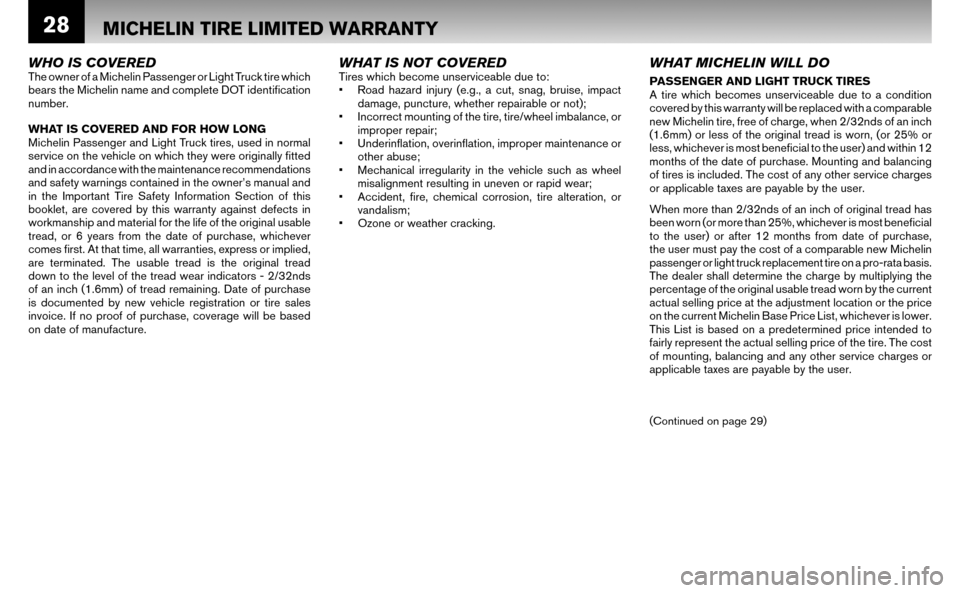
WHO IS COVEREDThe owner of a Michelin Passenger or Light Truck tire which
bears the Michelin name and complete DOT identifi cation
number.
WHAT IS COVERED AND FOR HOW LONG
Michelin Passenger and Light Truck tires, used in normal
service on the vehicle on which they were originally fi tted
and in accordance with the maintenance recommendations
and safety warnings contained in the owner’s manual and
in the Important Tire Safety Information Section of this
booklet, are covered by this warranty against defects in
workmanship and material for the life of the original usable
tread, or 6 years from the date of purchase, whichever
comes fi rst. At that time, all warranties, express or implied,
are terminated. The usable tread is the original tread
down to the level of the tread wear indicators - 2/32nds
of an inch (1.6mm) of tread remaining. Date of purchase
is documented by new vehicle registration or tire sales
invoice. If no proof of purchase, coverage will be based
on date of manufacture.WHAT IS NOT COVEREDTires which become unserviceable due to:
• Road hazard injury (e.g., a cut, snag, bruise, impact damage, puncture, whether repairable or not);
• Incorrect mounting of the tire, tire/wheel imbalance, or improper repair;
• Underinfl ation, overinfl ation, improper maintenance or other abuse;
• Mechanical irregularity in the vehicle such as wheel misalignment resulting in uneven or rapid wear;
• Accident, fi re, chemical corrosion, tire alteration, or vandalism;
• Ozone or weather cracking.WHAT MICHELIN WILL DO
PASSENGER AND LIGHT TRUCK TIRES
A tire which becomes unserviceable due to a condition
covered by this warranty will be replaced with a comparable
new Michelin tire, free of charge, when 2/32nds of an inch
(1.6mm) or less of the original tread is worn, (or 25% or
less, whichever is most benefi cial to the user) and within 12
months of the date of purchase. Mounting and balancing
of tires is included. The cost of any other service charges
or applicable taxes are payable by the user.
When more than 2/32nds of an inch of original tread has
been worn (or more than 25%, whichever is most benefi cial
to the user) or after 12 months from date of purchase,
the user must pay the cost of a comparable new Michelin
passenger or light truck replacement tire on a pro-rata basis.
The dealer shall determine the charge by multiplying the
percentage of the original usable tread worn by the current
actual selling price at the adjustment location or the price
on the current Michelin Base Price List, whichever is lower.
This List is based on a predetermined price intended to
fairly represent the actual selling price of the tire. The cost
of mounting, balancing and any other service charges or
applicable taxes are payable by the user.
MICHELIN TIRE LIMITED WARRANTY
(Continued on page 29)
Page 34 of 54
30
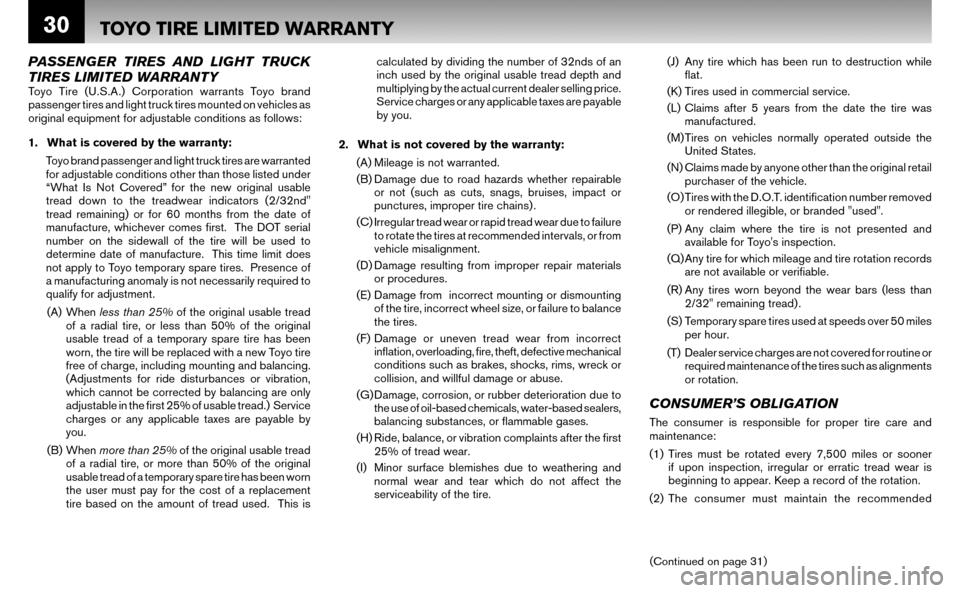
PASSENGER TIRES AND LIGHT TRUCK
TIRES LIMITED WARRANTY
Toyo Tire (U.S.A.) Corporation warrants Toyo brand
passenger tires and light truck tires mounted on vehicles as
original equipment for adjustable conditions as follows:
1. What is covered by the warranty:
Toyo brand passenger and light truck tires are warranted for adjustable conditions other than those listed under
“What Is Not Covered” for the new original usable
tread down to the treadwear indicators (2/32nd"
tread remaining) or for 60 months from the date of
manufacture, whichever comes fi rst. The DOT serial
number on the sidewall of the tire will be used to
determine date of manufacture. This time limit does
not apply to Toyo temporary spare tires. Presence of
a manufacturing anomaly is not necessarily required to
qualify for adjustment.
(A) When less than 25% of the original usable tread
of a radial tire, or less than 50% of the original
usable tread of a temporary spare tire has been
worn, the tire will be replaced with a new Toyo tire
free of charge, including mounting and balancing.
(Adjustments for ride disturbances or vibration,
which cannot be corrected by balancing are only
adjustable in the fi rst 25% of usable tread.) Service
charges or any applicable taxes are payable by
you.
(B) When more than 25% of the original usable tread
of a radial tire, or more than 50% of the original
usable tread of a temporary spare tire has been worn
the user must pay for the cost of a replacement
tire based on the amount of tread used. This is calculated by dividing the number of 32nds of an
inch used by the original usable tread depth and
multiplying by the actual current dealer selling price.
Service charges or any applicable taxes are payable
by you.
2. What is not covered by the warranty: (A) Mileage is not warranted.
(B) Damage due to road hazards whether repairable or not (such as cuts, snags, bruises, impact or
punctures, improper tire chains) .
(C) Irregular tread wear or rapid tread wear due to failure to rotate the tires at recommended intervals, or from
vehicle misalignment.
(D) Damage resulting from improper repair materials or procedures.
(E) Damage from incorrect mounting or dismounting of the tire, incorrect wheel size, or failure to balance
the tires.
(F) D amage or uneven tread wear from incorrect
infl ation, overloading, fi re, theft, defective mechanical
conditions such as brakes, shocks, rims, wreck or
collision, and willful damage or abuse.
(G) Damage, corrosion, or rubber deterioration due to the use of oil-based chemicals, water-based sealers,
balancing substances, or fl ammable gases.
(H) Ride, balance, or vibration complaints after the fi rst 25% of tread wear.
(I) Minor surface blemishes due to weathering and normal wear and tear which do not affect the
serviceability of the tire. (J) Any tire which has been run to destruction while
fl a t .
(K) Tires used in commercial service.
(L) Claims after 5 years from the date the tire was manufactured.
(M) Tires on vehicles normally operated outside the United States.
(N) Claims made by anyone other than the original retail purchaser of the vehicle.
(O) Tires with the D.O.T. identifi cation number removed or rendered illegible, or branded "used".
(P) Any claim where the tire is not presented and available for Toyo's inspection.
(Q) Any tire for which mileage and tire rotation records are not available or verifi able.
(R) Any tires worn beyond the wear bars (less than 2/32" remaining tread) .
(S) Temporary spare tires used at speeds over 50 miles per hour.
(T) Dealer service charges are not covered for routine or required maintenance of the tires such as alignments
or rotation.
CONSUMER’S OBLIGATION
The consumer is responsible for proper tire care and
maintenance:
(1) Tires must be rotated every 7,500 miles or sooner if upon inspection, irregular or erratic tread wear is
beginning to appear. Keep a record of the rotation.
(2) The consumer must maintain the recommended
TOYO TIRE LIMITED WARRANTY
(Continued on page 31)
Page 35 of 54
31
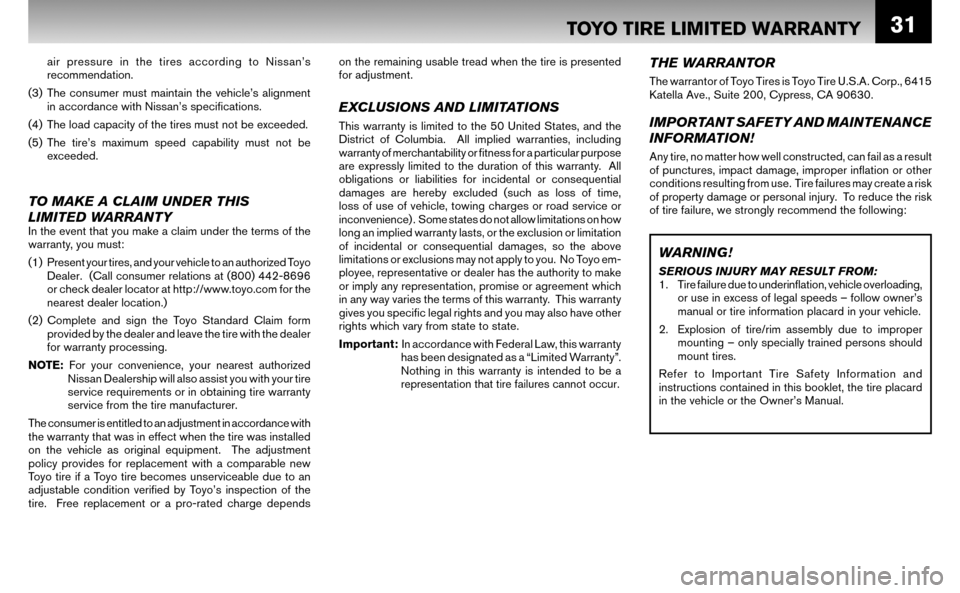
THE WARRANTOR
The warrantor of Toyo Tires is Toyo Tire U.S.A. Corp., 6415
Katella Ave., Suite 200, Cypress, CA 90630.
IMPORTANT SAFETY AND MAINTENANCE
INFORMATION!
Any tire, no matter how well constructed, can fail as a result
of punctures, impact damage, improper infl ation or other
conditions resulting from use. Tire failures may create a risk
of property damage or personal injury. To reduce the risk
of tire failure, we strongly recommend the following:
WARNING!
SERIOUS INJURY MAY RESULT FROM:
1. Tire failure due to underinfl ation, vehicle overloading,
or use in excess of legal speeds – follow owner’s
manual or tire information placard in your vehicle.
2. Explosion of tire/rim assembly due to improper mounting – only specially trained persons should
mount tires.
Refer to Important Tire Safety Information and
instructions contained in this booklet, the tire placard
in the vehicle or the Owner’s Manual.
TOYO TIRE LIMITED WARRANTY
air pressure in the tires according to Nissan’s
recommendation.
(3) The consumer must maintain the vehicle’s alignment in accordance with Nissan’s specifi cations.
(4) The load capacity of the tires must not be exceeded.
(5) The tire’s maximum speed capability must not be exceeded.
TO MAKE A CLAIM UNDER THIS
LIMITED WARRANTY
In the event that you make a claim under the terms of the
warranty, you must:
(1) P resent your tires, and your vehicle to an authorized Toyo
Dealer. (Call consumer relations at (800) 442-8696
or check dealer locator at http://www.toyo.com for the
nearest dealer location.)
(2) Complete and sign the Toyo Standard Claim form provided by the dealer and leave the tire with the dealer
for warranty processing.
NOTE: For your convenience, your nearest authorized Nissan Dealership will also assist you with your tire
service requirements or in obtaining tire warranty
service from the tire manufacturer.
The consumer is entitled to an adjustment in accordance with
the warranty that was in effect when the tire was installed
on the vehicle as original equipment. The adjustment
policy provides for replacement with a comparable new
Toyo tire if a Toyo tire becomes unserviceable due to an
adjustable condition verifi ed by Toyo’s inspection of the
tire. Free replacement or a pro-rated charge depends on the remaining usable tread when the tire is presented
for adjustment.
EXCLUSIONS AND LIMITATIONS
This warranty is limited to the 50 United States, and the
District of Columbia. All implied warranties, including
warranty of merchantability or fi tness for a particular purpose
are expressly limited to the duration of this warranty. All
obligations or liabilities for incidental or consequential
damages are hereby excluded (such as loss of time,
loss of use of vehicle, towing charges or road service or
inconvenience) . Some states do not allow limitations on how
long an implied warranty lasts, or the exclusion or limitation
of incidental or consequential damages, so the above
limitations or exclusions may not apply to you. No Toyo em-
ployee, representative or dealer has the authority to make
or imply any representation, promise or agreement which
in any way varies the terms of this warranty. This warranty
gives you specifi c legal rights and you may also have other
rights which vary from state to state.
Important: In accordance with Federal Law, this warranty
has been designated as a “Limited Warranty”.
Nothing in this warranty is intended to be
a
representation that tire failures cannot occur.
Page 37 of 54
33
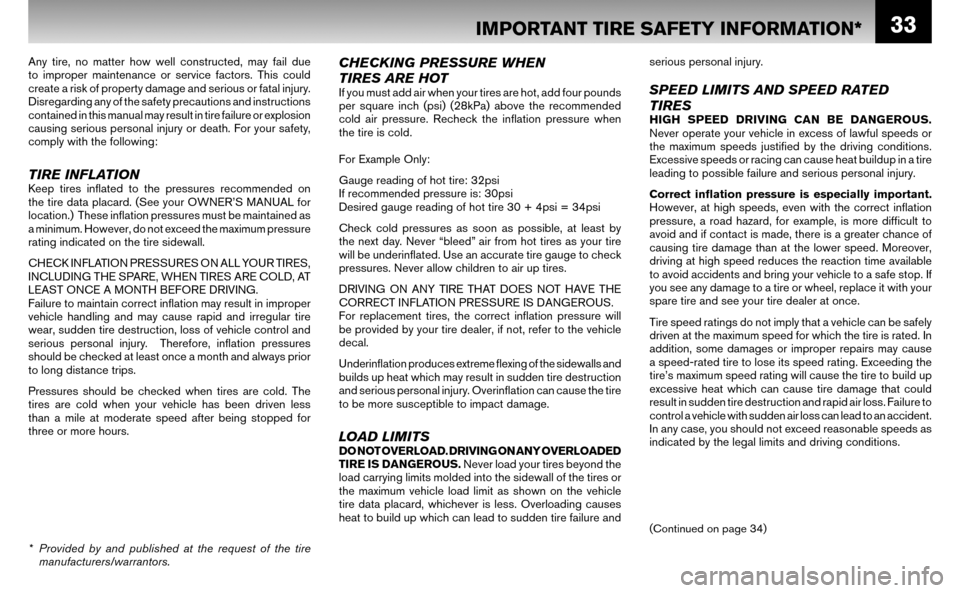
Any tire, no matter how well constructed, may fail due
to improper maintenance or service factors. This could
create a risk of property damage and serious or fatal injury.
Disregarding any of the safety precautions and instructions
contained in this manual may result in tire failure or explosion
causing serious personal injury or death. For your safety,
comply with the following:
TIRE INFLATIONKeep tires infl ated to the pressures recommended on
the tire data placard. (See your OWNER’S MANUAL for
location.) These infl ation pressures must be maintained as
a minimum. However, do not exceed the maximum pressure
rating indicated on the tire sidewall.
CHECK INFLATION PRESSURES ON ALL YOUR TIRES,
INCLUDING THE SPARE, WHEN TIRES ARE COLD, AT
LEAST ONCE A MONTH BEFORE DRIVING.
Failure to maintain correct infl ation may result in improper
vehicle handling and may cause rapid and irregular tire
wear, sudden tire destruction, loss of vehicle control and
serious personal injury. Therefore, infl ation pressures
should be checked at least once a month and always prior
to long distance trips.
Pressures should be checked when tires are cold. The
tires are cold when your vehicle has been driven less
than a mile at moderate speed after being stopped for
three or more hours.
CHECKING PRESSURE WHEN
TIRES ARE HOT
If you must add air when your tires are hot, add four pounds
per square inch (psi) (28kPa) above the recommended
cold air pressure. Recheck the infl ation pressure when
the tire is cold.
For Example Only:
Gauge reading of hot tire: 32psi
If recommended pressure is: 30psi
Desired gauge reading of hot tire 30 + 4psi = 34psi
Check cold pressures as soon as possible, at least by
the next day. Never “bleed” air from hot tires as your tire
will be underinfl ated. Use an accurate tire gauge to check
pressures. Never allow children to air up tires.
DRIVING ON ANY TIRE THAT DOES NOT HAVE THE
CORRECT INFLATION PRESSURE IS DANGEROUS.
For replacement tires, the correct infl ation pressure will
be provided by your tire dealer, if not, refer to the vehicle
decal.
Underinfl ation produces extreme fl exing of the sidewalls and
builds up heat which may result in sudden tire destruction
and serious personal injury. Overinfl ation can cause the tire
to be more susceptible to impact damage.
LOAD LIMITSDO NOT OVERLOAD. DRIVING ON ANY OVERLOADED
TIRE IS DANGEROUS. Never load your tires beyond the
load carrying limits molded into the sidewall of the tires or
the maximum vehicle load limit as shown on the vehicle
tire data placard, whichever is less. Overloading causes
heat to build up which can lead to sudden tire failure and serious personal injury.
SPEED LIMITS AND SPEED RATED
TIRES
HIGH SPEED DRIVING CAN BE DANGEROUS.
Never operate your vehicle in excess of lawful speeds or
the maximum speeds justifi ed by the driving conditions.
Excessive speeds or racing can cause heat buildup in a tire
leading to possible failure and serious personal injury.
Correct infl
ation pressure is especially important.
However, at high speeds, even with the correct infl ation
pressure, a road hazard, for example, is more diffi cult to
avoid and if contact is made, there is a greater chance of
causing tire damage than at the lower speed. Moreover,
driving at high speed reduces the reaction time available
to avoid accidents and bring your vehicle to a safe stop. If
you see any damage to a tire or wheel, replace it with your
spare tire and see your tire dealer at once.
Tire speed ratings do not imply that a vehicle can be safely
driven at the maximum speed for which the tire is rated. In
addition, some damages or improper repairs may cause
a speed-rated tire to lose its speed rating. Exceeding the
tire’s maximum speed rating will cause the tire to build up
excessive heat which can cause tire damage that could
result in sudden tire destruction and rapid air loss. Failure to
control a vehicle with sudden air loss can lead to an accident.
In any case, you should not exceed reasonable speeds as
indicated by the legal limits and driving conditions.
* Provided by and published at the request of the tire manufacturers/warrantors.
IMPORTANT TIRE SAFETY INFORMATION*
(Continued on page 34)
Page 38 of 54
34
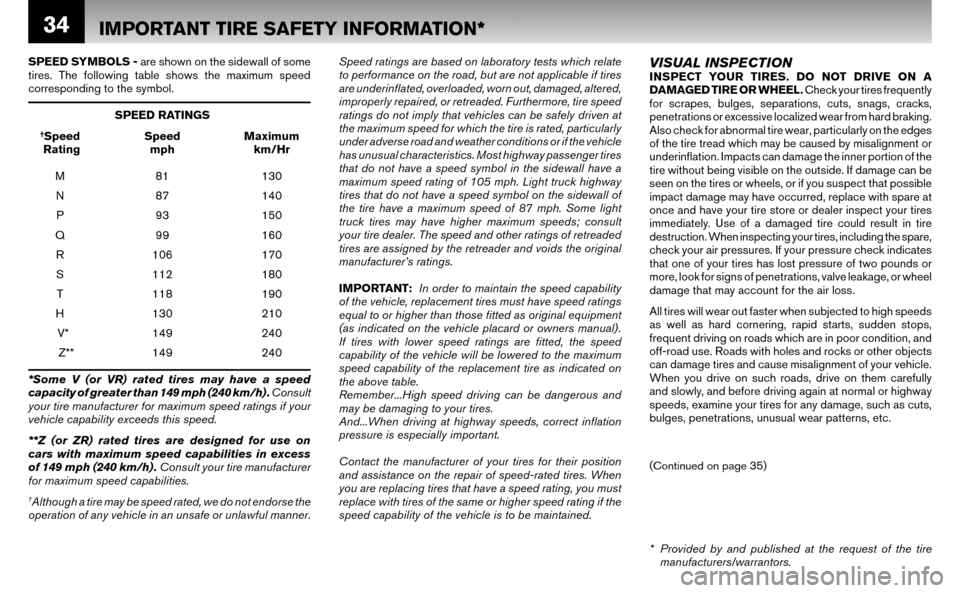
SPEED SYMBOLS - are shown on the sidewall of some
tires. The following table shows the maximum speed
corresponding to the symbol.
SPEED RATINGS
†Speed Speed Maximum
Rating mph km/Hr
M 81 130
N 87 140
P 93 150
Q 99 160
R 106 170
S 112 180
T 118 190
H 130 210
V* 149 240
Z** 149 240
*Some V (or VR) rated tires may have a speed
capacity of greater than 149 mph (240 km/h) . Consult
your tire manufacturer for maximum speed ratings if your
vehicle capability exceeds this speed.
**Z (or ZR) rated tires are designed for use on
cars with maximum speed capabilities in excess
of 149 mph (240 km/h) . Consult your tire manufacturer
for maximum speed capabilities.
†Although a tire may be speed rated, we do not endorse the
operation of any vehicle in an unsafe or unlawful manner. Speed ratings are based on laboratory tests which relate
to performance on the road, but are not applicable if tires
are underinfl
ated, overloaded, worn out, damaged, altered,
improperly repaired, or retreaded. Furthermore, tire speed
ratings do not imply that vehicles can be safely driven at
the maximum speed for which the tire is rated, particularly
under adverse road and weather conditions or if the vehicle
has unusual characteristics. Most highway passenger tires
that do not have a speed symbol in the sidewall have a
maximum speed rating of 105 mph. Light truck highway
tires that do not have a speed symbol on the sidewall of
the tire have a maximum speed of 87 mph. Some light
truck tires may have higher maximum speeds; consult
your tire dealer. The speed and other ratings of retreaded
tires are assigned by the retreader and voids the original
manufacturer’s ratings.
IMPORTANT: In order to maintain the speed capability
of the vehicle, replacement tires must have speed ratings
equal to or higher than those fi tted as original equipment
(as indicated on the vehicle placard or owners manual) .
If tires with lower speed ratings are fi tted, the speed
capability of the vehicle will be lowered to the maximum
speed capability of the replacement tire as indicated on
the above table.
Remember...High speed driving can be dangerous and
may be damaging to your tires.
And...When driving at highway speeds, correct infl ation
pressure is especially important.
Contact the manufacturer of your tires for their position
and assistance on the repair of speed-rated tires. When
you are replacing tires that have a speed rating, you must
replace with tires of the same or higher speed rating if the
speed capability of the vehicle is to be maintained.
VISUAL INSPECTIONINSPECT YOUR TIRES. DO NOT DRIVE ON A
DAMAGED TIRE OR WHEEL. Check your tires frequently
for scrapes, bulges, separations, cuts, snags, cracks,
penetrations or excessive localized wear from hard braking.
Also check for abnormal tire wear, particularly on the edges
of the tire tread which may be caused by misalignment or
underinfl ation. Impacts can damage the inner portion of the
tire without being visible on the outside. If damage can be
seen on the tires or wheels, or if you suspect that possible
impact damage may have occurred, replace with spare at
once and have your tire store or dealer inspect your tires
immediately. Use of a damaged tire could result in tire
destruction. When inspecting your tires, including the spare,
check your air pressures. If your pressure check indicates
that one of your tires has lost pressure of two pounds or
more, look for signs of penetrations, valve leakage, or wheel
damage that may account for the air loss.
All tires will wear out faster when subjected to high speeds
as well as hard cornering, rapid starts, sudden stops,
frequent driving on roads which are in poor condition, and
off-road use. Roads with holes and rocks or other objects
can damage tires and cause misalignment of your vehicle.
When you drive on such roads, drive on them carefully
and slowly, and before driving again at normal or highway
speeds, examine your tires for any damage, such as cuts,
bulges, penetrations, unusual wear patterns, etc.
* Provided by and published at the request of the tire manufacturers/warrantors.
IMPORTANT TIRE SAFETY INFORMATION*
(Continued on page 35)
Page 39 of 54
35
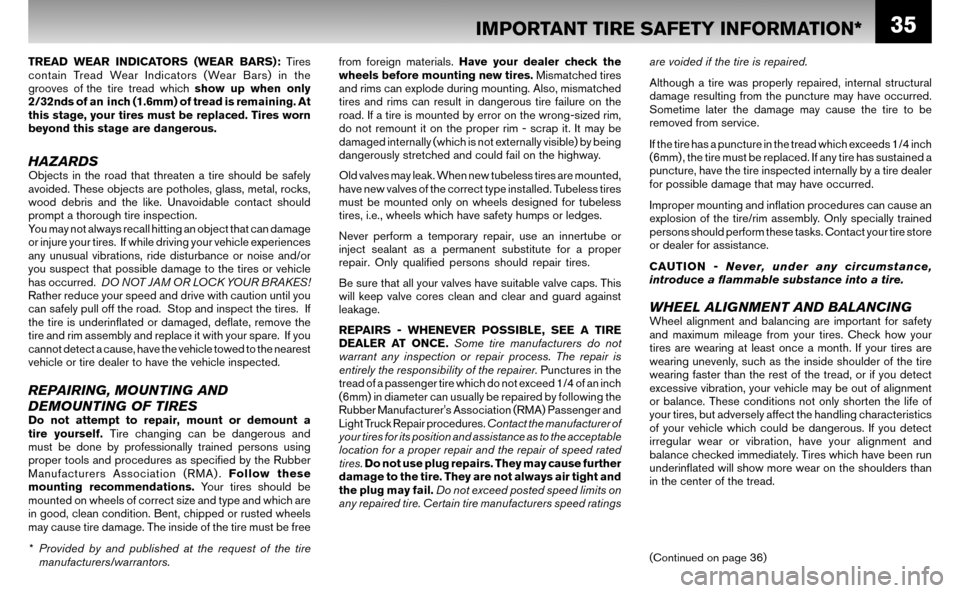
TREAD WEAR INDICATORS (WEAR BARS): Tires
contain Tread Wear Indicators (Wear Bars) in the
grooves of the tire tread which show up when only
2/32nds of an inch (1.6mm) of tread is remaining. At
this stage, your tires must be replaced. Tires worn
beyond this stage are dangerous.
HAZARDSObjects in the road that threaten a tire should be safely
avoided. These objects are potholes, glass, metal, rocks,
wood debris and the like. Unavoidable contact should
prompt a thorough tire inspection.
You may not always recall hitting an object that can damage
or injure your tires. If while driving your vehicle experiences
any unusual vibrations, ride disturbance or noise and/or
you suspect that possible damage to the tires or vehicle
has occurred. DO NOT JAM OR LOCK YOUR BRAKES!
Rather reduce your speed and drive with caution until you
can safely pull off the road. Stop and inspect the tires. If
the tire is underinfl ated or damaged, defl ate, remove the
tire and rim assembly and replace it with your spare. If you
cannot detect a cause, have the vehicle towed to the nearest
vehicle or tire dealer to have the vehicle inspected.
REPAIRING, MOUNTING AND
DEMOUNTING OF TIRES
Do not attempt to repair, mount or demount a
tire yourself. Tire changing can be dangerous and
must be done by professionally trained persons using
proper tools and procedures as specifi ed by the Rubber
Manufacturers Association (RMA) . Follow these
mounting recommendations. Your tires should be
mounted on wheels of correct size and type and which are
in good, clean condition. Bent, chipped or rusted wheels
may cause tire damage. The inside of the tire must be free from foreign materials. Have your dealer check the
wheels before mounting new tires.
Mismatched tires
and rims can explode during mounting. Also, mismatched
tires and rims can result in dangerous tire failure on the
road. If a tire is mounted by error on the wrong-sized rim,
do not remount it on the proper rim - scrap it. It may be
damaged internally (which is not externally visible) by being
dangerously stretched and could fail on the highway.
Old valves may leak. When new tubeless tires are mounted,
have new valves of the correct type installed. Tubeless tires
must be mounted only on wheels designed for tubeless
tires, i.e., wheels which have safety humps or ledges.
Never perform a temporary repair, use an innertube or
inject sealant as a permanent substitute for a proper
repair. Only qualifi ed persons should repair tires.
Be sure that all your valves have suitable valve caps. This
will keep valve cores clean and clear and guard against
leakage.
REPAIRS - WHENEVER POSSIBLE, SEE A TIRE
DEALER AT ONCE. Some tire manufacturers do not
warrant any inspection or repair process. The repair is
entirely the responsibility of the repairer. Punctures in the
tread of a passenger tire which do not exceed 1/4 of an inch
(6mm) in diameter can usually be repaired by following the
Rubber Manufacturer's Association (RMA) Passenger and
Light Truck Repair procedures. Contact the manufacturer of
your tires for its position and assistance as to the acceptable
location for a proper repair and the repair of speed rated
tires. Do not use plug repairs. They may cause further
damage to the tire. They are not always air tight and
the plug may fail. Do not exceed posted speed limits on
any repaired tire. Certain tire manufacturers speed ratings are voided if the tire is repaired.
Although a tire was properly repaired, internal structural
damage resulting from the puncture may have occurred.
Sometime later the damage may cause the tire to be
removed from service.
If the tire has a puncture in the tread which exceeds 1/4 inch
(6mm) , the tire must be replaced. If any tire has sustained a
puncture, have the tire inspected internally by a tire dealer
for possible damage that may have occurred.
Improper mounting and infl ation procedures can cause an
explosion of the tire/rim assembly. Only specially trained
persons should perform these tasks. Contact your tire store
or dealer for assistance.
CAUTION - Never, under any circumstance,
introduce a fl ammable substance into a tire.
WHEEL ALIGNMENT AND BALANCINGWheel alignment and balancing are important for safety
and maximum mileage from your tires. Check how your
tires are wearing at least once a month. If your tires are
wearing unevenly, such as the inside shoulder of the tire
wearing faster than the rest of the tread, or if you detect
excessive vibration, your vehicle may be out of alignment
or balance. These conditions not only shorten the life of
your tires, but adversely affect the handling characteristics
of your vehicle which could be dangerous. If you detect
irregular wear or vibration, have your alignment and
balance checked immediately. Tires which have been run
underinfl ated will show more wear on the shoulders than
in the center of the tread.
* Provided by and published at the request of the tire manufacturers/warrantors.
IMPORTANT TIRE SAFETY INFORMATION*
(Continued on page 36)