suspension NISSAN ARMADA 2018 Owner´s Manual
[x] Cancel search | Manufacturer: NISSAN, Model Year: 2018, Model line: ARMADA, Model: NISSAN ARMADA 2018Pages: 532, PDF Size: 2.3 MB
Page 418 of 532
VEHICLE RECOVERY (freeing a stuck
vehicle)
WARNING
.Stand clear of a stuck vehicle.
. Do not spin your tires at high
speed. This could cause them to
explode and result in serious in-
jury. Parts of your vehicle could
also overheat and be damaged.
Pulling a stuck vehicle
If your vehicle is stuck in sand, snow, mud,
etc., use a tow strap or other device
designed specifically for vehicle recovery.
Always follow the manufacturer’s instruc-
tions for the recovery device.
Attach the tow strap to the towing hook.
CAUTION
.Tow chains or cables must be
attached only to the main struc-
tural members of the vehicle or
the towing hooks. Otherwise, the
vehicle body will be damaged.
. Use the towing hook only to free
a vehicle stuck in sand, snow, mud, etc. Never tow the vehicle
for a long distance using only the
towing hook.
. The towing hook is under tre-
mendous force when used to free
a stuck vehicle. Never pull the
hook at an angle.
. Always pull the cable straight out
from the front or rear of the
vehicle.
. Pulling devices should be routed
so they do not touch any part of
the suspension, steering, brake or
cooling systems.
. Pulling devices such as ropes or
canvas straps are not recom-
mended for use in vehicle towing
or recovery.
Rocking a stuck vehicle
If your vehicle is stuck in sand, snow, mud,
etc., use the following procedure:
1. Turn off the Vehicle Dynamic Control
(VDC) system.
2. Make sure the area in front and behind the vehicle is clear of obstruc-
tions.
3. Turn the steering wheel right and left to clear an area around the front tires. 4. Slowly rock the vehicle forward and
backward.
.Shift back and forth between R(Reverse) and D (Drive).
.Apply the accelerator as little as possible to maintain the rocking
motion.
.Release the accelerator pedal be-
fore shifting between R and D.
.Do not spin the tires above 35 MPH(55 km/h).
5. If the vehicle cannot be freed after a few tries, contact a professional tow-
ing service to remove the vehicle.
In case of emergency6-19
Page 468 of 532
tires. Skid and traction capabilities of
studded snow tires, on wet or dry sur-
faces, may be poorer than that of non-
studded snow tires.
TIRE CHAINS
Use of tire chains may be prohibited
according to location. Check the local
laws before installing tire chains. When
installing tire chains, make sure they are
the proper size for the tires on your
vehicle and are installed according to
the chain manufacturer’s suggestions.
Use only SAE Class S chains.Class “S”
chains are used on vehicles with re-
stricted tire to vehicle clearance. Vehicles
that can use Class “S” chains are designed
to meet the SAE standard minimum
clearances between the tire and the
closest vehicle suspension or body com-
ponent required to accommodate the
use of a winter traction device (tire chains
or cables). The minimum clearances are
determined using the factory equipped
tire size. Other types may damage your
vehicle. Use chain tensioners when re-
commended by the tire chain manufac-
turer to ensure a tight fit. Loose end links
of the tire chain must be secured or
removed to prevent the possibility of
whipping action damage to the fenders
or underbody. If possible, avoid fully load-
ing your vehicle when using tire chains. In addition, drive at a reduced speed. Other-
wise, your vehicle may be damaged and/
or vehicle handling and performance may
be adversely affected.
Tire chains must be installed only on
the rear wheels and not on the front
wheels.
Do not use tire chains on dry roads.
Driving with tire chains in such conditions
can cause damage to the various me-
chanisms of the vehicle due to some
overstress.
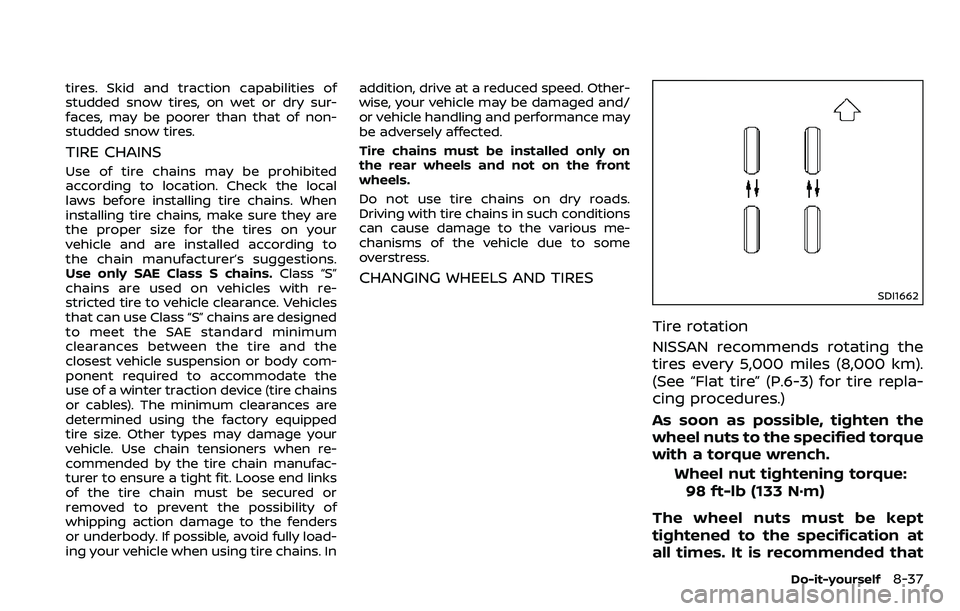
CHANGING WHEELS AND TIRES
SDI1662
Tire rotation
NISSAN recommends rotating the
tires every 5,000 miles (8,000 km).
(See “Flat tire” (P.6-3) for tire repla-
cing procedures.)
As soon as possible, tighten the
wheel nuts to the specified torque
with a torque wrench.
Wheel nut tightening torque:98 ft-lb (133 N·m)
The wheel nuts must be kept
tightened to the specification at
all times. It is recommended that
Do-it-yourself8-37
Page 477 of 532
9-6Maintenance and schedules
Exhaust system:
Visually inspect the exhaust pipes, muffler
and hangers for leaks, cracks, deteriora-
tion, and damage. Tighten connections or
replace parts as necessary.
Propeller shaft(s):
Check for damage, looseness, and grease
leakage.
In-cabin microfilter:
Replace at specified intervals. When driv-
ing for prolonged periods in dusty condi-
tions, replace the filter more frequently.
Steering gear and linkage, axle and
suspension parts:
Check for damage, looseness, and leak-
age of oil or grease. Under severe driving
conditions, inspect more frequently.
Tire rotation:
Tires should be rotated every 5,000 miles
(8,000km). When rotating tires, check for
damage and uneven wear. Replace if
necessary.
Transmission fluid/oil, differential oil:
Visually inspect for signs of leakage at
specified intervals.
Off-road maintenance:
Check the following items frequently
whenever you drive off-road through
deep sand, mud or water:.
Brake pads and rotors
. Brake linings and drums
. Brake lines and hoses
. Differential, transmission and transfer
case oil
. Steering linkage
. Propeller shaft(s) and front drive
shafts
. Engine air filter
. Clutch housing drain (AWD only)To help ensure smooth, safe and eco-
nomical driving, NISSAN provides two
maintenance schedules that may be
used, depending upon the conditions in
which you usually drive. These schedules
contain both distance and time intervals,
up to 120,000 miles (192,000 km)/144
months. For most people, the odometer
reading will indicate when service is
needed. However, if you drive very little,
your vehicle should be serviced at the
regular time intervals shown in the sche-
dule.
After 120,000 miles (192,000 km)/144
months, continue maintenance at the
same mileage/time intervals.
ADDITIONAL MAINTENANCE ITEMS
FOR SEVERE OPERATING CONDI-
TIONS
Additional maintenance items for se-
vere operating conditions; should be
performed on vehicles that are driven
under especially demanding conditions.
Additional maintenance items should be
performed if you primarily operate your
vehicle under the following conditions:
. Repeated short trips of less than 5
miles (8 km).
. Repeated short trips of less than 10
miles (16 km) with outside tempera-
tures remaining below freezing.
MAINTENANCE SCHEDULES
Page 482 of 532
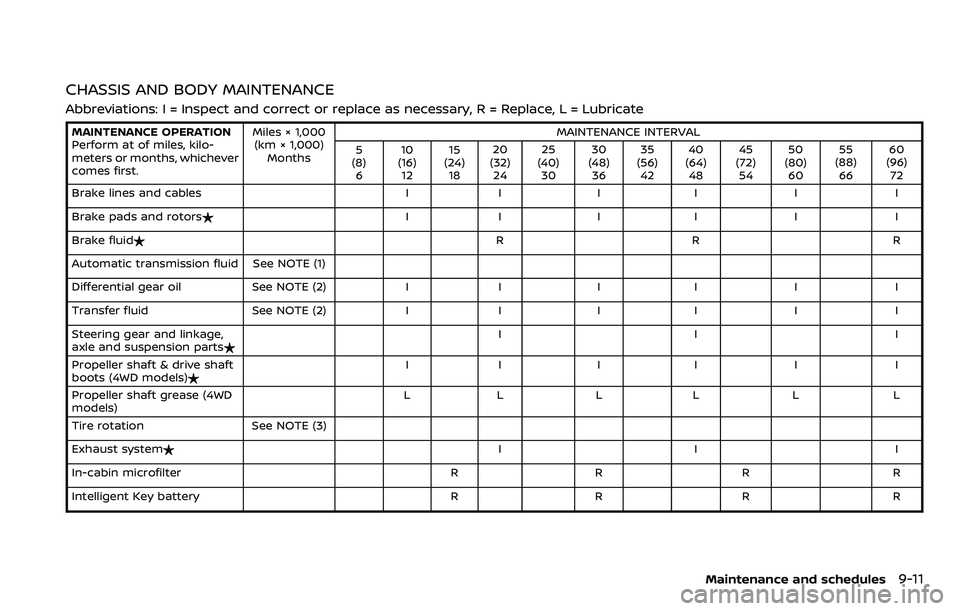
CHASSIS AND BODY MAINTENANCE
Abbreviations: I = Inspect and correct or replace as necessary, R = Replace, L = Lubricate
MAINTENANCE OPERATION
Perform at of miles, kilo-
meters or months, whichever
comes first.Miles × 1,000
(km × 1,000) Months MAINTENANCE INTERVAL
5
(8) 6 10
(16) 12 15
(24) 18 20
(32) 24 25
(40) 30 30
(48) 36 35
(56) 42 40
(64) 48 45
(72) 54 50
(80) 60 55
(88) 66 60
(96) 72
Brake lines and cables II II I I
Brake pads and rotors$ II I I I I
Brake fluid$ RR R
Automatic transmission fluid See NOTE (1)
Differential gear oil See NOTE (2)II II I I
Transfer fluid See NOTE (2)II II I I
Steering gear and linkage,
axle and suspension parts$ II I
Propeller shaft & drive shaft
boots (4WD models)$ II I I I I
Propeller shaft grease (4WD
models) LL L L L L
Tire rotation See NOTE (3)
Exhaust system$ II I
In-cabin microfilter RR R R
Intelligent Key battery RR R R
Maintenance and schedules9-11
Page 483 of 532
9-12Maintenance and schedules
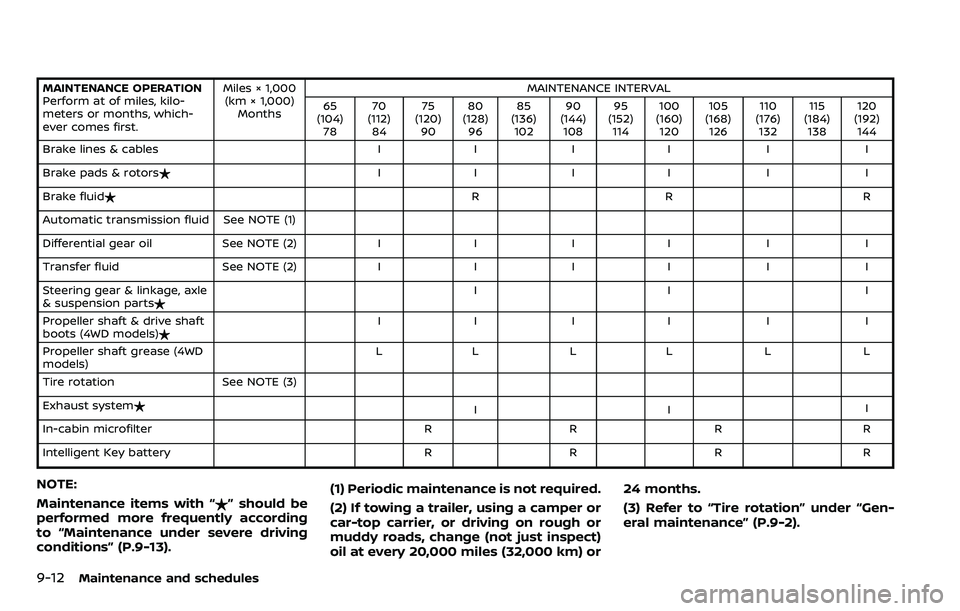
MAINTENANCE OPERATION
Perform at of miles, kilo-
meters or months, which-
ever comes first.Miles × 1,000
(km × 1,000) Months MAINTENANCE INTERVAL
65
(104) 78 70
(112) 84 75
(120) 90 80
(128) 96 85
(136) 102 90
(144) 108 95
(152) 114 100
(160) 120 105
(168) 126 110
(176) 132 115
(184) 138 120
(192) 144
Brake lines & cables II II I I
Brake pads & rotors$ II II I I
Brake fluid$ RR R
Automatic transmission fluid See NOTE (1)
Differential gear oil See NOTE (2)II II I I
Transfer fluid See NOTE (2)II II I I
Steering gear & linkage, axle
& suspension parts$ II I
Propeller shaft & drive shaft
boots (4WD models)$ II II I I
Propeller shaft grease (4WD
models) LL LL L L
Tire rotation See NOTE (3)
Exhaust system$ III
In-cabin microfilter RRR R
Intelligent Key battery RRR R
NOTE:
Maintenance items with “$” should be
performed more frequently according
to “Maintenance under severe driving
conditions” (P.9-13). (1) Periodic maintenance is not required.
(2) If towing a trailer, using a camper or
car-top carrier, or driving on rough or
muddy roads, change (not just inspect)
oil at every 20,000 miles (32,000 km) or24 months.
(3) Refer to “Tire rotation” under “Gen-
eral maintenance” (P.9-2).
Page 484 of 532
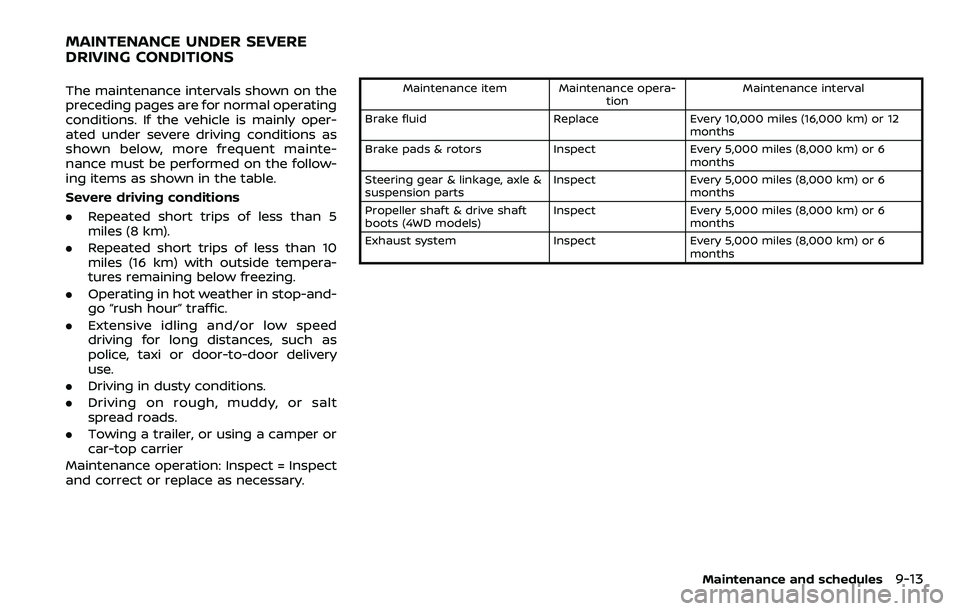
The maintenance intervals shown on the
preceding pages are for normal operating
conditions. If the vehicle is mainly oper-
ated under severe driving conditions as
shown below, more frequent mainte-
nance must be performed on the follow-
ing items as shown in the table.
Severe driving conditions
.Repeated short trips of less than 5
miles (8 km).
. Repeated short trips of less than 10
miles (16 km) with outside tempera-
tures remaining below freezing.
. Operating in hot weather in stop-and-
go “rush hour” traffic.
. Extensive idling and/or low speed
driving for long distances, such as
police, taxi or door-to-door delivery
use.
. Driving in dusty conditions.
. Driving on rough, muddy, or salt
spread roads.
. Towing a trailer, or using a camper or
car-top carrier
Maintenance operation: Inspect = Inspect
and correct or replace as necessary.Maintenance item Maintenance opera- tionMaintenance interval
Brake fluid ReplaceEvery 10,000 miles (16,000 km) or 12
months
Brake pads & rotors InspectEvery 5,000 miles (8,000 km) or 6
months
Steering gear & linkage, axle &
suspension parts Inspect
Every 5,000 miles (8,000 km) or 6
months
Propeller shaft & drive shaft
boots (4WD models) Inspect
Every 5,000 miles (8,000 km) or 6
months
Exhaust system InspectEvery 5,000 miles (8,000 km) or 6
months
Maintenance and schedules9-13
MAINTENANCE UNDER SEVERE
DRIVING CONDITIONS
Page 489 of 532
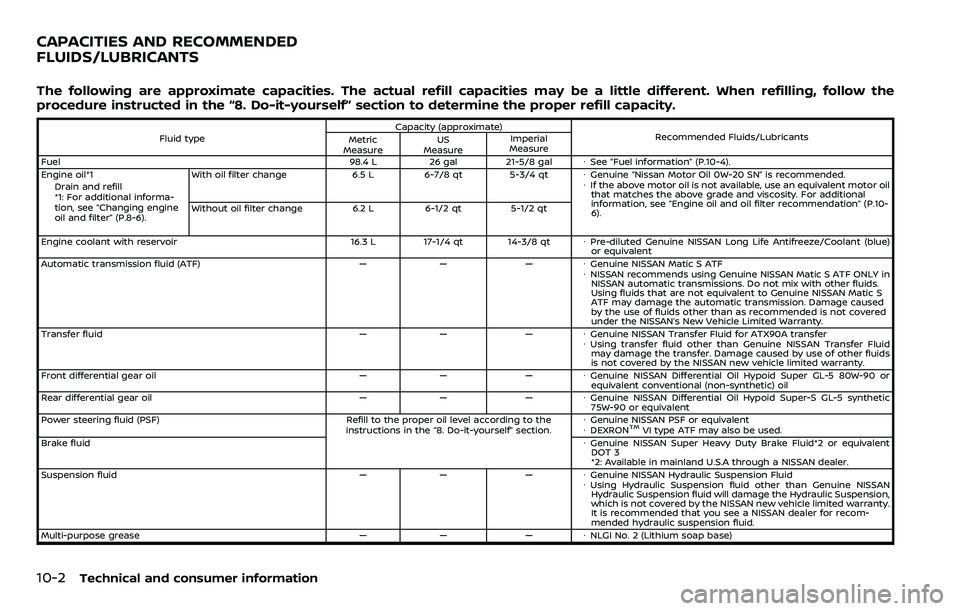
10-2Technical and consumer information
The following are approximate capacities. The actual refill capacities may be a little different. When refilling, follow the
procedure instructed in the “8. Do-it-yourself” section to determine the proper refill capacity.
Fluid typeCapacity (approximate)
Recommended Fluids/Lubricants
Metric
Measure US
Measure Imperial
Measure
Fuel 98.4 L 26 gal 21-5/8 gal ÂSee “Fuel information” (P.10-4).
Engine oil*1 With oil filter change 6.5 L6-7/8 qt 5-3/4 qtÂGenuine “Nissan Motor Oil 0W-20 SN” is recommended.
 If the above motor oil is not available, use an equivalent motor oil
that matches the above grade and viscosity. For additional
information, see “Engine oil and oil filter recommendation” (P.10-
6).
Drain and refill
*1: For additional informa-
tion, see “Changing engine
oil and filter” (P.8-6).
Without oil filter change
6.2 L6-1/2 qt 5-1/2 qt
Engine coolant with reservoir 16.3 L17-1/4 qt 14-3/8 qt ÂPre-diluted Genuine NISSAN Long Life Antifreeze/Coolant (blue)
or equivalent
Automatic transmission fluid (ATF) —— —ÂGenuine NISSAN Matic S ATF
 NISSAN recommends using Genuine NISSAN Matic S ATF ONLY in
NISSAN automatic transmissions. Do not mix with other fluids.
Using fluids that are not equivalent to Genuine NISSAN Matic S
ATF may damage the automatic transmission. Damage caused
by the use of fluids other than as recommended is not covered
under the NISSAN’s New Vehicle Limited Warranty.
Transfer fluid —— —ÂGenuine NISSAN Transfer Fluid for ATX90A transfer
 Using transfer fluid other than Genuine NISSAN Transfer Fluid
may damage the transfer. Damage caused by use of other fluids
is not covered by the NISSAN new vehicle limited warranty.
Front differential gear oil —— —ÂGenuine NISSAN Differential Oil Hypoid Super GL-5 80W-90 or
equivalent conventional (non-synthetic) oil
Rear differential gear oil —— —ÂGenuine NISSAN Differential Oil Hypoid Super-S GL-5 synthetic
75W-90 or equivalent
Power steering fluid (PSF) Refill to the proper oil level according to the
instructions in the “8. Do-it-yourself” section. Â
Genuine NISSAN PSF or equivalent
 DEXRON
TMVI type ATF may also be used.
Brake fluid ÂGenuine NISSAN Super Heavy Duty Brake Fluid*2 or equivalent
DOT 3
*2: Available in mainland U.S.A through a NISSAN dealer.
Suspension fluid —— —ÂGenuine NISSAN Hydraulic Suspension Fluid
 Using Hydraulic Suspension fluid other than Genuine NISSAN
Hydraulic Suspension fluid will damage the Hydraulic Suspension,
which is not covered by the NISSAN new vehicle limited warranty.
It is recommended that you see a NISSAN dealer for recom-
mended hydraulic suspension fluid.
Multi-purpose grease —— —ÂNLGI No. 2 (Lithium soap base)
CAPACITIES AND RECOMMENDED
FLUIDS/LUBRICANTS
Page 514 of 532
trailer lights while using the ve-
hicle tail light, stoplight and turn
signal circuits as a signal source.
The module/converter must draw
no more than 15 milliamps from
the stop and tail lamp circuits.
Using a module/converter that
exceeds these power require-
ments may damage the vehicle’s
electrical system. See a reputable
trailer retailer to obtain the prop-
er equipment and to have it
installed.
. Do not connect electrical devices
that draw more than 40 amps to
the vehicle. The fusible link may
melt.
Trailer lights should comply with federal
and/or local regulations. For assistance in
hooking up trailer lights, contact a NISSAN
dealer or reputable trailer retailer.
Trailer brakes
When towing a trailer load of 3,500 lbs.
(1,587 kg) or more, trailers with a brake
system MUST be used. However, most
states require a separate braking system
on trailers with a loaded weight above a
specific amount. Make sure the trailer
meets the local regulations and the
regulations where you plan to tow. Several types of braking systems are
available.
Surge Brakes -
The surge brake actuator
is mounted on the trailer tongue with a
hydraulic line running to each trailer
wheel. Surge brakes are activated by the
trailer pushing against the hitch ball
when the tow vehicle is braking. Hydraulic
surge brakes are common on rental
trailers and some boat trailers. In this
type of system, there is no hydraulic or
electric connection for brake operation
between the tow vehicle and the trailer.
Electric Trailer Brakes - Electric braking
systems are activated by an electronic
signal sent from a trailer brake controller
(special brake sensing module).
Have a professional supplier of towing
equipment make sure the trailer brakes
are properly installed and demonstrate
proper brake function testing.WARNING
Never connect a trailer brake system
directly to the vehicle brake system.
Pre-towing tips
. Be certain your vehicle maintains a
level position when a loaded or un-
loaded trailer is hitched. Do not drive
the vehicle if it has an abnormal nose-
up or nose-down condition; check for
improper tongue load, overload, worn
suspension or other possible causes
of either condition.
. Always secure items in the trailer to
prevent load shift while driving.
. Keep the cargo load as low as possible
in the trailer to keep the trailer center
of gravity low.
. Load the trailer so approximately 60%
of the trailer load is in the front half
and 40% is in the back half. Also make
sure the load is balanced side to side.
. Check your hitch, trailer tire pressure,
vehicle tire pressure, trailer light op-
eration, and trailer wheel lug nuts
every time you attach a trailer to the
vehicle.
. Be certain your rearview mirrors con-
form to all federal, state or local
regulations. If not, install any mirrors
required for towing before driving the
vehicle.
. Determine the overall height of the
vehicle and trailer so the required
clearance is known.
Technical and consumer information10-27