key battery NISSAN ARMADA 2021 Owner´s Manual
[x] Cancel search | Manufacturer: NISSAN, Model Year: 2021, Model line: ARMADA, Model: NISSAN ARMADA 2021Pages: 603, PDF Size: 3.16 MB
Page 283 of 603
fuel cut mode.
5. To stop the engine, shift the shift lever to the P (Park) position and push the
ignition switch to the OFF position.
In preparation for the next engine start,
the engine may have a slightly delayed
shutoff after placing the ignition switch in
the OFF position, depending on the driv-
ing conditions.
NOTE:
Care should be taken to avoid situations
that can lead to potential battery dis-
charge and potential no-start condi-
tions such as:
1. Installation or extended use of elec-
tronic accessories that consume
battery power when the engine is
not running (Phone chargers, GPS,
DVD players, etc.)
2. Vehicle is not driven regularly and/
or only driven short distances.
In these cases, the battery may need to
be charged to maintain battery health.
REMOTE ENGINE START (if so
equipped)
Vehicles started with the remote engine
start function require the ignition switch
to be placed in the ON position before the
shift lever can be moved from the P (Park)
position. To place the ignition switch in the ON position, perform the following
steps:
1. Make sure that the Intelligent Key is
on you.
2. Firmly depress the brake pedal.
3. Push the ignition switch once to the ON position.
For additional information about the
remote engine start function, see “Re-
mote engine start” (P.3-19).
ENGINE PROTECTION MODE
The engine has an engine protection
mode to reduce the chance of damage
if the coolant temperature becomes too
high (for example, when climbing steep
grades in high temperature with heavy
loads, such as when towing a trailer).
When the engine temperature reaches a
certain level:
. The engine coolant temperature
gauge will move toward the H posi-
tion.
. Engine power may be reduced.
. The air conditioning cooling function
may be automatically turned OFF for a
short time (the blower will continue to
operate).
Engine power and, under some condi-
tions, vehicle speed will decrease. Vehicle
speed can be controlled with the accel-
erator pedal, but the vehicle may not
accelerate at the desired speed. The
transmission will downshift or upshift as
it reaches prescribed shift points. You can
also shift manually.
As driving conditions change and engine
coolant temperature is reduced, vehicle
speed can be increased using the accel-
erator pedal, and air conditioning cooling
function will automatically be turned
back ON.
Starting and driving5-17
DRIVING THE VEHICLE
Page 412 of 603
5-146Starting and driving
SIC4455
VEHICLE DYNAMIC CONTROL (VDC)
OFF SWITCH
The vehicle should be driven with the
Vehicle Dynamic Control (VDC) system ON
for most driving conditions.
When the vehicle is stuck in mud or snow,
the VDC system reduces the engine out-
put to reduce wheel spin. The engine
speed will be reduced even if the accel-
erator is depressed to the floor. If max-
imum engine power is needed to free a
stuck vehicle, turn the VDC system off.
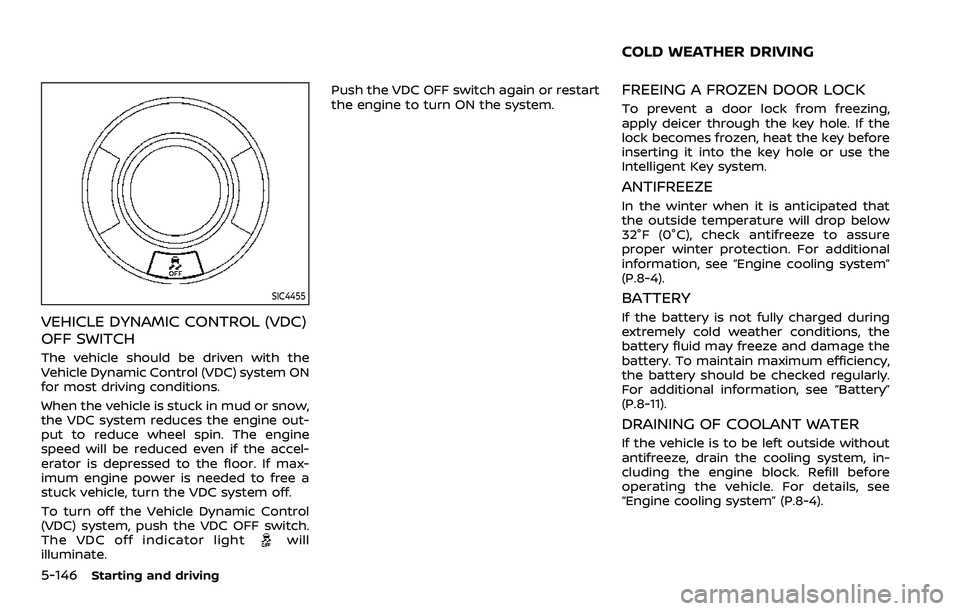
To turn off the Vehicle Dynamic Control
(VDC) system, push the VDC OFF switch.
The VDC off indicator light
will
illuminate. Push the VDC OFF switch again or restart
the engine to turn ON the system.
FREEING A FROZEN DOOR LOCK
To prevent a door lock from freezing,
apply deicer through the key hole. If the
lock becomes frozen, heat the key before
inserting it into the key hole or use the
Intelligent Key system.
ANTIFREEZE
In the winter when it is anticipated that
the outside temperature will drop below
32°F (0°C), check antifreeze to assure
proper winter protection. For additional
information, see “Engine cooling system”
(P.8-4).
BATTERY
If the battery is not fully charged during
extremely cold weather conditions, the
battery fluid may freeze and damage the
battery. To maintain maximum efficiency,
the battery should be checked regularly.
For additional information, see “Battery”
(P.8-11).
DRAINING OF COOLANT WATER
If the vehicle is to be left outside without
antifreeze, drain the cooling system, in-
cluding the engine block. Refill before
operating the vehicle. For details, see
“Engine cooling system” (P.8-4).
COLD WEATHER DRIVING
Page 447 of 603
8 Do-it-yourself
Maintenance precautions ...................................................... 8-2
Engine compartment check locations ........................ 8-3VK56VD engine ....................................................................... 8-3
Engine cooling system ............................................................. 8-4 Checking engine coolant level .................................... 8-5
Changing engine coolant ................................................ 8-5
Engine oil ........................................................................\
..................... 8-6 Checking engine oil level ................................................. 8-6
Changing engine oil and filter ..................................... 8-6
Automatic Transmission Fluid (ATF) ............................. 8-8
Power steering fluid ................................................................... 8-8
Brake fluid ........................................................................\
.................. 8-9
Window washer fluid .............................................................. 8-10
Battery ........................................................................\
........................ 8-11 Jump starting ........................................................................\
. 8-13
Variable voltage control system ................................... 8-13
Drive belts ........................................................................\
................ 8-13
Spark plugs ........................................................................\
............. 8-14 Replacing spark plugs ..................................................... 8-14
Air cleaner ........................................................................\
............... 8-15 Windshield wiper blades ..................................................... 8-16
Cleaning ........................................................................\
........... 8-16
Replacing ........................................................................\
........ 8-16
Rear window wiper blades ............................................... 8-17
Brakes ........................................................................\
........................ 8-17 Self-adjusting brakes ..................................................... 8-17
Brake pad wear warning ............................................ 8-17
Brake booster ...................................................................... 8-17
Fuses ........................................................................\
........................... 8-18 Engine compartment .................................................... 8-18
Passenger compartment ........................................... 8-20
Intelligent Key battery replacement .......................... 8-21
Lights ........................................................................\
.......................... 8-24
Headlights ........................................................................\
...... 8-26
Exterior and interior lights ........................................ 8-26
Wheels and tires ........................................................................\
8-28
Tire pressure ........................................................................\
8-28
Tire labeling ........................................................................\
.. 8-32
Types of tires ....................................................................... 8-34
Tire chains ........................................................................\
...... 8-35
Changing wheels and tires ...................................... 8-36
Page 448 of 603
8-2Do-it-yourself
When performing any inspection or main-
tenance work on your vehicle, always
take care to prevent serious accidental
injury to yourself or damage to the
vehicle. The following are general precau-
tions which should be closely observed.
WARNING
.Park the vehicle on a level sur-
face, apply the parking brake
securely and block the wheels to
prevent the vehicle from moving.
Move the shift lever to P (Park).
. Be sure the ignition switch is in
the OFF or LOCK position when
performing any parts replace-
ment or repairs.
. Never connect or disconnect the
battery or any transistorized
component while the ignition
switch is in the ON position.
. Never leave the engine or auto-
matic transmission related com-
ponent harnesses disconnected
while the ignition switch is in the
ON position.
. If you must work with the engine
running, keep your hands, cloth-
ing, hair and tools away from
moving fans, belts and any other moving parts.
. It is advisable to secure or re-
move any loose clothing and
remove any jewelry, such as
rings, watches, etc. before work-
ing on your vehicle.
. Always wear eye protection
whenever you work on your ve-
hicle.
. If you must run the engine in an
enclosed space such as a garage,
be sure there is proper ventilation
for exhaust gases to escape.
. Never get under the vehicle while
it is supported only by a jack. If it
is necessary to work under the
vehicle, support it with safety
stands.
. Keep smoking materials, flame
and sparks away from fuel tank
and the battery.
. Your vehicle is equipped with an
automatic engine cooling fan. It
may come on at any time without
warning, even if the ignition key is
in the OFF position and the en-
gine is not running. To avoid
injury, always disconnect the ne-
gative battery cable before work-
ing near the fan. .
Because the fuel lines are under
high pressure even when the
engine is off, it is recommended
you visit a NISSAN dealer for
service of the fuel filter or fuel
lines.
CAUTION
.Do not work under the hood while
the engine is hot. Turn the engine
off and wait until it cools down.
. Avoid direct contact with used
engine oil and coolant. Impro-
perly disposed engine oil, coolant,
and/or other vehicle fluids can
damage the environment. Always
conform to local regulations for
disposal of vehicle fluid.
This “8. Do-it-yourself” section gives in-
structions regarding only those items
which are relatively easy for an owner to
perform.
A genuine NISSAN Service Manual is also
available. (See “Owner’s Manual/Service
Manual order information” (P.10-40).)
You should be aware that incomplete or
improper servicing may result in operat-
ing difficulties or excessive emissions, and
MAINTENANCE PRECAUTIONS
Page 467 of 603

SDI2704
Extended storage fuse switch (if so
equipped)
To reduce battery drain, the extended
storage fuse switch comes from the
factory switched off. Prior to delivery of
your vehicle, the switch is pushed in
(switched on) and should always remain
on.
If the extended storage fuse switch is not
pushed in (switched on), the “Shipping
Mode On, Push Storage Fuse” warning
may appear on the vehicle information
display (if so equipped). See “Vehicle
information display” (P.2-19).
If any electrical equipment does not
operate, remove the extended storagefuse switch and check for an open fuse.
NOTE:
If the extended storage fuse switch
malfunctions or if the fuse is open, it is
not necessary to replace the switch. In
this case, remove the extended storage
fuse switch and replace it with a new
fuse of the same rating.
How to remove the extended storage
fuse switch:
1. To remove the extended storage fuse
switch, be sure the ignition switch is in
the OFF or LOCK position.
2. Be sure the headlight switch is in the OFF position.
3. Remove the fuse box cover.
4. Pinch the locking tabsfound on
each side of the storage fuse switch.
5. Pull the storage fuse switch straight out from the fuse box
.
CAUTION
Be careful not to allow children to
swallow the battery and removed
parts.
Do-it-yourself8-21
INTELLIGENT KEY BATTERY REPLACEMENT
Page 468 of 603

8-22Do-it-yourself
SDI2451
Replace the battery as follows:
1. Release the lock knob at the back ofthe Intelligent Key and remove the
mechanical key.
2. Insert a small screwdriver into the slit of the corner and twist it to separate
the upper part from the lower part. Use a cloth to protect the casing.
3. Replace the battery with a new one. Recommended battery: CR2025 or
equivalent.
.Do not touch the internal circuitand electric terminals as it could
cause a malfunction.
.Hold the battery by the edges.
Holding the battery across the
contact points will seriously deplete
the storage capacity.
.Make sure that the + side faces the bottom of the case.
SDI2452
4. Align the tips of the upper and lower
parts, and then push them together
until it is securely closed.
5. Push the buttons two or three times to check its operation.
If you need any assistance for replace-
ment, it is recommended you visit a
NISSAN dealer for this service.
FCC Notice:
For USA:
This device complies with Part 15 of the
FCC Rules. Operation is subject to the
following two conditions: (1) This device
may not cause harmful interference,
and (2) this device must accept any
interference received, including inter-
Page 496 of 603
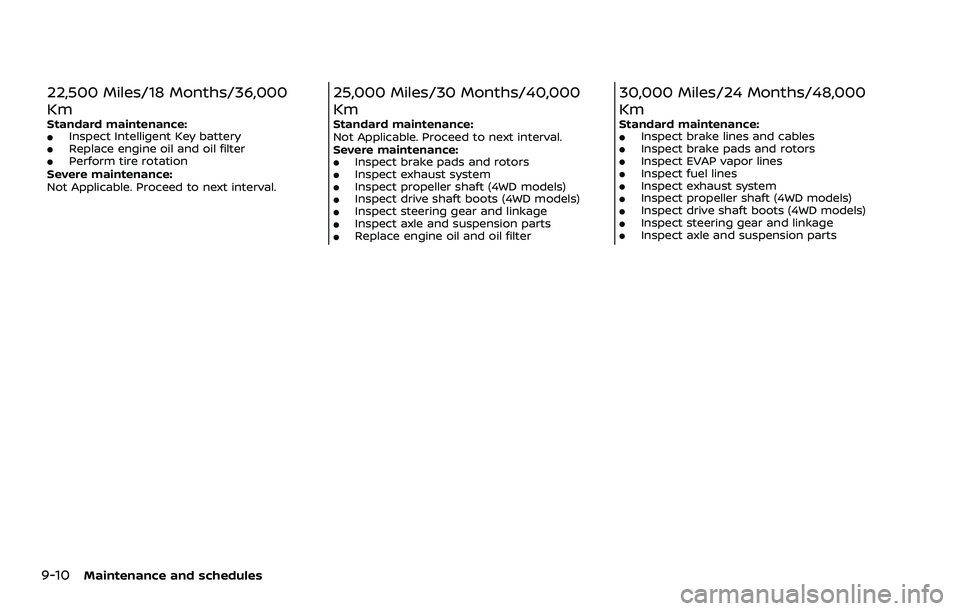
9-10Maintenance and schedules
22,500 Miles/18 Months/36,000
Km
Standard maintenance:.Inspect Intelligent Key battery.Replace engine oil and oil filter.Perform tire rotation
Severe maintenance:
Not Applicable. Proceed to next interval.
25,000 Miles/30 Months/40,000
Km
Standard maintenance:
Not Applicable. Proceed to next interval.
Severe maintenance:
.Inspect brake pads and rotors.Inspect exhaust system.Inspect propeller shaft (4WD models).Inspect drive shaft boots (4WD models).Inspect steering gear and linkage.Inspect axle and suspension parts.Replace engine oil and oil filter
30,000 Miles/24 Months/48,000
Km
Standard maintenance:.Inspect brake lines and cables.Inspect brake pads and rotors.Inspect EVAP vapor lines.Inspect fuel lines.Inspect exhaust system.Inspect propeller shaft (4WD models).Inspect drive shaft boots (4WD models).Inspect steering gear and linkage.Inspect axle and suspension parts
Page 498 of 603
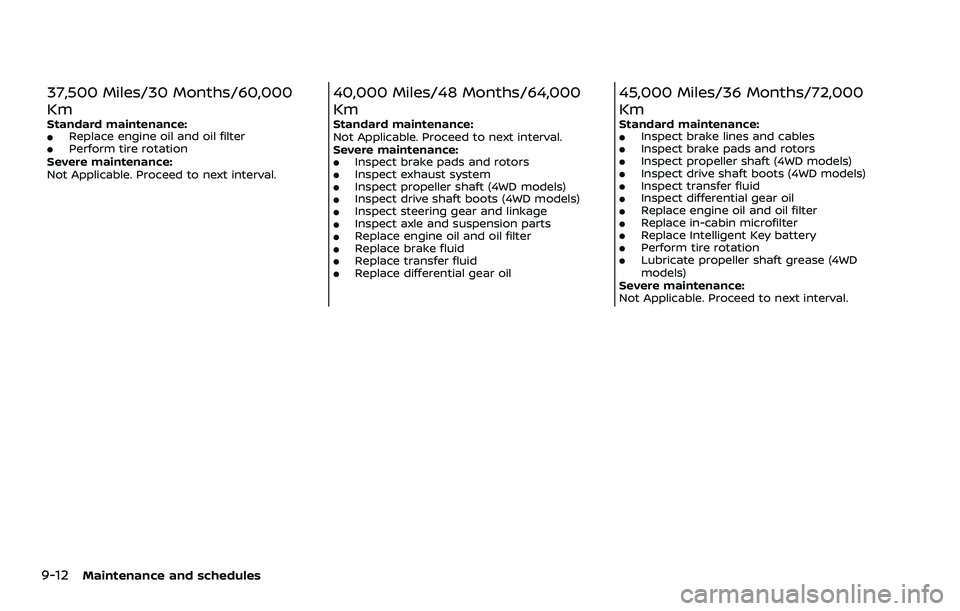
9-12Maintenance and schedules
37,500 Miles/30 Months/60,000
Km
Standard maintenance:.Replace engine oil and oil filter.Perform tire rotation
Severe maintenance:
Not Applicable. Proceed to next interval.
40,000 Miles/48 Months/64,000
Km
Standard maintenance:
Not Applicable. Proceed to next interval.
Severe maintenance:
.Inspect brake pads and rotors.Inspect exhaust system.Inspect propeller shaft (4WD models).Inspect drive shaft boots (4WD models).Inspect steering gear and linkage.Inspect axle and suspension parts.Replace engine oil and oil filter.Replace brake fluid.Replace transfer fluid.Replace differential gear oil
45,000 Miles/36 Months/72,000
Km
Standard maintenance:.Inspect brake lines and cables.Inspect brake pads and rotors.Inspect propeller shaft (4WD models).Inspect drive shaft boots (4WD models).Inspect transfer fluid.Inspect differential gear oil.Replace engine oil and oil filter.Replace in-cabin microfilter.Replace Intelligent Key battery.Perform tire rotation.Lubricate propeller shaft grease (4WD
models)
Severe maintenance:
Not Applicable. Proceed to next interval.
Page 501 of 603

60,000 Miles/72 Months/96,000
Km
Standard maintenance:
Not Applicable. Proceed to next interval.
Severe maintenance:
.Inspect brake pads and rotors.Inspect exhaust system.Inspect propeller shaft (4WD models).Inspect drive shaft boots (4WD models).Inspect steering gear and linkage.Inspect axle and suspension parts.Replace engine oil and oil filter.Replace brake fluid.Replace transfer fluid.Replace differential gear oil
65,000 Miles/78 Months/104,000
Km
Standard maintenance:
Not Applicable. Proceed to next interval.
Severe maintenance:
.Inspect brake pads and rotors.Inspect exhaust system.Inspect propeller shaft (4WD models).Inspect drive shaft boots (4WD models).Inspect steering gear and linkage.Inspect axle and suspension parts.Replace engine oil and oil filter
67,500 Miles/54 Months/108,000
Km
Standard maintenance:.Replace engine oil and oil filter.Replace Intelligent Key battery.Perform tire rotation
Severe maintenance:
Not Applicable. Proceed to next interval.
Maintenance and schedules9-15
Page 504 of 603
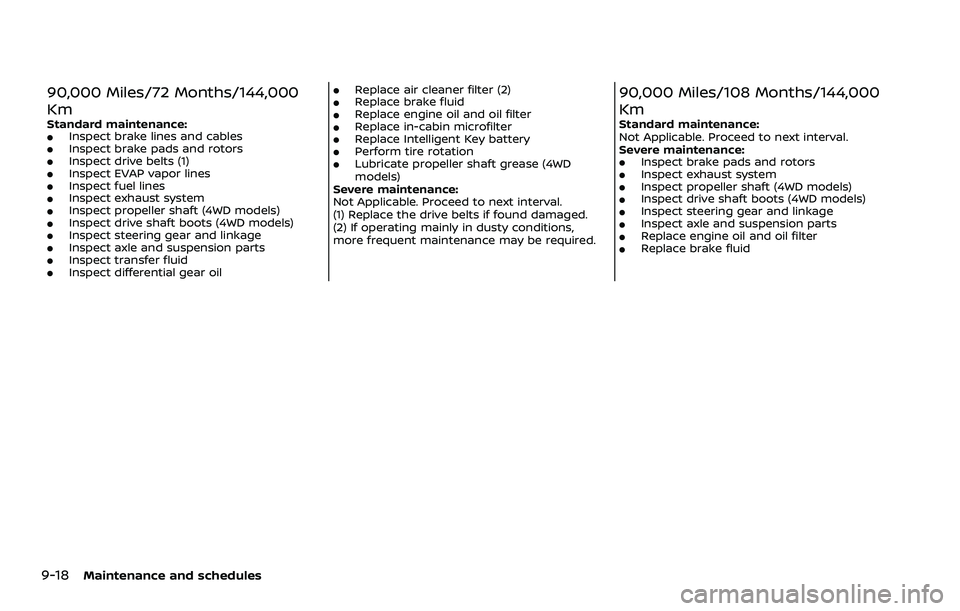
9-18Maintenance and schedules
90,000 Miles/72 Months/144,000
Km
Standard maintenance:.Inspect brake lines and cables.Inspect brake pads and rotors.Inspect drive belts (1).Inspect EVAP vapor lines.Inspect fuel lines.Inspect exhaust system.Inspect propeller shaft (4WD models).Inspect drive shaft boots (4WD models).Inspect steering gear and linkage.Inspect axle and suspension parts.Inspect transfer fluid.Inspect differential gear oil
.Replace air cleaner filter (2).Replace brake fluid.Replace engine oil and oil filter.Replace in-cabin microfilter.Replace Intelligent Key battery.Perform tire rotation.Lubricate propeller shaft grease (4WD
models)
Severe maintenance:
Not Applicable. Proceed to next interval.
(1) Replace the drive belts if found damaged.
(2) If operating mainly in dusty conditions,
more frequent maintenance may be required.
90,000 Miles/108 Months/144,000
Km
Standard maintenance:
Not Applicable. Proceed to next interval.
Severe maintenance:
.Inspect brake pads and rotors.Inspect exhaust system.Inspect propeller shaft (4WD models).Inspect drive shaft boots (4WD models).Inspect steering gear and linkage.Inspect axle and suspension parts.Replace engine oil and oil filter.Replace brake fluid