warning NISSAN FRONTIER 1997 D22 / 1.G Owner's Manual
[x] Cancel search | Manufacturer: NISSAN, Model Year: 1997, Model line: FRONTIER, Model: NISSAN FRONTIER 1997 D22 / 1.GPages: 204, PDF Size: 1.45 MB
Page 35 of 204
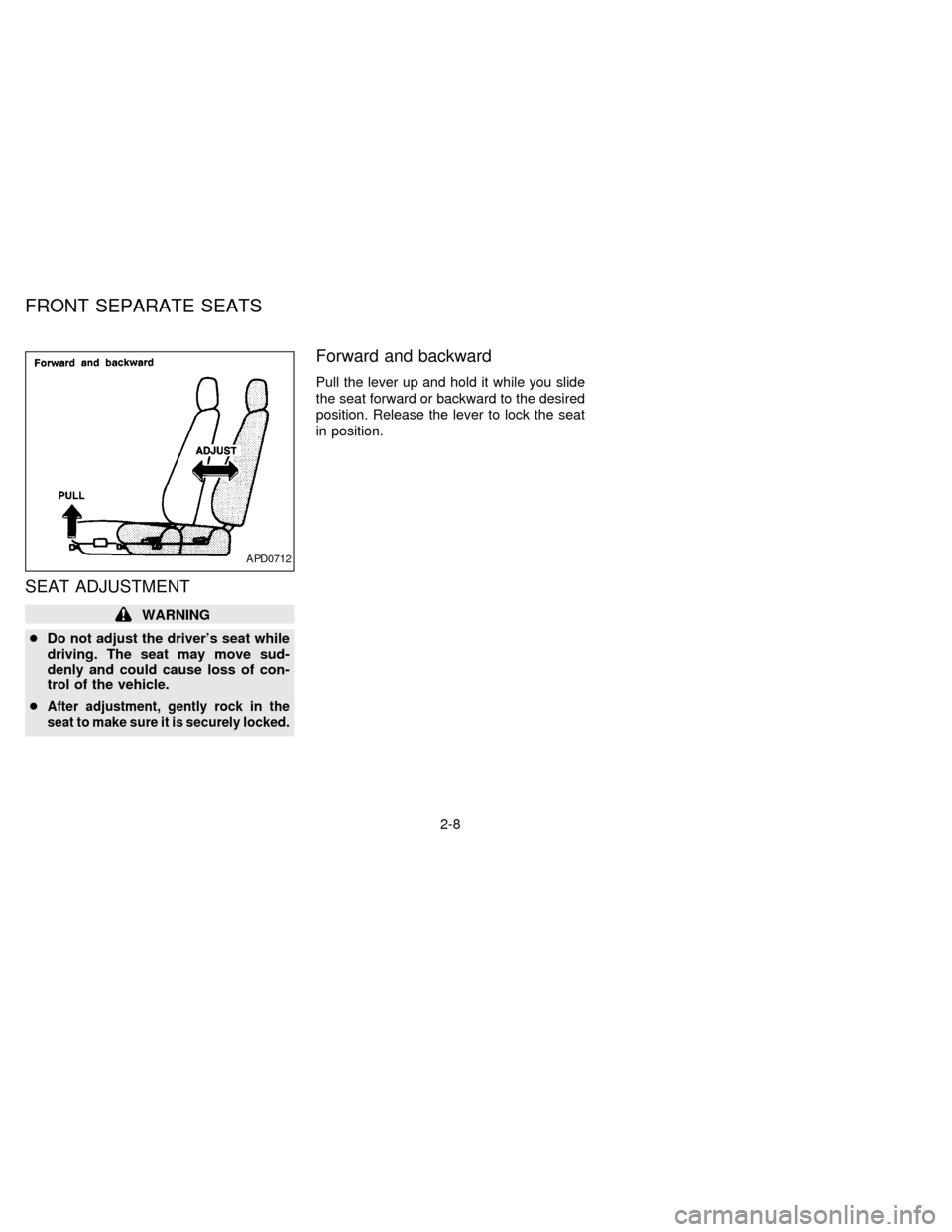
SEAT ADJUSTMENT
WARNING
cDo not adjust the driver's seat while
driving. The seat may move sud-
denly and could cause loss of con-
trol of the vehicle.
c
After adjustment, gently rock in the
seat to make sure it is securely locked.
Forward and backward
Pull the lever up and hold it while you slide
the seat forward or backward to the desired
position. Release the lever to lock the seat
in position.
APD0712
FRONT SEPARATE SEATS
2-8
ZX
Page 36 of 204
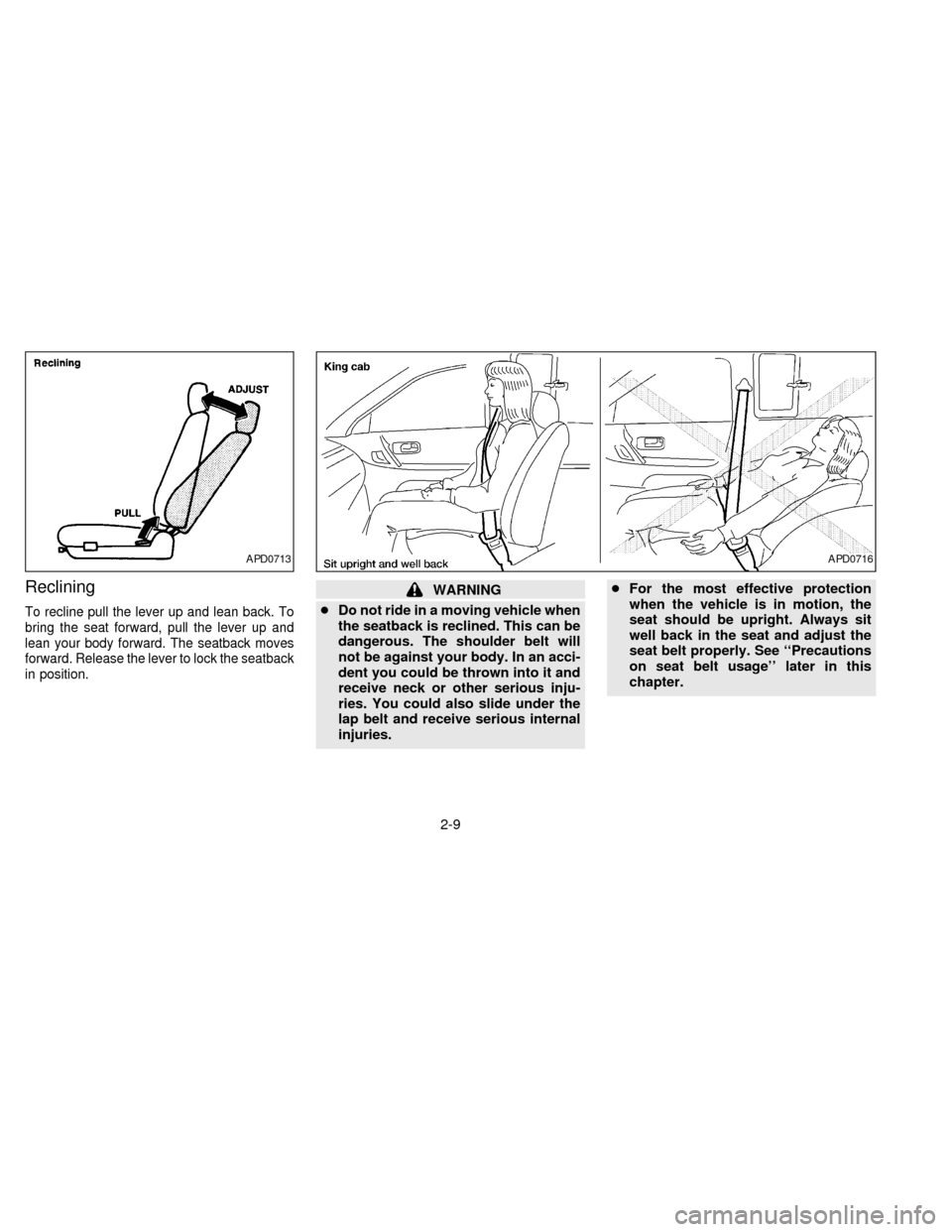
Reclining
To recline pull the lever up and lean back. To
bring the seat forward, pull the lever up and
lean your body forward. The seatback moves
forward. Release the lever to lock the seatback
in position.
WARNING
cDo not ride in a moving vehicle when
the seatback is reclined. This can be
dangerous. The shoulder belt will
not be against your body. In an acci-
dent you could be thrown into it and
receive neck or other serious inju-
ries. You could also slide under the
lap belt and receive serious internal
injuries.cFor the most effective protection
when the vehicle is in motion, the
seat should be upright. Always sit
well back in the seat and adjust the
seat belt properly. See ``Precautions
on seat belt usage'' later in this
chapter.
APD0713APD0716
2-9
ZX
Page 38 of 204
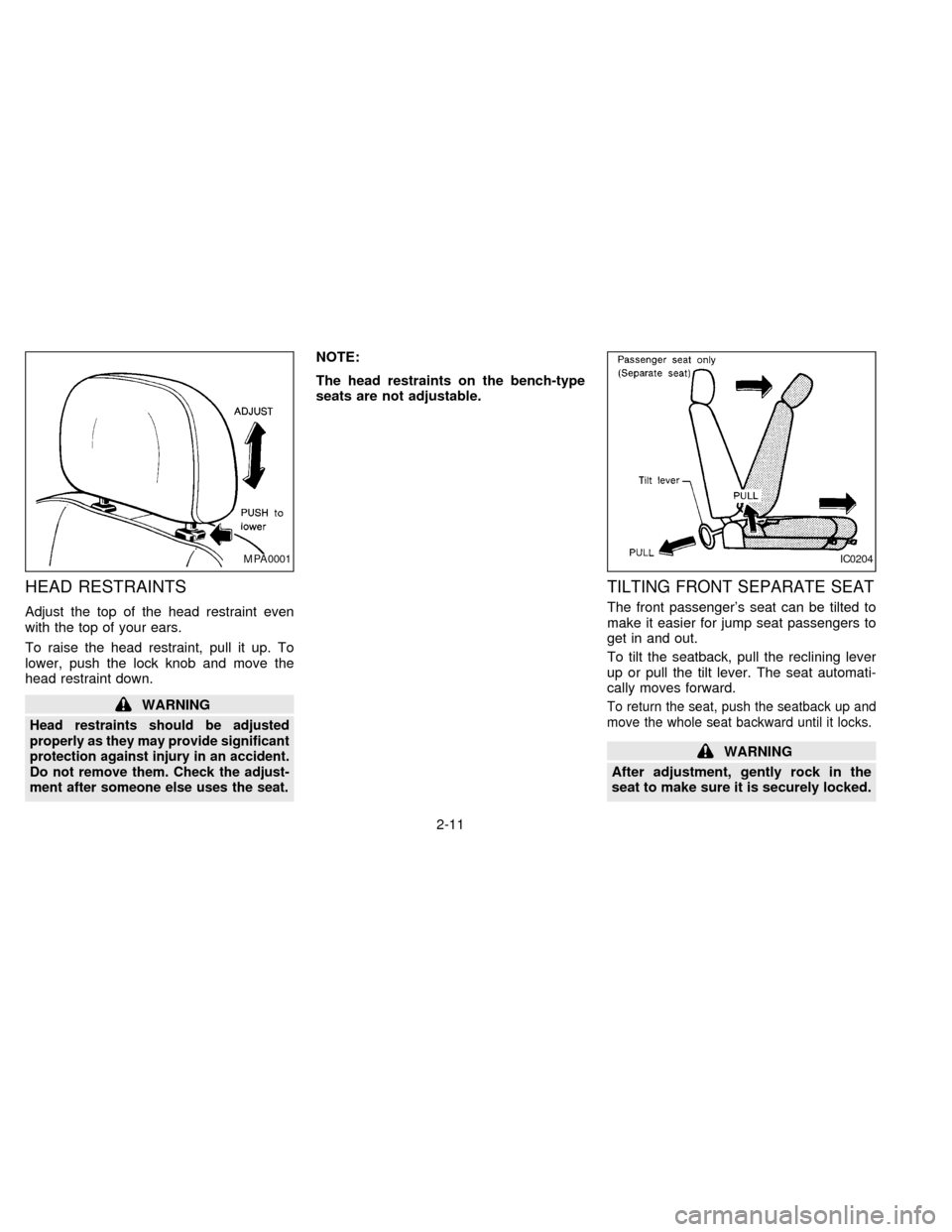
HEAD RESTRAINTS
Adjust the top of the head restraint even
with the top of your ears.
To raise the head restraint, pull it up. To
lower, push the lock knob and move the
head restraint down.
WARNING
Head restraints should be adjusted
properly as they may provide significant
protection against injury in an accident.
Do not remove them. Check the adjust-
ment after someone else uses the seat.
NOTE:
The head restraints on the bench-type
seats are not adjustable.
TILTING FRONT SEPARATE SEAT
The front passenger's seat can be tilted to
make it easier for jump seat passengers to
get in and out.
To tilt the seatback, pull the reclining lever
up or pull the tilt lever. The seat automati-
cally moves forward.
To return the seat, push the seatback up and
move the whole seat backward until it locks.
WARNING
After adjustment, gently rock in the
seat to make sure it is securely locked.
MPA0001IC0204
2-11
ZX
Page 39 of 204
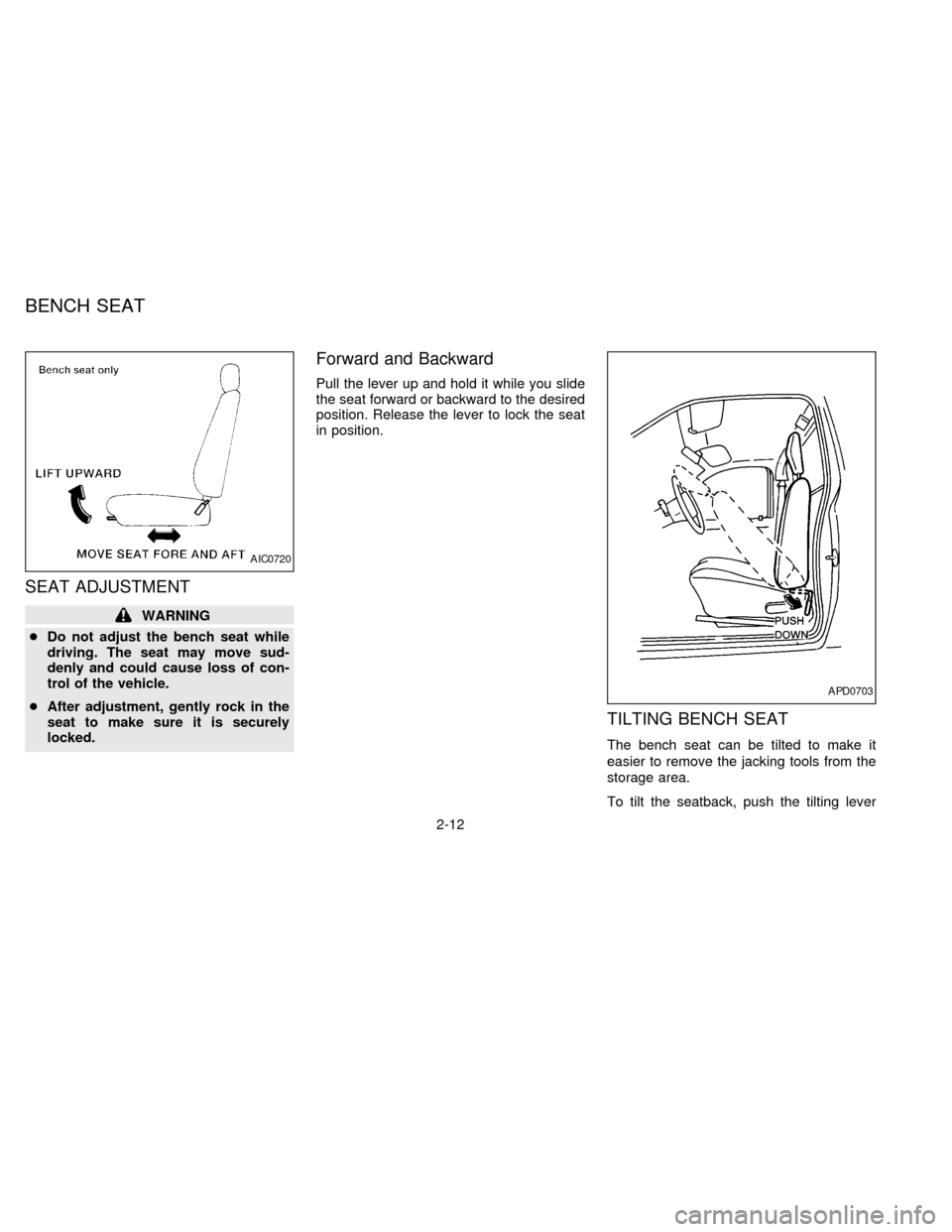
SEAT ADJUSTMENT
WARNING
cDo not adjust the bench seat while
driving. The seat may move sud-
denly and could cause loss of con-
trol of the vehicle.
cAfter adjustment, gently rock in the
seat to make sure it is securely
locked.
Forward and Backward
Pull the lever up and hold it while you slide
the seat forward or backward to the desired
position. Release the lever to lock the seat
in position.
TILTING BENCH SEAT
The bench seat can be tilted to make it
easier to remove the jacking tools from the
storage area.
To tilt the seatback, push the tilting lever
AIC0720
APD0703
BENCH SEAT
2-12
ZX
Page 40 of 204
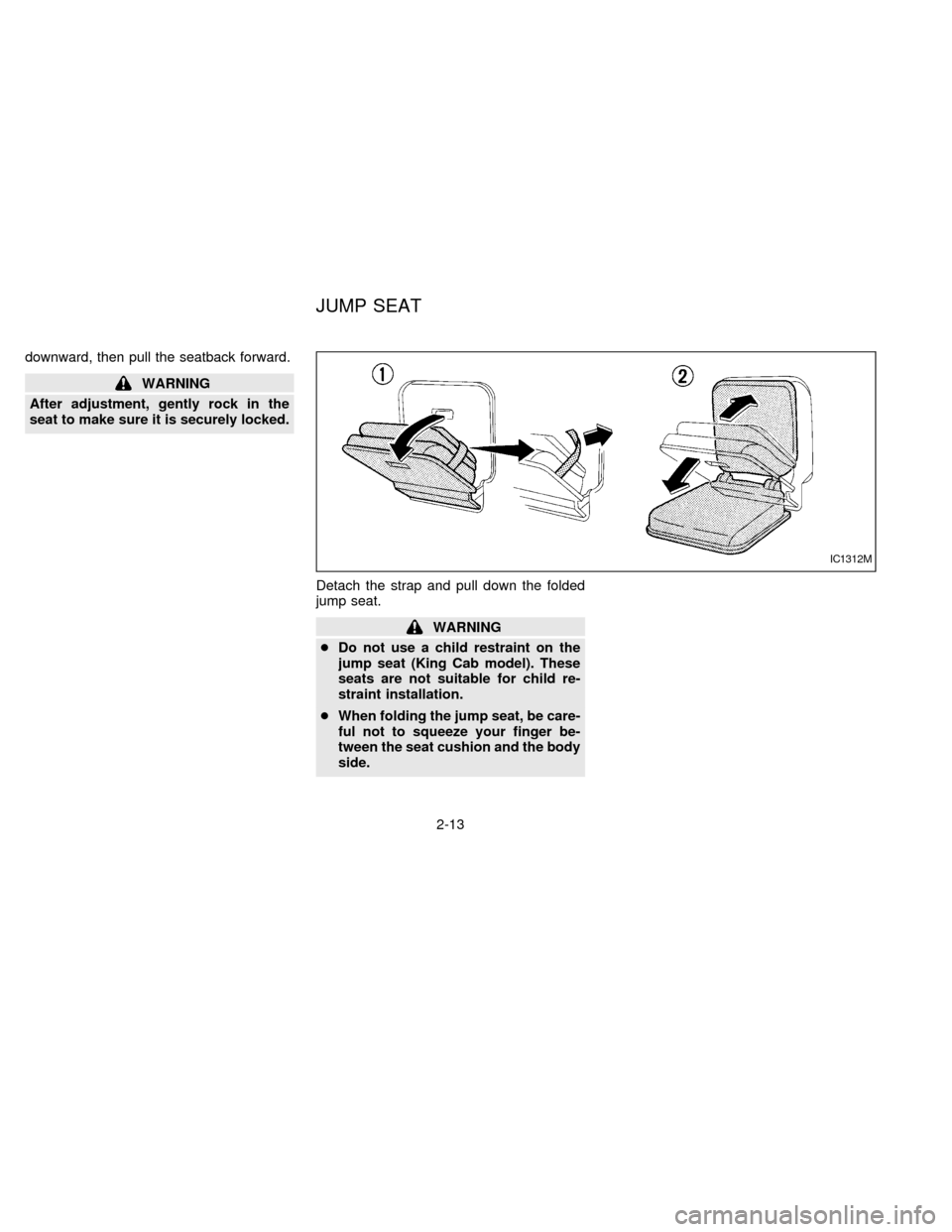
downward, then pull the seatback forward.
WARNING
After adjustment, gently rock in the
seat to make sure it is securely locked.
Detach the strap and pull down the folded
jump seat.
WARNING
cDo not use a child restraint on the
jump seat (King Cab model). These
seats are not suitable for child re-
straint installation.
cWhen folding the jump seat, be care-
ful not to squeeze your finger be-
tween the seat cushion and the body
side.
IC1312M
JUMP SEAT
2-13
ZX
Page 41 of 204
This Supplemental Restraint System sec-
tion contains important information concern-
ing the driver's supplemental air bag. The
Supplemental Restraint System Air Bag can
help reduce impact force to the driver in
certain frontal collisions. The supplemental
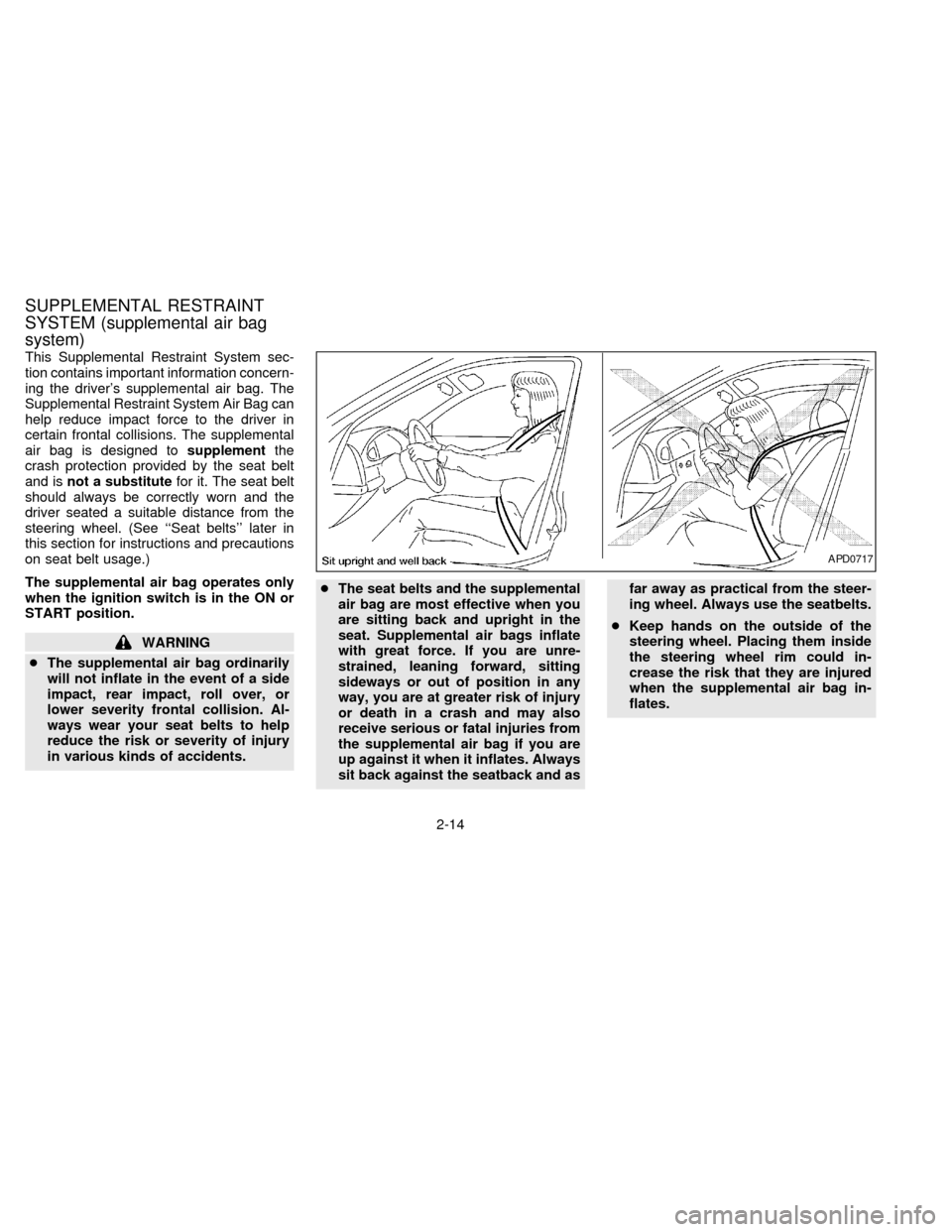
air bag is designed tosupplementthe
crash protection provided by the seat belt
and isnot a substitutefor it. The seat belt
should always be correctly worn and the
driver seated a suitable distance from the
steering wheel. (See ``Seat belts'' later in
this section for instructions and precautions
on seat belt usage.)
The supplemental air bag operates only
when the ignition switch is in the ON or
START position.
WARNING
cThe supplemental air bag ordinarily
will not inflate in the event of a side
impact, rear impact, roll over, or
lower severity frontal collision. Al-
ways wear your seat belts to help
reduce the risk or severity of injury
in various kinds of accidents.cThe seat belts and the supplemental
air bag are most effective when you
are sitting back and upright in the
seat. Supplemental air bags inflate
with great force. If you are unre-
strained, leaning forward, sitting
sideways or out of position in any
way, you are at greater risk of injury
or death in a crash and may also
receive serious or fatal injuries from
the supplemental air bag if you are
up against it when it inflates. Always
sit back against the seatback and asfar away as practical from the steer-
ing wheel. Always use the seatbelts.
cKeep hands on the outside of the
steering wheel. Placing them inside
the steering wheel rim could in-
crease the risk that they are injured
when the supplemental air bag in-
flates.
APD0717
SUPPLEMENTAL RESTRAINT
SYSTEM (supplemental air bag
system)
2-14
ZX
Page 42 of 204
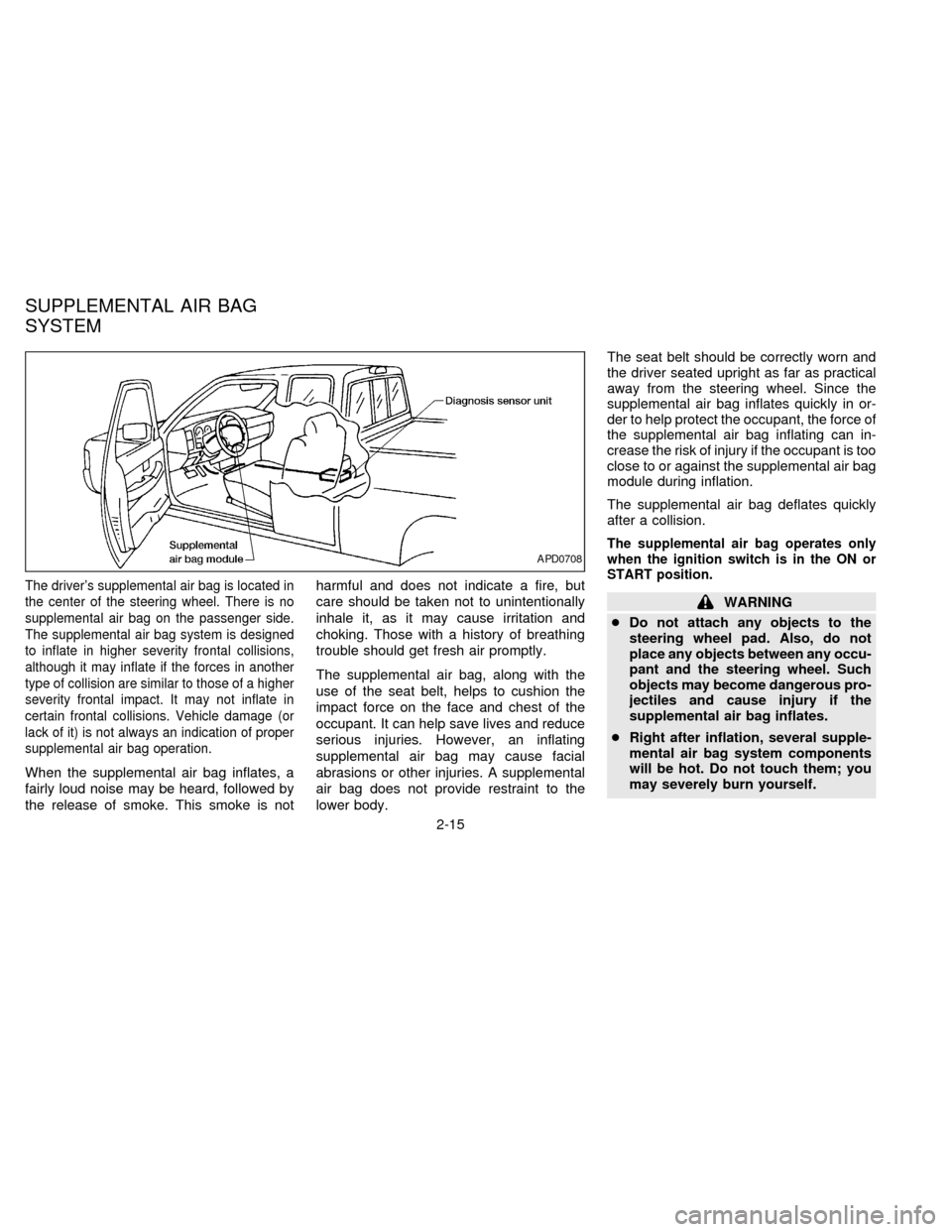
The driver's supplemental air bag is located in
the center of the steering wheel. There is no
supplemental air bag on the passenger side.
The supplemental air bag system is designed
to inflate in higher severity frontal collisions,
although it may inflate if the forces in another
type of collision are similar to those of a higher
severity frontal impact. It may not inflate in
certain frontal collisions. Vehicle damage (or
lack of it) is not always an indication of proper
supplemental air bag operation.
When the supplemental air bag inflates, a
fairly loud noise may be heard, followed by
the release of smoke. This smoke is notharmful and does not indicate a fire, but
care should be taken not to unintentionally
inhale it, as it may cause irritation and
choking. Those with a history of breathing
trouble should get fresh air promptly.
The supplemental air bag, along with the
use of the seat belt, helps to cushion the
impact force on the face and chest of the
occupant. It can help save lives and reduce
serious injuries. However, an inflating
supplemental air bag may cause facial
abrasions or other injuries. A supplemental
air bag does not provide restraint to the
lower body.The seat belt should be correctly worn and
the driver seated upright as far as practical
away from the steering wheel. Since the
supplemental air bag inflates quickly in or-
der to help protect the occupant, the force of
the supplemental air bag inflating can in-
crease the risk of injury if the occupant is too
close to or against the supplemental air bag
module during inflation.
The supplemental air bag deflates quickly
after a collision.
The supplemental air bag operates only
when the ignition switch is in the ON or
START position.
WARNING
cDo not attach any objects to the
steering wheel pad. Also, do not
place any objects between any occu-
pant and the steering wheel. Such
objects may become dangerous pro-
jectiles and cause injury if the
supplemental air bag inflates.
cRight after inflation, several supple-
mental air bag system components
will be hot. Do not touch them; you
may severely burn yourself.
APD0708
SUPPLEMENTAL AIR BAG
SYSTEM
2-15
ZX
Page 44 of 204

Warning labels about the supplemental air
bag system are placed in the vehicle as
shown in the illustration.The supplemental air bag warning light,
displaying AIR BAG in the instrument panel,
monitors the circuits of the supplemental air
bag. The circuits monitored by the supple-
mental air bag warning light are the diagno-
sis sensor unit, the supplemental air bag
module and all related wiring.
When the ignition key is in the ON or START
position, the supplemental air bag warning
light illuminates for about 7 seconds and
then turns off. This means the system is
operational.
If any of the following conditions occur, the
supplemental air bag needs servicing and
APD0705APD0706
WARNING LABELS SUPPLEMENTAL AIR BAG
WARNING LIGHT
2-17
ZX
Page 45 of 204
should be taken to your nearest authorized
NISSAN dealer:
1. The supplemental air bag warning light
does not come on and remain on for 7
seconds and then go off as described
above.
2. The supplemental air bag warning light
flashes intermittently or remains on.
3. The supplemental air bag warning light
does not come on at all.
Under these conditions, the Supplemental
Restraint System (supplemental air bag
system) may not function properly. It must
be checked and repaired.
WARNING
If the supplemental air bag warning
light is on, it could mean that the
supplemental air bag will not operate in
an accident.
Repair and replacement procedure
The supplemental air bag system is de-
signed to inflate on a one-time-only basis.
As a reminder, unless it is damaged, the
supplemental air bag warning light remainsilluminated after inflation has occurred.
Repair and replacement of the supplemen-
tal air bag system should be done only by
an authorized NISSAN dealer.
To ensure long-term functioning, the
system must be inspected 10 years after
the date of manufacture noted on the
certification label located on the driver
side front pillar.
When maintenance work is required on the
vehicle, the supplemental air bag system
and related parts should be pointed out to
the person conducting the maintenance.
The ignition key must always be in the LOCK
position when working under the hood or
inside the vehicle.
WARNING
cOnce the supplemental air bag in-
flates, the supplemental air bag
module will not function again and
should be replaced by an authorized
NISSAN dealer. The supplemental air
bag module cannot be repaired.cThe supplemental air bag system
should be inspected by an autho-
rized NISSAN dealer if there is any
damage to the front end portion of
the vehicle.
cIf you need to dispose of the supple-
mental air bag or scrap the vehicle,
contact an authorized NISSAN
dealer. Correct supplemental air bag
disposal procedures are set forth in
the appropriate NISSAN Service
Manual. Incorrect disposal proce-
dures could cause personal injury.
2-18
ZX
Page 46 of 204
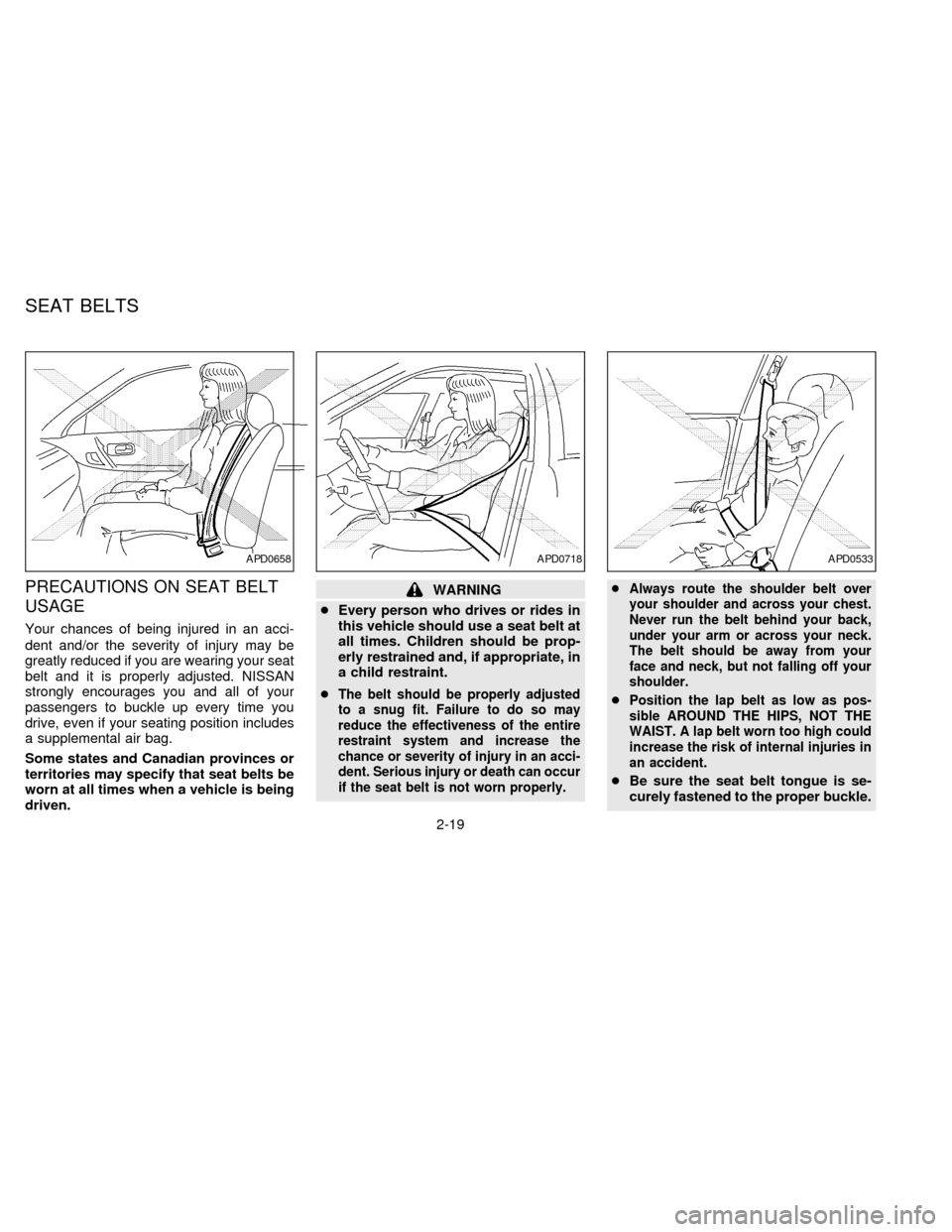
PRECAUTIONS ON SEAT BELT
USAGE
Your chances of being injured in an acci-
dent and/or the severity of injury may be
greatly reduced if you are wearing your seat
belt and it is properly adjusted. NISSAN
strongly encourages you and all of your
passengers to buckle up every time you
drive, even if your seating position includes
a supplemental air bag.
Some states and Canadian provinces or
territories may specify that seat belts be
worn at all times when a vehicle is being
driven.
WARNING
cEvery person who drives or rides in
this vehicle should use a seat belt at
all times. Children should be prop-
erly restrained and, if appropriate, in
a child restraint.
c
The belt should be properly adjusted
to a snug fit. Failure to do so may
reduce the effectiveness of the entire
restraint system and increase the
chance or severity of injury in an acci-
dent. Serious injury or death can occur
if the seat belt is not worn properly.cAlways route the shoulder belt over
your shoulder and across your chest.
Never run the belt behind your back,
under your arm or across your neck.
The belt should be away from your
face and neck, but not falling off your
shoulder.cPosition the lap belt as low as pos-
sible AROUND THE HIPS, NOT THE
WAIST. A lap belt worn too high could
increase the risk of internal injuries in
an accident.
cBe sure the seat belt tongue is se-
curely fastened to the proper buckle.
APD0658APD0718APD0533
SEAT BELTS
2-19
ZX