coolant NISSAN FRONTIER 2001 D22 / 1.G Owner's Manual
[x] Cancel search | Manufacturer: NISSAN, Model Year: 2001, Model line: FRONTIER, Model: NISSAN FRONTIER 2001 D22 / 1.GPages: 290, PDF Size: 3.14 MB
Page 248 of 290

Maintenance for off-road driving
(
only)
Whenever you drive off-road through sand,
mud or water as deep as the wheel hub,
more frequent maintenance may be re-
quired of the following items:
¶Brake pads and rotors
¶Brake linings and drums
¶Brake lines and hoses
¶Wheel bearing grease and free-running
hub grease
¶Differential, transmission and transfer oil
¶Steering linkage
¶Propeller shafts and front drive shafts
¶Air cleaner filter
These items should be checked frequently
to assure safe and proper operation of your
vehicle.
EXPLANATION OF
MAINTENANCE ITEMS
Additional information on the following
items with an ``*'' is found in the ``Do-it-
yourself'' section of this manual.
Emission control system
maintenance
Drive belts*Check drive belts for wear,
fraying or cracking and also for proper ten-
sion. Replace any damaged drive belts.
Air cleaner filterUnder normal driving con-
ditions, the air cleaner filter should be re-
placed in accordance with the maintenance
schedule. However, driving the vehicle in
dusty areas may cause rapid clogging of the
element. Consequently, the element may
have to be replaced more frequently.
Positive crankcase ventilation (PCV) fil-
terUnder normal driving conditions, the
filter should be replaced in accordance with
the maintenance schedule. If the vehicle is
operated under extremely adverse weather
conditions or in areas where ambient tem-
peratures are either extremely low or ex-
tremely high, the filter may become cloggedmore rapidly. In such an event, replace the
filter immediately.
EVAP Vapor linesCheck vapor lines and
connections for leaks, looseness, or dete-
rioration. If leaks are found, replace the
lines.
Fuel linesCheck the fuel hoses, piping and
connections for leaks, looseness or deterio-
ration. Replace any damaged parts.
Fuel filterIf the vehicle is operated under
extremely adverse weather conditions or in
areas where ambient temperatures are ei-
ther extremely low or extremely high, the
filter might become clogged. In such an
event, replace the filter immediately.
Engine coolant*Flush and refill the cooling
system.
Engine oil and oil filter*Under normal
driving conditions, the engine oil and oil filter
should be replaced in accordance with the
maintenance schedule. However, under se-
vere driving conditions, they may have to be
replaced more frequently.
Spark plugs*Replace with new plugs hav-
ing the correct heat range.
9-10Maintenance
ZX
Page 252 of 290
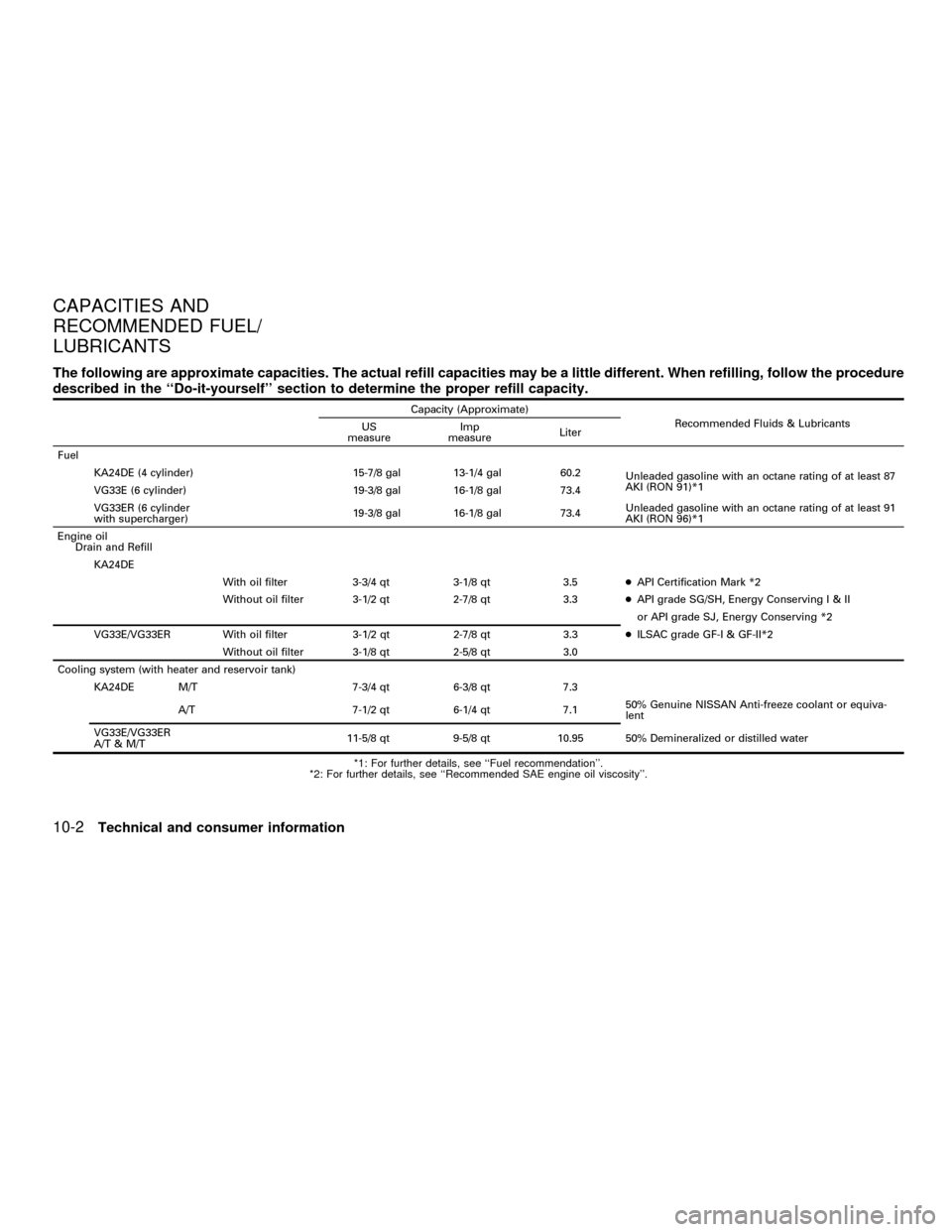
The following are approximate capacities. The actual refill capacities may be a little different. When refilling, follow the procedure
described in the ``Do-it-yourself'' section to determine the proper refill capacity.
Capacity (Approximate)
Recommended Fluids & Lubricants
US
measureImp
measureLiter
Fuel
KA24DE (4 cylinder) 15-7/8 gal 13-1/4 gal 60.2
Unleaded gasoline with an octane rating of at least 87
AKI (RON 91)*1
VG33E (6 cylinder) 19-3/8 gal 16-1/8 gal 73.4
VG33ER (6 cylinder
with supercharger)19-3/8 gal 16-1/8 gal 73.4Unleaded gasoline with an octane rating of at least 91
AKI (RON 96)*1
Engine oil
Drain and Refill
KA24DE
With oil filter 3-3/4 qt 3-1/8 qt 3.5cAPI Certification Mark *2
Without oil filter 3-1/2 qt 2-7/8 qt 3.3cAPI grade SG/SH, Energy ConservingI&II
or API grade SJ, Energy Conserving *2
VG33E/VG33ER With oil filter 3-1/2 qt 2-7/8 qt 3.3cILSAC grade GF-I & GF-II*2
Without oil filter 3-1/8 qt 2-5/8 qt 3.0
Cooling system (with heater and reservoir tank)
KA24DE M/T 7-3/4 qt 6-3/8 qt 7.3
A/T 7-1/2 qt 6-1/4 qt 7.150% Genuine NISSAN Anti-freeze coolant or equiva-
lent
VG33E/VG33ER
A/T & M/T11-5/8 qt 9-5/8 qt 10.95 50% Demineralized or distilled water
*1: For further details, see ``Fuel recommendation''.
*2: For further details, see ``Recommended SAE engine oil viscosity''.
CAPACITIES AND
RECOMMENDED FUEL/
LUBRICANTS
10-2Technical and consumer information
ZX
Page 276 of 290

trailer is hitched. Do not drive the vehicle
if it has an abnormal nose-up or nose-
down condition; check for improper
tongue load, overload, worn suspension
or other possible causes of either con-
dition.
cAlways secure items in the trailer to
prevent load shift while driving.
cBe certain your outside mirrors conform
to all federal, state or local regulations. If
not, install any mirrors required for tow-
ing before driving the vehicle.
Trailer towing tips
In order to gain skill and an understanding
of the vehicle's behavior, you should prac-
tice turning, stopping and backing up in an
area which is free from traffic. Steering,
stability and braking performance will be
somewhat different than under normal driv-
ing conditions.
cAlways secure items in the trailer to
prevent load shift while driving.
c
Avoid abrupt starts, acceleration or
stops.
cAvoid sharp turns or lane changes.cAlways drive your vehicle at a moderate
speed.
cAlways block the wheels on both vehicle
and trailer when parking. Parking on a
slope is not recommended; however, if
you must do so, and if your vehicle is
equipped with automatic transmission,
first block the wheels and apply the
parking brake, and then move the trans-
mission shift selector lever into the P
(Park) position. If you move the shift
lever to the P (Park) position before
blocking the wheels and applying the
parking brake, transmission damage
could occur.
cWhen going down a hill, shift into a lower
gear and use the engine braking effect.
When ascending a long grade, down-
shift the transmission to a lower gear
and reduce speed to reduce chances of
engine overloading and/or overheating.
However, for long steep grades, do not
stay in 1st or 2nd gear when driving
above 35 MPH (56 km/h).
cIf the engine coolant rises to an ex-
tremely high temperature when the air
conditioning system is on, turn off the air
conditioner. Coolant heat can be addi-tionally vented by opening the windows,
switching the fan control to high and
setting the temperature control to the
HOT position.
cTrailer towing requires more fuel than
normal circumstances.
cAvoid towing a trailer for your vehicle's
first 500 miles (805 km).
cHave your vehicle serviced more often
than at intervals specified in the recom-
mended Maintenance Schedule.
cWhen making a turn, your trailer wheels
will be closer to the inside of the turn
than your vehicle wheels. To compen-
sate for this, make a larger than normal
turning radius during the turn.
cCrosswinds and rough roads adversely
affect vehicle/trailer handling, possibly
causing vehicle sway. When being
passed by larger vehicles, be prepared
for possible changes in crosswinds that
could affect vehicle handling. If swaying
does occur, firmly grip the steering
wheel, steer straight ahead, and imme-
diately (but gradually) reduce vehicle
speed. This combination helps to stabi-
lize the vehicle. Never increase speed.
10-26Technical and consumer information
ZX
Page 279 of 290
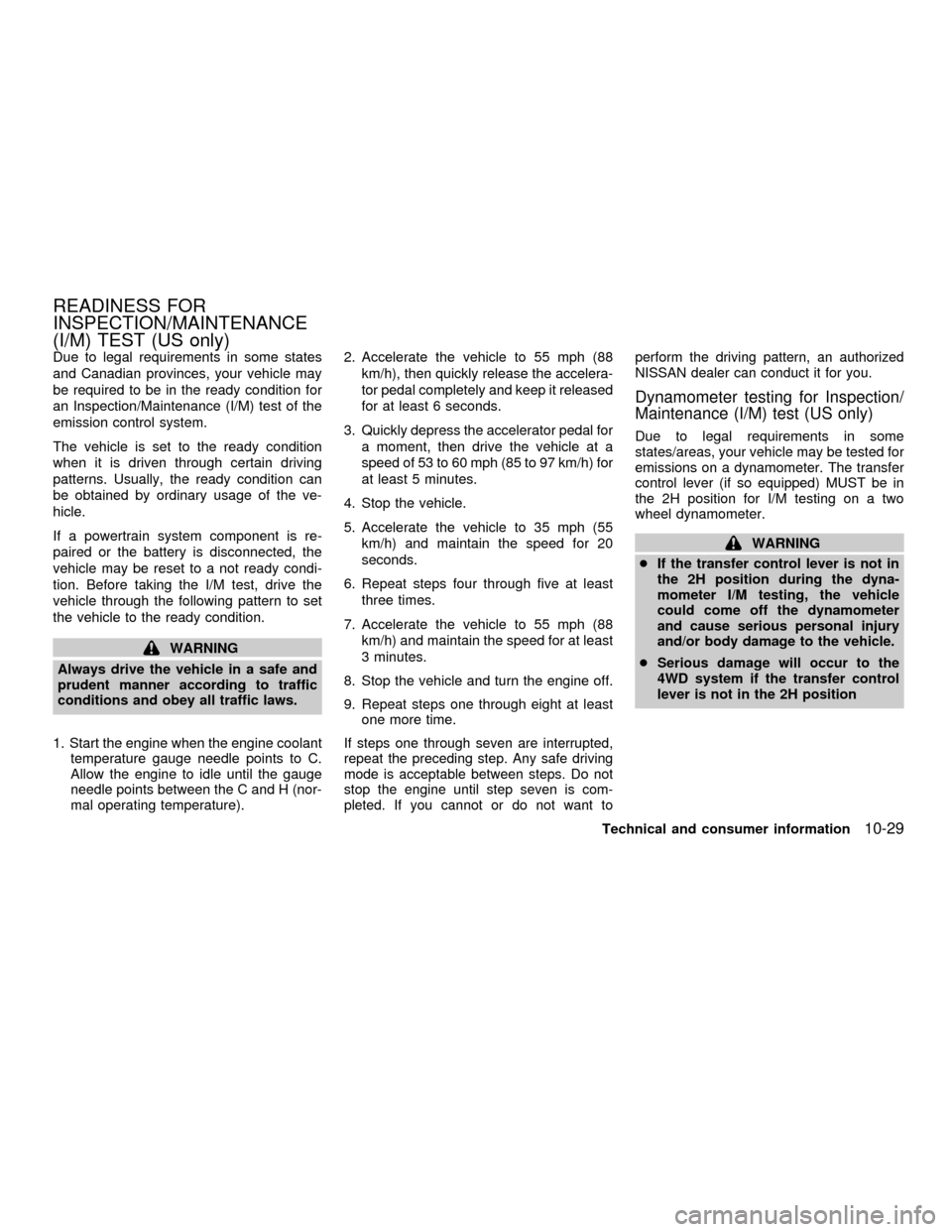
Due to legal requirements in some states
and Canadian provinces, your vehicle may
be required to be in the ready condition for
an Inspection/Maintenance (I/M) test of the
emission control system.
The vehicle is set to the ready condition
when it is driven through certain driving
patterns. Usually, the ready condition can
be obtained by ordinary usage of the ve-
hicle.
If a powertrain system component is re-
paired or the battery is disconnected, the
vehicle may be reset to a not ready condi-
tion. Before taking the I/M test, drive the
vehicle through the following pattern to set
the vehicle to the ready condition.
WARNING
Always drive the vehicle in a safe and
prudent manner according to traffic
conditions and obey all traffic laws.
1. Start the engine when the engine coolant
temperature gauge needle points to C.
Allow the engine to idle until the gauge
needle points between the C and H (nor-
mal operating temperature).2. Accelerate the vehicle to 55 mph (88
km/h), then quickly release the accelera-
tor pedal completely and keep it released
for at least 6 seconds.
3. Quickly depress the accelerator pedal for
a moment, then drive the vehicle at a
speed of 53 to 60 mph (85 to 97 km/h) for
at least 5 minutes.
4. Stop the vehicle.
5. Accelerate the vehicle to 35 mph (55
km/h) and maintain the speed for 20
seconds.
6. Repeat steps four through five at least
three times.
7. Accelerate the vehicle to 55 mph (88
km/h) and maintain the speed for at least
3 minutes.
8. Stop the vehicle and turn the engine off.
9. Repeat steps one through eight at least
one more time.
If steps one through seven are interrupted,
repeat the preceding step. Any safe driving
mode is acceptable between steps. Do not
stop the engine until step seven is com-
pleted. If you cannot or do not want toperform the driving pattern, an authorized
NISSAN dealer can conduct it for you.
Dynamometer testing for Inspection/
Maintenance (I/M) test (US only)
Due to legal requirements in some
states/areas, your vehicle may be tested for
emissions on a dynamometer. The transfer
control lever (if so equipped) MUST be in
the 2H position for I/M testing on a two
wheel dynamometer.
WARNING
cIf the transfer control lever is not in
the 2H position during the dyna-
mometer I/M testing, the vehicle
could come off the dynamometer
and cause serious personal injury
and/or body damage to the vehicle.
cSerious damage will occur to the
4WD system if the transfer control
lever is not in the 2H position
READINESS FOR
INSPECTION/MAINTENANCE
(I/M) TEST (US only)
Technical and consumer information10-29
ZX
Page 283 of 290

11 Index
A
Air bag
Passenger supplemental air bag ON/OFF
switch and light ..................................... 1-17
Air bag (See supplemental restraint
system) ...................................................... 1-14
Air bag warning light .................................. 1-20
Air cleaner housing filter ............................ 8-21
Air conditioner
Air conditioner specification label ....... 10-14
Air conditioner system refrigerant and
lubrication recommendations ................ 10-8
Alarm system (See vehicle security
system) ...................................................... 2-12
Anchor point locations ............................... 1-41
Antenna...................................................... 4-39
Anti-lock brake system (ABS).................... 5-26
Anti-lock brake system, rear (R-ABS) ....... 5-26
Anti-lock brake warning light ....................... 2-8
Ashtray (See cigarette lighter and
ashtray) ...................................................... 2-20
Audio system
FM-AM radio with cassette player and
compact disc (CD) player ..................... 4-17
FM-AM radio with compact disc (CD)
changer ................................................. 4-25
FM-AM radio with compact disc (CD)
player .................................................... 4-10Steering wheel audio control switch ..... 4-38
Auto-lock free-running hubs ...................... 5-21
Automatic
Automatic power window switch .......... 2-24
Automatic transmission fluid (ATF) ...... 8-14
Driving with automatic transmission ....... 5-9
Transmission selector lever lock
release .................................................. 5-12
B
Battery........................................................ 8-17
Battery replacement (See multi-remote
control system) ............................................ 3-7
Before starting the engine ........................... 5-8
Belts (See drive belts) ............................... 8-19
Brake
Anti-lock brake system (ABS) .............. 5-26
Anti-lock brake system, rear (R-ABS) .. 5-26
Brake booster ....................................... 8-25
Brake fluid ................................... 10-3, 8-16
Brake light (See stop light) ................... 8-33
Brake pedal .......................................... 8-24
Brake system ........................................ 5-25
Brake warning light ................................. 2-8
Brake wear indicators ................. 2-12, 8-25
Parking brake check ............................. 8-24
Parking brake operation ....................... 5-16Break-in schedule ...................................... 5-19
Bulb check/instrument panel ....................... 2-7
Bulb replacement ....................................... 8-33
C
Capacities and recommended fuel/
lubricants.................................................... 10-2
Car phone or CB radio .............................. 4-39
Cargo (See vehicle loading
information) .............................................. 10-15
Check engine indicator light
(See malfunction indicator light) ................ 2-11
Child restraint with top tether strap ........... 1-41
Child restraints ........................................... 1-32
Cigarette lighter (accessory) and
ashtray ....................................................... 2-20
Cleaning exterior and interior ...................... 7-2
Clutch
Clutch fluid ............................................ 8-16
Clutch pedal.......................................... 8-26
Cold weather driving .................................. 5-27
Controls
Audio controls (steering wheel) ............ 4-38
Coolant
Capacities and recommended fuel/
lubricants .............................................. 10-2
Changing engine coolant........................ 8-7
ZX
Page 284 of 290

Checking engine coolant level ............... 8-6
Engine coolant temperature gauge ........ 2-5
Corrosion protection .................................... 7-5
Cruise control............................................. 5-17
Cup holders ............................................... 2-21
D
Daytime running light system
(Canada only) ............................................ 2-18
Defogger switch
Rear window defogger switch .............. 2-16
Dimensions and weights.......................... 10-11
Door locks .................................................... 3-2
Drive belts .................................................. 8-19
Driving
Auto-lock free-running hubs ................. 5-21
Cold weather driving............................. 5-27
Driving with automatic transmission ....... 5-9
Driving with manual transmission ......... 5-15
Precautions when starting and driving ... 5-2
E
Economy - fuel........................................... 5-20
Emission control information label........... 10-14
Emission control system warranty ........... 10-28
Engine
Before starting the engine ...................... 5-8
Capacities and recommended fuel/
lubricants .............................................. 10-2Changing engine coolant........................ 8-7
Changing engine oil.............................. 8-11
Changing engine oil filter...................... 8-13
Checking engine coolant level ............... 8-6
Checking engine oil level ..................... 8-10
Engine compartment check locations .... 8-3
Engine coolant temperature gauge ........ 2-5
Engine cooling system ........................... 8-6
Engine oil .............................................. 8-10
Engine oil and oil filter
recommendation ................................... 10-6
Engine oil pressure warning light ........... 2-9
Engine oil viscosity ............................... 10-7
Engine serial number ......................... 10-13
Engine specifications ............................ 10-9
Starting the engine ................................. 5-8
Exhaust gas (Carbon monoxide) ................. 5-2
F
Flashers (See hazard warning flasher
switch) ........................................................ 2-19
Flat tire ......................................................... 6-2
Floor mat positioning aid ............................. 7-4
Fluid
Automatic transmission fluid (ATF) ...... 8-14
Brake fluid ................................... 10-3, 8-16
Capacities and recommended fuel/
lubricants .............................................. 10-2
Clutch fluid ............................................ 8-16
Engine coolant ........................................ 8-6
Engine oil .............................................. 8-10Power steering fluid .............................. 8-15
Window washer fluid ............................ 8-16
F.M.V.S.S. certification label ................... 10-13
Front seats
Bench...................................................... 1-6
Separate ................................................. 1-2
Fuel
Capacities and recommended fuel/
lubricants .............................................. 10-2
Fuel economy ....................................... 5-20
Fuel filler cap ........................................ 3-11
Fuel gauge.............................................. 2-6
Fuel octane rating................................. 10-5
Fuel recommendation ........................... 10-4
Fuses ......................................................... 8-27
G
Gauge
Engine coolant temperature gauge ........ 2-5
Fuel gauge.............................................. 2-6
Odometer ................................................ 2-3
Speedometer .......................................... 2-3
Tachometer............................................. 2-5
General maintenance .................................. 9-2
H
Hazard warning flasher switch .................. 2-19
Headlight aiming adjustment ..................... 8-30
Headlight and turn signal switch ............... 2-17
11-2
ZX