clutch NISSAN FRONTIER 2011 Owner´s Manual
[x] Cancel search | Manufacturer: NISSAN, Model Year: 2011, Model line: FRONTIER, Model: NISSAN FRONTIER 2011Pages: 377, PDF Size: 8.49 MB
Page 288 of 377
8 Maintenance and do-it-yourself
Maintenance requirements..........................8-2
General maintenance ..............................8-2
Explanation of general maintenance items .........8-2
Maintenance precautions . . .........................8-5
Engine compartment check locations ................8-6
Engine cooling system .............................8-8
Checking engine coolant level ...................8-9
Changing engine coolant ........................8-9
Engine oil ........................................ 8-10
Checking engine oil level .......................8-10
Changing engine oil ........................... 8-11
Changing engine oil filter .......................8-12
5-speed automatic transmission fluid ...............8-13
Power steering fluid ............................... 8-14
Brake and clutch (if so equipped) fluid ..............8-14
Brake fluid .................................... 8-14
Clutch fluid (if so equipped) ....................8-15
Windshield-washer fluid ........................... 8-15
Windshield-washer fluid reservoir ...............8-15
Battery .......................................... 8-16
Jump starting ................................. 8-17
Variable voltage control system .....................8-17
Drive belt ........................................ 8-18Spark plugs .
..................................... 8-19
Replacing spark plugs ......................... 8-19
Air cleaner ....................................... 8-20
In-cabin microfilter (if so equipped) ..............8-20
Windshield wiper blades .......................... 8-22
Cleaning ..................................... 8-22
Replacing .................................... 8-22
Brakes .......................................... 8-23
Fuses ........................................... 8-24
Engine compartment ........................... 8-24
Passenger compartment .......................8-25
Battery replacement .............................. 8-26
Keyfob (if so equipped) ........................ 8-27
Lights ........................................... 8-28
Headlights .................................... 8-28
Exterior
and interior lights ....................... 8-30
Wheels and tires ................................. 8-32
Tire pressure .................................. 8-32
Tire labeling ................................... 8-36
Types of tires .................................. 8-38
Tire chains .................................... 8-39
Changing wheels and tires .....................8-39
Page 291 of 377
Seat beltsCheck that all parts of the seat belt
system (for example, buckles, anchors, adjusters
and retractors) operate properly and smoothly,
and are installed securely. Check the belt web-
bing for cuts, fraying, wear or damage.
Steering wheel Check for changes in the steer-
ing system, such as excessive freeplay, hard
steering or strange noises.
Warning lights and chimes Make sure all
warning lights and chimes are operating properly.
Windshield wiper and washer* Check that
the wipers and washer operate properly and that
the wipers do not streak.
Windshield defroster Check that the air
comes out of the defroster outlets properly and in
sufficient quantity when operating the heater or
air conditioner.
Under the hood and vehicle
The maintenance items listed here should be
checked periodically (for example, each time you
check the engine oil or refuel) .
Battery* Check the fluid level in each cell. It
should be between the MAX and MIN lines. Ve-
hicles operated in high temperatures or under
severe conditions require frequent checks of the
battery fluid level. Brake and clutch fluid levels*
Make sure that
the brake and clutch fluid level is between the
MIN and MAX lines on the reservoir.
Engine coolant level* Check the coolant level
when the engine is cold.
Engine drive belts* Make sure the drive belts
are not frayed, worn, cracked or oily.
Engine oil level* Check the level after parking
the vehicle on a level surface with the engine off.
Wait more than 10 minutes for the oil to drain
back into the oil pan.
Exhaust system Make sure there are no loose
supports, cracks or holes. If the sound of the
exhaust seems unusual or there is a smell of
exhaust fumes, immediately have the exhaust
system inspected by a NISSAN dealer. See the
carbon monoxide warning in the “Starting and
driving” section of this manual.
Fluid leaks Check under the vehicle for fuel, oil,
water or other fluid leaks after the vehicle has
been parked for a while. Water dripping from the
air conditioner after use is normal. If you should
notice any leaks or if gasoline fumes are evident,
check for the cause and have it corrected imme-
diately. Power steering fluid level* and lines
Check
the level when the fluid is cold, with the engine
off. Check the lines for proper attachment, leaks,
cracks, etc.
Radiator and hoses Check the front of the
radiator and clean off any dirt, insects, leaves,
etc., that may have accumulated. Make sure the
hoses have no cracks, deformation, rot or loose
connections.
Underbody The underbody is frequently ex-
posed to corrosive substances such as those
used on icy roads or to control dust. It is very
important to remove these substances from the
underbody, otherwise rust may form on the floor
pan, frame, fuel lines and exhaust system. At the
end of winter, the underbody should be thor-
oughly flushed with plain water, in those areas
where mud and dirt may have accumulated. See
the “Appearance and care” section of this
manual.
Windshield-washer fluid* Check that there is
adequate fluid in the reservoir.
8-4Maintenance and do-it-yourself
Page 293 of 377
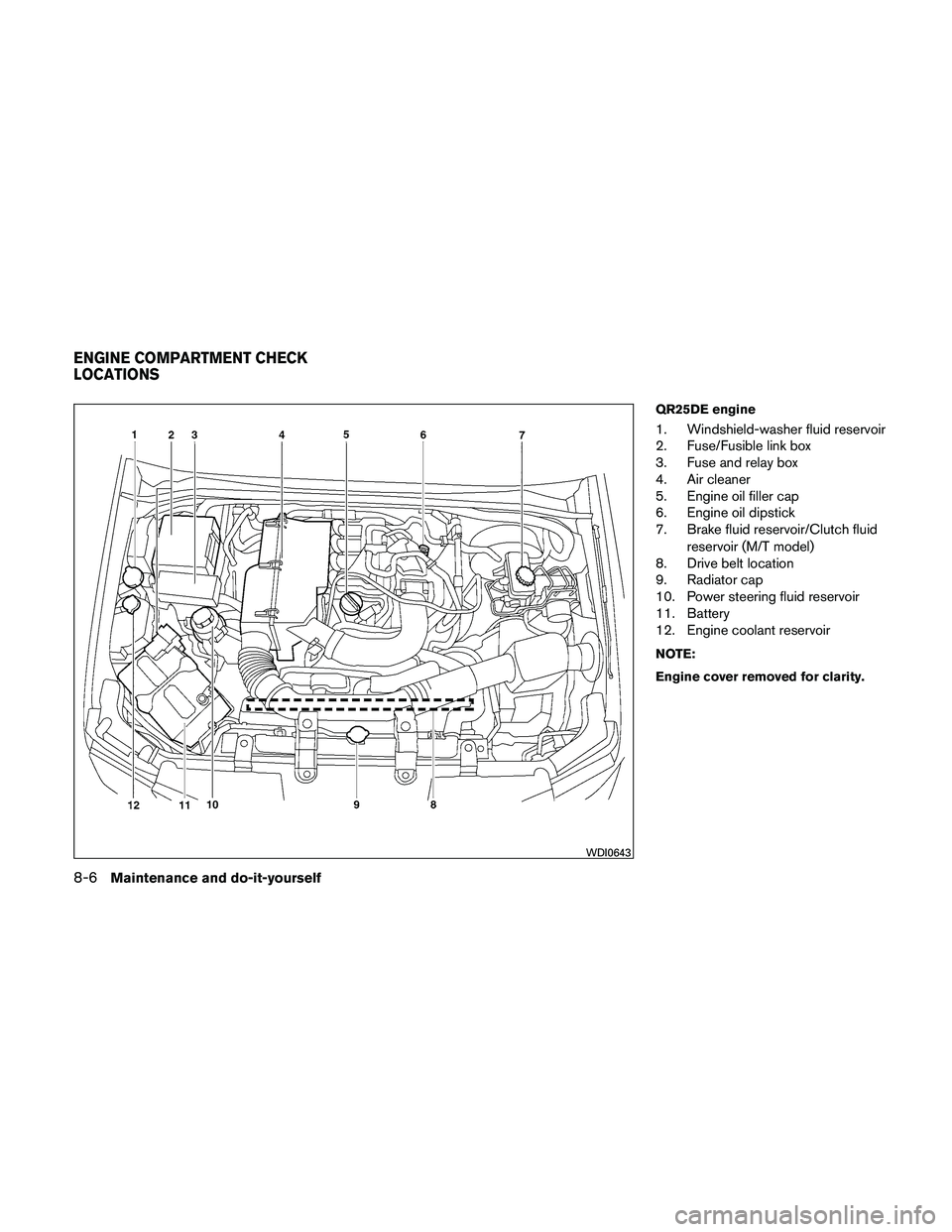
QR25DE engine
1. Windshield-washer fluid reservoir
2. Fuse/Fusible link box
3. Fuse and relay box
4. Air cleaner
5. Engine oil filler cap
6. Engine oil dipstick
7. Brake fluid reservoir/Clutch fluidreservoir (M/T model)
8. Drive belt location
9. Radiator cap
10. Power steering fluid reservoir
11. Battery
12. Engine coolant reservoir
NOTE:
Engine cover removed for clarity.
WDI0643
ENGINE COMPARTMENT CHECK
LOCATIONS
8-6Maintenance and do-it-yourself
Page 294 of 377
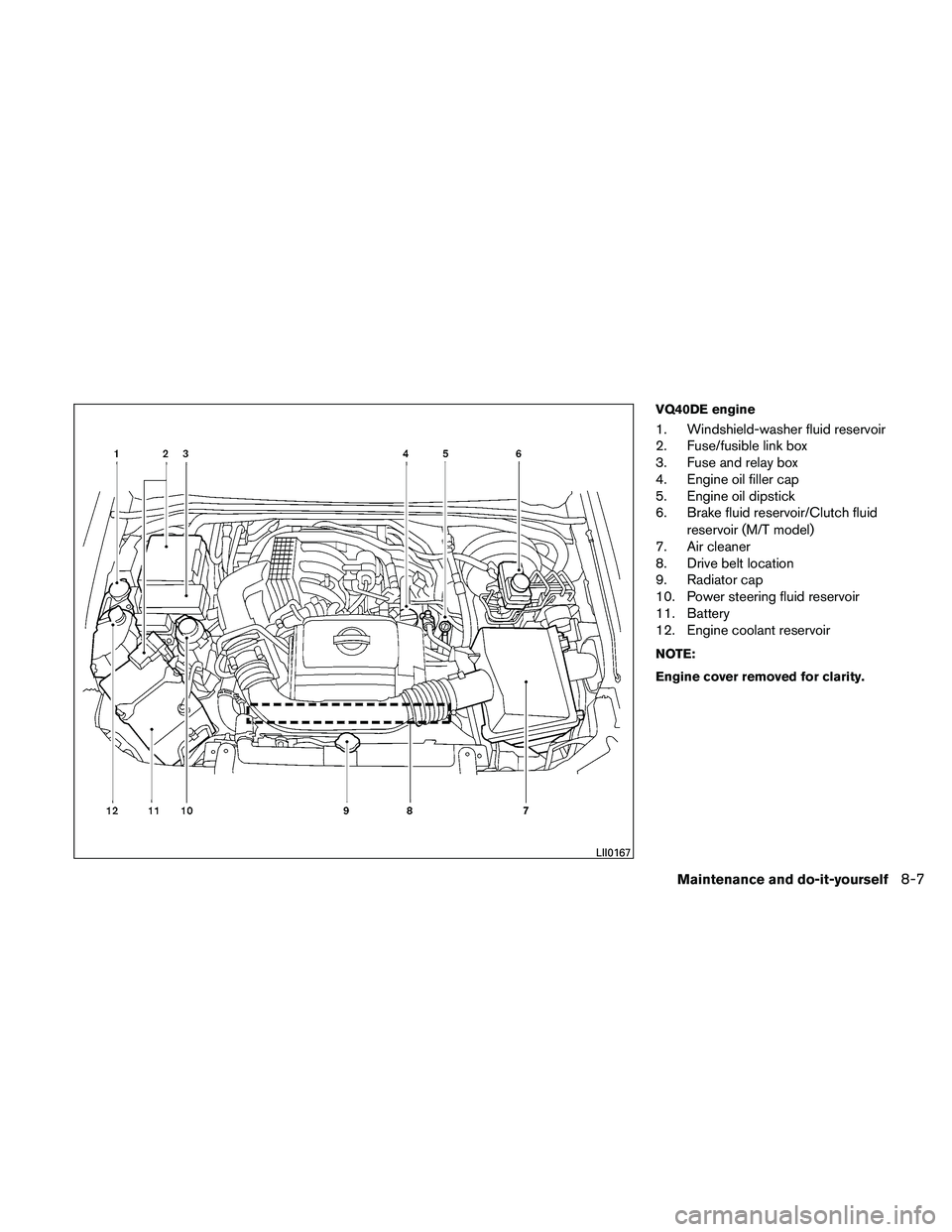
VQ40DE engine
1. Windshield-washer fluid reservoir
2. Fuse/fusible link box
3. Fuse and relay box
4. Engine oil filler cap
5. Engine oil dipstick
6. Brake fluid reservoir/Clutch fluidreservoir (M/T model)
7. Air cleaner
8. Drive belt location
9. Radiator cap
10. Power steering fluid reservoir
11. Battery
12. Engine coolant reservoir
NOTE:
Engine cover removed for clarity.
LII0167
Maintenance and do-it-yourself8-7
Page 301 of 377
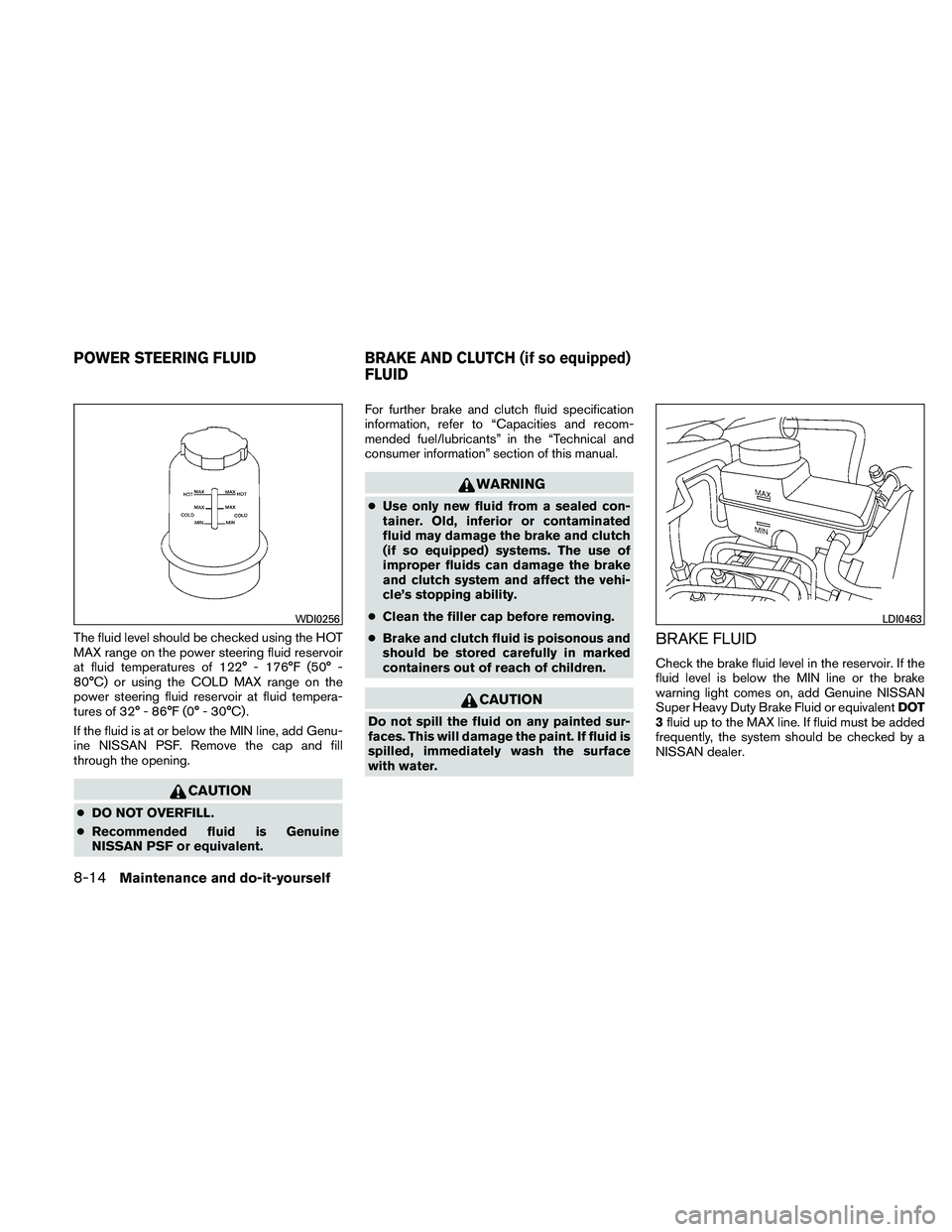
The fluid level should be checked using the HOT
MAX range on the power steering fluid reservoir
at fluid temperatures of 122° - 176°F (50° -
80°C) or using the COLD MAX range on the
power steering fluid reservoir at fluid tempera-
tures of 32° - 86°F (0° - 30°C) .
If the fluid is at or below the MIN line, add Genu-
ine NISSAN PSF. Remove the cap and fill
through the opening.
CAUTION
●DO NOT OVERFILL.
● Recommended fluid is Genuine
NISSAN PSF or equivalent. For further brake and clutch fluid specification
information, refer to “Capacities and recom-
mended fuel/lubricants” in the “Technical and
consumer information” section of this manual.
WARNING
●
Use only new fluid from a sealed con-
tainer. Old, inferior or contaminated
fluid may damage the brake and clutch
(if so equipped) systems. The use of
improper fluids can damage the brake
and clutch system and affect the vehi-
cle’s stopping ability.
● Clean the filler cap before removing.
● Brake and clutch fluid is poisonous and
should be stored carefully in marked
containers out of reach of children.
CAUTION
Do not spill the fluid on any painted sur-
faces. This will damage the paint. If fluid is
spilled, immediately wash the surface
with water.
BRAKE FLUID
Check the brake fluid level in the reservoir. If the
fluid level is below the MIN line or the brake
warning light comes on, add Genuine NISSAN
Super Heavy Duty Brake Fluid or equivalent DOT
3 fluid up to the MAX line. If fluid must be added
frequently, the system should be checked by a
NISSAN dealer.
WDI0256LDI0463
POWER STEERING FLUID BRAKE AND CLUTCH (if so equipped)
FLUID
8-14Maintenance and do-it-yourself
Page 302 of 377
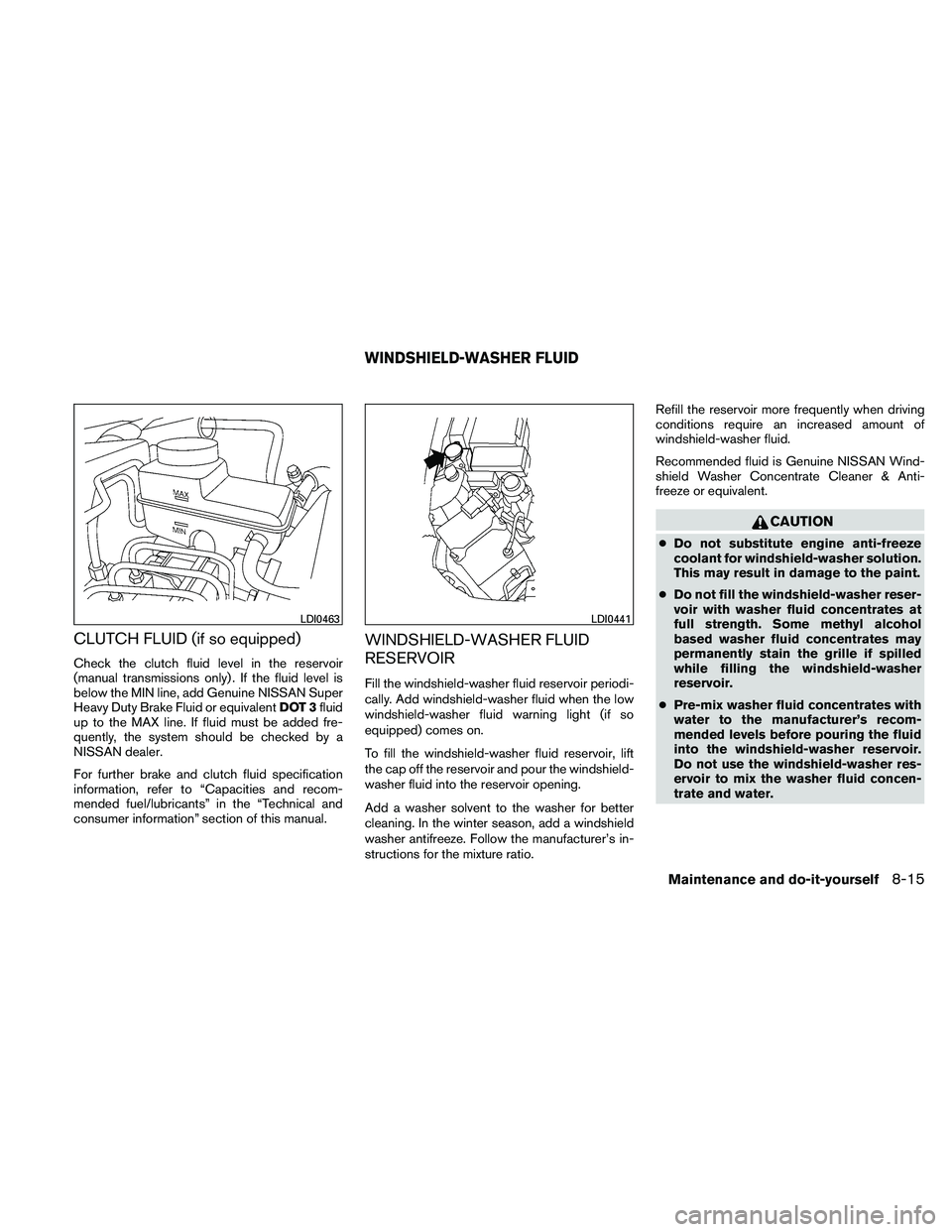
CLUTCH FLUID (if so equipped)
Check the clutch fluid level in the reservoir
(manual transmissions only) . If the fluid level is
below the MIN line, add Genuine NISSAN Super
Heavy Duty Brake Fluid or equivalentDOT 3fluid
up to the MAX line. If fluid must be added fre-
quently, the system should be checked by a
NISSAN dealer.
For further brake and clutch fluid specification
information, refer to “Capacities and recom-
mended fuel/lubricants” in the “Technical and
consumer information” section of this manual.
WINDSHIELD-WASHER FLUID
RESERVOIR
Fill the windshield-washer fluid reservoir periodi-
cally. Add windshield-washer fluid when the low
windshield-washer fluid warning light (if so
equipped) comes on.
To fill the windshield-washer fluid reservoir, lift
the cap off the reservoir and pour the windshield-
washer fluid into the reservoir opening.
Add a washer solvent to the washer for better
cleaning. In the winter season, add a windshield
washer antifreeze. Follow the manufacturer’s in-
structions for the mixture ratio. Refill the reservoir more frequently when driving
conditions require an increased amount of
windshield-washer fluid.
Recommended fluid is Genuine NISSAN Wind-
shield Washer Concentrate Cleaner & Anti-
freeze or equivalent.
CAUTION
●
Do not substitute engine anti-freeze
coolant for windshield-washer solution.
This may result in damage to the paint.
● Do not fill the windshield-washer reser-
voir with washer fluid concentrates at
full strength. Some methyl alcohol
based washer fluid concentrates may
permanently stain the grille if spilled
while filling the windshield-washer
reservoir.
● Pre-mix washer fluid concentrates with
water to the manufacturer’s recom-
mended levels before pouring the fluid
into the windshield-washer reservoir.
Do not use the windshield-washer res-
ervoir to mix the washer fluid concen-
trate and water.
LDI0463LDI0441
WINDSHIELD-WASHER FLUID
Maintenance and do-it-yourself8-15
Page 331 of 377
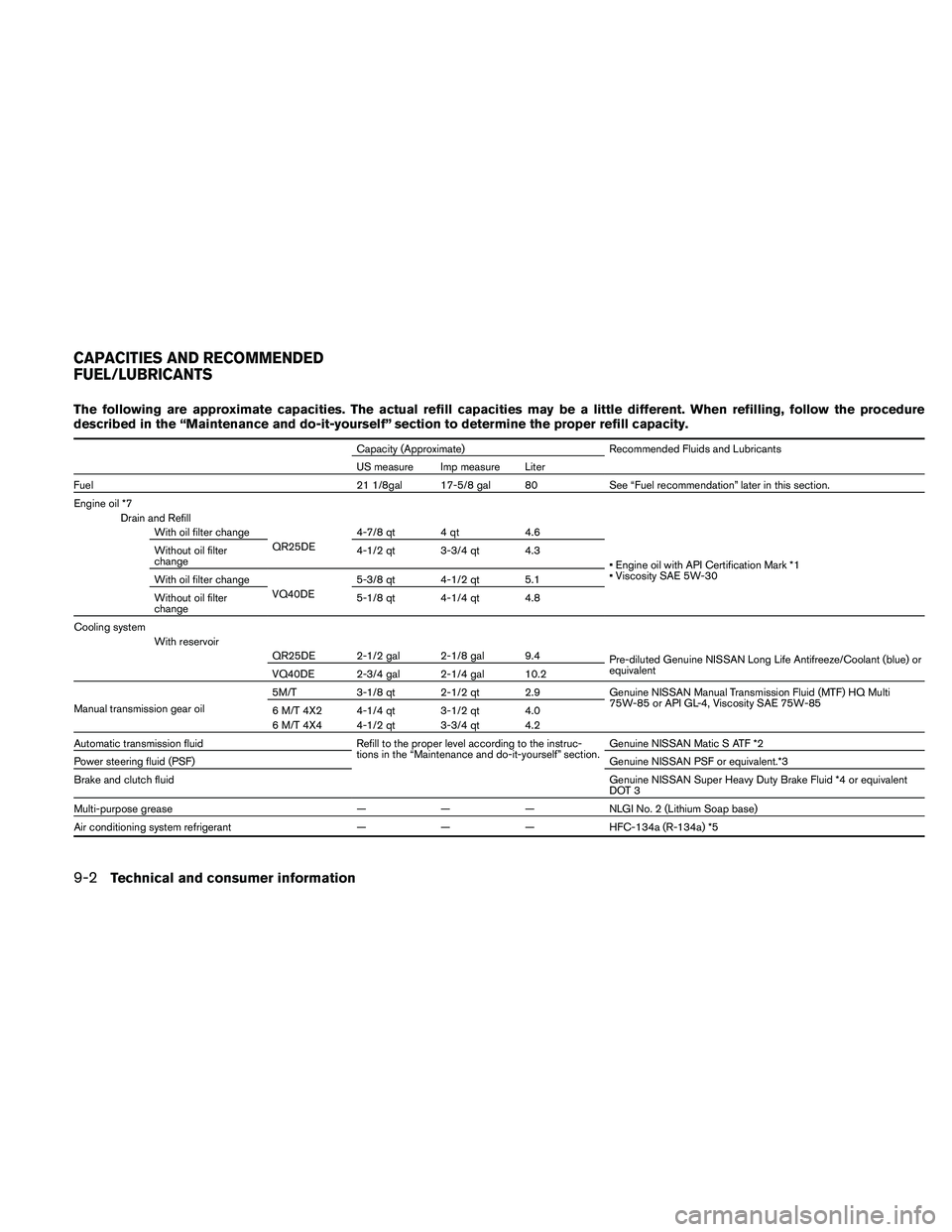
The following are approximate capacities. The actual refill capacities may be a little different. When refilling, follow the procedure
described in the “Maintenance and do-it-yourself” section to determine the proper refill capacity.
Capacity (Approximate)Recommended Fluids and Lubricants
US measure Imp measure Liter
Fuel 21 1/8gal 17-5/8 gal 80See “Fuel recommendation” later in this section.
Engine oil *7 Drain and RefillWith oil filter change
QR25DE4-7/8 qt 4 qt
4.6
Engine oil with API Certification Mark *1
Viscosity SAE 5W-30
Without oil filter
change
4-1/2 qt 3-3/4 qt 4.3
With oil filter change VQ40DE5-3/8 qt 4-1/2 qt 5.1
Without oil filter
change 5-1/8 qt 4-1/4 qt 4.8
Cooling system With reservoir QR25DE 2-1/2 gal 2-1/8 gal 9.4 Pre-diluted Genuine NISSAN Long Life Antifreeze/Coolant (blue) or
equivalent
VQ40DE 2-3/4 gal 2-1/4 gal 10.2
Manual transmission gear oil 5M/T
3-1/8 qt 2-1/2 qt 2.9 Genuine NISSAN Manual Transmission Fluid (MTF) HQ Multi
75W-85 or API GL-4, Viscosity SAE 75W-85
6 M/T 4X2 4-1/4 qt 3-1/2 qt 4.0
6 M/T 4X4 4-1/2 qt 3-3/4 qt 4.2
Automatic transmission fluid Refill to the proper level according to the instruc-
tions in the “Maintenance and do-it-yourself” section.Genuine NISSAN Matic S ATF *2
Power steering fluid (PSF) Genuine NISSAN PSF or equivalent.*3
Brake and clutch fluid Genuine NISSAN Super Heavy Duty Brake Fluid *4 or equivalent
DOT 3
Multi-purpose grease ———NLG IN o.2 (Lithium Soap base)
Air conditioning system refrigerant ———HFC-134a (R-134a) *5
CAPACITIES AND RECOMMENDED
FUEL/LUBRICANTS
9-2Technical and consumer information
Page 371 of 377
ClutchClutch fluid ..................8-15
Clutch interlock (clutch start) switch ......2-36
C.M.V.S.S. certification label ..........9-11
Cold weather driving ..............5-38
Compact disc (CD) player ...........4-27
Compass display ................2-10
Console box ...................2-41
Controls Audio controls (steering wheel) .......4-35
Heater and air conditioner controls . .4-2, 4-10
Coolant Capacities and recommended
fuel/lubricants .................9-2
Changing engine coolant ...........8-9
Checking engine coolant level ........8-9
Engine coolant temperature gauge .....2-6
Corrosion protection ...............7-5
Cruise control ..................5-20
Cup holders ...................2-43
Curtain side-impact and rollover air bag . . . .1-73
D
Daytime running light system (Canada only) . .2-30
Defroster switch Rear window defroster switch .......2-27
Dimensions and weights .............9-9
Dimmer switch for instrument panel ......2-31
Door locks .....................3-3
Door open warning light .............2-16
Drive belt .....................8-18
Driving Cold weather driving ............5-38
Driving with automatic transmission . . . .5-13 Driving with manual transmission
......5-17
Precautions when starting and driving . . . .5-2
E
Economy - fuel ..................5-22
Electronic locking rear differential (E-Lock)
system ......................5-29
Electronic locking rear differential (E-Lock)
system switch ..................2-35
Emission control information label .......9-12
Emission control system warranty .......9-36
Engine Before starting the engine ..........5-12
Block
heater .................5-39
Capacities and recommended
fuel/lubricants .................9-2
Changing engine coolant ...........8-9
Changing engine oil .............8-11
Changing engine oil filter ..........8-12
Checking engine coolant level ........8-9
Checking engine oil level ..........8-10
Engine compartment check locations . . . .8-6
Engine coolant temperature gauge .....2-6
Engine cooling system ............8-8
Engine oil ...................8-10
Engine oil and oil filter recommendation . . .9-6
Engine oil pressure warning light ......2-17
Engine oil viscosity ..............9-6
Engine serial number ............9-11
Engine specifications .............9-8
Starting the engine .............5-12
Engine oil pressure gauge ............2-8
Event data recorders ..............9-38
Exhaust gas (Carbon monoxide) .........5-2 F
First aid kit .....................6-2
Flashers
(See hazard warning flasher switch) ......2-32
Flat tire .......................6-3
Floor mat positioning aid .............7-5
Fluid Brake fluid ..................8-14
Capacities and recommended
fuel/lubricants .................9-2
Clutch fluid ..................8-15
Engine coolant .................8-8
Engine oil ...................8-10
Power steering fluid .............8-14
Windshield-washer fluid ...........8-15
F.M.V.S.S. certification label ...........9-11
Fog light switch .................2-31
Front air bag system
(See supplemental restraint system) ......1-68
Front
seats.....................1-2
Fuel Capacities and recommended
fuel/lubricants .................9-2
Fuel economy ................5-22
Fuel gauge ...................2-7
Fuel octane rating ...............9-5
Fuel recommendation .............9-4
Fuel-filler door and cap ...........3-11
Loose fuel cap warning ........2-5, 3-11
Fuses .......................8-24
Fusible links ...................8-25
10-2
Page 374 of 377
Event data..................9-38
Refrigerant recommendation ...........9-7
Registering your vehicle in another country . .9-10
Remote keyless entry system ...........3-6
Reporting safety defects (US only) .......9-37
Roof rack .....................2-45
S
Safety Child safety rear door lock ..........3-6
Child seat belts .....1-23, 1-34, 1-46, 1-56
Reporting safety defects (US only) .....9-37
Seat Jump seat ...................1-5
Seat adjustment Front manual seat adjustment ........1-2
Front power seat adjustment .........1-4
Seat belt Child safety ..................1-21
Infants and small children ..........1-22
Injured Person ................1-16
Larger children ................1-22
Precautions on seat belt usage .......1-13
Pregnant women ...............1-16
Pre-tensioner seat belt system .......1-74
Seat belt extenders .............1-20
Seat belt maintenance ............1-21
Seat belts ...................1-13
Shoulder belt height adjustment ......1-20
Three-point type with retractor .......1-16
Seat belt warning light ..............2-19
Seatback pockets ................2-43
Seats Adjustment ...................1-2 Front seats
...................1-2
Heated seats .................2-33
Manual front seat adjustment .........1-2
Security indicator light ..............2-22
Security system (NISSAN vehicle immobilizer
system) , engine start ........2-25, 3-2, 5-11
Self-adjusting brakes ..............8-23
Service
manual order form ...........9-39
Servicing air conditioner .............4-17
Shift lock release .................5-15
Shifting Automatic transmission ...........5-14
Manual transmission .............5-17
Shoulder belt height adjustment ........1-20
Side air bag system (See supplemental side air
bag, curtain and rollover air bag systems) . . .1-73
Spark plug replacement .............8-19
Speedometer ...................2-4
SRS warning label ................1-75
Starting Before starting the engine ..........5-12
Jump starting .................6-9
Precautions when starting and driving . . . .5-2
Push starting .................6-11
Starting the engine .............5-12
Steering Power steering fluid .............8-14
Power steering system ...........5-32
Tilting steering wheel ............3-13
Steering wheel audio control switch ......4-35
Stop light .....................8-30
Storage ......................2-38
Storage tray ................2-38, 2-39
Sun visors ....................3-13
Sunglasses case .................2-41
Sunroof (see Moonroof) .............2-49 Supplemental air bag warning labels
......1-75
Supplemental air bag warning light . . .1-76, 2-19
Supplemental front impact air bag system . . .1-68
Supplemental restraint system Information and warning labels .......1-75
Precautions on supplemental restraint
system ....................1-61
Supplemental restraint system
(Supplemental air bag system) .........1-61
Switch Autolight switch ...............2-29
Automatic power window switch ......2-48
Clutch interlock (clutch start) switch . . . .2-36
Electronic locking rear differential (E-Lock)
system switch ................2-35
Fog light switch ...............2-31
Hazard
warning flasher switch .......2-32
Headlight and turn signal switch ......2-28
Headlight control switch ..........2-28
Hill descent control switch .........2-34
Ignition switch ................5-10
Overdrive switch ...............5-16
Power door lock switch ............3-4
Rear window defroster switch .......2-27
Turn signal switch ..............2-31
Vehicle dynamic control (VDC) off
switch .....................2-34
Windshield wiper and washer switch . . .2-26
T
Tachometer ....................2-6
Tailgate latch ............3-16, 3-18, 3-19
Temperature gauge Engine coolant temperature gauge .....2-6
10-5