ECU NISSAN FRONTIER 2021 User Guide
[x] Cancel search | Manufacturer: NISSAN, Model Year: 2021, Model line: FRONTIER, Model: NISSAN FRONTIER 2021Pages: 492, PDF Size: 2.86 MB
Page 52 of 492
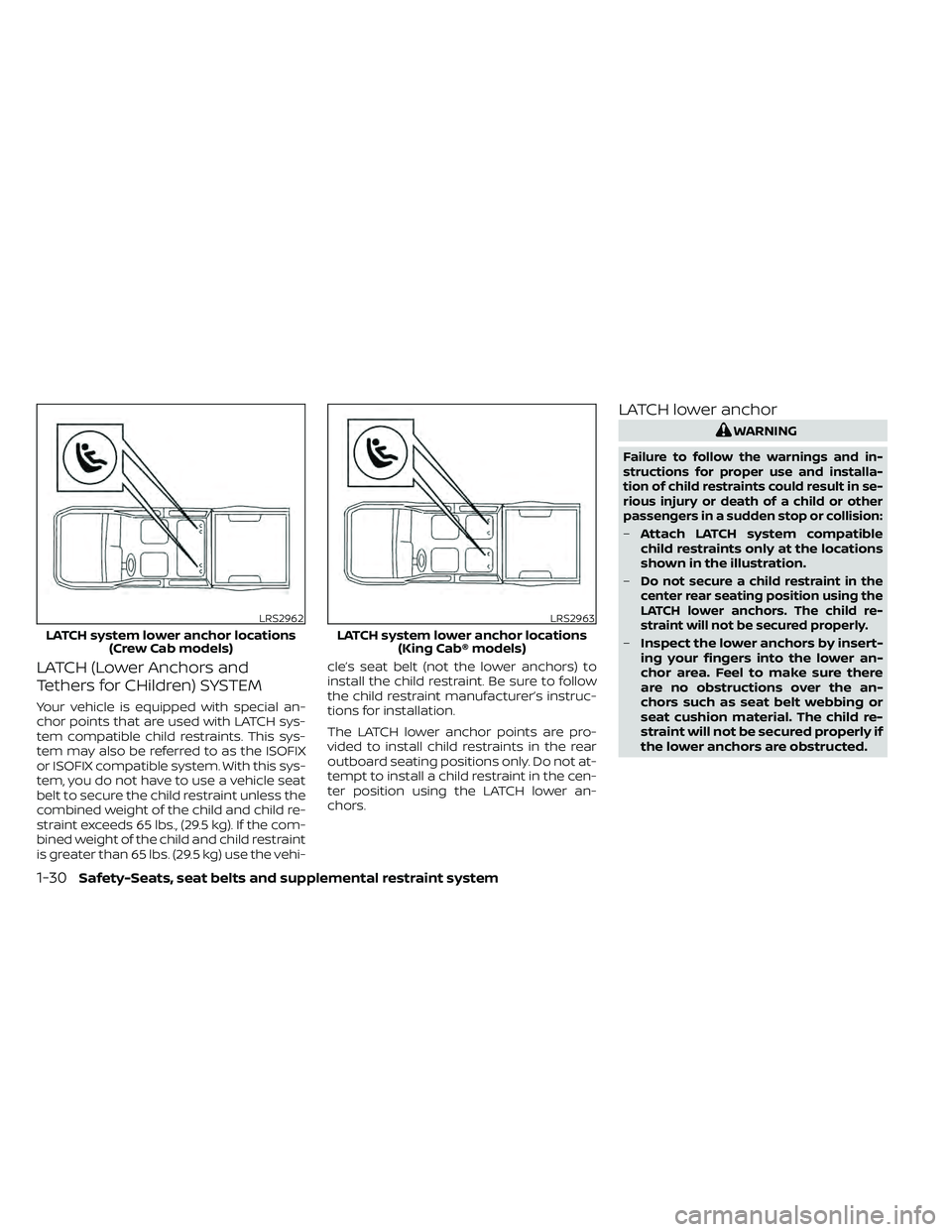
LATCH (Lower Anchors and
Tethers for CHildren) SYSTEM
Your vehicle is equipped with special an-
chor points that are used with LATCH sys-
tem compatible child restraints. This sys-
tem may also be referred to as the ISOFIX
or ISOFIX compatible system. With this sys-
tem, you do not have to use a vehicle seat
belt to secure the child restraint unless the
combined weight of the child and child re-
straint exceeds 65 lbs., (29.5 kg). If the com-
bined weight of the child and child restraint
is greater than 65 lbs. (29.5 kg) use the vehi-cle’s seat belt (not the lower anchors) to
install the child restraint. Be sure to follow
the child restraint manufacturer’s instruc-
tions for installation.
The LATCH lower anchor points are pro-
vided to install child restraints in the rear
outboard seating positions only. Do not at-
tempt to install a child restraint in the cen-
ter position using the LATCH lower an-
chors.
LATCH lower anchor
Page 54 of 492
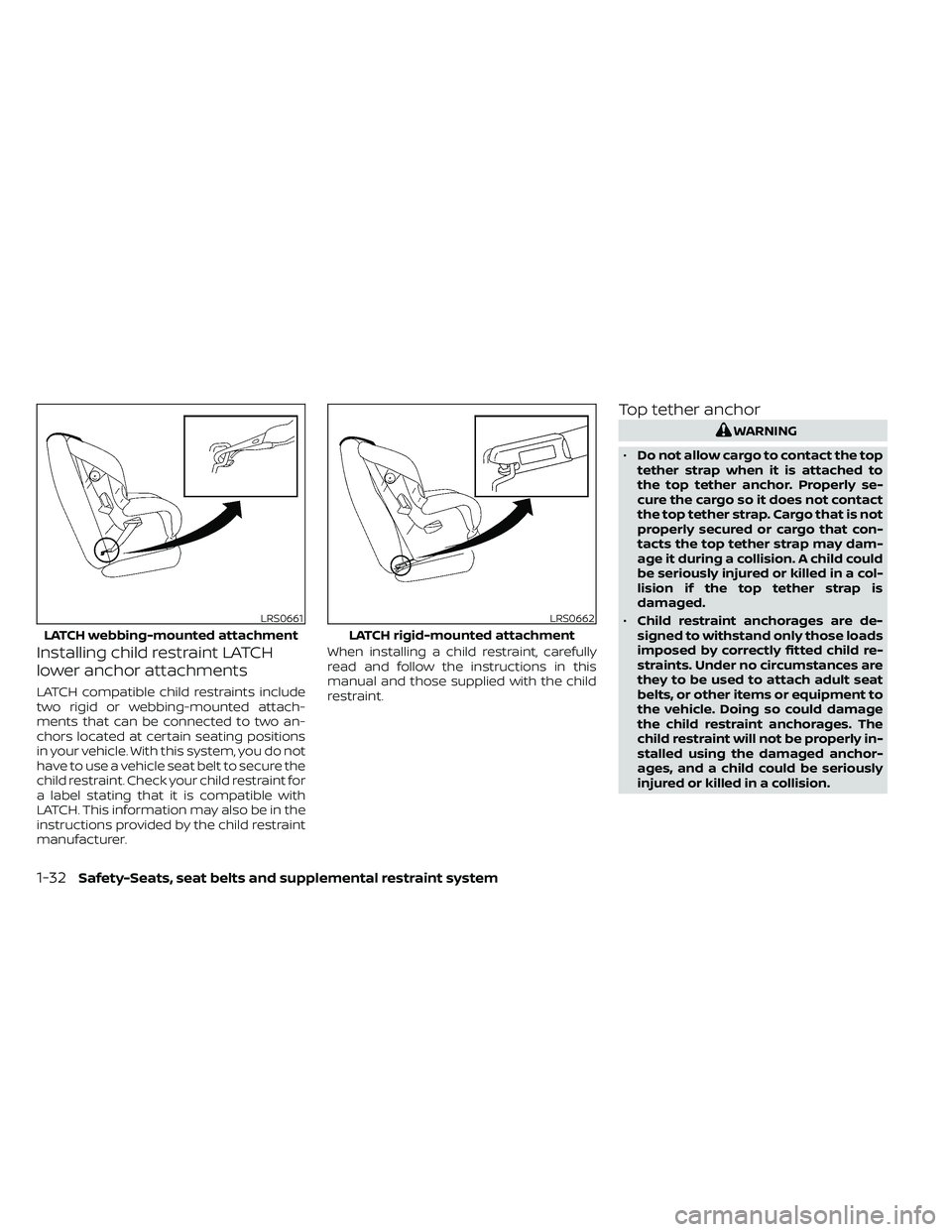
Installing child restraint LATCH
lower anchor attachments
LATCH compatible child restraints include
two rigid or webbing-mounted attach-
ments that can be connected to two an-
chors located at certain seating positions
in your vehicle. With this system, you do not
have to use a vehicle seat belt to secure the
child restraint. Check your child restraint for
a label stating that it is compatible with
LATCH. This information may also be in the
instructions provided by the child restraint
manufacturer.When installing a child restraint, carefully
read and follow the instructions in this
manual and those supplied with the child
restraint.
Top tether anchor
Page 56 of 492
REAR-FACING CHILD RESTRAINT
INSTALLATION USING LATCH (Crew
Cab models)
For additional information, refer to all Warn-
ings and Cautions in the “Child safety” and
“Child restraints” sections of this manual
before installing a child restraint.
Do not use the lower anchors if the com-
bined weight of the child and the child re-
straint exceeds 65 lbs. (29.5 kg). If the com-
bined weight of the child and the child
restraint is greater than 65 lbs., (29.5 kg) use
the vehicle's seat belt (not the lower an-
chors) to install the child restraint. Be sure
to follow the child restraint manufacturer's
instructions for installation.
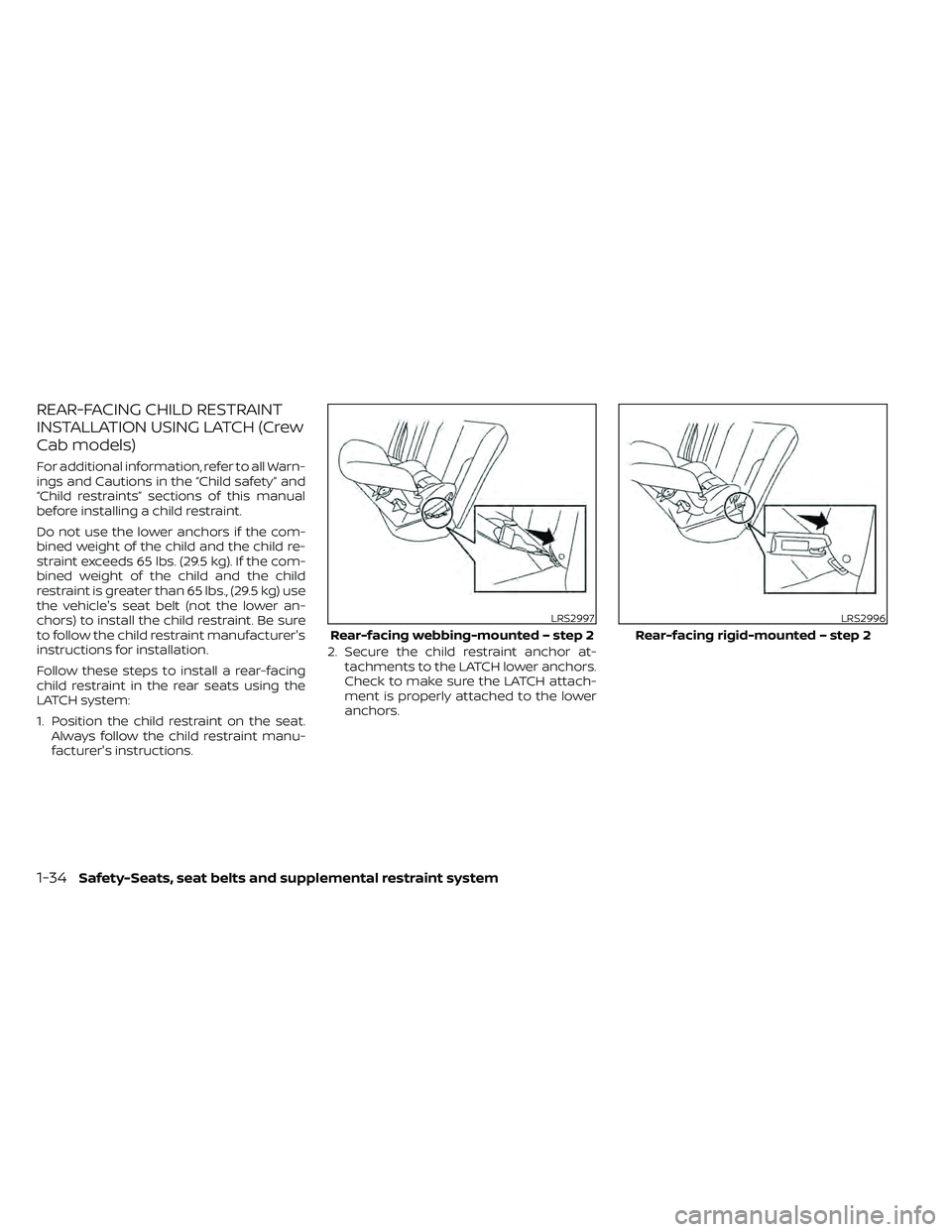
Follow these steps to install a rear-facing
child restraint in the rear seats using the
LATCH system:
1. Position the child restraint on the seat.Always follow the child restraint manu-
facturer's instructions. 2. Secure the child restraint anchor at-
tachments to the LATCH lower anchors.
Check to make sure the LATCH attach-
ment is properly attached to the lower
anchors.
LRS2997
Rear-facing webbing-mounted – step 2
Page 57 of 492
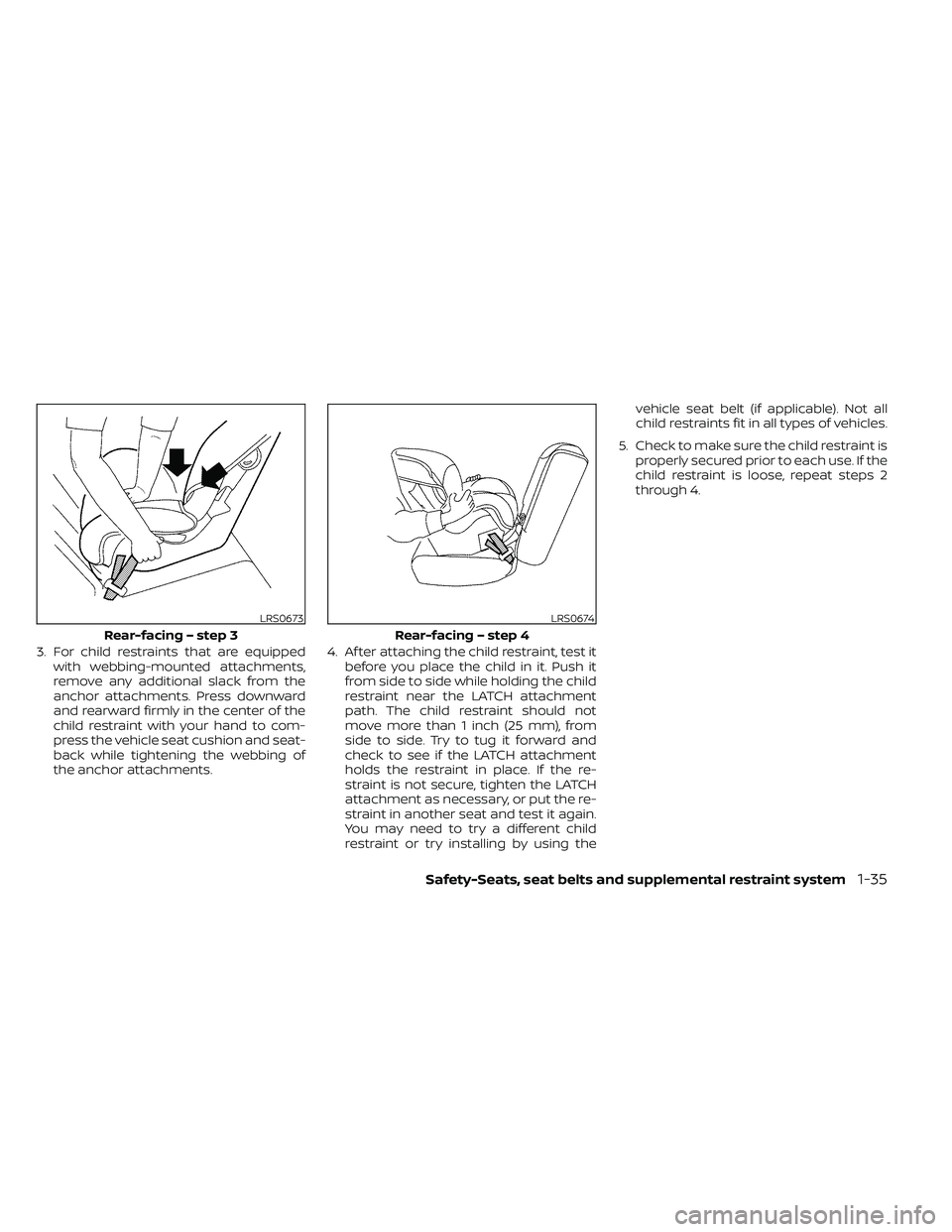
3. For child restraints that are equippedwith webbing-mounted attachments,
remove any additional slack from the
anchor attachments. Press downward
and rearward firmly in the center of the
child restraint with your hand to com-
press the vehicle seat cushion and seat-
back while tightening the webbing of
the anchor attachments. 4. Af ter attaching the child restraint, test it
before you place the child in it. Push it
from side to side while holding the child
restraint near the LATCH attachment
path. The child restraint should not
move more than 1 inch (25 mm), from
side to side. Try to tug it forward and
check to see if the LATCH attachment
holds the restraint in place. If the re-
straint is not secure, tighten the LATCH
attachment as necessary, or put the re-
straint in another seat and test it again.
You may need to try a different child
restraint or try installing by using the vehicle seat belt (if applicable). Not all
child restraints fit in all types of vehicles.
5. Check to make sure the child restraint is properly secured prior to each use. If the
child restraint is loose, repeat steps 2
through 4.
LRS0673
Rear-facing – step 3
Safety-Seats, seat belts and supplemental restraint system1-35
Page 60 of 492
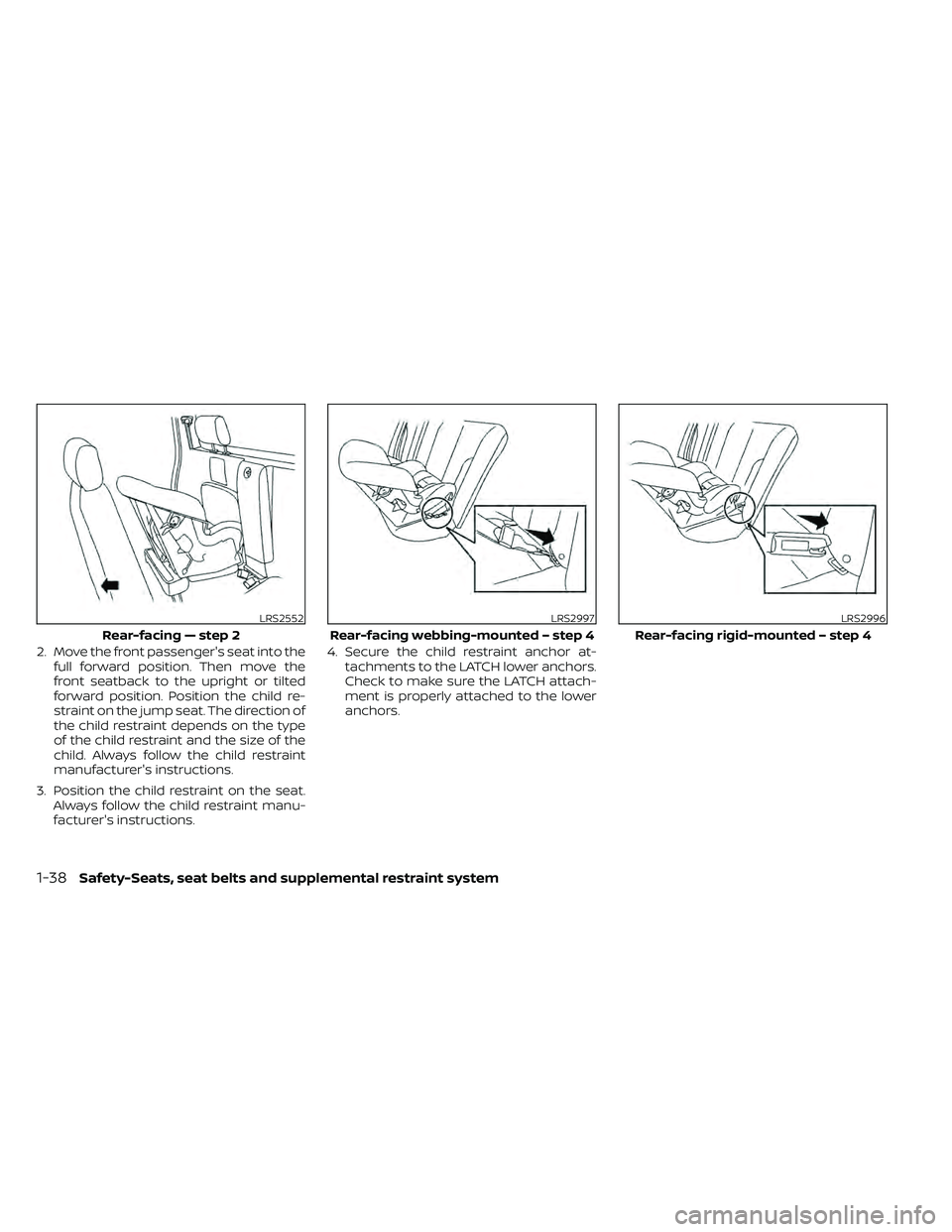
2. Move the front passenger's seat into thefull forward position. Then move the
front seatback to the upright or tilted
forward position. Position the child re-
straint on the jump seat. The direction of
the child restraint depends on the type
of the child restraint and the size of the
child. Always follow the child restraint
manufacturer's instructions.
3. Position the child restraint on the seat. Always follow the child restraint manu-
facturer's instructions. 4. Secure the child restraint anchor at-
tachments to the LATCH lower anchors.
Check to make sure the LATCH attach-
ment is properly attached to the lower
anchors.
LRS2552
Rear-facing — step 2
Page 61 of 492
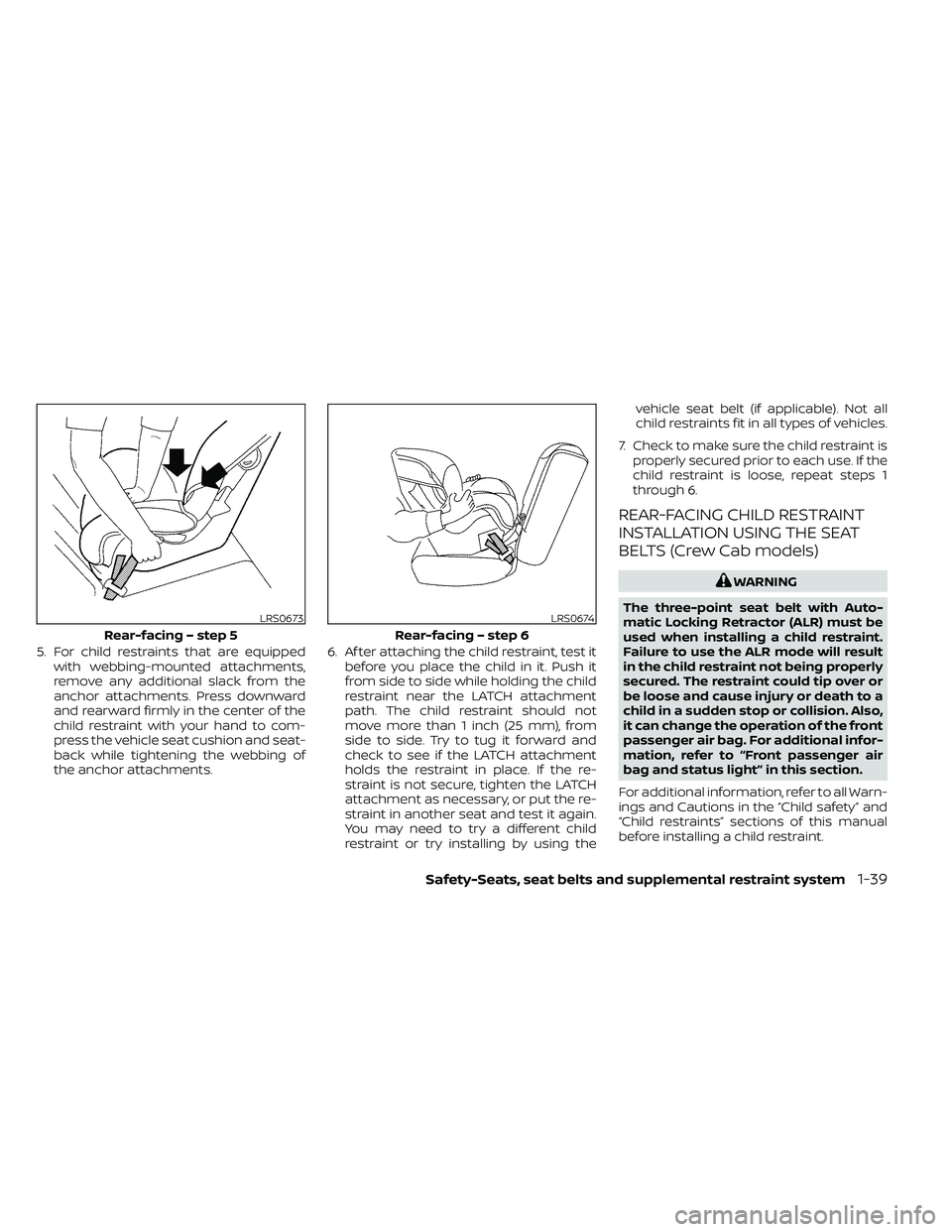
5. For child restraints that are equippedwith webbing-mounted attachments,
remove any additional slack from the
anchor attachments. Press downward
and rearward firmly in the center of the
child restraint with your hand to com-
press the vehicle seat cushion and seat-
back while tightening the webbing of
the anchor attachments. 6. Af ter attaching the child restraint, test it
before you place the child in it. Push it
from side to side while holding the child
restraint near the LATCH attachment
path. The child restraint should not
move more than 1 inch (25 mm), from
side to side. Try to tug it forward and
check to see if the LATCH attachment
holds the restraint in place. If the re-
straint is not secure, tighten the LATCH
attachment as necessary, or put the re-
straint in another seat and test it again.
You may need to try a different child
restraint or try installing by using the vehicle seat belt (if applicable). Not all
child restraints fit in all types of vehicles.
7. Check to make sure the child restraint is properly secured prior to each use. If the
child restraint is loose, repeat steps 1
through 6.
REAR-FACING CHILD RESTRAINT
INSTALLATION USING THE SEAT
BELTS (Crew Cab models)
LRS0673
Rear-facing – step 5
Safety-Seats, seat belts and supplemental restraint system1-39
Page 64 of 492
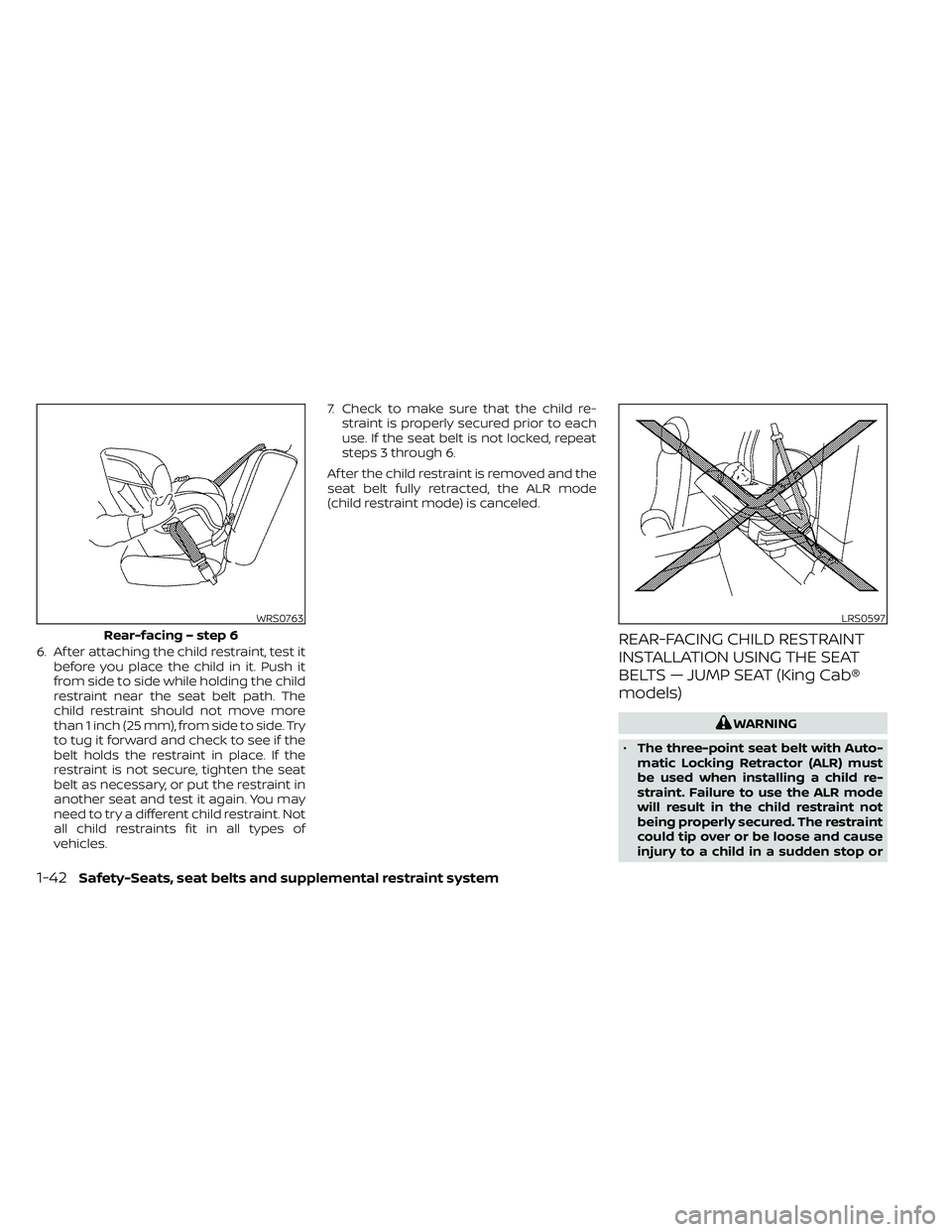
6. Af ter attaching the child restraint, test itbefore you place the child in it. Push it
from side to side while holding the child
restraint near the seat belt path. The
child restraint should not move more
than 1 inch (25 mm), from side to side. Try
to tug it forward and check to see if the
belt holds the restraint in place. If the
restraint is not secure, tighten the seat
belt as necessary, or put the restraint in
another seat and test it again. You may
need to try a different child restraint. Not
all child restraints fit in all types of
vehicles. 7. Check to make sure that the child re-
straint is properly secured prior to each
use. If the seat belt is not locked, repeat
steps 3 through 6.
Af ter the child restraint is removed and the
seat belt fully retracted, the ALR mode
(child restraint mode) is canceled.REAR-FACING CHILD RESTRAINT
INSTALLATION USING THE SEAT
BELTS — JUMP SEAT (King Cab®
models)
1-42Safety-Seats, seat belts and supplemental restraint system
Page 68 of 492
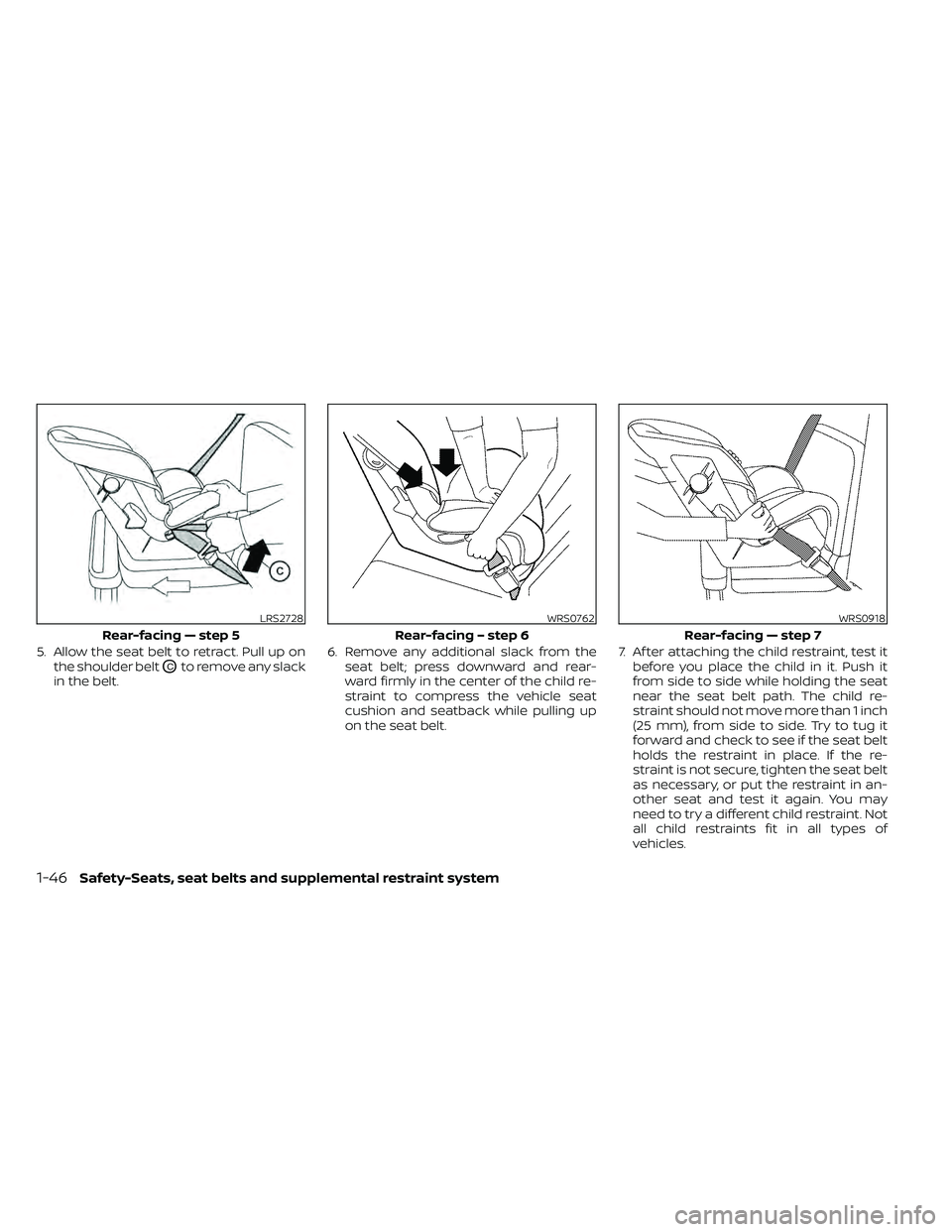
5. Allow the seat belt to retract. Pull up onthe shoulder belt
OCto remove any slack
in the belt. 6. Remove any additional slack from the
seat belt; press downward and rear-
ward firmly in the center of the child re-
straint to compress the vehicle seat
cushion and seatback while pulling up
on the seat belt. 7. Af ter attaching the child restraint, test it
before you place the child in it. Push it
from side to side while holding the seat
near the seat belt path. The child re-
straint should not move more than 1 inch
(25 mm), from side to side. Try to tug it
forward and check to see if the seat belt
holds the restraint in place. If the re-
straint is not secure, tighten the seat belt
as necessary, or put the restraint in an-
other seat and test it again. You may
need to try a different child restraint. Not
all child restraints fit in all types of
vehicles.
LRS2728
Rear-facing — step 5
Page 69 of 492
8. Check to make sure that the child re-straint is properly secured prior to each
use. If the seat belt is not locked, repeat
steps 3 through 7.
Af ter the child restraint is removed and the
seat belt fully retracted, the ALR mode
(child restraint mode) is canceled.
FORWARD-FACING CHILD
RESTRAINT INSTALLATION USING
LATCH (Crew Cab models)
For additional information, refer to all Warn-
ings and Cautions in the “Child safety” and
“Child restraints” sections of this manual
before installing a child restraint.
Do not use the lower anchors if the com-
bined weight of the child and the child re-
straint exceeds 65 lbs. (29.5 kg). If the com-
bined weight of the child and the child
restraint is greater than 65 lbs., (29.5 kg) use
the vehicle's seat belt (not the lower an-
chors) to install the child restraint. Be sure
to follow the child restraint manufacturer's
instructions for installation.
Follow these steps to install a forward-
facing child restraint in the rear seats using
the LATCH system:
1. Position the child restraint on the seat. Always follow the child restraint manu-
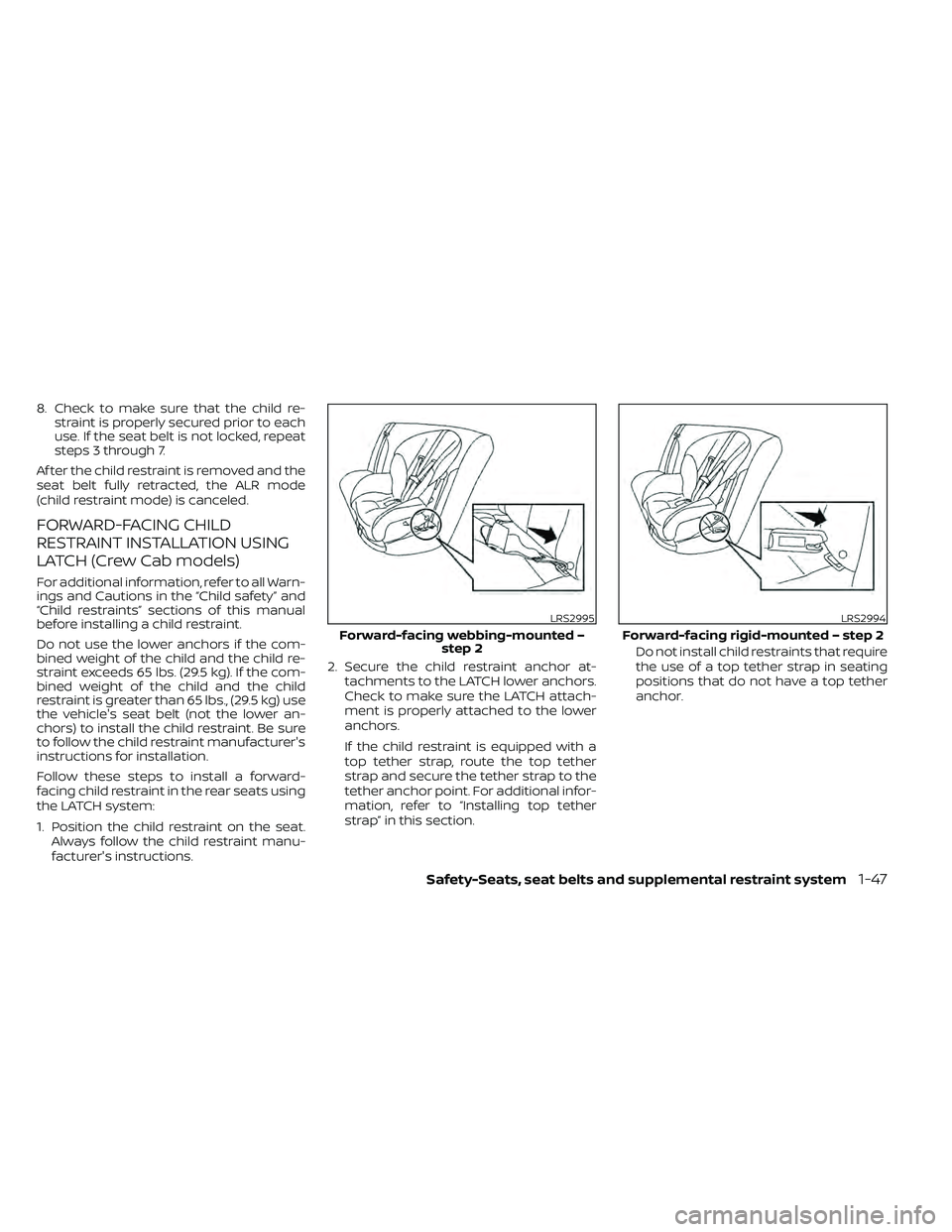
facturer's instructions. 2. Secure the child restraint anchor at-
tachments to the LATCH lower anchors.
Check to make sure the LATCH attach-
ment is properly attached to the lower
anchors.
If the child restraint is equipped with a
top tether strap, route the top tether
strap and secure the tether strap to the
tether anchor point. For additional infor-
mation, refer to “Installing top tether
strap” in this section. Do not install child restraints that require
the use of a top tether strap in seating
positions that do not have a top tether
anchor.
LRS2995
Forward-facing webbing-mounted –
step 2
Safety-Seats, seat belts and supplemental restraint system1-47
Page 70 of 492
3. The back of the child restraint should besecured against the vehicle seatback.
If necessary, adjust or remove the head
restraint/headrest to obtain the correct
child restraint fit. If the head restraint/
headrest is removed, store it in a secure
place. Be sure to reinstall the head
restraint/headrest when the child re-
straint is removed. For additional infor-
mation, refer to “Head restraints/
headrests” in this section.
If the seating position does not have an
adjustable head restraint/headrest and
it is interfering with the proper child re-
straint fit, try another seating position or
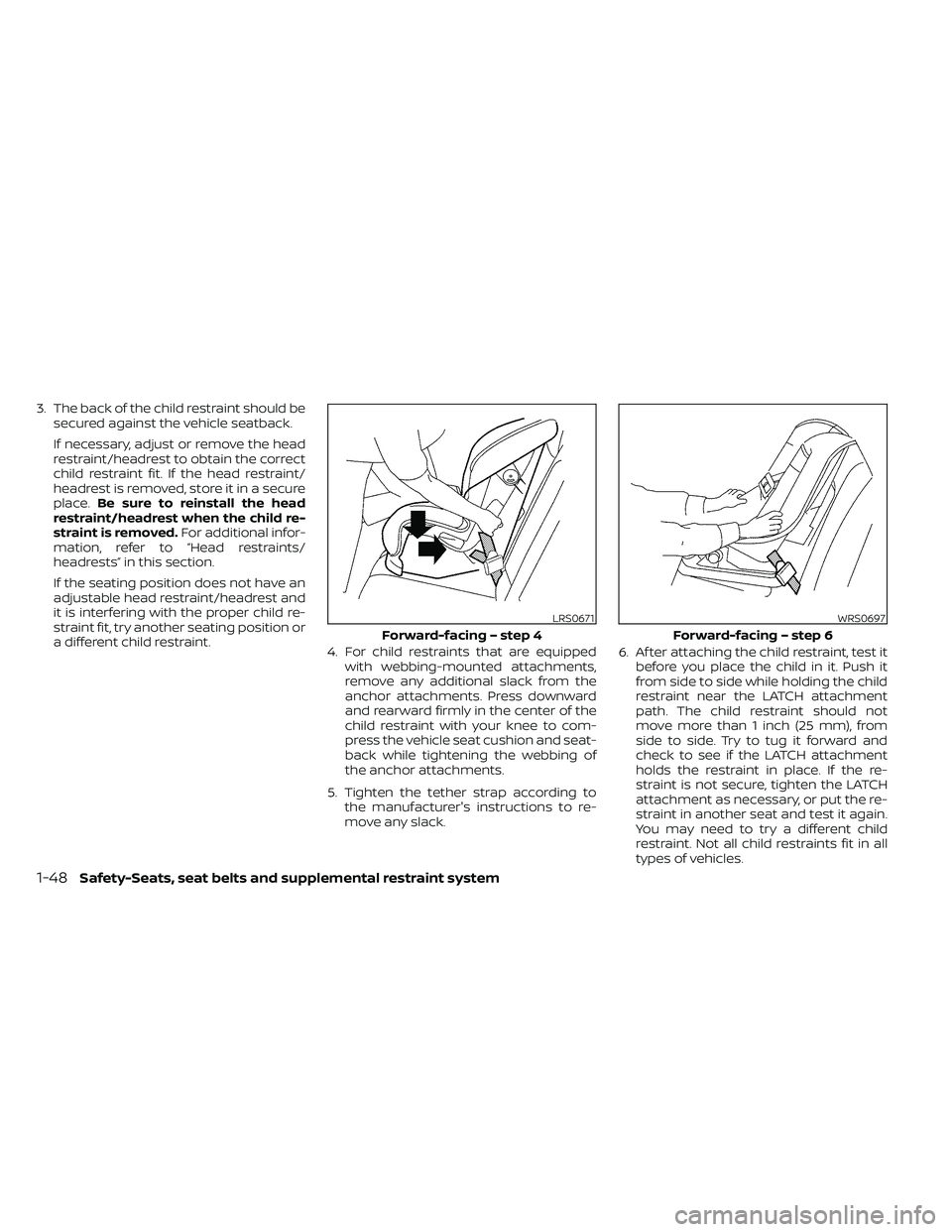
a different child restraint. 4. For child restraints that are equipped
with webbing-mounted attachments,
remove any additional slack from the
anchor attachments. Press downward
and rearward firmly in the center of the
child restraint with your knee to com-
press the vehicle seat cushion and seat-
back while tightening the webbing of
the anchor attachments.
5. Tighten the tether strap according to the manufacturer's instructions to re-
move any slack. 6. Af ter attaching the child restraint, test it
before you place the child in it. Push it
from side to side while holding the child
restraint near the LATCH attachment
path. The child restraint should not
move more than 1 inch (25 mm), from
side to side. Try to tug it forward and
check to see if the LATCH attachment
holds the restraint in place. If the re-
straint is not secure, tighten the LATCH
attachment as necessary, or put the re-
straint in another seat and test it again.
You may need to try a different child
restraint. Not all child restraints fit in all
types of vehicles.
LRS0671
Forward-facing – step 4