4WD NISSAN FRONTIER 2022 Owner´s Manual
[x] Cancel search | Manufacturer: NISSAN, Model Year: 2022, Model line: FRONTIER, Model: NISSAN FRONTIER 2022Pages: 556, PDF Size: 6.11 MB
Page 497 of 556
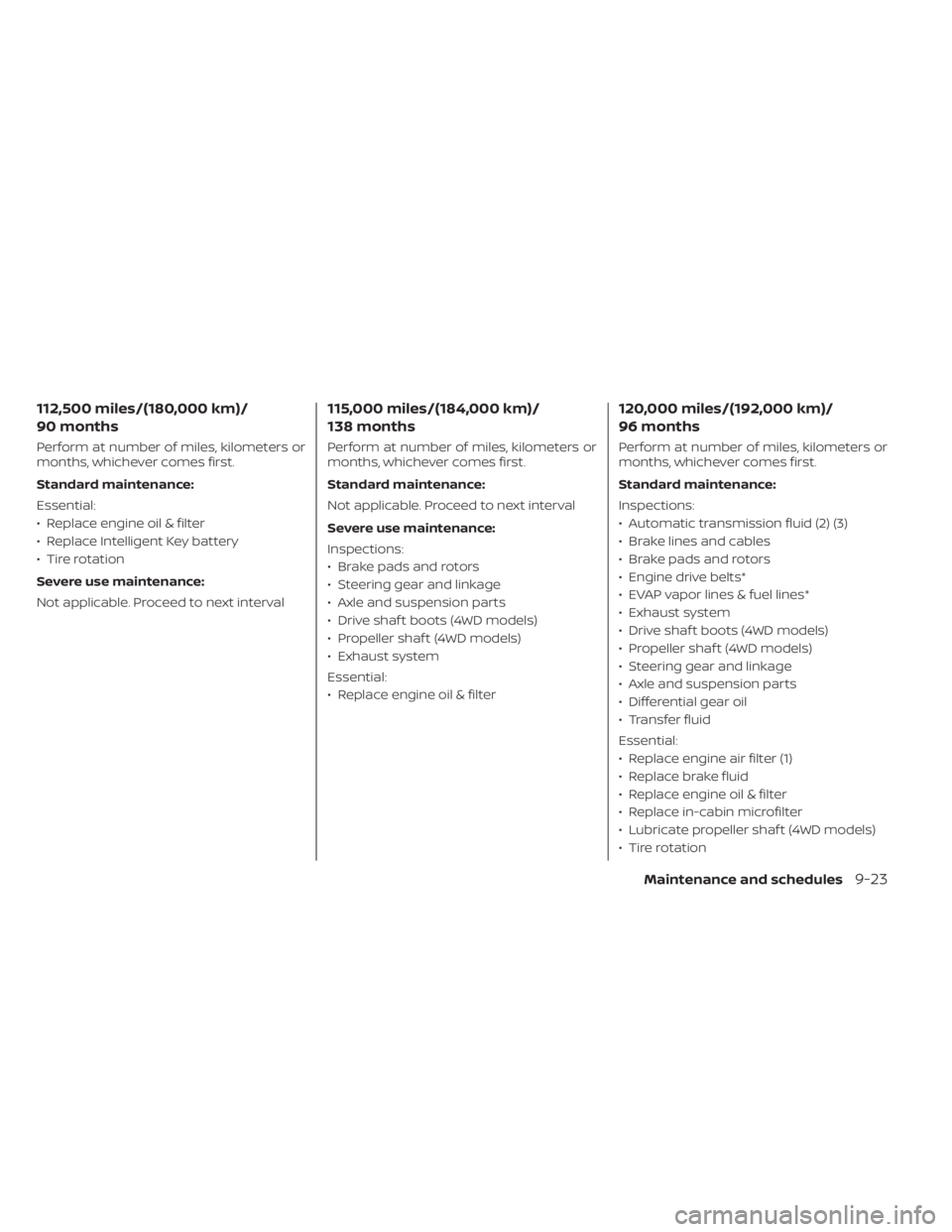
112,500 miles/(180,000 km)/
90 months
Perform at number of miles, kilometers or
months, whichever comes first.
Standard maintenance:
Essential:
• Replace engine oil & filter
• Replace Intelligent Key battery
• Tire rotation
Severe use maintenance:
Not applicable. Proceed to next interval
115,000 miles/(184,000 km)/
138 months
Perform at number of miles, kilometers or
months, whichever comes first.
Standard maintenance:
Not applicable. Proceed to next interval
Severe use maintenance:
Inspections:
• Brake pads and rotors
• Steering gear and linkage
• Axle and suspension parts
• Drive shaf t boots (4WD models)
• Propeller shaf t (4WD models)
• Exhaust system
Essential:
• Replace engine oil & filter
120,000 miles/(192,000 km)/
96 months
Perform at number of miles, kilometers or
months, whichever comes first.
Standard maintenance:
Inspections:
• Automatic transmission fluid (2) (3)
• Brake lines and cables
• Brake pads and rotors
• Engine drive belts*
• EVAP vapor lines & fuel lines*
• Exhaust system
• Drive shaf t boots (4WD models)
• Propeller shaf t (4WD models)
• Steering gear and linkage
• Axle and suspension parts
• Differential gear oil
• Transfer fluid
Essential:
• Replace engine air filter (1)
• Replace brake fluid
• Replace engine oil & filter
• Replace in-cabin microfilter
• Lubricate propeller shaf t (4WD models)
• Tire rotation
Maintenance and schedules9-23
Page 499 of 556
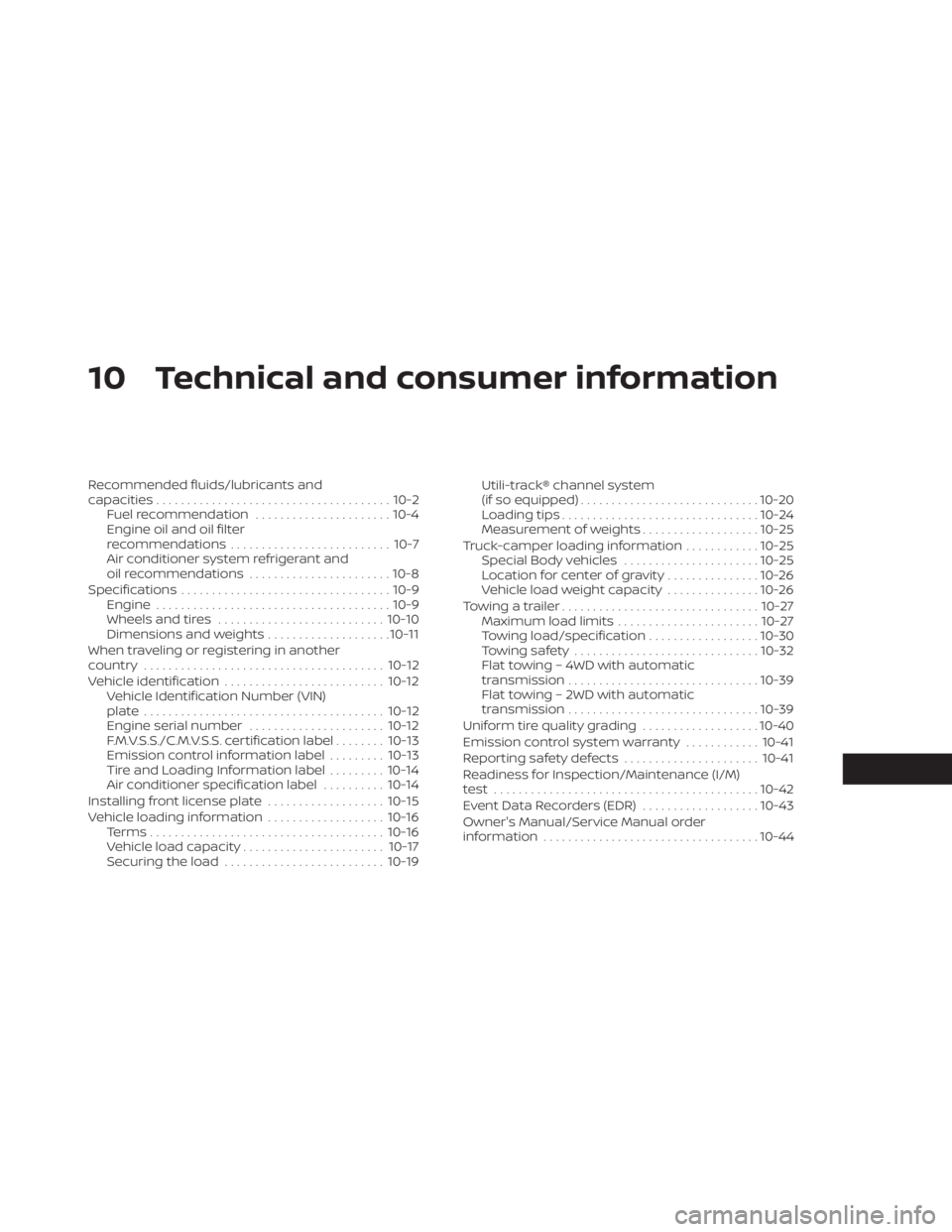
10 Technical and consumer information
Recommended fluids/lubricants and
capacities...................................... 10-2
Fuel recommendation ......................10-4
Engine oil and oil filter
recommendations .......................... 10-7
Air conditioner system refrigerant and
oil recommendations .......................10-8
Specifications .................................. 10-9
Engine ...................................... 10-9
Wheels and tires ........................... 10-10
Dimensions and weights ....................10-11
When traveling or registering in another
country ....................................... 10-12
Vehicle identification .......................... 10-12
Vehicle Identification Number (VIN)
plate ....................................... 10-12
Engine serial number ......................10-12
F.M.V.S.S./C.M.V.S.S. certification label ........10-13
Emission control information label .........10-13
Tire and Loading Information label .........10-14
Air conditioner specification label ..........10-14
Installing front license plate ...................10-15
Vehicle loading information ...................10-16
Terms ...................................... 10-16
Vehicle load capacity ....................... 10-17
Securing the load .......................... 10-19Utili-track® channel system
(if so equipped)
............................. 10-20
Loading tips ................................ 10-24
Measurement of weights ...................10-25
Truck-camper loading information ............10-25
Special Body vehicles ......................10-25
Location for center of gravity ...............10-26
Vehicle load weight capacity ...............10-26
Towing a trailer ................................ 10-27
Maximum load limits ....................... 10-27
Towing load/specification ..................10-30
Towing safety .............................. 10-32
Flat towing – 4WD with automatic
transmission ...............................
10-39
Flat
towing – 2WD with automatic
transmission ............................... 10-39
Uniform tire quality grading ...................10-40
Emission control system warranty ............10-41
Reporting safety defects ......................10-41
Readiness for Inspection/Maintenance (I/M)
test ........................................... 10-42
Event Data Recorders (EDR) ...................10-43
Owner's Manual/Service Manual order
information ................................... 10-44
Page 509 of 556
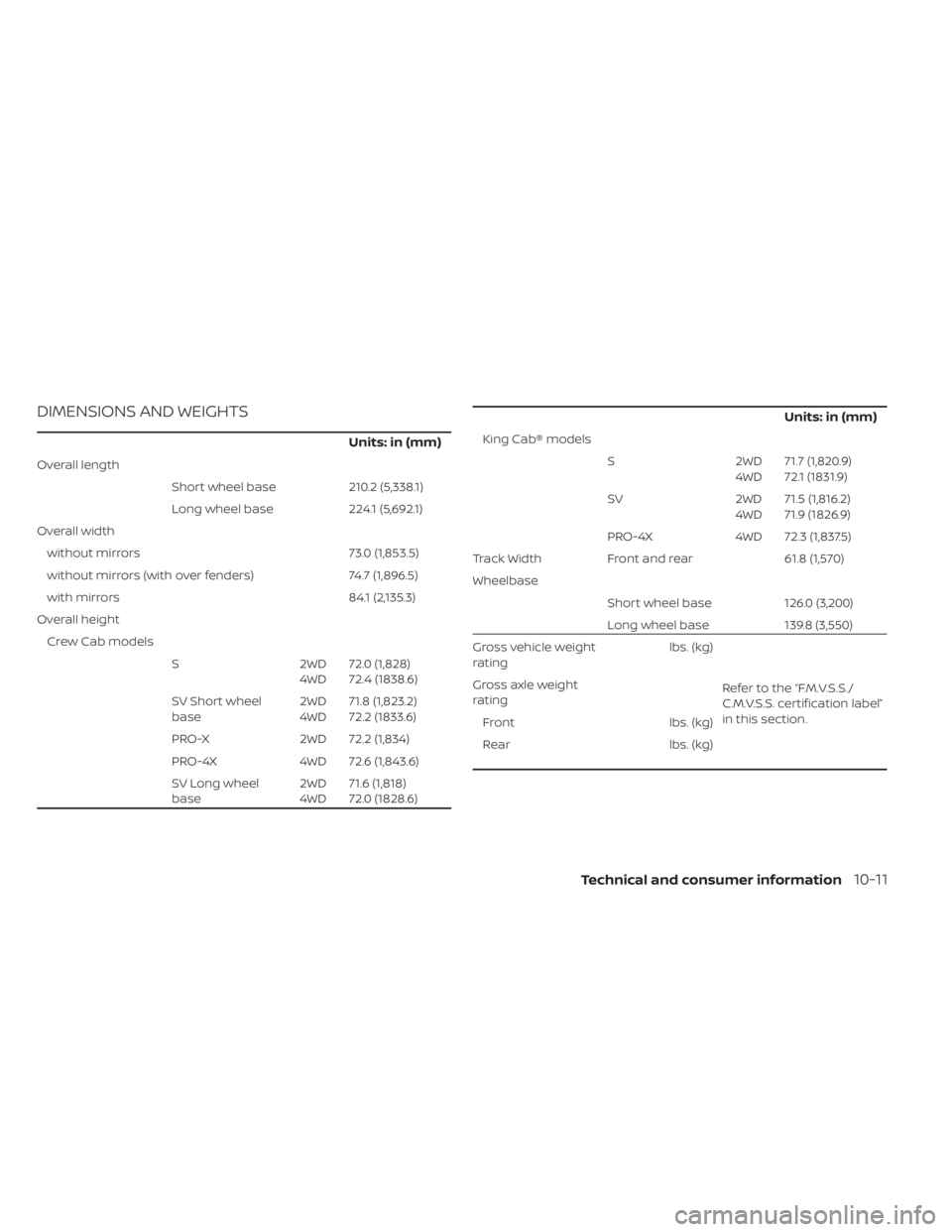
DIMENSIONS AND WEIGHTS
Units: in (mm)
Overall lengthShort wheel base 210.2 (5,338.1)
Long wheel base 224.1 (5,692.1)
Overall width without mirrors 73.0 (1,853.5)
without mirrors (with over fenders) 74.7 (1,896.5)
with mirrors 84.1 (2,135.3)
Overall height Crew Cab models S 2WD
4WD 72.0 (1,828)
72.4 (1838.6)
SV Short wheel
base 2WD
4WD 71.8 (1,823.2)
72.2 (1833.6)
PRO-X 2WD 72.2 (1,834)
PRO-4X 4WD 72.6 (1,843.6)
SV Long wheel
base 2WD
4WD 71.6 (1,818)
72.0 (1828.6)
Units: in (mm)
King Cab® models
S 2WD 4WD71.7 (1,820.9)
72.1 (1831.9)
SV 2WD 4WD71.5 (1,816.2)
71.9 (1826.9)
PRO-4X 4WD 72.3 (1,837.5)
Track Width Front and rear 61.8 (1,570)
Wheelbase Short wheel base 126.0 (3,200)
Long wheel base 139.8 (3,550)
Gross vehicle weight
rating lbs. (kg)
Refer to the “F.M.V.S.S./
C.M.V.S.S. certification label”
in this section.
Gross axle weight
rating
Front lbs. (kg)
Rear lbs. (kg)
Technical and consumer information10-11
Page 529 of 556
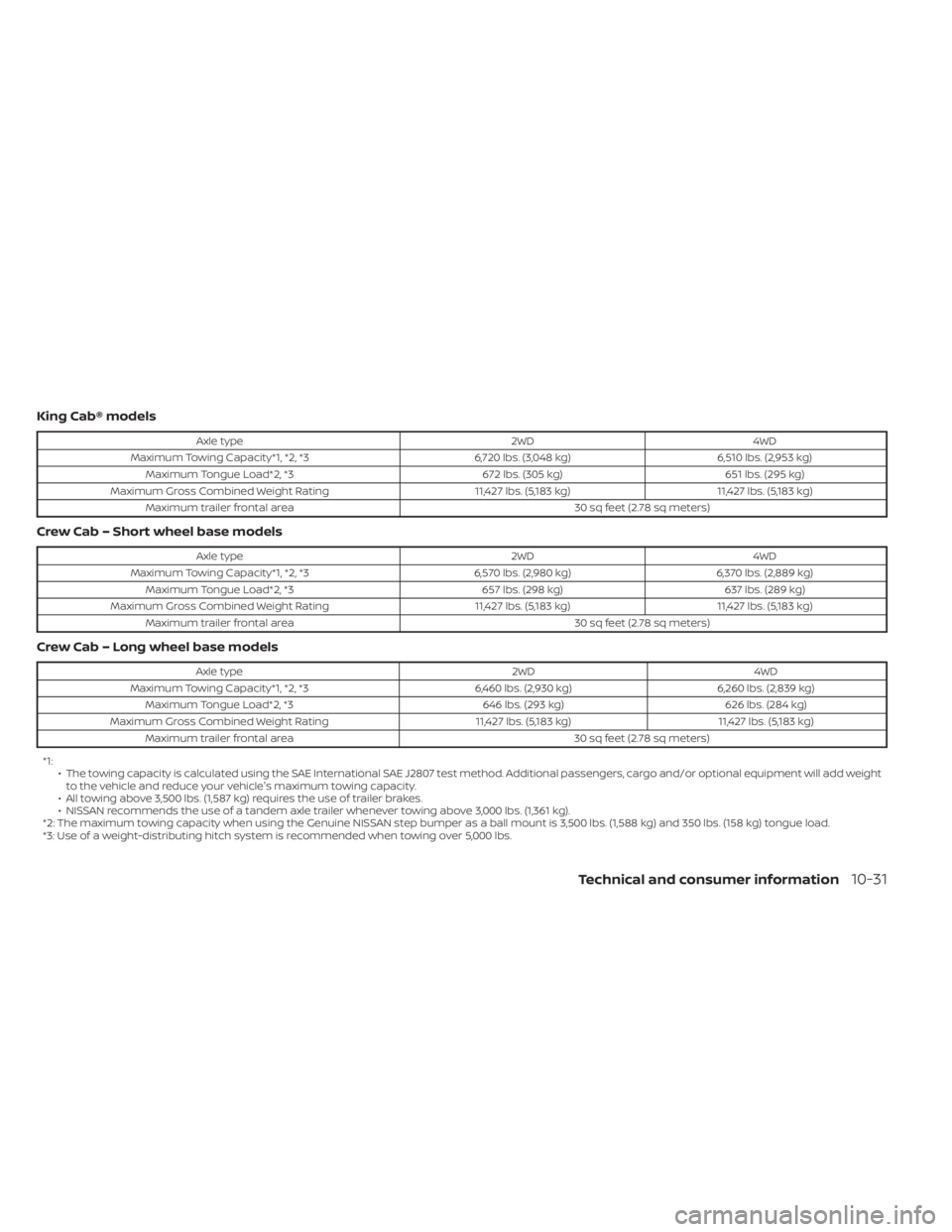
King Cab® models
Axle type2WD4WD
Maximum Towing Capacity*1, *2, *3 6,720 lbs. (3,048 kg)6,510 lbs. (2,953 kg)
Maximum Tongue Load*2, *3 672 lbs. (305 kg)651 lbs. (295 kg)
Maximum Gross Combined Weight Rating 11,427 lbs. (5,183 kg)11,427 lbs. (5,183 kg)
Maximum trailer frontal area 30 sq feet (2.78 sq meters)
Crew Cab – Short wheel base models
Axle type2WD4WD
Maximum Towing Capacity*1, *2, *3 6,570 lbs. (2,980 kg)6,370 lbs. (2,889 kg)
Maximum Tongue Load*2, *3 657 lbs. (298 kg)637 lbs. (289 kg)
Maximum Gross Combined Weight Rating 11,427 lbs. (5,183 kg)11,427 lbs. (5,183 kg)
Maximum trailer frontal area 30 sq feet (2.78 sq meters)
Crew Cab – Long wheel base models
Axle type2WD4WD
Maximum Towing Capacity*1, *2, *3 6,460 lbs. (2,930 kg)6,260 lbs. (2,839 kg)
Maximum Tongue Load*2, *3 646 lbs. (293 kg)626 lbs. (284 kg)
Maximum Gross Combined Weight Rating 11,427 lbs. (5,183 kg)11,427 lbs. (5,183 kg)
Maximum trailer frontal area 30 sq feet (2.78 sq meters)
*1: • The towing capacity is calculated using the SAE International SAE J2807 test method. Additional passengers, cargo and/or optional equipment will a dd weight
to the vehicle and reduce your vehicle's maximum towing capacity.
• All towing above 3,500 lbs. (1,587 kg) requires the use of trailer brakes.
• NISSAN recommends the use of a tandem axle trailer whenever towing above 3,000 lbs. (1,361 kg).
*2: The maximum towing capacity when using the Genuine NISSAN step bumper as a ball mount is 3,500 lbs. (1,588 kg) and 350 lbs. (158 kg) tongue load.
*3: Use of a weight-distributing hitch system is recommended when towing over 5,000 lbs.
Technical and consumer information10-31
Page 535 of 556
• Lock the trailer hitch coupler with a pin orlock to prevent the coupler from inadver-
tently becoming unlatched.
• Avoid abrupt starts, acceleration or stops.
• Avoid sharp turns or lane changes.
• Always drive your vehicle at a moderate speed.
• When backing up, hold the bottom of the steering wheel with one hand. Move your
hand in the direction in which you want
the trailer to go. Make small corrections
and back up slowly. If possible, have
someone guide you when you are back-
ing up.
Always block the wheels on both vehicle
and trailer when parking. Parking on a
slope is not recommended; however, if you
must do so:
CAUTION
If you move the shif t lever to the P
(Park) position before blocking the
wheels and applying the parking brake,
transmission damage could occur. 1. Apply and hold the brake pedal.
2. Have someone place blocks on the
downhill side of the vehicle and trailer
wheels.
3. Af ter the wheel blocks are in place, slowly release the brake pedal until the
blocks absorb the vehicle load.
4. Apply the parking brake.
5. Shif t the transmission into P (Park).
6. Make sure the 4WD shif t indicator light (if so equipped) indicates the transfer case
is in 4H, 4LO, or 2WD and that the ATP
light is off. If the 4WD shif t indicator light
is flashing, or the ATP light is ON, make
sure the transmission is in P (Park) and
turn the 4WD switch to 2WD or 4H. For
additional information, see “Automatic
transmission park warning light” (P. 2-11)
and “Using 4-wheel drive (4WD)” (P. 5-109).
7. Turn off the engine.
To drive away:
1. Start the vehicle.
2. Apply and hold the brake pedal.
3. Shif t the transmission into gear.
4. Release the parking brake. 5. Drive slowly until the vehicle and trailer
are clear from the blocks.
6. Apply and hold the brake pedal.
7. Have someone retrieve and store the blocks.
• While going downhill, the weight of the trailer pushing on the tow vehicle may
decrease overall stability. Therefore, to
maintain adequate control, reduce your
speed and shif t to a lower gear. Avoid
long or repeated use of the brakes when
descending a hill, as this reduces their
effectiveness and could cause overheat-
ing. Shif ting to a lower gear instead pro-
vides “engine braking” and reduces the
need to brake as frequently.
• If the engine coolant temperature rises to a high temperature, see “If your vehicle
overheats” (P. 6-13).
• Trailer towing requires more fuel than normal circumstances.
• Avoid towing a trailer for your vehicle's first 500 miles (805 km).
• For the first 500 miles (805 km) that you do tow, do not drive over 50 mph (80
km/h).
Technical and consumer information10-37
Page 537 of 556
Tow mode includes the following features:
• Grade logic — Adjusts transmission shif tswhen pulling a trailer or hauling a load up
a grade.
• Downhill Speed Control (DSC) — auto- matically downshif ts when driving down
a grade with a trailer or heavy load to help
control vehicle speed.
Driving the vehicle in the tow mode with no
trailer/load or light trailer/light load will not
cause any damage. However, fuel
economy may be reduced and the
transmission/engine driving characteris-
tics may feel unusual.
When towing a trailer, final drive gear oil
should be replaced and transmission oil/
fluid should be changed more fre-
quently. For additional information, see
the “Do-it-yourself ” section of this
manual.
FLAT TOWING – 4WD WITH
AUTOMATIC TRANSMISSION
Towing a vehicle behind a recreational ve-
hicle, such as a motor home, is sometimes
called flat towing.
CAUTION
• DO NOT flat tow a 4WD vehicle
equipped with an automatic trans-
mission. Flat towing or using a ve-
hicle dolly WILL DAMAGE internal
transmission parts due to lack of
lubrication.
• For emergency towing procedures,
see “Towing recommended by
NISSAN” in the “In case of emer-
gency ” (P. 6-15).
FLAT TOWING – 2WD WITH
AUTOMATIC TRANSMISSION
Towing a vehicle behind a recreational ve-
hicle, such as a motor home, is sometimes
called flat towing.
CAUTION
• Failure to follow these guidelines can
result in severe transmission
damage.
• Whenever flat towing your vehicle,
always tow forward, never backward. •
DO NOT tow any automatic transmis-
sion vehicle with all four wheels on
the ground. Doing so WILL DAMAGE
internal transmission parts due to
lack of transmission lubrication.
• For emergency towing procedures,
see “Towing recommended by
NISSAN” in the “In case of emer-
gency ” (P. 6-15).
To tow a vehicle equipped with an auto-
matic transmission, an appropriate vehicle
dolly MUST be placed under the towed ve-
hicle’s drive wheels. Alwaysfollow the dolly
manufacturer’s recommendations when
using their product.
Automatic Transmission
To tow a vehicle equipped with an auto-
matic transmission, an appropriate vehicle
dolly MUST be placed under the towed ve-
hicle's drive wheels. Alwaysfollow the dolly
manufacturer's recommendations when
using their product.
NOTE:
If the battery is completely drained the
transmission will not manually shif t to
other positions.
Technical and consumer information10-39
Page 540 of 556
You may contact Transport Cana-
da's Defect Investigations and Re-
calls Division toll free at 1-800-333-
0510. You may also report safety
defects online at: http://
www.tc.gc.ca/eng/
motorvehiclesafety/menu.htm
(English speakers) or http://
www.tc.gc.ca/fra/
securiteautomobile/menu.htm
(French speakers)
Or contact Transport Canada by
mail at:
Transport Canada Motor Vehicle
Safety Investigations Laboratory
80 Noel Street Gatineau, QC J8Z0A1
Additional information concerning
motor vehicle safety may be ob-
tained from Transport Canada's
Road Safety Information Centre at
1-800-333-0371 or online at
www.tc.gc.ca/roadsafety (English
speakers) or www.tc.gc.ca/
securiteroutiere (French speakers).To notif y NISSAN of any safety con-
cerns please contact our Consumer
Information Centre toll free at
1-800-387-0122.WARNING
A vehicle equipped with Four-Wheel
Drive (4WD) should never be tested us-
ing a two wheel dynamometer (such as
the dynamometers used by some
states for emissions testing), or similar
equipment. Make sure you inform the
test facility personnel that your vehicle
is equipped with 4WD before it is placed
on a dynamometer. Using the wrong
test equipment may result in transmis-
sion damage or unexpected vehicle
movement which could result in seri-
ous vehicle damage or personal injury.
Due to legal requirements in some states
and Canadian Provinces, your vehicle may
be required to be in what is called the
“ready condition” for an Inspection/
Maintenance (I/M) test of the emission
control system.
The vehicle is set to the “ready condition”
when it is driven through certain driving
patterns. Usually, the ready condition can
be obtained by ordinary usage of the
vehicle.
READINESS FOR INSPECTION/
MAINTENANCE (I/M) TEST
10-42Technical and consumer information
Page 543 of 556
11 Index
4
4-Wheel Drive................5-1094WD......................5-109
A
Active Brake Limited Slip (ABLS)
system....................5-120Air bag (See supplemental restraint
system).....................1-71Air bag systemFront (See supplemental front impact air
bag system)
................1-78Air bag warning labels...........1-88Air bag warning light.........1-88, 2-14Air bag warning light,
supplemental.............1-88, 2-14Air cleaner housing filter..........8-18Air conditionerAir conditioner operation. . . .4-30, 4-36Air conditioner service..........4-40Air conditioner specification label. .10-14Air conditioner system refrigerant
recommendations............10-8Air conditioner system refrigerant and oil
recommendations............10-8Heater and air conditioner (automatic)
(if so equipped)..............4-35
Heater and air conditioner
controls.................. .4-36Servicing air conditioner........4-40Air flow charts.................4-31Alarm system (See vehicle security
system)................... .2-34Anchor point locations...........1-33Antenna....................4-40Anti-lock brake warning light........2-11Anti-lock Braking System (ABS)......5-119Antifreeze...................5-129Autolight switch...............2-39Automatic
Automatic power window switch. . .2-71Driving with automatic
transmission................5-18Automatic anti-glare inside mirror. . . .3-25Automatic door locks.............3-7Automatic Emergency Braking (AEB) with
Pedestrian Detection............5-81Automatic transmission fluid temperature
gauge..................... .2-8
B
Battery.................5-129, 8-14Charge warning light...........2-13Battery replacement............8-23Key fob...................8-23NISSAN Intelligent Key®.........8-24
Before starting the engine.........5-17Belt (See drive belt)..............8-16Blind Spot Warning (BSW)..........5-32Booster seats.................1-66Brake
Anti-lock Braking System (ABS). . . .5-119Brake fluid.................8-12Brake light (See stop light).......8-27Brake system...............5-118Brake warning light............2-12Brake wear indicators.......2-19,8-20Parking brake operation.........5-23Self-adjusting brakes..........8-20Brake fluid...................8-12Brake system................5-118Brakes.....................8-20Break-in schedule..............5-107Brightness controlInstrument panel.............2-44Bulb check/instrument panel.......2-11Bulb replacement..............8-27
C
C.M.V.S.S. certification label........10-13Capacities and recommended
fuel/lubricants................10-2Car phone or CB radio............4-41Cargo (See vehicle loading
information)................ .10-16
Page 549 of 556
Tire pressure................8-30Tire rotation.................8-39Tires of 4-wheel drive...........8-41Types of tires................8-37Uniform tire quality grading......10-40Wheel/tire size...............10-10Wheels and tires..........8-30, 10-10Tire pressure
Low tire pressure warning light.....2-15Tire Pressure Monitoring System
(TPMS)...................... .5-5Top tether strap child restraint.......1-33Tow mode switch...............2-53Towing
2-wheel drive models...........6-16Flat towing................ .10-39Tow truck towing..............6-14Towing load/specification.......10-30Trailer towing...............10-27Towing a trailer................10-27Traffic Sign Recognition (TSR)........5-24Transceiver
HomeLink® Universal
Transceiver
. . .2-76, 2-77, 2-78, 2-79, 2-80TransmissionDriving with automatic
transmission
................5-18Travel (See registering a vehicle in another
country)................... .10-12Trip odometer..................2-5Truck - camper loading...........10-25Truck box....................3-27Turn signal switch...............2-44
U
Under seat storage bin...........2-64Uniform tire quality grading........10-40USB Charging Ports.............2-58Using four wheel drive (4WD).......5-109
V
Vanity mirror..................3-24Variable voltage control system......8-16Vehicle dimensions and weights.....10-11Vehicle Dynamic Control (VDC) OFF
switch..................... .2-48Vehicle Dynamic Control (VDC)
system.....................5-121Vehicle identification.............10-12Vehicle identification number (VIN). . . .10-12Vehicle identification number (VIN)
plate...................... .10-12Vehicle immobilizer system.....2-36, 5-16Vehicle information display.........2-20Vehicle loading information........10-16Vehicle recovery................6-16Vehicle security system...........2-34Vehicle security system (NISSAN Vehicle
Immobilizer System), engine start.2-36, 5-16Ventilators...................4-26Visors......................3-24Voltmeter....................2-8
W
Warning
Air bag warning light........1-88, 2-14Anti-lock brake warning light.......2-11Battery charge warning light......2-13Brake warning light............2-12Engine oil pressure warning light. . . .2-13Hazard warning flasher switch......6-2Loose fuel cap warning..........2-28Low fuel warning light. . . .2-13, 2-18, 2-29Low tire pressure warning light.....2-15Low windshield-washer fluid warning
light......................2-29Passenger air bag and status light. . .1-80Seat belt warning light.......1-18,2-13Supplemental air bag warning
light................. .1-88, 2-14Vehicle security system.........2-34Warning labels (for SRS)..........1-88Warning/indicator lights and audible
reminders..................2-11Warning lights.................2-11Warning lights, indicator lights and audible
reminders....................2-10Warning systems switch..........2-48Warning/indicator lights and audible
reminders....................2-11Audible reminders.............2-11Indicator lights...............2-11Warning lights................2-11Weights
(See dimensions and weights).......10-11Wheel/tire size................10-10
11-7