roof NISSAN FRONTIER 2023 User Guide
[x] Cancel search | Manufacturer: NISSAN, Model Year: 2023, Model line: FRONTIER, Model: NISSAN FRONTIER 2023Pages: 572, PDF Size: 6.58 MB
Page 193 of 572
POWER MOONROOF
The moonroof will only operate when the
ignition switch is in the ON position. The
power moonroof is operational for about
45 seconds, even if the ignition switch is
placed in the ACC or OFF position. If the
driver's door or the front passenger's door
is opened during this period of about 45
seconds, power to the moonroof is
canceled.
Sliding the moonroof
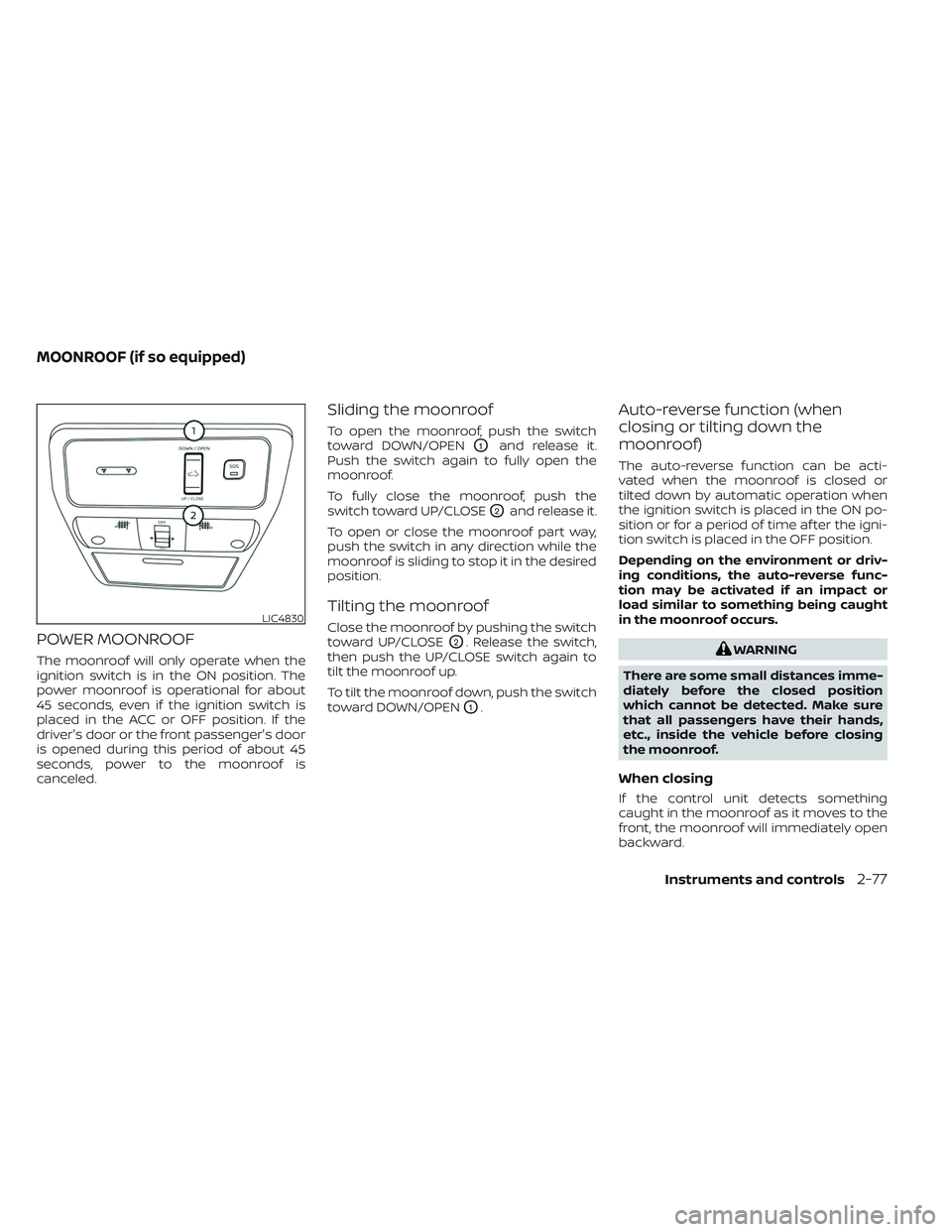
To open the moonroof, push the switch
toward DOWN/OPEN
O1and release it.
Push the switch again to fully open the
moonroof.
To fully close the moonroof, push the
switch toward UP/CLOSE
O2and release it.
To open or close the moonroof part way,
push the switch in any direction while the
moonroof is sliding to stop it in the desired
position.
Tilting the moonroof
Close the moonroof by pushing the switch
toward UP/CLOSE
O2. Release the switch,
then push the UP/CLOSE switch again to
tilt the moonroof up.
To tilt the moonroof down, push the switch
toward DOWN/OPEN
O1.
Auto-reverse function (when
closing or tilting down the
moonroof)
The auto-reverse function can be acti-
vated when the moonroof is closed or
tilted down by automatic operation when
the ignition switch is placed in the ON po-
sition or for a period of time af ter the igni-
tion switch is placed in the OFF position.
Depending on the environment or driv-
ing conditions, the auto-reverse func-
tion may be activated if an impact or
load similar to something being caught
in the moonroof occurs.
WARNING
There are some small distances imme-
diately before the closed position
which cannot be detected. Make sure
that all passengers have their hands,
etc., inside the vehicle before closing
the moonroof.
When closing
If the control unit detects something
caught in the moonroof as it moves to the
front, the moonroof will immediately open
backward.
LIC4830
MOONROOF (if so equipped)
Instruments and controls2-77
Page 194 of 572
When tilting down
If the control unit detects something
caught in the moonroof as it tilts down, the
moonroof will immediately tilt up.
If the auto-reverse function malfunctions
and repeats opening or tilting up the
moonroof, keep pushing the tilt down
switch within 5 seconds af ter it happens;
the moonroof will fully close gradually.
Make sure nothing is caught in the
moonroof.
WARNING
• In an accident you could be thrown
from the vehicle through an open
moonroof. Always use seat belts and
child restraints.
• Do not allow anyone to stand up or
extend any portion of their body out
of the moonroof opening while the
vehicle is in motion or while the
moonroof is closing.
CAUTION
• Remove water drops, snow, ice or
sand from the moonroof before
opening.
• Do not place heavy objects on the
moonroof or surrounding area.
Sunshade
Open and close the sunshade by sliding it
forward or backward.
If the moonroof does not close
Have your moonroof checked and re-
paired. It is recommended that you visit a
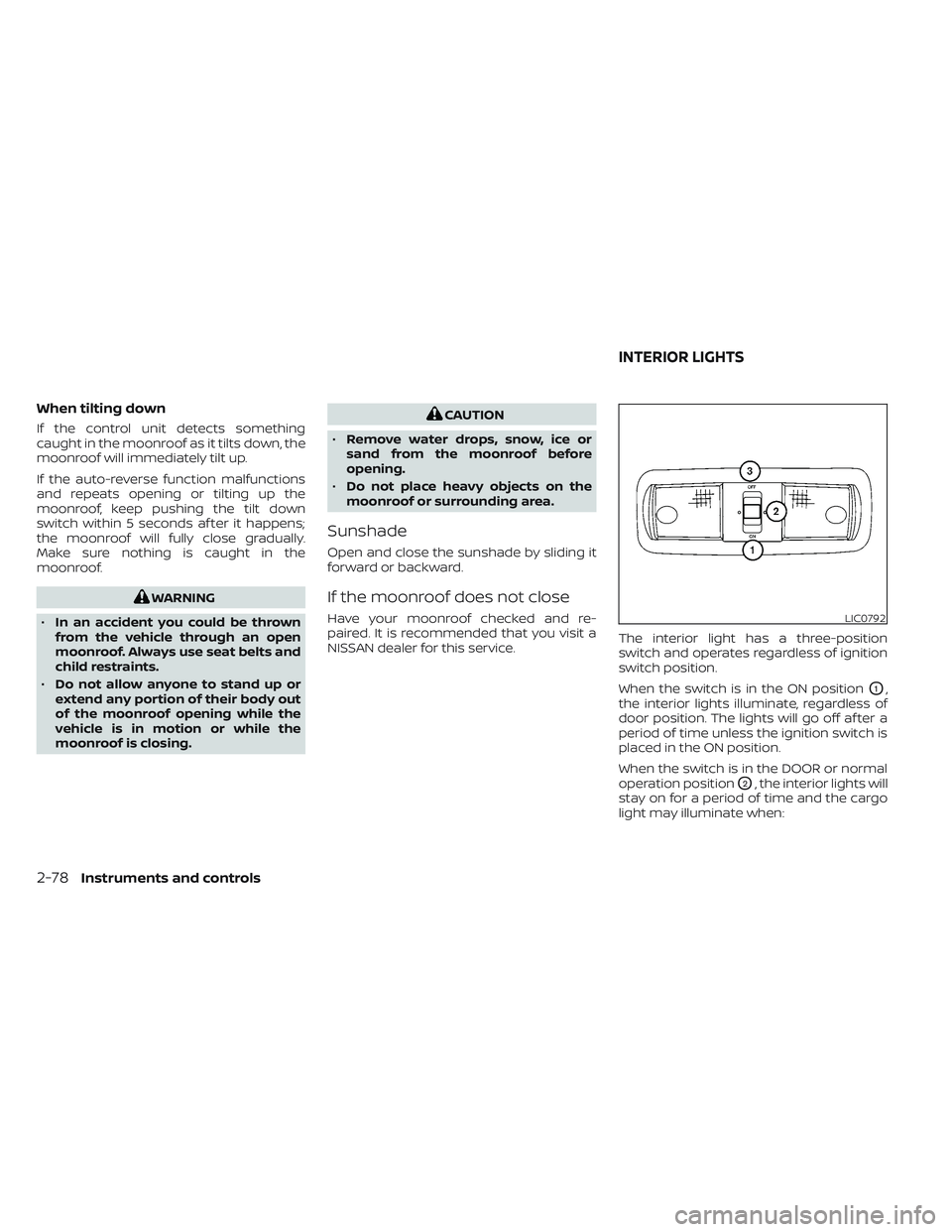
NISSAN dealer for this service. The interior light has a three-position
switch and operates regardless of ignition
switch position.
When the switch is in the ON position
O1,
the interior lights illuminate, regardless of
door position. The lights will go off af ter a
period of time unless the ignition switch is
placed in the ON position.
When the switch is in the DOOR or normal
operation position
O2, the interior lights will
stay on for a period of time and the cargo
light may illuminate when:
LIC0792
INTERIOR LIGHTS
2-78Instruments and controls
Page 235 of 572
4 Monitor, climate, audio, phone and
voice recognition systems
NissanConnect® Owner’s Manual...............4-2
RearView Monitor (if so equipped) ...............4-3
RearView Monitor system operation ..........4-4
How to read the displayed lines ..............4-4
Difference between predicted and
actual distances .............................4-5
How to park with predicted course lines ....... 4-7Adjusting the screen.........................4-8
How to turn on and off predicted
course lines ..................................4-8
RearView Monitor system limitations .........4-8
System maintenance ....................... 4-10
Intelligent Around View® Monitor
(if so equipped) .................................. 4-11
Intelligent Around View® Monitor
system operation ........................... 4-12
Difference between predicted and
actual distances ............................ 4-16
How to park with predicted course lines ......4-18How to switch the display ...................4-19
Off-road mode (if so equipped) ..............4-20
Adjusting the screen ........................ 4-20
Intelligent Around View® Monitor
system limitations .......................... 4-21
System maintenance .......................4-23Moving Object Detection (MOD) (if so
equipped)
...................................... 4-24
MOD system operation ......................4-25
Turning MOD on and off (if so equipped) .....4-26
MOD system limitations .....................4-27
System maintenance .......................4-28
Vents .......................................... 4-28
Heater and air conditioner (manual)
(if so equipped) ................................. 4-29
Controls ..................................... 4-30
Heater operation ............................ 4-31
Air conditioner operation ....................4-33
Air flow charts ............................... 4-34
Heater and air conditioner (automatic)
(if so equipped) ................................. 4-38
Automatic operation ........................ 4-39
Manual operation ........................... 4-41
Operating tips ............................... 4-42
Servicing air conditioner ........................4-43
Antenna ........................................ 4-44
Roof Mounted Antenna ......................4-44
Car phone or CB radio .......................... 4-44
iPod®/iPhone® ................................. 4-45
Page 278 of 572
ROOF MOUNTED ANTENNA
The antenna is located on the rear part of
the vehicle roof.
CAUTION
• A build up of ice on the antenna can
affect radio performance. Remove
the ice to restore radio reception.
• When removing snow from the roof,
do not apply strong force to the an-
tenna. That might break the antenna
and dent the roof panel.
• When using a high pressure car wash,
keep the high pressure nozzle away
from the antenna. The seal may be
deformed or damaged.
• The radio performance may be af-
fected if cargo carried on the roof
blocks the radio signal. If possible, do
not put cargo near the antenna. When installing a CB, ham radio or car
phone in your vehicle, be sure to observe
the following precautions; otherwise, the
new equipment may adversely affect the
engine control system and other electronic
parts.
WARNING
• A cellular phone should not be used
for any purpose while driving so full
attention may be given to vehicle op-
eration. Some jurisdictions prohibit
the use of cellular phones while
driving.
• If you must make a call while your
vehicle is in motion, the hands free
cellular phone operational mode is
highly recommended. Exercise ex-
treme caution at all times so full at-
tention may be given to vehicle
operation.
• If you are unable to devote full atten-
tion to vehicle operation while talk-
ing on the phone, pull off the road to
a safe location and stop your vehicle.
CAUTION
• Keep the antenna as far away as pos-
sible from the electronic control
modules.
• Keep the antenna wire more than 8 in
(20 cm) away from the electronic
control system harnesses. Do not
route the antenna wire next to any
harness.
• Adjust the antenna standing-wave
ratio as recommended by the
manufacturer.
• Connect the ground wire from the CB
radio chassis to the body.
• For additional information, it is rec-
ommended that you visit a NISSAN
dealer for servicing.
ANTENNA CAR PHONE OR CB RADIO
4-44Monitor, climate, audio, phone and voice recognition systems
Page 292 of 572
•Unsecured cargo can be thrown
around when driving over rough ter-
rain. Properly secure all cargo so it
will not be thrown forward and cause
injury to you or your passengers.
• To avoid raising the center of gravity
excessively, do not exceed the rated
capacity of the roof rack (if so
equipped) and evenly distribute the
load. Secure heavy loads in the cargo
area as far forward and as low as
possible. Do not equip the vehicle
with tires larger than specified in this
manual. This could cause your ve-
hicle to roll over.
• Do not grip the inside or spokes of
the steering wheel when driving off-
road. The steering wheel could move
suddenly and injure your hands. In-
stead drive with your fingers and
thumbs on the outside of the rim.
• Before operating the vehicle, ensure
that the driver and all passengers
have their seat belts fastened.
• Always drive with the floor mats (if so
equipped) in place as the floor may
become hot. •
Lower your speed when encounter-
ing strong crosswinds. With a higher
center of gravity, your NISSAN is more
affected by strong side winds. Slower
speeds ensure better vehicle control.
• Do not drive beyond the perfor-
mance capability of the tires, even
with 4WD engaged (if so equipped).
• For 4WD equipped vehicles, do not
attempt to raise two wheels off the
ground and shif t the transmission to
any drive or reverse position with the
engine running. Doing so may result
in drivetrain damage or unexpected
vehicle movement which could result
in serious vehicle damage or per-
sonal injury. •
Do not attempt to test a 4WD
equipped vehicle on a 2-wheel dyna-
mometer (such as the dynamom-
eters used by some states for emis-
sions testing), or similar equipment
even if the other two wheels are
raised off the ground. Make sure you
inform test facility personnel that
your vehicle is equipped with 4WD
before it is placed on a dynamom-
eter. Using the wrong test equipment
may result in drivetrain damage or
unexpected vehicle movement
which could result in serious vehicle
damage or personal injury.
• Accelerating quickly, sharp steering
maneuvers or sudden braking may
cause loss of control.
• If at all possible, avoid sharp turning
maneuvers, particularly at high
speeds. Your NISSAN 4WD vehicle has
a higher center of gravity than a pas-
senger car. The vehicle is not de-
signed for cornering at the same
speeds as passenger cars. Failure to
operate this vehicle correctly could
result in loss of control and/or a roll-
over accident.
5-12Starting and driving
Page 435 of 572
7 Appearance and care
Cleaning exterior................................ 7-2
Washing ..................................... 7-2
Waxing ....................................... 7-3
Removing spots .............................. 7-3
Underbody ................................... 7-3
Glass ......................................... 7-3
Aluminum alloy wheels (if so equipped) ....... 7-3
Chromeparts................................ 7-3
Tire dressings ................................ 7-4
Cleaning interior ................................ 7-4 Air fresheners
................................ 7-5
Power moonroof (if so equipped) ............. 7-5
Floor mats (if so equipped) ................... 7-5
Seatbelts ....................................7-6
Corrosion protection ............................ 7-7
Most common factors contributing to
vehicle corrosion ............................. 7-7
Environmental factors influence the
rate of corrosion ............................. 7-7
Protect your vehicle from corrosion .......... 7-7
Page 439 of 572
AIR FRESHENERS
Most air fresheners use a solvent that
could affect the vehicle interior. If you use
an air freshener, take the following
precautions:
• Hanging-type air fresheners can causepermanent discoloration when they con-
tact vehicle interior surfaces. Place the air
freshener in a location that allows it to
hang free and not contact an interior
surface.
• Liquid-type air fresheners typically clip on the vents. These products can cause im-
mediate damage and discoloration
when spilled on interior surfaces.
Carefully read and follow the manufactur-
er's instructions before using the air
fresheners.
POWER MOONROOF (if so
equipped)
The sunshade is made from a tricot
material.
CAUTION
To help prevent damaging the moon-
roof while cleaning:
• Do not rub the material with a cloth.
Doing so can damage the surface of
the material or cause a stain to
spread.
• Never use benzine, thinner or any
similar chemical to clean the sun-
shade. This may discolor the moon-
roof and damage the surface.
• Clean water based stains by patting
the surface with a clean sof t cloth
dampened in warm water. Press a
clean dry cloth onto the surface to
remove as much dampness as pos-
sible and then let air dry.
• Clean oil based stains by patting the
surface with a clean sof t cloth damp-
ened in warm water. Press a clean dry
cloth onto the surface to remove as
much dampness as possible and
then let air dry.
FLOOR MATS (if so equipped)
WARNING
To avoid potential pedal interference
that may result in a collision, injury or
death:
• NEVER place a floor mat on top of
another floor mat in the driver front
position or install them upside down
or backwards.
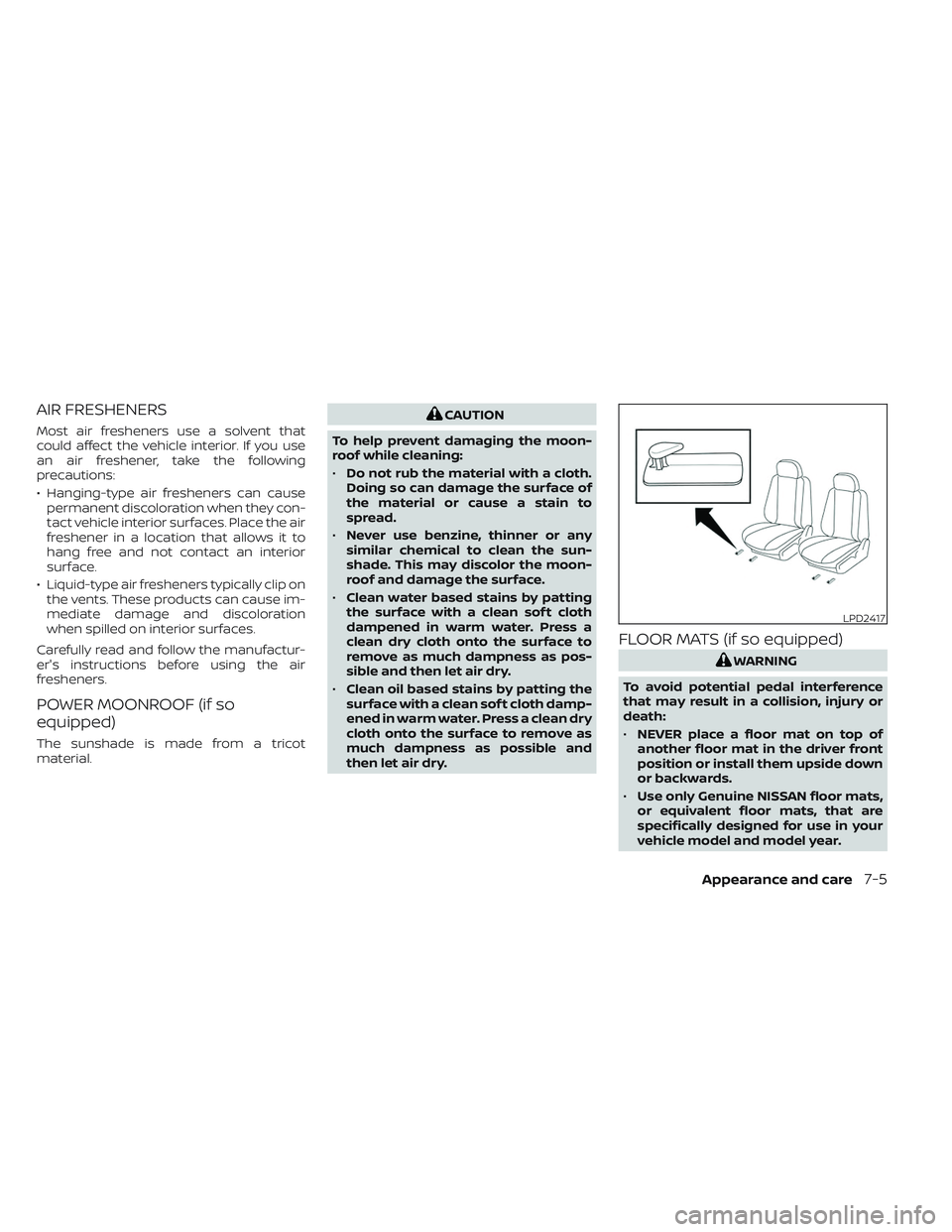
• Use only Genuine NISSAN floor mats,
or equivalent floor mats, that are
specifically designed for use in your
vehicle model and model year.
LPD2417
Appearance and care7-5
Page 562 of 572
J
Jump seat....................1-6Jump starting..............6-11,8-18
K
Key.........................3-2Key fob battery replacement........8-26Keyless entry
With Intelligent Key system (See Intelligent
Key system)
.................3-13KeysNISSAN Intelligent Key®........3-2,3-8NISSAN Vehicle Immobilizer System
keys..................... .3-4
L
Labels
Air conditioner specification label. . .10-14C.M.V.S.S. certification label.......10-13Emission control information label. .10-13Engine serial number..........10-12Tire and Loading Information label. .10-14Vehicle identification number (VIN). .10-12Vehicle identification number (VIN)
plate.................... .10-12Warning labels (for SRS)..........1-90Lane Departure Warning (LDW).......5-27Light
Air bag warning light........1-90, 2-15
Brake light (See stop light)........8-29Bulb check/instrument panel......2-13Bulb replacement.............8-29Charge warning light...........2-14Exterior and Interior lights........8-29Fog light switch..............2-49Fog lights..................8-28Headlight and turn signal switch. . . .2-43Headlight control switch.........2-43Headlights..................8-28Interior light.................2-78Light bulbs.................8-28Low tire pressure warning light.....2-17Low windshield-washer fluid warning
light..................... .2-34Passenger air bag and status light. . .1-80Security indicator light..........2-15Warning/indicator lights and audible
reminders..................2-13Lights......................8-28Map lights..................2-79Lock
Child safety rear door lock.........3-7Door locks................. .3-4Power door locks..............3-6Loose fuel cap warning...........2-33Low fuel warning light.....2-15,2-19,2-34Low tire pressure warning light.......2-17Low windshield-washer fluid warning
light...................... .2-34Luggage (See vehicle loading
information)..................10-16
M
Maintenance
General maintenance...........9-2Inside the vehicle..............9-3Maintenance precautions.........8-2Outside the vehicle.............9-2Seat belt maintenance..........1-23Under the hood and vehicle.......9-4Maintenance requirements..........9-2Maintenance schedules............9-7Malfunction indicator light..........2-19Manual front seat adjustment........1-3Map lights....................2-79Map pocket................. .2-68Meters and gauges............2-4, 2-8Instrument brightness control.....2-49Mirror
Automatic anti-glare inside mirror. . .3-25Heated mirrors...............3-26Outside mirrors..............3-25Rearview...................3-25Vanity mirror................3-24Mirrors......................3-25Moonroof.................2-77,7-5Moving Object Detection (MOD)......4-24
N
NISSAN Intelligent Key®..........3-2,3-8NISSAN Vehicle Immobilizer
System................. .2-41, 5-16NissanConnect® Owner's Manual......4-2
11-4
Page 564 of 572
Seat belt maintenance..........1-23Seat belts................1-14,7-6Shoulder belt height adjustment. . . .1-22Three-point type with retractor.....1-18Seat belt extenders..............1-22Seat belt warning light.........1-17,2-15Seatback pockets...............2-68SeatsAdjustment..................1-2Front seats..................1-2Manual front seat adjustment......1-3Rear seat.................. .1-6Security indicator light............2-15Security system (NISSAN Vehicle Immobilizer
System), engine start.........2-41, 5-16Security systems
Vehicle security system.........2-39Self-adjusting brakes.............8-22Service manual order form........10-44Servicing air conditioner...........4-43Shif tingAutomatic transmission.........5-20Shoulder belt height adjustment......1-22Side air bag system (See supplemental side
air bag, curtain and rollover air bag
systems)
................... .1-86Sonar
Rear system................5-124Spark plug replacement...........8-19Spark plugs...................8-19Specifications................ .10-9Speedometer................. .2-5Speedometer and odometer........2-4SRS warning label...............1-90
Stability control................5-121Standard maintenance............9-8Starting
Before starting the engine........5-17Jump starting............6-11,8-18Precautions when starting and
driving................. .5-4, 5-11Push starting................6-13Starting the engine (gasoline engine
only).......................5-17Steering
Power steering fluid............8-14Power steering system.........5-117Tilting steering wheel...........3-23Steering wheel.................3-23Stop light....................8-29Storage.................... .2-67Storage tray...................2-71Sun visors....................3-24Sunglasses case................2-72Sunglasses holder..............2-72Sunroof...................2-77,7-5Supplemental air bag warning labels. . .1-90Supplemental air bag warning
light....................1-90, 2-15Supplemental front impact air bag
system......................1-77Supplemental restraint system
Information and warning labels.....1-90Precautions on supplemental restraint
system....................1-70Supplemental restraint system (Supplemen-
tal air bag system)...............1-70Switch Autolight switch
..............2-44Automatic power window switch. . .2-76Electronic locking rear differential (E-Lock)
system switch...............2-55Fog light switch..............2-49Hazard warning flasher switch......6-2Headlight and turn signal switch. . . .2-43Headlight control switch.........2-43Hill descent control switch........2-54Instrument brightness control.....2-49Power door lock switch..........3-6Power inverter switch...........2-56Rear sonar system OFF switch.....2-56Tow mode switch.............2-57Turn signal switch.............2-49
T
Tachometer..................
.2-6Tailgate.....................3-27Temperature gauge
Engine coolant temperature gauge. . .2-6Thef t (NISSAN Vehicle Immobilizer System),
engine start...............2-41, 5-16Three-way catalyst...............5-5Tie down hooks................3-31Tilting steering wheel.............3-23TireFlat tire................... .6-3Spare tire..........6-4, 6-5, 6-6, 8-44Tire and Loading Information label. .10-14Tire chains.................8-40Tire pressure................8-32
11-6