stop start NISSAN FRONTIER 2023 Repair Manual
[x] Cancel search | Manufacturer: NISSAN, Model Year: 2023, Model line: FRONTIER, Model: NISSAN FRONTIER 2023Pages: 572, PDF Size: 6.58 MB
Page 415 of 572
SPECIAL WINTER EQUIPMENT
It is recommended that the following items
be carried in the vehicle during winter:
• A scraper and stiff-bristled brush to re-move ice and snow from the windows
and wiper blades.
• A sturdy, flat board to be placed under the jack to give it firm support.
• A shovel to dig the vehicle out of snowdrif ts.
• Extra washer fluid to refill the windshield- washer fluid reservoir.
DRIVING ON SNOW OR ICE
WARNING
• Wet ice (32°F, 0°C and freezing rain),
very cold snow or ice can be slick and
very hard to drive on. The vehicle will
have much less traction or “grip” un-
der these conditions. Try to avoid
driving on wet ice until the road is
salted or sanded.
• Whatever the condition, drive with
caution. Accelerate and slow down
with care. If accelerating or down-
shif ting too fast, the drive wheels will
lose even more traction. •
Allow more stopping distance under
these conditions. Braking should be
started sooner than on dry
pavement.
• Allow greater following distances on
slippery roads.
• Watch for slippery spots (glare ice).
These may appear on an otherwise
clear road in shaded areas. If a patch
of ice is seen ahead, brake before
reaching it. Try not to brake while on
the ice, and avoid any sudden steer-
ing maneuvers.
• Do not use the cruise control on slip-
pery roads.
• Snow can trap dangerous exhaust
gases under your vehicle. Keep snow
clear of the exhaust pipe and from
around your vehicle.
ENGINE BLOCK HEATER (if so
equipped)
Engine block heaters are used to assist
with cold temperature starting.
The engine block heater should be used
when the outside temperature is 20°F (-7°C)
or lower.
WARNING
• Do not use your engine block heater
with an ungrounded electrical sys-
tem or a 2-pronged adapter. You can
be seriously injured by an electrical
shock if you use an ungrounded
connection.
• Disconnect and properly store the
engine block heater cord before
starting the engine. Damage to the
cord could result in an electrical
shock and can cause serious injury.
• Use a heavy-duty 3-wire, 3-pronged
extension cord rated for at least 10 A.
Plug the extension cord into a
Ground Fault Interrupt (GFI) pro-
tected, grounded 110-VAC outlet.
Failure to use the proper extension
cord or a grounded outlet can result
in a fire or electrical shock and cause
serious personal injury.
Starting and driving5-135
Page 427 of 572
4. Lower the vehicle slowly until the tiretouches the ground. Then, with the
wheel nut wrench, tighten the wheel
nuts securely in the sequence illustrated
(
O1,O2,O3,O4,O5,O6). Lower the vehicle
completely .
WARNING
• Incorrect wheel nuts or improperly
tightened wheel nuts can cause the
wheel to become loose or come off.
This could cause an accident.
• Do not use oil or grease on the wheel
studs or nuts. This could cause the
nuts to become loose.
• Retighten the wheel nuts when the
vehicle has been driven for 620 miles
(1,000 km) (also in cases of a flat tire,
etc.).
As soon as possible, tighten the wheel
nuts to the specified torque with a
torque wrench.
Wheel nut tightening torque: 98 f t-lb (133 N·m)
The wheel nuts must be kept tightened to
specification at all times. It is recom-
mended that wheel nuts be tightened to
specifications at each lubrication interval.
Adjust tire pressure to the COLD
pressure.
COLD pressure: Af ter vehicle has been
parked for 3 hours or more or driven less
than 1 mile (1.6 km).
COLD tire pressures are shown on the
Tire and Loading Information label lo-
cated in the driver's door opening.
5. Securely store the jacking equipment in the vehicle and the flat tire under the
vehicle. For additional information about
storing the flat tire, see “Getting the
spare tire and tools (all models)” (P. 6-6).
WARNING
• Always make sure that the spare tire
and jacking equipment are properly
secured af ter use. Such items can be-
come dangerous projectiles in an ac-
cident or sudden stop.
• The spare tire is designed for emer-
gency use. For additional informa-
tion, see “Wheels and tires” (P. 8-32). To start your engine with a booster battery,
the instructions and precautions below
must be followed.
WARNING
• If done incorrectly, jump starting can
lead to a battery explosion, resulting
in severe injury or death. It could also
damage your vehicle.
• Explosive hydrogen gas is always
present in the vicinity of the battery.
Keep all sparks and flames away
from the battery.
• Do not allow battery fluid to come
into contact with eyes, skin, clothing
or painted surfaces. Battery fluid is a
corrosive sulfuric acid solution which
can cause severe burns. If the fluid
should come into contact with any-
thing, immediately flush the con-
tacted area with water.
• Keep battery out of the reach of
children.
• The booster battery must be rated at
12 volts. Use of an improperly rated
battery can damage your vehicle.
JUMP STARTING
In case of emergency6-11
Page 429 of 572
CAUTION
• Always connect positive (+) to posi-
tive (+) and negative (−) to body
ground (for example, strut mounting
bolt, engine lif t bracket, etc.) — not to
the battery.
• Make sure the jumper cables do not
touch moving parts in the engine
compartment and that the cable
clamps do not contact any other
metal.
5. Start the engine of the booster vehicle and let it run for a few minutes.
6.
Keep the engine speed of the booster ve-
hicle at about 2,000 rpm and start the
engine of the vehicle being jump started.
CAUTION
Do not keep the starter motor engaged
for more than 10 seconds. If the engine
does not start right away, place the ig-
nition switch in the OFF position and
wait 3 to 4 seconds before trying again.
7. Af ter starting the engine, carefully dis- connect the negative cable and then the
positive cable.
CAUTION
•
Do not push start this vehicle. The
three-way catalyst may be damaged.
• Automatic transmission models can-
not be push-started or tow-started.
Attempting to do so may cause
transmission damage.
WARNING
• Do not continue to drive if your ve-
hicle overheats. Doing so could cause
engine damage or a vehicle fire.
• To avoid the danger of being scalded,
never remove the radiator or coolant
reservoir cap while the engine is still
hot. When the radiator or coolant res-
ervoir cap is removed, pressurized
hot water will spurt out, possibly
causing serious injury.
• Do not open the hood if steam is
coming out.
If your vehicle is overheating (indicated by
an extremely high temperature gauge
reading), or if you feel a lack of engine
power, detect abnormal noise, etc. take the
following steps.
1. Move the vehicle safely off the road, ap- ply the parking brake and move the shif t
lever to P (Park).
Do not stop the engine.
2. Turn off the air conditioner. Open all the windows, move the heater or air condi-
tioner temperature control to maximum
hot and fan control to high speed.
PUSH STARTING IF YOUR VEHICLE OVERHEATS
In case of emergency6-13
Page 430 of 572
3. Get out of the vehicle. Look and listen forsteam or coolant escaping from the ra-
diator before opening the hood. If steam
or coolant is escaping, turn off the en-
gine. Do not open the hood further until
no steam or coolant can be seen.
4. Open the engine hood.
WARNING
If steam or water is coming from the
engine, stand clear to prevent getting
burned.
5. Visually check drive belts for damage or looseness. Also check if the cooling fan
is running. The radiator hoses and radia-
tor should not leak water. If coolant is
leaking, the water pump belt is missing
or loose, or the cooling fan does not run,
stop the engine.
WARNING
Be careful not to allow your hands, hair,
jewelry or clothing to come into con-
tact with, or get caught in, engine belts
or the engine cooling fan. The engine
cooling fan can start at any time. 6. Af ter the engine cools down, check the
coolant level in the engine coolant res-
ervoir tank with the engine running. Add
coolant to the engine coolant reservoir
tank if necessary. Have your vehicle re-
paired. It is recommended that you visit
a NISSAN dealer for this service. When towing your vehicle, all jurisdictional
and local regulations for towing must be
followed. Incorrect towing equipment
could damage your vehicle. Towing in-
structions are available from a NISSAN
dealer. Local service operators are gener-
ally familiar with the applicable laws and
procedures for towing. To assure proper
towing and to prevent accidental damage
to your vehicle, NISSAN recommends hav-
ing a service operator tow your vehicle. It is
advisable to have the service operator
carefully read the following precautions:
WARNING
• Never ride in a vehicle that is being
towed.
• Never get under your vehicle af ter it
has been lif ted by a tow truck.
CAUTION
• When towing, make sure that the
transmission, axles, steering system
and powertrain are in working condi-
tion. Use dollies or flatbed if any of
the listed systems are not working.
• Always attach safety chains before
towing.
TOWING YOUR VEHICLE
6-14In case of emergency
Page 462 of 572
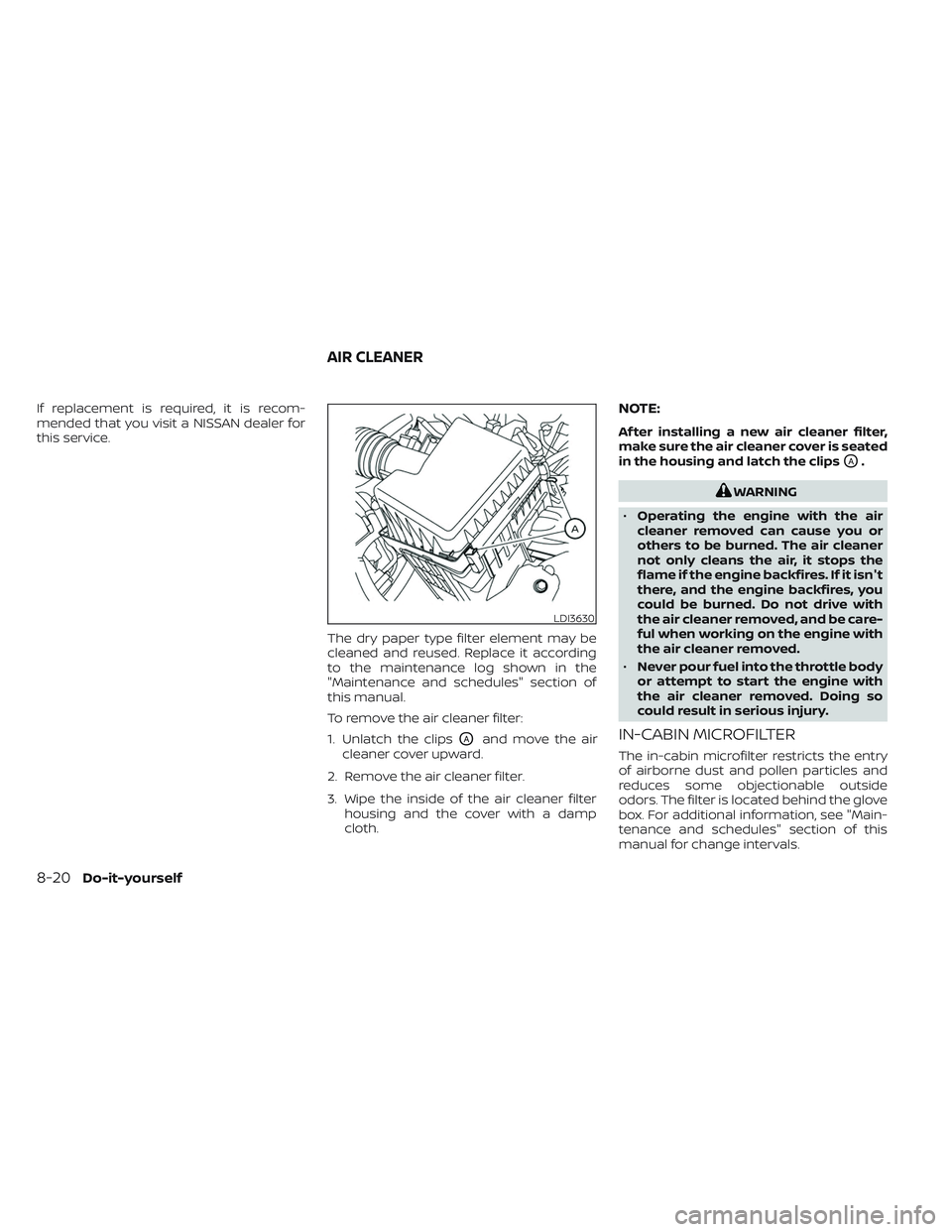
If replacement is required, it is recom-
mended that you visit a NISSAN dealer for
this service.The dry paper type filter element may be
cleaned and reused. Replace it according
to the maintenance log shown in the
"Maintenance and schedules" section of
this manual.
To remove the air cleaner filter:
1. Unlatch the clips
OAand move the air
cleaner cover upward.
2. Remove the air cleaner filter.
3. Wipe the inside of the air cleaner filter housing and the cover with a damp
cloth.
NOTE:
Af ter installing a new air cleaner filter,
make sure the air cleaner cover is seated
in the housing and latch the clips
OA.
WARNING
• Operating the engine with the air
cleaner removed can cause you or
others to be burned. The air cleaner
not only cleans the air, it stops the
flame if the engine backfires. If it isn't
there, and the engine backfires, you
could be burned. Do not drive with
the air cleaner removed, and be care-
ful when working on the engine with
the air cleaner removed.
• Never pour fuel into the throttle body
or attempt to start the engine with
the air cleaner removed. Doing so
could result in serious injury.
IN-CABIN MICROFILTER
The in-cabin microfilter restricts the entry
of airborne dust and pollen particles and
reduces some objectionable outside
odors. The filter is located behind the glove
box. For additional information, see "Main-
tenance and schedules" section of this
manual for change intervals.
LDI3630
AIR CLEANER
8-20Do-it-yourself
Page 492 of 572
Brake pedal:Check the pedal for smooth
operation. If the brake pedal suddenly goes
down further than normal, the pedal feels
spongy or the vehicle seems to take longer
to stop, have your vehicle checked imme-
diately. It is recommended that you visit a
NISSAN dealer for this service. Keep the
floor mat away from the pedal.
Brakes: Check that the brakes do not pull
the vehicle to one side when applied.
Parking brake: Check the parking brake
operation regularly. The vehicle should be
securely held on a fairly steep hill with only
the parking brake applied. If the parking
brake needs adjustment, it is recom-
mended that you visit a NISSAN dealer for
this service.
Seats: Check seat position controls such
as seat adjusters, seatback recliner, etc., to
ensure they operate smoothly and all
latches lock securely in every position.
Check that the head restraints/headrests
move up and down smoothly and the locks
(if so equipped) hold securely in all latched
positions.
Seat belts: Check that all parts of the seat
belt system (for example, buckles, anchors,
adjusters and retractors) operate properly
and smoothly, and are installed securely. Check the belt webbing for cuts, fraying,
wear or damage.
Steering wheel:
Check for changes in the
steering system, such as excessive free
play, hard steering or strange noises.
Warning lights and chimes: Make sure all
warning lights and chimes are operating
properly.
Windshield defroster: Check that the air
comes out of the defroster outlets properly
and in sufficient quantity when operating
the heater or air conditioner.
Windshield wiper and washer*: Check
that the wipers and washer operate prop-
erly and that the wipers do not streak.
Under the hood and vehicle
The maintenance items listed here should
be checked periodically (for example, each
time you check the engine oil or refuel).
Battery (for maintenance free batter-
ies)*: This vehicle is equipped with a sealed
maintenance free battery. It is recom-
mended that you visit a NISSAN dealer for
service.
NOTE:
Care should be taken to avoid situations
that can lead to potential battery dis-
charge and potential no-start conditions
such as:
1. Installation or extended use of elec- tronic accessories that consume bat-
tery power when the engine is not
running (Phone chargers, GPS, DVD
players, etc.).
2. Vehicle is not driven regularly and/or only driven short distances.
In these cases, the battery may need to
be charged to maintain battery health.
Brake fluid level*: Make sure that the fluid
level is between the MAX and MIN lines on
the reservoir.
Engine coolant level*: Check the coolant
level when the engine is cold.
Engine drive belts*: Check engine drive
belts for wear, fraying or cracking and for
proper tension. Replace any damaged
drive belts.
9-4Maintenance and schedules
Page 552 of 572
• Avoid abrupt starts, acceleration or stops.
• Avoid sharp turns or lane changes.
• Always drive your vehicle at a moderatespeed.
• When backing up, hold the bottom of the steering wheel with one hand. Move your
hand in the direction in which you want
the trailer to go. Make small corrections
and back up slowly. If possible, have
someone guide you when you are back-
ing up.
Always block the wheels on both vehicle
and trailer when parking. Parking on a
slope is not recommended; however, if you
must do so:
CAUTION
If you move the shif t lever to the P
(Park) position before blocking the
wheels and applying the parking brake,
transmission damage could occur.
1. Apply and hold the brake pedal.
2. Have someone place blocks on the downhill side of the vehicle and trailer
wheels.
3. Af ter the wheel blocks are in place, slowly release the brake pedal until the
blocks absorb the vehicle load. 4. Apply the parking brake.
5. Shif t the transmission into P (Park).
6. Make sure the 4WD shif t indicator light (if
so equipped) indicates the transfer case
is in 4H, 4LO, or 2WD and that the ATP
light is off. If the 4WD shif t indicator light
is flashing, or the ATP light is ON, make
sure the transmission is in P (Park) and
turn the 4WD switch to 2WD or 4H. For
additional information, see “Automatic
transmission park warning light” (P. 2-13)
and “Using 4-wheel drive (4WD)” (P. 5-109).
7. Turn off the engine.
To drive away:
1. Start the vehicle.
2. Apply and hold the brake pedal.
3. Shif t the transmission into gear.
4. Release the parking brake.
5. Drive slowly until the vehicle and trailer are clear from the blocks.
6. Apply and hold the brake pedal.
7. Have someone retrieve and store the blocks. • While going downhill, the weight of the
trailer pushing on the tow vehicle may
decrease overall stability. Therefore, to
maintain adequate control, reduce your
speed and shif t to a lower gear. Avoid
long or repeated use of the brakes when
descending a hill, as this reduces their
effectiveness and could cause overheat-
ing. Shif ting to a lower gear instead pro-
vides “engine braking” and reduces the
need to brake as frequently.
• If the engine coolant temperature rises to a high temperature, see “If your vehicle
overheats” (P. 6-13).
• Trailer towing requires more fuel than normal circumstances.
• Avoid towing a trailer for your vehicle's first 500 miles (805 km).
• For the first 500 miles (805 km) that you do tow, do not drive over 50 mph (80
km/h).
• Have your vehicle serviced more of ten than at intervals specified. For additional
information, see the “Maintenance and
schedules” section of this manual.
• When making a turn, your trailer wheels will be closer to the inside of the turn than
your vehicle wheels. To compensate for
this, make a larger than normal turning
radius during the turn.
10-38Technical and consumer information
Page 559 of 572
11 Index
4
4-Wheel Drive................5-1094WD......................5-109
A
Active Brake Limited Slip (ABLS)
system....................5-120Air bag (See supplemental restraint
system).....................1-70Air bag systemFront (See supplemental front impact air
bag system)
................1-77Air bag warning labels............1-90Air bag warning light.........1-90, 2-15Air bag warning light,
supplemental..............1-90, 2-15Air cleaner housing filter..........8-20Air conditionerAir conditioner operation. . . .4-33, 4-39Air conditioner service..........4-43Air conditioner specification label. .10-14Air conditioner system refrigerant and oil
recommendations............10-8Air conditioner system refrigerant
recommendations............10-8Heater and air conditioner (automatic)
(if so equipped)..............4-38
Heater and air conditioner controls.4-39Servicing air conditioner........4-43Air flow charts................4-34Alarm system (See vehicle security
system)................... .2-39Anchor point locations............1-31Antenna....................4-44Anti-lock brake warning light.......2-13Anti-lock Braking System (ABS)......5-118Antifreeze...................5-134Autolight switch...............2-44Automatic
Automatic power window switch. . .2-76Driving with automatic transmission.5-19Automatic anti-glare inside mirror. . . .3-25Automatic door locks.............3-7Automatic Emergency Braking (AEB) with
Pedestrian Detection............5-81Automatic transmission fluid temperature
gauge..................... .2-8
B
Battery.................5-134, 8-16Charge warning light...........2-14Battery replacement............8-26Key fob...................8-26NISSAN Intelligent Key®.........8-26Before starting the engine.........5-17Belt (See drive belt)..............8-19
Blind Spot Warning (BSW)..........5-32Booster seats.................1-64Brake
Anti-lock Braking System (ABS). . . .5-118Brake fluid.................8-14Brake light (See stop light).......8-29Brake system...............5-118Brake warning light............2-13Brake wear indicators.......2-21,8-22Parking brake operation.........5-24Self-adjusting brakes..........8-22Brake fluid...................8-14Brake system................5-118Brakes.....................8-22Break-in schedule..............5-107Brightness controlInstrument panel.............2-49Bulb check/instrument panel.......2-13Bulb replacement..............8-29
C
C.M.V.S.S. certification label........10-13Capacities and recommended
fuel/lubricants................10-2Car phone or CB radio...........4-44Cargo (See vehicle loading
information)................ .10-16Cargo lamp switch.............2-50Cargo light................. .2-80
Page 561 of 572
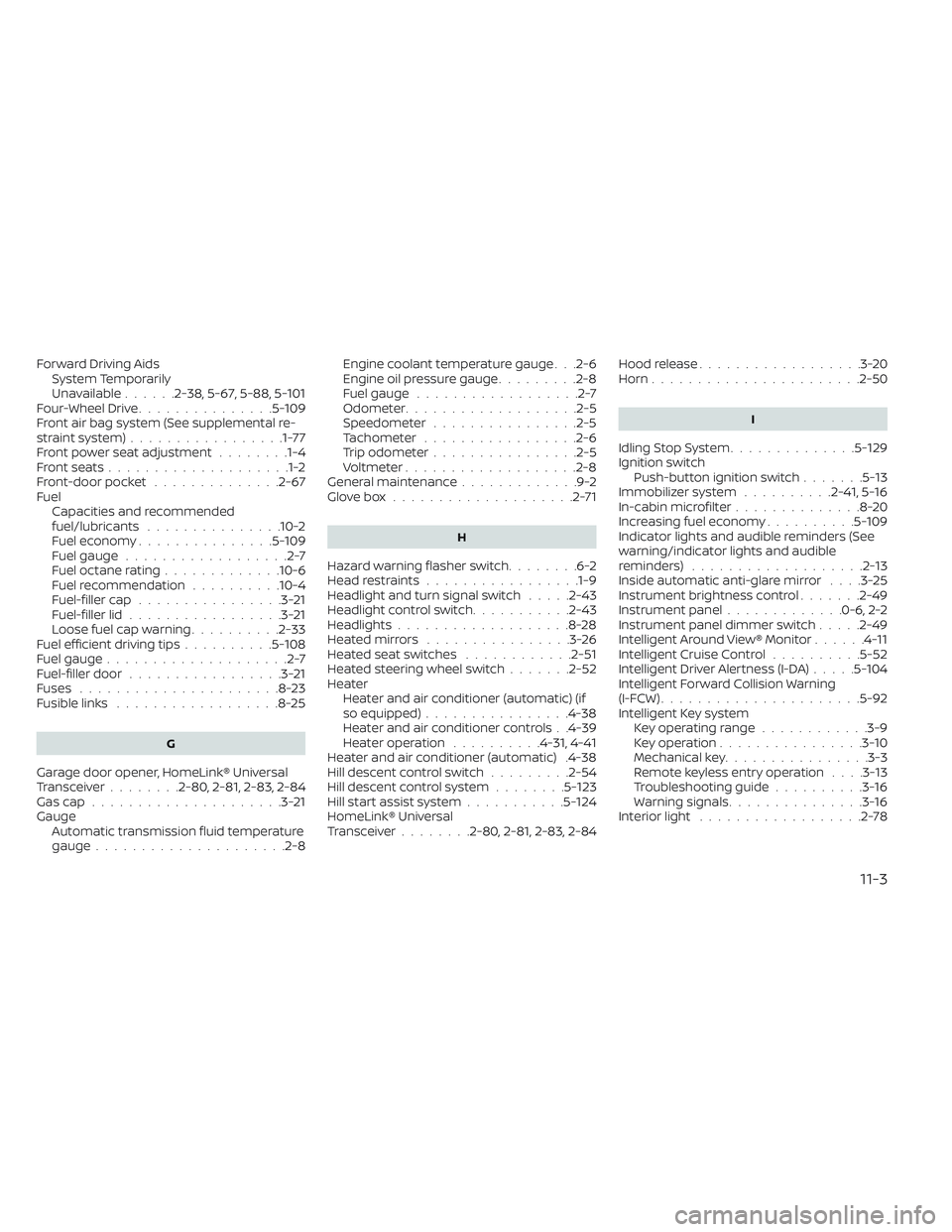
Forward Driving AidsSystem Temporarily
Unavailable
......2-38, 5-67, 5-88, 5-101Four-Wheel Drive...............5-109Front air bag system (See supplemental re-
straint system).................1-77Front power seat adjustment........1-4Front seats....................1-2Front-door pocket..............2-67FuelCapacities and recommended
fuel/lubricants
...............10-2Fuel economy...............5-109Fuel gauge..................2-7Fuel octane rating.............10-6Fuel recommendation..........10-4Fuel-filler cap................3-21Fuel-filler lid.................3-21Loose fuel cap warning..........2-33Fuel efficient driving tips..........5-108Fuel gauge....................2-7Fuel-filler door.................3-21Fuses......................8-23Fusible links..................8-25
G
Garage door opener, HomeLink® Universal
Transceiver........2-80, 2-81, 2-83, 2-84Gas cap.....................3-21GaugeAutomatic transmission fluid temperature
gauge
.................... .2-8
Engine coolant temperature gauge. . .2-6Engine oil pressure gauge.........2-8Fuel gauge..................2-7Odometer...................2-5Speedometer................2-5Tachometer.................2-6Trip odometer................2-5Voltmeter.................. .2-8General maintenance.............9-2Glove box....................2-71
H
Hazard warning flasher switch........6-2Head restraints.................1-9Headlight and turn signal switch.....2-43Headlight control switch...........2-43Headlights...................8-28Heated mirrors................3-26Heated seat switches............2-51Heated steering wheel switch.......2-52Heater
Heater and air conditioner (automatic) (if
so equipped)
................4-38Heater and air conditioner controls. .4-39Heater operation..........4-31, 4-41Heater and air conditioner (automatic).4-38Hill descent control switch.........2-54Hill descent control system........5-123Hill start assist system...........5-124HomeLink® Universal
Transceiver........2-80, 2-81, 2-83, 2-84
Hood release..................3-20Horn...................... .2-50
I
Idling Stop System..............5-129Ignition switch
Push-button ignition switch.......5-13Immobilizer system..........2-41, 5-16In-cabin microfilter..............8-20Increasing fuel economy..........5-109Indicator lights and audible reminders (See
warning/indicator lights and audible
reminders)
...................2-13Inside automatic anti-glare mirror. . . .3-25Instrument brightness control.......2-49Instrument panel.............0-6, 2-2Instrument panel dimmer switch.....2-49Intelligent Around View® Monitor......4-11Intelligent Cruise Control..........5-52Intelligent Driver Alertness (I-DA).....5-104Intelligent Forward Collision Warning
(I-FCW)..................... .5-92Intelligent Key system
Key operating range............3-9Key operation................3-10Mechanical key................3-3Remote keyless entry operation. . . .3-13Troubleshooting guide..........3-16Warning signals...............3-16Interior light..................2-78
11-3
Page 562 of 572
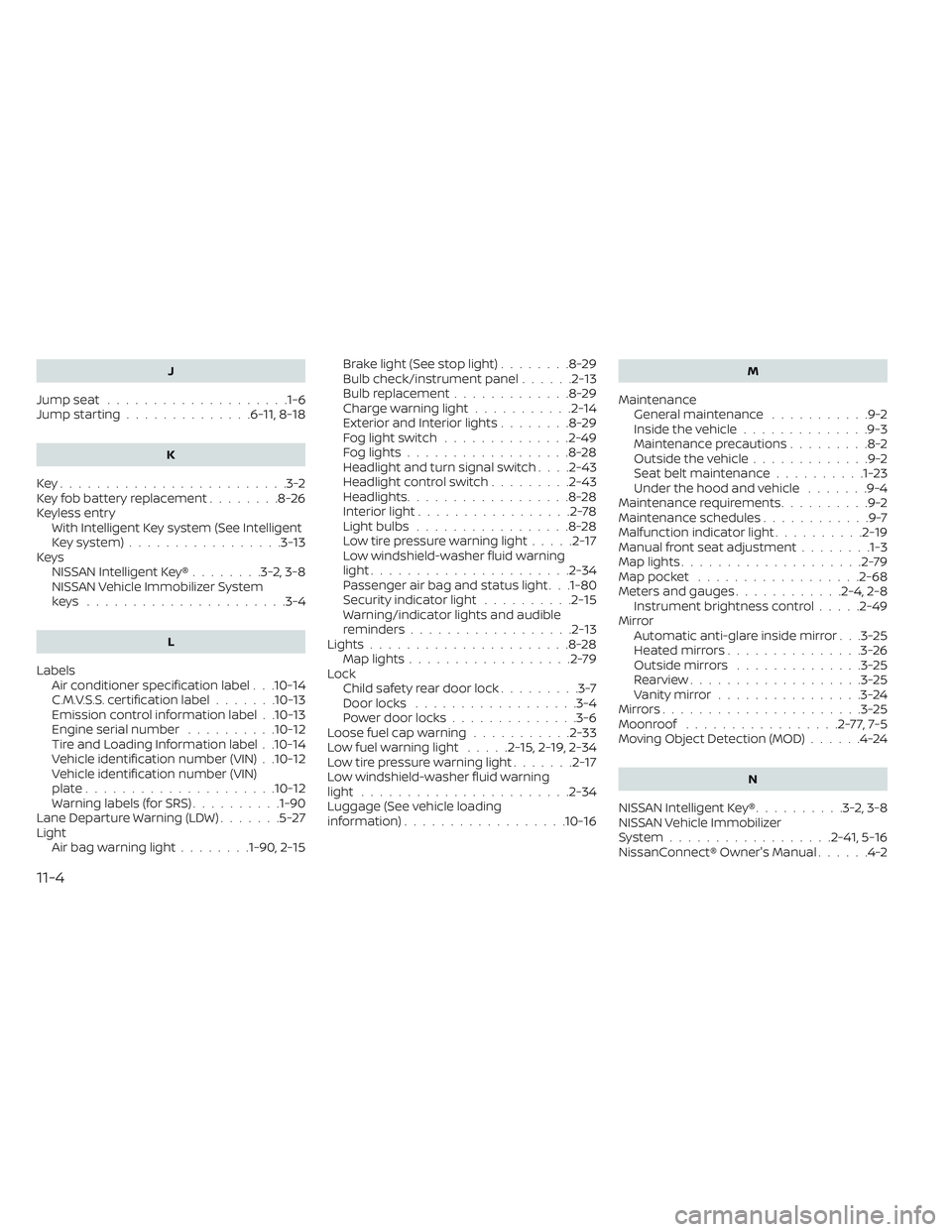
J
Jump seat....................1-6Jump starting..............6-11,8-18
K
Key.........................3-2Key fob battery replacement........8-26Keyless entry
With Intelligent Key system (See Intelligent
Key system)
.................3-13KeysNISSAN Intelligent Key®........3-2,3-8NISSAN Vehicle Immobilizer System
keys..................... .3-4
L
Labels
Air conditioner specification label. . .10-14C.M.V.S.S. certification label.......10-13Emission control information label. .10-13Engine serial number..........10-12Tire and Loading Information label. .10-14Vehicle identification number (VIN). .10-12Vehicle identification number (VIN)
plate.................... .10-12Warning labels (for SRS)..........1-90Lane Departure Warning (LDW).......5-27Light
Air bag warning light........1-90, 2-15
Brake light (See stop light)........8-29Bulb check/instrument panel......2-13Bulb replacement.............8-29Charge warning light...........2-14Exterior and Interior lights........8-29Fog light switch..............2-49Fog lights..................8-28Headlight and turn signal switch. . . .2-43Headlight control switch.........2-43Headlights..................8-28Interior light.................2-78Light bulbs.................8-28Low tire pressure warning light.....2-17Low windshield-washer fluid warning
light..................... .2-34Passenger air bag and status light. . .1-80Security indicator light..........2-15Warning/indicator lights and audible
reminders..................2-13Lights......................8-28Map lights..................2-79Lock
Child safety rear door lock.........3-7Door locks................. .3-4Power door locks..............3-6Loose fuel cap warning...........2-33Low fuel warning light.....2-15,2-19,2-34Low tire pressure warning light.......2-17Low windshield-washer fluid warning
light...................... .2-34Luggage (See vehicle loading
information)..................10-16
M
Maintenance
General maintenance...........9-2Inside the vehicle..............9-3Maintenance precautions.........8-2Outside the vehicle.............9-2Seat belt maintenance..........1-23Under the hood and vehicle.......9-4Maintenance requirements..........9-2Maintenance schedules............9-7Malfunction indicator light..........2-19Manual front seat adjustment........1-3Map lights....................2-79Map pocket................. .2-68Meters and gauges............2-4, 2-8Instrument brightness control.....2-49Mirror
Automatic anti-glare inside mirror. . .3-25Heated mirrors...............3-26Outside mirrors..............3-25Rearview...................3-25Vanity mirror................3-24Mirrors......................3-25Moonroof.................2-77,7-5Moving Object Detection (MOD)......4-24
N
NISSAN Intelligent Key®..........3-2,3-8NISSAN Vehicle Immobilizer
System................. .2-41, 5-16NissanConnect® Owner's Manual......4-2
11-4