power steering NISSAN GT-R 1998 User Guide
[x] Cancel search | Manufacturer: NISSAN, Model Year: 1998, Model line: GT-R, Model: NISSAN GT-R 1998Pages: 230, PDF Size: 12.66 MB
Page 36 of 230

TROUBLE DIAGNOSES
Symptom Matrix Chart (Cont'd)
-RELATION BETWEEN TROUBLE SYMPTOMS AND SENSORS
-. - Sensors No I Hard
start start Rough
idle
Poor derivability Engine
stall
Symptom
@: High possibility 0: Low possibility
Crankshaft position
sensor (POS,
REF) Instantaneous
xeak
Ring gear crankshaft
position sensor
[RB20DE
(UB)]
s 1 Signal iigh output
,ow output
"
2 Power supply
Engine coolant tem-
perature sensor
iigh resistance
-ow resistance
- -- Heated oxygen sen-
sor
Knock sensor
iigh output
.ow output
Ipedshort
Vehicle s~eed sensor
Throttle position sen-
sor Jnstable output
'oar adjustment
Turbo pressure sen-
sor
(TIC)
Refrigerant pressure
sensor
Ignition switch (IGN)
k$n;pRnT)sw
i tch
Air conditioner switch
ParWneutral position
switch
Power steering oil
pressure switch
Electrical load switch
Multiplex communica-
tion line
Control unit power
supply
Sensor ground
Control unif and con-
nector
*: Fast idle
'oor contact
Vater intrusion
Page 37 of 230

TROUBLE DIAGNOSES
Symptom Matrix Chart (Cont'd)
Sensor-related problems I Symptom characteristics and ins~ection hints
Open Engine
will not start when either REF signal circuit or POS signal circuit is open.
Neither fuel system nor ignition system outputs control signals.
Crankshaft position sensor
(POS, REF) Instanta-
neous break Symptoms
vary with the break time and the vehicle's driving conditions. Light
shock or surging will occur while the vehicle is being driven, and the engine will
stall at idle speed.
Ring gear crankshaft position
sensor
[RB20DE
(UB)]
Signal
Mass air flow sensor Open
Open
High output
Low output I Aidfuel
ratio becomes lean. Dirty hot wire or air entering the system could be the
cause. No
airfluel ratio compensation
is carried out during lean bum status. Drivability
may be affected.
Enters fail-safe mode. Driving under
2,400 rpm is allowed.
Airlfuel
ratio becomes rich. Black smoke may be noted. Poor contact at the
ground could be the cause.
Engine coolant temperature sen-
sor Open
Open
Opedshort
High resis-
tance
Low resis-
tance
Opedshort
Heated oxygen sensor
I
Airlfuel ratio becomes over-rich.
Same symptom as when signal wire is open.
Enters fail-safe mode. Malfunction indicator lamp comes ON. Ordinary driving is
allowed. Problems tend to occur when engine is cold or engine coolant tempera-
ture
is high.
Detects low engine coolant temperature. Problems tend to occur after engine
warm-up.
Detects high engine coolant temperature. Problems tend to occur when engine is
cold.
Base
aidfuel ratio is used.
lgnition timing is retarded within the knock control range. Lack of power may be
OpedShort
I noted.
Knock sensor lgnition
timing is retarded within the knock control range. Lack of power may be
High
Output
(noted.
Low output
1 lgnition timing may not be retarded when knock is detected.
Vehicle speed sensor
Throttle position sensor
Opedshort
Opedshort
Unstable out-
put
Poor adjust-
ment
Open
Turbo pressure sensor
(TE) Fuel
cut time becomes-shorter, or no fuel cut is observed.
Base idle speed is used. Fuel injection is not increased during acceleration.
AIT shift point changes for AfF vehicles.
Unnecessary cut-in fuel injection could be the cause. Poor contact at the ground
or control unit could be the cause.
ldle judgment is "OFF while idling. Condition returns
normal by turning the igni-
tion switch ON and OFF repeatedly.
Turbo pressure is judged zero. No remarkable malfunction will be detected.
Refrigerant pressure is judged high. ldle speed remains high while the air condi-
tioner is ON.
Refrigerant pressure sensor
Short Refrigerant pressure
is judged low. ldle speed remains low while the air condi-
tioner is ON.
lgnition switch (IGN)
lgnition switch (START)
Air conditioner switch Open
Engine
will not start because neither fuel system nor ignition system outputs con-
trol signals.
Engine starts in normal condition. Engine may not start when temperature is
extremefy
low.
Air conditioner will not operate. No other malfunction will be noted.
Park/neutral
position switch is judged "OFF. Target engine speed for cold engine
in
N or P position is reduced.
ParWneutral position switch is judged
"0N"I Fast Jdle is effective when the engine
is cold and the gear is in other than N and P posrtlons. Vehrcle excessrvely
creeps.
Open
Open
Parklneutral
position
switch
Short
Power steering oil pressure
switch Open
Engine may
stall when the steering wheel is turned while the vehicle is standstill
and the accelerator pedal is lightly pressed, or when the steering wheel is turned
Electrical load switch Short
Open
Open/short
Multiplex communication line
- -- during deceleration. '
Power steering switch is judged 'ON." Value will be compensated constantly.
Idle speed drops so that the engine can stall when electrical load is applied.
Torque reduction control is not performed. Therefore,
shift shock becomes
greater.
- -- -- -- -- Engine will not start because neither fuel system nor ignition system outputs con-
trol signals.
Open
Control unit power supply
- -- - - --- - - - - - O~edshort I Same symptoms as when sensor harness is open.
Sensor ground -- - Poor contact
Water intru-
sion - -- - - - - - -- -- In case of poor contact, the connector fitting may be loose. In case of water
intrusion, the engine stalls and become inoperative for a while. The engine may restart soon in some cases.
Control unit
and connector
Page 39 of 230

TROUBLE DIAGNOSES
Symptom Matrix Chart (Cont'd)
An open circuit causes no fuel injection to the corresponding cylinder, and the heated oxygen sensor output becomes lean. When the open circuits are
observed at all cylinders, the engine will not start.
Actuator-related malfunction
Injector Symptom
characteristics and inspection hints
Drive
circuit
lgnition signal
(POW&
transistor
drive
siqnal)
(open
Injection Open
Short
Fuel pump relay
1 Open 1 Engine will not start. In case of instantaneous break, surging may occur.
A
short circuit causes continuous fuel injection to the corresponding cylinder, and
over-rich airlfuel ratio and misfire will be noted. When the short circuits are
observed at all cylinders, the engine will not start.
Foreign
material
Clogs
L
Foreign
material causes continuous fuel injection to the corresponding cylinder.
Symptoms vary with the condition how the injection port is clogged.
Aidfuel ratio
compensation factor becomes larger.
(1 10 to 125%)
Canister purge control valve Ignition primary
signal (Power
transistor ground)
Auxiliary electric fan relay
[RB25DE, RB25DETI
1 Short
Open
Open -
Open
Open
Leaks
Open
Open
lgnition coil
AAC valve
The valve purges constantly. In summertime, engine may stall at idle speed due
i to rich aidfuel ratio. In wintertime, various malfunctions may occur due to lean
airlfuel ratio.
An open circuit causes no fuel injection to the corresponding cylinder, and the '
heated oxygen sensor output becomes lean. When the open circuits are observed at all cylinders, the engine will not start. In case of instantaneous break, symptoms vary with the break time and the
vehicle's driving conditions. Light shock or surging will occur while the vehicle
is being driven.
The engine will stall when break time is long.
AAC valve is fully closed. Symptoms vary with the base engine speed. When it is
too low, engine may stall while the vehicle is decelerating or when the power
steering load or electrical load is applied.
Power
supply
s~de
primary
Second-
arY side
Power
supply
Drive
circuit
Open Open Auxiliary
electric fan will not operate even after warm-up is completed.
The valve
will not purge. Gasoline smell may be noted when the weather is hot.
Variable valve timing control
solenoid valve
Variable air intake control sole-
noid valve (NA)
Air jet swirl control solenoid
valve
[RB20DE
(UB)]
Injector ground (Total ground) lnstanta- Symptoms vary
with the break time and the vehicle's driving conditions. Surging neous break or engine stall may occur when the instantaneous break occurred during fuel
I I injection. I
Open
, Open
Short
Turbo pressure control solenoid
valve (TIC) Valve
timing not switched.
Variable air intake valve opens, and torque in low speed range is reduced.
Variable air intake valve closes, and torque in high speed range is reduced.
Open
Short Air jet
swirl control valve remains closed.
Air jet swirl control valve remains open.
Open
Open Swing valve opens earlier, and
maximum turbo pressure is reduced.
Engine will not start
because the injectors do not operate.
Page 41 of 230
TROUBLE DIAGNOSES
Symptom Matrix Chart (Cont'd)
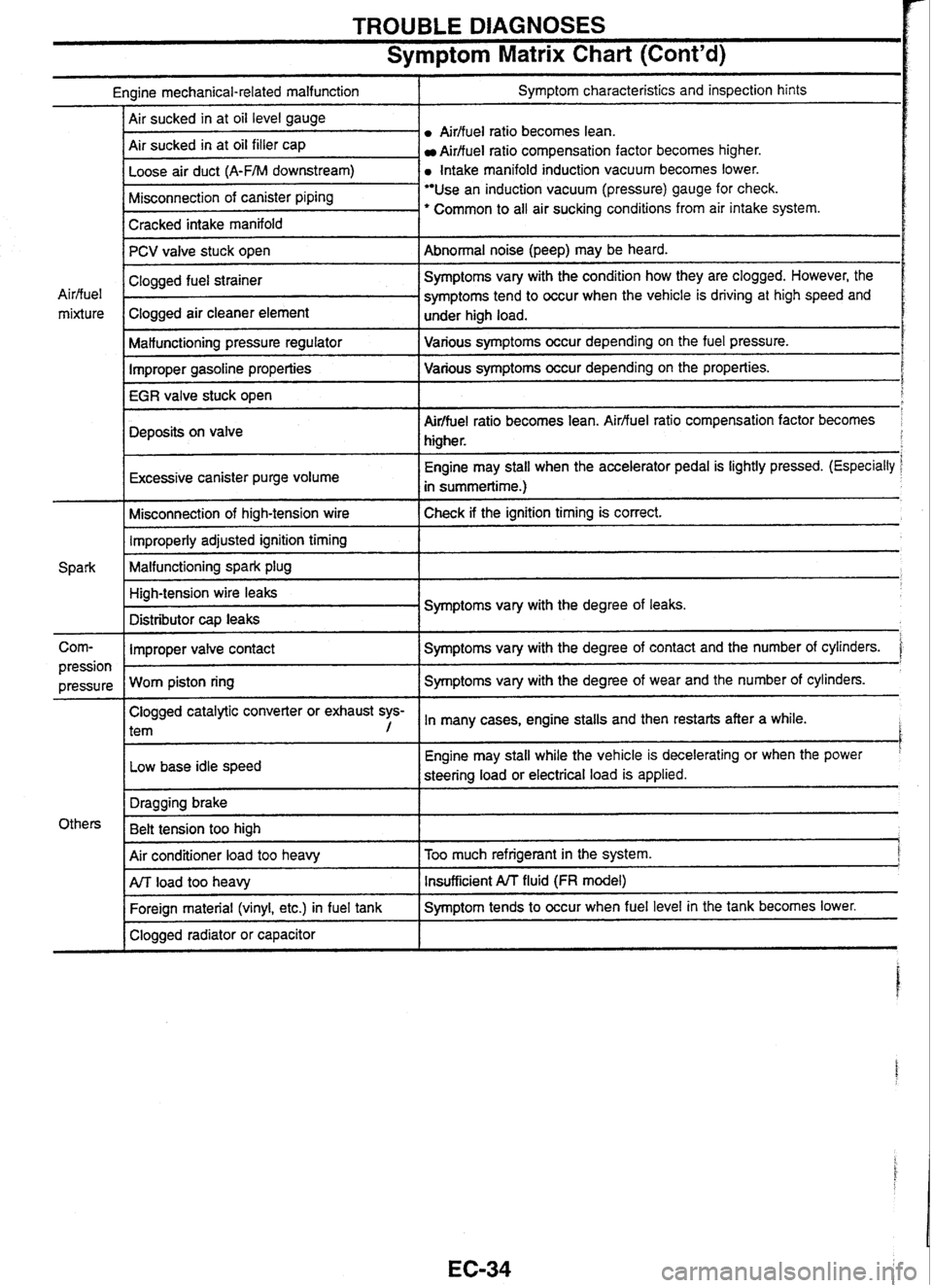
Engine mechanical-related malfunction I Symptom characteristics and inspection hints
Airffuel
ratio becomes lean.
Air sucked in at oil filler cap
Aidfuel ratio compensation factor becomes higher.
a Intake manifold induction vacuum becomes lower.
I Cracked intake manifold I
Misconnection of canister piping Use an induction vacuum (pressure) gauge for check.
' Common to all air sucking conditions from air intake system.
-
PCV valve stuck open
I Malfunctioning pressure regulator I Various symptoms occur depending on the fuel pressure.
Abnormal noise (peep) may
be heard.
Air/fuel
mixture
Improper gasoline properties Various
symptoms occur depending on the properties.
IEGRiale
stuck open
I
Clogged fuel strainer .
Clogged air cleaner element
Deposits on valve
r
Symptoms vary with the condition how they are clogged. However, the
symptoms tend to occur when the vehicle is driving at high speed and
under high load.
I
Air/fuel ratio becomes lean. Airfluel ratio compensation factor becomes
higher.
Excessive canister purge volume
I
Engine may stall when the accelerator pedal is lightly pressed. (Especially
in summertime.)
Misconnection of high-tension wire Check if the ignition timing
is correct. 1 Improperly adjusted ignition timing 1
Malfunctioning spark plug 1
Corn- I Improper valve contact I Symptoms vary with the degree of contact and the number of cylinders. '
High-tension wire leaks
Distributor
cap leaks Symptoms
vary with the degree of leaks.
Clogged catalytic converter or exhaust sys-
l tem , In many cases, engine stalls and then restarts after a while. I
pression I
Low base idle speed
pressure
Worn piston ring I
Engine may
stall while the vehicle is decelerating or when the power '
steering load or electrical load is applied.
Symptoms vary
with the degree of wear and the number of cylinders.
I
Air conditioner load too heavy I Too much refrigerant in the system. j
Others Dragging
brake
Belt tension too high
1
I Clogged radiator or capacitor I
ArJ load too heavy
Foreign material (vinyl, etc.) in fuel tank Insufficient A/T fluid (FR model)
Symptom tends to occur when fuel level in the tank becomes lower.
Page 42 of 230
TROUBLE DIAGNOSES
ldle speed adjusting screw
ECL1641 C
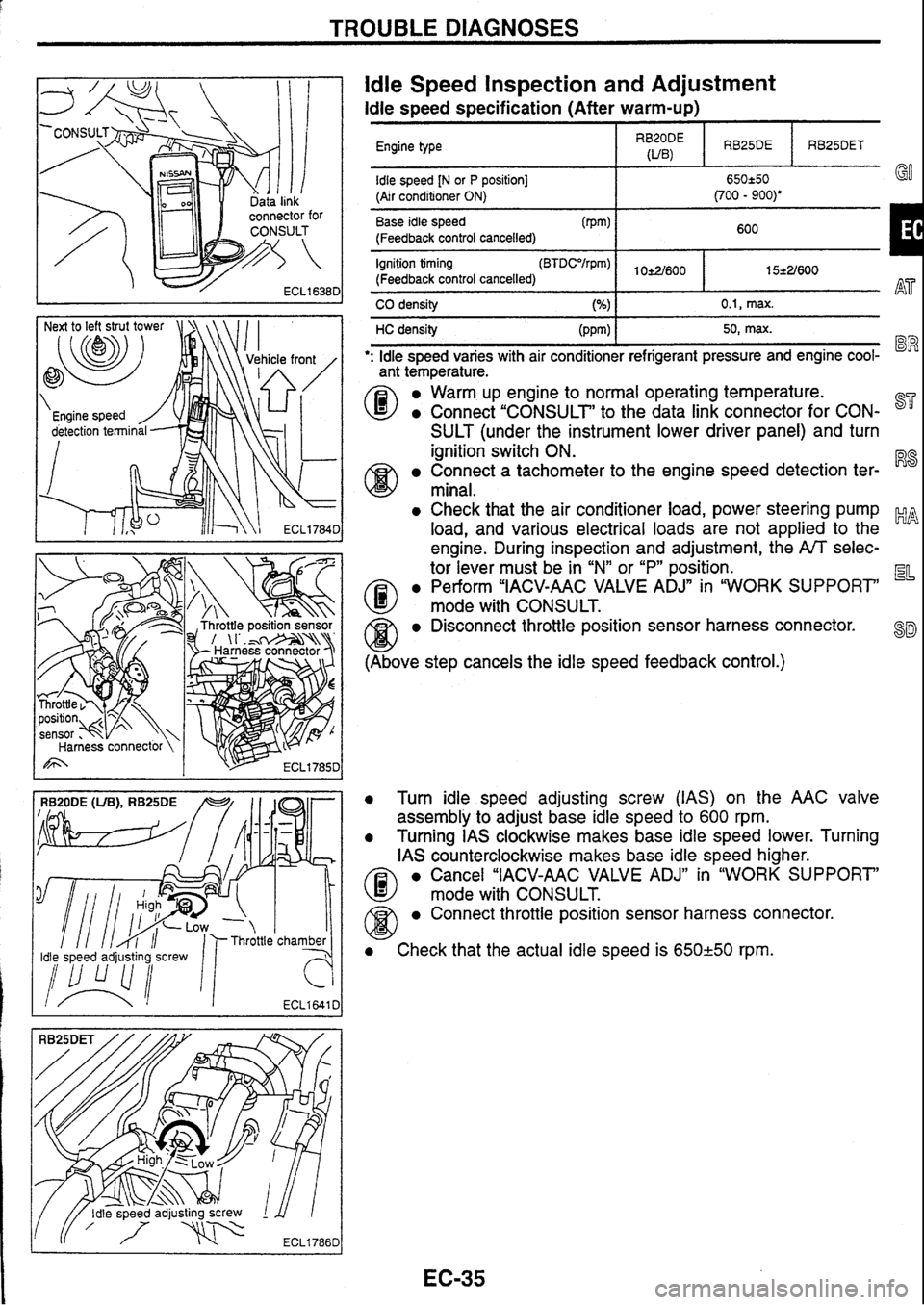
ldle Speed Inspection and Adjustment
ldle speed specification (After warm-up)
Engine type I RygE I RB25DE I RB25DET
Base idle speed (Pm)
(Feedback control cancelled) 600
I 1
idle speed [N or P position] (Air conditioner ON)
Ignition timing
(Feedback control cancelled) I 15*2/600
. . I I
650250 Go (700 - 900)'
CO density 0.1, max.
HC density 50, max.
': ldle speed varies with air conditioner refrigerant pressure and engine cool- "" "
ant temperature.
0
a Warm up engine to normal operating temperature.
a Connect "CONSULT' to the data link connector for CON- 87'
SULT (under the instrument lower driver panel) and turn
ignition switch ON.
Connect a tachometer to the engine speed detection ter- R8
minal.
a Check that the air conditioner load, power steering pump ~p, -4 load, and various electrical loads are not applied to the
engine. During inspection and adjustment, the
A/T selec-
tor lever must be in
"N"
or
"P"
position.
a Perform "IACV-AAC VALVE ADJn in "WORK SUPPORT EL
@ mode with CONSULS.
@ a Disconnect throttle position sensor harness connector. 8~
(Above step cancels the idle speed feedback control.)
0 Turn idle speed adjusting screw (IAS) on the AAC valve
assembly to adjust base idle speed to
600 rpm.
a Turning IAS clockwise makes base idle speed lower. Turning
IAS counterclockwise makes base idle speed higher.
a Cancel "IACV-AAC VALVE ADJ" in "WORK SUPPORT'
@ mode with CONSULT.
a Connect throttle position sensor harness connector.
a Check that the actual idle speed is 650-1-50 rpm.
Page 47 of 230
TROUBLE DIAGNOSES
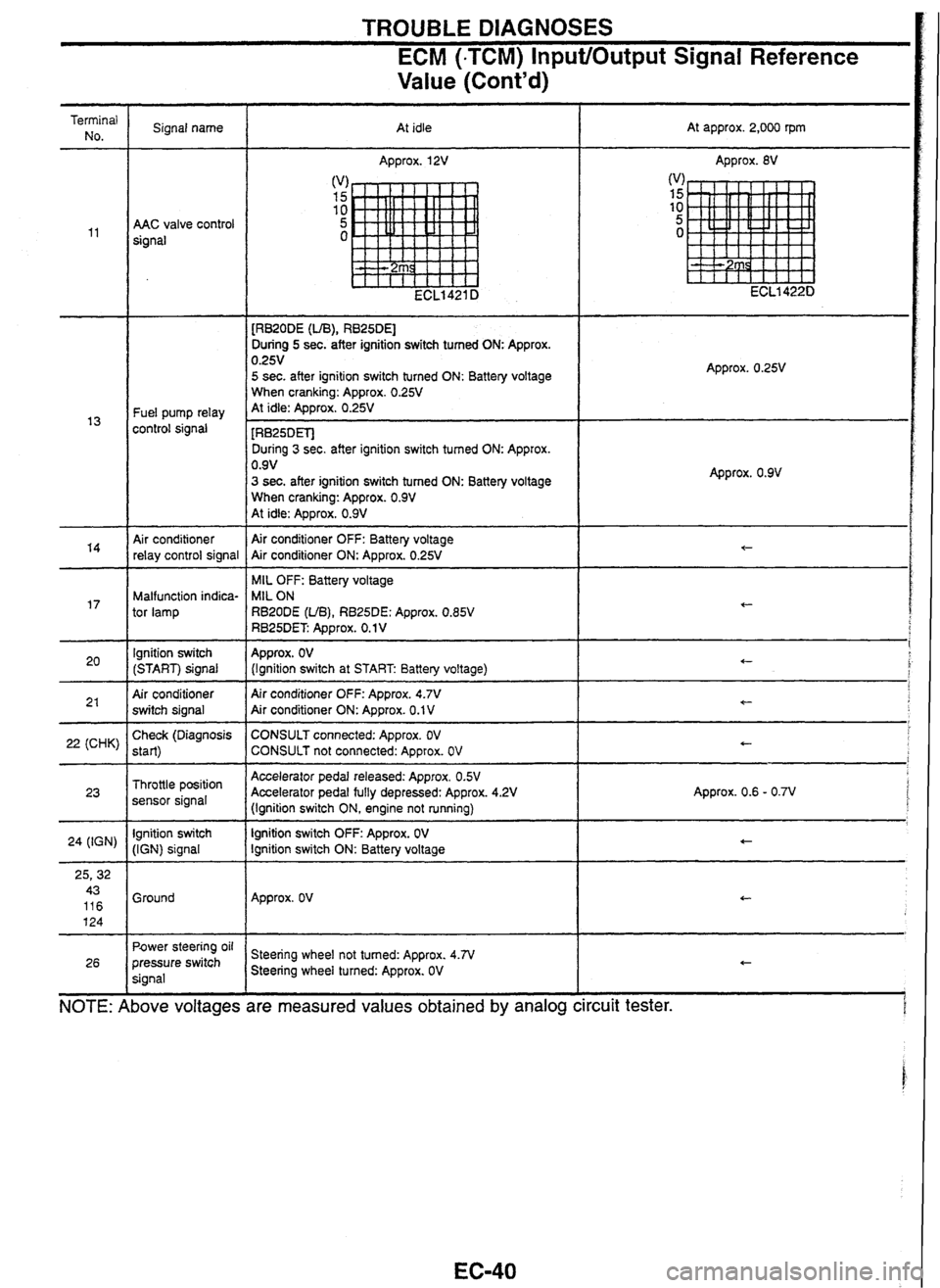
ECM (-TCM) InputlOutput Signal Reference
Value (Cont'd)
d
voltages are
Terminal No. Signal name
At idle At
approx. 2,000 rpm
Approx.
12V Approx. 8V
AAC valve control
signal
[RB20DE
(UB), RB25DEl
During 5 sec. after ignition switch tumed ON: Approx. 0.25V 5 sec. after ignition switch turned ON: Battery voltage
When cranking: Approx. 0.25V At idle: Approx. 0.25V Fuel pump relay
control signal - - [RB25DETJ
During 3 sec. after ignition switch tumed ON: Approx.
0.9V
3 sec. after ignition switch tumed ON: Battery voltage
When cranking: Approx. 0.9V At idle: Approx. 0.9V
Approx. 0.9V
Air conditioner
relay control signal Air conditioner
OFF: Battery voltage
Air conditioner ON: Approx. 0.25V
MIL OFF: Battery voltage
MIL ON
RBZODE
(UB), RB25DE: Approx. 0.85V RB25DET Approx. 0.1 V
Malfunction indica-
tor lamp
lgnition switch
(START) signal
Air conditioner
switch signal Approx.
OV (Ignition
switch at START Battery voltage)
Air conditioner OFF: Approx.
4.7V Air conditioner ON: Approx. 0.1 V -
22 (CHK) Check
(Diagnosis
start)
Throttle position
sensor signal
lgnition switch
(IGN) signal CONSULT
connected: Approx. OV CONSULT not connected: Approx. OV
Accelerator pedal released: Approx. OSV Accelerator pedal fully depressed: Approx. 4.2V
(Ignition switch ON, engine not running)
lgnition switch
OFF: Approx. OV lgnition switch ON: Battery voltage Approx.
0.6 - 0.7V
24
(IGN)
Ground Approx.
OV
Power
steering oil
pressure switch
signal Steering
wheel not tumed: Approx. 4.N Steering wheel turned: Approx. OV
26
NOTE: I bove measured values obtained by analog ircuit
tester.
Page 57 of 230

TROUBLE DIAGNOSES
Shift Mechanism
1 Turbine sensor 1
tine pressure solenoid I 1
Shift solenoid B
Full switch
ECM-TCM
(All side) (RB20DE, RB25DET) or TCM (RB25DE) p-
ECM.TCM (Engine side) * I
(RB20DE. RB25DET) or Venrle speed sensor 2
ECM (RB25DE) ,
1 (RB25DET)
POWER ~nd~calor lamp @AT;
( POWER (Except M-AT) ] 1 SNOW I
Shift control unit
(Except RB20DE)
Overdrive control switch
I
O/D OFF
indicator lamp
Steering shift main switch
- ATN 1983D
Page 123 of 230
ELECTRIC SUPER HICAS
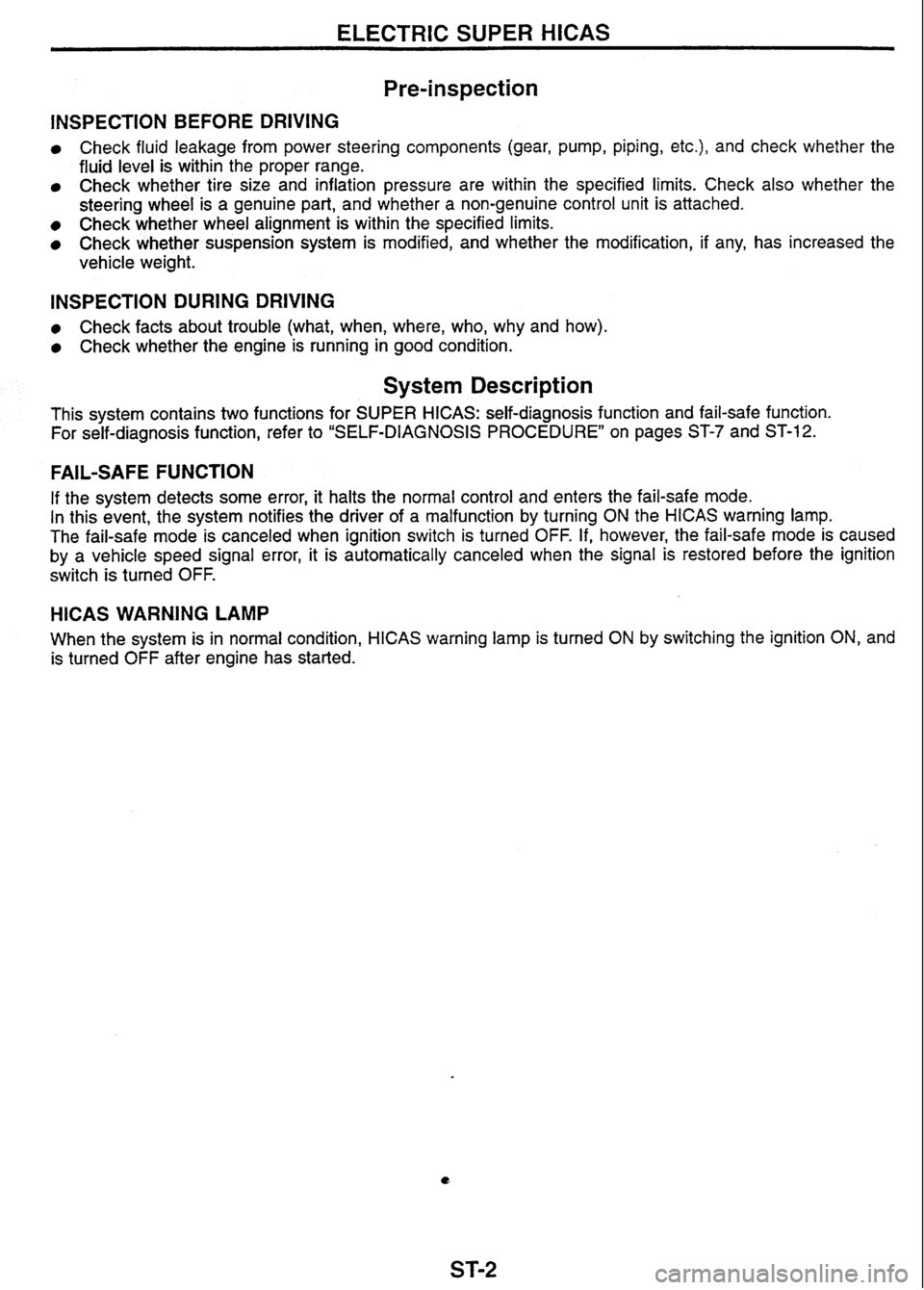
INSPECTION BEFORE DRIVING
Check fluid leakage from power steering components (gear, pump, piping, etc.), and check whether the
fluid level is within the proper range.
Check whether tire size and inflation pressure are within the specified limits. Check also whether the
steering wheel is a genuine part, and whether a non-genuine control unit is attached.
Check whether wheel alignment is within the specified limits.
Check whether suspension system is modified, and whether the modification, if any, has increased the
vehicle weight.
INSPECTION DURING DRIVING
Check facts about trouble (what, when, where, who, why and how).
Check whether the engine is running in good condition.
System Description
This system contains two functions for SUPER HICAS: self-diagnosis function and fail-safe function.
For self-diagnosis function, refer to "SELF-DIAGNOSIS PROCEDURE on pages ST-7 and
ST-12.
FAIL-SAFE FUNCTION
If the system detects some error, it halts the normal control and enters the fail-safe mode.
In this event, the system notifies the driver of a malfunction by turning ON the HICAS warning lamp.
The fail-safe mode is canceled when ignition switch
is turned OFF. If, however, the fail-safe mode is caused
by a vehicle speed signal error, it is automatically canceled when the signal is restored before the ignition
switch is turned OFF.
HICAS WARNING LAMP
When the system is in normal condition, HICAS warning lamp is turned ON by switching the ignition ON, and
is turned OFF after engine has started.
Page 126 of 230

ELECTRIC SUPER HICAS
Control
Unit Input/Output Signal Specifications
USING CIRCUIT TESTER
Terminal No.
Check item Specification
When control unit is disconnected
: Continuity exists.
Control unit ground circuit
Motor driving output signal
When ignition switch is
ON : Power supply voltage
(In fail-safe mode
: OV)
Motor voltage
When vehicle speed is
0 krn/h : Approx. 4.4 - 6.6V
When vehicle speed is
100 km/h : Approx. 2.4 - 3.6V EPS solenoid driving signal
Battery voltage
I Power supply voltage
Data link connector for CONSULT
(TX) I -
Engine speed signal Measure
tachometer driving signal.
Refer to EC section YECM (TCM) Input/Output Signal
Reference
Value7
.
When ignition switch is ON : Power supply voltage
When ignition switch is OFF
: OV Ignition voltage
Body
/ ground HlCAS waming
lamp When HlCAS warning
lamp is ON
: Approx. OV
When
HlCAS
warning
lamp
is
OFF : Approx. 12V
When ignition switch is ON : Approx. 12V
(In fail-safe mode : Approx. OV)
Output
signal for driving motor relay
Data link connector for CONSULT
(RX) I -
Stop lamp switch signal
(Send brake pedal operation signal to control unit.) When
pedal is depressed : Power supply voltage
When
pedal is not depressed
: OV
Continuity exists.
v Steering angle sensor 2
Steering angle sensor 1
Body
ground When steering wheel
is turned, the voltage changes
between 0 and 5V.
Ground
circuit for rear steering angle sensor
Output signal of rear steering angle sensor
I When neutral : Approx. 2.4V
-
Neutral signal of rear steering angle sensor
When ignition switch is ON
When ignition switch is
OFF
--
When neutral : Appro~. 5V
: Approx. 5V
: Approx. OV Power supply for rear steering angle sensor
Page 127 of 230

ELECTRIC SUPER HlCAS
Control Unit
Input/Output Signal Specifications
(Cont'd)
USING CONSULT
The displayed output signals represent the control unit com-
puted data. If the output circuit (harness) should
be open,
correct values may be displayed.
Monitor item
VHCL SPEED SE
[km/hj
STOP LAMP SW
[ON-OFF] Data monitor
I Condition
Specification
--
STEERING ANG Steering
wheel is turned right Steering angle (degrees) mea-
[R/Ll or left. sured from neutral position
NEUTRAL SIG Steering wheel is in neutral When neutral: ON
[ON-OFF] position
or turned right or left. When
turned (right or left): OFF
Brake pedal operation Check
item
Vehicle is running or driving
wheels are turning.
Steering angle sensor circuit
Approximately
equal to speed-
ometer reading
When pedal is depressed: ON
When pedal is not depressed:
I OFF
In neutral position:
Approx.
2.4V Vehicle
speed sensor circuit
Stop lamp switch circuit
ENGINE SPEED
[r~ml
1"l I Actuator is operating in active I In right lock position:
test. Engine
is running.
Approx. 4.4V
in left lock position:
Approx.
0.4V
Rear steering angle sensing
system
Approximately
equal to tachom-
eter reading
POWER STR SOL
[A1
Wiring
in ECM-HICAS control
unit
MOTOR CURRENT
PI
Vehicle speed is changed from
0 to 100 krnh.
HlCAS RELAY
[ON-OFF]
FAILSAFE
[ON-OFF] At
0 km/h:
Approx. 1.1 0A
At
100 krn/h: Approx. 0.48A
WARNING LAMP
[ON-OFF] System related to power steer-
ing solenoid output signal
RR ST
ANG-VOL
[Vl
MOTOR VOLTAGE
[vl
Actuator is operating in active
test.
Ignition switch is ON or engine
is running.
I Power supply system for
OK
if output current is detected
during operation Motor
and its power supply
system
1 signal from control unit
When ignition
switch is ON: ON
Not in operation HICAS
motor relay
System related to relay driving
Check malfunctioning parts
using self-diagnosis and data
monitor.
Approx.
5V
When warning lamp is ON: ON
When warning lamp is OFF:
OFF
Rear steering angle sensing
system Warning
lamp circuit
Power supply voltage Motor power
supply system
C/U
VOLTAGE
[VI Control unit power supply cir-
cuit
Ignition
switch is ON or engine
is running. Power
supply voltage