engine NISSAN GT-R 2013 R35 Owners Manual
[x] Cancel search | Manufacturer: NISSAN, Model Year: 2013, Model line: GT-R, Model: NISSAN GT-R 2013 R35Pages: 346, PDF Size: 4.19 MB
Page 244 of 346
See your 2013 Warranty Information Booklet for
important related information and warranty
coverage exclusions. See also section 2 (page
2-29) and section 5 (page 5-49) of this Owner’s
Manual, “Transmission Clutch Temperature
High” and “Vehicle Dynamic Control (VDC)
System” for important additional related informa-
tion.
.Except for the emergency cases above,
any issues related to driving stability
(e.g., steering maneuvers and maneu-
vers during acceleration and decelera-
tion) and any damages to drivetrain
components (e.g., transfer, clutch, a
sort of gear, transaxle case) will not
be covered by warranty if there is a
record in the Vehicle Status Data
Recorder (VSDR) that the vehicle was
driven with VDC off.
. When attempting to free the vehicle
from mud or fresh snow, the VDC will
detect the tire slipping, and the engine
speed may not increase even when the
accelerator pedal is depressed. To raise
the engine speed, use the VDC set up
switch to turn the VDC system OFF and
select SAVE mode with the transmis-
sion switch. (
“VDC, transmission
and suspension setup switches” page 5-24)
. When the VDC system is turned OFF,
all VDC functions (including traction
control) , except for the ABS functions,
are deactivated.
FREEING A FROZEN DOOR LOCK
To prevent a door lock from freezing, apply
deicer through the key hole. If the lock becomes
frozen, heat the key before inserting it into the
key hole or use the Intelligent Key system.
ANTI-FREEZE
In the winter when it is anticipated that the
outside temperature will drop below 328F(0 8C) ,
check antifreeze to assure proper winter protec-
tion. (
“Engine cooling system” page 8-10)
BATTERY
If the battery is not fully charged during
extremely cold weather conditions, the battery
fluid may freeze and damage the battery. To
maintain maximum efficiency, the battery should
be checked regularly. (
“Battery” page 8-
17)
DRAINING OF COOLANT WATER
If the vehicle is to be left outside without
antifreeze, drain the cooling system, including
the engine block. Refill before operating the
vehicle. For details, contact a GT-R certified
NISSAN dealer.
Starting and driving5-51
COLD WEATHER DRIVING
Page 245 of 346
5-52Starting and driving
TIRE EQUIPMENT
The GT-R summer tires are made from a
specially formulated rubber to maximize the
vehicle’s performance capabilities. Performance
of summer tires is substantially reduced when
temperatures are less than 328F(08C) so you
must drive carefully. NISSAN recommends the
use of winter or all-season tires on all four
wheels if you plan to operate your vehicle in
snowy or icy conditions when temperatures are
less than 328F(0 8C) .
WARNING
Never use summer tires when the
temperature is below −48F(−208C) to
prevent permanent tread deformation
which may cause tire damage or tire
failure. This may cause a loss of vehicle
control which can result in serious
personal injury or death.
Tire chains may be used. (
“Tire chains”
page 8-39)
If you install tires, they must also be the specified
size, brand, construction and tread pattern on all
four wheels.
SPECIAL WINTER EQUIPMENT
It is recommended that the following items be
carried in the vehicle during winter:
. A scraper and stiff-bristled brush to remove
ice and snow from the windows and wiper
blades.
. A sturdy, flat board to be placed under the
jack to give it firm support.
. A shovel to dig the vehicle out of snowdrifts.
. Extra window washer fluid to refill the
reservoir tank.
DRIVING ON SNOW OR ICE
WARNING
.Wet ice (328F, 0 8C and freezing rain) ,
very cold snow or ice can be slick
and very hard to drive on. The
vehicle will have much less traction
or “grip” under these conditions. Try
to avoid driving on wet ice until the
road is salted or sanded.
. Whatever the condition, drive with
caution. Accelerate and slow down
with care. If accelerating or down-
shifting too fast, the drive wheels
will lose even more traction. .
Allow more stopping distance under
these conditions. Braking should be
started sooner than on dry pave-
ment.
. Allow greater following distances
on slippery roads.
. Watch for slippery spots (glare ice) .
These may appear on an otherwise
clear road in shaded areas. If a
patch of ice is seen ahead, brake
before reaching it. Try not to brake
while on the ice, and avoid any
sudden steering maneuvers.
. Do not use the cruise control on
slippery roads.
. Snow can trap dangerous exhaust
gases under your vehicle. Keep
snow clear of the exhaust pipe and
from around your vehicle.
NOTE:
When driving on snow, select the SAVE
mode with the setup switch. By selecting
the SAVE mode, the engine output is
controlled appropriately for snow or slip-
pery road surfaces. This enables the vehi-
cle to start or accelerate smoothly.
Page 246 of 346
ENGINE BLOCK HEATER (if so
equipped)
The engine block heater should be used when
the outside temperature is 208F(−78C) or lower.
To use the engine block heater
1. Turn the engine off.
2. Plug the engine block heater cord into a
grounded 3-wire, 3-pronged extension cord.
3. Plug the extension cord into a Ground Fault Interrupt (GFI) protected, grounded 110-
volt AC (VAC) outlet.
4. The engine block heater must be plugged in for at least 2 - 4 hours, depending on
outside temperatures, to properly warm the
engine coolant. Use an appropriate timer to
turn the engine block heater on.
5. Before starting the engine, unplug and properly store the cord to keep it away from
moving parts.
WARNING
.Do not use your engine block heater
with an ungrounded electrical sys-
tem or a 2-pronged adapter. You can
be seriously injured by an electrical
shock if you use an ungrounded connection.
. Disconnect and properly store the
engine block heater cord before
starting the engine. Damage to the
cord could result in an electrical
shock and can cause serious injury.
. Use a heavy-duty 3-wire, 3-pronged
extension cord rated for at least
10A. Plug the extension cord into a
Ground Fault Interrupt (GFI) pro-
tected, grounded 110-VAC outlet.
Failure to use the proper extension
cord or a grounded outlet can result
in a fire or electrical shock and
cause serious personal injury.
Starting and driving5-53
Page 248 of 346
6 In case of emergency
Roadside assistance program .............................................. 6-2
Emergency engine shut off .................................................... 6-2
Flat tire ........................................................................\
................ 6-2Tire Pressure Monitoring System (TPMS) ................... 6-2
Run-flat tires ........................................................................\
6-3
Jump starting ........................................................................\
..... 6-4 Push starting ........................................................................\
..... 6-7
If your vehicle overheats ........................................................ 6-7
Towing your vehicle ................................................................ 6-8
Towing recommended by NISSAN ............................. 6-9
Vehicle recovery (freeing a stuck vehicle) .............. 6-10
Page 249 of 346
6-2In case of emergency
In the event of a roadside emergency, Roadside
Assistance Service is available to you. Please
refer to your Warranty Information Booklet (U.S.)
or Warranty & Roadside Assistance Information
Booklet (Canada) for details.To shut off the engine in an emergency situation
while driving, perform the following procedure:
.Rapidly push the push-button ignition switch
3 consecutive times in less than 1.5
seconds, or
. Push and hold the push-button ignition
switch for more than 2 seconds.TIRE PRESSURE MONITORING
SYSTEM (TPMS)
This vehicle is equipped with the Tire Pressure
Monitoring System (TPMS) . It monitors tire
pressure of all tires. When the low tire pressure
warning light is lit, one or more of your tires is
significantly under-inflated. If the vehicle is being
driven with low tire pressure, the TPMS will
activate and warn you of it by the low tire
pressure warning light (in the instrument panel)
or the LOW PRESSURE information screen (on
the display) . This system will activate only when
the vehicle is driven at speeds above 16 MPH
(25 km/h). (
“Low tire pressure warning
light” page 2-26) (“Tire Pressure Monitor-
ing System (TPMS)” page 5-4)
WARNING
. If the low tire pressure warning light
illuminates or LOW PRESSURE in-
formation is displayed on the moni-
tor screen while driving, avoid
sudden steering maneuvers or
abrupt braking, reduce vehicle
speed, pull off the road to a safe
location and stop the vehicle as
soon as possible. Driving with un-
der-inflated tires may permanently
ROADSIDE ASSISTANCE
PROGRAM EMERGENCY ENGINE SHUT OFF FLAT TIRE
Page 251 of 346
6-4In case of emergency
NOTICE
.Never install tire chains on a punc-
tured run-flat tire, as this could
damage your vehicle.
. Avoid driving over any projection or
pothole, as the clearance between
the vehicle and the ground is smal-
ler than normal.
. Do not enter an automated car wash
with a punctured run-flat tire.
. Have the punctured tire replaced by
your GT-R certified NISSAN dealer
as soon as possible, as the tire’s
performance capability is reduced.
If you have a flat tire and have to stop the
vehicle, follow the instructions below.
1. Safely move the vehicle off the road and away from traffic.
2. Turn on the hazard warning flashers.
3. Park on a level surface and apply the parking brake. Move the shift lever to the
&Pposition.
4. Turn off the engine.
5. Raise the hood to warn other traffic, and to signal professional road assistance person-
nel that you need assistance. 6. Have all passengers get out of the vehicle
and stand in a safe place, away from traffic
and clear of the vehicle.
If needed Roadside Assistance is available.
Please see your Warranty Information Booklet
for the toll-free number to call (U.S.) or Warranty
Information Booklet (Canada).
For the tire removing procedure, see the
following section. (
“Jacking vehicle and
removing wheels” page 8-42)
The following circumstances indicate that the
battery is discharged.
. The starter motor does not turn or it turns
weakly and the engine does not start.
. The vehicle lights are much dimmer than
usual.
. The sound of the horn is weak. The horn
makes no sound.
NOTICE
When the battery is discharged, do not
close either of the front doors. The
automatic window adjusting function
will not work, and the side roof panel
may be damaged.
To start your engine with a booster battery, the
instructions and precautions below must be
followed.
For the battery maintenance information, see the
following section. (
“Battery” page 8-17)
JUMP STARTING
Page 253 of 346
6-6In case of emergency
WARNING
Always follow the instructions below.
Failure to do so could result in damage
to the charging system and cause
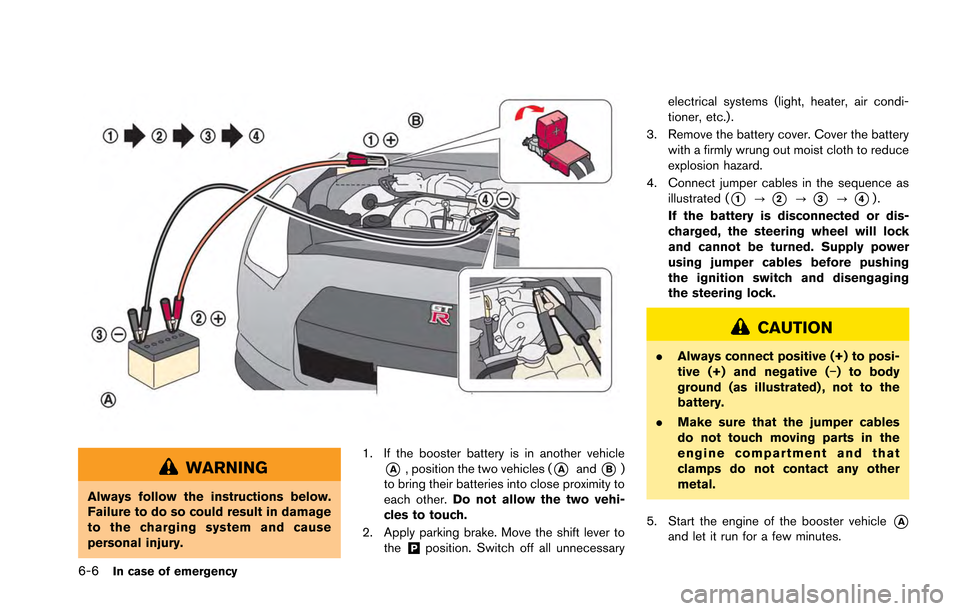
personal injury.1. If the booster battery is in another vehicle
*A, position the two vehicles (*Aand*B)
to bring their batteries into close proximity to
each other. Do not allow the two vehi-
cles to touch.
2. Apply parking brake. Move the shift lever to the
&Pposition. Switch off all unnecessary electrical systems (light, heater, air condi-
tioner, etc.).
3. Remove the battery cover. Cover the battery with a firmly wrung out moist cloth to reduce
explosion hazard.
4. Connect jumper cables in the sequence as illustrated (
*1?*2?*3?*4).
If the battery is disconnected or dis-
charged, the steering wheel will lock
and cannot be turned. Supply power
using jumper cables before pushing
the ignition switch and disengaging
the steering lock.
CAUTION
. Always connect positive (+) to posi-
tive (+) and negative (−) to body
ground (as illustrated) , not to the
battery.
. Make sure that the jumper cables
do not touch moving parts in the
engine compartment and that
clamps do not contact any other
metal.
5. Start the engine of the booster vehicle
*Aand let it run for a few minutes.
Page 254 of 346
6. Keep the engine speed of the boostervehicle
*Aat about 2,000 rpm, and start
the engine of the vehicle being jump started
*B.
NOTE:
Do not keep the starter motor engaged
for more than 10 seconds. If the engine
does not start right away, push the
ignition switch to the OFF position and
wait 10 seconds before trying again.
7. After starting your engine, carefully discon- nect the negative cable and then the positive
cable (
*4?*3?*2?*1).
8. Be sure to dispose of the cloth used to cover the vent holes as it may be contami-
nated with corrosive acid.
9. Put the battery cover on.
NOTE:
If the clamp clip is difficult to connect to
the battery terminal, remove the cowl top
cover to make it easier. (
“Removing
the cowl top cover” page 8-9)
Do not attempt to start the engine by pushing.
NOTICE
Your NISSAN cannot be push-started or
tow-started. Attempting to do so may
cause transmission damage.
If needed, Roadside Assistance is available.
Please see your Warranty Information Booklet
for the toll-free number to call (U.S.) or Warranty
& Roadside Assistance Information Booklet
(Canada) .
WARNING
. Do not continue to drive if your
vehicle overheats. Doing so could
cause engine damage or a vehicle
fire.
. To avoid the danger of being
scalded, never remove the radiator
filler cap and the coolant reservoir
cap while the engine is still hot.
When the cap is removed, pressur-
ized hot water will spurt out, possi-
bly causing serious injury.
. Do not open the hood if steam is
coming out.
If your vehicle is overheating (indicated by an
extremely high temperature gauge reading) , or if
you feel a lack of engine power, detect unusual
noise, etc., take the following steps:
1. Move the vehicle safely off the road, apply the parking brake and move the shift lever to
the
&Pposition.
Do not stop the engine.
2. Turn off the air conditioner. Open all the windows, move the temperature control to
maximum hot and fan control to high speed.
In case of emergency6-7
PUSH STARTING IF YOUR VEHICLE OVERHEATS
Page 255 of 346
6-8In case of emergency
3. If engine overheating is caused by climbinga long hill on a hot day, run the engine at a
fast idle (approximately 1,500 rpm) until the
temperature gauge indication returns to
normal.
4. Get out of the vehicle. Look and listen for steam or coolant escaping from the radiator
before opening the hood. (If steam or
coolant is escaping, turn off the engine.)
Do not open the hood further until no steam
or coolant can be seen.
5. Open the engine hood.
WARNING
If steam or water is coming from the
engine, stand clear to prevent getting
burned.
6. Visually check drive belts for damage or looseness. Also check if the cooling fan is
running. The radiator hoses and radiator
should not leak water. If coolant is leaking,
the drive belts are missing or loose, or the
cooling fan does not run, stop the engine.
WARNING
Be careful not to allow your hands, hair,
jewelry or clothing to come into contact
with, or get caught in, engine belts or
the engine cooling fan. The engine
cooling fan can start at any time.
7. When the coolant temperature gauge goes down to the midpoint, stop the engine and
wait until the gauge goes down further to
“C” (cold).
8. After the engine cools down, check the coolant level in the reservoir tank. Add
coolant to the reservoir, if necessary, after
opening the coolant reservoir cap with a
heavy cloth covering it. (
“Engine cool-
ing system” page 8-10)
9. Have your vehicle repaired at the nearest GT-R certified NISSAN dealer.
If needed, Roadside Assistance is available.
Please see your Warranty Information Booklet
for the toll-free number to call (U.S.) or Warranty
& Roadside Assistance Information Booklet
(Canada) .
When towing your vehicle, all State (Provincial in
Canada) and local regulations for towing must
be followed. Incorrect towing equipment could
damage your vehicle. Towing instructions are
available from a GT-R certified NISSAN dealer.
Local service operators are familiar with the
applicable laws and procedures for towing. To
assure proper towing and to prevent accidental
damage to your vehicle, NISSAN recommends
that you have a service operator tow your
vehicle. It is advisable to have the service
operator carefully read the following precau-
tions.
WARNING
. Never ride in a vehicle that is being
towed.
. Never get under your vehicle after it
has been lifted by a tow truck.
CAUTION
Always attach safety chains before
towing.
If needed, Roadside Assistance is available.
Please see your Warranty Information Booklet
TOWING YOUR VEHICLE
Page 268 of 346
8 Maintenance and do-it-yourself
Maintenance requirement ....................................................... 8-3Scheduled maintenance ................................................... 8-3
General maintenance ........................................................ 8-3
Where to go for service ................................................... 8-3
General maintenance .............................................................. 8-4 Explanation of maintenance items ................................. 8-4
Maintenance precautions ....................................................... 8-6
Engine compartment check locations ................................. 8-8 Removing the cowl top cover ......................................... 8-9
Engine cooling system ......................................................... 8-10
Checking engine coolant level ..................................... 8-11
Changing engine coolant .............................................. 8-12
Engine oil ........................................................................\
........ 8-12
Checking engine oil level .............................................. 8-12
Changing engine oil and filter ...................................... 8-13
Transmission oil ..................................................................... 8-14
Power steering fluid .............................................................. 8-14
Brake fluid ........................................................................\
....... 8-15
Window washer fluid ........................................................... 8-16
Battery ........................................................................\
.............. 8-17
Precautions ....................................................................... 8-17
Fluid level check .............................................................. 8-17
Jump starting .................................................................... 8-18 Drive belts ........................................................................\
...... 8-19
Spark plugs ........................................................................\
.... 8-19
Replacing spark plugs ................................................. 8-20
Air cleaner ........................................................................\
...... 8-20
Windshield wiper blades .................................................... 8-21 Cleaning ........................................................................\
.. 8-21
Replacing the wiper blades ....................................... 8-21
Brakes ........................................................................\
............. 8-22 Self-adjusting brakes ................................................... 8-22
Brake pad wear warning ............................................. 8-22
High performance brake system ............................... 8-22
Replacing the brake pads ........................................... 8-23
Fuses ........................................................................\
............... 8-23
Engine compartment .................................................... 8-23
Passenger compartment ............................................. 8-24
Intelligent Key battery replacement .................................. 8-26
Lights ........................................................................\
............... 8-28 Headlights ....................................................................... 8-29Exterior and interior lights ........................................... 8-29
Wheels and tires .................................................................. 8-31
Tire pressure .................................................................. 8-31
Tire and loading information label ............................ 8-33
Checking the tire pressure ......................................... 8-34