engine NISSAN GT-R 2013 R35 Owners Manual
[x] Cancel search | Manufacturer: NISSAN, Model Year: 2013, Model line: GT-R, Model: NISSAN GT-R 2013 R35Pages: 346, PDF Size: 4.19 MB
Page 317 of 346
9-4Technical and consumer information
FUEL RECOMMENDATION
VR38 engine
Use unleaded premium gasoline with an octane
rating of at least 93 AKI (Anti-Knock Index)
number (Research octane number 98) to max-
imize vehicle performance.
If the premium gasoline specified above is not
available, you may use unleaded premium gaso-
line with an octane rating of at least 91 AKI
number (Research octane number 96) , but you
may notice a decrease in performance.
Do not use gasoline with an octane rating lower
than 91 AKI (Research octane number 96) .
NOTICE
.Using a fuel other than that speci-
fied could adversely affect the emis-
sion control system, and may also
affect warranty coverage.
. Under no circumstances should a
leaded gasoline be used, because
this will damage the three-way cat-
alyst.
. Do not use E-15 or E-85 fuel in your
vehicle. Your vehicle is not designed
to run on E-15 or E-85 fuel. Using E- 15 or E-85 fuel in a vehicle not
specifically designed for E-15 or E-
85 fuel can adversely affect the
emission control devices and sys-
tems of the vehicle. Damage caused
by such fuel is not covered by the
NISSAN new vehicle limited war-
ranty.
. U.S. government regulations require
ethanol dispensing pumps to be
identified by a small, square, orange
and black label with the common
abbreviation or the appropriate per-
centage for that region.
. NISSAN recommends using fuels
that contain no alcohol. However,
fuels containing up to 10% alcohol
may be used, if necessary. To avoid
serious engine damage due to in-
creased cylinder temperatures, do
not use fuels that contain more
alcohol than indicated in this sec-
tion. Also, do not use fuel additives,
fuel stabilizers or fuel deicers that
contain alcohol.
Gasoline specifications
NISSAN recommends using gasoline that meets
the World-Wide Fuel Charter (WWFC) speci-
fications where it is available. Many of the
automobile manufacturers developed this spe-
cification to improve emission system and
vehicle performance. Ask your service station
manager if the gasoline meets the World-Wide
Fuel Charter (WWFC) specifications.
Reformulated gasoline
Some fuel suppliers are now producing refor-
mulated gasolines. These gasolines are specially
designed to reduce vehicle emissions. NISSAN
supports efforts towards cleaner air and sug-
gests that you use reformulated gasoline when
available.
Gasoline containing oxygenates
Some fuel suppliers sell gasoline containing
oxygenates such as ethanol, MTBE and metha-
nol with or without advertising their presence.
NISSAN does not recommend the use of fuels
of which the oxygenate content and the fuel
compatibility for your NISSAN cannot be readily
determined. If in doubt, ask your service station
manager.
If you use oxygenate-blend gasoline, please take
the following precautions as the usage of such
Page 318 of 346
fuels may cause vehicle performance problems
and/or fuel system damage.
.The fuel should be unleaded and have
an octane rating no lower than that
recommended for unleaded gasoline.
. If an oxygenate-blend, excepting a
methanol blend, is used, it should
contain no more than 10% oxygenate.
(MTBE may, however, be added up to
15%.)
. E-15 fuel contains more than 10%
oxygenate. E-15 fuel will adversely
affect the emission control devices
and systems of the vehicle and should
not be used. Damage caused by such
fuel is not covered under the NISSAN
new vehicle limited warranty.
. If a methanol blend is used, it should
contain no more than 5% methanol
(methyl alcohol and wood alcohol) . It
should also contain a suitable amount
of appropriate cosolvents and corro-
sion inhibitors. If not properly formu-
lated with the appropriate cosolvents
and corrosion inhibitors, such metha-
nol blends may cause fuel system
damage and/or vehicle performance
malfunctions. At this time, sufficient data is not available to ensure that all
methanol blends are suitable for use in
NISSAN vehicles.
If any undesirable driveability problems such as
engine stalling or hard hot starting are experi-
enced after using oxygenate-blend fuels, im-
mediately change to a non-oxygenate fuel or a
fuel with a low blend of MTBE.
NOTICE
Take care not to spill gasoline during
refueling. Gasoline containing oxyge-
nates can cause paint damage.
E-15 fuel
E-15 fuel is a mixture of approximately 15% fuel
ethanol and 85% unleaded gasoline. E-15 can
only be used in vehicles designed to run on E-
15 fuel. Do not use E-15 in your vehicle. U.S.
government regulations require fuel ethanol
dispensing pumps to be identified with small,
square, orange and black label with the common
abbreviation or the appropriate percentage for
that region.
E-85 fuel
E-85 fuel is a mixture of approximately 85% fuel
ethanol and 15% unleaded gasoline. E-85 can
only be used in a Flexible Fuel Vehicle (FFV) . Do
not use E-85 fuel in your vehicle. U.S. govern-
ment regulations require fuel ethanol dispensing
pumps to be identified by a small, square,
orange and black label with the common
abbreviation or the appropriate percentage for
that region.
Aftermarket fuel additives
NOTICE
NISSAN does not recommend the use
of any aftermarket fuel additives (Ex-
ample: fuel injector cleaner, intake
valve deposit removers, etc.) which are
sold commercially. Many of these ad-
ditives intended for gum, varnish or
deposit removal may contain active
solvent or similar ingredients that can
be harmful to the fuel system and
engine.
Technical and consumer information9-5
Page 319 of 346
9-6Technical and consumer information
Octane rating tips
Using unleaded gasoline with an octane
rating lower than recommended above can
cause persistent, heavy spark knock.
(Spark knock is a metallic rapping noise.)
If severe, this can lead to engine damage.
If you detect a persistent heavy spark
knock even when using gasoline of the
stated octane rating, or if you hear steady
spark knock while holding a steady speed
on level roads, have a GT-R certified
NISSAN dealer correct the condition. Fail-
ure to correct the condition is misuse of
the vehicle, for which NISSAN is not
responsible.
Incorrect ignition timing will result in knocking,
after-run or overheating. This in turn may cause
excessive fuel consumption or damage to the
engine. If any of the above symptoms are
encountered, have your vehicle checked at a
GT-R certified NISSAN dealer or other compe-
tent service facility.
However, now and then you may notice
light spark knock for a short time while
accelerating or driving up hills. This is no
cause for concern, because you get the
greatest fuel benefit when there is light
spark knock for a short time under heavy
engine load.
ENGINE OIL AND OIL FILTER RE-
COMMENDATION
Selecting the correct oil
It is essential to choose the correct grade,
quality, and viscosity engine oil to ensure
satisfactory engine life and performance.
(
“Capacities and recommended fuel/lubri-
cants” page 9-2)
Mobil 1 (0W-40) (100% synthetic) is the factory
fill oil. The VR38 engine with its plasma-sprayed
bores was developed using this oil. NISSAN
cannot ensure proper engine operation and
durability if other 0W-40 synthetic oil is used.
If Mobil 1 (0W-40) is not available, Mobil 1
(10W-40) (100% synthetic) may be used;
however, some performance loss may be
noticed.
NOTICE
Using an engine oil other than that
specified could adversely affect the
engine. See the 2013 NISSAN GT-R
Warranty Information Booklet for de-
tails and exclusions.
Oil additives
NISSAN does not recommend the use of oil
additives. The use of an oil additive is not
necessary when the proper oil type is used and
maintenance intervals are followed.
Oil which may contain foreign matter or has
been previously used should not be used.
Oil viscosity
The engine oil viscosity or thickness changes
with temperature. Because of this, it is important
that the engine oil viscosity be selected based
on the temperatures at which the vehicle will be
operated before the next oil change. Choosing
an oil viscosity other than that recommended
could cause serious engine damage.
Selecting the correct oil filter
Your new vehicle is equipped with a high-quality
genuine NISSAN oil filter. NISSAN recommends
to use the genuine NISSAN oil filter for the
reason described in change intervals.
Change intervals
The oil and oil filter change intervals for your
engine are based on the use of the specified
quality oils and filters. Oil and filter other than the
specified quality, or oil and filter change intervals
longer than recommended could reduce engine
Page 320 of 346
life. Damage to engines caused by improper
maintenance or use of incorrect oil and filter
quality and/or viscosity is not covered by the
NISSAN new vehicle limited warranties.
Your engine was filled with a high quality engine
oil when it was built. You do not have to change
the oil before the first recommended change
interval. Oil and filter change intervals depend
upon how you use your vehicle. Operation under
the following conditions may require more
frequent oil and filter changes.
.repeated short distance driving at cold
outside temperatures
. driving in dusty conditions
. extensive idling
. stop and go “rush hour” traffic
Refer to the “NISSAN Service and Maintenance
Guide” for the maintenance schedule.
AIR CONDITIONING SYSTEM RE-
FRIGERANT AND LUBRICANT RE-
COMMENDATIONS
The air conditioning system in your
NISSAN vehicle must be charged with the
refrigerant HFC-134a (R-134a) and the
lubricant, NISSAN UV Luminous Oil Type
S or the exact equivalents.
NOTICE
The use of any other refrigerant or
lubricant will cause severe damage to
the air conditioning system and will
require the replacement of all air con-
ditioner system components.
The refrigerant HFC-134a (R-134a) in your
NISSAN vehicle will not harm the earth’s ozone
layer. Although this refrigerant does not affect
the earth’s atmosphere, certain governmental
regulations require the recovery and recycling of
any refrigerant during automotive air condition-
ing system service. Your GT-R certified NISSAN
dealer has the trained technicians and equip-
ment needed to recover and recycle your air
conditioning system refrigerant.
Contact a GT-R certified NISSAN dealer when
servicing your air conditioning system.
Technical and consumer information9-7
Page 321 of 346
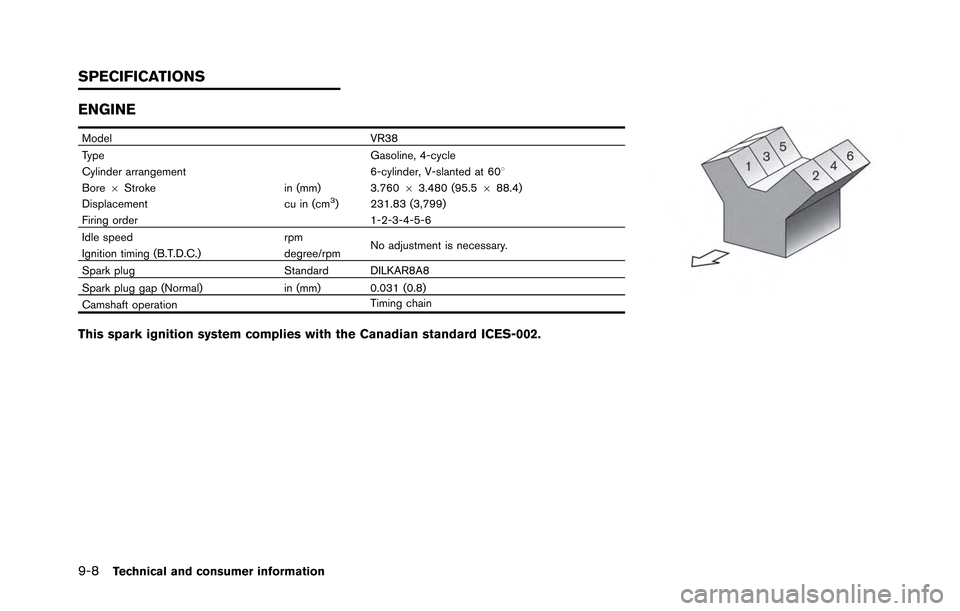
9-8Technical and consumer information
ENGINE
ModelVR38
Type Gasoline, 4-cycle
Cylinder arrangement 6-cylinder, V-slanted at 608
Bore 6Stroke in (mm) 3.76063.480 (95.5 688.4)
Displacement cu in (cm
3) 231.83 (3,799)
Firing order 1-2-3-4-5-6
Idle speed rpm
No adjustment is necessary.
Ignition timing (B.T.D.C.) degree/rpm
Spark plug Standard DILKAR8A8
Spark plug gap (Normal) in (mm) 0.031 (0.8)
Camshaft operation Timing chain
This spark ignition system complies with the Canadian standard ICES-002.
SPECIFICATIONS
Page 324 of 346
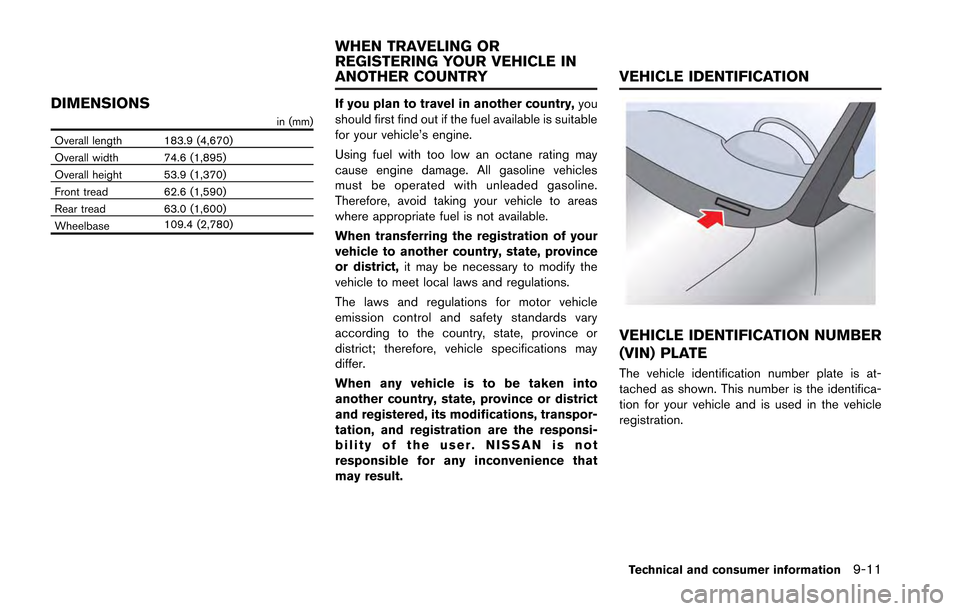
DIMENSIONS
in (mm)
Overall length 183.9 (4,670)
Overall width 74.6 (1,895)
Overall height 53.9 (1,370)
Front tread 62.6 (1,590)
Rear tread 63.0 (1,600)
Wheelbase 109.4 (2,780)
If you plan to travel in another country,
you
should first find out if the fuel available is suitable
for your vehicle’s engine.
Using fuel with too low an octane rating may
cause engine damage. All gasoline vehicles
must be operated with unleaded gasoline.
Therefore, avoid taking your vehicle to areas
where appropriate fuel is not available.
When transferring the registration of your
vehicle to another country, state, province
or district, it may be necessary to modify the
vehicle to meet local laws and regulations.
The laws and regulations for motor vehicle
emission control and safety standards vary
according to the country, state, province or
district; therefore, vehicle specifications may
differ.
When any vehicle is to be taken into
another country, state, province or district
and registered, its modifications, transpor-
tation, and registration are the responsi-
bility of the user. NISSAN is not
responsible for any inconvenience that
may result.
VEHICLE IDENTIFICATION NUMBER
(VIN) PLATE
The vehicle identification number plate is at-
tached as shown. This number is the identifica-
tion for your vehicle and is used in the vehicle
registration.
Technical and consumer information9-11
WHEN TRAVELING OR
REGISTERING YOUR VEHICLE IN
ANOTHER COUNTRY VEHICLE IDENTIFICATION
Page 325 of 346
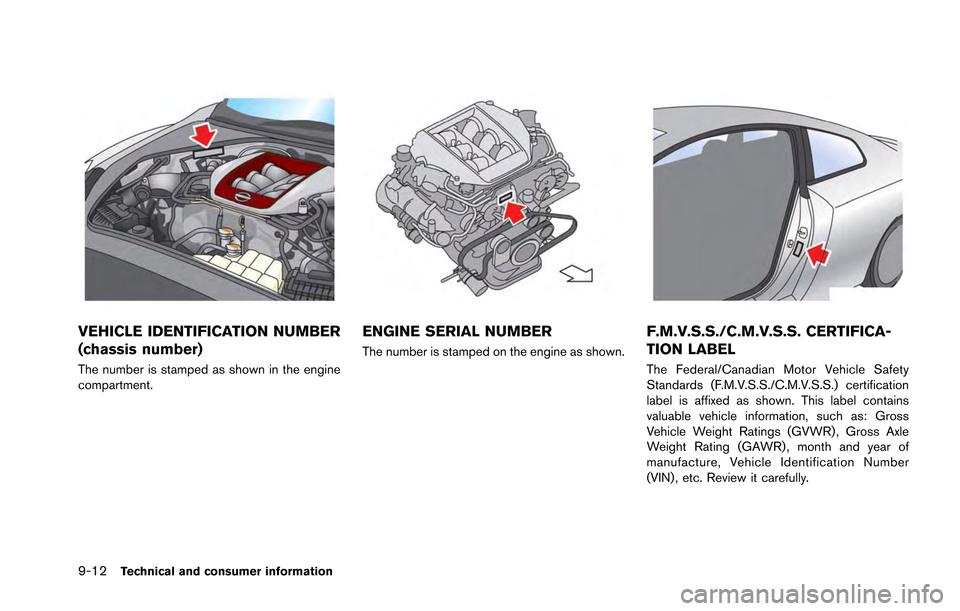
9-12Technical and consumer information
VEHICLE IDENTIFICATION NUMBER
(chassis number)
The number is stamped as shown in the engine
compartment.
ENGINE SERIAL NUMBER
The number is stamped on the engine as shown.
F.M.V.S.S./C.M.V.S.S. CERTIFICA-
TION LABEL
The Federal/Canadian Motor Vehicle Safety
Standards (F.M.V.S.S./C.M.V.S.S.) certification
label is affixed as shown. This label contains
valuable vehicle information, such as: Gross
Vehicle Weight Ratings (GVWR) , Gross Axle
Weight Rating (GAWR) , month and year of
manufacture, Vehicle Identification Number
(VIN) , etc. Review it carefully.
Page 333 of 346
9-20Technical and consumer information
www.tc.gc.ca/roadsafety (English speak-
ers) or www.tc.gc.ca/securiteroutiere
(French speakers).
To notify NISSAN of any safety concerns
please contact our Consumer Information
Centre toll free at 1-800-387-0122.A vehicle equipped with All-Wheel Drive (AWD)
should never be tested using a two wheel
dynamometer (such as the dynamometers used
by some states for emissions testing), or similar
equipment. Make sure you inform test facility
personnel that your vehicle is equipped with
AWD before it is placed on a dynamometer.
Using the wrong test equipment may result in
transmission damage or unexpected vehicle
movement which could result in serious vehicle
damage or personal injury.
Due to legal requirements in some states/ areas,
your vehicle may be required to be in what is
called the “ready condition” for an Inspection/
Maintenance (I/M) test of the emission control
system.
The vehicle is set to the “ready condition” when
it is driven through certain driving patterns.
Usually, the “ready condition” can be obtained
by ordinary usage of the vehicle.
If a powertrain system component is repaired or
the battery is disconnected, the vehicle may be
reset to a “not ready condition”. Before taking
the I/M test, check the vehicle’s inspection/
maintenance test readiness condition. Push the
ignition switch to the ON position without
starting the engine. If the Malfunction Indicator
Light (MIL) comes on steady for 20 seconds and
then blinks for 10 seconds, the I/M testcondition is “not ready”. If the MIL does not
blink after 20 seconds, the I/M test condition is
“ready”.
Contact a GT-R certified NISSAN dealer to set
“ready condition” or to prepare the vehicle for
testing.
READINESS FOR INSPECTION/
MAINTENANCE (I/M) TEST (US only)
Page 334 of 346
This vehicle is equipped with an Event Data
Recorder (EDR) . The main purpose of an EDR is
to record, in certain crash or near crash-like
situations, such as an air bag deployment or
hitting a road obstacle, data that will assist in
understanding how a vehicle’s systems per-
formed. The EDR is designed to record data
related to vehicle dynamics and safety systems
for a short period of time, typically 30 seconds
or less. The EDR in this vehicle is designed to
record such data as:
.How various systems in your vehicle were
operating;
. Whether or not the driver and passenger
safety belts were buckled/fastened;
. How far (if at all) the driver was depressing
the accelerator and/or brake pedal; and,
. How fast the vehicle was traveling.
. Sounds are not recorded.
These data can help provide a better under-
standing of the circumstances in which crashes
and injuries occur. NOTE: EDR data are
recorded by your vehicle only if a nontrivial
crash situation occurs; no data are recorded by
the EDR under normal driving conditions and no
personal data (e.g. name, gender, age and crash
location) are recorded. However, other parties,
such as law enforcement, could combine the EDR data with the type of personally identifying
data routinely acquired during a crash investiga-
tion.
To read data recorded by an EDR, special
equipment is required and access to the vehicle
or the EDR is needed. In addition to the vehicle
manufacturer and NISSAN dealer, other parties,
such as law enforcement, that have the special
equipment, can read the information if they have
access to the vehicle or the EDR. EDR data will
only be accessed with the consent of the vehicle
owner or lessee or as otherwise required or
permitted by law.The Vehicle Status Data Recorder (VSDR) is
different from the Event Data Recorder de-
scribed in “Event Data Recorder” in this section.
The VSDR is not a crash-activated device, but it
records and accumulates vehicle data while
driving.
Examples are:
.
Vehicle operating information such as the
wheel speeds of the front and rear wheels
. Engine control information such as the
engine speed and boost pressure
The VSDR always records and stores vehicle
operating data between periodic inspections,
which can assist and be used for servicing,
diagnosing and performing warranty repairs.
The VSDR does not record sounds, conversa-
tions or images.
To read data recorded by the VSDR, special
equipment is required and access to the vehicle
or the VSDR is needed.
HANDLING OF DATA
NISSAN and third parties affiliated with NISSAN
can acquire and use the data recorded by the
VSDR in order to confirm the part replacement
history to improve the quality of NISSAN
vehicles.
With the exception of the following cases,
Technical and consumer information9-21
EVENT DATA RECORDERS (EDR) VEHICLE STATUS DATA RECORDER
(VSDR)
Page 336 of 346
10 Index
A
Additional maintenance items............................ GTR-12
Air cleaner..................................................................... 8-20
Air conditionerAir conditioner specification label.................... 9-13
Air conditioning system refrigerant and
lubricant recommendations......................................... 9-7
Air fresheners................................................................. 7-5
All-season tires...................................................... GTR-11
All-Wheel Drive............................................................ 5-41
All-Wheel Drive driving safety precautions ............ 5-9
Anti-freeze..................................................................... 5-51
Anti-lock Braking System.......................................... 5-48
Anti-lock Braking System warning.......................... 2-36
Audible reminders....................................................... 2-31
Automatic Automatic door lock system................................. 3-5
Average fuel consumption and speed................... 2-16
Avoiding body damage........................................ GTR-11
Avoiding collision and rollover ................................... 5-7
AWD clutch high temperature warning................. 2-36
AWD system characteristics.................................... 5-43
AWD system warning ................................................ 2-37
AWD warning light ..................................................... 5-41
B
Battery................................................................ 5-51, 8-17 Intelligent Key battery discharge...................... 5-11
Intelligent Key battery discharge indicator..... 2-43
Intelligent Key battery replacement ................. 8-26 Before starting the engine........................................ 5-13
Body repair ............................................................. GTR-12
Booster seats............................................................... 1-28
Brake
Brake assist........................................................... 5-48
Brake fluid............................................... GTR-4, 8-15
Brake pad wear warning.................................... 8-22
Brake system......................................................... 5-47
Brakes..................................................................... 8-22
High performance brake system ...................... 8-22
Low brake fluid warning ..................................... 2-35
Parking brake ........................................................ 5-33
Parking brake break-in........................................ 5-47
Parking brake release warning ......................... 2-35
Replacing the brake pads.................................. 8-23
Self-adjusting brakes .......................................... 8-22
Brake dust............................................................... GTR-27
Brake pad................................................................ GTR-15
Brake pad and disc rotor...................................... GTR-5
Brake pad break-in procedure........................... GTR-15
Brake system information.................................... GTR-27
Brakes.................................................... GTR-19, GTR-23
Braking precautions.................................................... 5-47
Break-in schedule ........................................ GTR-9, 5-39
C
Capacities and recommended fuel/lubricants ....... 9-2
Changing Changing engine coolant................................... 8-12
Changing engine oil and filter........................... 8-13 Changing wheels and tires................................ 8-39
Checking Checking bulbs..................................................... 2-24
Checking engine coolant level.......................... 8-11
Checking engine oil level................................... 8-12
Checking the tire pressure................................ 8-34
Checking the exhaust finisher and rear
bumper clearance ................................................... GTR-9
Child restraints............................................................. 1-14
Child safety................................................................... 1-12
Chrome parts ................................................................. 7-4
Cleaning ........................................................................ 8-21
Cleaning exterior ........................................................... 7-2
Cleaning interior ............................................................ 7-5
Clearing the programmed information................... 2-66
Closing the fuel-filler door ........................................ 3-25
Closing the hood......................................................... 3-19
Coat hooks ................................................................... 2-58
Cockpit ............................................................................ 2-3
Cold weather driving.................................................. 5-51
Console box ................................................................. 2-58
Cool down .............................................................. GTR-13
Coolant Changing engine coolant................................... 8-12
Checking engine coolant level.......................... 8-11
Draining of coolant water................................... 5-51
Engine coolant temperature gauge .................... 2-7
Coolant level and mixture ratio.......................... GTR-15
Corrosion protection .................................................... 7-8
Cracks on brake pad ........................................... GTR-27
Cracks on the disc rotors................................... GTR-27