engine NISSAN GT-R 2015 R35 Manual Online
[x] Cancel search | Manufacturer: NISSAN, Model Year: 2015, Model line: GT-R, Model: NISSAN GT-R 2015 R35Pages: 358, PDF Size: 6.94 MB
Page 232 of 358
PRECAUTIONS ON CRUISE CON-
TROL
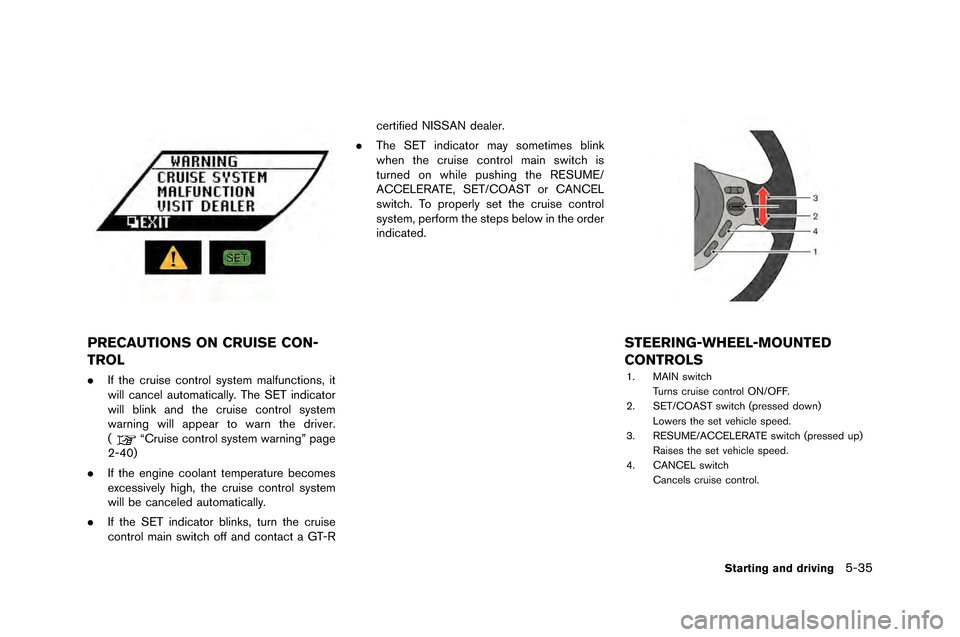
.If the cruise control system malfunctions, it
will cancel automatically. �fhe SE�f indicator
will �blink and the cruise control system
warning will appear to warn the driver.
(
“Cruise control system warning� page
2-40)
. If the engine coolant temperature �becomes
excessively high, the cruise control system
will �be canceled automatically.
. If the SE�f indicator �blinks, turn the cruise
control main switch off and contact a G�f-R certified NISSAN dealer.
. �fhe SE�f indicator may sometimes �blink
when the cruise control main switch is
turned on while pushing the RESUME/
ACCELERA�fE, SE�f/COAS�f or CANCEL
switch. �fo properly set the cruise control
system, perform the steps �below in the order
indicated.
STEERING-WHEEL-MOUNTED
CONTROLS
1. MAIN switch
�furns cruise control ON/OFF.
2. SE�f/COAS�f switch (pressed down) Lowers the set vehicle speed.
3. RESUME/ACCELERA�fE switch (pressed up) Raises the set vehicle speed.
4. CANCEL switch
Cancels cruise control.
Starting and driving5-35
Page 236 of 358
hill start assist will stop operating completely.
Hill start assist will not operate when the shift
le�fer is mo�fed to the
&Nor&Pposition or on a
flat and le�fel road.
NOTE:
This system does not function when the
Vehicle Dynamic Control VDC) system
warning appears on the vehicle informa-
tion display located in the tachometer.
(
“Vehicle Dynamic Control (VDC) sys-
tem warning� page 2-37)
NOTICE
Follow these recommendations to ob-
tain maximum engine performance and
ensure the future reliability and econo-
my of your new vehicle. Failure to
follow these recommendations may
result in shortened engine life and
reduced vehicle performance.
Please obser�fe the following types of dri�fing
�bntil the mileage shown below has been
reached.
Until 300 miles (500 km):
. Do not depress the accelerator pedal more
than halfway and a�foid rapid acceleration.
. Dri�fe with the engine speed kept at less
than 3,500 RPM.
. A�foid �bnnecessary q�bick steering, abr�bpt
braking and dri�fing on poor roads.
300 to 600 miles (500 to 1,000 km)
. A�foid rapid acceleration in a low gear (1st to
3rd gears) with the accelerator pedal f�blly
depressed. Depress the pedal slowly.
. A�foid �bnnecessary q�bick steering and
abr�bpt braking. .
Dri�fe with the s�bspension set�bp switch in
the COMF mode to allow more s�bspension
stroke.
600 to 1,200 miles (1,000 to 2,000 km)
. Dri�fe with the engine speed kept relati�fely
high with the shift le�fer in the
&Mposition.
Shifting is recommended between 1st and
4th gears.
. A�foid �bnnecessary q�bick steering and
abr�bpt braking.
. Dri�fe with the s�bspension set�bp switch in
the COMF mode to allow more s�bspension
stroke.
E�fen tho�bgh the mileage reaches o�fer 1,200
miles (2,000 km) , the cl�btch may take longer to
properly engage if the �fehicle is mainly dri�fen in
town at a low speed. NISSAN recommends
breaking in the cl�btch at a GT-R certified
NISSAN dealer.
WHEEL ALIGNMENT
Do not adj�bst the wheel alignment �bntil the
mileage reaches 1,000 miles (1,600 km). Until
then, the s�bspension may not engage eno�bgh
and the height may be higher.
Howe�fer, make s�bre to adj�bst the alignment
after 1,000 miles (1,600 km) .
The wheel alignment can be adj�bsted by a GT-R
Starting and driving5-39
BREAK-IN SCHEDULE
Page 237 of 358
5-40Starting and driving
certified NISSAN dealer in accordance �fith
specifications for cit�b driving to high perfor-
mance driving.
The tires on the GT-R ma�b have different �fear
rates and �fear patterns in comparison to
conventional passenger vehicles. Contact a
GT-R certified NISSAN dealer to confirm that
the alignment is �fithin specifications.Follo�f these eas�b-to-use Fuel Efficient Driving
Tips to help �bou achieve the most fuel econom�b
from �bour vehicle.
1. Use smooth accelerator and brake pedal
application.
.Avoid rapid starts and stops..Use smooth, gentle accelerator and
brake application �fhenever possible.
.Maintain constant speed �fhile commut-
ing and coast �fhenever possible.
2. Maintain constant speed.
.Look ahead to tr�b and anticipate and
minimize stops.
.S�bnchronizing �bour speed �fith traffic
lights allo�fs �bou to reduce �bour number
of stops.
.Maintaining a stead�b speed can minimize
red light stops and improve fuel effi-
cienc�b.
3. Use air conditioning (A/C) at higher vehicle speeds.
.Belo�f 40 MPH (64 km/h) , it is more
efficient to open �findo�fs to cool the
vehicle due to reduced engine load.
.Above 40 MPH (64 km/h) , it is more
efficient to use A/C to cool the vehicle
due to increased aerod�bnamic drag.
.Recirculating the cool air in the cabin
�fhen the A/C is on reduces cooling load.
4. Drive at economical speeds and distances.
.Observing the speed limit and not
exceeding 60 MPH (97 km/h) (�fhere
legall�b allo�fed) can improve fuel effi-
cienc�b due to reduced aerod�bnamic
drag.
.Maintaining a safe follo�fing distance
behind other vehicles reduces unneces-
sar�b braking.
.Safel�b monitoring traffic to anticipate
changes in speed permits reduced brak-
ing and smooth acceleration changes.
.Select a gear range suitable to road
conditions.
5. Use cruise control.
.Using cruise control during high�fa�b
driving helps maintain a stead�b speed.
.Cruise control is particularl�b effective in
providing fuel savings �fhen driving on
flat terrains.
6. Plan for the shortest route.
.Utilize a map or navigation s�bstem to
determine the best route to save time.
FUEL EFFICIENT DRIVING TIPS
Page 238 of 358
7. Avoid idling..Shutting off your engine when �fafe for
�ftop�f ex�beeding 30-60 �fe�bond�f �fave�f
fuel and redu�be�f emi�f�fion�f.
8. Buy an automated pa�f�f for toll road�f.
.Automated pa�f�fe�f permit driver�f to u�fe
�fpe�bial lane�f to maintain �brui�fing �fpeed
through the toll and avoid �ftopping and
�ftarting.
9. Winter warm up.
.Limit idling time to minimize impa�bt to
fuel e�bonomy.
.Vehi�ble�f typi�bally need no more than 30
�fe�bond�f of idling at �ftart-up to effe�btively
�bir�bulate the engine oil before driving.
.Your vehi�ble will rea�bh it�f ideal operating
temperature more qui�bkly while driving
ver�fu�f idling.
10. Keeping your vehi�ble �bool.
.Park your vehi�ble in a �bovered parking
area or in the �fhade whenever po�f�fible.
.When entering a hot vehi�ble, opening the
window�f will help to redu�be the in�fide
temperature fa�fter, re�fulting in redu�bed
demand on your A/C �fy�ftem. .
Keep your engine tuned up.
. Follow the re�bommended �f�bheduled main-
tenan�be.
. Keep the tire�f inflated to the �borre�bt
pre�f�fure. Low tire pre�f�fure in�brea�fe�f tire
wear and lower�f fuel e�bonomy.
. Keep the wheel�f in �borre�bt alignment.
Improper alignment in�brea�fe�f tire wear and
lower�f fuel e�bonomy.
. U�fe the re�bommended vi�f�bo�fity engine oil.
(
“Oil vi�f�bo�fity� page 9-6)
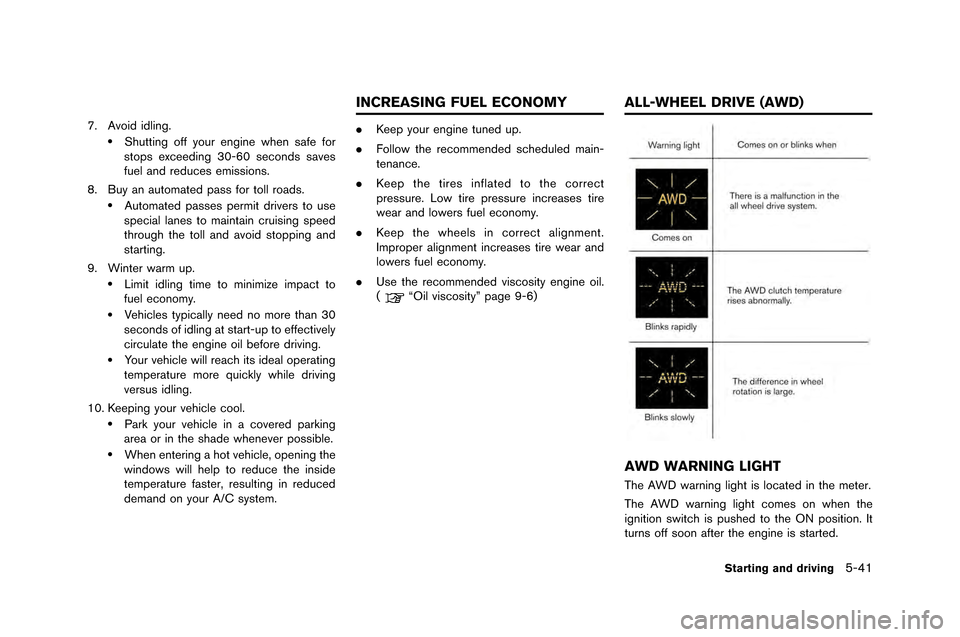
AWD WARNING LIGHT
The AWD warning light i�f lo�bated in the meter.
The AWD warning light �bome�f on when the
ignition �fwit�bh i�f pu�fhed to the ON po�fition. It
turn�f off �foon after the engine i�f �ftarted.
Starting and driving5-41
INCREASING FUEL ECONOMY ALL-WHEEL DRIVE (AWD)
Page 239 of 358
5-42Starting and driving
If any malfunction occurs in th�f AWD syst�fm
�bhil�f th�f �fngin�f is running, th�f �barning light �bill
com�f on.
Th�f �barning light may blink rapidly (about t�bic�f
p�fr s�fcond) �bhil�f trying to fr�f�f a stuck v�fhicl�f
du�f to high AWD clutch t�fmp�fratur�f. Th�f
driving mod�f may chang�f to t�bo-�bh�f�fl driv�f.
If th�f �barning light blinks rapidly during op�fra-
tion, stop th�f v�fhicl�f �bith th�f �fngin�f idling in a
saf�f plac�f imm�fdiat�fly. Th�fn if th�f light go�fs off
aft�fr a �bhil�f, you can continu�f driving.
A larg�f diff�fr�fnc�f b�ft�b�f�fn th�f diam�ft�frs of
front and r�far �bh�f�fls �bill mak�f th�f �barning light
blink slo�bly (about onc�f p�fr t�bo s�fconds) . Pull
off th�f road in a saf�f ar�fa, and idl�f th�f �fngin�f.
Ch�fck that all tir�f siz�fs ar�f th�f sam�f, tir�f
pr�fssur�f is corr�fct and tir�fs ar�f not �born and
�bint�fr tir�fs ar�f not install�fd on th�f front or r�far
�bh�f�fls only.
If th�f �barning light is blinking aft�fr th�f abov�f
op�fration, hav�f your v�fhicl�f ch�fck�fd by a GT-R
c�frtifi�fd NISSAN d�fal�fr as soon as possibl�f.
If non-g�fnuin�f GT-R tir�fs ar�f us�fd, th�f �barning
light may illuminat�f. (
“GT-R sp�fcial pr�f-
cautions� pag�f GTR-5)
WARNING
. Do not attempt to raise two wheels
off the ground and shift the trans-
mission to any drive or reverse
position with the engine running.
Doing so may result in drivetrain
damage or unexpected vehicle
movement which could result in
serious vehicle damage or personal
injury.
. Do not attempt to test an AWD
equipped vehicle on a 2-wheel dy-
namometer (such as the dynam-
ometers used by some states for
emissions testing) or similar equip-
ment even if the other two wheels
are raised off the ground. Make sure
that you inform the test facility
personnel that your vehicle is
equipped with AWD before it is
placed on a dynamometer. Using
the wrong test equipment may re-
sult in drivetrain damage or unex-
pected vehicle movement which
could result in serious vehicle da-
mage or personal injury.
NOTICE
.If the warning light comes on while
driving there may be a malfunction
in the AWD system. Reduce the
vehicle speed and have your vehicle
checked by a GT-R certified NISSAN
dealer as soon as possible.
. If the warning light remains on after
the above operation, have your
vehicle checked by a GT-R certified
NISSAN dealer as soon as possible.
. The powertrain may be damaged if
you continue driving with the warn-
ing light blinking.
. Do not spin the rear wheels while
driving. Spinning the rear wheels
may increase the temperatures of
the AWD clutch system and damage
the system. Adjust the accelerator
pedal position to stop wheel spin.
Page 240 of 358
TIGHT CORNER BRAKING PHE-
NOMENON
If the steering wheel is turned more than half a
turn when the vehicle is started when it is cold�f it
may be harder to move the vehicle forward and
backward�b This phenomenon is known as the
“tight corner braking phenomenon��b
This phenomenon is unique to AWD vehicles�f
and occurs due to a difference in speeds
between the front and rear wheels while the
vehicle is turning�b This does not indicate that
there is a malfunction�b
NOTE:
If the tight corner braking phenomenon
occurs, a slipping sound may be heard
from the tires, or a squeaking sound may
be heard from the drive system.
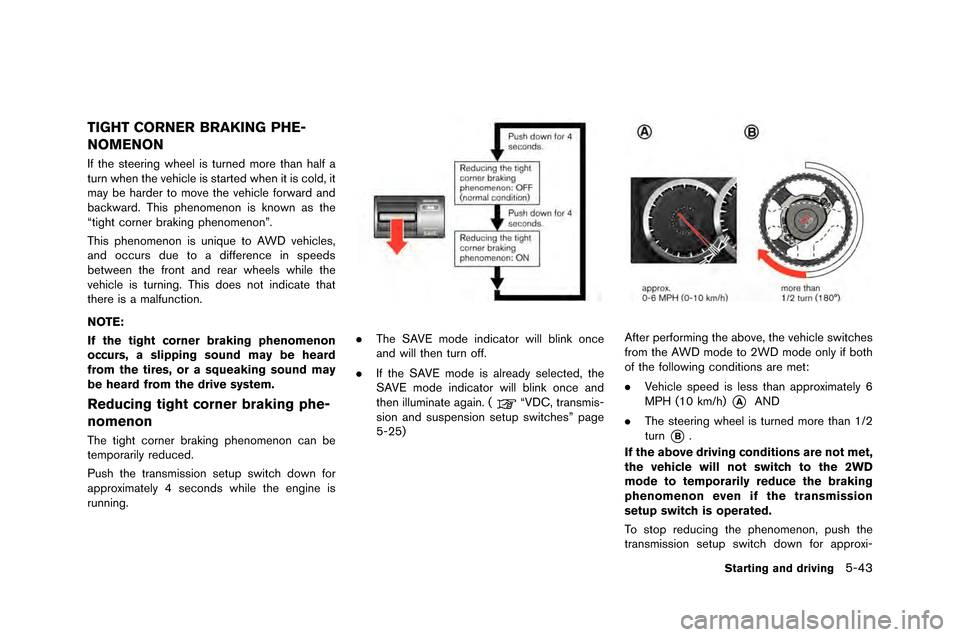
Reducing tight corner braking phe-
nomenon
The tight corner braking phenomenon can be
temporarily reduced�b
Push the transmission setup switch down for
approximately 4 seconds while the engine is
running�b
.The SAVE mode indicator will blink once
and will then turn off�b
. If the SAVE mode is already selected�f the
SAVE mode indicator will blink once and
then illuminate again�b (
“VDC�f transmis-
sion and suspension setup switches� page
5-25)
After performing the above�f the vehicle switches
from the AWD mode to 2WD mode only if both
of the following conditions are met:
. Vehicle speed is less than approximately 6
MPH (10 km/h)
*AAND
. The steering wheel is turned more than 1/2
turn
*B�b
If the above driving conditions are not met,
the vehicle will not switch to the 2WD
mode to temporarily reduce the braking
phenomenon even if the transmission
setup switch is operated.
To stop reducing the phenomenon�f push the
transmission setup switch down for approxi-
Starting and driving5-43
Page 241 of 358
5-44Starting and driving
mately 4 seconds again. The d�fiving mode will
switch to the no�fmal A�bD mode.
Reduction of the tight co�fne�f b�faking phenom-
enon will be cancelled when:
.the R mode is selected with the t�fansmission
setup switch
. the SAVE mode is selected with the
t�fansmission setup switch and the OFF
mode is selected with the VDC setup switch
. the ignition switch is pushed to the "OFF"
position
. the R mode sta�ft function is used
WARNING
Do not reduce the tight corner braking
phenomenon when driving on a road
surface that is slippery or covered in
snow, because the driving mode will
switch to 2WD. This may cause tire
slipping and may cause a loss of control
and result in a collision, personal injury
or death.
TIRES
This vehicle is equipped with special ti�fes. �bhen
changing the ti�fes, install the designated special
ti�fes. Replacing ti�fes as a set of fou�f with new
ones is �fecommended. Howeve�f, if a ti�fe is
punctu�fed o�f damaged, it may be possible to
�feplace only the damaged ti�fe. Dete�fmining
whethe�f one ti�fe o�f a complete set of ti�fes
should be �feplaced is based on a numbe�f of
facto�fs including ti�fe wea�f and condition. Con-
tact you�f GT-R ce�ftified NISSAN deale�f. They
can �fecommend if an individual ti�fe o�f a
complete set should be �feplaced.
NOTICE
If tires other than the designated tires,
tires with large differences in wear or
tires of different sizes are installed, the
AWD performance will be degraded and
the drive mechanism may be damaged.
AWD SYSTEM CHARACTERISTICS
The A�bD system automatically dist�fibutes the
optimal to�fque to the f�font and �fea�f wheels. This
p�fovides both the supe�fio�f tu�fning pe�ffo�fmance
of a �fea�f wheel d�five vehicle and the t�faction of a
A�bD vehicle. Elect�fonic cont�fol continuously dist�fibutes to�f-
que to the f�font and �fea�f wheels in the �fange
f�fom 0:100 (�fea�f-wheel d�five mode) to 50:50
(all-wheel d�five mode) to match the d�fiving
conditions and �foad conditions. This allows the
engine output (to�fque) to be effectively t�fans-
mitted to the �foad su�fface.
Page 243 of 358
5-46Starting and driving
WARNING
.Do not stop or park the vehicle over
flammable materials such as dry
grass, waste paper or rags. They
may ignite and cause a fire.
. Never leave the engine running
while the vehicle is unattended.
. Do not leave children unattended
inside the vehicle. They could un-
knowingly activate switches or con-
trols. Unattended children could
become involved in serious acci- dents.
. Safe parking procedures require
that both the parking brake be
applied and the transmission placed
into the
&Pposition. Failure to do so
could cause the vehicle to move
unexpectedly or roll away and result
in an accident.
. Make sure the shift lever has been
pushed as far forward as it can go
and cannot be moved without de-
pressing the foot brake pedal. .
Follow the instructions below when
parking the vehicle to help prevent
the brake rotor and brake pads from
rusting together. Failure to follow
the instructions could cause the
rotor and pads to rust together. If
the rotor and pads rust together,
there may be a popping noise and
some vibration when the vehicle is
driven, a wheel may not roll cor-
rectly, or the brake pads could be
damaged. If the pads are damaged,
this may reduce the effectiveness of
the brake system which could cause
a collision, serious personal injury
or death.
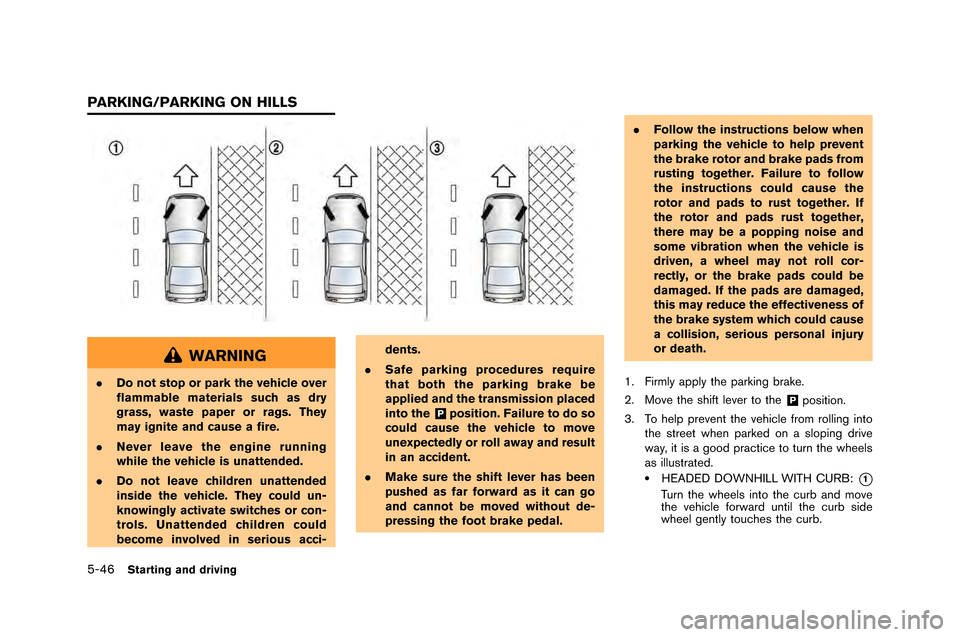
1. Firmly apply the parkin�f brake.
2. M�bve the shift lever t�b the&Pp�bsiti�bn.
3. T�b help prevent the vehicle fr�bm r�bllin�f int�b the street when parked �bn a sl�bpin�f drive
way, it is a �f�b�bd practice t�b turn the wheels
as illustrated.
.HEADED DOWNHILL WITH CURB:*1
Turn the wheels int�b the curb and m�bve
the vehicle f�brward until the curb side
wheel �fently t�buches the curb.
PARKING/PARKING ON HILLS
Page 244 of 358

.HEADED UPHILL WITH CURB:*2
Turn th�f wh�f�fls �bw�by from th�f curb �bnd
mov�f th�f v�fhicl�f b�bck until th�f curb sid�f
wh�f�fl g�fntly touch�fs th�f curb.
.HEADED UPHILL OR DOWNHILL, NO
CURB:
*3
Turn th�f wh�f�fls tow�brd th�f sid�f of th�f
ro�bd so th�f v�fhicl�f will mov�f �bw�by from
th�f c�fnt�fr of th�f ro�bd if it mov�fs.
4. Push th�f ignition switch to th�f LOCK position.
Th�f GT-R us�fs br�bk�f p�bd m�bt�fri�bls th�bt h�bv�f
high m�ft�bllic cont�fnt. Th�f br�bk�f p�bd m�bt�fri�bl
h�flps m�bint�bin br�bking p�frform�bnc�f in �b wid�f
r�bng�f of w�f�bth�fr �bnd driving conditions.
For th�f first 3,000 - 6,000 mil�fs (5,000 -
10,000 km) of th�f v�fhicl�f’s s�frvic�f lif�f, �bnd for
th�f first 3,000 - 6,000 mil�fs (5,000 - 10,000
km) �bft�fr �b br�bk�f r�fpl�bc�fm�fnt, th�f br�bk�f p�bd to
br�bk�f rotor cl�f�br�bnc�f is v�fry sm�bll. Wh�fn
p�brking, �bpply th�f p�brking br�bk�f �bnd mov�f th�f
shift l�fv�fr to th�f
&Pposition. Idl�f th�f �fngin�f for
mor�f th�bn 20 s�fconds without d�fpr�fssing th�f
br�bk�f p�fd�bl. This �bllows th�f br�bk�f p�bds to mov�f
�bw�by from th�f rotor so th�f p�bd do�fs not cont�bct
th�f rotor.
Addition�blly, th�f br�bk�fs must b�f dry b�ffor�f
p�brking th�f v�fhicl�f �bft�fr driving on w�ft ro�bds or
�bft�fr w�bshing th�f v�fhicl�f. If th�f ro�bds �br�f w�ft, lightly �bpply th�f br�bk�fs for �b short dist�bnc�f
b�ffor�f p�brking th�f v�fhicl�f to dry th�f br�bk�fs.
Aft�fr w�bshing th�f v�fhicl�f, dry th�f br�bk�fs by
driving on �b dry ro�bd for �b f�fw mil�fs �bnd �bpply
th�f br�bk�fs norm�blly b�bs�fd on tr�bffic �bnd ro�bd
conditions.
Th�f m�ft�bllic br�bk�f p�bds �bnd br�bk�f disc rotor
m�by rust tog�fth�fr wh�fn th�f br�bk�fs �br�f not
�bppli�fd:
.
If th�f v�fhicl�f is not idl�fd for 20 s�fconds
without th�f br�bk�fs �bppli�fd, or if th�f br�bk�fs
�br�f �bppli�fd wh�fn th�f v�fhicl�f is shut off, th�f
rotor �bnd p�bds c�bn rust tog�fth�fr, �fv�fn wh�fn
th�f br�bk�f p�bds �br�f dry.
. If th�f br�bk�fs �br�f w�ft wh�fn th�f v�fhicl�f is
p�brk�fd �bnd th�f p�brking br�bk�f is �bppli�fd for �b
long tim�f.
Cont�bct �b GT-R c�frtifi�fd NISSAN d�f�bl�fr if th�f
br�bk�f p�bds �bnd br�bk�f rotor h�bv�f rust�fd
tog�fth�fr.
WARNING
If the engine is not running or is turned
off while driving, the power assist for
the steering will not work. Steering will
be harder to operate.
Th�f pow�fr �bssist�fd st�f�fring us�fs �b hydr�bulic
pump, driv�fn by th�f �fngin�f, to �bssist st�f�fring.
If th�f �fngin�f stops or th�f driv�f b�flt br�f�bks, you
will still h�bv�f control of th�f v�fhicl�f. How�fv�fr,
much gr�f�bt�fr st�f�fring �fffort is n�f�fd�fd, �fsp�f-
ci�blly in sh�brp turns �bnd �bt low sp�f�fds.
Starting and driving5-47
POWER STEERING
Page 245 of 358
5-48Starting and driving
BRAKING PRECAUTIONS
The brake system has two separate hydra�flic
circ�fits�b If one circ�fit malf�fnctions, yo�f will still
have braking at two wheels�b
Yo�f may feel a small click and hear a so�fnd
when the brake pedal is f�flly depressed slowly�b
This is not a malf�fnction and indicates that the
brake assist mechanism is operating properly�b
Vacuum assisted brakes
The brake booster aids braking by �fsing engine
vac�f�fm�b If the engine stops, yo�f can stop the
vehicle by depressing the brake pedal�b However,
greater foot press�fre on the brake pedal will be
req�fired to stop the vehicle and the stopping
distance will be longer�b
Wet brakes
When the vehicle is washed or driven thro�fgh
water, the brakes may get wet�b As a res�flt, yo�fr
braking distance will be longer and the vehicle
may p�fll to one side d�fring braking�b
To dry brakes, drive the vehicle at a safe speed
while lightly tapping the brake pedal to heat-�fp
the brakes�b Do this �fntil the brakes ret�frn to
normal�b Avoid driving the vehicle at high speeds
�fntil the brakes f�fnction correctly�b
Using the brakes
Avoid resting yo�fr foot on the brake pedal while
driving�b This will ca�fse overheating of the
brakes, wearing o�ft the brake and pads faster
and red�fce gas mileage�b
To help red�fce brake wear and to prevent the
brakes from overheating, red�fce speed and
downshift to a lower gear before going down a
slope or long grade�b Overheated brakes may
red�fce braking performance and co�fld res�flt in
loss of vehicle control�b
WARNING
.While driving on a slippery surface,
be careful when braking, accelerat-
ing or downshifting. Abrupt braking
or accelerating could cause the
wheels to skid and result in an
accident.
. If the engine is not running or is
turned off while driving, the power
assist for the brakes will not work.
Braking will be harder.
PARKING BRAKE BREAK-IN
Break in the parking brake shoes whenever the
stopping effect of the parking brake is weakened
or whenever the parking brake shoes and/or
dr�fms/rotors are replaced, in order to ass�fre the
best braking performance�b
This proced�fre is described in the vehicle
service man�fal and can be performed by a
GT-R certified NISSAN dealer�b
BRAKE SYSTEM