check engine light NISSAN LATIO 2009 Service Owner's Manual
[x] Cancel search | Manufacturer: NISSAN, Model Year: 2009, Model line: LATIO, Model: NISSAN LATIO 2009Pages: 4331, PDF Size: 58.04 MB
Page 1585 of 4331
EC
NP
O
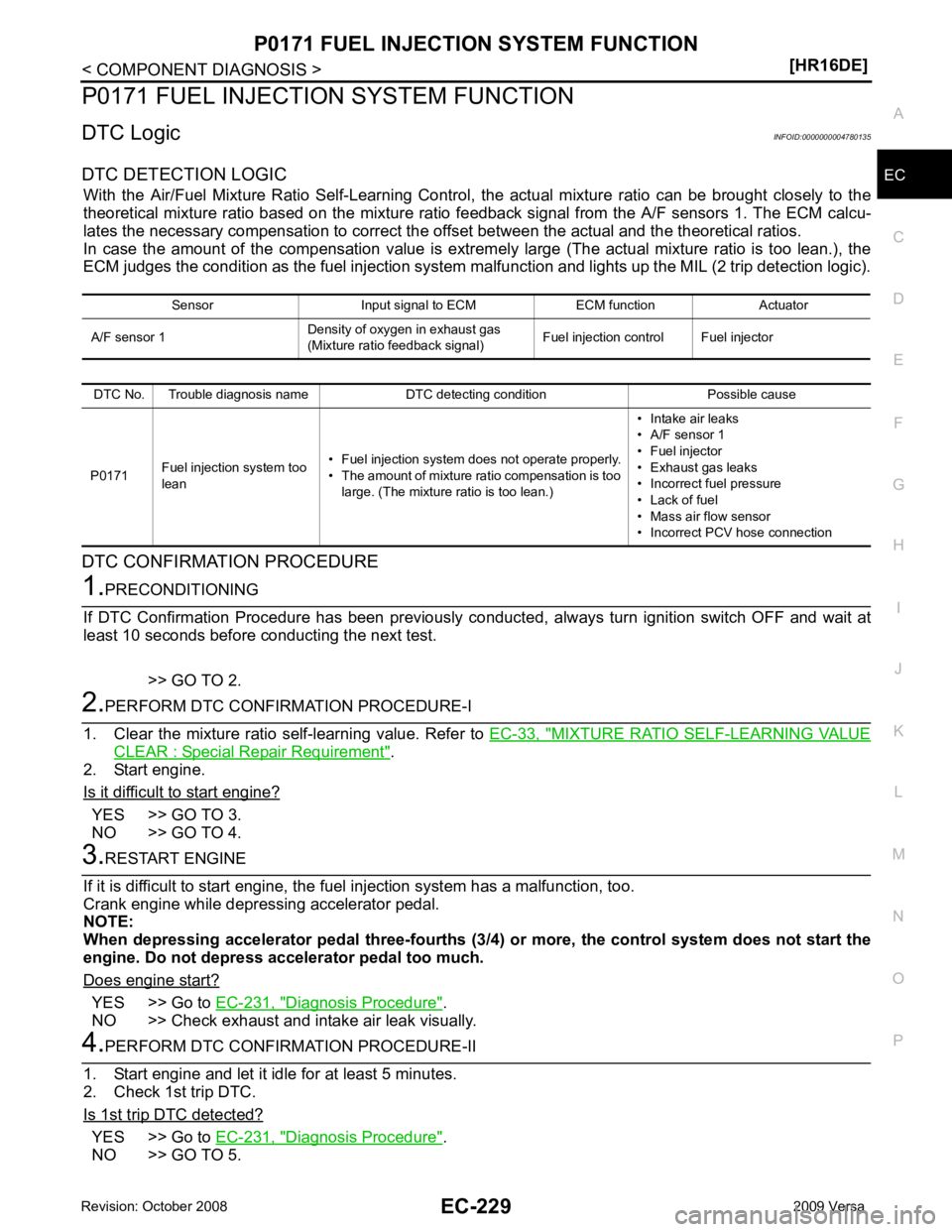
P0171 FUEL INJECTION SYSTEM FUNCTION
DTC Logic INFOID:0000000004780135
DTC DETECTION LOGIC With the Air/Fuel Mixture Ratio Self-Learning Control, the actual mixture ratio can be brought closely to the
theoretical mixture ratio based on the mixture ratio f eedback signal from the A/F sensors 1. The ECM calcu-
lates the necessary compensation to correct the of fset between the actual and the theoretical ratios.
In case the amount of the compensation value is extrem ely large (The actual mixture ratio is too lean.), the
ECM judges the condition as the fuel injection system malfunction and lights up the MIL (2 trip detection logic).
DTC CONFIRMATION PROCEDURE MIXTURE RATIO SELF-LEARNING VALUE
CLEAR : Special Repair Requirement " .
2. Start engine.
Is it difficult to start engine? YES >> GO TO 3.
NO >> GO TO 4. YES >> Go to
EC-231, " Diagnosis Procedure " .
NO >> Check exhaust and intake air leak visually. YES >> Go to
EC-231, " Diagnosis Procedure " .
NO >> GO TO 5. Sensor Input signal to ECM ECM function Actuator
A/F sensor 1 Density of oxygen in exhaust gas
(Mixture ratio feedback signal) Fuel injection control Fuel injectorDTC No. Trouble diagnosis name DTC detecting condition Possible cause
P0171 Fuel injection system too
lean • Fuel injection system does not operate properly.
• The amount of mixture ratio compensation is too large. (The mixture ratio is too lean.) • Intake air leaks
• A/F sensor 1
• Fuel injector
• Exhaust gas leaks
• Incorrect fuel pressure
• Lack of fuel
• Mass air flow sensor
• Incorrect PCV hose connection
Page 1591 of 4331
EC
NP
O
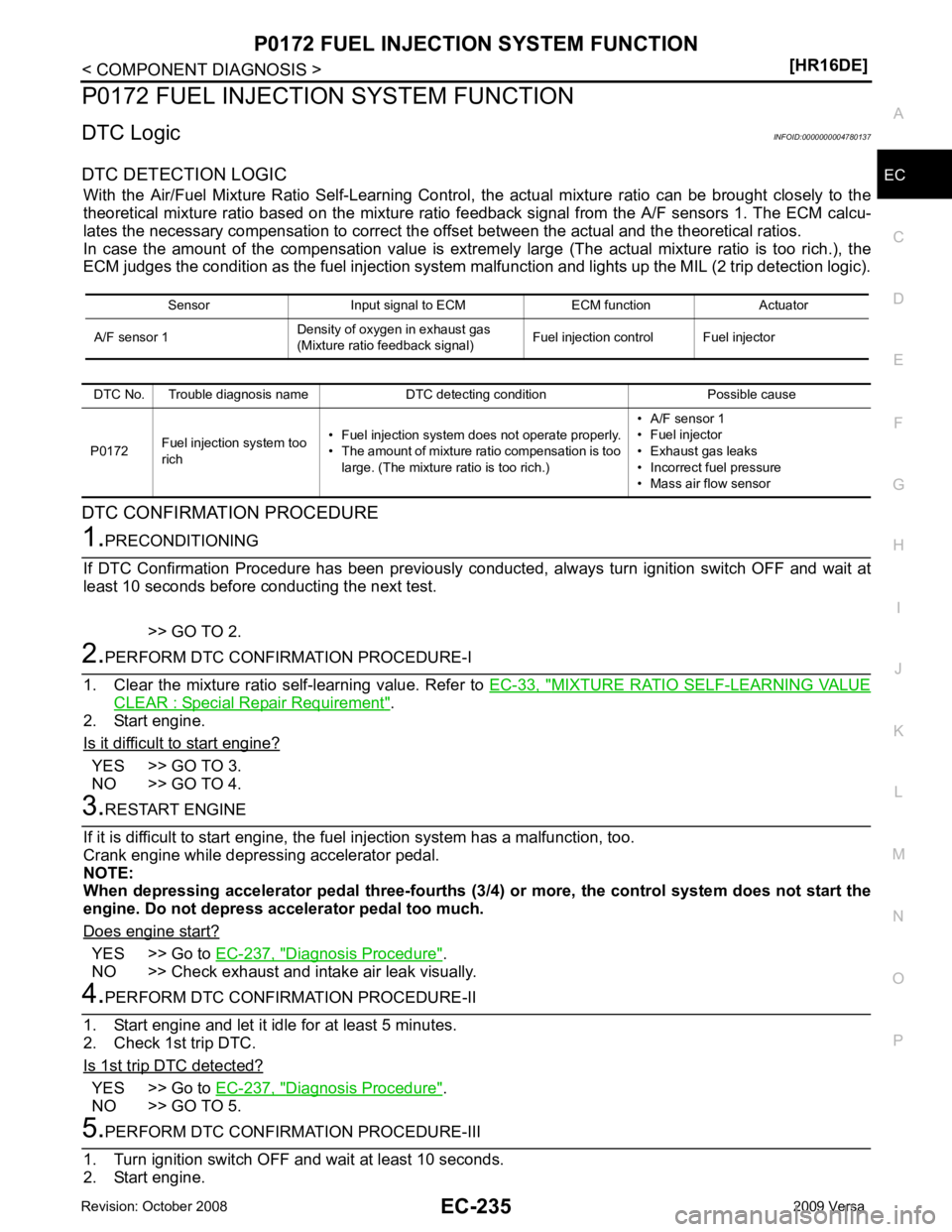
P0172 FUEL INJECTION SYSTEM FUNCTION
DTC Logic INFOID:0000000004780137
DTC DETECTION LOGIC With the Air/Fuel Mixture Ratio Self-Learning Control, the actual mixture ratio can be brought closely to the
theoretical mixture ratio based on the mixture ratio f eedback signal from the A/F sensors 1. The ECM calcu-
lates the necessary compensation to correct the of fset between the actual and the theoretical ratios.
In case the amount of the compensation value is extrem ely large (The actual mixture ratio is too rich.), the
ECM judges the condition as the fuel injection system malfunction and lights up the MIL (2 trip detection logic).
DTC CONFIRMATION PROCEDURE MIXTURE RATIO SELF-LEARNING VALUE
CLEAR : Special Repair Requirement " .
2. Start engine.
Is it difficult to start engine? YES >> GO TO 3.
NO >> GO TO 4. YES >> Go to
EC-237, " Diagnosis Procedure " .
NO >> Check exhaust and intake air leak visually. YES >> Go to
EC-237, " Diagnosis Procedure " .
NO >> GO TO 5. DTC No. Trouble diagnosis name DTC detecting condition Possible cause
P0172 Fuel injection system too
rich • Fuel injection system does not operate properly.
• The amount of mixture ratio compensation is too large. (The mixture ratio is too rich.) • A/F sensor 1
• Fuel injector
• Exhaust gas leaks
• Incorrect fuel pressure
• Mass air flow sensor
Page 1637 of 4331
EC
NP
O
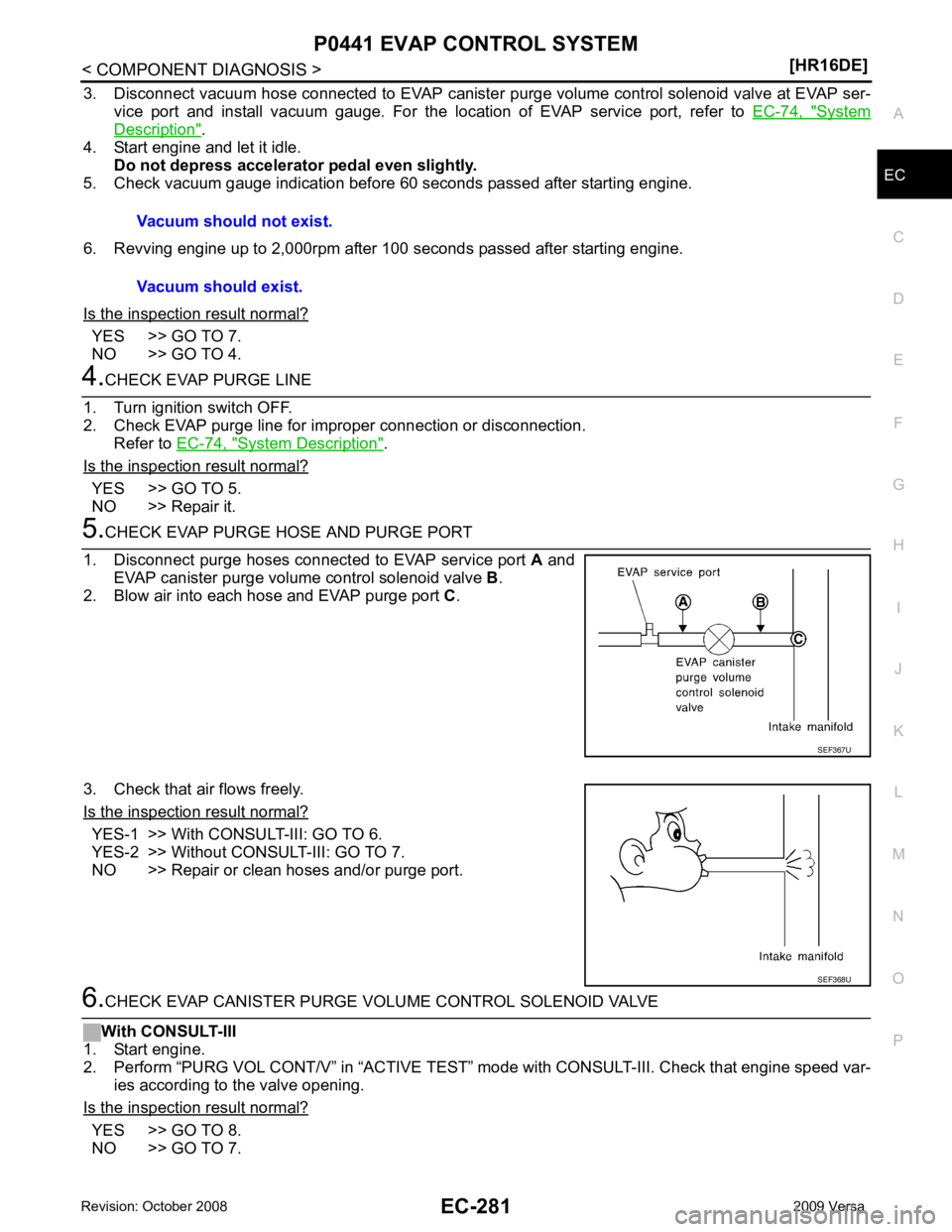
3. Disconnect vacuum hose connected to EVAP canister
purge volume control solenoid valve at EVAP ser-
vice port and install vacuum gauge. For the location of EVAP service port, refer to EC-74, " System
Description " .
4. Start engine and let it idle.
Do not depress accelerator pedal even slightly.
5. Check vacuum gauge indication before 60 seconds passed after starting engine.
6. Revving engine up to 2,000rpm after 100 seconds passed after starting engine.
Is the inspection result normal? YES >> GO TO 7.
NO >> GO TO 4. System Description " .
Is the inspection result normal? YES >> GO TO 5.
NO >> Repair it. YES-1 >> With CONSULT-III: GO TO 6.
YES-2 >> Without CONSULT-III: GO TO 7.
NO >> Repair or clean hoses and/or purge port. YES >> GO TO 8.
NO >> GO TO 7. Vacuum should not exist.
Vacuum should exist. SEF368U
Page 1802 of 4331
![NISSAN LATIO 2009 Service Owners Manual EC-446< COMPONENT DIAGNOSIS >
[HR16DE]
MALFUNCTION INDICATOR LAMP
MALFUNCTION INDICATOR LAMP
Description INFOID:0000000004780371
The Malfunction Indicator Lamp (MIL) is located on the combination
mete](/img/5/57359/w960_57359-1801.png "NISSAN LATIO 2009 Service Owners Manual EC-446< COMPONENT DIAGNOSIS >
[HR16DE]
MALFUNCTION INDICATOR LAMP
MALFUNCTION INDICATOR LAMP
Description INFOID:0000000004780371
The Malfunction Indicator Lamp (MIL) is located on the combination
mete")
EC-446< COMPONENT DIAGNOSIS >
[HR16DE]
MALFUNCTION INDICATOR LAMP
MALFUNCTION INDICATOR LAMP
Description INFOID:0000000004780371
The Malfunction Indicator Lamp (MIL) is located on the combination
meter.
The MIL will light up when the ignition switch is turned ON without
the engine running. This is a bulb check.
When the engine is started, the MIL should go off. If the MIL remains
on, the on board diagnostic system has detected an engine system
malfunction.
For details, refer to EC-90, " Diagnosis Description " .
Component Function Check INFOID:00000000047803721.
CHECK MIL FUNCTION
1. Turn ignition switch ON.
2. Make sure that MIL lights up.
Is the inspection result normal? YES >> INSPECTION END
NO >> Go to EC-448, " Diagnosis Procedure " . SEF217U
Page 1870 of 4331
![NISSAN LATIO 2009 Service Owners Manual EC-514< SERVICE INFOMATION >
[MR TYPE 1]
PRECAUTIONS
• Keep engine control system parts and harness dry.
• Before replacing ECM, perform “ECM Terminals and Refer-
ence Value” inspecti](/img/5/57359/w960_57359-1869.png "NISSAN LATIO 2009 Service Owners Manual EC-514< SERVICE INFOMATION >
[MR TYPE 1]
PRECAUTIONS
• Keep engine control system parts and harness dry.
• Before replacing ECM, perform “ECM Terminals and Refer-
ence Value” inspecti")
EC-514< SERVICE INFOMATION >
[MR TYPE 1]
PRECAUTIONS
• Keep engine control system parts and harness dry.
• Before replacing ECM, perform “ECM Terminals and Refer-
ence Value” inspection and m ake sure ECM functions prop-
erly. Refer to EC-597, " ECM Terminal and Reference Value " .
• Handle mass air flow sensor carefully to avoid damage.
• Do not disassemble m ass air flow sensor.
• Do not clean mass air flow senso r with any type of detergent.
• Do not disassemble electric throttle control actuator.
• Even a slight leak in the ai r intake system can cause serious
incidents.
• Do not shock or jar the camshaft position sensor (PHASE),
crankshaft position sensor (POS).
• After performing each TROUBLE DIAGNOSIS, perform DTC
Confirmation Procedure or Overall Function Check.
The DTC should not be displ ayed in the DTC Confirmation
Procedure if the repair is co mpleted. The Overall Function
Check should be a good result if the repair is completed.
• When measuring ECM signals with a circuit tester, never allow
the two tester probes to contact.
Accidental contact of probes will cause a short circuit and
damage the ECM power transistor.
• Do not use ECM ground termina ls when measuring input/out-
put voltage. Doing so may result in damage to the ECM's tran-
sistor. Use a ground other than ECM terminals, such as the
ground. MEF040D
SEF217U
SEF348N
Page 1897 of 4331

EC
NP
O
ON BOARD DIAGNOSTIC (OBD) SYSTEM
Introduction INFOID:0000000004537038
The ECM has an on board diagnostic system, which detects malfunctions related to engine sensors or actua-
tors. The ECM also records various emis sion-related diagnostic information including:
The above information can be checked using procedures listed in the table below. ×: Applicable —: Not applicable
*: When DTC and 1st trip DTC simultaneously appear on the display, they cannot be clearly distinguished from each other.
The malfunction indicator lamp (MIL) on the instrument panel lights up when the same malfunction is detected
in two consecutive trips (Two trip detection logic), or when the ECM enters fail-safe mode.
(Refer to EC-582, " Fail-Safe Chart " .)
Two Trip Detection Logic INFOID:0000000004537039
When a malfunction is detected for the first time, 1st tr ip DTC and 1st trip Freeze Frame data are stored in the
ECM memory. The MIL will not light up at this stage. <1st trip>
If the same malfunction is detected again during the next drive, the DTC and Freeze Frame data are stored in
the ECM memory, and the MIL lights up. The MIL lights up at the same time when the DTC is stored. <2nd
trip> The “trip” in the “Two Trip Detection Logic” m eans a driving mode in which self-diagnosis is performed
during vehicle operation. Specific on board diagnostic item s will cause the ECM to light up or blink the MIL,
and store DTC and Freeze Frame data, even in the 1st trip, as shown below.
×: Applicable —: Not applicable
When there is an open circuit on MIL circuit, the ECM c annot warn the driver by MIL lighting up when there is
malfunction on engine control system. Emission-related diagnostic information Diagnostic service
Diagnostic Tr ouble Code (DTC) Service $03 of SAE J1979
Freeze Frame data Service $02 of SAE J1979
System Readiness Test (SRT) code Service $01 of SAE J1979
1st Trip Diagnostic Trou ble Code (1st Trip DTC) Service $07 of SAE J1979
1st Trip Freeze Frame data
Test values and Test limi ts Service $06 of SAE J1979
Calibration ID Servic e $09 of SAE J1979
DTC 1st trip DTC Freeze Frame
data 1st trip Freeze
Frame data SRT code SRT status Test value
CONSULT-III × × × × × × —
GST × × × —× × ×
ECM × ×* — — — ×— Items
MIL DTC 1st trip DTC
1st trip 2nd trip 1st trip
displaying 2nd trip
displaying 1st trip
displaying 2nd trip
display-
ing
Blinking Lighting
up Blinking
Lighting
up
Misfire (Possible three way catalyst
damage) — DTC: P0300 - P0304 is
being detected ×
— — — — — ×—
Misfire (Possible three way catalyst
damage) — DTC: P0300 - P0304 is
being detected — —
×— — ×— —
One trip detection diagnoses
(Refer to EC-542, " Emission-relat-
ed Diagnostic Information " .)
—
×— — ×— — —
Except above — — — ×— × × —
Page 1913 of 4331
![NISSAN LATIO 2009 Service Owners Manual ON BOARD DIAGNOSTIC (OBD) SYSTEM
EC-557
< SERVICE INFOMATION >
[MR TYPE 1] C
D E
F
G H
I
J
K L
M A EC
NP
O
4. Touch "ERASE". (The DTC in the ECM will be erased.)
With GST
NOTE:
If the ignition switch](/img/5/57359/w960_57359-1912.png "NISSAN LATIO 2009 Service Owners Manual ON BOARD DIAGNOSTIC (OBD) SYSTEM
EC-557
< SERVICE INFOMATION >
[MR TYPE 1] C
D E
F
G H
I
J
K L
M A EC
NP
O
4. Touch \"ERASE\". (The DTC in the ECM will be erased.)
With GST
NOTE:
If the ignition switch")
ON BOARD DIAGNOSTIC (OBD) SYSTEM
EC-557
< SERVICE INFOMATION >
[MR TYPE 1] C
D E
F
G H
I
J
K L
M A EC
NP
O
4. Touch "ERASE". (The DTC in the ECM will be erased.)
With GST
NOTE:
If the ignition switch stays ON after repair work, be sure to turn ignition switch OFF once. Wait at least 10 sec-
onds and then turn it ON (engine stopped) again.
1. Select Service $04 with GST.
No Tools
NOTE:
If the ignition switch stays ON after repair work, be sure to turn ignition switch OFF once. Wait at least 10 sec-
onds and then turn it ON (engine stopped) again.
1. Erase DTC in ECM. Refer to How to Erase Diagnostic Test Mode II (Self-diagnostic Results).
• If the battery is disconnected, the emission-relate d diagnostic information will be lost within 24
hours.
• The following data are cleared when the ECM memory is erased.
- Diagnostic trouble codes
- 1st trip diagnostic trouble codes
- Freeze frame data
- 1st trip freeze frame data
- System readiness test (SRT) codes
- Test values
Malfunction Indicator Lamp (MIL) INFOID:0000000004537041
DESCRIPTION The MIL is located on the instrument panel.
1. The MIL will light up when the ignition switch is turned ON with- out the engine running. This is a bulb check.
If the MIL does not light up, refer to DI-20 or see
EC-1010 .
2. When the engine is start ed, the MIL should go off.
If the MIL remains on, the on board diagnostic system has
detected an engine system malfunction.
ON BOARD DIAGNOSTIC SYSTEM FUNCTION The on board diagnostic system has the following three functions. SEF217U
Page 1914 of 4331
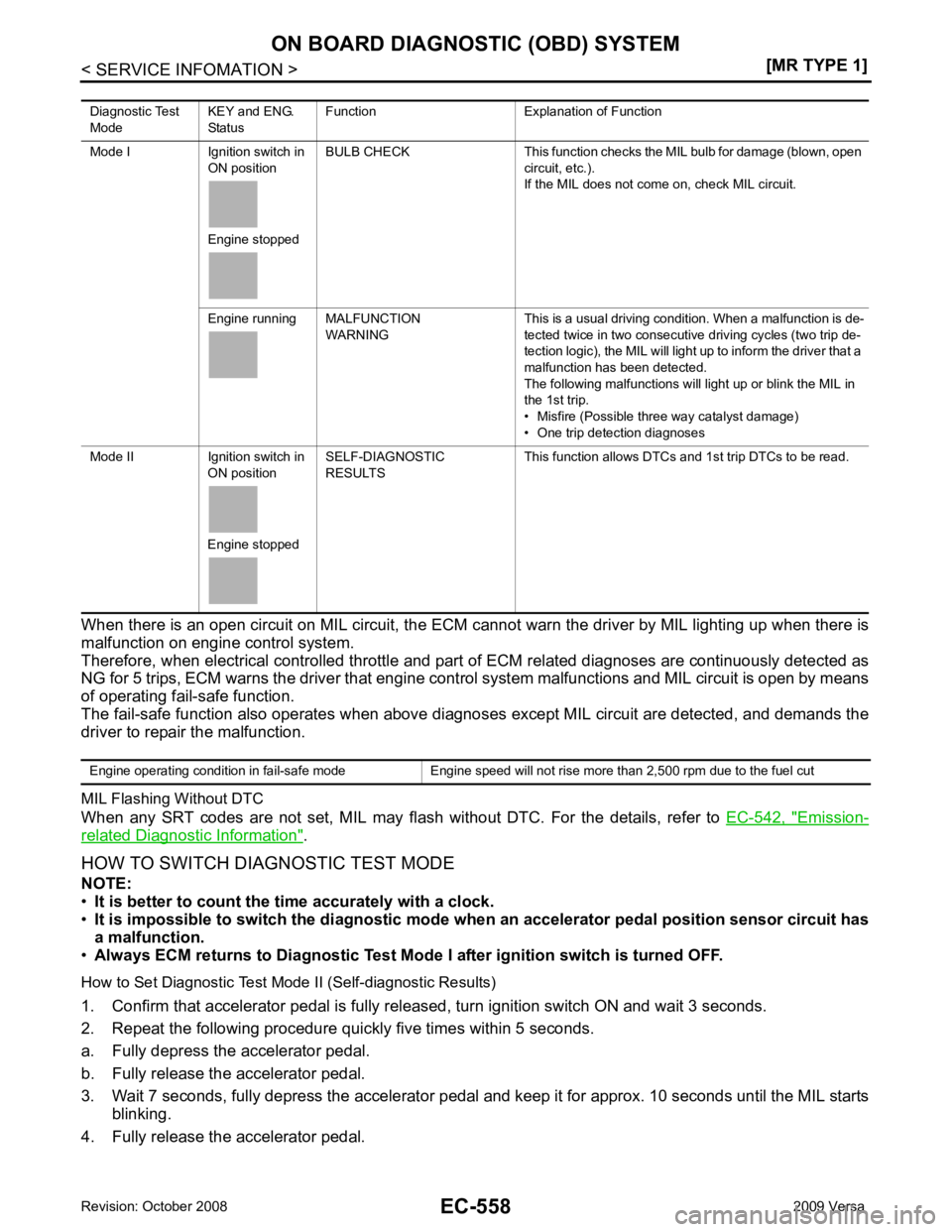
Emission-
related Diagnostic Information " .
HOW TO SWITCH DIAGNOSTIC TEST MODE
NOTE:
• It is better to count the ti me accurately with a clock.
• It is impossible to switch the di agnostic mode when an accelerator pedal position sensor circuit has
a malfunction.
• Always ECM returns to Diagnostic Test Mode I after ignition switch is turned OFF.
How to Set Diagnostic Test Mode II (Self-diagnostic Results)
1. Confirm that accelerator pedal is fully releas ed, turn ignition switch ON and wait 3 seconds.
2. Repeat the following procedure quickly five times within 5 seconds.
a. Fully depress the accelerator pedal.
b. Fully release the accelerator pedal.
3. Wait 7 seconds, fully depress the accelerator pedal and keep it for approx. 10 seconds until the MIL starts blinking.
4. Fully release the accelerator pedal. Diagnostic Test
Mode KEY and ENG.
Status Function Explanation of Function
Mode I Ignition switch in ON position
Engine stopped BULB CHECK This function checks the MIL bulb for damage (blown, open
circuit, etc.).
If the MIL does not come on, check MIL circuit.
Engine running MALFUNCTION WARNING This is a usual driving condition. When a malfunction is de-
tected twice in two consecutive driving cycles (two trip de-
tection logic), the MIL will light up to inform the driver that a
malfunction has been detected.
The following malfunctions will light up or blink the MIL in
the 1st trip.
• Misfire (Possible three way catalyst damage)
• One trip detection diagnoses
Mode II Ignition switch in ON position
Engine stopped SELF-DIAGNOSTIC
RESULTS This function allows DTCs an
d 1st trip DTCs to be read.
Page 1925 of 4331
![NISSAN LATIO 2009 Service Owners Manual BASIC SERVICE PROCEDURE
EC-569
< SERVICE INFOMATION >
[MR TYPE 1] C
D E
F
G H
I
J
K L
M A EC
NP
O
Yes >> GO TO 14.
No >> 1. Follow the instruction of Idle Air Volume Learning. 2. GO TO 4. 14.
CHECK TA](/img/5/57359/w960_57359-1924.png "NISSAN LATIO 2009 Service Owners Manual BASIC SERVICE PROCEDURE
EC-569
< SERVICE INFOMATION >
[MR TYPE 1] C
D E
F
G H
I
J
K L
M A EC
NP
O
Yes >> GO TO 14.
No >> 1. Follow the instruction of Idle Air Volume Learning. 2. GO TO 4. 14.
CHECK TA")
BASIC SERVICE PROCEDURE
EC-569
< SERVICE INFOMATION >
[MR TYPE 1] C
D E
F
G H
I
J
K L
M A EC
NP
O
Yes >> GO TO 14.
No >> 1. Follow the instruction of Idle Air Volume Learning. 2. GO TO 4. 14.
CHECK TARGET IDLE SPEED AGAIN
With CONSULT-III
1. Start engine and warm it up to normal operating temperature.
2. Read idle speed in “DATA MONITOR” mode with CONSULT-III. Refer to EC-570, " Idle Speed and Ignition
Timing Check " .
Without CONSULT-III
1. Start engine and warm it up to normal operating temperature.
2. Check idle speed. Refer to EC-570, " Idle Speed and Ignition Timing Check " .
OK or NG OK >> GO TO 15.
NG >> GO TO 17. 15.
CHECK IGNITION TIMING AGAIN
1. Run engine at idle.
2. Check ignition timing with a timing light. Refer to EC-570, " Idle Speed and Ignition Timing Check " .
- Timing indicator (1)
OK or NG OK >> GO TO 19
NG >> GO TO 16. 16.
CHECK TIMING CHAIN INSTALLATION
Check timing chain installation. Refer to EM-160 .
OK or NG OK >> GO TO 17.
NG >> 1. Repair the timing chain installation.
2. GO TO 4. 17.
DETECT MALFUNCTIONING PART
Check the following.
• Check crankshaft position sensor (POS) and circuit. Refer to EC-775 .
• Check camshaft position s ensor (PHASE) and circuit.
Refer to EC-781 .
OK or NG OK >> GO TO 18.
NG >> 1. Repair or replace. 2. GO TO 4. 18.
CHECK ECM FUNCTION M/T: 700
± 50 rpm (in Neutral position)
A/T: 700 ± 50 rpm (in P or N position)
CVT: 700 ± 50 rpm (in P or N position)
M/T: 700 ± 50 rpm (in Neutral position)
A/T: 700 ± 50 rpm (in P or N position)
CVT: 700 ± 50 rpm (in P or N position) M/T: 13
± 5 ° BTDC (in Neutral position)
A/T: 13 ± 5 ° BTDC (in P or N position)
CVT: 13 ± 5 ° BTDC (in P or N position) PBIB3263E
Page 1929 of 4331
![NISSAN LATIO 2009 Service Owners Manual EC
NP
O
[Air conditioner, headlamp, rear window defogger]
On vehicles equipped with daytime light systems, if the parking brake is applied before the engine is
started the headlamp will not be illumi](/img/5/57359/w960_57359-1928.png "NISSAN LATIO 2009 Service Owners Manual EC
NP
O
[Air conditioner, headlamp, rear window defogger]
On vehicles equipped with daytime light systems, if the parking brake is applied before the engine is
started the headlamp will not be illumi")
EC
NP
O
[Air conditioner, headlamp, rear window defogger]
On vehicles equipped with daytime light systems, if the parking brake is applied before the engine is
started the headlamp will not be illuminated.
• Steering wheel: Neutral (Straight-ahead position)
• Vehicle speed: Stopped
• Transmission: Warmed-up
- Models with CONSULT-III (A/T and CVT models)
• Drive vehicle until “FLUID TEMP SE” in “DATA MONI TOR” mode of “A/T” or “CVT” system indicates less
than 0.9V.
- Models without CONSULT-III (A/T and CVT models) and M/T models
• Drive vehicle for 10 minutes.
OPERATION PROCEDURE
With CONSULT-III
1. Perform EC-572, " Accelerator Pedal Released Position Learning " .
2. Perform EC-572, " Throttle Valve Closed Position Learning " .
3. Start engine and warm it up to normal operating temperature.
4. Check that all items listed under the topic PREP ARATION (previously mentioned) are in good order.
5. Select “IDLE AIR VOL LEA RN” in “WORK SUPPORT” mode.
6. Touch “START” and wait 20 seconds.
7. Make sure that “CMPLT” is displayed on CONSULT-III screen. If “CMPLT” is not displayed, Idle Air Vol-
ume Learning will not be carried out successfully. In this case, find the cause of the incident by referring to
the DIAGNOSTIC PROCEDURE below.
8. Rev up the engine two or three times and make sure that idle speed and ignition timing are within the specifications.
Refer to EC-566, " Basic Inspection " .
Without CONSULT-III
NOTE:
• It is better to count the time accurately with a clock.
• It is impossible to switch the di agnostic mode when an accelerator pedal position sensor circuit has
a malfunction.
1. Perform EC-572, " Accelerator Pedal Released Position Learning " .
2. Perform EC-572, " Throttle Valve Closed Position Learning " .
3. Start engine and warm it up to normal operating temperature.
4. Check that all items listed under the topic PREP ARATION (previously mentioned) are in good order.
5. Turn ignition switch OFF and wait at least 10 seconds.
6. Confirm that accelerator pedal is fully releas ed, turn ignition switch ON and wait 3 seconds.
7. Repeat the following procedure quick ly five times within 5 seconds.
a. Fully depress the accelerator pedal.
b. Fully release the accelerator pedal.
8. Wait 7 seconds, fully depress the accelerator pedal and keep it for approx. 20 seconds until the MIL stops
blinking and turned ON.
9. Fully release the accelerator pedal within 3 seconds after the MIL turned ON.
10. Start engine and let it idle.