check engine light NISSAN LATIO 2009 Service Owner's Guide
[x] Cancel search | Manufacturer: NISSAN, Model Year: 2009, Model line: LATIO, Model: NISSAN LATIO 2009Pages: 4331, PDF Size: 58.04 MB
Page 1931 of 4331
EC
NP
O
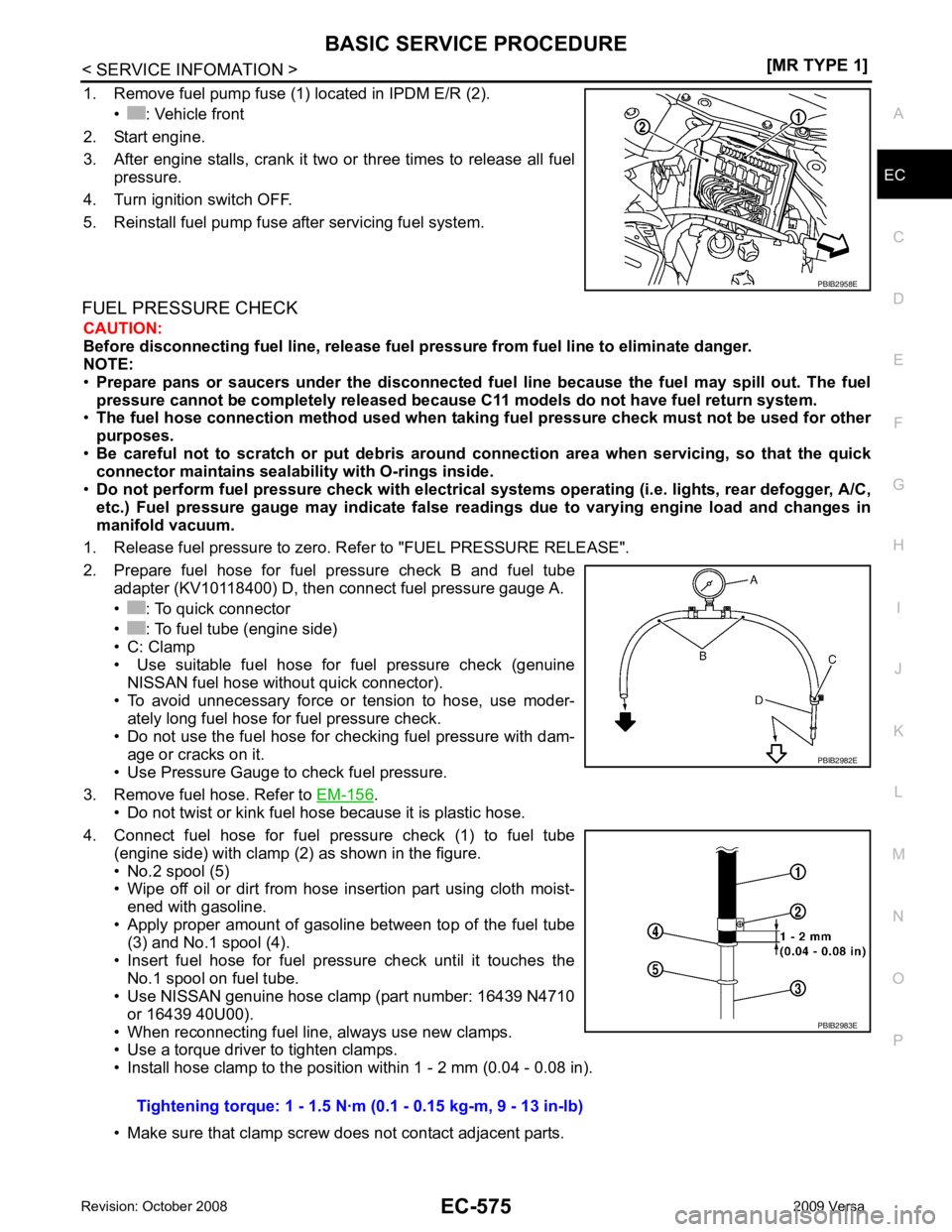
1. Remove fuel pump fuse (1) located in IPDM E/R (2).
• : Vehicle front
2. Start engine.
3. After engine stalls, crank it two or three times to release all fuel pressure.
4. Turn ignition switch OFF.
5. Reinstall fuel pump fuse after servicing fuel system.
FUEL PRESSURE CHECK CAUTION:
Before disconnecting fuel line, release fuel pressure from fuel line to eliminate danger.
NOTE:
• Prepare pans or saucers under the disconnected fuel line because the fuel may spill out. The fuel
pressure cannot be completely released because C11 models do not have fuel return system.
• The fuel hose connection method u sed when taking fuel pressure check must not be used for other
purposes.
• Be careful not to scratch or put debris around connection area when servicing, so that the quick
connector maintains sealability with O-rings inside.
• Do not perform fuel pressure check with electrical syst ems operating (i.e. lights, rear defogger, A/C,
etc.) Fuel pressure gauge may indicate false readin gs due to varying engine load and changes in
manifold vacuum.
1. Release fuel pressure to zero. Refer to "FUEL PRESSURE RELEASE".
2. Prepare fuel hose for fuel pressure check B and fuel tube adapter (KV10118400) D, then connect fuel pressure gauge A.
• : To quick connector
• : To fuel tube (engine side)
• C: Clamp
• Use suitable fuel hose for fuel pressure check (genuine
NISSAN fuel hose without quick connector).
• To avoid unnecessary force or tension to hose, use moder- ately long fuel hose for fuel pressure check.
• Do not use the fuel hose for checking fuel pressure with dam- age or cracks on it.
• Use Pressure Gauge to check fuel pressure.
3. Remove fuel hose. Refer to EM-156 .
• Do not twist or kink fuel hose because it is plastic hose.
4. Connect fuel hose for fuel pressure check (1) to fuel tube (engine side) with clamp (2) as shown in the figure.
• No.2 spool (5)
• Wipe off oil or dirt from hose insertion part using cloth moist-
ened with gasoline.
• Apply proper amount of gasoline between top of the fuel tube (3) and No.1 spool (4).
• Insert fuel hose for fuel pressure check until it touches the No.1 spool on fuel tube.
• Use NISSAN genuine hose clamp (part number: 16439 N4710
or 16439 40U00).
• When reconnecting fuel line, always use new clamps.
• Use a torque driver to tighten clamps.
• Install hose clamp to the positi on within 1 - 2 mm (0.04 - 0.08 in).
• Make sure that clamp screw does not contact adjacent parts.
Page 1967 of 4331
![NISSAN LATIO 2009 Service Owners Guide EC
NP
O
NOTE:
Any monitored item that does not match the vehicle being diagnosed is deleted from the display automatically.
ACTIVE TEST MODE
Test Item AT OD CANCEL
[ON/OFF] • Indicates [ON/OFF] cond](/img/5/57359/w960_57359-1966.png "NISSAN LATIO 2009 Service Owners Guide EC
NP
O
NOTE:
Any monitored item that does not match the vehicle being diagnosed is deleted from the display automatically.
ACTIVE TEST MODE
Test Item AT OD CANCEL
[ON/OFF] • Indicates [ON/OFF] cond")
EC
NP
O
NOTE:
Any monitored item that does not match the vehicle being diagnosed is deleted from the display automatically.
ACTIVE TEST MODE
Test Item AT OD CANCEL
[ON/OFF] • Indicates [ON/OFF] condition of A/T O/D cancel signal sent
from the TCM. • For M/T models always “OFF” is displayed
CRUISE LAMP
[ON/OFF] • Indicates [ON/OFF]
condition of CRUISE lamp determined
by the ECM according to the input signals.
SET LAMP
[ON/OFF] • Indicates [ON/OFF] condition of SET lamp determined by the
ECM according to the input signals.
A/F ADJ-B1 • Indicates the correction factor stored in ECM. The factor is
calculated from the difference between the target air/fuel ratio
stored in ECM and the air/fuel ratio calculated from air fuel ra-
tio (A/F) sensor 1 signal.
Monitored item [Unit] Description Remarks TEST ITEM CONDITION JUDGEMENT CHECK ITEM (REMEDY)
FUEL INJEC-
TION • Engine: Return to the original
trouble condition
• Change the amount of fuel injec- tion using CONSULT-III. If trouble symptom disappears, see
CHECK ITEM. • Harness and connectors
• Fuel injector
• Air fuel ratio (A/F) sensor 1
IGNITION TIM-
ING • Engine: Return to the original
trouble condition
• Timing light: Set
• Retard the ignition timing using
CONSULT-III. If trouble symptom disappears, see
CHECK ITEM. • Perform Idle Air Volume Learning.
POWER BAL-
ANCE • Engine: After warming up, idle the
engine.
• A/C switch OFF
• Shift lever: P or N (A/T, CVT), Neutral (M/T)
• Cut off each fuel injector signal
one at a time using CONSULT-III. Engine runs rough or dies.
• Harness and connectors
• Compression
• Fuel injector
• Power transistor
• Spark plug
• Ignition coil
COOLING FAN* • Ignition switch: ON
• Turn the cooling fan “LOW”, “HI” and “OFF” with CONSULT-III. Cooling fan moves and stops. • Harness and connectors
• Cooling fan relay
• Cooling fan motor
ENG COOLANT
TEMP • Engine: Return to the original
trouble condition
• Change the engine coolant tem- perature using CONSULT-III. If trouble symptom disappears, see
CHECK ITEM. • Harness and connectors
• Engine coolant temperature sen-
sor
• Fuel injector
FUEL PUMP RE-
LAY • Ignition switch: ON
(Engine stopped)
• Turn the fuel pump relay ON and OFF using CONSULT-III and lis-
ten to operating sound. Fuel pump relay makes the operat-
ing sound. • Harness and connectors
• Fuel pump relay
PURG VOL
CONT/V • Engine: After warming up, run en-
gine at 1,500 rpm.
• Change the EVAP canister purge volume control solenoid valve
opening percent using CON-
SULT-III. Engine speed changes according to
the opening percent. • Harness and connectors
• EVAP canister purge volume con- trol solenoid valve
FUEL/T TEMP
SEN • Change the fuel tank temperature using CONSULT-III.
Page 2035 of 4331
![NISSAN LATIO 2009 Service Owners Guide DTC P0122, P
0123 TP SENSOR
EC-679
< SERVICE INFOMATION >
[MR TYPE 1] C
D E
F
G H
I
J
K L
M A EC
NP
O
DTC P0122, P0123 TP SENSOR
Component Description INFOID:0000000004537143
Electric throttle contr](/img/5/57359/w960_57359-2034.png "NISSAN LATIO 2009 Service Owners Guide DTC P0122, P
0123 TP SENSOR
EC-679
< SERVICE INFOMATION >
[MR TYPE 1] C
D E
F
G H
I
J
K L
M A EC
NP
O
DTC P0122, P0123 TP SENSOR
Component Description INFOID:0000000004537143
Electric throttle contr")
DTC P0122, P
0123 TP SENSOR
EC-679
< SERVICE INFOMATION >
[MR TYPE 1] C
D E
F
G H
I
J
K L
M A EC
NP
O
DTC P0122, P0123 TP SENSOR
Component Description INFOID:0000000004537143
Electric throttle control actuator consists of throttle control motor,
throttle position sensor, etc. The throttle position sensor responds to
the throttle valve movement.
The throttle position sensor has two sensors. These sensors are a
kind of potentiometers which transform the throttle valve position into
output voltage, and emit the voltage signal to the ECM. In addition,
these sensors detect the opening and closing speed of the throttle
valve and feed the voltage signals to the ECM. The ECM judges the
current opening angle of the throttle valve from these signals and the
ECM controls the throttle control motor to make the throttle valve
opening angle properly in response to driving condition.
CONSULT-III Reference Val ue in Data Monitor Mode INFOID:0000000004537144
Specification data are reference values.
*: Throttle position sensor 2 signal is converted by ECM internally. Thus, it differs from ECM terminal voltage signal.
On Board Diagnosis Logic INFOID:0000000004537145
These self-diagnoses have the on e trip detection logic.
NOTE:
If DTC P0122 or P0123 is displayed with DTC P0643, first perform the trouble diagnosis for DTC P0643.
Refer to EC-874 .
FAIL-SAFE MODE When the malfunction is detected, ECM ent ers fail-safe mode and the MIL lights up.
DTC Confirmation Procedure INFOID:0000000004537146
NOTE:
If DTC Confirmation Procedure has been previously conduc ted, always turn ignition switch OFF and wait at
least 10 seconds before conducting the next test.
TESTING CONDITION:
Before performing the following procedure, confirm that battery voltage is more than 8V at idle.
1. Start engine and let it idle for 1 second.
2. Check DTC.
3. If DTC is detected, go to EC-681, " Diagnosis Procedure " . PBIB0145E
MONITOR ITEM CONDITION SPECIFICATION
TP SEN 1-B1
TP SEN 2-B1* • Ignition switch: ON
(Engine stopped)
• Shift lever: D (A/T, CVT),
1st (M/T) Accelerator pedal: Fully released More than 0.36V
Accelerator pedal: Fully depressed Less than 4.75V DTC No. Trouble diagnosis name DTC detecting condition Possible cause
P0122
0122 Throttle position sensor
2 circuit low input An excessively low voltage from the TP sensor
2 is sent to ECM. • Harness or connectors
(TP sensor 2 circuit is open or shorted.)
• Electric throttle control actuator (TP sensor 2)
P0123
0123 Throttle position sensor
2 circuit high input An excessively high voltage from the TP sensor
2 is sent to ECM. Engine operation condition in fail-safe mode
The ECM controls the electric throttle control actuator in regulating the throttle opening in order for the idle position to be within +10
degrees.
The ECM regulates the opening speed of the throttle valve to be slower than the normal condition.
So, the acceleration will be poor.
Page 2121 of 4331

EC
NP
O
DTC P0300 - P0304 MULTIPLE CYLINDER
MISFIRE, NO. 1 - 4 CYLINDER
MISFIRE
On Board Diagnosis Logic INFOID:0000000004537254
When a misfire occurs, engine speed will fluctuate. If the engine speed fluctuates enough to cause the crank-
shaft position (CKP) sensor (POS) signal to vary , ECM can determine that a misfire is occurring.
The misfire detection logic consists of the following two conditions.
1. One Trip Detection Logic (Three Way Catalyst Damage) On the 1st trip that a misfire condition occurs that can damage the three way catalyst (TWC) due to over-
heating, the MIL will blink.
When a misfire condition occurs, the ECM monitors the CKP sensor (POS) signal every 200 engine revo-
lutions for a change.
When the misfire condition decreases to a level t hat will not damage the TWC, the MIL will turn off.
If another misfire condition occurs that can damage the TWC on a second trip, the MIL will blink.
When the misfire condition decreases to a level t hat will not damage the TWC, the MIL will remain on.
If another misfire condition occurs that can damage the TWC, the MIL will begin to blink again.
2. Two Trip Detection Logic (Exhaust quality deterioration) For misfire conditions that will not damage the TWC (but will affect vehicle emissions), the MIL will only
light when the misfire is detected on a second trip. Du ring this condition, the ECM monitors the CKP sen-
sor signal every 1,000 engine revolutions.
A misfire malfunction can be detected on any one cylinder or on multiple cylinders.
DTC Confirmation Procedure INFOID:0000000004537255
CAUTION:
Always drive vehicle in safe manner according to traf fic conditions and obey all traffic laws when driv-
ing.
NOTE:
If DTC Confirmation Procedure has been previously conduc ted, always turn ignition switch OFF and wait at
least 10 seconds before conducting the next test.
1. Start engine and warm it up to normal operating temperature.
2. Turn ignition switch OFF and wait at least 10 seconds.
3. Restart engine and let it idle for about 15 minutes.
4. Check 1st trip DTC.
5. If 1st trip DTC is detected, go to EC-766, " Diagnosis Procedure " .
NOTE:
If 1st trip DTC is not detected during above proc edure, performing the following procedure is advised.
a. Turn ignition switch OFF and wait at least 10 seconds.
b. Start engine and drive the vehicle under the similar conditi ons to (1st trip) Freeze Frame Data for a certain
time. Refer to table below. Sensor Input Signal to ECM ECM function
Crankshaft position sensor (POS) Engine speed On board diagnosis of misfire DTC No. Trouble diagnosis name DTC detecting condition Possible cause
P0300
0300 Multiple cylinder misfire
detected Multiple cylinder misfire.
• Improper spark plug
• Insufficient compression
• Incorrect fuel pressure
• Fuel injector circuit is open or shorted
• Fuel injector
• Intake air leak
• The ignition signal circuit is open or shorted
• Lack of fuel
• Drive plate or flywheel
• Air fuel ratio (A/F) sensor 1
• Incorrect PCV hose connection
P0301
0301 No.1 cylinder misfire de-
tected No. 1 cylinder misfires.
P0302
0302 No. 2 cylinder misfire
detected No. 2 cylinder misfires.
P0303
0303 No. 3 cylinder misfire
detected No. 3 cylinder misfires.
P0304
0304 No. 4 cylinder misfire
detected No. 4 cylinder misfires.
Page 2127 of 4331
EC
NP
O
DTC P0327, P0328 KS
Component Description INFOID:0000000004537257
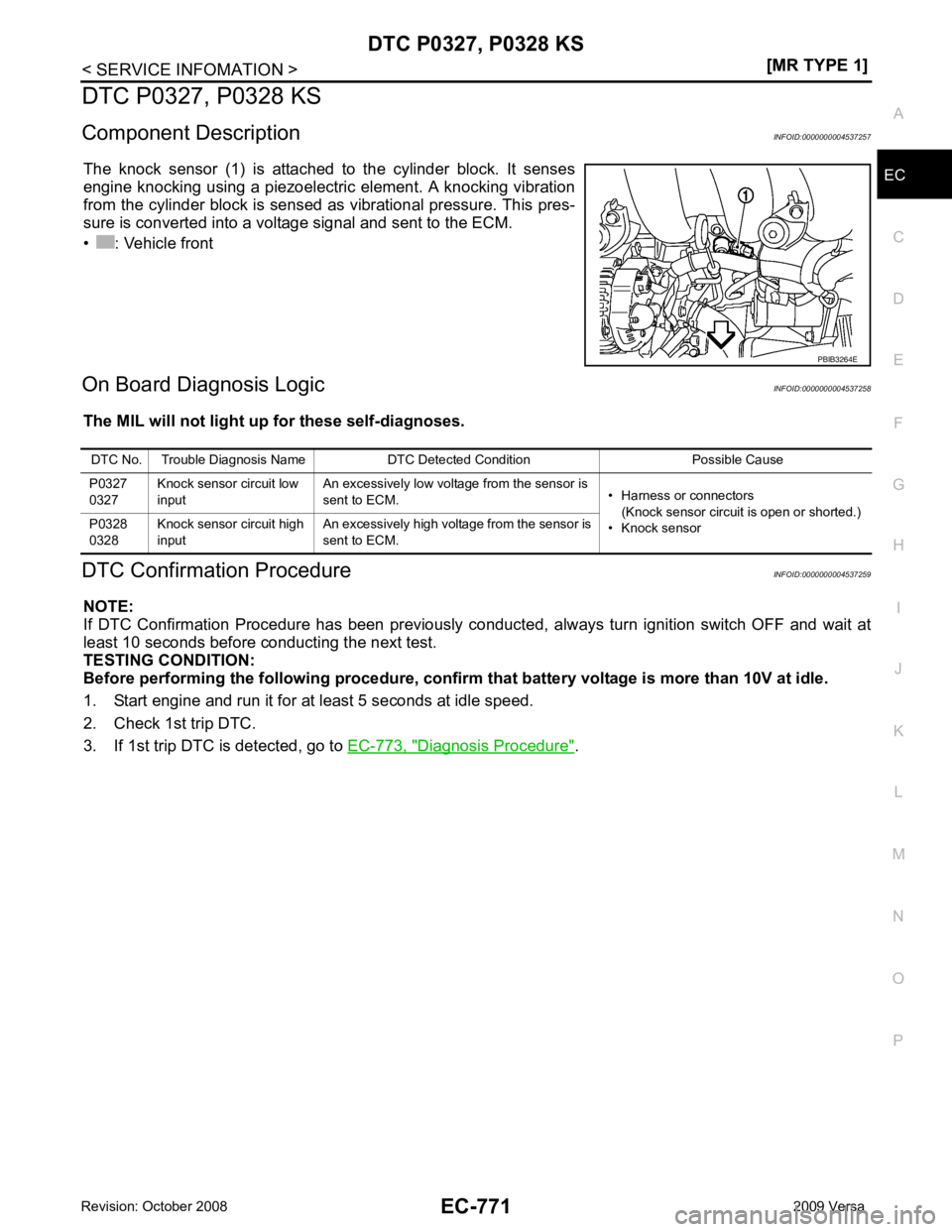
The knock sensor (1) is attached to the cylinder block. It senses
engine knocking using a piezoelectric element. A knocking vibration
from the cylinder block is sensed as vibrational pressure. This pres-
sure is converted into a voltage signal and sent to the ECM.
• : Vehicle front
On Board Diagnosis Logic INFOID:0000000004537258
The MIL will not light up for these self-diagnoses.
DTC Confirmation Procedure INFOID:0000000004537259
NOTE:
If DTC Confirmation Procedure has been previously conduc ted, always turn ignition switch OFF and wait at
least 10 seconds before conducting the next test.
TESTING CONDITION:
Before performing the following procedure, confirm that battery voltage is more than 10V at idle.
1. Start engine and run it for at least 5 seconds at idle speed.
2. Check 1st trip DTC.
3. If 1st trip DTC is detected, go to EC-773, " Diagnosis Procedure " .
Page 2150 of 4331
![NISSAN LATIO 2009 Service Owners Guide EC-794< SERVICE INFOMATION >
[MR TYPE 1]
DTC P0441 EVAP CONTROL SYSTEM
With CONSULT-III
1. Disconnect vacuum hose connected to EVAP canister purge volume control solenoid valve at EVAP ser-
vice po](/img/5/57359/w960_57359-2149.png "NISSAN LATIO 2009 Service Owners Guide EC-794< SERVICE INFOMATION >
[MR TYPE 1]
DTC P0441 EVAP CONTROL SYSTEM
With CONSULT-III
1. Disconnect vacuum hose connected to EVAP canister purge volume control solenoid valve at EVAP ser-
vice po")
EC-794< SERVICE INFOMATION >
[MR TYPE 1]
DTC P0441 EVAP CONTROL SYSTEM
With CONSULT-III
1. Disconnect vacuum hose connected to EVAP canister purge volume control solenoid valve at EVAP ser-
vice port and install vacuum gauge. For the location of EVAP service port, refer to EC-527, " Description " .
2. Start engine and let it idle.
3. Select “PURG VOL CONT/V” in “A CTIVE TEST” mode with CONSULT-III.
4. Rev engine up to 2,000 rpm.
5. Touch “Qd” and “Qu” on CONSULT-III screen to adjust “PURG VOL CONT/V” opening and check vacuum
existence.
OK or NG OK >> GO TO 7.
NG >> GO TO 4. 3.
CHECK PURGE FLOW
Without CONSULT-III
1. Start engine and warm it up to normal operating temperature.
2. Stop engine.
3. Disconnect vacuum hose connected to EVAP canister purge volume control solenoid valve at EVAP ser-
vice port and install vacuum gauge. For the location of EVAP service port, refer to EC-527, " Description " .
4. Start engine and let it idle.
Do not depress accelerator pedal even slightly.
5. Check vacuum gauge indication before 60 seconds passed after starting engine.
6. Revving engine up to 2,000 rpm after 100 seconds passed after starting engine.
OK or NG OK >> GO TO 7.
NG >> GO TO 4. 4.
CHECK EVAP PURGE LINE
1. Turn ignition switch OFF.
2. Check EVAP purge line for improper connection or disconnection.
Refer to EC-527, " Description " .
OK or NG OK >> GO TO 5.
NG >> Repair it. 5.
CHECK EVAP PURGE HOSE AND PURGE PORT
1. Disconnect purge hoses connected to EVAP service port A and
EVAP canister purge volume control solenoid valve B.
2. Blow air into each hose and EVAP purge port C.
PURG VOL CONT/V VACUUM
100% Should exist.
0% should not exist. Vacuum should not exist.
Vacuum should exist. SEF367U
Page 2163 of 4331
![NISSAN LATIO 2009 Service Owners Guide DTC P0443 EVAP CANISTE
R PURGE VOLUME CONTROL SOLENOID VALVE
EC-807
< SERVICE INFOMATION >
[MR TYPE 1] C
D E
F
G H
I
J
K L
M A EC
NP
O
Do not use ECM ground terminals wh
en measuring input/output volt](/img/5/57359/w960_57359-2162.png "NISSAN LATIO 2009 Service Owners Guide DTC P0443 EVAP CANISTE
R PURGE VOLUME CONTROL SOLENOID VALVE
EC-807
< SERVICE INFOMATION >
[MR TYPE 1] C
D E
F
G H
I
J
K L
M A EC
NP
O
Do not use ECM ground terminals wh
en measuring input/output volt")
DTC P0443 EVAP CANISTE
R PURGE VOLUME CONTROL SOLENOID VALVE
EC-807
< SERVICE INFOMATION >
[MR TYPE 1] C
D E
F
G H
I
J
K L
M A EC
NP
O
Do not use ECM ground terminals wh
en measuring input/output voltage. Doing so may result in dam-
age to the ECM's transistor. Use a ground ot her than ECM terminals, such as the ground.
: Average voltage for pulse signal (Actual pulse signal can be confirmed by oscilloscope.)
Diagnosis Procedure INFOID:00000000045372971.
CHECK EVAP CANISTER PURG E VOLUME CONTROL SOLENOID VALVE POWER SUPPLY CIRCUIT
1. Turn ignition switch OFF.
2. Disconnect EVAP canister purge volume control solenoid valve (1) harness connector.
- EVAP service port (2)
- : Vehicle front
3. Turn ignition switch ON. TERMI-
NAL
NO. WIRE
COLOR ITEM CONDITION DATA (DC Voltage)
9 P EVAP canister purge volume
control solenoid valve [Engine is running]
• Idle speed
• Accelerator pedal: Not depressed even slightly, after engine starting. BATTERY VOLTAGE
(11 - 14V)
[Engine is running]
• Engine speed: About 2,000 rpm (More
than 100 seconds after starting engine) Approximately 10V
32 P ECM relay
(Self shut-off) [Engine is running]
[Ignition switch: OFF]
• For a few seconds after turning ignition switch OFF 0 - 1.0V
[Ignition switch: OFF]
• More than a few seconds after turning ig- nition switch OFF BATTERY VOLTAGE
(11 - 14V)
105 G Power supply for ECM [Ignition switch: ON]BATTERY VOLTAGE
(11 - 14V) PBIB0050E
PBIB0520E
BBIA0703E
Page 2170 of 4331
![NISSAN LATIO 2009 Service Owners Guide EC-814< SERVICE INFOMATION >
[MR TYPE 1]
DTC P0444, P0445 EVAP CANISTER
PURGE VOLUME CONTROL SOLENOID
VALVE
Do not use ECM ground terminals when measuring in put/output voltage. Doing so may result](/img/5/57359/w960_57359-2169.png "NISSAN LATIO 2009 Service Owners Guide EC-814< SERVICE INFOMATION >
[MR TYPE 1]
DTC P0444, P0445 EVAP CANISTER
PURGE VOLUME CONTROL SOLENOID
VALVE
Do not use ECM ground terminals when measuring in put/output voltage. Doing so may result")
EC-814< SERVICE INFOMATION >
[MR TYPE 1]
DTC P0444, P0445 EVAP CANISTER
PURGE VOLUME CONTROL SOLENOID
VALVE
Do not use ECM ground terminals when measuring in put/output voltage. Doing so may result in dam-
age to the ECM's transistor. Use a ground ot her than ECM terminals, such as the ground.
: Average voltage for pulse signal (Actual pulse signal can be confirmed by oscilloscope.)
Diagnosis Procedure INFOID:00000000045373051.
CHECK EVAP CANISTER PURGE VOLUME CONTROL SOLENOID VALVE POWER SUPPLY CIRCUIT
1. Turn ignition switch OFF.
2. Disconnect EVAP canister purge volume control solenoid valve (1) harness connector.
- EVAP canister port (2)
3. Turn ignition switch ON. TER-
MI-
NAL
NO. WIRE
COLOR ITEM CONDITION DATA (DC Voltage)
9 P EVAP canister purge volume
control solenoid valve [Engine is running]
• Idle speed
• Accelerator pedal: Not depressed even
slightly, after engine starting. BATTERY VOLTAGE
(11 - 14V)
[Engine is running]
• Engine speed: About 2,000 rpm (More than 100 seconds after starting engine) Approximately 10V
32 P ECM relay
(Self shut-off) [Engine is running]
[Ignition switch: OFF]
• For a few seconds after turning ignition
switch OFF 0 - 1.0V
[Ignition switch: OFF]
• More than a few seconds after turning igni- tion switch OFF BATTERY VOLTAGE
(11 - 14V)
105 G Power supply for ECM [Ignition switch: ON]BATTERY VOLTAGE
(11 - 14V) PBIB0050E
PBIB0520E
BBIA0693E
Page 2186 of 4331
![NISSAN LATIO 2009 Service Owners Guide EC-830< SERVICE INFOMATION >
[MR TYPE 1]
DTC P0451 EVAP CONTROL
SYSTEM PRESSURE SENSOR
Do not depress accelerator pedal even slightly.
3. Check 1st trip DTC.
4. If 1st trip DTC is detected, go to EC](/img/5/57359/w960_57359-2185.png "NISSAN LATIO 2009 Service Owners Guide EC-830< SERVICE INFOMATION >
[MR TYPE 1]
DTC P0451 EVAP CONTROL
SYSTEM PRESSURE SENSOR
Do not depress accelerator pedal even slightly.
3. Check 1st trip DTC.
4. If 1st trip DTC is detected, go to EC")
EC-830< SERVICE INFOMATION >
[MR TYPE 1]
DTC P0451 EVAP CONTROL
SYSTEM PRESSURE SENSOR
Do not depress accelerator pedal even slightly.
3. Check 1st trip DTC.
4. If 1st trip DTC is detected, go to EC-830, " Diagnosis Procedure " .
Diagnosis Procedure INFOID:00000000045373261.
CHECK GROUND CONNECTIONS
1. Turn ignition switch OFF.
2. Loosen and retighten ground screws on the body.
Refer to EC-632, " Ground Inspection " .
OK or NG OK >> GO TO 2.
NG >> Repair or replace ground connections. 2.
CHECK EVPA CONTROL SYSTEM PRESS URE SENSOR CONNECTOR FOR WATER
1. Disconnect EVAP control system pressure sensor (1) harness connector.
- EVAP canister (2)
- EVAP canister vent control valve (3)
2. Check sensor harness connector for water.
OK or NG OK >> GO TO 3.
NG >> Repair or replace harness connector. 3.
CHECK COMPONENTS POWER SUPPLY
Check harness for short to power and short to ground, between the following terminals.
OK or NG OK >> GO TO 4.
NG >> Repair short to ground or short to power in harness or connectors. 4.
CHECK COMPONENTS
Check the following. :
Vehicle front
1. Body ground E24 2. Engine ground F9 3. engine ground F16
4. Body ground E15 BBIA0698E
Water should not exist.
BBIA0693E
ECM terminal Sensor terminal Reference Wiring Diagram
74 Refrigerant pressure sensor terminal 3 EC-1006, " Wiring Diagram "
75 Crankshaft position sensor (POS) terminal 1
EC-776, " Wiring Diagram "
76 EVAP control system pressure sensor terminal 3
EC-834, " Wiring Diagram "
102 APP sensor terminal 5
EC-949, " Wiring Diagram "
Page 2275 of 4331
EC
NP
O
DTC P1715 INPUT SPEED SENS
OR (PRIMARY SPEED SENSOR)
Description INFOID:0000000004537437
ECM receives primary speed sensor signal from TCM through CAN communication line.
CONSULT-III Reference Val ue in Data Monitor Mode INFOID:0000000004537438
Specification data are reference values.
On Board Diagnosis Logic INFOID:0000000004537439
NOTE:
• If DTC P1715 is displayed with DTC U1000 or U 1001 first perform the trouble diagnosis for DTC
U1000, U1001. Refer to EC-633 .
• If DTC P1715 is displayed with DTC U1010, firs t perform the trouble diagnosis for DTC U1010. Refer
to EC-635 .
• If DTC P1715 is displayed with DT C P0335, first perform the trouble diagnosis for DTC P0335. Refer
to EC-775 .
• If DTC P1715 is displayed with DTC P0340 firs t perform the trouble diagnosis for DTC P0340.
Refer to EC-781 .
• If DTC P1715 is displayed with DT C P0605, first perform the trouble diagnosis for DTC P0605. Refer
to EC-872 .
The MIL will not light up for this diagnosis.
DTC Confirmation Procedure INFOID:0000000004537440
CAUTION:
Always drive vehicle at a safe speed.
NOTE:
If DTC Confirmation Procedure has been previously conduc ted, always turn ignition switch OFF and wait at
least 10 seconds before conducting the next test.
1. Start engine.
2. Drive vehicle at a speed of more than 50 km/h (31 MPH) for at least 5 seconds.
3. Check 1st trip DTC.
4. If 1st trip DTC is detected, go to EC-919, " Diagnosis Procedure " .
Diagnosis Procedure INFOID:0000000004537441.
OK or NG OK >> GO TO 2.
NG >> Perform trouble shooting relevant to DTC indicated. .
MONITOR ITEM CONDITION SPECIFICATION
I/P PULLY SPD • Vehicle speed: More than 20 km/h (12MPH) Almost the same speed as the
tachometer indication DTC No. Trouble diagnosis name DTC detecting condition Possible cause
P1715
1715 Input speed sensor
(Primary speed sensor)
(TCM output) Primary speed sensor signal is different
from the theoretical value calculated by
ECM from secondary speed sensor signal
and engine rpm signal. • Harness or connectors
(CAN communication line is open or shorted)
• Harness or connectors (Primary speed sensor circuit is open or short-
ed)
• TCM