check engine light NISSAN LATIO 2009 Service Manual PDF
[x] Cancel search | Manufacturer: NISSAN, Model Year: 2009, Model line: LATIO, Model: NISSAN LATIO 2009Pages: 4331, PDF Size: 58.04 MB
Page 2705 of 4331
![NISSAN LATIO 2009 Service Manual PDF DTC P0451 EVAP CONTROL
SYSTEM PRESSURE SENSOR
EC-1349
< SERVICE INFOMATION >
[MR TYPE 2] C
D E
F
G H
I
J
K L
M A EC
NP
O
Do not depress accelerator pedal even slightly.
3. Check 1st trip DTC.
4. If 1](/img/5/57359/w960_57359-2704.png "NISSAN LATIO 2009 Service Manual PDF DTC P0451 EVAP CONTROL
SYSTEM PRESSURE SENSOR
EC-1349
< SERVICE INFOMATION >
[MR TYPE 2] C
D E
F
G H
I
J
K L
M A EC
NP
O
Do not depress accelerator pedal even slightly.
3. Check 1st trip DTC.
4. If 1")
DTC P0451 EVAP CONTROL
SYSTEM PRESSURE SENSOR
EC-1349
< SERVICE INFOMATION >
[MR TYPE 2] C
D E
F
G H
I
J
K L
M A EC
NP
O
Do not depress accelerator pedal even slightly.
3. Check 1st trip DTC.
4. If 1st trip DTC is detected, go to EC-1349, " Diagnosis Procedure " .
Diagnosis Procedure INFOID:00000000045002121.
CHECK GROUND CONNECTIONS
1. Turn ignition switch OFF.
2. Loosen and retighten ground screws on the body.
Refer to EC-1144, " Ground Inspection " .
OK or NG OK >> GO TO 2.
NG >> Repair or replace ground connections. 2.
CHECK EVPA CONTROL SYS TEM PRESSURE SENSOR CONNECTOR FOR WATER
1. Disconnect EVAP control system pressure sensor (1) harness
connector.
- EVAP canister (2)
- EVAP canister vent control valve (3)
2. Check sensor harness connector for water.
OK or NG OK >> GO TO 3.
NG >> Repair or replace harness connector. 3.
CHECK COMPONENTS POWER SUPPLY
Check harness for short to power and short to ground, between the following terminals.
OK or NG OK >> GO TO 4.
NG >> Repair short to ground or short to power in harness or connectors. 4.
CHECK COMPONENTS
Check the following. :
Vehicle front
1. Body ground E24 2. Engine ground F9 3. engine ground F16
4. Body ground E15 BBIA0698E
Water should not exist.
BBIA0693E
ECM terminal Sensor terminal Reference Wiring Diagram
74 Refrigerant pressure sensor terminal 3 EC-1528, " Wiring Diagram "
75 Crankshaft position sensor (POS) terminal 1
EC-1294, " Wiring Diagram "
76 EVAP control system pressure sensor terminal 3
EC-1353, " Wiring Diagram "
102 APP sensor terminal 5
EC-1471, " Wiring Diagram "
Page 2794 of 4331
for ASCD functions.
On Board Diagn osis Logic INFOID:0000000004500316
NOTE:
• If DTC P1574 is displayed with DTC UXXXX, first perform the tr ouble diagnosis for DTC UXXXX.
• If DTC P1574 is displayed with DTC P0500, first pe rform the trouble diagnosis for DTC P0500. Refer
to EC-1387 .
This self-diagnosis has the one trip detection logic.
The MIL will not light up for this diagnosis.
DTC Confirmation Procedure INFOID:0000000004500317
CAUTION:
Always drive vehicle at a safe speed.
NOTE:
If DTC Confirmation Procedure has been previously conduc ted, always turn ignition switch OFF and wait at
least 10 seconds before conducting the next test.
TESTING CONDITION:
Step 3 may be conducted with the drive wheels lifted in the shop or by driving the vehicle. If a road test
is expected to be easier, it is unnecessary to lift the vehicle.
1. Start engine.
2. Drive the vehicle at more than 40 km/h (25MPH).
3. Check DTC.
4. If DTC is detected, go to EC-1438, " Diagnosis Procedure " .
Diagnosis Procedure INFOID:0000000004500318 (A/T) or
CVT-209 (CVT).
OK or NG OK >> GO TO 2.
NG >> Perform trouble shooting relevant to DTC indicated. .
OK or NG OK >> GO TO 3.DTC No.
Trouble diagnosis
name DTC detecting condition Possible cause
P1574
1574 ASCD vehicle speed
sensor ECM detects a difference between two vehicle
speed signals is out of the specified range. • Harness or connectors
(CAN communication line is open or shorted.)
• Harness or connectors (Combination meter circuit is open or shorted.)
• TCM
• ABS actuator and electric unit (control unit)
• Combination meter
• ECM
Page 2797 of 4331
EC
NP
O
DTC P1715 INPUT SPEED SENS
OR (PRIMARY SPEED SENSOR)
Description INFOID:0000000004500323
ECM receives primary speed sensor signal from TCM through CAN communication line.
CONSULT-III Reference Val ue in Data Monitor Mode INFOID:0000000004500324
Specification data are reference values.
On Board Diagnosis Logic INFOID:0000000004500325
NOTE:
• If DTC P1715 is displayed with DTC UXXXX, first perform the tr ouble diagnosis for DTC UXXXX.
• If DTC P1715 is displayed with DT C P0335, first perform the trouble diagnosis for DTC P0335. Refer
to EC-1293 .
• If DTC P1715 is displayed with DTC P0340 firs t perform the trouble diagnosis for DTC P0340.
Refer to EC-1299 .
• If DTC P1715 is displayed with DT C P0605, first perform the trouble diagnosis for DTC P0605. Refer
to EC-1393 .
• If DTC P1715 is displayed with DT C P0607, first perform the trouble diagnosis for DTC P0607. Refer
to EC-1395 .
The MIL will not lights up for this diagnosis.
DTC Confirmation Procedure INFOID:0000000004500326
CAUTION:
Always drive vehicle at a safe speed.
NOTE:
If DTC Confirmation Procedure has been previously conduc ted, always turn ignition switch OFF and wait at
least 10 seconds before conducting the next test.
1. Start engine.
2. Drive vehicle at a speed of more than 50 km/h (31 MPH) for at least 5 seconds.
3. Check 1st trip DTC.
4. If 1st trip DTC is detected, go to EC-1441, " Diagnosis Procedure " .
Diagnosis Procedure INFOID:0000000004500327.
OK or NG OK >> GO TO 2.
NG >> Perform trouble shooting relevant to DTC indicated. Removal and Installation " .
MONITOR ITEM CONDITION SPECIFICATION
I/P PULLY SPD • Vehicle speed: More than 20 km/h (12MPH) Almost the same speed as the
tachometer indication DTC No. Trouble diagnosis name DTC detecting condition Possible cause
P1715
1715 Input speed sensor
(Primary speed sensor)
(TCM output) Primary speed sensor signal is different
from the theoretical value calculated by
ECM from secondary speed sensor signal
and engine rpm signal. • Harness or connectors
(CAN communication line is open or shorted)
• Harness or connectors (Primary speed sensor circuit is open or short-
ed)
• TCM
Page 2799 of 4331

EC
NP
O
DTC P1805 BRAKE SWITCH
Description INFOID:0000000004500328
Brake switch signal is applied to the ECM through t he stop lamp switch when the brake pedal is depressed.
This signal is used mainly to decrease the engine speed when the vehicle is driving.
CONSULT-III Reference Val ue in Data Monitor Mode INFOID:0000000004500329
Specification data are reference values.
On Board Diagnosis Logic INFOID:0000000004500330
The MIL will not light up for this self-diagnosis.
FAIL-SAFE MODE When the malfunction is detected, the ECM enters in fail-safe mode.
DTC Confirmation Procedure INFOID:0000000004500331
1. Turn ignition switch ON.
2. Fully depress the brake pedal for at least 5 seconds.
3. Erase the DTC.
4. Check 1st trip DTC.
5. If 1st trip DTC is detected, go to EC-1445, " Diagnosis Procedure " .
MONITOR ITEM CONDITION SPECIFICATION
BRAKE SW • Ignition switch: ON Brake pedal: Fully released OFF
Brake pedal: Slightly depressed ON DTC No. Trouble diagnosis name DTC detecting condition Possible cause
P1805
1805 Brake switch A brake switch signal is not sent to ECM for
extremely long time while the vehicle is driv-
ing. • Harness or connectors
(Stop lamp switch circuit is open or shorted.)
• Stop lamp switch Engine operation condition in fail-fail safe mode
ECM controls the electric throttle control actuator by regulating the throttle opening to a small range. Therefore, acceleration will be poor.
Vehicle condition Driving condition Engine: Idling NormalAccelerating Poor acceleration
Page 2803 of 4331

EC
NP
O
DTC P2100, P2103 THROTTLE
CONTROL MOTOR RELAY
Component Description INFOID:0000000004500335
Power supply for the throttle control motor is provided to the ECM via throttle control motor relay. The throttle
control motor relay is ON/OFF controlled by the ECM. When the ignition switch is turned ON, the ECM sends
an ON signal to throttle control motor relay and batte ry voltage is provided to the ECM. When the ignition
switch is turned OFF, the ECM sends an OFF signal to throttle control motor relay and battery voltage is not
provided to the ECM.
CONSULT-III Reference Val ue in Data Monitor Mode INFOID:0000000004500336
Specification data are reference values.
On Board Diagnosis Logic INFOID:0000000004500337
These self-diagnoses have one trip detection logic.
FAIL-SAFE MODE When the malfunction is detected, ECM ent ers fail-safe mode and the MIL lights up.
DTC Confirmation Procedure INFOID:0000000004500338
NOTE:
If DTC Confirmation Procedure has been previously conduc ted, always turn ignition switch OFF and wait at
least 10 seconds before conducting the next test.
PROCEDURE FOR DTC P2100 1. Turn ignition switch ON and wait at least 2 seconds.
2. Start engine and let it idle for 5 seconds.
3. Check 1st trip DTC.
4. If DTC is detected, go to EC-1449, " Diagnosis Procedure " .
PROCEDURE FOR DTC P2103 TESTING CONDITION:
Before performing the following procedure, confirm that battery voltage is more than 10V at idle.
1. Turn ignition switch ON and wait at least 1 second.
2. Check DTC.
3. If DTC is detected, go to EC-1449, " Diagnosis Procedure " .
MONITOR ITEM CONDITION SPECIFICATION
THRTL RELAY • Ignition switch: ON ON DTC No. Trouble diagnosis name DTC detecting condition Possible cause
P2100
2100 Throttle control motor
relay circuit open ECM detects a voltage of power source for
throttle control motor is excessively low. • Harness or connectors
(Throttle control motor relay circuit is
open)
• Throttle control motor relay
P2103
2103 Throttle control motor
relay circuit short ECM detects the throttle
control motor relay is
stuck ON. • Harness or connectors
(Throttle control motor relay circuit is
shorted)
• Throttle control motor relay Engine operating condition in fail-safe mode
ECM stops the electric throttle control actuator control, throttle valve is maintained at a fixed opening (approx. 5 degrees) b y the return
spring.
Page 2807 of 4331

EC
NP
O
DTC P2101 ELECTRIC THRO
TTLE CONTROL FUNCTION
Description INFOID:0000000004500341
NOTE:
If DTC P2101 is displayed with DTC P2100 or P2119, first perform the trouble diagnosis for DTC P2100
or P2119. Refer to EC-1447 or
EC-1462 .
Electric throttle control actuator consists of throttle control motor, throttle position sensor, etc.
The throttle control motor is operated by the ECM and it opens and closes the throttle valve.
The current opening angle of the throttle valve is detected by the throttle position sensor and it provides feed-
back to the ECM to control the throttle control motor to make the throttle valve opening angle properly in
response to driving condition.
On Board Diagnosis Logic INFOID:0000000004500342
This self-diagnosis has the on e trip detection logic.
FAIL-SAFE MODE When the malfunction is detec ted, the ECM enters fail-safe mode and the MIL lights up.
DTC Confirmation Procedure INFOID:0000000004500343
NOTE:
If DTC Confirmation Procedure has been previously conduc ted, always turn ignition switch OFF and wait at
least 10 seconds before conducting the next test.
TESTING CONDITION:
Before performing the follo wing procedure, confirm that battery vo ltage is more than 11V when engine
is running.
1. Turn ignition switch ON and wait at least 2 seconds.
2. Start engine and let it idle for 5 seconds.
3. Check DTC.
4. If DTC is detected, go to EC-1453, " Diagnosis Procedure " .
DTC No. Trouble diagnosis name DTC detecting condition Possible cause
P2101
2101 Electric throttle control
performance Electric throttle control function does not oper-
ate properly. • Harness or connectors
(Throttle control motor circuit is open or
shorted)
• Electric throttle control actuator Engine operating condition in fail-safe mode
ECM stops the electric throttle control actuator control, throttle valve is maintained at a fixed opening (approx. 5 degrees) b y the return
spring.
Page 2813 of 4331

EC
NP
O
DTC P2118 THROTTLE CONTROL MOTOR
Component Description INFOID:0000000004500348
The throttle control motor is operated by the ECM and it opens and closes the throttle valve.
The current opening angle of the throttle valve is detected by the throttle position sensor and it provides feed-
back to the ECM to control the throttle control motor to make the throttle valve opening angle properly in
response to driving condition.
On Board Diagnosis Logic INFOID:0000000004500349
This self-diagnosis has the on e trip detection logic.
FAIL-SAFE MODE
When the malfunction is detected, ECM ent ers fail-safe mode and the MIL lights up.
DTC Confirmation Procedure INFOID:0000000004500350
NOTE:
If DTC Confirmation Procedure has been previously conduc ted, always turn ignition switch OFF and wait at
least 10 seconds before conducting the next test.
1. Turn ignition switch ON and wait at least 2 seconds.
2. Start engine and let it idle for 5 seconds.
3. Check DTC.
4. If DTC is detected, go to EC-1459, " Diagnosis Procedure " .
DTC No. Trouble diagnosis name DTC detecting condition Possible cause
P2118
2118 Throttle control motor
circuit short ECM detects short in both circuits between
ECM and throttle control motor. • Harness or connectors
(Throttle control motor circuit is shorted.)
• Electric throttle control actuator
(Throttle control motor) Engine operating condition in fail-safe mode
ECM stops the electric throttle control actuator control, throttle valve is maintained at a fixed opening (approx. 5 degrees) b y the return
spring.
Page 2832 of 4331
![NISSAN LATIO 2009 Service Manual PDF EC-1476< SERVICE INFOMATION >
[MR TYPE 2]
DTC P2135 TP SENSOR
DTC P2135 TP SENSOR
Component Description INFOID:0000000004501174
Electric throttle control actuator consists of throttle control](/img/5/57359/w960_57359-2831.png "NISSAN LATIO 2009 Service Manual PDF EC-1476< SERVICE INFOMATION >
[MR TYPE 2]
DTC P2135 TP SENSOR
DTC P2135 TP SENSOR
Component Description INFOID:0000000004501174
Electric throttle control actuator consists of throttle control")
EC-1476< SERVICE INFOMATION >
[MR TYPE 2]
DTC P2135 TP SENSOR
DTC P2135 TP SENSOR
Component Description INFOID:0000000004501174
Electric throttle control actuator consists of throttle control motor,
throttle position sensor, etc. The throttle position sensor responds to
the throttle valve movement.
The throttle position sensor has two sensors. These sensors are a
kind of potentiometers which transform the throttle valve position into
output voltage, and emit the voltage signal to the ECM. In addition,
these sensors detect the opening and closing speed of the throttle
valve and feed the voltage signals to the ECM. The ECM judges the
current opening angle of the throttle valve from these signals and the
ECM controls the throttle control motor to make the throttle valve
opening angle properly in response to driving condition.
CONSULT-III Reference Value in Data Monitor Mode INFOID:0000000004501175
Specification data are reference values.
*: Throttle position sensor 2 signal is converted by ECM internally. Thus, it differs from ECM terminal voltage signal.
On Board Diagn osis Logic INFOID:0000000004500377
This self-diagnosis has the one trip detection logic.
NOTE:
If DTC P2135 is displayed with DTC P0643, firs t perform the trouble diagnosis for DTC P0643.
Refer to EC-1396 .
FAIL-SAFE MODE
When the malfunction is detected, the ECM enters fail-safe mode and the MIL lights up.
DTC Confirmation Procedure INFOID:0000000004500378
NOTE:
If DTC Confirmation Procedure has been previously conduc ted, always turn ignition switch OFF and wait at
least 10 seconds before conducting the next test.
TESTING CONDITION:
Before performing the following procedure, confirm that battery voltage is more than 8V at idle.
1. Start engine and let it idle for 1 second.
2. Check DTC. PBIB0145E
MONITOR ITEM CONDITION SPECIFICATION
TP SEN 1-B1
TP SEN 2-B1* • Ignition switch: ON
(Engine stopped)
• Shift lever: D (A/T, CVT),
1st (M/T) Accelerator pedal: Fully released More than 0.36V
Accelerator pedal: Fully depressed Less than 4.75V DTC No. Trouble diagnosis name DTC detecting condition Possible cause
P2135
2135 Throttle position sensor
circuit range/performance Rationally incorrect voltage is sent to ECM
compared with the signals from TP sensor 1
and TP sensor 2. • Harness or connector
(TP sensor 1 and 2 circuit is open or short-
ed.)
• Electric throttle control actuator (TP sensor 1 and 2) Engine operation condition in fail-safe mode
The ECM controls the electric throttle control actuator in regulating the throttle opening in order for the idle position to be within +10
degrees.
The ECM regulates the opening speed of the throttle valve to be slower than the normal condition.
So, the acceleration will be poor.
Page 2898 of 4331

EI
N
O P
If possible, drive the vehicle with
the customer until the noise is duplicated. Note any additional information on
the Diagnostic Worksheet regarding the conditions or lo cation of the noise. This information can be used to
duplicate the same conditions when you confirm the repair.
If the noise can be duplicated easily during the test drive, to help identify the source of the noise, try to dupli-
cate the noise with the vehicle stopped by doing one or all of the following:
• Close a door.
• Tap or push/pull around the area where the noise appears to be coming from.
• Rev the engine.
• Use a floor jack to recreate vehicle “twist”.
• At idle, apply engine load (electrical load, half-clutch on M/T model, drive position on A/T and CVT models).
• Raise the vehicle on a hoist and hit a tire with a rubber hammer.
• Drive the vehicle and attempt to duplicate the conditions the customer states exist when the noise occurs.
• If it is difficult to duplicate the noise, drive the vehicle slowly on an undulating or rough road to stress the
vehicle body.
CHECK RELATED SERVICE BULLETINS After verifying the customer concern or symptom, che ck ASIST for Technical Service Bulletins (TSBs) related
to that concern or symptom.
If a TSB relates to the symptom, follow the procedure to repair the noise.
LOCATE THE NOISE AND IDENTIFY THE ROOT CAUSE 1. Narrow down the noise to a general area. To help pi npoint the source of the noise, use a listening tool
(Chassis Ear: J-39570, Engine Ear: J-39565 and mechanics stethoscope).
2. Narrow down the noise to a more specific area and identify the cause of the noise by: • Removing the components in the area that you suspect the noise is coming from.
Do not use too much force when removing clips and fasteners, otherwise clips and fasteners
can be broken or lost during the repair , resulting in the creation of new noise.
• Tapping or pushing/pulling the component that you suspect is causing the noise.
Do not tap or push/pull the component with excessi ve force, otherwise the noise will be elimi-
nated only temporarily.
• Feeling for a vibration with your hand by touching t he component(s) that you suspect is (are) causing
the noise.
• Placing a piece of paper between components that you suspect are causing the noise.
• Looking for loose components and contact marks.
Refer to EI-8, " Generic Squeak and Rattle Troubleshooting " .
REPAIR THE CAUSE • If the cause is a loose component, tighten the component securely.
• If the cause is insufficient clearance between components:
- Separate components by repositioning or loosening and retightening the component, if possible.
- Insulate components with a suitable insulator such as urethane pads, foam blocks, felt cloth tape or ure- thane tape. A NISSAN Squeak and Rattle Kit (J-43980) is available through your authorized NISSAN Parts
Department.
CAUTION:
Do not use excessive force as many components are constructed of plastic and may be damaged.
Always check with the Parts Department for the latest parts information.
The following materials are contained in the NISSA N Squeak and Rattle Kit (J-43980). Each item can be
ordered separately as needed.
URETHANE PADS [1.5 mm (0.059 in) thick]
Insulates connectors, harness, etc.
76268-9E005: 100 x 135 mm (3.94 x 5.31 in)/76884-71L01: 60 x 85 mm (2.36 x 3.35 in)/76884-71L02: 15 x 25
mm (0.59 x 0.98 in)
INSULATOR (Foam blocks)
Insulates components from contact. Can be used to fill space behind a panel.
73982-9E000: 45 mm (1.77 in) thick, 50 x 50 mm (1.97 x 1.97 in)/73982-50Y00: 10 mm (0.39 in) thick, 50 x 50
mm (1.97 x 1.97 in)
INSULATOR (Light foam block)
80845-71L00: 30 mm (1.18 in) thick, 30 x 50 mm (1.18 x 1.97 in)
FELT CLOTH TAPE
Used to insulate where movement does not occur. Ideal for instrument panel applications.
68370-4B000: 15 x 25 mm (0.59 x 0.98 in) pad/ 68239-13E00: 5 mm (0.20 in) wide tape roll
Page 2984 of 4331
EM
NP
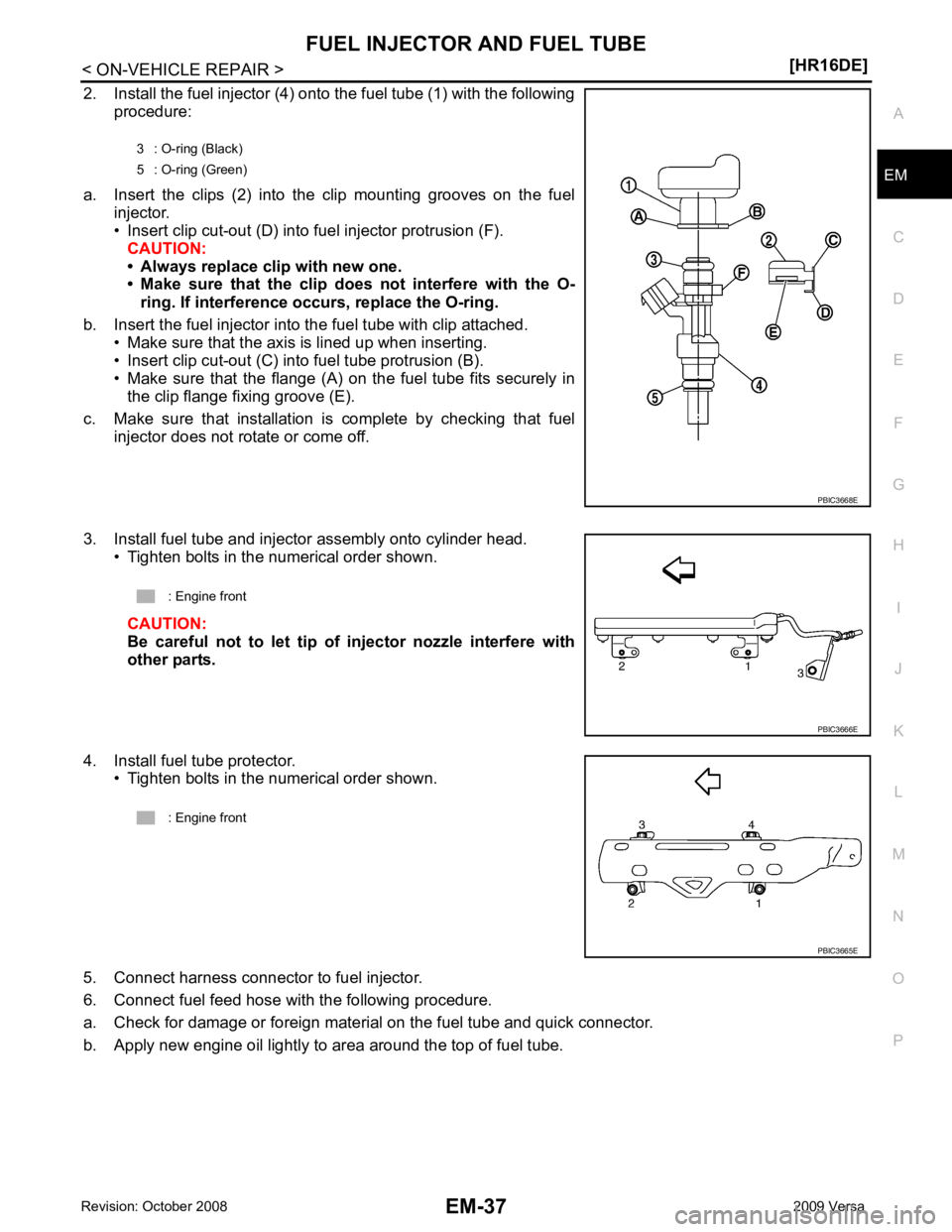
O
2. Install the fuel injector (4) onto the fuel tube (1) with the following
procedure:
a. Insert the clips (2) into the clip mounting grooves on the fuel injector.
• Insert clip cut-out (D) into fuel injector protrusion (F). CAUTION:
• Always replace clip with new one.
• Make sure that the clip do es not interfere with the O-
ring. If interference occurs, replace the O-ring.
b. Insert the fuel injector into the fuel tube with clip attached. • Make sure that the axis is lined up when inserting.
• Insert clip cut-out (C) into fuel tube protrusion (B).
• Make sure that the flange (A) on the fuel tube fits securely in the clip flange fixing groove (E).
c. Make sure that installation is complete by checking that fuel injector does not rotate or come off.
3. Install fuel tube and injector assembly onto cylinder head. • Tighten bolts in the numerical order shown.
CAUTION:
Be careful not to let tip of injector nozzle interfere with
other parts.
4. Install fuel tube protector. • Tighten bolts in the numerical order shown.
5. Connect harness connector to fuel injector.
6. Connect fuel feed hose with the following procedure.
a. Check for damage or foreign material on the fuel tube and quick connector.
b. Apply new engine oil lightly to area around the top of fuel tube. 3 : O-ring (Black)
5 : O-ring (Green)